


John Martin Paintings: Introduction
John Martin's paintings pursue astonishment through scale, viewpoint and atmosphere. They imagine biblical judgement, ancient catastrophe, literary crisis and supernatural power in ways that make ordinary human action look fragile. A king's feast becomes a palace of doom. A battlefield becomes a theatre of miracle. A volcanic eruption swallows cities. Hell itself becomes architecture.
Martin's major painted works are best approached as more than a simple list of disasters. His best paintings are carefully organised worlds, shaped by perspective, light, architecture and distance. The figures are often tiny because the emphasis is not individual portraiture. It is scale: the measure of human beings against history, prophecy, nature, divine power or infernal ambition.
Martin was a painter, printmaker and illustrator, so his works also move between media. Some subjects first reached audiences through prints; others were reproduced after major canvases. That print circulation matters because it helped turn Martin's imagery into public spectacle. Yet the paintings retain a particular force. Their size, colour and theatrical presence make the viewer feel that an event is unfolding across a whole world.
At a Glance
- ArtistJohn Martin
- FocusMajor paintings and selected works
- Main subjectsBiblical judgement, Miltonic architecture, ancient disaster, Shakespeare and sublime landscape
- Key workPandemonium
- Related doorwayPrints and Paradise Lost
Contents
- Introduction
- How to Approach Martin's Paintings
- The Flagship Work: Pandemonium
- Apocalypse and the Last Judgement Pictures
- Biblical Spectacle: Belshazzar and Joshua
- Ancient Disaster: Pompeii and Herculaneum
- Early Sublime: Sadak
- Literary Crisis: Macbeth
- Paintings and Prints
- What to Look For Across the Works
How to Approach Martin's Paintings
Viewpoint is often the first clue to a Martin painting. He places the viewer at a heightened, unstable or panoramic position. We look across halls, down into abysses, out over armies or toward distant cities. The position of the viewer becomes part of the drama.
The next question is scale. In Martin's most characteristic works, people are small but not irrelevant. Their smallness is a moral and emotional device. It shows that power has moved beyond the human body: a miracle halts the sun, a volcano destroys civic order, a divine judgement divides humanity, a demonic palace rises out of Hell.
Architecture is the third key. Martin's buildings are never mere scenery. They are symbols of ambition, wealth, rebellion, empire or civilisation. When those structures are placed beneath apocalyptic light or geological force, their magnificence becomes precarious. Martin loved towers, terraces, gates, halls, walls and vast recessions because they let him turn stories into engineered space.
Light completes the effect. It can come from God, lava, lightning, fire, a supernatural sky or the glowing depths of Hell. Martin uses light less to clarify than to overwhelm. It gives the painting an event structure: the viewer senses that the world has changed because light has entered it violently.
The Flagship Work: Pandemonium
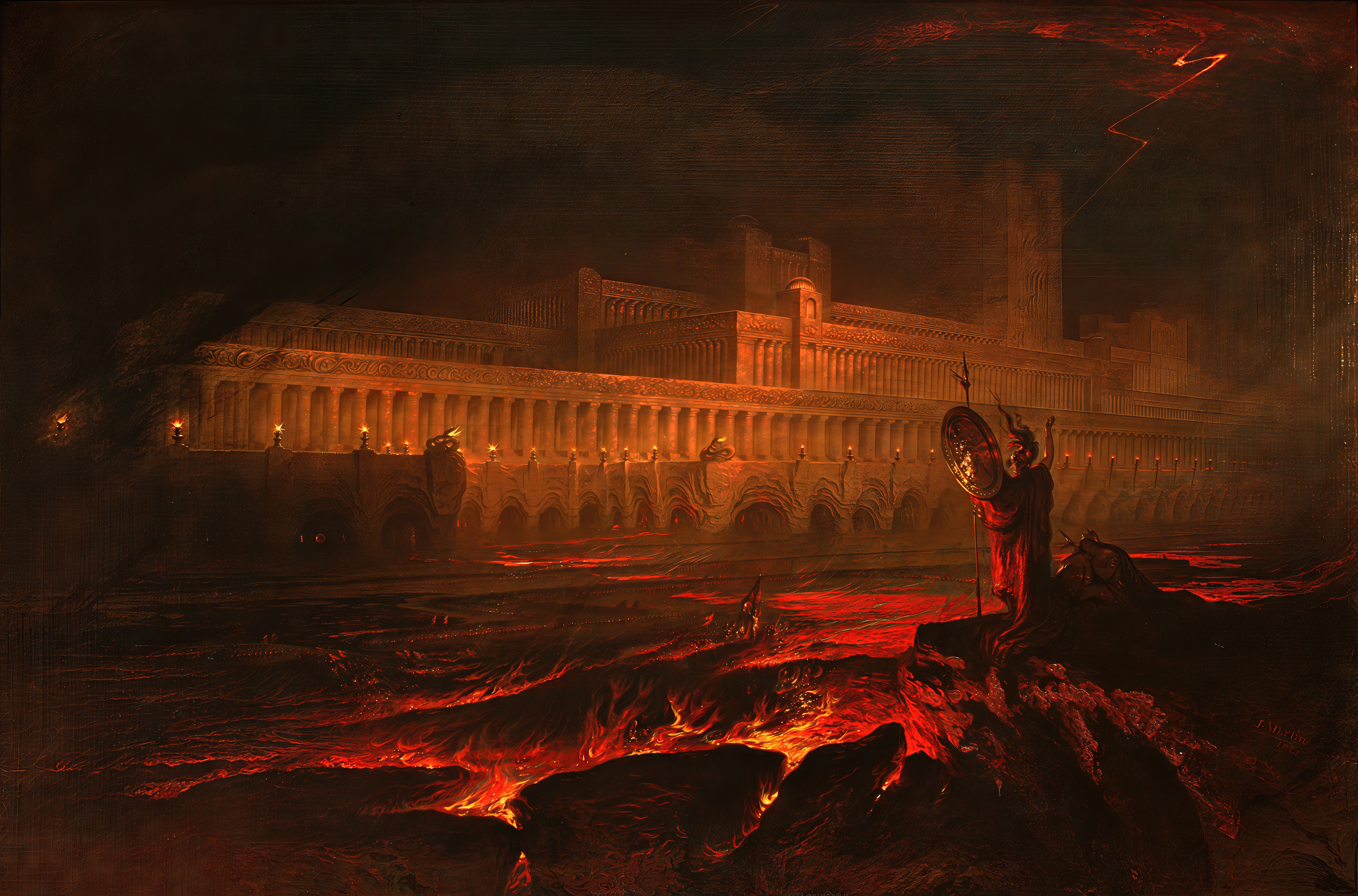
Pandemonium is the natural centre of Martin's painted imagination. Painted in 1841 and now in the Louvre, it takes its subject from Book I of John Milton's Paradise Lost: Satan creating the palace that will house the fallen angels. The Louvre records the work as an oil on canvas, inventory RF 2006 21, and links it directly to Milton's lines on the rise of the infernal palace.
The painting shows Hell becoming an architectural and political order. Satan stands at the right, the palace appears across the middle distance, and the demon host is barely visible below in the red depths. Martin gives evil a capital city, and the result is both magnificent and unstable.
Pandemonium also shows how Martin returned to a subject through different forms. The Louvre notes engraved versions from 1824 and 1831 before the 1841 painting. That matters because Martin's art often moved between print, exhibition and painting. The subject was tested in black and white, circulated through Milton illustration, then remade in oil with colour, scale and an original frame designed by Martin himself.
Pandemonium is the natural starting point because it gathers several of Martin's strongest interests: Milton, architecture, fire, darkness, tiny figures, public spectacle and the Romantic sublime. Martin's Hell is not only a place of punishment. It is a built world, and that built world reveals the ambition of rebellion.
Apocalypse and the Last Judgement Pictures
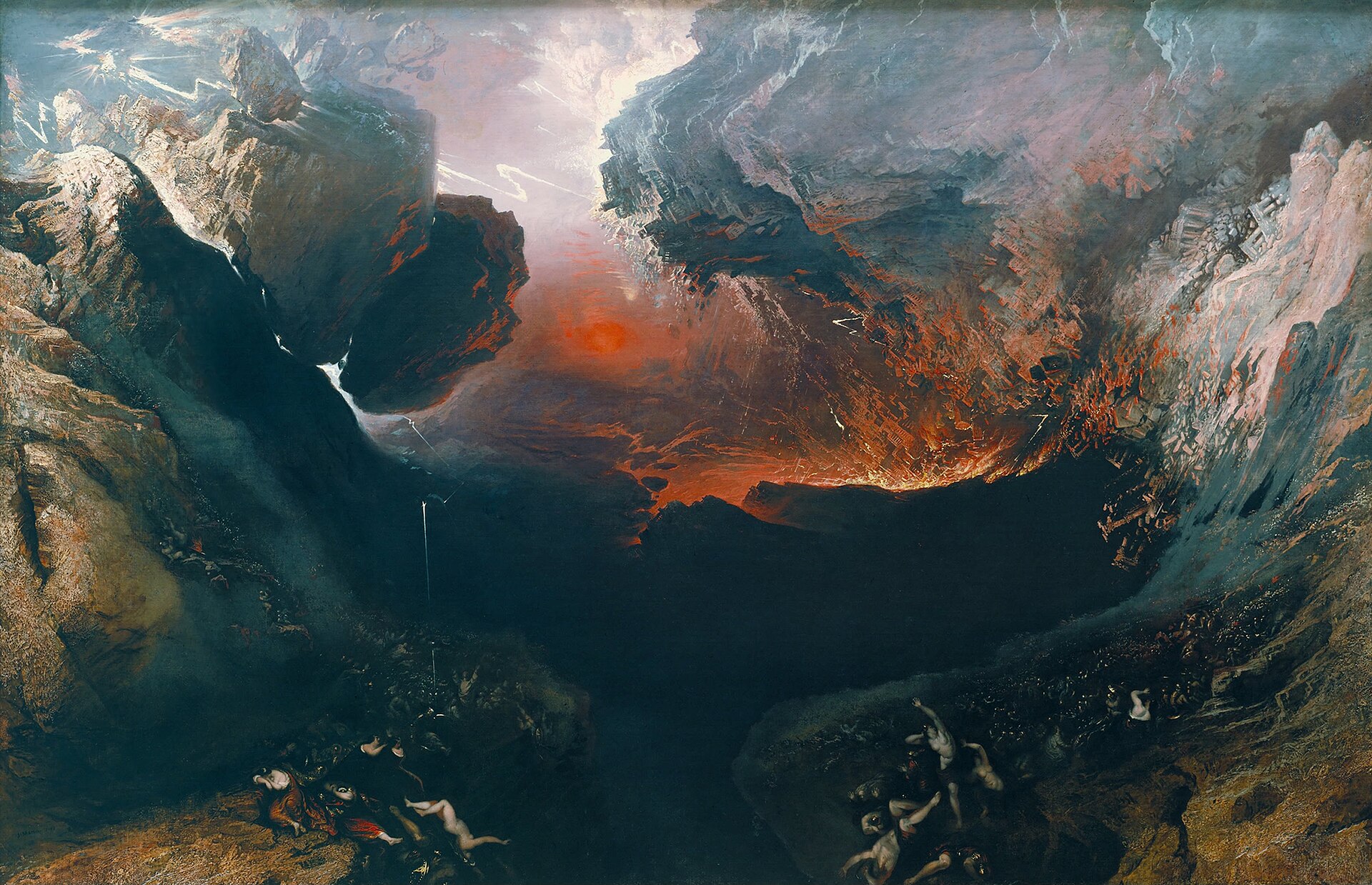
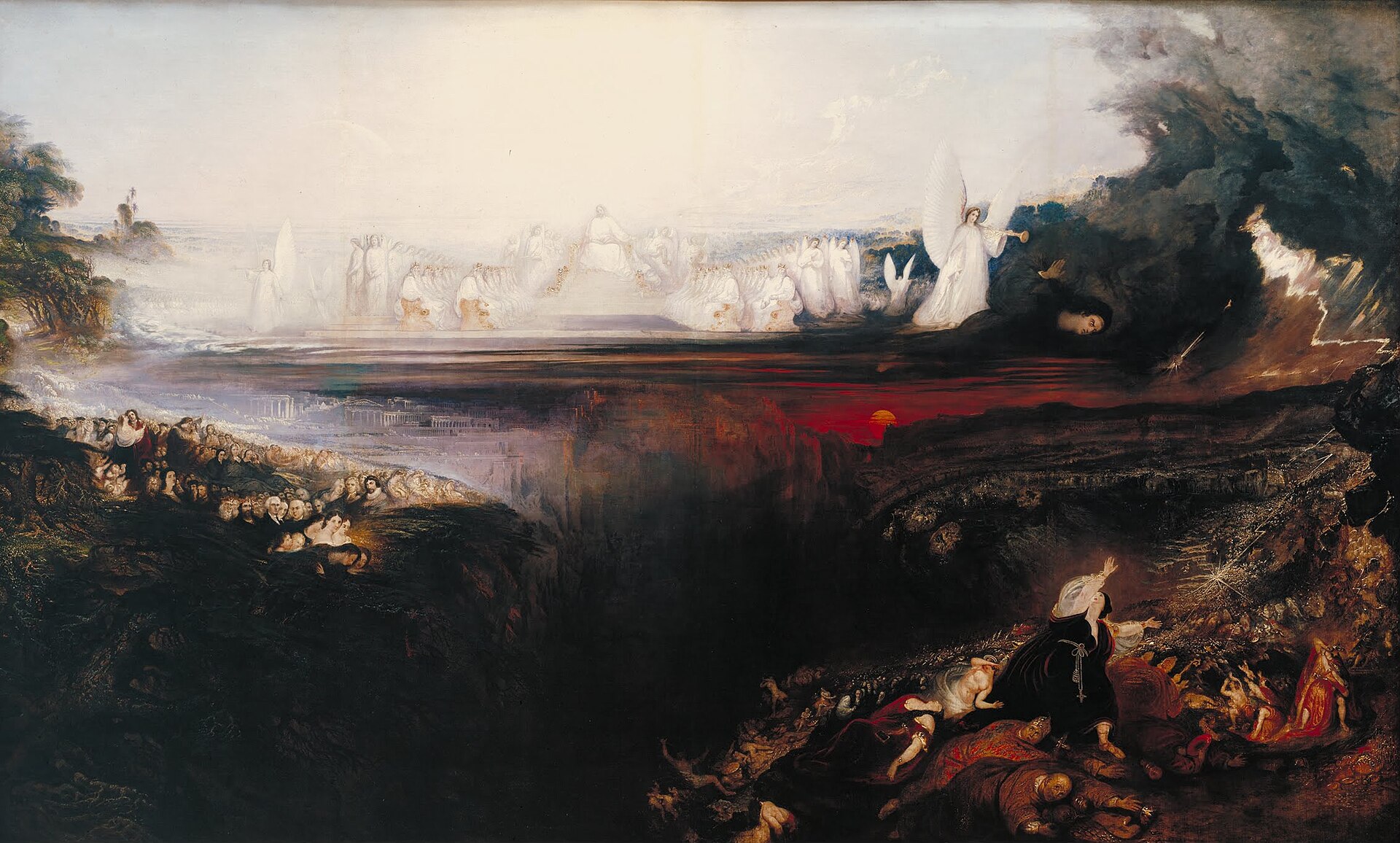
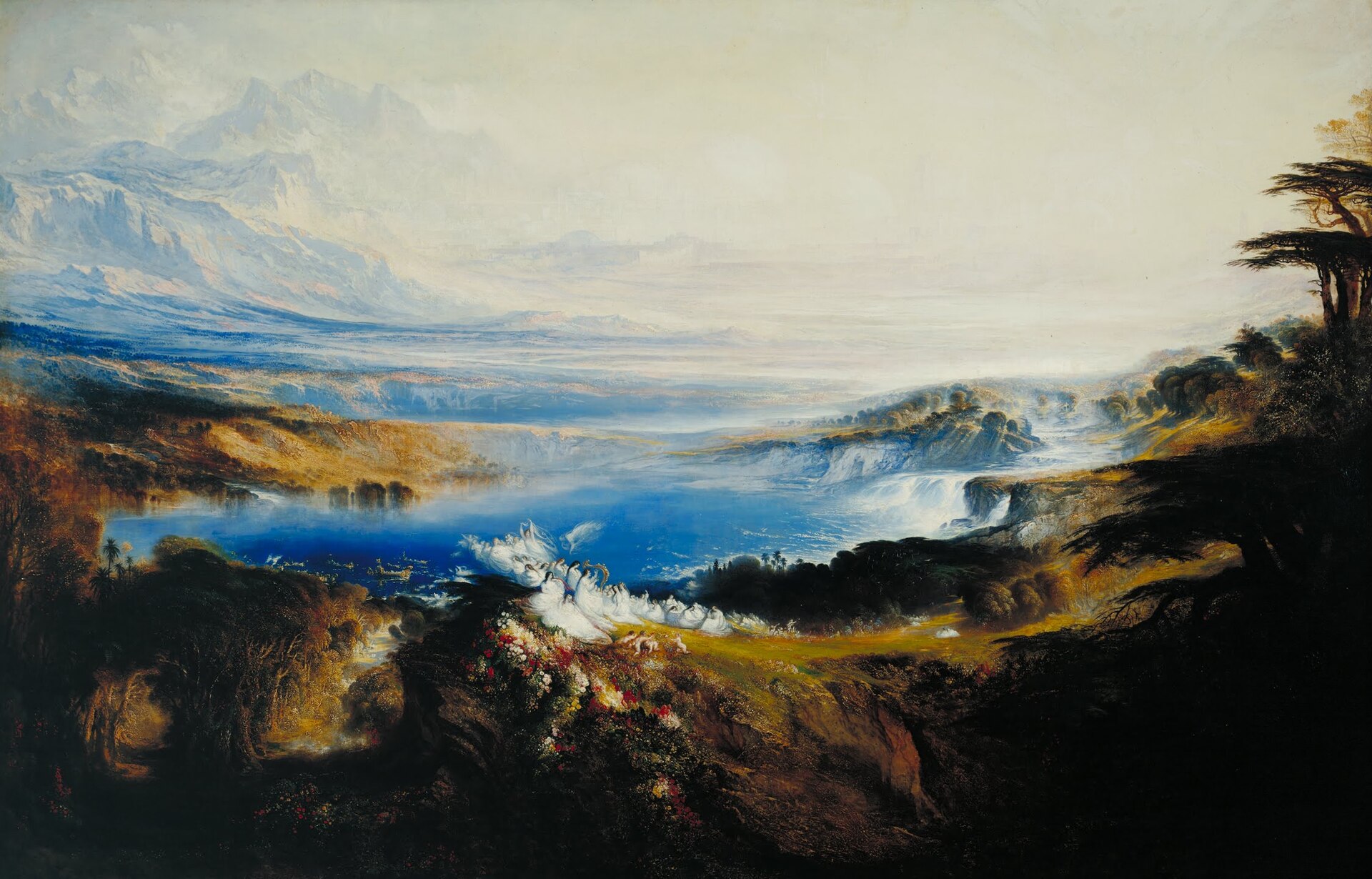
Martin's late apocalyptic paintings widen the drama from a single infernal capital to the fate of humanity. The Great Day of His Wrath, The Last Judgement and The Plains of Heaven form a group of judgement pictures associated with Tate Britain through Google Arts & Culture's records. They show destruction, judgement and salvation as connected parts of one moral vision.
The Great Day of His Wrath, dated around 1851 in the Tate-linked Google Arts record, is the most famous image of Martin's apocalyptic collapse. The subject comes from Revelation. Mountains and cities seem to break apart as the earth crashes inward. Humanity is dwarfed by a world that can no longer hold itself together.
The Last Judgement, dated 1853 in the same Tate-linked record set, places Christ in judgement above the divided world. The saved gather toward Mount Zion and the damned fall toward the abyss. The picture is not simply a chaotic disaster scene. It is a work about sorting, division and moral architecture: Martin builds a whole universe around the act of judgement.
The Plains of Heaven, dated around 1851, gives the sequence a different emotional register. It is quieter, blue and expansive, a vision of salvation rather than destruction. The Tate-linked record describes poets and artists among the blessed, placed within a celestial landscape of water, distance and mountains. That calm matters because it shows that Martin's imagination was not limited to ruin. He could picture peace, but he pictured it with the same panoramic breadth.
Seen together, the three works keep Martin from becoming a one-note painter of catastrophe. They show him thinking in sequences: destruction leads to judgement, judgement leads to separation, and separation opens onto paradise or loss. The individual studies of these paintings can examine the visual and theological details more closely. This guide sets the relationship among them.
Biblical Spectacle: Belshazzar and Joshua
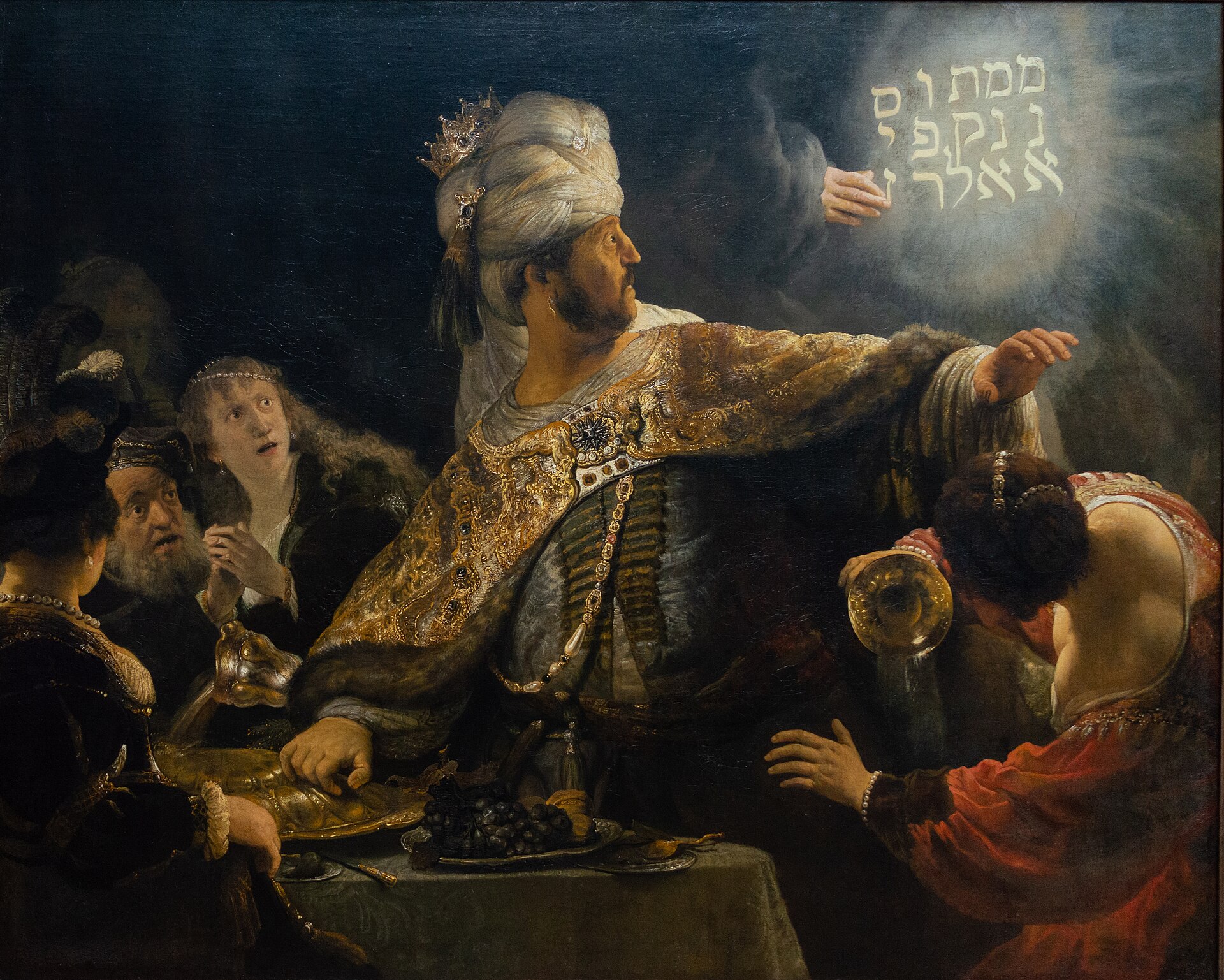
Martin's biblical paintings often turn a scriptural episode into a vast public event. Belshazzar's Feast, painted in 1820 and now in the Yale Center for British Art, is one of his great early achievements. Yale's record identifies the subject from the Book of Daniel: the Babylonian king feasts with sacred vessels taken from Jerusalem, a mysterious hand writes on the wall, and Daniel interprets the warning of the kingdom's fall.
Martin's genius was to give that moral crisis architectural scale. The feast is not a small scene around a table. It becomes a glittering hall of power, crowd movement and fear. The writing on the wall matters because it interrupts display. Luxury, ceremony and kingship suddenly appear weak before judgement.
Yale also notes Charles Lamb's later comparison between Martin's version of the subject and the extravagance of George IV's Brighton Pavilion. That comparison is useful because it shows how Martin's biblical painting could speak beyond the ancient story. A Babylonian feast could become a way to think about modern spectacle, luxury and public taste.
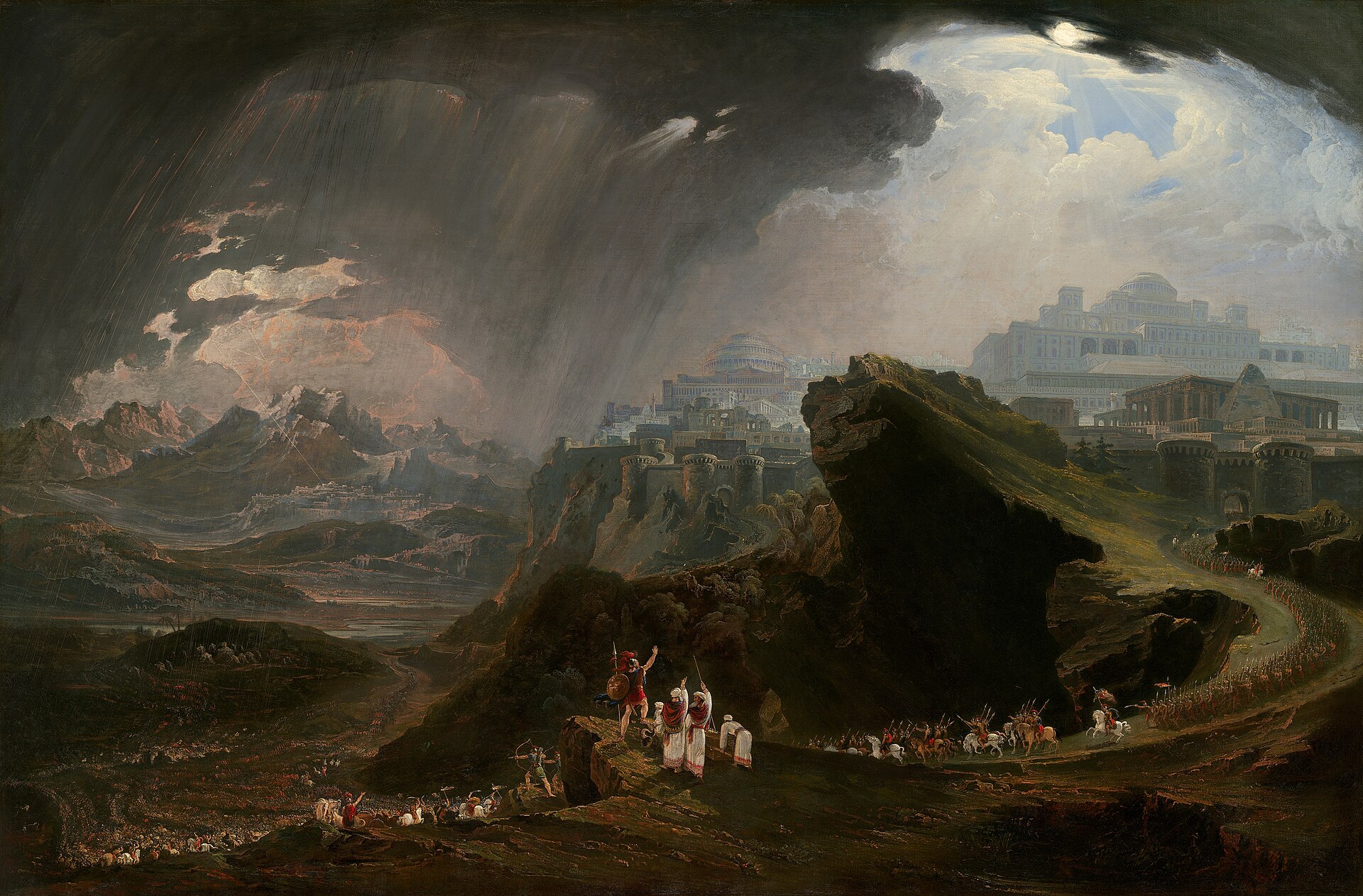
Joshua Commanding the Sun to Stand Still upon Gibeon, painted in 1816 and now in the National Gallery of Art in Washington, shows another side of Martin's biblical imagination. The NGA records it as an oil on canvas, exhibited at the Royal Academy in 1816 and at the British Institution in 1817. The subject allowed Martin to combine battlefield, city, mountain, storm and miraculous light.
In the painting, Joshua raises his arm as the biblical miracle unfolds. The NGA's description emphasises the armies, rocky outcrop, distant city, storm and brilliant sun. Martin does not isolate the miracle in a small devotional scene. He lets the entire landscape respond. The sun, the weather, the battle and the architecture all become part of the same command.
Together, Belshazzar's Feast and Joshua show why Martin's biblical painting mattered. He did not merely illustrate scripture. He staged scripture at the scale of public vision.
Ancient Disaster: Pompeii and Herculaneum
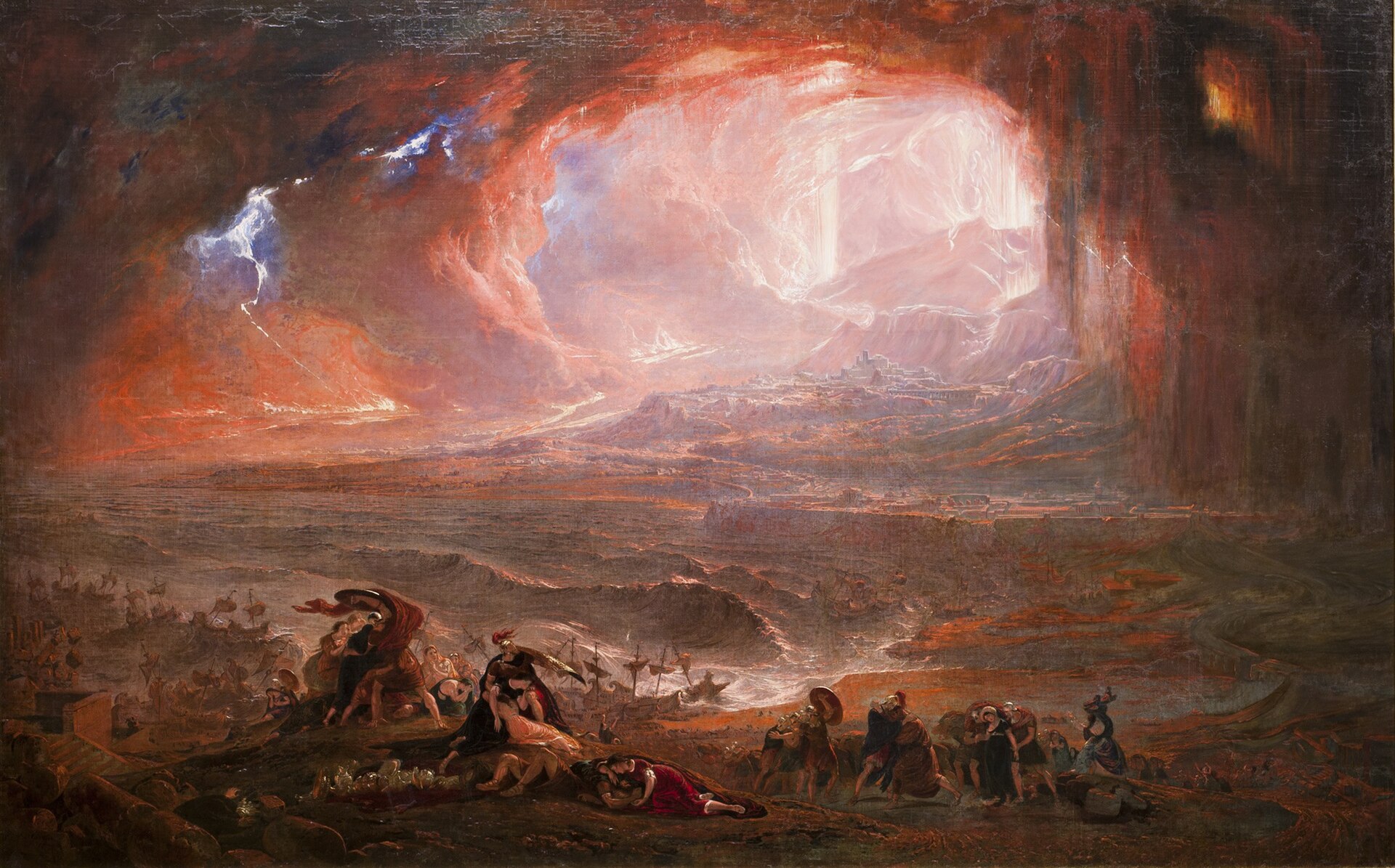
The Destruction of Pompeii and Herculaneum, painted in 1822 and owned by Tate, is Martin's great ancient-disaster painting. ACMI's account describes Mount Vesuvius in eruption, Herculaneum in the distance, Pompeii nearer the foreground, lava colouring the landscape red, and ash clouds and lightning convulsing the sky.
The painting is a useful bridge between history painting and modern spectacle. The subject is the eruption of Vesuvius in 79 CE, but Martin's treatment is not archaeological reconstruction alone. He stages catastrophe as an overwhelming visual event. The cities are visible enough to matter, but the volcanic world around them is stronger than civic order.
This painting also has a remarkable modern afterlife. It was damaged in the Tate flood of 1928 and later restored for renewed display during the twenty-first-century reassessment of Martin. That story belongs with the dedicated study of the work, but even here it sharpens the point. Martin's image of destruction survived its own material crisis.
The work also explains why Martin is sometimes discussed in relation to cinema or immersive spectacle. ACMI notes that his epic apocalyptic paintings have been compared to blockbuster experience and that Tate's 2011 display used a theatre-like setting and audio narrative to suggest how dramatically such paintings could once be shown. The comparison needs care, but it helps modern viewers understand Martin's control of viewpoint, light and staged catastrophe.
Early Sublime: Sadak
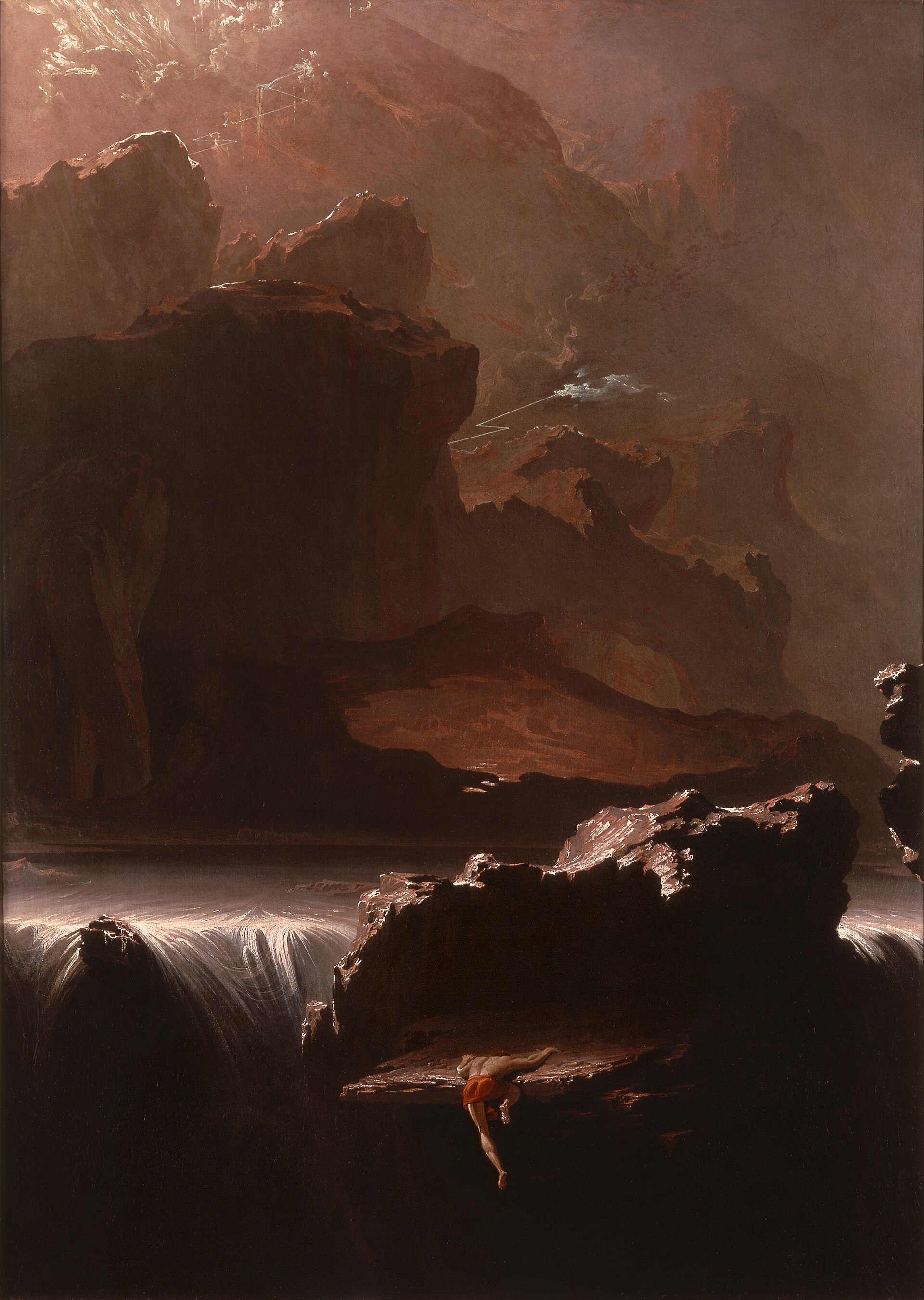
Sadak in Search of the Waters of Oblivion, painted in 1812 and now in the Saint Louis Art Museum, is one of the best early entrances into Martin's art. The museum records it as an oil on canvas, public domain, and identifies the subject from James Ridley's Tales of the Genii.
Sadak is a Persian nobleman on a perilous search for the Waters of Oblivion. Martin places him near the bottom of the canvas, clinging to rock while immense precipices rise above him. Rays of light suggest the possibility of success, but the dominant experience is danger, height and exposure.
The painting is important because it shows Martin's mature pattern already forming. A small figure faces a world that is nearly too large to understand. The subject is literary rather than biblical, but the emotional structure is close to his later works. The human being is measured against landscape, light and fate.
For viewers new to Martin, Sadak can be a more intimate first step than the apocalyptic paintings. It has one central figure, a clear physical ordeal and a direct sense of upward struggle. Yet it already contains the grandeur that would later spread across cities, palaces and cosmic landscapes.
Literary Crisis: Macbeth
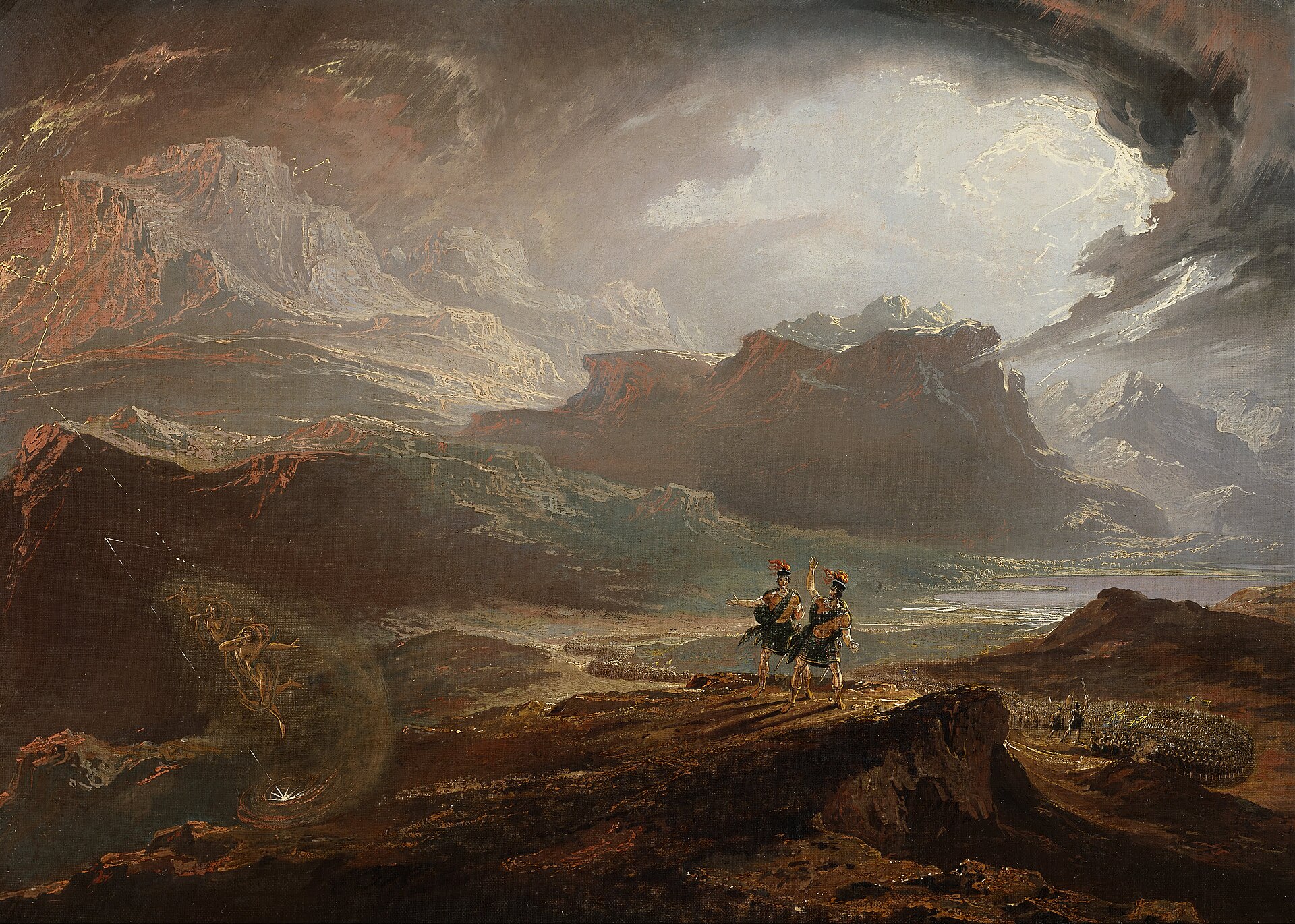
Martin's Macbeth, about 1820 and in the National Galleries of Scotland, shows how his imagination worked with Shakespeare. The museum identifies the scene as Macbeth and Banquo's meeting with the witches. The supernatural figures emerge from mist and lightning while the men react in shock, isolated before an army that diminishes into the distance.
The painting is smaller than some of Martin's vast public spectacles, but it still thinks on a large scale. The landscape becomes a stage for consequence. Macbeth's encounter with prophecy is not presented as a private psychological moment alone. It becomes the opening of a world in which fate, ambition and violence will spread outward.
The National Galleries of Scotland also notes that a larger version was exhibited at the British Institution in 1820 but remained unsold, and that Sir Walter Scott later wished he could afford it for Abbotsford. Those details remind us that Martin's literary subjects belonged to a culture of exhibition, collecting and celebrity reading. Shakespeare, like Milton, gave him a way to turn literature into visual theatre.
Paintings and Prints
Martin's paintings should not be separated too sharply from his printmaking. The National Portrait Gallery notes that his works were popularised through affordable mezzotint prints, and the British Museum identifies him as a painter, draughtsman and printmaker. Many viewers would have known his images through reproduction as well as through large canvases.
That circulation shaped how his paintings were understood. A subject could appear as an oil painting, an engraving after a painting, a book illustration or a related print. Pandemonium is the clearest example in this guide because the Louvre records Martin's earlier engraved versions before the 1841 painting. Belshazzar's Feast and Joshua also have important print histories.
Prints and paintings need to be kept distinct, but their relationship matters. Oil on canvas gives Martin colour, scale and physical presence; mezzotint gives him darkness, tonal gradation and reproducible drama. The exchange between media helps explain why his art reached large audiences and why his images can feel both painterly and theatrical.
What to Look For Across the Works
Look for the small figure first. Sadak clings to rock, Satan stands above infernal depths, Joshua raises his arm, Macbeth and Banquo react before the witches, crowds fill Belshazzar's hall and humanity shrinks beneath the Last Judgement skies. The small figure is Martin's measuring instrument.
Then look for the architecture. Hell has a palace. Babylon has a banquet hall. Biblical cities and ancient towns sit beneath storm, miracle or eruption. Architecture lets Martin visualise ambition, civilisation and order before those things are tested.
Then follow the light. In Martin, light is almost always active. It burns, judges, reveals, destroys or transforms. It is rarely just atmosphere. A shaft of light in Sadak, the fiery depths of Pandemonium, the writing in Belshazzar, the halted sun in Joshua and the catastrophic sky in The Great Day of His Wrath all give light narrative force.
Finally, notice how often the paintings place a viewer between fascination and warning. Martin's disasters are beautiful enough to attract the eye, but their beauty is uneasy. He wants grandeur to seduce and trouble us at once.
Where to Begin
Start with Pandemonium for the flagship statement: Milton, Hell, architecture, print history and Romantic spectacle in one painting.
Then move to the Last Judgement group: The Great Day of His Wrath for collapse, The Last Judgement for moral division and The Plains of Heaven for salvation.
Next, use Belshazzar's Feast and Joshua Commanding the Sun to Stand Still upon Gibeon to understand Martin's biblical theatre before the late apocalypse.
Then compare The Destruction of Pompeii and Herculaneum with Sadak in Search of the Waters of Oblivion. One destroys cities; the other isolates a single climber. Both depend on scale, peril and light.
End with Macbeth to see how Martin translated literary crisis into landscape and supernatural atmosphere. It proves that his imagination did not need only biblical catastrophe. He could make Shakespeare feel cosmic too.
Frequently Asked Questions
Discussion
What detail in John Martin Paintings changes how you read John Martin's use of scale, light or atmosphere?
Reader Insights
Which figure, architectural form or passage of light first anchors the scene for you?
How does the source story or subject change the emotional force of the image?
Where does this work feel closest to, or furthest from, Pandemonium?
Join the Conversation
Share your reading of John Martin Paintings below.
References
- National Galleries of Scotland, John Martin artist biography: View Source, accessed 2 August 2026.
- National Portrait Gallery, John Martin person record: View Source, accessed 2 August 2026.
- Louvre Collections, *Le Pandemonium, 1841*, RF 2006 21: View Source, accessed 2 August 2026.
- British Museum, John Martin biographical record: View Source, accessed 2 August 2026.
- National Gallery of Art, *Joshua Commanding the Sun to Stand Still upon Gibeon*: View Source, accessed 2 August 2026.
- Yale Center for British Art, *Belshazzar's Feast*: View Source, accessed 2 August 2026.
- Saint Louis Art Museum, *Sadak in Search of the Waters of Oblivion*: View Source, accessed 2 August 2026.
- National Galleries of Scotland, *Macbeth*: View Source, accessed 2 August 2026.
- Google Arts & Culture, *The Great Day of His Wrath*: View Source, accessed 2 August 2026.
- Google Arts & Culture, *The Last Judgement*: View Source, accessed 2 August 2026.
- Google Arts & Culture, *The Plains of Heaven*: View Source, accessed 2 August 2026.
- ACMI, *The Destruction of Pompeii and Herculaneum*: View Source, accessed 2 August 2026.
- Tate Shop, Martin Myrone, *John Martin - Sketches of My Life*: View Source, accessed 2 August 2026.
