Joshua Commanding the Sun to Stand Still by John Martin: Introduction
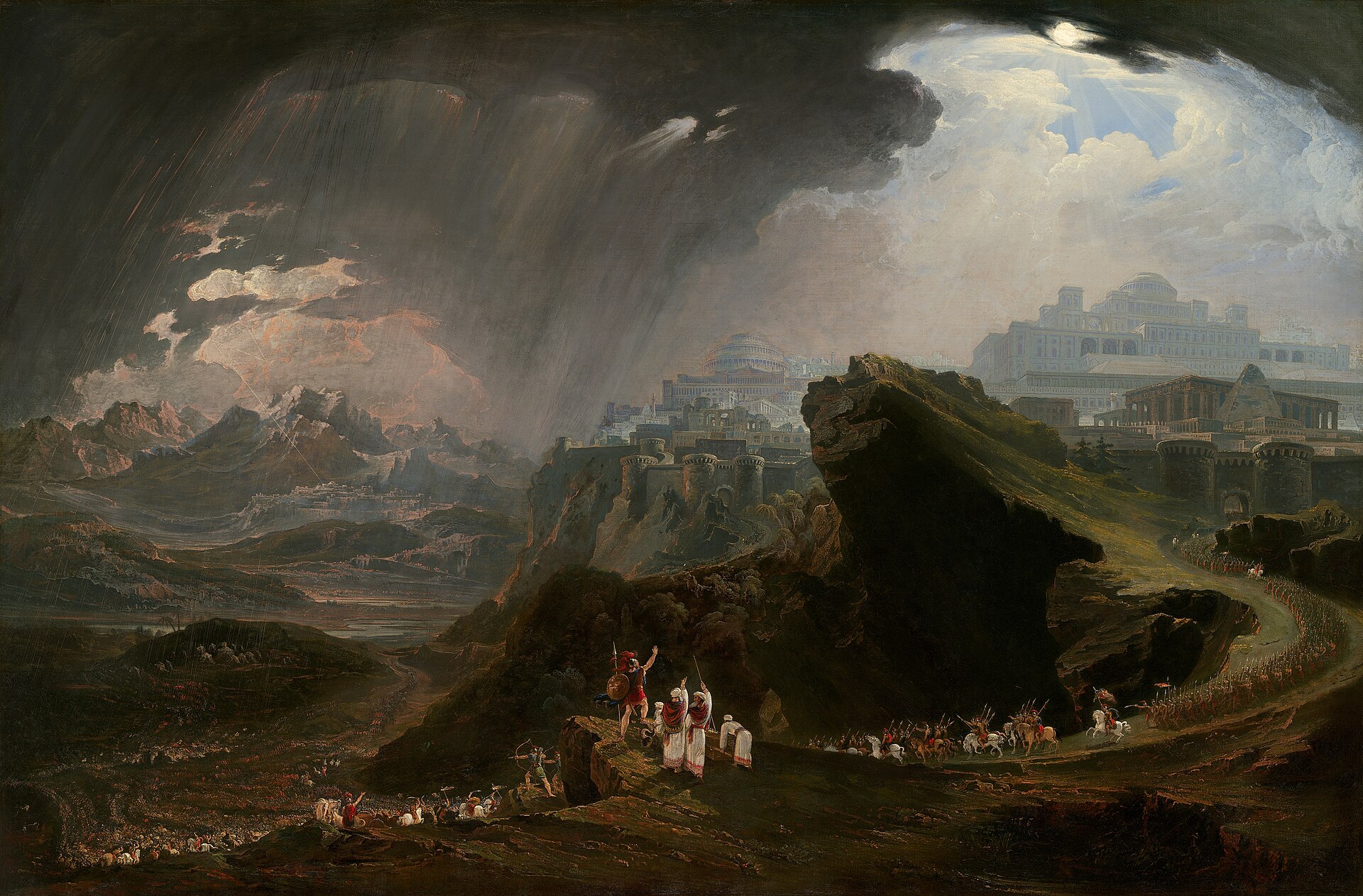
John Martin's Joshua Commanding the Sun to Stand Still upon Gibeon is one of the early works in which his imagination becomes unmistakably his own. Painted in 1816, the picture turns an Old Testament battle into a vast theatre of landscape, architecture, armies, storm and supernatural light. It is now in the National Gallery of Art in Washington, where the object record identifies it as an oil on canvas measuring 150 by 231 centimetres.
The subject comes from Joshua 10. The Israelites come to the aid of Gibeon against the Amorites. During the battle, Joshua calls for the sun and moon to pause so that the fighting can continue in daylight. The biblical story is brief, strange and immense. Martin makes it panoramic. He does not isolate Joshua as a simple hero in the foreground. He places him inside a world that appears to be moving on several scales at once: soldiers advance, storm breaks, light pours through cloud, cities rise from cliffs and the sky itself becomes part of the battle.
This is not a court interior like Belshazzar's Feast. It is not a classical disaster like The Destruction of Pompeii and Herculaneum. It is not one of the Last Judgement sequence paintings. It is a biblical battle and cosmic miracle, and its power lies in the way Martin makes military action, weather and divine intervention feel inseparable.
At a Glance
- ArtistJohn Martin
- Full titleJoshua Commanding the Sun to Stand Still upon Gibeon
- Date1816
- MediumOil on canvas
- CollectionNational Gallery of Art, Washington
- SubjectJoshua 10:12-14, the command for the sun and moon to stand still during battle
- Related worksa circa 1822 preparatory drawing at the Metropolitan Museum of Art and 1827 mezzotint/etching versions in several museum collections
Contents
- Introduction
- How to Read the Composition
- The Miracle of Sun and Moon
- Battle, Landscape and Architecture
- Exhibition and Early Reputation
- Drawing and Print Afterlife
- How Joshua Differs from Belshazzar, Pompeii and the Last Judgement
- The Road, the City and the Viewer
- Why the Painting Matters
What Is Happening in the Painting?
The scene shows the battle associated with Gibeon. In the biblical account, the people of Gibeon ask Joshua for help when enemy kings attack them. Joshua marches with his army and defeats the Amorites. At the crucial moment, he commands the sun over Gibeon and the moon over the valley of Aijalon to stand still.
Martin chooses this supernatural pause as the painting's dramatic centre. Joshua stands on a rocky projection with his arm raised toward the sky. Around him are attendants, soldiers and sacred objects. Beyond him, ranks of men move through the landscape toward the battle. The city, cliffs, valleys and storm clouds are not background decoration. They are part of the miracle's scale.
The National Gallery of Art's description makes clear how much Martin packs into the composition: armies marching and fighting, immense rock formations, massive buildings, storm clouds, rain, lightning, a sunlit break in the sky and a distant city. The effect is not a tidy battle scene. It is a world under command.
The miracle is therefore visual before it is theological. The viewer sees a landscape divided by weather and light. On one side, storm darkens the valley. On the other, the sun breaks through and pours light over Joshua's command. Martin treats the sky as the decisive field of action.
How to Read the Composition
Begin with Joshua. He stands with his back partly turned, placed where the viewer can see both his gesture and the world he addresses. His raised arm is small compared with the sky, the mountains and the architecture, but it gives the picture its command structure. Everything seems to answer that gesture.
Then follow the movement of the road. Lines of soldiers descend from the city and move into the conflict below. Martin uses the road and rocky outcrop to pull the eye from the foreground into the mass action of the battle. The scene is crowded, but not random. Its movement is organised around the miracle.
The city on the right gives the composition its architectural weight. Domed buildings, walls and towers rise above the cliffs. Martin was already learning how to make architecture feel like a form of power. In Belshazzar's Feast, that power becomes a courtly interior. In Joshua, it is set high in the landscape, close to the sky and storm.
The left side of the picture is more turbulent. Rain and lightning drive into the valley. The battlefield is lower, darker and more chaotic than the luminous area around Joshua. The painting's drama depends on this contrast: command above, conflict below; sunlit opening on one side, storm violence on the other.
The eye also has to move between human scale and cosmic scale. Joshua is identifiable, but the armies are tiny. The miracle is not shown as a private devotional event. It is something that reorganises the whole visual field.
The Miracle of Sun and Moon
Joshua 10 is an ideal subject for Martin because it links military history to cosmic disturbance. The miracle is not simply that one army defeats another. The structure of day itself is changed. Time, light and weather become part of the battle.
Martin does not need to show the sun stopping in a literal diagrammatic way. Instead, he shows the sky as contested space. The cloud opens; the sun floods one side of the composition; storm and lightning sweep across the other. The painting makes the viewer feel a supernatural extension of daylight without reducing the miracle to a mechanical illustration.
The moon is less immediately dominant than the sun, but the story's cosmic scale depends on both. Joshua's command addresses the visible order of heaven. Martin turns that order into theatrical space: a sky large enough to contain miracle, weather and war.
This is why the painting feels different from a conventional battle picture. The outcome is not decided only by tactics or force. It is decided by a command that reaches beyond the battlefield. Martin's spectacle depends on that leap from army to cosmos.
Battle, Landscape and Architecture
Martin combines several genres at once. The painting is a biblical subject, a battle scene, a landscape and an architectural fantasy. That mixture was risky, but it became one of his strengths. Instead of placing a few heroic bodies in the centre, he stretches the action across a huge environment.
The soldiers matter, but they do not dominate. They are part of a larger system of motion. Columns of men, horses, banners and distant figures give the scene its military pressure, while mountains and city walls give it structural grandeur. The viewer senses that the battle extends beyond what can be comfortably grasped.
The buildings are especially important. They do not simply identify Gibeon or provide a scenic backdrop. They turn the biblical setting into a monumental imagined world. Martin's later works would repeatedly use architecture to measure ambition, empire and collapse. In Joshua, that habit appears early: architecture rises beside miracle, as if human construction and divine command are being tested against one another.
The landscape also gives the painting emotional depth. Cliffs and valleys create danger. The descending road creates momentum. The storm gives violence to the atmosphere before the armies even meet. Martin's battlefield is not flat ground where figures can be counted. It is a landscape charged with command.
Exhibition and Early Reputation
The National Gallery of Art records the painting's exhibition at the Royal Academy in 1816, at the British Institution in 1817 and in Martin's one-man show at the Egyptian Hall in Piccadilly in 1822. Those dates place Joshua at the centre of Martin's early public career.
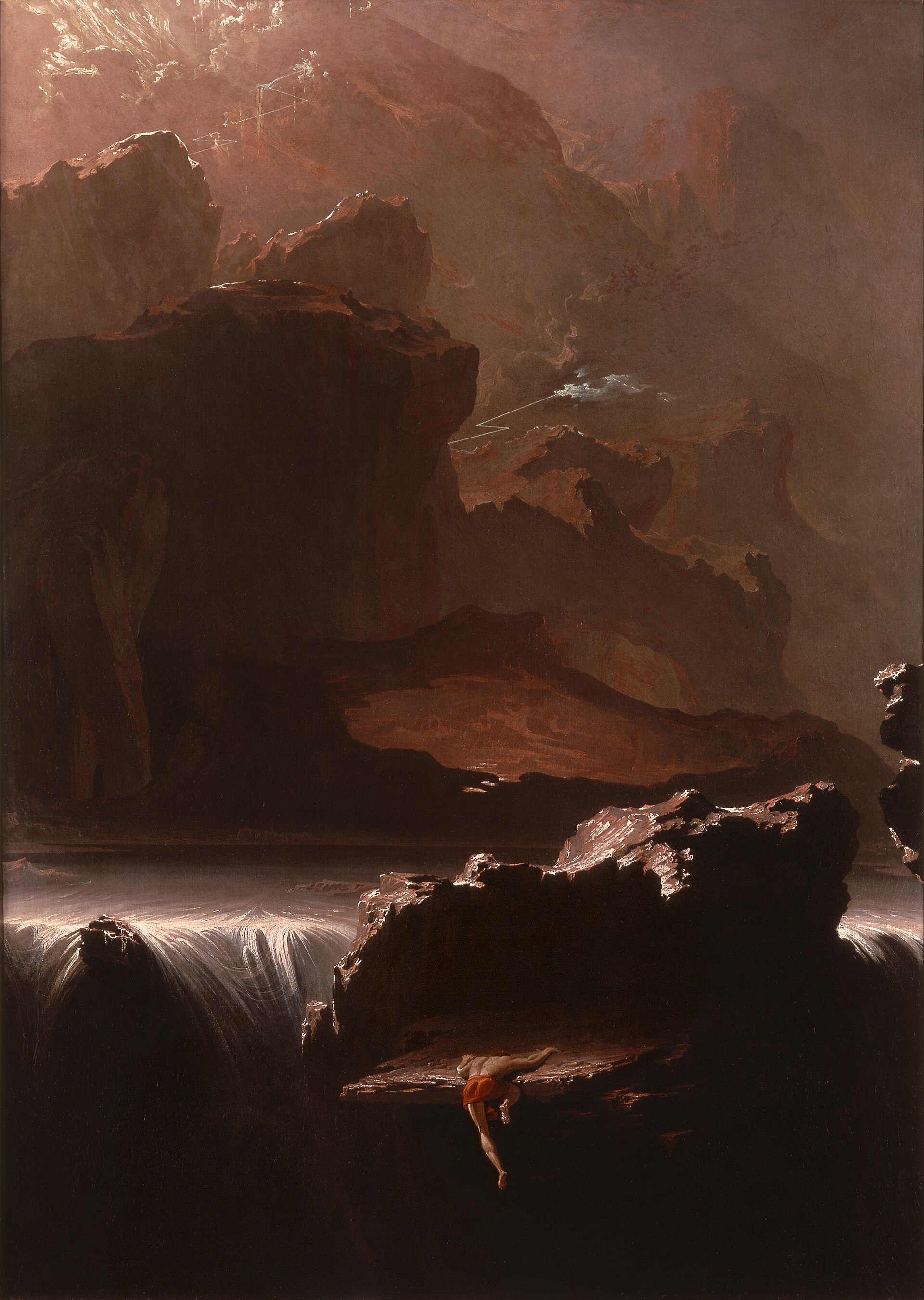
The Metropolitan Museum of Art describes a related drawing as preparation for the painting that launched Martin's future successes. That is a strong way to understand the work. Sadak in Search of the Waters of Oblivion had already shown Martin's taste for isolated figures and overwhelming landscape, but Joshua expanded his ambition into biblical spectacle on a public scale.
The Dictionary of National Biography records that Martin felt wronged by the Royal Academy's treatment of Joshua. Whether one reads that as personal grievance or professional tension, it points to a broader issue: Martin's pictures did not behave like traditional academic history paintings. Their force came from vastness, atmosphere and visual shock as much as from figure grouping.
The painting's later presence in the 1822 Egyptian Hall show also matters. Martin understood that his art could work as an event. Viewers were invited into a world of scale, narrative and sensation. Joshua was not only an illustration of scripture. It was a demonstration of what a modern biblical spectacle could do.
Drawing and Print Afterlife
Martin returned to Joshua through drawing and print. The Metropolitan Museum of Art owns a circa 1822 drawing in pen and brown ink, wash and red chalk, heightened with white and squared for transfer. The Met connects that drawing directly to the 1816 painting and to the later 1827 reproductions. It shows Martin refining or preparing the composition for renewed circulation.
The National Gallery of Art owns an 1827 proof of Joshua Commanding the Sun to Stand Still, made in mezzotint and etching in black and brownish black on chine colle. The inscription recorded by NGA states that the work was painted and engraved by John Martin and published in London on May 9, 1827. This is important because it presents Martin not only as the painter of a successful subject, but as an artist deeply involved in its printed life.
The Yale Center for British Art also owns an 1827 published-state mezzotint with chine colle, in the Paul Mellon Collection. Its record includes subject terms that neatly capture the image's content: battle, Bible, daylight, hail, moon, mountain, prayer, rain, storm and sun. National Gallery of Victoria has another 1827 mezzotint, and the Art Institute of Chicago records a later 1835 Joshua Commanding the Sun to Stand Still from Illustrations of the Bible.
Together these records show that Joshua did not remain confined to a single painting. The printed versions extended the reach of the painting's storm, army and miracle beyond the exhibition room.
How Joshua Differs from Belshazzar, Pompeii and the Last Judgement
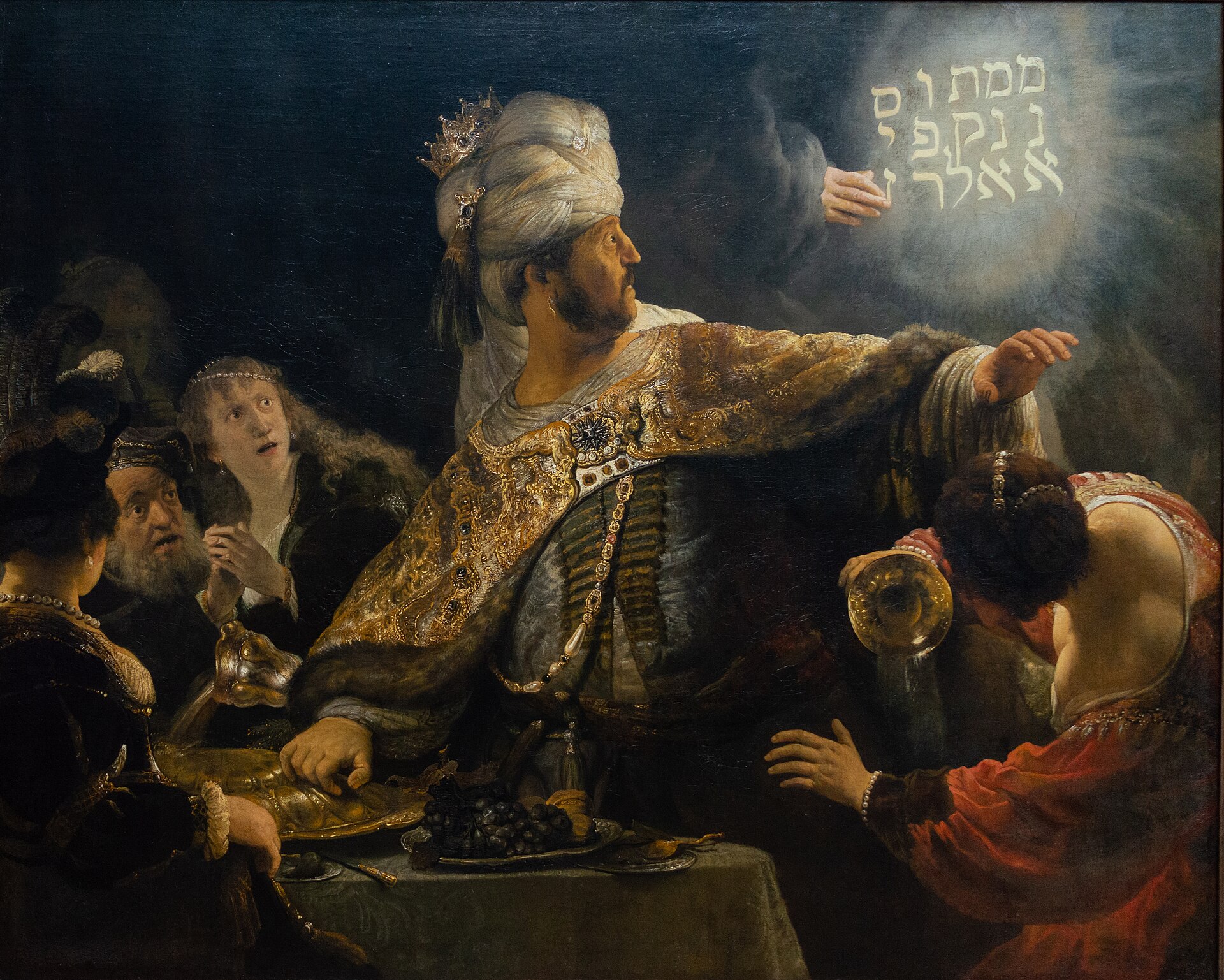
Joshua belongs with Martin's grand spectacles, but it should not be flattened into a single category. It shares with Belshazzar's Feast a biblical subject and a dramatic intervention from beyond ordinary human power. Yet the two paintings work very differently. Belshazzar is a court interior where a written judgement interrupts luxury. Joshua is an exterior battle where command appears to arrest the heavens.
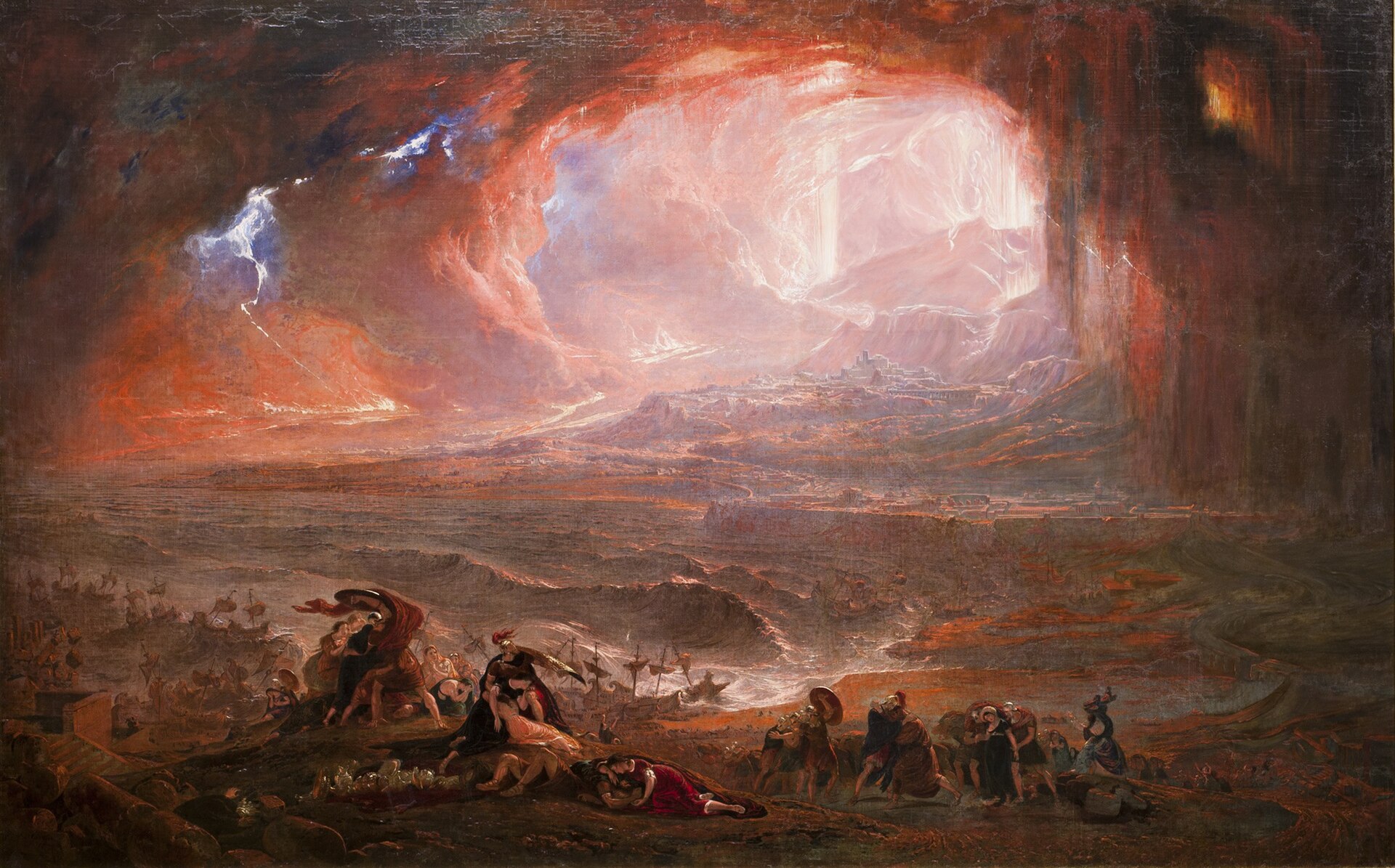
It also differs from The Destruction of Pompeii and Herculaneum. Both works use vast scenery, massed figures and violent atmosphere, but Pompeii is a classical disaster driven by volcanic force. Joshua is a battle miracle: weather and light intervene inside a biblical war.
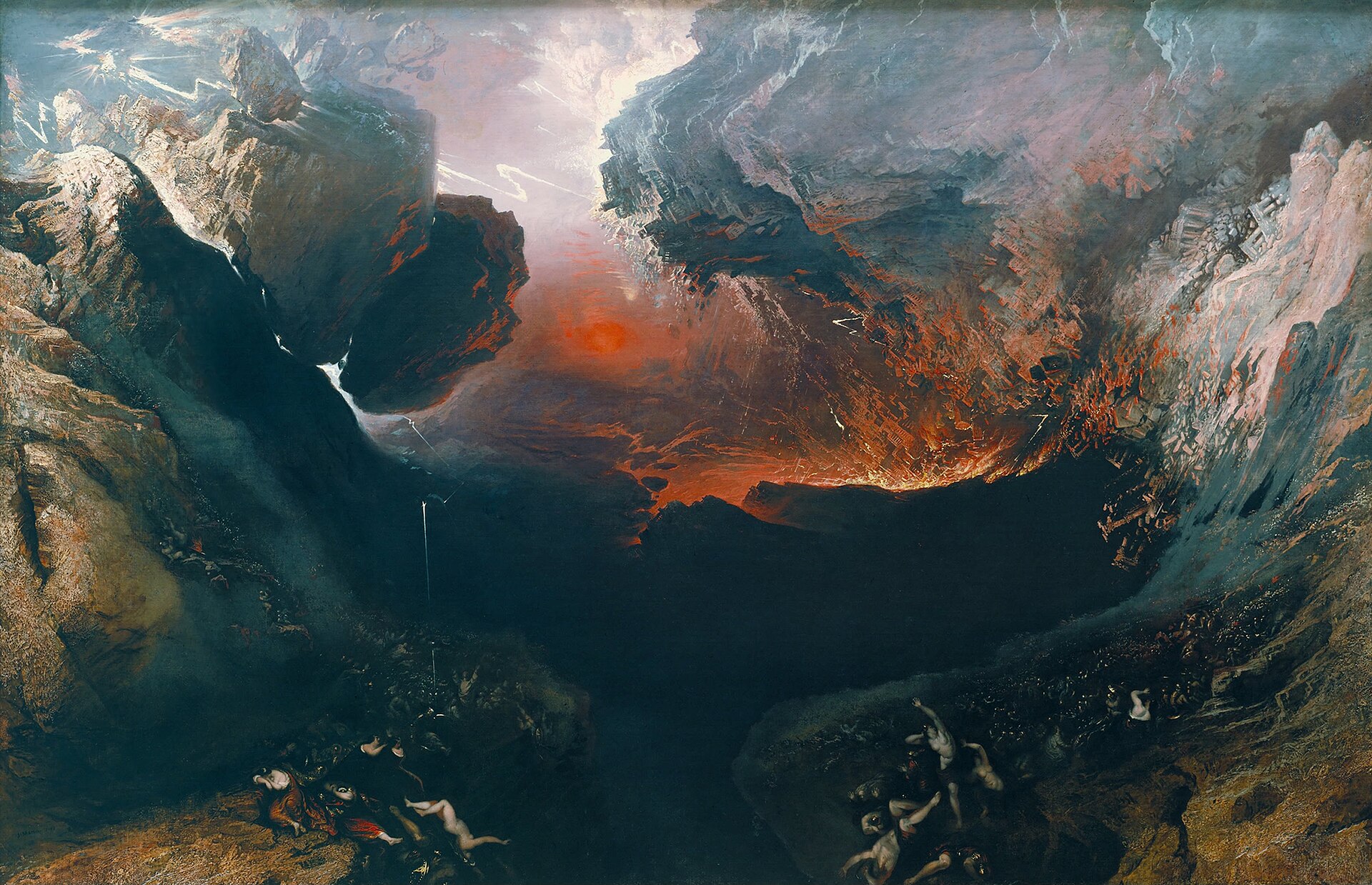
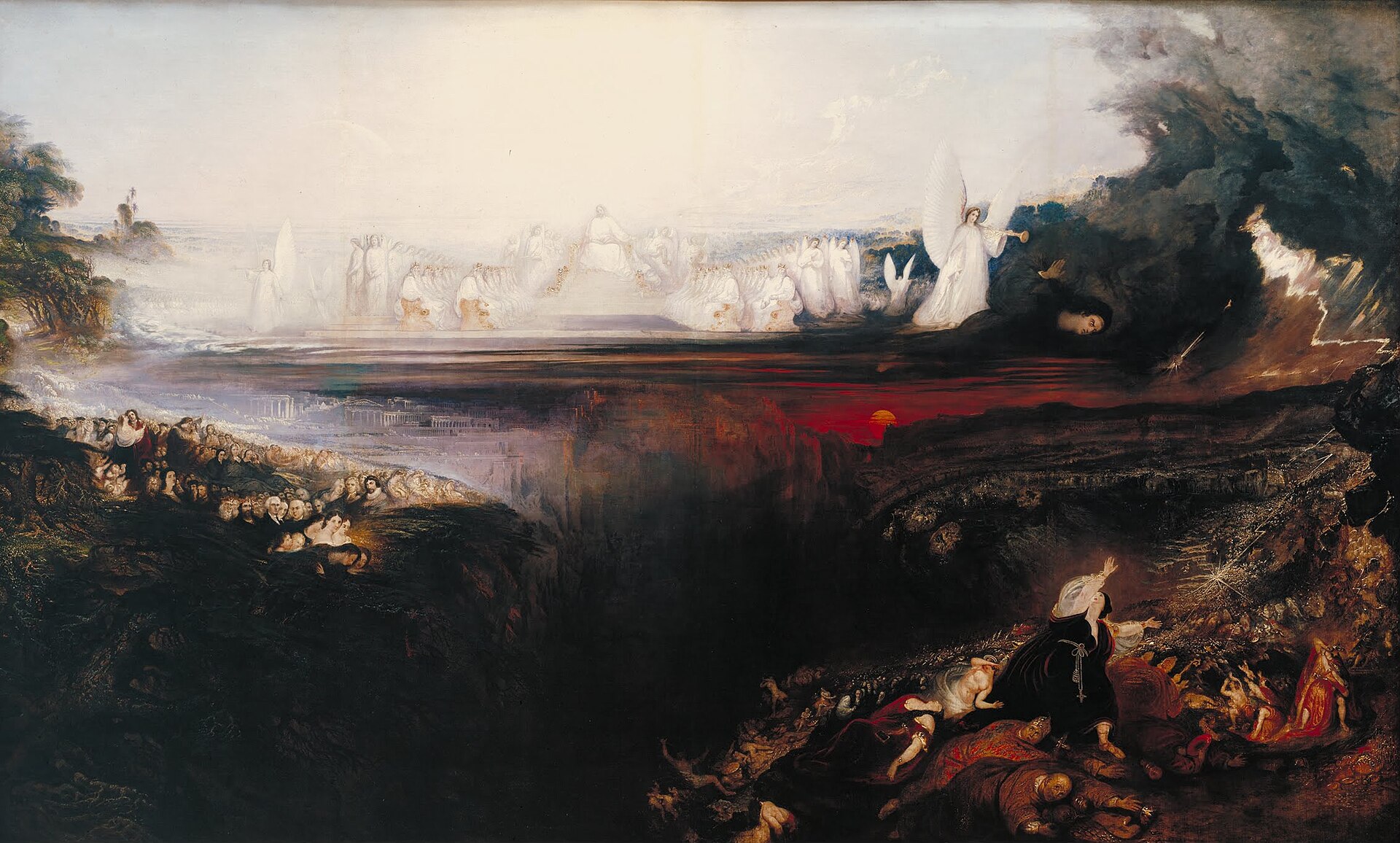
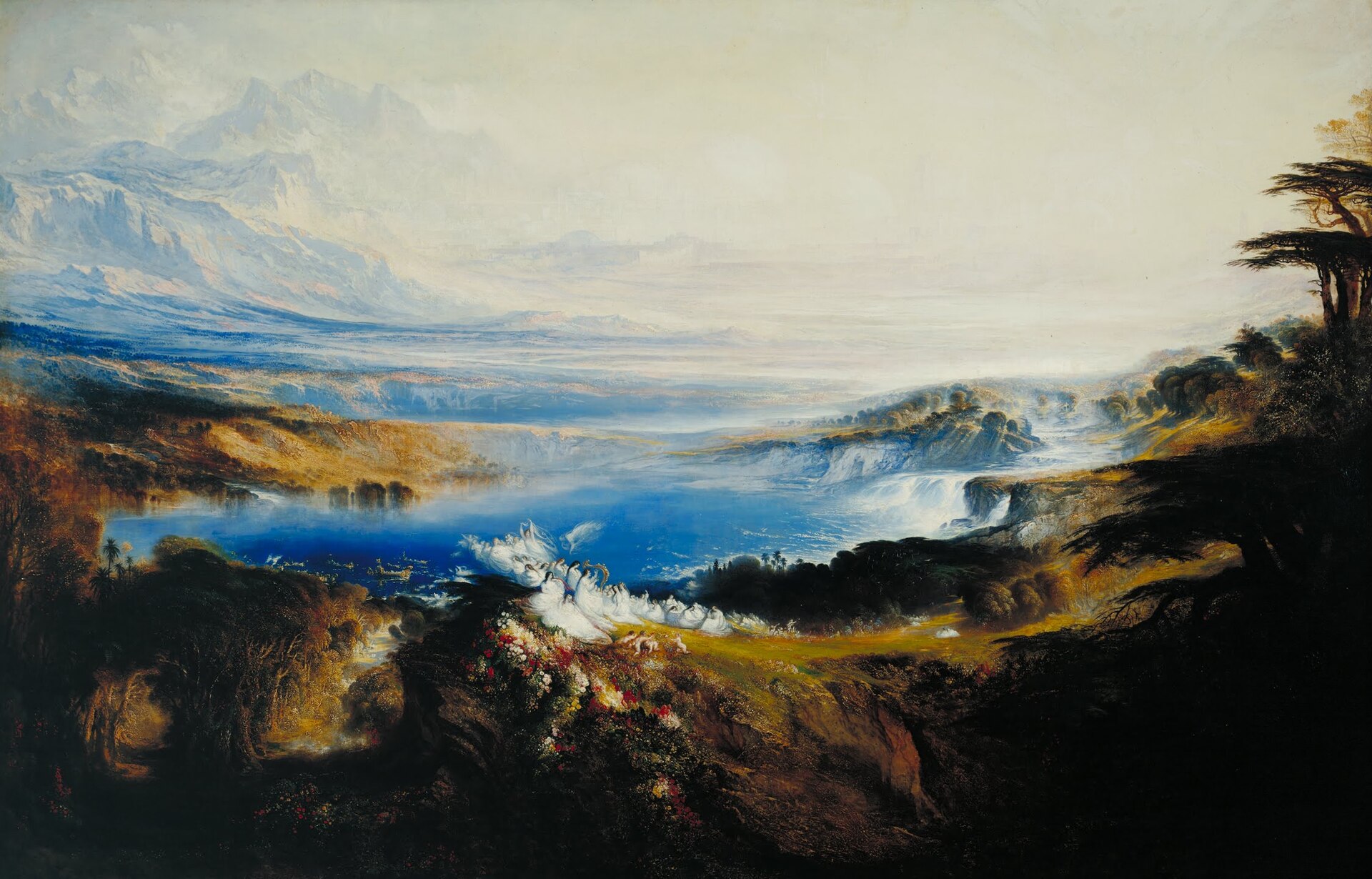
The Last Judgement paintings create another kind of comparison. They concern final cosmic judgement and the fate of humanity. Joshua is earlier, more historical in story and more martial in action. Its scale anticipates the later apocalyptic works, but its drama remains tied to a commander, an army and a specific miracle of daylight.
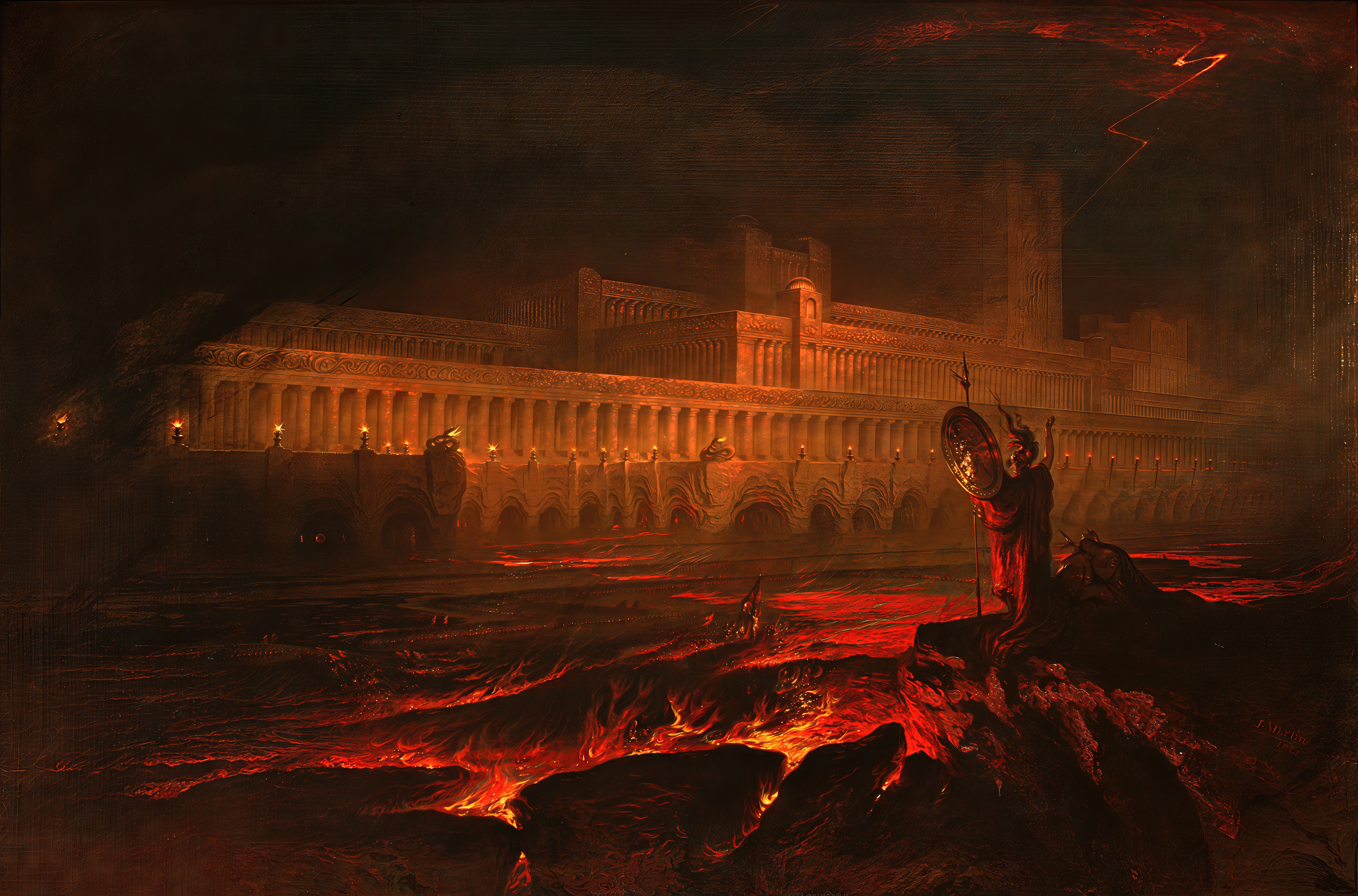
Seen beside Pandemonium, Martin's major Miltonic spectacle, Joshua reveals how early Martin had begun to think in monumental terms. Both works turn literary or biblical material into immense visual architecture. But Pandemonium imagines the capital of fallen angels from Milton, while Joshua imagines a battlefield where heaven itself seems to pause.
The Road, the City and the Viewer
One of the most effective details in Joshua is the road that runs from the city toward the foreground. It gives the viewer a way into the painting, but it also shows how Martin thinks about command. The road carries troops, horses and movement down from the elevated city toward the battlefield. It turns the landscape into a procession.
That procession matters because Joshua does not stand alone like a saint in a devotional image. He is surrounded by military and priestly action. Figures near him gesture toward the sky, while others carry sacred objects and the army continues forward. The miracle is therefore not detached from the human effort below it. Prayer, command, battle and movement all happen at once.
The city also changes the story's atmosphere. It is not a simple marker for Gibeon. Its walls, domes and towers make the setting feel politically and architecturally charged. Martin gives the viewer a civilisation at risk, not just a patch of ground where armies clash. The sunlit architecture on the right and the storm-torn valley on the left create a visual argument about order and violence.
This is why the painting can feel cinematic before cinema existed. It gives the eye an establishing view, a commander, a mass movement, a weather event and a distant battlefield in one sweeping design. Martin's achievement is to make those parts read as one event.
Why the Painting Matters
Joshua Commanding the Sun to Stand Still upon Gibeon matters because it shows Martin finding the public language that would shape his career. The ingredients are already there: the tiny human figure against an immense setting, the combination of architecture and landscape, the charged sky, the dramatic light and the sense that ordinary space has been opened to supernatural force.
The painting is also one of the clearest examples of Martin's refusal to keep biblical art small. He does not reduce scripture to moral anecdote. He builds an environment large enough for the story's impossibility. The viewer is asked to believe, at least visually, that a human command can address the sun.
That ambition helps explain why the work remained important through later drawings and prints. It could be read as a painting, studied as a composition and reproduced as a dramatic image. Its subject gave Martin one of his most powerful formulas: put a figure at the edge of a vast world, let the heavens answer, and make scale itself carry the meaning.
Frequently Asked Questions
Discussion
What detail in Joshua Commanding the Sun to Stand Still changes how you read John Martin's use of scale, light or atmosphere?
Reader Insights
Which figure, architectural form or passage of light first anchors the scene for you?
How does the source story or subject change the emotional force of the image?
Where does this work feel closest to, or furthest from, Pandemonium?
Join the Conversation
Share your reading of Joshua Commanding the Sun to Stand Still below.
References
- National Gallery of Art, *Joshua Commanding the Sun to Stand Still upon Gibeon*, 1816, 2004.64.1: View Source, accessed 2 August 2026.
- National Gallery of Art, *Joshua Commanding the Sun to Stand Still*, 1827 print, 2002.65.3: View Source, accessed 2 August 2026.
- The Metropolitan Museum of Art, *Joshua Commanding the Sun to Stand Still Upon Gibeon (Joshua: 10: 12-14)*, ca. 1822, 1975.131.200: View Source, accessed 2 August 2026.
- Yale Center for British Art, *Joshua Commanding the Sun to Stand Still*, 1827, B1977.14.11941: View Source, accessed 2 August 2026.
- National Gallery of Victoria, *Joshua Commanding the Sun to Stand Still*, 1827, 3486-3: View Source, accessed 2 August 2026.
- Art Institute of Chicago, *Joshua Commanding the Sun to Stand Still, from Illustrations of the Bible*, 1835, 1991.216.10: View Source, accessed 2 August 2026.
- World English Bible, Joshua 10:12-14: View Source, accessed 2 August 2026.
- Dictionary of National Biography, John Martin: View Source, accessed 2 August 2026.