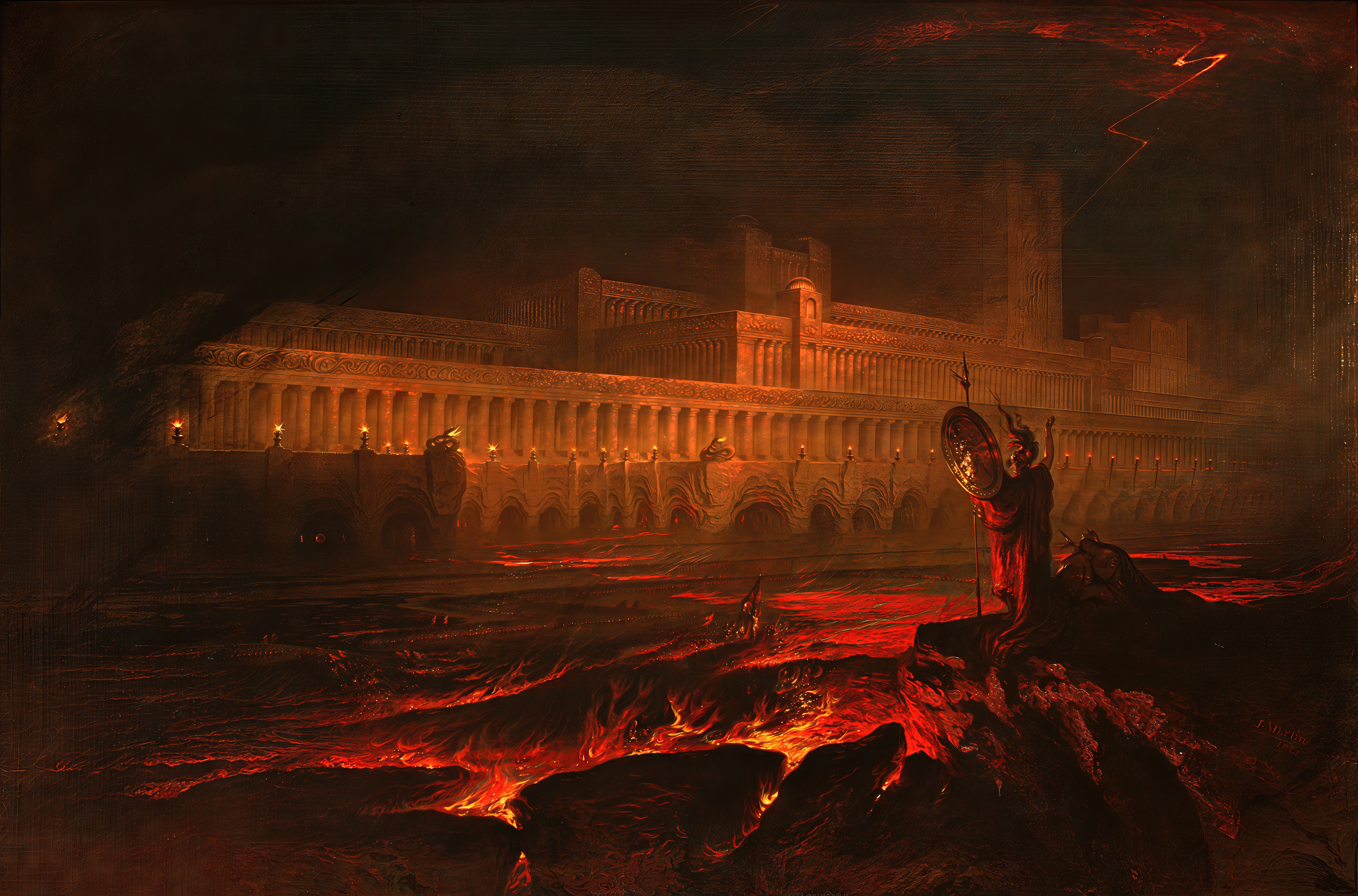
Pandemonium by John Martin: Introduction
John Martin's Pandemonium is a vision of Hell as architecture. Painted in 1841 and now in the Louvre, it turns a passage from John Milton's Paradise Lost into a dark theatre of lava, smoke, monumental building and microscopic figures. The scene is not the familiar infernal landscape of punishment alone. It is the moment when Satan calls a capital city into being for the fallen angels: a palace, a council chamber and a spectacle of rebellious power.
Martin had already made the subject famous through prints before he returned to it as a large oil painting. That earlier print history matters. Pandemonium is not simply an illustration enlarged into paint. It is the mature version of an image Martin had tested through mezzotint, through the market for Milton illustrations and through the public appetite for vast biblical and literary scenes. The Louvre painting carries that print-born drama onto canvas, with the additional force of colour, scale and an original frame designed by the artist himself.
The result is one of Martin's clearest statements of the Romantic sublime. Human or demonic bodies are almost lost inside a landscape of fire and stone. Architecture rises like a force of nature. Light does not clarify the scene so much as make it more unstable: red heat spreads below, blackness gathers above, and a pale demonic palace appears to have been breathed out of the burning ground.
At a Glance
- ArtistJohn Martin
- TitleLe Pandemonium, 1841 or Pandemonium
- Date1841
- MediumOil on canvas
- Dimensions1.23 m high by 1.85 m wide; with frame, 1.625 m high by 2.235 m wide
- CollectionMusee du Louvre, Department of Paintings
- Inventory numberRF 2006 21
- SubjectSatan creating Pandemonium in Book I of John Milton's Paradise Lost
- Related print traditionMartin made earlier engraved versions of the subject in 1824 and 1831
- Displayrecorded by the Louvre as on display in Salle 713, Denon wing
Contents
- Introduction
- How to Read the Composition
- Annotated Details
- Milton's Pandemonium
- From Mezzotint to Oil Painting
- Looking Closely at the Louvre Painting
- Satan Without Hero Worship
- Illustration, But Not Illustration Only
- Romantic Sublime and Popular Spectacle
- Exhibition, Pairing and Provenance
- Why Pandemonium Matters in Martin's Art
What Is Happening in the Painting?
The painting shows the construction of Pandemonium, the palace of Hell in Paradise Lost. Milton places the episode after Satan and the rebel angels have fallen. They do not yet rule; they are defeated, disoriented and gathering themselves into a counterfeit kingdom. The palace becomes the visible sign of that ambition.
Martin sets Satan in the foreground at the right, standing above the glowing abyss. The Louvre identifies him as the figure who brings the palace into being with his breath. Below him, barely distinguishable in the fiery depths, are the demon hosts who will assemble there. The palace itself appears across the middle distance: enormous, fortified, domed and lit by the furnace-like glow of Hell.
That balance between figure and setting is central to the work. Satan is important, but he is not allowed to dominate the scene in the way a heroic protagonist might. Martin's true protagonist is the environment: the pressure of space, heat, smoke, architecture and distance. The viewer sees Hell as a system, not just a stage.
The composition also changes the emotional tempo of the subject. Milton's text moves with astonishing speed: the infernal structure rises suddenly from the earth. Martin slows that moment down and makes it visible. The palace is already there and still seems to be forming. The molten foreground, the spreading architectural mass and the restless sky give the painting the feeling of a world still hardening after catastrophe.
Annotated Details from Pandemonium
This annotated view follows eight details that make Martin's flagship work readable at speed: Satan's ledge, the palace of Hell, the molten lower world, the smoke-darkened sky and the smaller passages that control how the eye moves through the scene.
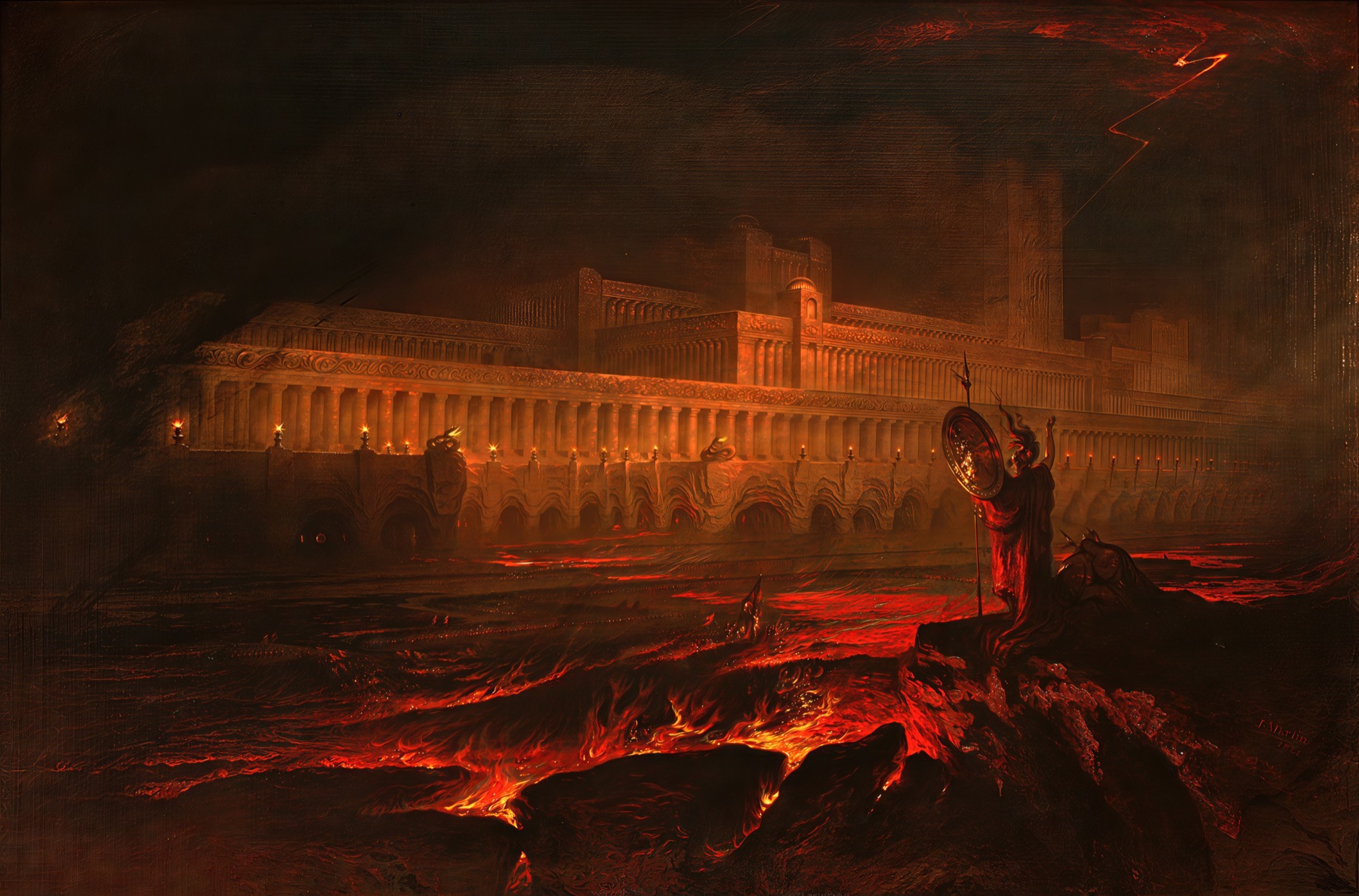
Details from PANDEMONIUM
Close looking keeps the Miltonic subject, the print-to-painting development and Martin's architectural sublime visible inside one image.
Satan on the ledge
Satan is commanding but small, positioned at the edge between viewer, abyss and palace rather than enlarged into a heroic centre.
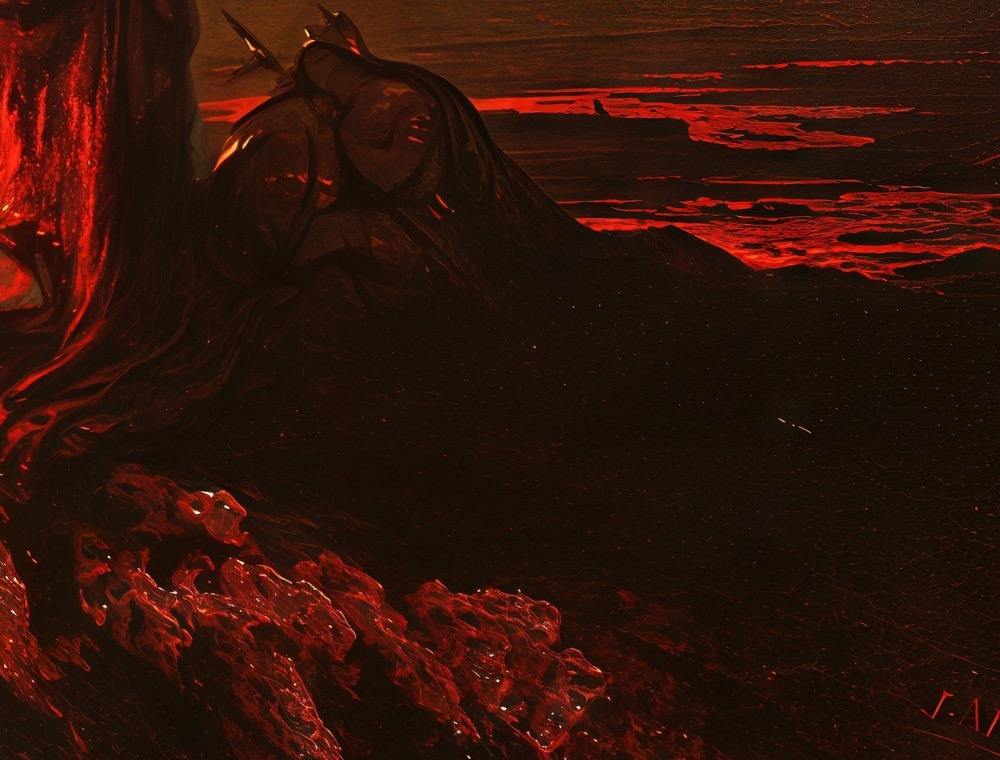
Palace of Hell
The central architecture gives rebellion a capital city: ordered, monumental and unstable within the furnace-lit landscape.
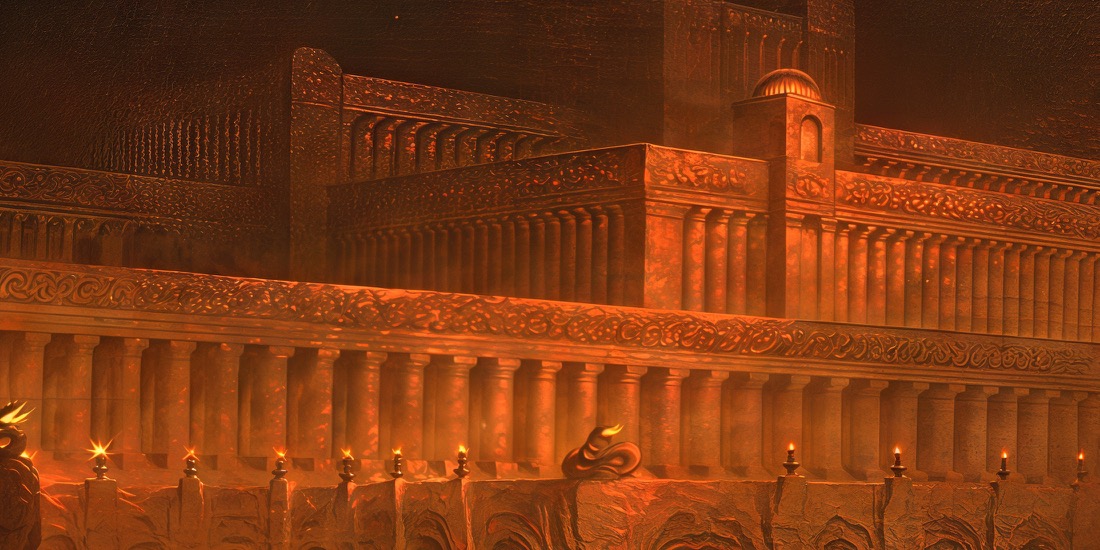
Molten abyss
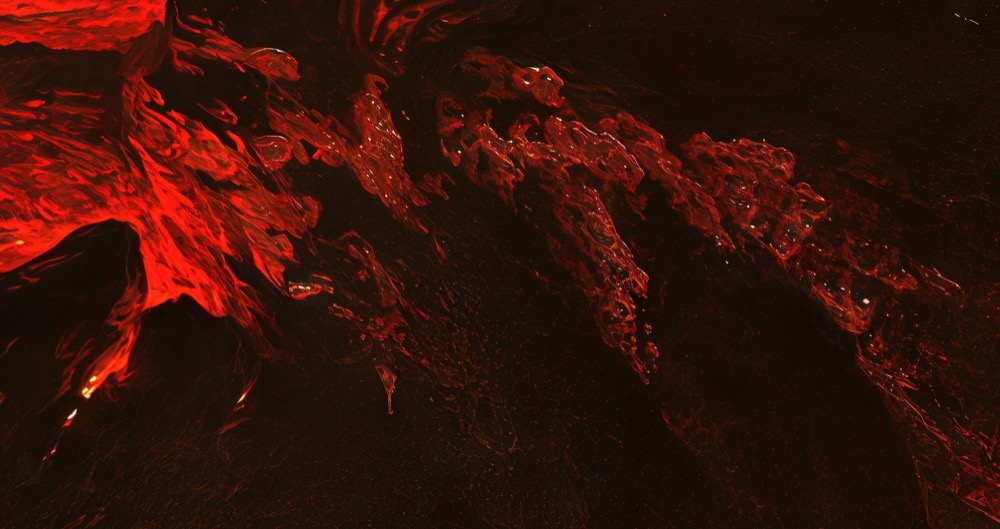
The glowing lower world makes the palace feel raised over fire, depth and tiny demonic labour rather than stable ground.
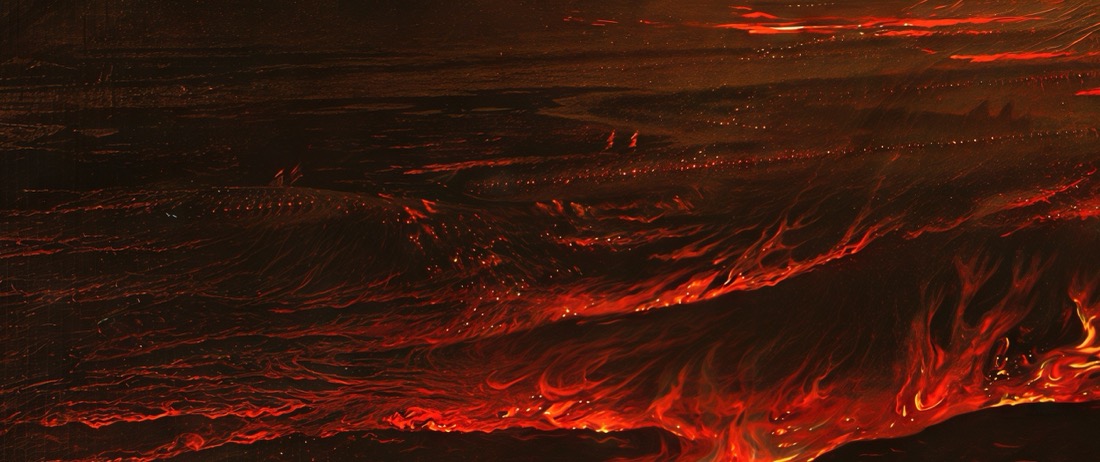
Infernal sky
The smoke-darkened sky presses downward, so the scene is lit from below instead of relieved by heavenly light.
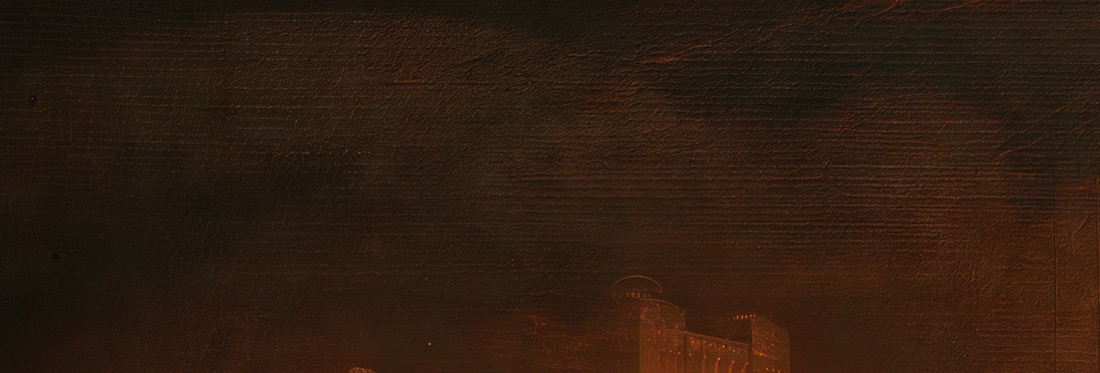
Distant towers
The left-hand recession turns the palace into a city system rather than one isolated building.
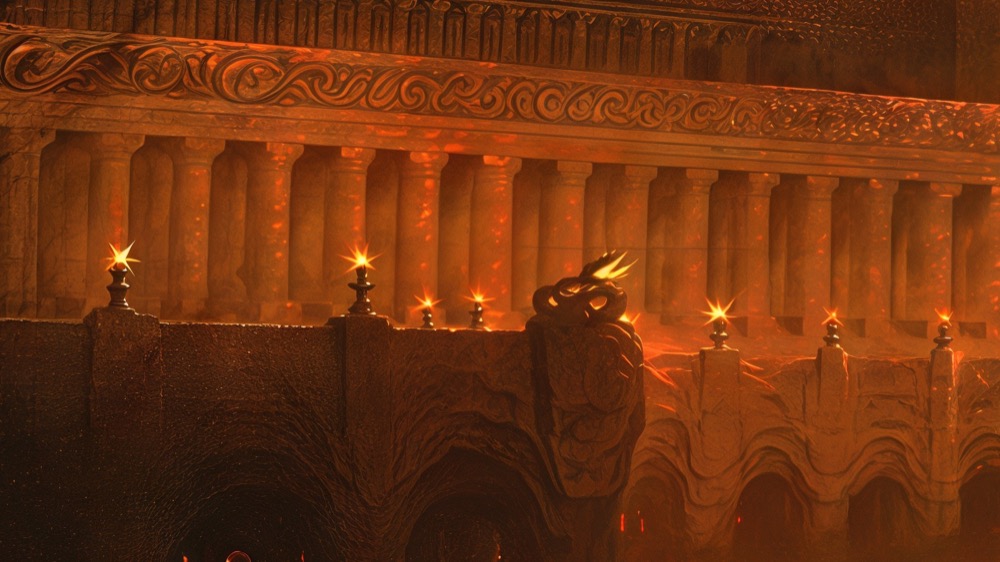
Furnace mouth
The bright lower opening concentrates the sense that Pandemonium is being formed out of heat and eruption.
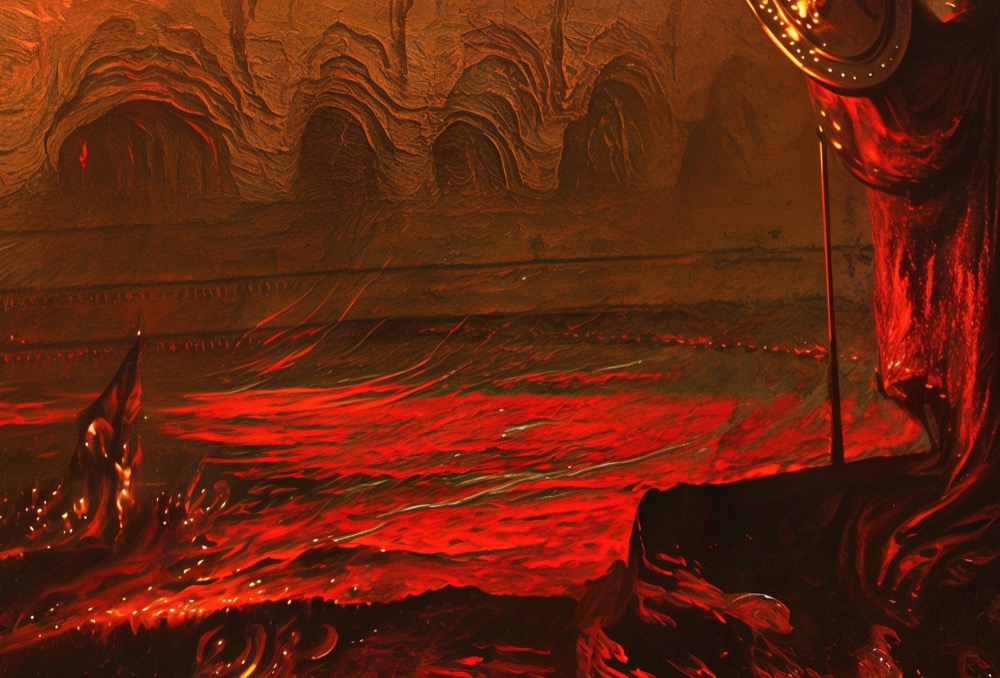
Foreground ledge
The broken foreground edge gives the viewer an unstable foothold before the scene drops into the infernal depth.
Smoke veil
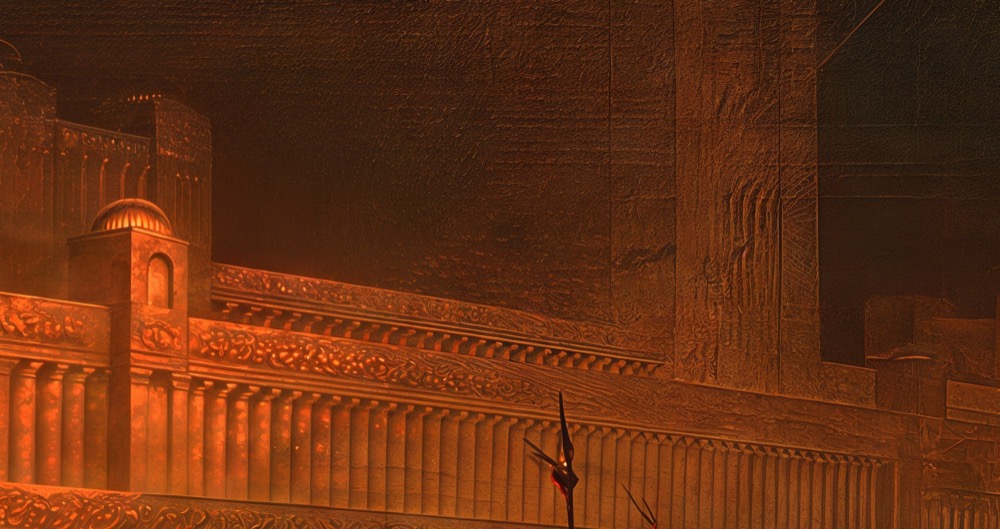
Smoke around the architecture makes the palace appear and disappear, as if it is still hardening into form.
How to Read the Composition
A useful way to read Pandemonium is to move through it in three stages: the ledge, the palace and the abyss. The ledge gives the viewer a foothold. It is where Satan stands, and it is also where the viewer's eye first learns the scale of the scene. The palace then stretches across the centre, not as a tidy architectural portrait but as a vast mass of walls, columns and towers half absorbed by smoke. The abyss below pulls the eye downward into molten fire.
Those three zones create a powerful instability. The viewer is close to the foreground danger, far from the palace and above the infernal depths all at once. Martin's space does not settle into a calm landscape view. It keeps shifting between looking across, looking down and looking into darkness.
The palace is especially important because it is both a building and a sign. Its columns and walls suggest order, labour and authority. Its setting suggests corruption, heat and terror. That contradiction gives the painting much of its charge. Martin makes Pandemonium impressive enough to feel plausible as a capital, but he surrounds it with the evidence of what kind of capital it is.
The lower part of the image should not be passed over as mere scenery. The glowing lava and small figures give the painting its moral and physical scale. Without them, the palace might become a fantasy building. With them, it becomes a structure raised over suffering, depth and unstable ground. Martin makes architecture depend on the infernal world beneath it.
The sky completes the effect. It does not open into relief or daylight. It presses downward, darkening the upper half of the painting and making the palace appear illuminated by forces from below rather than from above. That reversal is central to the work's meaning. This is splendour without heavenly light.
Milton's Pandemonium
Martin's subject comes from Book I of Paradise Lost, first published in 1667. Milton describes Pandemonium as the capital of Hell, a palace made for the consultation of the fallen angels. The famous passage begins with the sudden rise of a "fabric huge", a building that appears almost as if exhaled from the infernal ground.
The Louvre links Martin's painting directly to Book I, lines 710-719, and identifies the moment as Satan creating the palace that will house the demons. That source matters because it keeps the painting from being read as a general fantasy of Hell. Martin is not inventing a random infernal city. He is picturing a particular Miltonic image: grandeur made corrupt, magnificence born from rebellion and theatrical beauty shadowed by moral ruin.
Milton's Pandemonium is full of architectural language: temple, pillars, gold, roof, cornice and carved ornament. Martin translates those words into a kind of infernal classicism. The building in the painting is not merely a cavern or a ruin. It has walls, domes, mass and ceremony. It looks like civilisation, but its foundations are lava and darkness.
This is why the painting is more complex than a simple image of evil. Martin gives Satan's palace genuine grandeur. The viewer can feel why such a spectacle would fascinate an audience. At the same time, the grandeur is unstable. The scale is overwhelming, the light is toxic, and the architectural splendour seems inseparable from violence.
The word "Pandemonium" itself also matters. In ordinary modern English it often means noise, disorder or uproar. Milton's meaning is more exact: a place of all demons, a capital for fallen powers. Martin holds those meanings together. His painting shows an ordered building and a chaotic world at the same time. The palace is not disorderly in its design; it is terrifying because it gives disorder a monumental home.
That makes the subject especially suited to Martin. He was drawn again and again to scenes in which organised civilisation and overwhelming force meet: feasts interrupted by judgement, cities destroyed by disaster, armies reduced to tiny marks beneath supernatural skies. Pandemonium is one of the purest forms of that interest because the city is being created in front of us. It is both architecture and event.
From Mezzotint to Oil Painting
Martin first approached the subject through prints. The British Museum records an 1824 Pandemonium as an illustration to Milton's Paradise Lost, made in mezzotint with etching and published by Septimus Prowett in London. The museum's description places Satan on a cliff in the foreground, addressing the rebel angels below and gesturing toward the city of Pandemonium.
That print already contains the essential Martin formula: a tiny figure placed against a colossal constructed world, with the viewer positioned at the edge of a dark theatrical space. Mezzotint suited that effect. Its tonal range could give Martin darkness, smoke, burning light and architectural recession in a way that made the printed image feel dramatic rather than merely diagrammatic.
The 1831 version shows Martin returning to the subject on a larger scale. The Art Gallery of New South Wales describes its 1831 Pandemonium as a large-scale reworking of Martin's earlier engraving for the Paradise Lost series. Yale Center for British Art also holds an 1831 Pandemonium, listing it as a mezzotint and etching with hand colouring, and records it as public domain.
The Louvre painting therefore belongs to a long development rather than a sudden one-off invention. Martin had already explored how to make Milton's palace legible in black and white. In 1841 he used oil paint to deepen the atmosphere, colour and surface drama of the idea. The painting does not abandon the print. It amplifies it.
That sequence is important for understanding Martin's career. He was a painter, but he was also an engraver and illustrator. His public reputation depended not only on large exhibition paintings but also on the circulation of prints. A viewer who knew the Milton illustrations could see the Louvre painting as a return to familiar territory made more spectacular and more painterly.
The print evidence also helps explain why Martin's compositions often feel so legible at a distance. A print must survive reduction, tonal compression and repeated viewing. Martin's best images use bold structures: a ledge, a gulf, a distant city, a shaft or glow of light, a crowd diminished by scale. Those structures carry over into the oil painting. Pandemonium has plenty of atmospheric richness, but beneath it is a strong graphic architecture.
The 1824 and 1831 versions also show Martin thinking commercially and serially. The Paradise Lost illustrations belonged to a book and print culture in which literary subjects could reach viewers beyond a single exhibition room. That does not make them less serious. It means Martin's Milton was encountered through repeatable images, collected impressions and the private act of looking at printed plates.
When the 1841 painting returns to the subject, it brings that reproducible image-world back into the public arena of large-scale painting. Colour and the original frame give the scene a physical presence that the prints could not have in the same way. At the same time, the painting keeps the print's dark tonal drama. Martin's achievement is to make the oil painting feel both pictorially grand and graphically sharp.
Looking Closely at the Louvre Painting
At first glance, the scene reads as a mass of red and black, but Martin carefully organises the terror. The foreground drops sharply into heat. The lower left and lower centre are alive with glowing lava and smoke, a reminder that the palace is not being built on neutral ground. Hell is not scenery around the building; it is the material out of which the building seems to rise.
The right foreground gives the viewer a ledge, a theatrical side-stage from which Satan surveys the creation. His figure is small relative to the architecture, but his placement matters. He stands at the edge between viewer and abyss, as if conducting the transformation. His presence anchors the narrative without reducing the painting to a portrait of Satan.
The palace itself is placed across the central field of vision. Martin avoids presenting it as a clean facade. Instead, the eye catches walls, towers, domes and layered architectural forms through smoke and darkness. The building feels too large to comprehend at once. It is both object and atmosphere.
Colour does much of the work. The hot reds and oranges below suggest molten creation, while the darker upper half holds the palace in a threatening dusk. The contrast makes the building appear almost luminous, but not heavenly. It is lit from below, from the fires that also threaten to consume it.
Martin's use of scale is equally important. The demons are not shown as individual characters with readable expressions. They are masses and traces, glimpsed in the burning lower world. This reduction of figures gives the landscape and architecture a terrifying priority. Even Satan is smaller than the system he commands.
The original frame adds another layer of meaning. The Louvre records that Martin designed the frame himself and that it is decorated with serpents and dragons. The frame is not a neutral border in this case. It extends the infernal subject into the viewer's space and makes the painting feel like an object conceived as a total spectacle.
Martin also controls the viewer's distance with unusual care. The foreground is close enough to feel dangerous, but the palace remains far enough away to resist ordinary inspection. That tension is one reason the painting feels so large. The viewer can identify the broad event but cannot settle every detail. Martin gives enough visual information to orient the eye, then withholds enough to keep the scene uncanny.
The painting's darkness is not empty. It is active darkness, built from smoke, shadow and theatrical recession. Instead of simply hiding the palace, it makes the architecture appear as a revelation. The eye moves from heat to structure, from the burning lower world to the pale mass of the city, and then back to the small figure of Satan. That movement repeats the subject: a palace emerging from infernal matter.
The frame's serpents and dragons deepen this effect because they make the boundary of the picture feel inhabited. A conventional frame can separate image from room; Martin's frame reinforces the fiction that the infernal world is pressing outward. For a painting about a palace called into being by theatrical power, that is a meaningful choice. The object itself participates in the drama.
Satan Without Hero Worship
Paintings of Satan can easily tip into glamour. Martin avoids that partly by making Satan small and partly by making his achievement morally disturbing rather than triumphant. The figure is commanding, but he is surrounded by forces that make command look precarious. The palace may answer his will, yet the world around it remains volcanic, unstable and dark.
This reading fits Milton's poem, where Satan's rhetorical power is inseparable from deception and pride. Martin does not need to moralise the scene with an explanatory symbol. The composition does the work. Satan stands high, but not safely. He creates a palace, but it rises from Hell. He commands a multitude, but the multitude is swallowed by scale.
The painting therefore asks the viewer to feel attraction and unease at once. The spectacle is magnificent. The red glow, the architectural depth and the vastness of the setting are meant to hold attention. But admiration curdles because the splendour has been detached from goodness. Martin's infernal architecture is persuasive because it shows how grandeur can serve rebellion.
That tension is one reason Pandemonium is more than a fantasy scene. It gives visual form to a political and moral problem: what happens when beauty, engineering, ceremony and mass persuasion are turned toward a fallen cause? Martin's answer is not quiet. It is a palace blazing in Hell.
Illustration, But Not Illustration Only
Because Pandemonium is based on Paradise Lost, it is tempting to treat the painting as a straightforward illustration of Milton. It is more than that. Martin begins with a literary passage, but he converts it into a visual argument about scale, power and spectacle.
Milton's lines give Martin the event: a huge fabric rising from the earth, richly built and astonishing in its speed. Martin keeps that core, but he does not simply list the details of the poem. He chooses a viewpoint, gives the palace a dramatic distance, places Satan on the right-hand ledge and turns the surrounding space into a furnace-lit world. These choices are painterly and interpretive.
The earlier prints make this even clearer. In print, Martin had to solve the problem of how to make Milton's sudden palace visible in tonal form. By the time he painted the 1841 oil, he had already tested the subject as an image that could stand on its own. The painting therefore sits between literature and exhibition spectacle: it remembers the text, but it speaks through scale, light and distance.
That is why Pandemonium remains effective even for viewers who have never read Paradise Lost. Knowing Milton deepens the painting, but the image is not dependent on prior literary knowledge for its basic force. The viewer immediately understands that a vast power is being organised in a hostile world. The poem gives the scene its name and moral frame; Martin gives it a body.
Romantic Sublime and Popular Spectacle
Pandemonium belongs to a nineteenth-century public culture that loved scale, catastrophe and visual astonishment. Martin's paintings of biblical, historical and literary themes were known for settings in which tiny figures are overwhelmed by huge landscapes, cities and forces. The National Galleries of Scotland summarises this aspect of his art clearly: his small figures intensify the sense that human drama is being engulfed by surrounding powers.
That makes Martin a natural artist to place near British Romanticism, though his work has a different temper from J. M. W. Turner or William Blake. Turner often dissolves form into weather, light and movement. Blake's visionary art tends toward compressed symbolic intensity. Martin uses vast architecture and staged depth. His sublime is engineered. It feels planned, built and displayed.
The National Portrait Gallery describes Martin as famous for dramatic panoramas inspired by historic and biblical disaster, and notes the importance of affordable mezzotint prints in popularising his work. Pandemonium sits exactly at that intersection of learned literary subject and public spectacle. Its source is Milton, but its appeal is also visual, theatrical and immediate.
The painting's drama should not be mistaken for shallowness. Martin's theatricality is part of the meaning. Pandemonium is a palace made to impress, persuade and organise rebellion. A restrained image would miss the danger of Milton's scene. Martin understands that evil in Paradise Lost often has grandeur; the problem is not that the demons lack imagination, but that their imagination serves pride.
Martin's reputation has often depended on whether viewers trust that theatricality. Some audiences have loved the force of his apocalyptic imagination; others have treated it as melodrama. Pandemonium is a strong test case because the subject itself demands excess. Hell's capital should not feel modest. The danger lies in making spectacle empty, and Martin avoids that by tying the spectacle to Milton, to architecture and to a precise dramatic moment.
The painting also speaks to nineteenth-century Britain as an age of engineering, industry and urban transformation. The first recorded owner, Benjamin Hick, was an engineer and steam-locomotive builder. That fact does not turn the painting into an industrial allegory by itself, but it makes the collecting history feel apt. Martin's Hell is full of constructed magnitude. Its terror comes from a world that has been built, lit, organised and scaled beyond the body.
Seen this way, Pandemonium is not only a Romantic image of the supernatural. It is also an image of modern spectacle before cinema: a vast scene designed to overwhelm the eye, absorb the viewer and make architecture feel animated. Martin's later appeal to film designers and fantasy visual culture is easy to understand from this painting, even though the work remains rooted in Milton and nineteenth-century history painting.
Exhibition, Pairing and Provenance
The Louvre records that Pandemonium was exhibited at the Royal Academy in London in 1841 as number 570. The entry used a line from Paradise Lost to identify the subject. The same Louvre record also notes a pendant composition, La Cite celeste, shown at the Royal Academy that year as number 428 and now in a private collection.
That pairing is fascinating: the infernal city and the heavenly city, shown in the same year. Even without the pendant beside it, Pandemonium gains meaning from that contrast. Martin was not only painting Hell as a spectacular environment; he was setting it against an imagined celestial architecture. His later career would continue to build drama through vast contrasts between judgement, destruction and salvation.
The provenance recorded by the Louvre begins with Benjamin Hick of Bolton, an engineer and steam-locomotive builder. After Hick's death, the painting was sold in Manchester in 1843 with its pendant. It then entered the Whiteley family line, later passed through Peter Nahum in London, the Forbes Magazine Collection and French and Co. in New York, before the Louvre acquired it in 2006 through the Belliot bequest.
That history is not just a list of owners. It also shows how Martin's work travelled through different kinds of nineteenth- and twentieth-century interest: industrial wealth, private collecting, specialist dealers, corporate collection and finally a major public museum. The Louvre's acquisition brought a major British Romantic picture, still in its original frame, into the French national collection.
The Louvre bibliography also points to the painting's modern reassessment. It was included in the Tate Britain exhibition John Martin: Apocalypse in 2011-2012 and has appeared in Louvre-related exhibitions and publications. The work's current prominence is part of a broader recovery of Martin as more than a sensationalist painter of disaster.
The 2006 Louvre acquisition is especially significant because it placed a major British Romantic work within a collection better known to many visitors for French, Italian and Northern European painting. The display context recorded by the Louvre, in a British and American paintings room, encourages viewers to see Martin not as an isolated eccentric but as part of a broader nineteenth-century visual culture.
The painting's survival with its Martin-designed frame strengthens that museum importance. Many old paintings reach museums in later or altered frames, which can change the viewer's sense of scale and intention. Here the frame is part of the evidence for Martin's conception of the work. The serpents and dragons are not decorative afterthoughts; they support the painting's claim to be an immersive infernal object.
The provenance also shows the work's movement between public fame and private custody. Exhibited in 1841, sold after Hick's death in 1843, preserved through family descent and later circulating through dealers and collections, it eventually became a public museum object. That journey helps explain why the painting can feel both famous and rediscovered: it belongs to Martin's public exhibition world, but its modern visibility depends heavily on the Louvre's acquisition and recent scholarship.
Why Pandemonium Matters in Martin's Art
Several features make Pandemonium a natural flagship for John Martin. It unites his literary ambition, his printmaking career, his appetite for architectural scale and his skill at turning catastrophe into spectacle. It also gives readers an immediate way into his art. Even before the details are understood, the painting announces Martin's world: tiny figures, enormous forces, biblical or literary subject matter and a visual language built around awe.
The work is also a bridge between several parts of Martin's output. It connects to his Milton illustrations, to his later apocalyptic scenes, to his architectural imagination and to the nineteenth-century public that encountered his images through both exhibitions and prints. It is therefore not only one important painting among many. It is a key to the way Martin's art moved between page, print, canvas and public spectacle.
The painting also helps explain why Martin can feel surprisingly modern. His image of Hell is almost cinematic: wide scale, sharp viewpoint, blazing light, architectural fantasy and dramatic distance. Yet it is rooted in older materials: Miltonic epic, history painting, biblical imagination, classical architecture and the tonal craft of mezzotint.
That combination is the essence of Martin's appeal. He made literary and religious subjects feel physically immense. In Pandemonium, the viewer does not simply learn that Satan's palace was built. The viewer is placed at the edge of its creation.
Related Works and Comparisons
The closest comparisons are Martin's own Pandemonium prints. The 1824 version recorded by the British Museum and Hammer Museum, and the 1831 versions recorded by Yale and the Art Gallery of New South Wales, show how he returned to the same Miltonic scene over time. They are essential for understanding the Louvre painting as the culmination of a print-to-painting sequence.
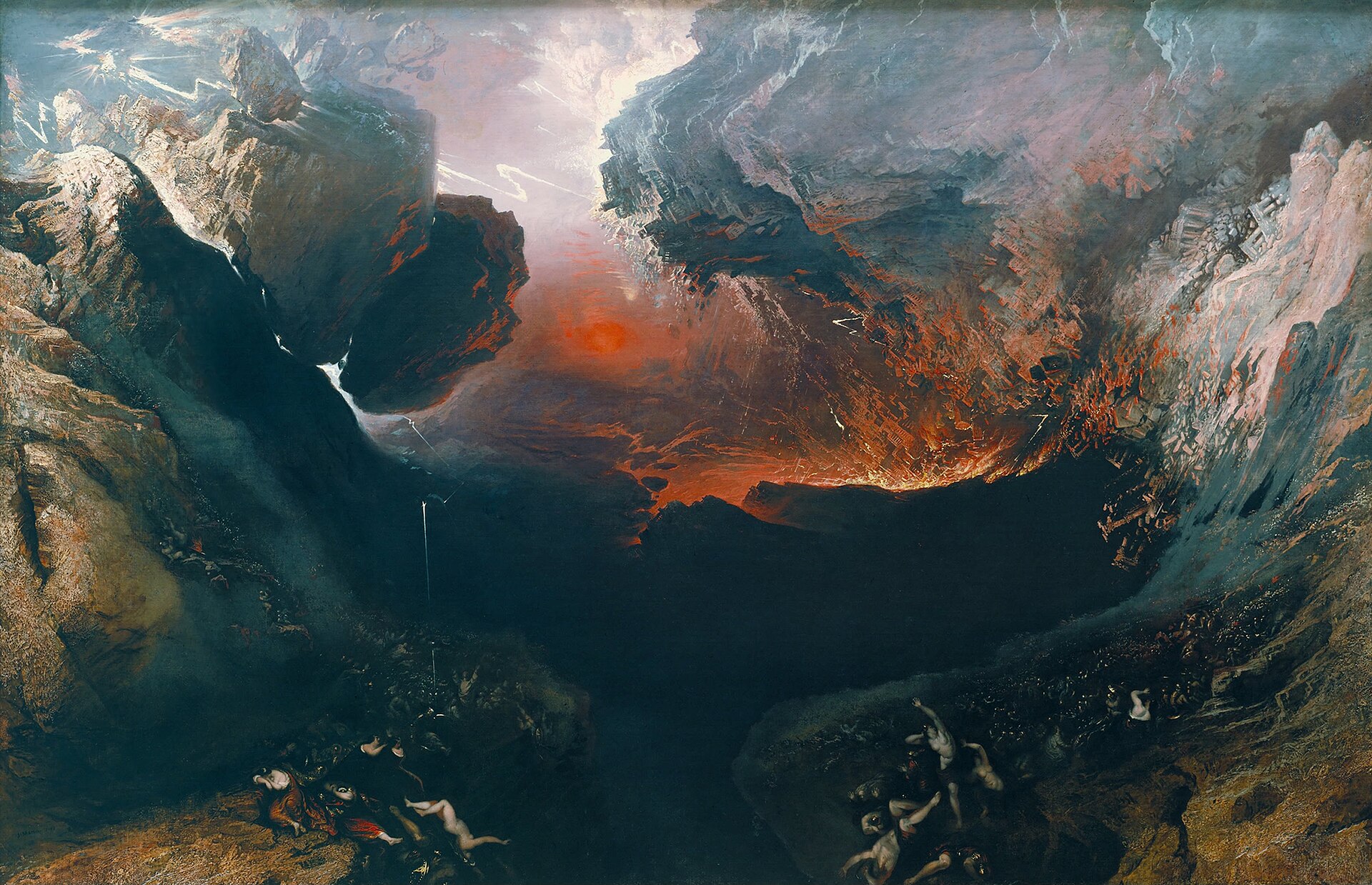
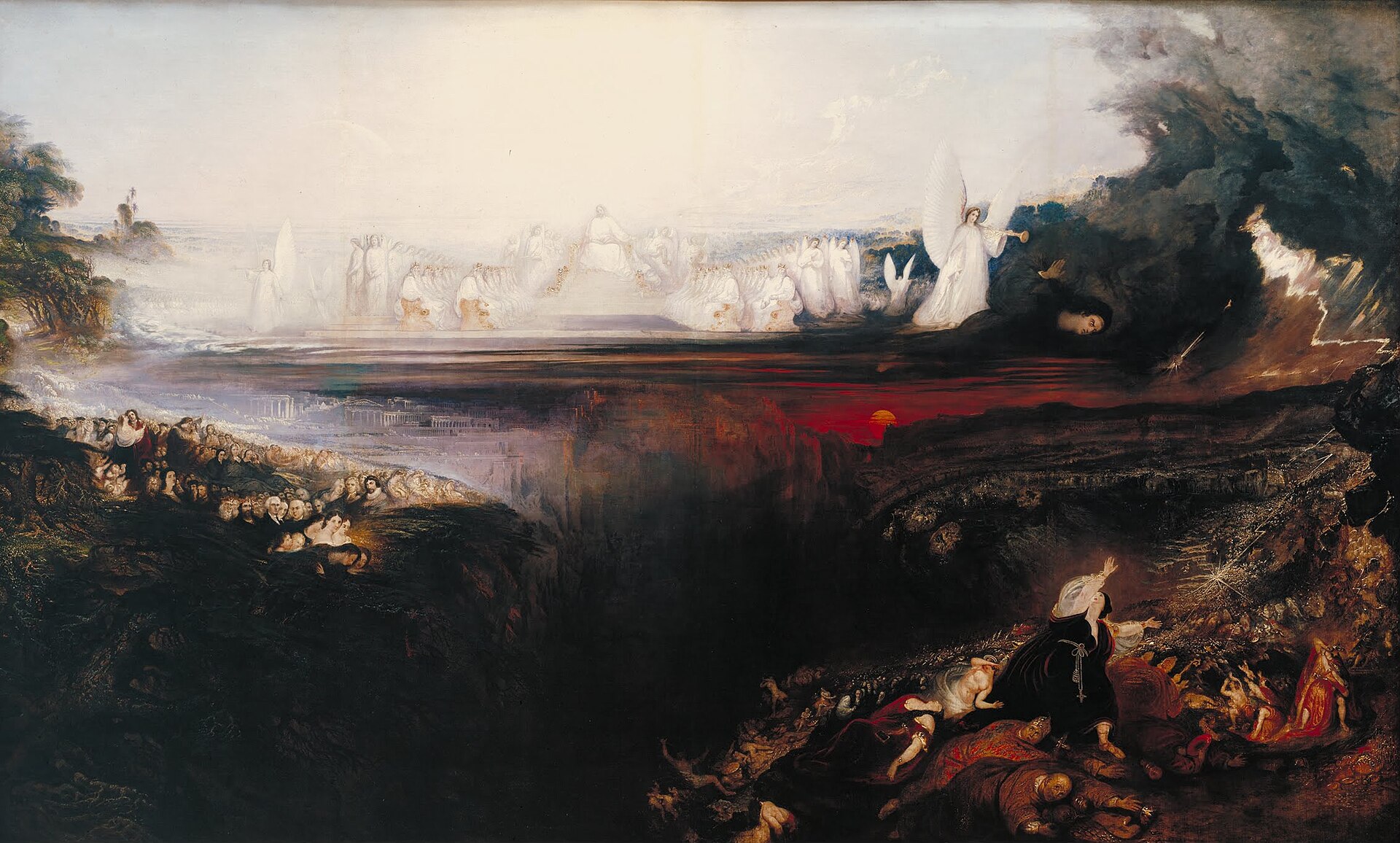
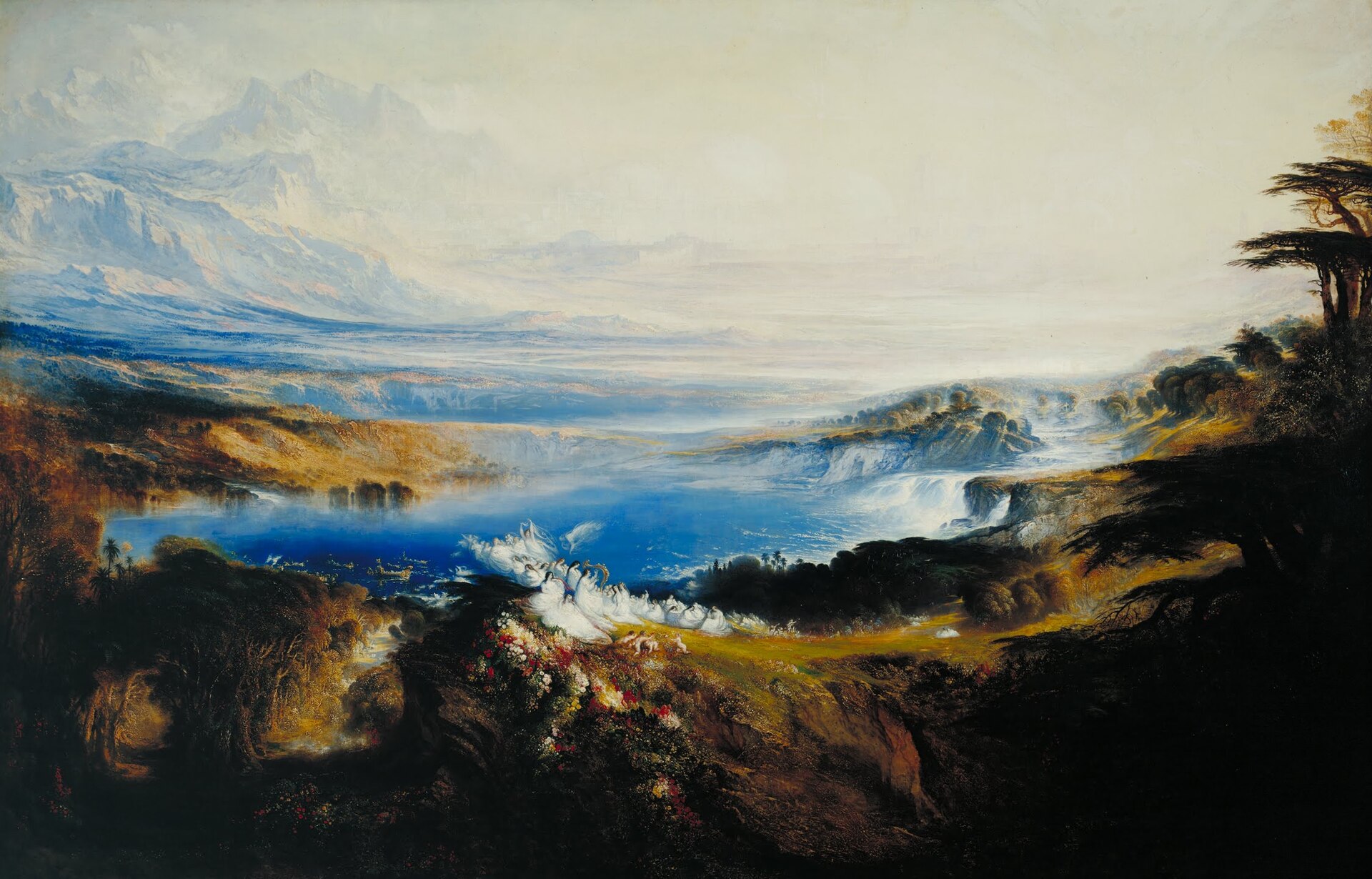
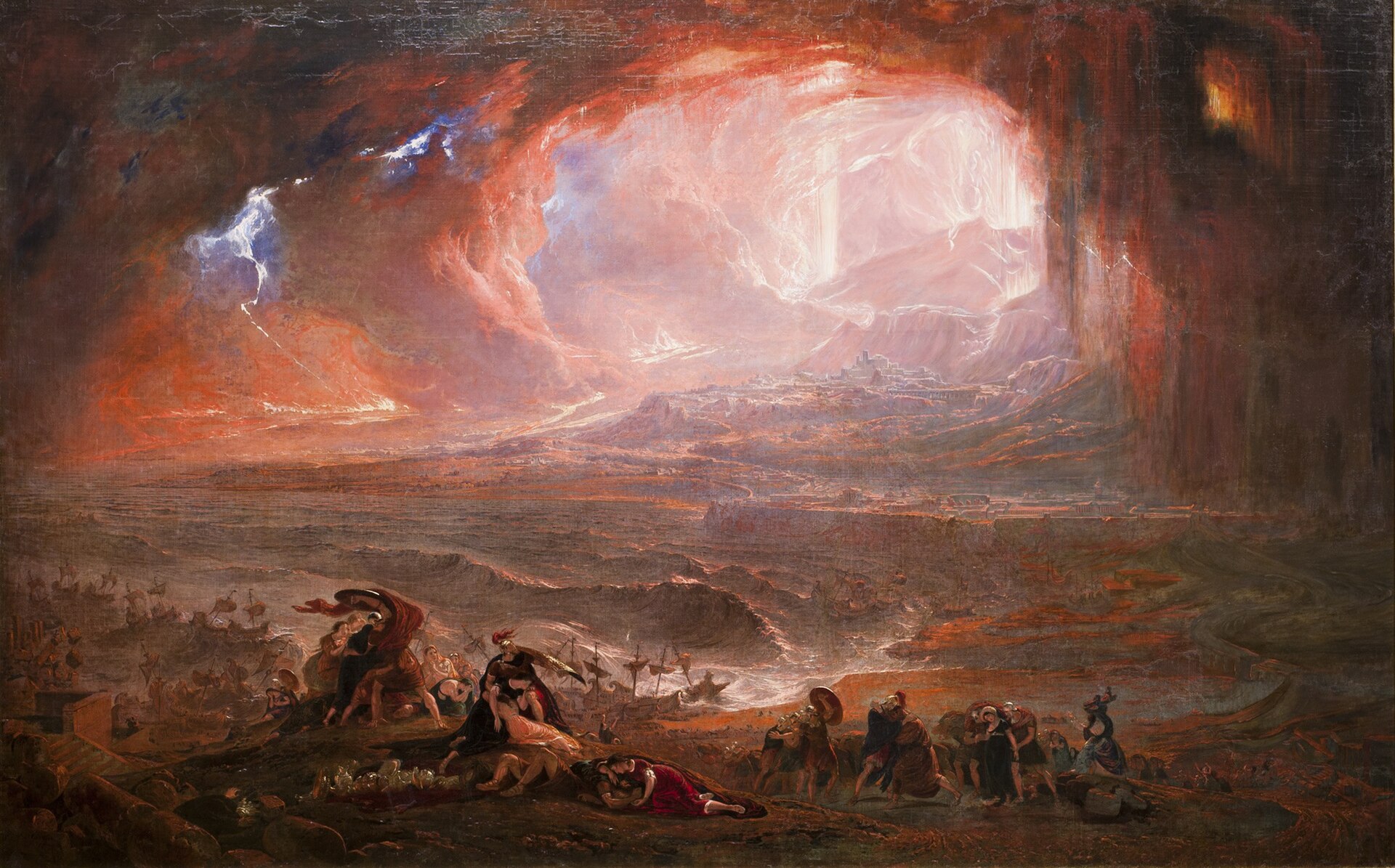
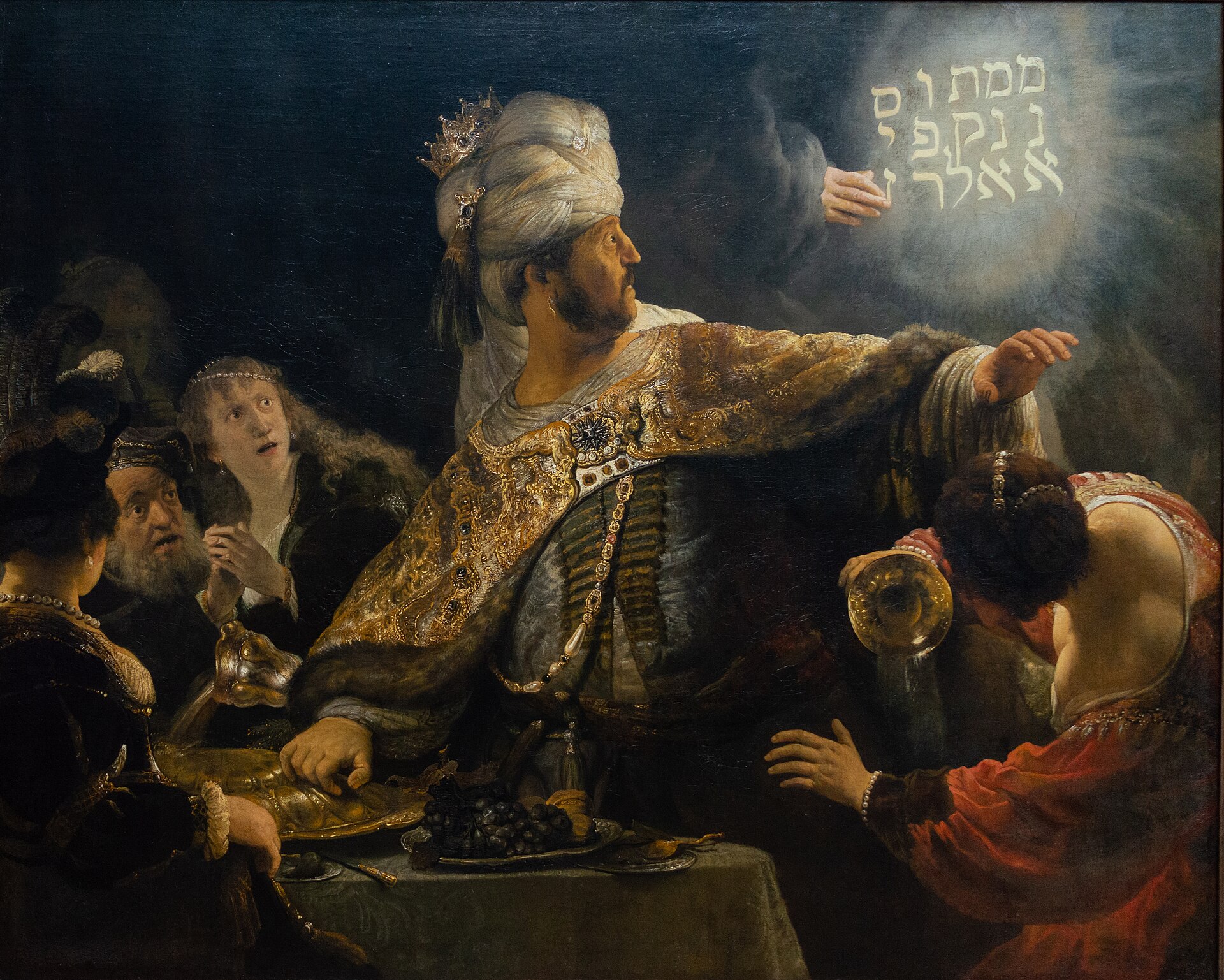
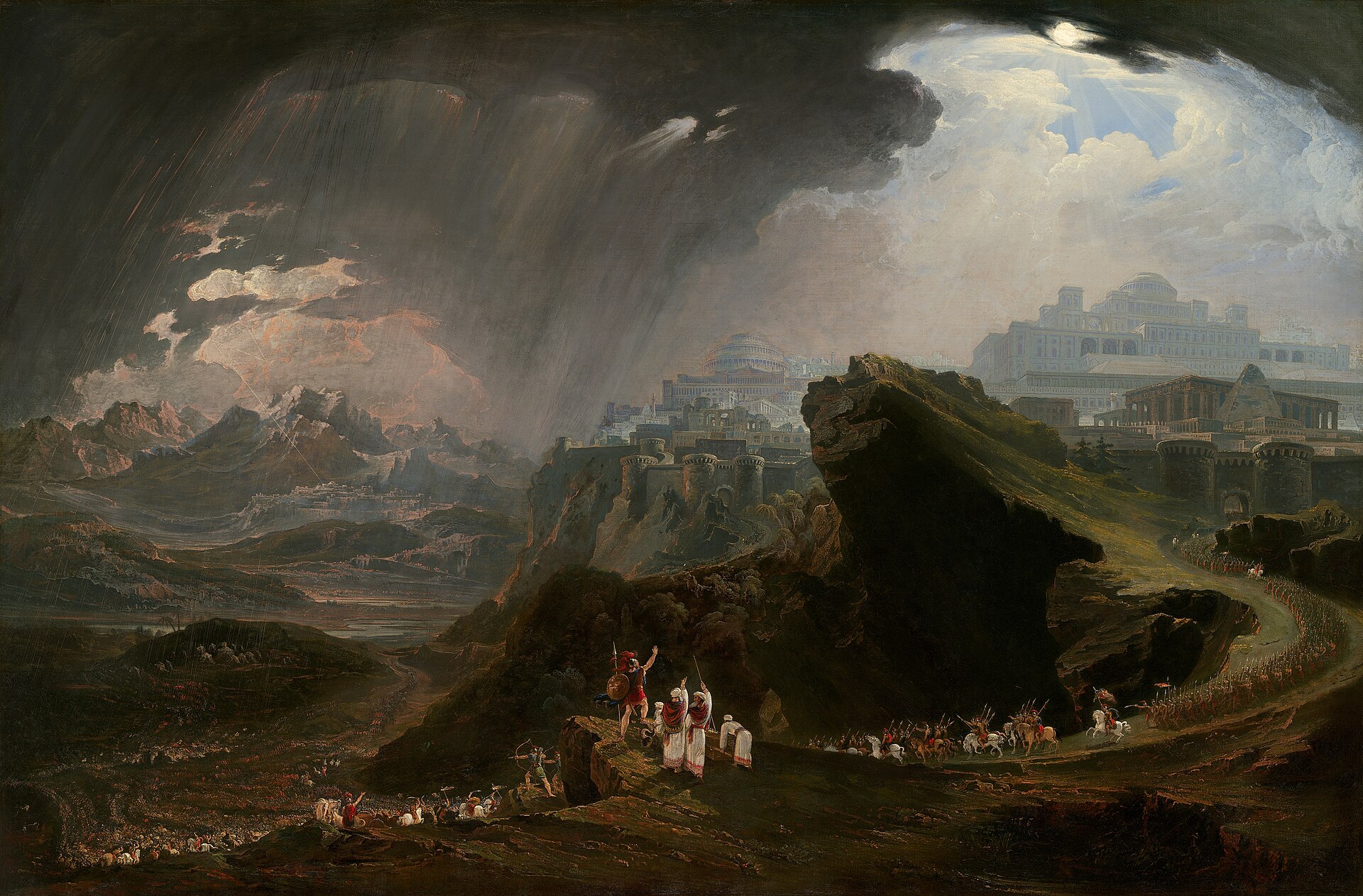
Within Martin's broader work, Belshazzar's Feast, Joshua Commanding the Sun to Stand Still, The Destruction of Pompeii and Herculaneum and the Last Judgement triptych all share his taste for vast settings, massed figures and moments of divine or historical crisis. Those works shift the subject matter, but they keep the same pressure of scale.
The painting also belongs near the wider Romantic imagination. It can be read alongside William Blake's visionary Miltonic art, Turner's sublime landscapes and Gustave Dore's later illustrated worlds, though Martin's method is distinct. He does not dissolve the scene into pure vision. He builds it as a world the eye can enter, measure and fear.
Frequently Asked Questions
Discussion
What detail in Pandemonium changes how you read John Martin's use of scale, light or atmosphere?
Reader Insights
Which figure, architectural form or passage of light first anchors the scene for you?
How does the source story or subject change the emotional force of the image?
Where does this work feel closest to, or furthest from, Pandemonium?
Join the Conversation
Share your reading of Pandemonium below.
References
- Louvre Collections, *Le Pandemonium, 1841*, RF 2006 21: View Source, accessed 2 August 2026.
- Louvre Collections JSON record, *Le Pandemonium, 1841*: View Source, accessed 2 August 2026.
- British Museum, *Pandemonium*, 1824, registration number 1978,0520.11.4: View Source, accessed 2 August 2026.
- Yale Center for British Art, *Pandemonium*, 1831, B1977.14.11944: View Source, accessed 2 August 2026.
- Art Gallery of New South Wales, *Pandemonium*, 1831, 419.2009: View Source, accessed 2 August 2026.
- Hammer Museum, *Pandemonium*, 1824, 2000.6.1D: View Source, accessed 2 August 2026.
- National Galleries of Scotland, John Martin artist biography: View Source, accessed 2 August 2026.
- National Portrait Gallery, John Martin person record: View Source, accessed 2 August 2026.
- Tate Shop, Martin Myrone, *John Martin - Sketches of My Life*: View Source, accessed 2 August 2026.
- Wikisource, *Paradise Lost* Book I, 1674 text: View Source, accessed 2 August 2026.