 by Tom Gurney
Tom Gurney BSc (Hons) is an art history expert with over 20 years experience
Page Created on August 31, 2026 / Page Updated on November 6, 2026
Email: tomgurney1@gmail.com / Phone: +44 7429 011000
A Friendly Call: Introduction
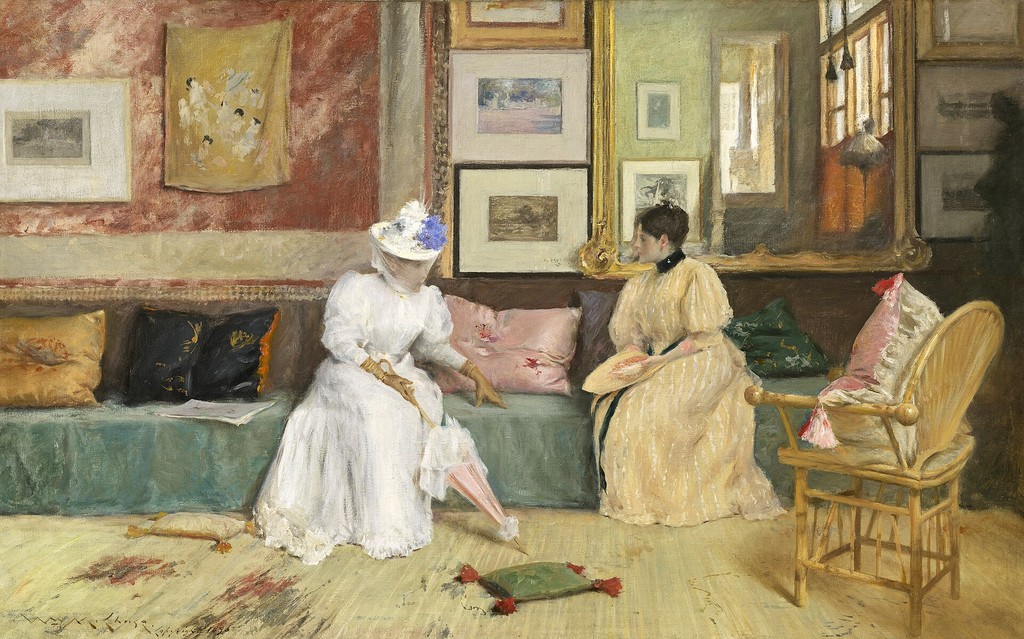
William Merritt Chase’s A Friendly Call presents an encounter that feels both immediate and carefully arranged. Two women sit facing one another on a long sofa. One still wears her hat and gloves and holds a closed parasol; the other listens from among coloured cushions. Around them, pictures, textiles, a gilded mirror and an empty wicker chair make the room almost as active as its occupants.
The painting offers no decisive incident. Chase uses posture, distance, reflection and light to make every gap matter.
At a Glance
- ArtistWilliam Merritt Chase (1849–1916).
- Date1895.
- MediumOil on canvas.
- Dimensions76.5 × 122.5 cm.
- CollectionNational Gallery of Art, Washington, accession 1943.1.2.
- SettingChase’s summer house at Shinnecock Hills, Long Island.
William Merritt Chase in context
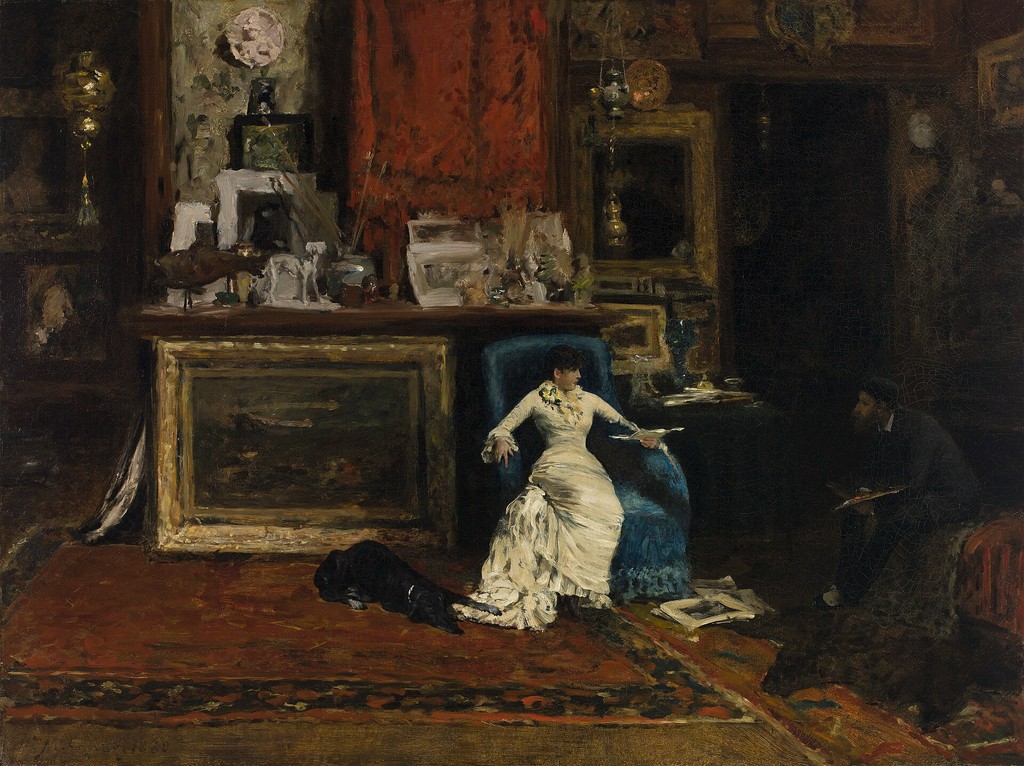
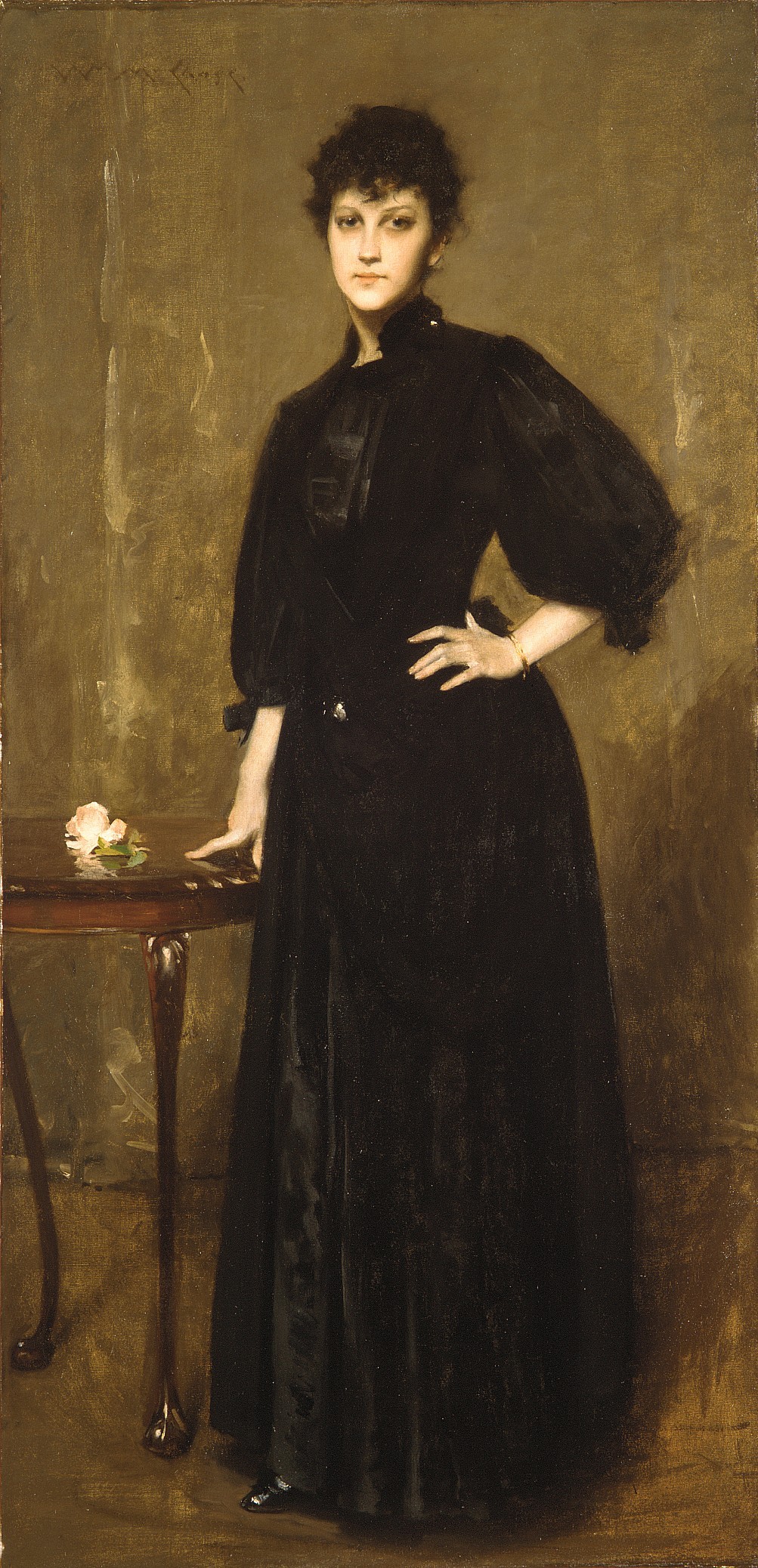
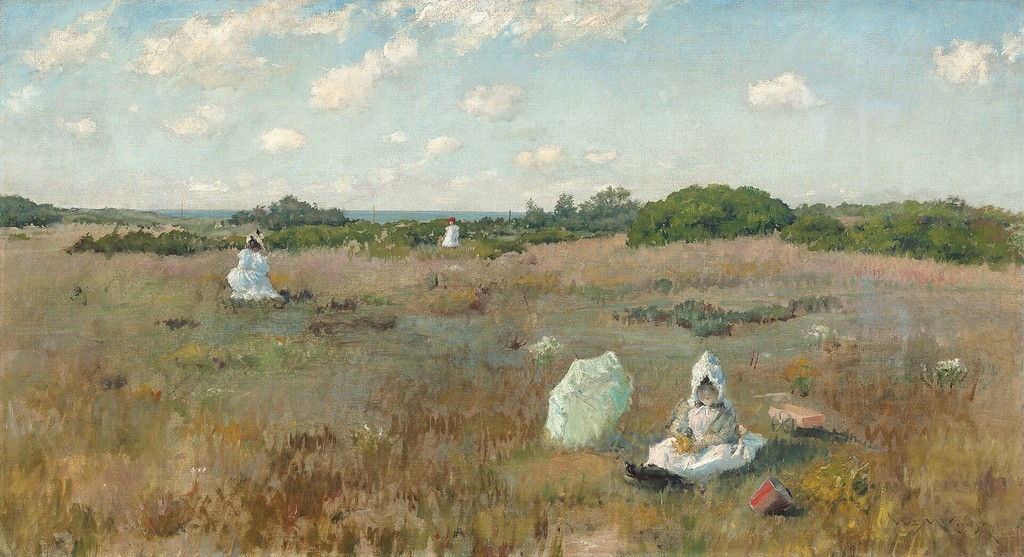
Keying Up – The Court Jester
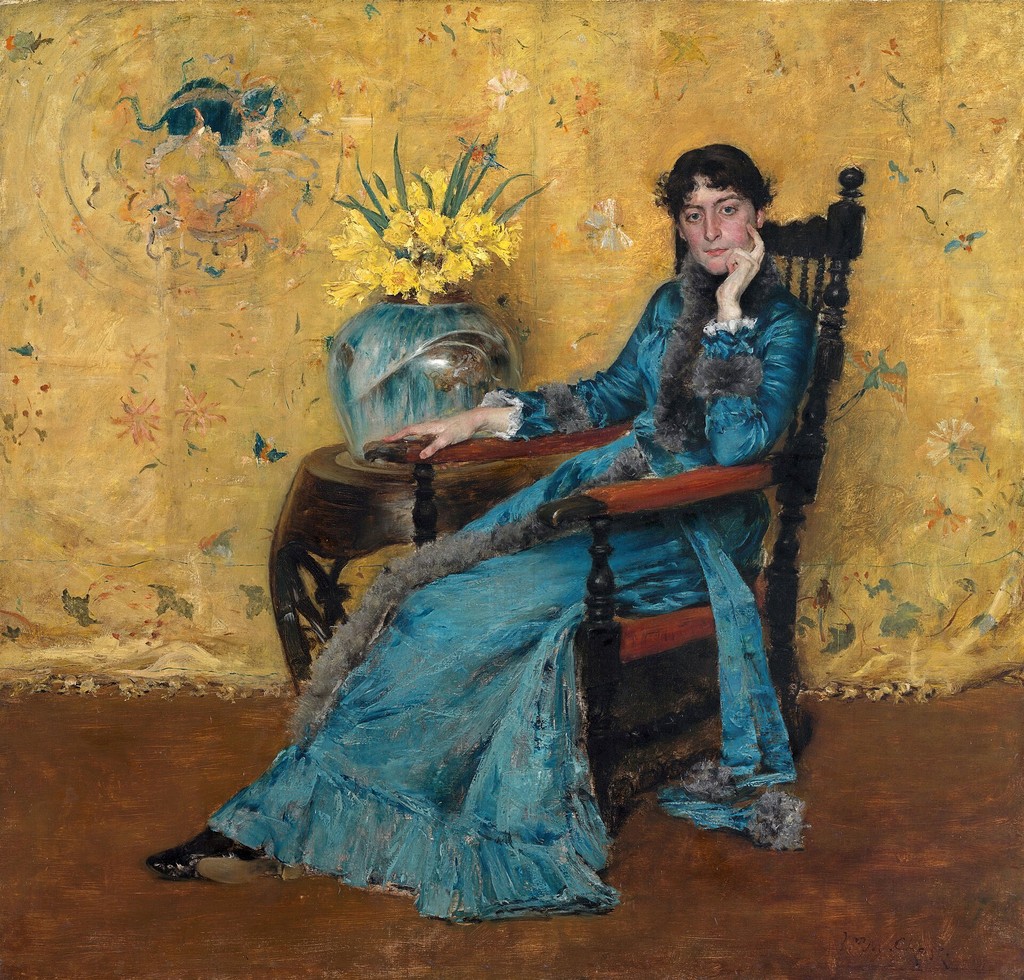
1875Portrait of Dora Wheeler
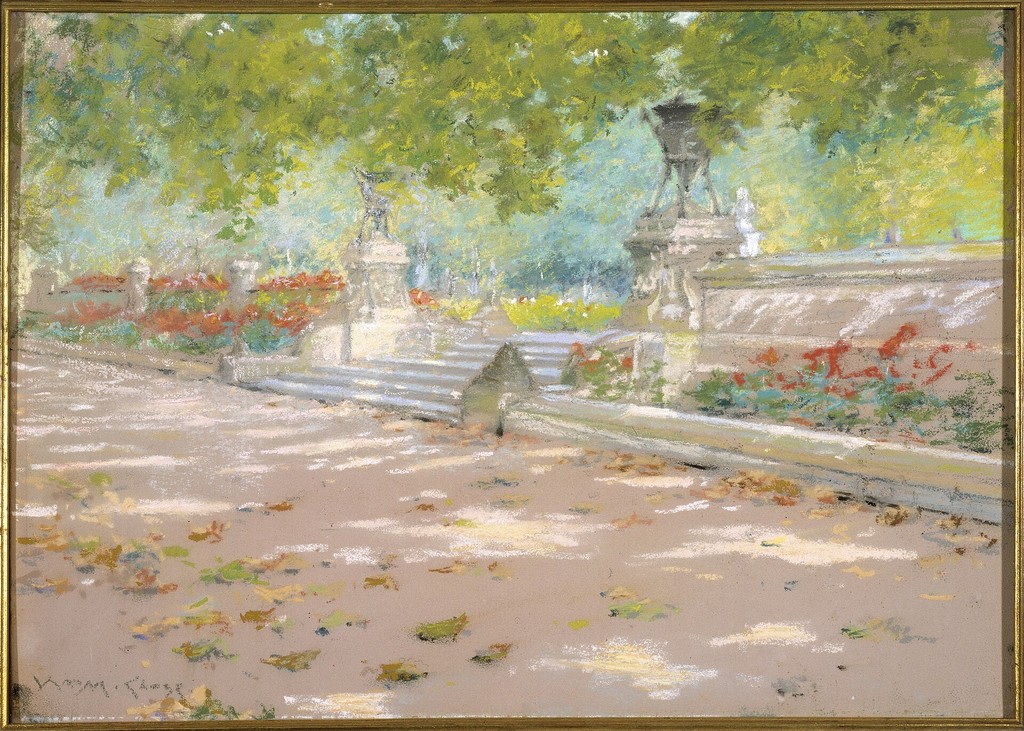
1882–83Terrace, Prospect Park
c. 1887A Friendly Call
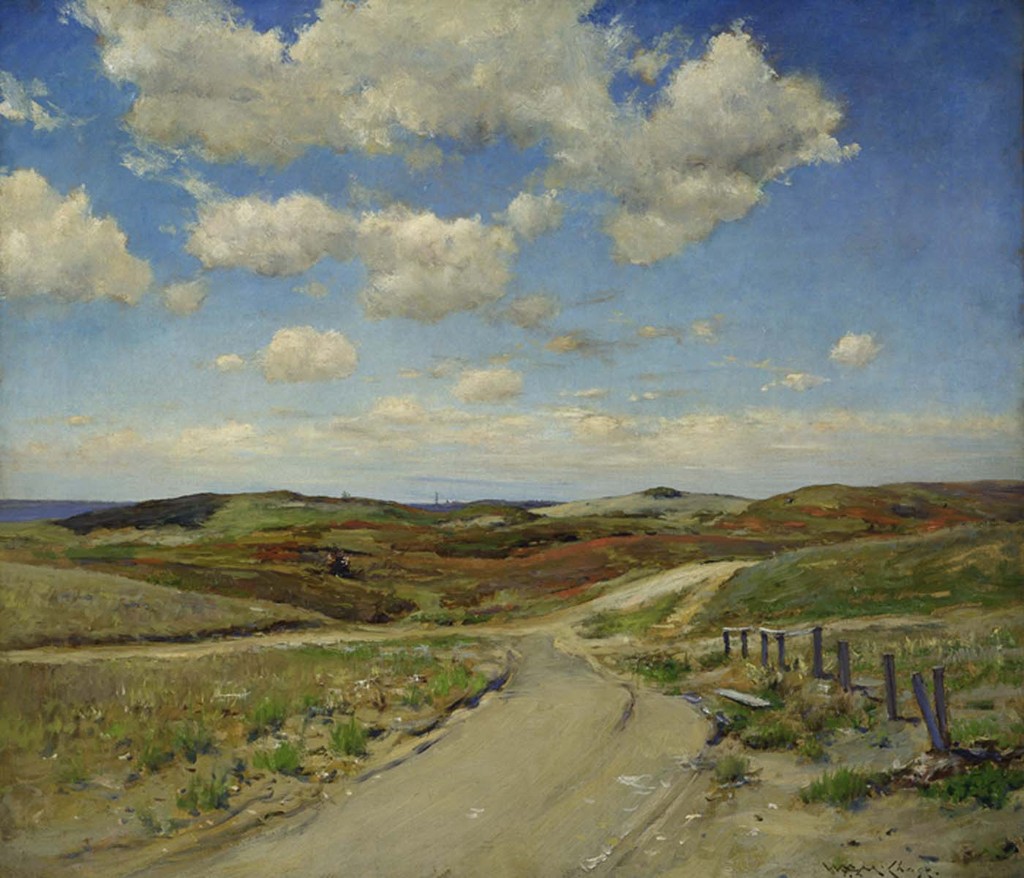
1895Shinnecock Hills
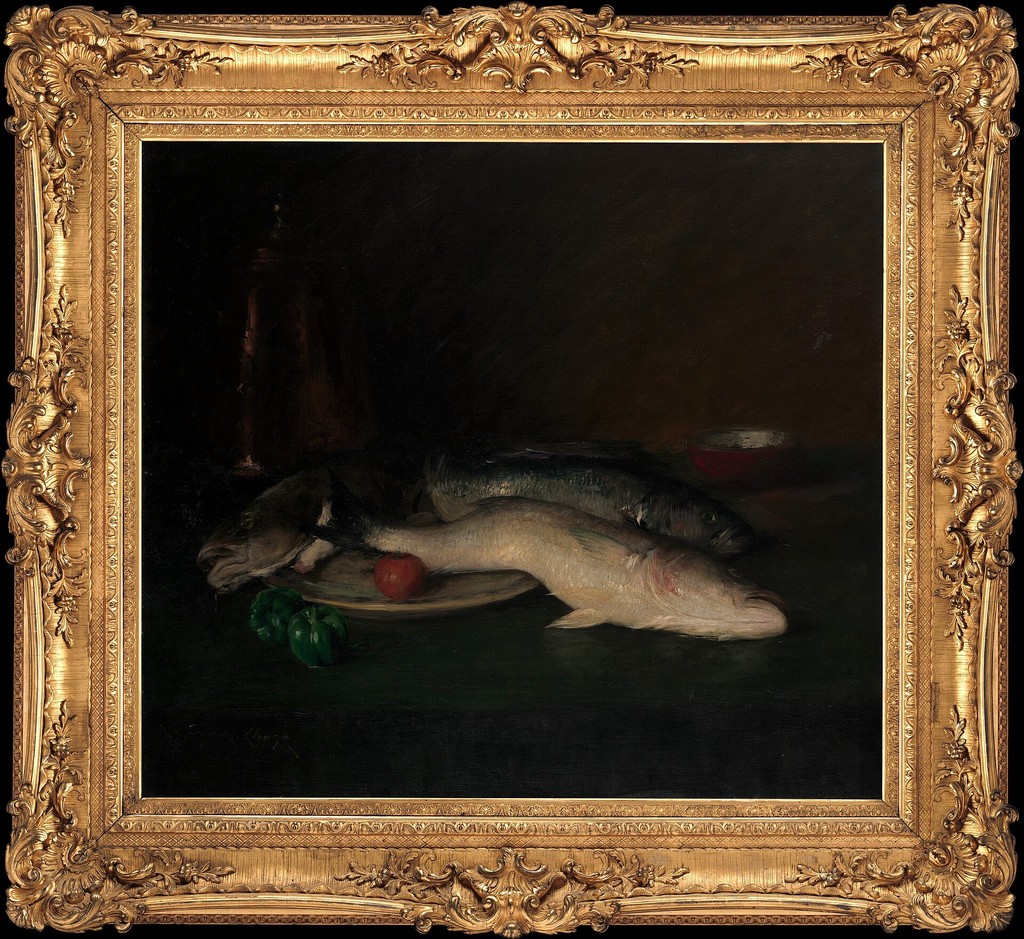
c. 1895Still Life: Fish
by 1908Contents
- Introduction
- First Look: An Asymmetrical Interior
- A Conversation Without a Fixed Story
- Spatial Intervals and Social Distance
- Dress, Colour and Staged Informality
- Pictures, Textiles and the Gilded Mirror
- Shinnecock: House, School and Occupied Land
- Interior Light and the World Outside
- The Painting’s Place in Chase’s Art
- How to Look at A Friendly Call
First Look: An Asymmetrical Interior
Begin with the room rather than the presumed conversation. The sofa extends across most of the middle register, but the women do not occupy it evenly. The visitor sits left of centre, while her companion appears farther right beneath the large mirror. They turn towards each other across a compressed interval of cushions. A broad stretch of sofa continues to the left, and a wicker chair projects into the foreground at right.
That imbalance creates movement without action. The empty sofa draws the eye towards the figures; the chair turns it back into their exchange. Pictures and fabrics accumulate behind them in uneven groups. At right, the mirror opens a deeper space, reflecting windows, more pictures and steps towards a sunlit room. Reflection carries vision beyond the sitting area.[1]
The floor fills almost the lower third of the canvas. Scattered cushions and the parasol interrupt its pale expanse. Their diagonals lead towards the women and make the furnishings look momentarily disturbed. Order and informality coexist in a cultivated room that avoids rigid display.
A Conversation Without a Fixed Story
The National Gallery of Art identifies the woman at right as Chase’s wife, Alice, and describes the woman in white as her visitor.[1] The visitor’s hat, veil, gloves and parasol suggest that she has arrived from outdoors and has not settled for a prolonged stay. Alice holds a flat yellow object in her lap, possibly a hat. These details support the broad situation named by the title, but they do not reveal what the women are saying, how long the visit has lasted or what will follow.
Chase withholds the clues that conventional narrative painting might use to explain an event. Alice is seen in profile. The visitor leans forward and extends one hand towards the cushion between them. It may punctuate speech, invite response or simply steady her pose. The possibilities remain alternatives, not parts of a recoverable anecdote.
The viewer consequently reads the angle of a shoulder, the separation between hands and the direction of each head. Chase establishes sociability without turning the meeting into a dramatic episode.
Spatial Intervals and Social Distance
Although the women face one another, they do not touch. A pink cushion lies between them, and the visitor’s fingertips come to rest near its centre. The gap is narrow enough for intimacy but distinct enough to preserve the formality of a call. Their skirts spread into separate pools of white and yellow, while dark edging and a vertical black ribbon help keep the figures visually apart.
Other intervals repeat this balance. Black and ochre cushions separate the visitor from the blank sofa; dark green upholstery and the chair bound Alice’s side. Above them, the stack of pictures between their heads acts like a hinge, dividing the wall while linking the composition.
Social atmosphere therefore resides in spacing as much as expression. Furniture regulates proximity, clothing distinguishes arrival from reception, and the picture-filled wall supplies a cultural setting. The elements make the visit legible without proving the women’s relationship.
Dress, Colour and Staged Informality
The visitor’s white dress is the brightest mass. Grey, cream and blue touches keep it luminous without describing every fold. Her pale hat nearly merges with the pictures above, while its blue decoration accents her face. The shell-pink parasol carries that brightness towards the floor.
Alice’s striped yellow dress answers the warmer surroundings. Its ochres connect her to the mirror and chair; her black collar, belt and ribbon provide internal structure. White and yellow clarify the figures, while pink, green, red, gold and black travel among clothes, cushions, carpet, hangings and frames.
The scene feels spontaneous and composed at once. Cushions lie on the floor, the chair stands empty and the visitor retains her outdoor accessories, yet every hue is disciplined. A tassel or flower can look incidental while serving as a measured colour note. Chase’s broader paintings and artworks likewise pair responsive handling with deliberate arrangement.
Pictures, Textiles and the Gilded Mirror
The wall is not neutral. Framed images, patterned cloths and divisions of red, cream and brown create unequal rectangles. Their geometry contrasts with curved bodies, cushions, parasol and chair. The National Gallery notes this opposition and relates the mirror reflection to Chase’s admiration for Velázquez’s Las Meninas.[1]
That comparison is an interpretive proposal, not proof of a direct quotation. Visibly, the mirror changes the scene. It reflects neither viewer nor painter, but reveals windows and an adjoining ascent beyond the front plane. Depth is partly constructed from something seen indirectly.
The smaller pictures matter as shapes even when their subjects are indistinct. A Parrish account of Chase’s Shinnecock studio explains how pictures within pictures could join domestic and productive life.[2] Here, displayed art makes looking and arranging part of the household’s identity. The Tenth Street Studio had already turned an interior into self-presentation; this room gives the strategy a lighter domestic register.
Shinnecock: House, School and Occupied Land
Chase painted A Friendly Call during the Shinnecock years. He led the Shinnecock Hills Summer School of Art between 1891 and 1902, combining outdoor work, portrait demonstrations and criticism with painting at his family’s summer house. The Parrish places it on Sugar Loaf Hill, about three miles from the school’s Art Village.[3]
The interior should not be detached from this wider setting. The school and expanding resort community stood on ancestral and present Shinnecock land near the Shinnecock Reservation. Parrish research records continuing relationships between the Chase household, summer colonists and members of the Shinnecock Nation, including exchanges of food, domestic work and other labour.[3][4] These institutional findings establish an occupied social landscape beyond the pictured room; they do not authorise assumptions about the visitor’s identity or make the painting a record of all those relationships.
A Friendly Call shows privileged comfort inside one summer house, not the full network that sustained the colony. The account of Shinnecock landscapes and teaching restores that history, while Shinnecock Hills shows Chase organising the land as a different pictorial experience.
Interior Light and the World Outside
Outdoors enters through objects and illumination rather than a landscape view. Hat, gloves and parasol mark a passage across the threshold. In the mirror, windows admit pale light and steps rise towards another bright area, connecting the room to movement beyond it.
Light also distinguishes surfaces. It spreads softly across the floor and white dress, catches the mirror’s gold frame, and flashes on the pictures’ mounts. Darker brown wall panels and green upholstery hold the figures in place. Chase does not dissolve everything into a single atmospheric effect: colour remains anchored to the room’s structure.
The combination complicates a simple Impressionist label. Responsive brushwork and ordinary subject matter matter, but so do tonal contrasts and geometry. His portraiture also joins vivid surfaces to controlled presentation. Here, light makes spatial intervals easier to feel.
The Painting’s Place in Chase’s Art
The 1895 date makes this a revealing hinge in Chase’s career. That year he gave up his celebrated Tenth Street space, while his Shinnecock summers continued. The National Gallery records that A Friendly Call received the Shaw Fund prize at the Society of American Artists’ annual exhibition and entered Samuel T. Shaw’s collection before passing to Chester Dale and, in 1943, to the Gallery.[1]
Its exhibition history confirms a finished public statement, not merely a private family record. Yet the subject remains quiet: two people, a furnished room and an unresolved pause. Colouristic immediacy sits within repeated rectangles, directional objects and rationed gaps.
Within William Merritt Chase’s wider career, the picture connects sociable space, display, dress, domestic life and the boundary between observation and staging. The visit feels caught in passing, but its naturalness has been built.
How to Look at A Friendly Call
Trace the room’s rectangles: sofa, wall divisions, frames and mirror. Then follow the curves of skirts, chair arms, cushions and parasol, noticing where these systems meet. The furnishings are active shapes, not mere decoration.
Finally, separate observation from inference. Outdoor dress, Alice’s turned pose and rich furnishings are visible. A courteous call is a reasonable reading; the conversation and visitor’s name remain unknown. Chase sustains attention by leaving that difference intact.
Researched works directory
This searchable evidence census contains 208 distinct records assembled from public collection data and a reproducible Wikidata snapshot. It is not a catalogue raisonné, not a claim of complete oeuvre coverage, and it keeps works with repeated titles as separate objects.
| Name | Date | Medium |
|---|---|---|
| A City Park | 1887 | Painting |
| A Corner of My Studio | Date unknown | Painting |
| A Dutch Landscape | 1884 | Painting |
| A Friendly Call | 1895 | Painting |
| A Gray Day | 1886 | Painting |
| A Modern Magdalen | 1888 | Painting |
| A Spanish Gypsy | 1905 | Painting |
| Albert Harkness (1822–1907) | 1908 | Painting |
| Alice | 1892 | Painting |
| An Afternoon Stroll | 1895 | Painting |
| An English Cod | 1904 | Painting |
| At the Seaside | 1890 | Painting |
| August B. Loeb | 1905 | Painting |
| Baron Hugo von Habermann | 1875 | Painting |
| Beach | 1895 | Painting |
| Bessie Potter | 1895 | Painting |
| Big Copper Kettle and Fish (Fish) | Date unknown | Painting |
| Bildnis Hugo von Habermann | 1875 | Painting |
| Brass Kettle and Catfish | Date unknown | Painting |
| Carmencita | 1890 | Painting |
| Courtyard in Venice | 1877 | Painting |
| Crucifixion | 1875 | Painting |
| Der japanische Holzschnitt | 1888 | Painting |
| Dieudonnée | 1899 | Painting |
| Dorothy | 1902 | Painting |
| Dr. Eduardo San Giovanni | 1906 | Drawing |
| Duveneck Painting "The Turkish Page | 1876 | Painting |
| Edward Everett Hale (1822-1909) | 1884 | Painting |
| Edward Guthrie Kennedy | 1895 | Painting |
| Edward Steichen | 1903 | Painting |
| Female Figure Study (front view) | Date unknown | Painting |
| Female Figure Study (side view) | Date unknown | Painting |
| First Touch of Autumn | 1898 | Painting |
| Fish | 1910 | Painting |
| Fish and Still Life | 1906 | Painting |
| Fish and Still Life | 1908 | Painting |
| Florence | 1907 | Painting |
| For the Little One | 1896 | Painting |
| Garden of the Orphanage, Haarlem, Holland | 1883 | Painting |
| Gathering Autumn Flowers | 1894 | Painting |
| Gathering Flowers, Shinnecock, Long Island | 1897 | Drawing |
| Girl at a Bureau | Date unknown | Painting |
| Girl in a Japanese Costume | 1890 | Painting |
| Girl in Ciociaro costume | 1876 | Painting |
| Girl in White | 1890 | Painting |
| Girl with Doll | 1910 | Painting |
| Gray Day on the Bay | 1886 | Painting |
| Gray Day on the Lagoon | 1913 | Painting |
| Harbor Scene, Brooklyn Dock | 1886 | Painting |
| Harriet Hubbard Ayer | 1880 | Painting |
| Head of a Man | 1875 | Painting |
| Hide and Seek | 1888 | Painting |
| I Think I'm Ready Now | 1883 | Painting |
| Idle Hours | 1894 | Painting |
| In the Park (A By-path) | 1889 | Painting |
| In the Studio Corner | 1881 | Painting |
| In Venice | 1877 | Painting |
| James Abbott McNeill Whistler | 1885 | Painting |
| John Butler Talcott | 1900 | Painting |
| Just Onions (Onions; Still Life) | Date unknown | Painting |
| Keying Up" - The Court Jester | 1875 | Painting |
| Keying Up: The Court Jester | 1875 | |
| L'Éventail de plumes | Date unknown | Painting |
| Lady in Black | 1888 | Painting |
| Lady Playing Guitar | Date unknown | Painting |
| Landscape- Shinnecock, Long Island | 1896 | Painting |
| Long Island Landscape after a Shower of Rain (After the Shower) | 1889 | Painting |
| Lydia Field Emmet | 1892 | Painting |
| Man Wearing Gold Rimmed Glasses | 1892 | Painting |
| Marine | 1888 | Painting |
| Monkeying with Literature | 1877 | Painting |
| Moses Swaim | Date unknown | Painting |
| Mother and Child (The First Portrait) | 1887 | Painting |
| Mrs. Charles Scott | Date unknown | Painting |
| Mrs. Chase | 1890 | Painting |
| Mrs. Chase in Prospect Park | 1886 | Painting |
| Mrs. William Clark | 1915 | Painting |
| Mrs. William Merritt Chase | 1890 | Painting |
| My Little Daughter Dorothy | 1894 | Painting |
| My Palette | 1875 | Painting |
| Myra Reynolds | 1898 | Painting |
| Near the Beach, Shinnecock | 1895 | Painting |
| Near the Beach, Shinnecock | Date unknown | Painting |
| North River Shad | 1910 | Painting |
| Nude | 1901 | Painting |
| Open Air Breakfast | 1888 | Painting |
| Outskirts of Madrid | 1882 | Painting |
| Pablo de Sarasate: Portrait of a Violinist | 1875 | Painting |
| Park Bench | 1890 | Painting |
| Peace, Fort Hamilton | 1888 | Painting |
| Pink Azalea—Chinese Vase | 1885 | Painting |
| Portrait Head | 1882 | Painting |
| Portrait of a Boy in Van Dyck Costume | 1875 | Painting |
| Portrait of a Child | 1884 | Painting |
| Portrait of a Lady in Black | 1895 | Painting |
| Portrait of a Lady in Black (Annie Traquair Lang) | 1911 | Painting |
| Portrait of a Lady in Pink | Date unknown | Painting |
| Portrait of a Man | 1874 | Painting |
| Portrait of a Man | 1875 | Painting |
| Portrait of a Woman | Date unknown | Painting |
| Portrait of Artist Beck Wenzell | 1900 | Painting |
| Portrait of Baroness Ida-Gro van Dahlerup | 1907 | Painting |
| Portrait of Dora Wheeler | 1882 | Painting |
| Portrait of Lavinia Borden Cook | Date unknown | Painting |
| Portrait of Louis Betts | Date unknown | Painting |
| Portrait of Master Otis Barton and his Grandfather | 1903 | Painting |
| Portrait of Miss D. | Date unknown | Painting |
| Portrait of Mrs. C. (Lady with a White Shawl) | 1893 | Painting |
| Portrait of Mrs. George B. Ely (Caroline Boies Ely) | Date unknown | Painting |
| Portrait of My Daughter Alice | 1895 | Painting |
| Portrait of My Father (David Hester Chase) | Date unknown | Painting |
| Portrait of My Mother (Sarah Swaim Chase) | 1892 | Painting |
| Portrait of William Francklyn Paris | Date unknown | Painting |
| Portrait of William Gurley Munson | 1868 | Painting |
| Ready for the Ride | 1877 | Painting |
| Red Snapper | Date unknown | Painting |
| Robert Frederick Blum | Date unknown | Painting |
| Roland | 1902 | Painting |
| Roses | 1883 | Drawing |
| Seaside Flowers | 1897 | Painting |
| Selbstbildnis | 1875 | Painting |
| Selbstporträt | 1915 | Painting |
| Self-Portrait | 1909 | Drawing |
| Self Portrait | 1914 | Painting |
| Self-Portrait | 1915 | Painting |
| Self-portrait dressed as Johan Claesz Loo by Frans Hals | 1903 | Painting |
| Seventeenth Century Lady | 1895 | Painting |
| Shell Beach at Shinnecock | 1892 | Painting |
| Shinnecock Hills | 1892 | Painting |
| Shinnecock Hills | 1893 | Painting |
| Shinnecock Hills | 1895 | Painting |
| Shinnecock Hills | 1895 | Painting |
| Shinnecock Hills Landscape | 1890 | Painting |
| Shinnecock Studio Interior | 1892 | Drawing |
| Sketch for a Picture--Columbus before the Council of Salamanca (A) (Christopher Columbus before the Council of Salamanca) | 1876 | Painting |
| Sketch for a Picture--Columbus before the Council of Salamanca (B) (Christopher Columbus before the Spanish Council) | 1876 | Painting |
| Sketch of a Child:Helen | 1898 | Painting |
| St. Jerome | 1875 | Painting |
| Still Life | 1912 | Painting |
| Still Life | Date unknown | Painting |
| Still Life | Date unknown | Painting |
| Still Life | Date unknown | Painting |
| Still Life (Brass Bowl) | Date unknown | Painting |
| Still Life (Brushes, Books and Pottery) | 1904 | Painting |
| Still Life: Fish | 1900 | Painting |
| Still Life: Fish | 1903 | Painting |
| Still Life: Fish | 1908 | Painting |
| Still Life: Fish | 1912 | Painting |
| Still-life: Fish and Bowl | 1895 | Painting |
| Still Life (Fruit and Copper Pot) | Date unknown | Painting |
| Still Life (Fruit and Pottery) | Date unknown | Painting |
| Still Life--Striped Bass | 1907 | Painting |
| Still Life with Fish | 1800 | Painting |
| Still Life with Fish | 1910 | Painting |
| Still Life with Fish | 1912 | Painting |
| Still Life with Fish | Date unknown | Painting |
| Still life with fruit | 1871 | Painting |
| Still Life with Hummingbird | 1870 | Painting |
| Still Life with Watermelon | 1869 | Painting |
| Studio Interior | 1882 | Painting |
| Study Head | Date unknown | Painting |
| Study of a Girl in Japanese Dress | 1895 | Painting |
| Study of a Young Woman | 1883 | Painting |
| Study of Flesh Color and Gold | 1888 | Drawing |
| Summer at Shinnecock Hills | 1891 | Painting |
| Sunlight and Shadow, Shinnecock Hills | 1893 | Painting |
| Tenth Street Studio | 1880 | Painting |
| Terrace at the Mall | 1890 | Painting |
| Terrace, Prospect Park | 1887 | Drawing |
| The Antiquary Shop | 1879 | Painting |
| The Apprentice (Boy with Apple) | 1876 | Painting |
| The Big Brass Bowl | Date unknown | Painting |
| The Blue Kimono | 1915 | Painting |
| The Boat Harbor (Gowanus Pier) | 1888 | Painting |
| The Coast of Holland | 1884 | Painting |
| The Emerald Lady | Date unknown | Painting |
| The Family Cow (Calf's Head) | 1869 | Painting |
| The Keynote | 1915 | Painting |
| The Kimono | 1895 | Painting |
| The Mirror | 1900 | Painting |
| The Model | 1888 | Drawing |
| The Moorish Warrior | 1878 | Painting |
| The Old Road to the Sea | 1893 | Painting |
| The Patrician | 1875 | Painting |
| The Song | 1907 | Painting |
| The Stately Model | 1898 | Painting |
| The Tenth Street Studio | 1880 | Painting |
| The Tow Path | 1880 | Painting |
| The Turkish Page (Unexpected Intrusion) | 1876 | Painting |
| The Whistling Boy | 1875 | Painting |
| The Wounded Poacher | 1878 | Painting |
| The Yield of the Waters | 1878 | Painting |
| The Young Orphan | 1884 | Painting |
| Thomas E. Kirby | 1900 | Painting |
| Thomas Moran | Date unknown | Painting |
| Under a French Sky | 1882 | Painting |
| Venetian Lace Making | Date unknown | Drawing |
| View from Central Park | 1889 | Painting |
| View near Polling | 1875 | Painting |
| William A. Clark | 1915 | Painting |
| William Andrews Clark | 1915 | Painting |
| William Nimick Frew | 1915 | Painting |
| William Rockhill Nelson | 1907 | Painting |
| Wind-Swept Sands | 1894 | Painting |
| Woman in White | 1902 | Painting |
| Woman Seated | 1885 | Drawing |
| Woman Standing in a Landscape | Date unknown | Painting |
| Worthington Whittredge | 1890 | Painting |
Frequently Asked Questions
Chase painted it in 1895, during his Shinnecock period. The dated signature appears at the lower left, and the National Gallery records its first exhibition and Shaw Fund prize in that year.[1]
It is oil on canvas and measures 76.5 × 122.5 cm. The National Gallery of Art’s accession number is 1943.1.2.[1]
The National Gallery identifies the seated woman at right as Chase’s wife, Alice. It describes the woman in white as a visitor but does not give her a name, so a more specific identity would exceed the registered evidence.[1]
The Gallery locates it in Chase’s summer house at Shinnecock Hills, Long Island. The house formed part of the family setting in which Chase also maintained a studio while directing the nearby summer school.[1][3]
It opens a second spatial field by reflecting windows, pictures and steps behind the viewer’s implied position. The Gallery also suggests a possible homage to Velázquez’s Las Meninas, but the mirror’s compositional effect is visible whether or not that relationship is accepted.[1]
Discussion
Use this evidence-led guide as a starting point for close looking rather than a final verdict.
Share an observation about A Friendly Call or a source that adds useful context.
Reader Insights
Which visible detail most changes your reading of A Friendly Call?
How do medium, scale, setting and current museum evidence shape the encounter?
What remains uncertain once documented fact is separated from visual inference?
Join the Conversation
Add your reading below, keeping observations specific and evidence clear.
References
- A Friendly Call — National Gallery of Art, accessed 31 August 2026, accessed 31 August 2026.
- Pictures in Pictures — Parrish Art Museum, accessed 31 August 2026, accessed 31 August 2026.
- William Merritt Chase: The Shinnecock Years — Parrish Art Museum, accessed 31 August 2026, accessed 31 August 2026.
- William Merritt Chase and His Neighbors — Parrish Art Museum, accessed 31 August 2026, accessed 31 August 2026.