 by Tom Gurney
Tom Gurney BSc (Hons) is an art history expert with over 20 years experience
Page Created on August 31, 2026 / Page Updated on November 6, 2026
Email: tomgurney1@gmail.com / Phone: +44 7429 011000
William Merritt Chase Biography: Introduction
William Merritt Chase built a career around contrasts: Munich darkness and outdoor light, theatrical studios and public parks, formal portraits and freshly worked pastels. Born in Indiana and established in New York, he became both a widely exhibited painter and a prominent teacher. His biography is therefore not a straight march towards Impressionism, but the story of an artist who kept several visual languages in active use.
At a Glance
- Born1 November 1849, Williamsburg, Indiana
- Died25 October 1916, New York City
- Early trainingBarton S. Hays in Indianapolis and the National Academy of Design in New York
- European studyMunich from 1872, followed by work in Venice
- Major teaching settingsArt Students League, Brooklyn Art Association, Shinnecock Hills, Chase School of Art and Pennsylvania Academy of the Fine Arts
- Known forportraits, still lifes, studio interiors, urban park scenes, Shinnecock landscapes, oils and pastels
William Merritt Chase in context
Munich School
c. 1850–1900Aesthetic Movement
c. 1860–1900American Impressionism
c. 1885–1920Ten American Painters
1898–1919James McNeill Whistler
1834–1903Frank Duveneck
1848–1919William Merritt Chase
1849–1916John Henry Twachtman
1853–1902John Singer Sargent
1856–1925Childe Hassam
1859–1935Keying Up – The Court Jester
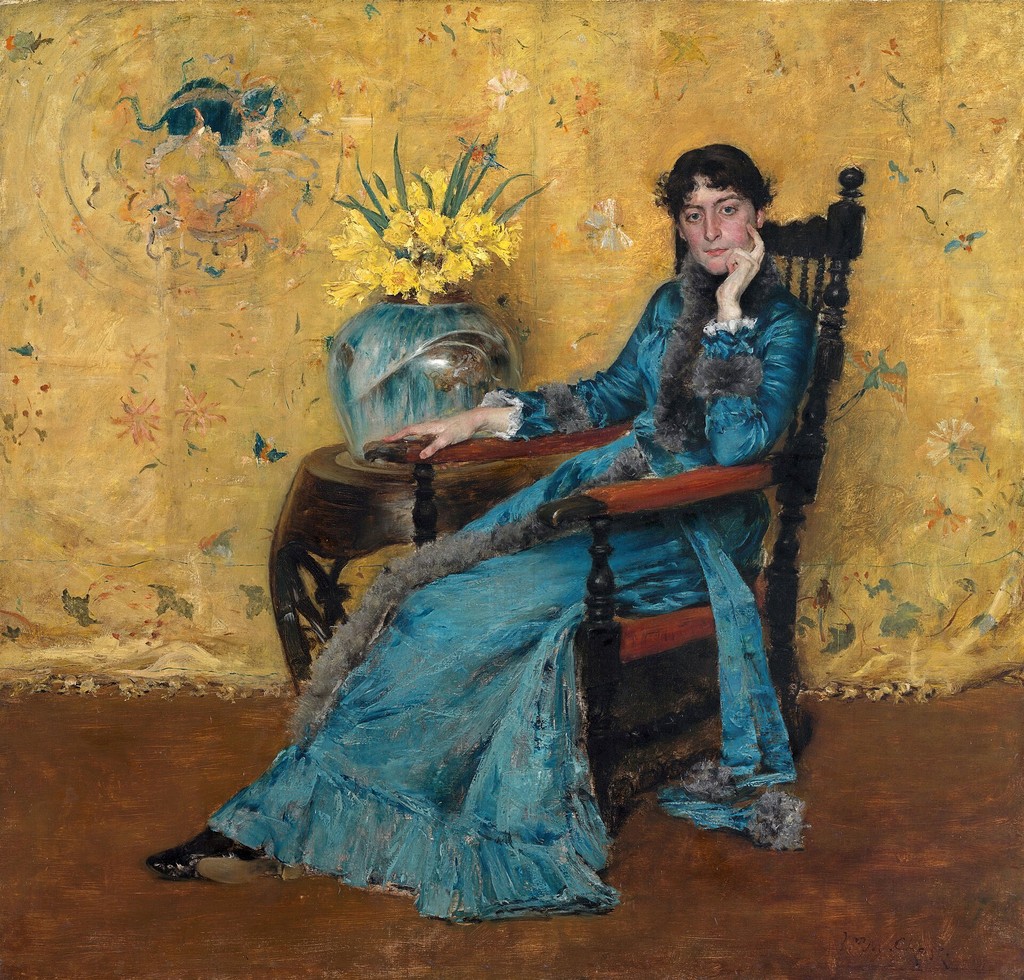
1875Portrait of Dora Wheeler
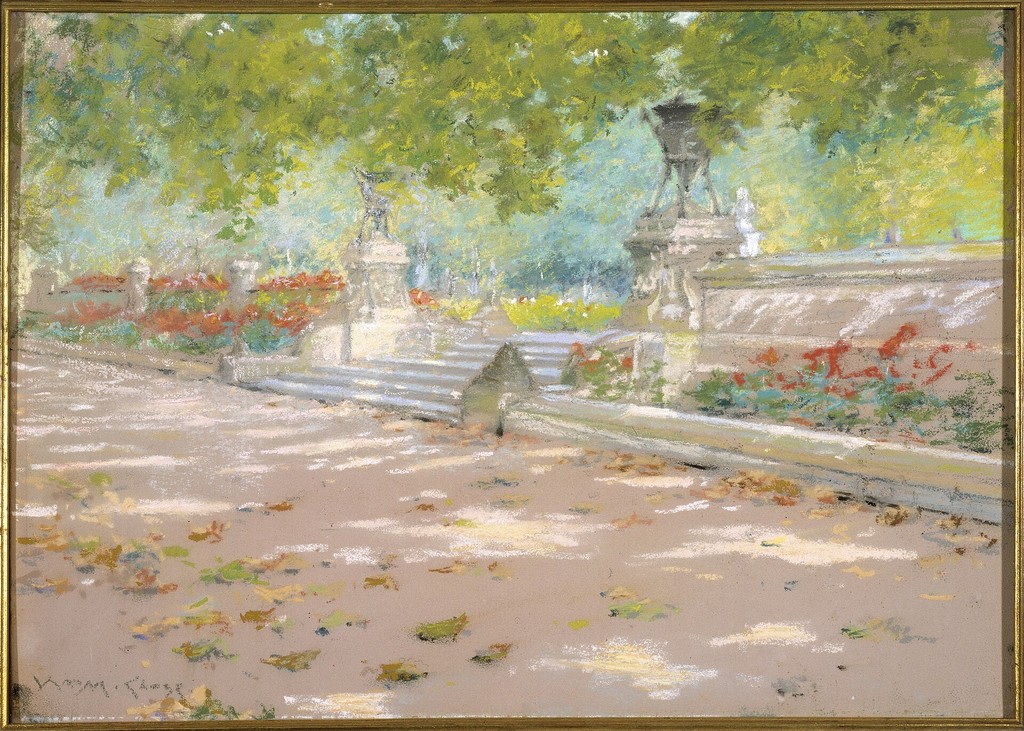
1882–83Terrace, Prospect Park
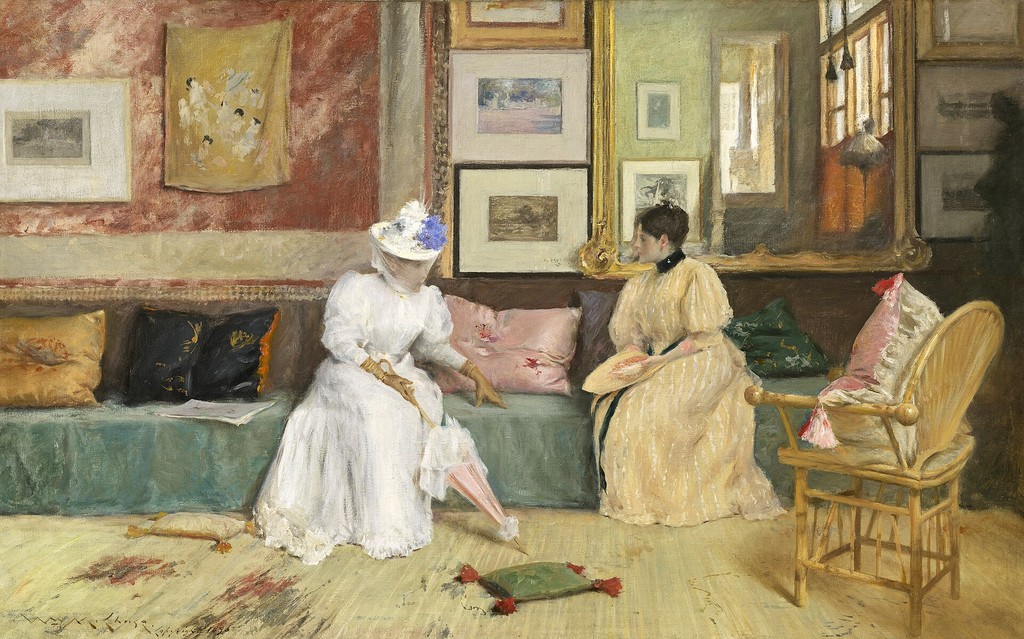
c. 1887A Friendly Call
1895Shinnecock Hills
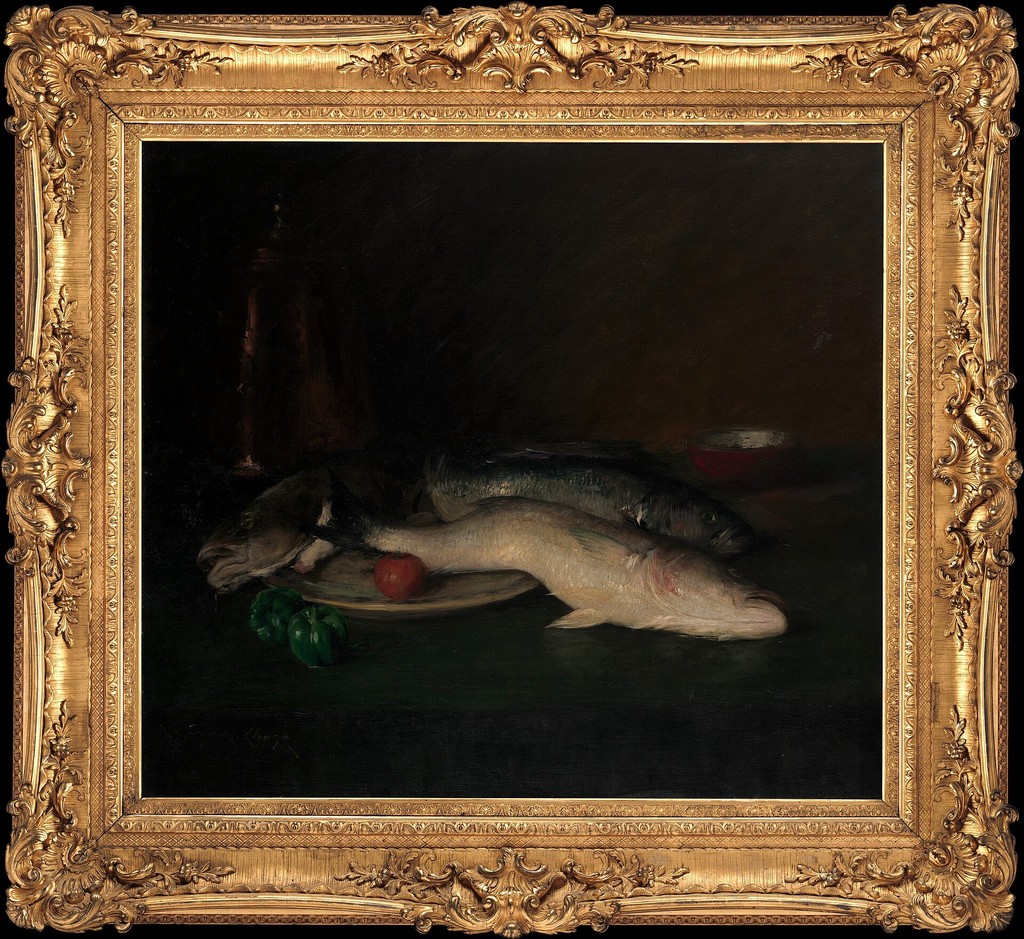
c. 1895Still Life: Fish
by 1908Contents
- Introduction
- Indiana, New York and St Louis
- Munich Training and the Venetian Interlude
- The Art Students League and Tenth Street
- Marriage, Family and a Broader Range of Subjects
- Shinnecock Hills, 1891–1902
- Schools, Classrooms and Artistic Independence
- International Exchange, the Ten and the Late Career
- Death and a Plural Legacy
Indiana, New York and St Louis
Chase was the eldest of six children born to the family of a shoe merchant. His first sustained artistic training came in Indianapolis with Barton S. Hays. In 1869 he moved to New York, studied with Joseph Oriel Eaton and enrolled at the National Academy of Design. Financial difficulties interrupted that period, and Chase joined his family in St Louis, where he found professional work painting still lifes.[1]
St Louis also provided the decisive opening for study abroad. A group of local businessmen recognised his ability and agreed to support further training in Europe. Their patronage enabled him to leave in 1872 for Munich, then an important destination for American painters who wanted rigorous academic study without following the more common route to Paris. This movement from provincial beginnings to metropolitan institutions established a pattern that would recur throughout his life: formal instruction, ambitious self-presentation and practical attention to earning a living were closely connected.
Munich Training and the Venetian Interlude
Chase entered Munich’s Royal Academy in 1872. There he encountered a tradition of vigorous brushwork, strong light–dark contrasts and close study of painters such as Frans Hals and Peter Paul Rubens. The resulting pictures often use deep browns and blacks, with bright passages made to emerge sharply from shadow. His 1875 “Keying Up” — The Court Jester brought that Munich manner to an American audience and helped establish his reputation.[1]
The experience did not confine him to one permanent style. Munich supplied techniques that Chase could revive whenever a portrait, still life or studio interior required concentrated tonal drama. His later lightening of colour was an addition to this repertoire, not the cancellation of his early training. That continuity is central to understanding Chase’s path from Munich to Tenth Street.
Before returning to the United States, he worked in Venice among other American artists, including Frank Duveneck and John Twachtman. Venice encouraged an international exchange of methods and subjects, while the company of fellow painters strengthened networks that later mattered in New York. Chase returned to New York in 1878, bringing with him both academic credentials and the social confidence of an artist who had worked within European circles.[1][2]
The Art Students League and Tenth Street
Soon after his 1878 return, Chase began teaching at the recently founded Art Students League. He would teach there until 1896, the first long chapter in a career that also included the Brooklyn Art Association, the Pennsylvania Academy of the Fine Arts and schools bearing his own name. An archival finding aid records not only these posts but surviving lecture notes, student recollections and letters of thanks, evidence that teaching was a sustained part of his professional identity rather than a late supplement to painting.[2]
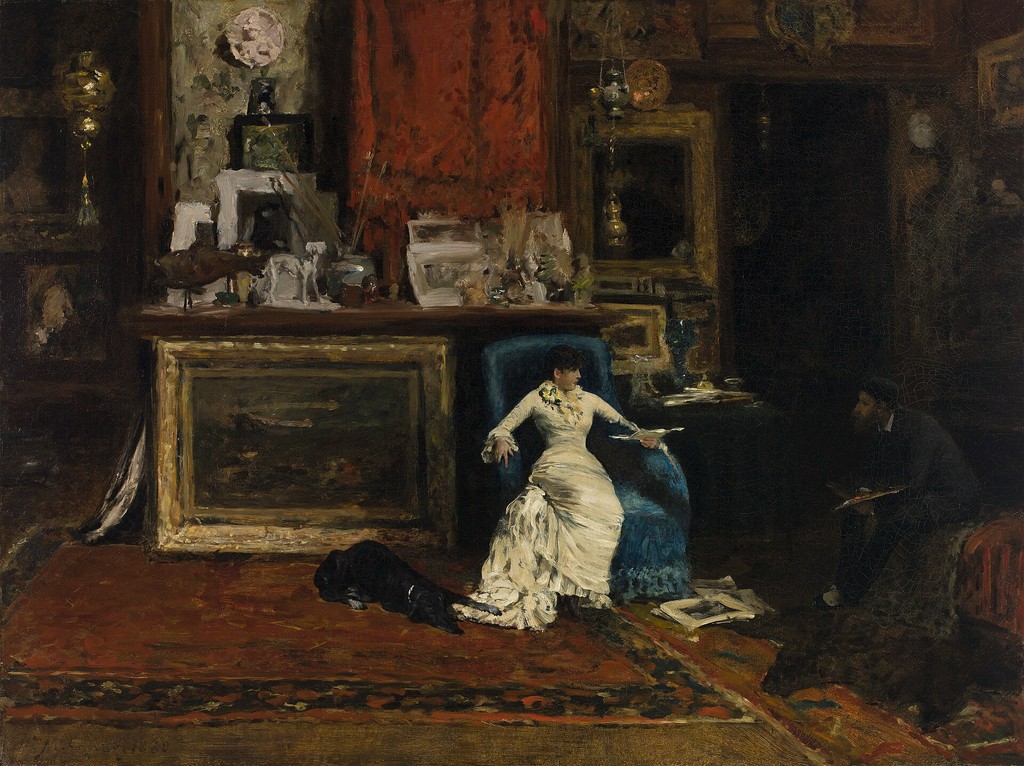
Chase also took space in the Tenth Street Studio Building. He eventually occupied its great gallery, previously associated with Albert Bierstadt, and filled it with paintings, textiles, metalwork, furniture and other collected objects. Visitors encountered a carefully arranged environment in which art-making, display and sociability overlapped. The Tenth Street Studio records that setting in 1880, but the room itself also served as a meeting place for artists, students and patrons. Chase gave up the costly space in 1895.[1][2]
His public roles expanded alongside the studio. He was active in the Society of American Artists and served as its president from 1885 to 1895. The organisation offered a prominent exhibition platform outside the older National Academy system. Chase’s involvement joined institutional leadership to a visible metropolitan persona: he could teach, exhibit, entertain and seek portrait commissions within overlapping New York art worlds.
Marriage, Family and a Broader Range of Subjects
In 1886 Chase married Alice Gerson, a family friend who had modelled for him. Alice and the couple’s children became recurring presences in portraits, interiors, garden scenes and landscapes. These images brought domestic experience into his art, yet they were not casual family snapshots. Clothing, furnishings, poses and carefully selected settings allowed Chase to examine modern social identity through compositional arrangement and paint handling.[3]
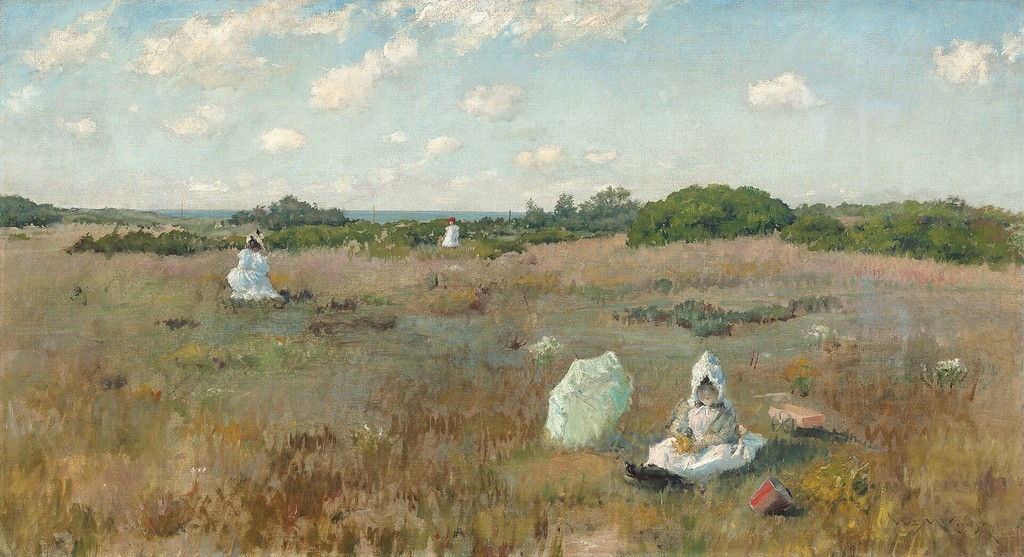
During the 1880s he also worked increasingly in the open air. The New York park scenes shifted attention towards Prospect Park, Central Park and ordinary urban leisure. Small formats, cropped views and lighter colour answered the visual conditions of public space without erasing the darker tonal structures still present in his portraiture and still-life paintings. The different subjects coexisted.
Pastel was equally important to this expansion. Chase treated it as a finished, painterly medium capable of soft atmosphere, decisive colour and immediate surface effects. With Robert Frederick Blum, he helped found the Society of Painters in Pastel, promoting wider acceptance of the medium in the United States.[3] Works such as Terrace, Prospect Park show why his pastels and works on paper should not be reduced to preparation for oil paintings.
Shinnecock Hills, 1891–1902
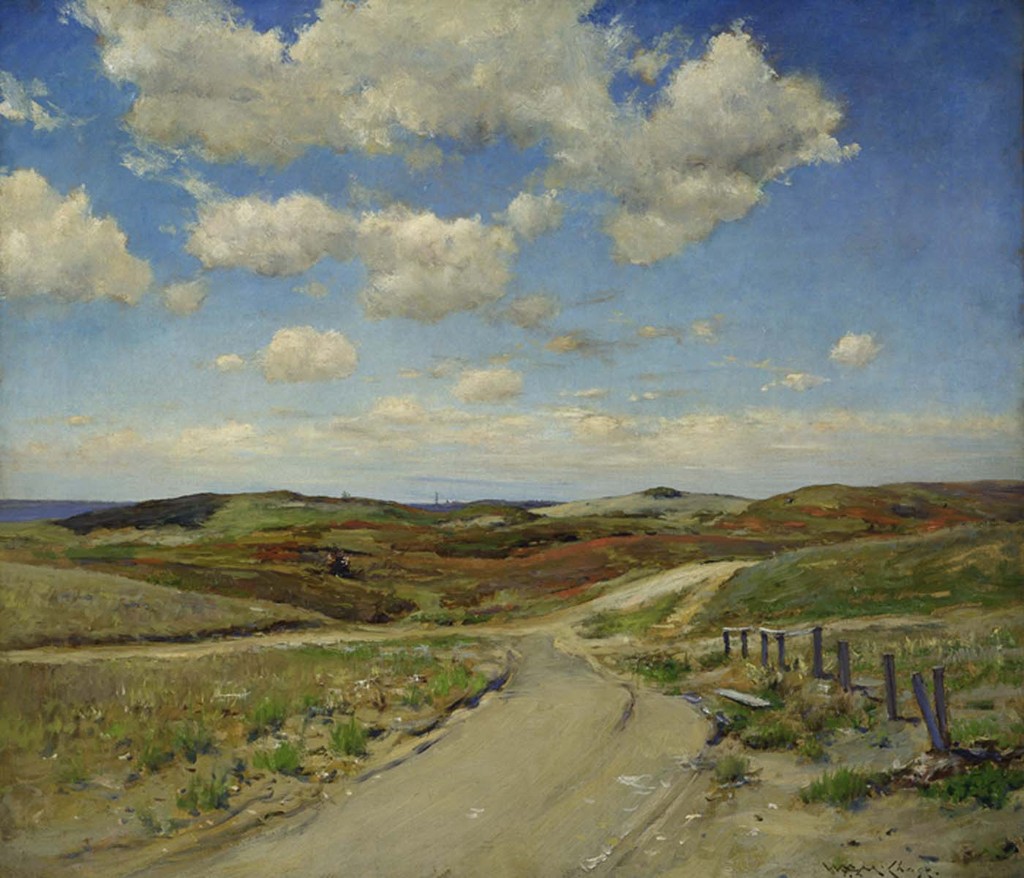
Chase first went to Shinnecock Hills in 1891 at the invitation of Jane Ralston Hoyt, who was developing a summer art academy in connection with a new resort and real-estate venture. He became founding director of the Shinnecock Hills Summer School of Art and taught there through 1902. Classes combined outdoor painting, portrait demonstrations and critiques, while Chase also worked independently and spent summers with his growing family.[4]
The school and summer colony occupied ancestral and present Shinnecock land. The nearby Shinnecock Reservation was not outside the colony’s history: Parrish Art Museum research documents relationships between Nation members, the Chase family and the school community, including paid work, guiding and the making of portraits. That evidence changes how the familiar landscapes are read. Their open roads, grasses and broad skies do not represent an unpeopled territory; they are selective views made within a place of continuing Indigenous presence and colonial development.[4]
Chase’s Shinnecock pictures often employ a higher horizon, broken colour and open-air brightness, yet no single formula defines them. Shinnecock Hills presents a road threading through cultivated-looking bands of land, while domestic interiors connect the summer house to studio practice and family life. The Shinnecock landscapes and teaching years brought artistic production, instruction and the economics of a summer colony into the same setting.
Schools, Classrooms and Artistic Independence
Chase taught at the Brooklyn Art Association in 1887 and again from 1891 to 1896. In 1896 he opened the Chase School of Art in Manhattan, conceived as an alternative model of advanced training; under later management it became the New York School of Art. He also taught at the Pennsylvania Academy of the Fine Arts from 1896 to 1909.[2] Together with the Art Students League and Shinnecock, these posts gave his instruction an unusually wide institutional reach.
Lists of famous pupils can obscure what the surviving evidence actually supports. The archive includes lecture material and collective letters from students at Shinnecock and the Art Students League, but it does not turn every enrolment into a documented personal mentorship. What can be said securely is that Chase advocated close looking, technical command and individual artistic judgement across several schools. The later diversity of artists who passed through those institutions is consistent with instruction that did not demand one fixed Chase style.
International Exchange, the Ten and the Late Career
Chase’s artistic contacts remained international. In London in 1885 he painted James McNeill Whistler, adapting the muted palette, fluid handling and ambiguous space associated with Whistler’s own portraits. The episode demonstrates admiration and exchange, although the relationship later deteriorated.[5] Chase also engaged with the example of John Singer Sargent. Such encounters belonged to an eclectic practice in which borrowing could be deliberate, visible and transformed for a new subject.
In 1902, after John Twachtman’s death, Chase joined the Ten American Painters and continued to exhibit with the group.[3] Membership aligned him with artists associated with modern outdoor painting, but his work still ranged across interiors, formal likenesses and bravura fish still lifes. A major retrospective has consequently framed his achievement through stylistic experiment, multiple media and international context rather than a single school.[6]
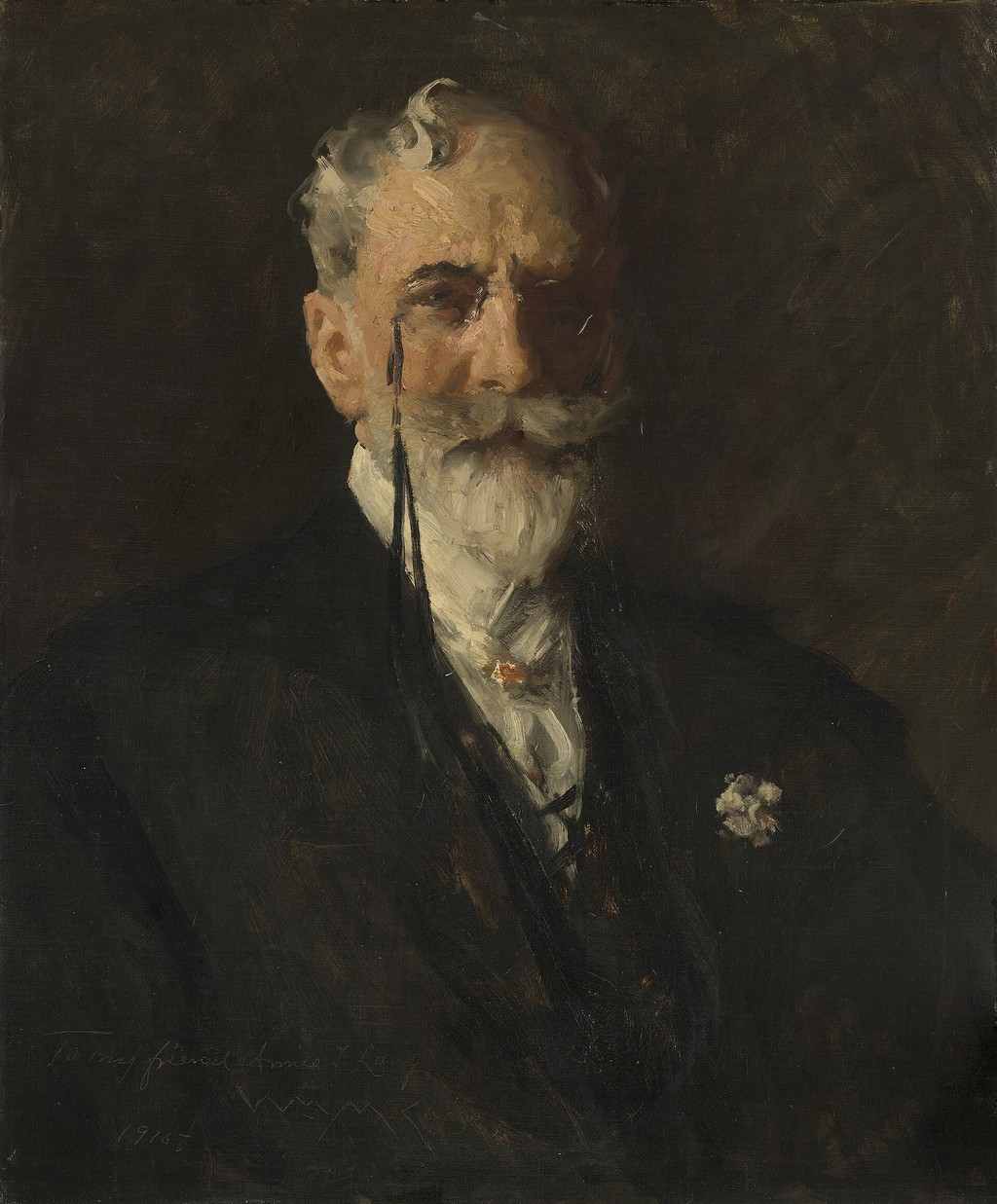
Teaching, travel and exhibition continued into his final years. The 1915 Self-Portrait at the National Gallery of Art shows the ageing artist in dark clothing, with a white flower and the right side of his face receding into shadow. Its loose handling and concentrated tonal design bring late self-presentation into contact with the resources he had first developed in Munich. The painting, accession 2014.136.15, was made only a year before his death.[7]
Death and a Plural Legacy
Chase died in New York City on 25 October 1916, shortly before his sixty-seventh birthday. By then his career had linked Midwestern beginnings, European academies, New York exhibition culture, Long Island summers and decades of classroom work. His influence cannot be measured only by resemblance between his pictures and those of particular students; it also lies in the institutions, habits of looking and professional networks through which he taught.[2][3]
The paintings resist a tidy sequence from dark realism to bright Impressionism. Munich tonalities remained available in late portraits and still lifes, while lighter colour entered parks, pastels and Shinnecock views. Studio display, domestic life and outdoor observation likewise overlapped. Chase’s enduring subject was not one place or manner, but the act of making a modern artistic life from many traditions.
Follow William Merritt Chase's career through four stages
Indiana, New York, St Louis and Munich
Early lessons in Indianapolis and New York led to professional still-life work in St Louis and patron-supported study at the Munich Royal Academy. Dark tonal structures, vigorous handling and old-master study remained durable resources after Chase returned to New York in 1878.
Teaching, display and a public artistic identity
Chase began teaching at the Art Students League and made the Tenth Street Studio Building both workplace and social setting. Portraits, interiors and carefully staged display established a cosmopolitan public identity without limiting his practice to one subject or manner.
Open air, pastel, family and summer teaching
New York park scenes and painterly pastels joined the Shinnecock landscapes and summer school. From 1891 to 1902 Chase taught on ancestral and present Shinnecock land within a growing summer-colony economy, while family and working life entered both interiors and open-air pictures.
The Ten, international schools and persistent range
After joining the Ten American Painters in 1902, Chase continued exhibiting and teaching through several institutions and summer programmes. Late portraits and fish still lifes retained controlled tonal force alongside lighter landscape and pastel practices.
Researched works directory
This searchable evidence census contains 208 distinct records assembled from public collection data and a reproducible Wikidata snapshot. It is not a catalogue raisonné, not a claim of complete oeuvre coverage, and it keeps works with repeated titles as separate objects.
| Name | Date | Medium |
|---|---|---|
| A City Park | 1887 | Painting |
| A Corner of My Studio | Date unknown | Painting |
| A Dutch Landscape | 1884 | Painting |
| A Friendly Call | 1895 | Painting |
| A Gray Day | 1886 | Painting |
| A Modern Magdalen | 1888 | Painting |
| A Spanish Gypsy | 1905 | Painting |
| Albert Harkness (1822–1907) | 1908 | Painting |
| Alice | 1892 | Painting |
| An Afternoon Stroll | 1895 | Painting |
| An English Cod | 1904 | Painting |
| At the Seaside | 1890 | Painting |
| August B. Loeb | 1905 | Painting |
| Baron Hugo von Habermann | 1875 | Painting |
| Beach | 1895 | Painting |
| Bessie Potter | 1895 | Painting |
| Big Copper Kettle and Fish (Fish) | Date unknown | Painting |
| Bildnis Hugo von Habermann | 1875 | Painting |
| Brass Kettle and Catfish | Date unknown | Painting |
| Carmencita | 1890 | Painting |
| Courtyard in Venice | 1877 | Painting |
| Crucifixion | 1875 | Painting |
| Der japanische Holzschnitt | 1888 | Painting |
| Dieudonnée | 1899 | Painting |
| Dorothy | 1902 | Painting |
| Dr. Eduardo San Giovanni | 1906 | Drawing |
| Duveneck Painting "The Turkish Page | 1876 | Painting |
| Edward Everett Hale (1822-1909) | 1884 | Painting |
| Edward Guthrie Kennedy | 1895 | Painting |
| Edward Steichen | 1903 | Painting |
| Female Figure Study (front view) | Date unknown | Painting |
| Female Figure Study (side view) | Date unknown | Painting |
| First Touch of Autumn | 1898 | Painting |
| Fish | 1910 | Painting |
| Fish and Still Life | 1906 | Painting |
| Fish and Still Life | 1908 | Painting |
| Florence | 1907 | Painting |
| For the Little One | 1896 | Painting |
| Garden of the Orphanage, Haarlem, Holland | 1883 | Painting |
| Gathering Autumn Flowers | 1894 | Painting |
| Gathering Flowers, Shinnecock, Long Island | 1897 | Drawing |
| Girl at a Bureau | Date unknown | Painting |
| Girl in a Japanese Costume | 1890 | Painting |
| Girl in Ciociaro costume | 1876 | Painting |
| Girl in White | 1890 | Painting |
| Girl with Doll | 1910 | Painting |
| Gray Day on the Bay | 1886 | Painting |
| Gray Day on the Lagoon | 1913 | Painting |
| Harbor Scene, Brooklyn Dock | 1886 | Painting |
| Harriet Hubbard Ayer | 1880 | Painting |
| Head of a Man | 1875 | Painting |
| Hide and Seek | 1888 | Painting |
| I Think I'm Ready Now | 1883 | Painting |
| Idle Hours | 1894 | Painting |
| In the Park (A By-path) | 1889 | Painting |
| In the Studio Corner | 1881 | Painting |
| In Venice | 1877 | Painting |
| James Abbott McNeill Whistler | 1885 | Painting |
| John Butler Talcott | 1900 | Painting |
| Just Onions (Onions; Still Life) | Date unknown | Painting |
| Keying Up" - The Court Jester | 1875 | Painting |
| Keying Up: The Court Jester | 1875 | |
| L'Éventail de plumes | Date unknown | Painting |
| Lady in Black | 1888 | Painting |
| Lady Playing Guitar | Date unknown | Painting |
| Landscape- Shinnecock, Long Island | 1896 | Painting |
| Long Island Landscape after a Shower of Rain (After the Shower) | 1889 | Painting |
| Lydia Field Emmet | 1892 | Painting |
| Man Wearing Gold Rimmed Glasses | 1892 | Painting |
| Marine | 1888 | Painting |
| Monkeying with Literature | 1877 | Painting |
| Moses Swaim | Date unknown | Painting |
| Mother and Child (The First Portrait) | 1887 | Painting |
| Mrs. Charles Scott | Date unknown | Painting |
| Mrs. Chase | 1890 | Painting |
| Mrs. Chase in Prospect Park | 1886 | Painting |
| Mrs. William Clark | 1915 | Painting |
| Mrs. William Merritt Chase | 1890 | Painting |
| My Little Daughter Dorothy | 1894 | Painting |
| My Palette | 1875 | Painting |
| Myra Reynolds | 1898 | Painting |
| Near the Beach, Shinnecock | 1895 | Painting |
| Near the Beach, Shinnecock | Date unknown | Painting |
| North River Shad | 1910 | Painting |
| Nude | 1901 | Painting |
| Open Air Breakfast | 1888 | Painting |
| Outskirts of Madrid | 1882 | Painting |
| Pablo de Sarasate: Portrait of a Violinist | 1875 | Painting |
| Park Bench | 1890 | Painting |
| Peace, Fort Hamilton | 1888 | Painting |
| Pink Azalea—Chinese Vase | 1885 | Painting |
| Portrait Head | 1882 | Painting |
| Portrait of a Boy in Van Dyck Costume | 1875 | Painting |
| Portrait of a Child | 1884 | Painting |
| Portrait of a Lady in Black | 1895 | Painting |
| Portrait of a Lady in Black (Annie Traquair Lang) | 1911 | Painting |
| Portrait of a Lady in Pink | Date unknown | Painting |
| Portrait of a Man | 1874 | Painting |
| Portrait of a Man | 1875 | Painting |
| Portrait of a Woman | Date unknown | Painting |
| Portrait of Artist Beck Wenzell | 1900 | Painting |
| Portrait of Baroness Ida-Gro van Dahlerup | 1907 | Painting |
| Portrait of Dora Wheeler | 1882 | Painting |
| Portrait of Lavinia Borden Cook | Date unknown | Painting |
| Portrait of Louis Betts | Date unknown | Painting |
| Portrait of Master Otis Barton and his Grandfather | 1903 | Painting |
| Portrait of Miss D. | Date unknown | Painting |
| Portrait of Mrs. C. (Lady with a White Shawl) | 1893 | Painting |
| Portrait of Mrs. George B. Ely (Caroline Boies Ely) | Date unknown | Painting |
| Portrait of My Daughter Alice | 1895 | Painting |
| Portrait of My Father (David Hester Chase) | Date unknown | Painting |
| Portrait of My Mother (Sarah Swaim Chase) | 1892 | Painting |
| Portrait of William Francklyn Paris | Date unknown | Painting |
| Portrait of William Gurley Munson | 1868 | Painting |
| Ready for the Ride | 1877 | Painting |
| Red Snapper | Date unknown | Painting |
| Robert Frederick Blum | Date unknown | Painting |
| Roland | 1902 | Painting |
| Roses | 1883 | Drawing |
| Seaside Flowers | 1897 | Painting |
| Selbstbildnis | 1875 | Painting |
| Selbstporträt | 1915 | Painting |
| Self-Portrait | 1909 | Drawing |
| Self Portrait | 1914 | Painting |
| Self-Portrait | 1915 | Painting |
| Self-portrait dressed as Johan Claesz Loo by Frans Hals | 1903 | Painting |
| Seventeenth Century Lady | 1895 | Painting |
| Shell Beach at Shinnecock | 1892 | Painting |
| Shinnecock Hills | 1892 | Painting |
| Shinnecock Hills | 1893 | Painting |
| Shinnecock Hills | 1895 | Painting |
| Shinnecock Hills | 1895 | Painting |
| Shinnecock Hills Landscape | 1890 | Painting |
| Shinnecock Studio Interior | 1892 | Drawing |
| Sketch for a Picture--Columbus before the Council of Salamanca (A) (Christopher Columbus before the Council of Salamanca) | 1876 | Painting |
| Sketch for a Picture--Columbus before the Council of Salamanca (B) (Christopher Columbus before the Spanish Council) | 1876 | Painting |
| Sketch of a Child:Helen | 1898 | Painting |
| St. Jerome | 1875 | Painting |
| Still Life | 1912 | Painting |
| Still Life | Date unknown | Painting |
| Still Life | Date unknown | Painting |
| Still Life | Date unknown | Painting |
| Still Life (Brass Bowl) | Date unknown | Painting |
| Still Life (Brushes, Books and Pottery) | 1904 | Painting |
| Still Life: Fish | 1900 | Painting |
| Still Life: Fish | 1903 | Painting |
| Still Life: Fish | 1908 | Painting |
| Still Life: Fish | 1912 | Painting |
| Still-life: Fish and Bowl | 1895 | Painting |
| Still Life (Fruit and Copper Pot) | Date unknown | Painting |
| Still Life (Fruit and Pottery) | Date unknown | Painting |
| Still Life--Striped Bass | 1907 | Painting |
| Still Life with Fish | 1800 | Painting |
| Still Life with Fish | 1910 | Painting |
| Still Life with Fish | 1912 | Painting |
| Still Life with Fish | Date unknown | Painting |
| Still life with fruit | 1871 | Painting |
| Still Life with Hummingbird | 1870 | Painting |
| Still Life with Watermelon | 1869 | Painting |
| Studio Interior | 1882 | Painting |
| Study Head | Date unknown | Painting |
| Study of a Girl in Japanese Dress | 1895 | Painting |
| Study of a Young Woman | 1883 | Painting |
| Study of Flesh Color and Gold | 1888 | Drawing |
| Summer at Shinnecock Hills | 1891 | Painting |
| Sunlight and Shadow, Shinnecock Hills | 1893 | Painting |
| Tenth Street Studio | 1880 | Painting |
| Terrace at the Mall | 1890 | Painting |
| Terrace, Prospect Park | 1887 | Drawing |
| The Antiquary Shop | 1879 | Painting |
| The Apprentice (Boy with Apple) | 1876 | Painting |
| The Big Brass Bowl | Date unknown | Painting |
| The Blue Kimono | 1915 | Painting |
| The Boat Harbor (Gowanus Pier) | 1888 | Painting |
| The Coast of Holland | 1884 | Painting |
| The Emerald Lady | Date unknown | Painting |
| The Family Cow (Calf's Head) | 1869 | Painting |
| The Keynote | 1915 | Painting |
| The Kimono | 1895 | Painting |
| The Mirror | 1900 | Painting |
| The Model | 1888 | Drawing |
| The Moorish Warrior | 1878 | Painting |
| The Old Road to the Sea | 1893 | Painting |
| The Patrician | 1875 | Painting |
| The Song | 1907 | Painting |
| The Stately Model | 1898 | Painting |
| The Tenth Street Studio | 1880 | Painting |
| The Tow Path | 1880 | Painting |
| The Turkish Page (Unexpected Intrusion) | 1876 | Painting |
| The Whistling Boy | 1875 | Painting |
| The Wounded Poacher | 1878 | Painting |
| The Yield of the Waters | 1878 | Painting |
| The Young Orphan | 1884 | Painting |
| Thomas E. Kirby | 1900 | Painting |
| Thomas Moran | Date unknown | Painting |
| Under a French Sky | 1882 | Painting |
| Venetian Lace Making | Date unknown | Drawing |
| View from Central Park | 1889 | Painting |
| View near Polling | 1875 | Painting |
| William A. Clark | 1915 | Painting |
| William Andrews Clark | 1915 | Painting |
| William Nimick Frew | 1915 | Painting |
| William Rockhill Nelson | 1907 | Painting |
| Wind-Swept Sands | 1894 | Painting |
| Woman in White | 1902 | Painting |
| Woman Seated | 1885 | Drawing |
| Woman Standing in a Landscape | Date unknown | Painting |
| Worthington Whittredge | 1890 | Painting |
Frequently Asked Questions
He was born on 1 November 1849 in Williamsburg, Indiana. After early study in Indianapolis, he moved to New York in 1869 to attend the National Academy of Design, then worked in St Louis before European patrons supported his Munich training.[1]
Chase returned in 1878, after study at Munich’s Royal Academy and a period working in Venice. Back in Manhattan, he accepted an Art Students League post and secured rooms in the Tenth Street Studio Building.[1][2]
Alice Gerson was a family friend and model whom Chase married in 1886. She and the couple’s children appeared repeatedly in his portraits, interiors and outdoor scenes, linking family life to his sustained exploration of modern dress, domestic space and leisure.[3]
His principal teaching settings included the Art Students League, Brooklyn Art Association, Shinnecock Hills Summer School of Art, Chase School of Art or New York School of Art, and Pennsylvania Academy of the Fine Arts. The dates and circumstances varied, so attendance at one of these institutions should not automatically be described as an intensive personal mentorship.[2]
Chase participated in American Impressionist circles, joined the Ten American Painters and used open-air light and broken colour in many landscapes. Yet he also retained Munich-derived tonal drama in portraits, studios and still lifes. “Impressionist” identifies an important part of his practice, not its complete range.[3][6]
Discussion
Use this evidence-led guide as a starting point for close looking rather than a final verdict.
Share an observation about William Merritt Chase Biography or a source that adds useful context.
Reader Insights
Which work most clearly complicates the familiar label of American Impressionist?
Where do training, display, family, place or teaching most productively alter your reading?
Which source or surviving object would you investigate next?
Join the Conversation
Add your reading below, keeping observations specific and evidence clear.
References
- William Merritt Chase (1849–1916) — Metropolitan Museum of Art, accessed 31 August 2026, accessed 31 August 2026.
- William Merritt Chase papers — Smithsonian Archives of American Art, accessed 31 August 2026, accessed 31 August 2026.
- William Merritt Chase — Smithsonian American Art Museum, accessed 31 August 2026, accessed 31 August 2026.
- William Merritt Chase: The Shinnecock Years — Parrish Art Museum, accessed 31 August 2026, accessed 31 August 2026.
- James Abbott McNeill Whistler — Metropolitan Museum of Art, accessed 31 August 2026, accessed 31 August 2026.
- William Merritt Chase: A Modern Master — Terra Foundation for American Art, accessed 31 August 2026, accessed 31 August 2026.
- Self-Portrait — National Gallery of Art, accessed 31 August 2026, accessed 31 August 2026.