 by Tom Gurney
Tom Gurney BSc (Hons) is an art history expert with over 20 years experience
Page Created on August 31, 2026 / Page Updated on November 6, 2026
Email: tomgurney1@gmail.com / Phone: +44 7429 011000
Terrace, Prospect Park: Introduction
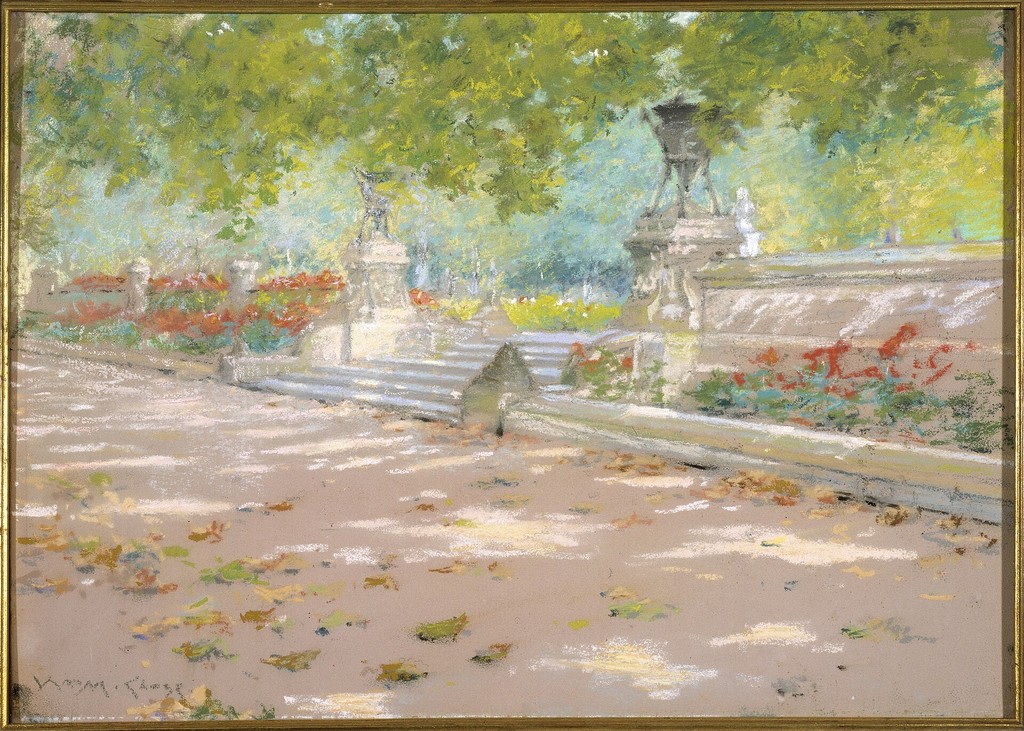
In Terrace, Prospect Park, William Merritt Chase turns a modest corner of Brooklyn’s designed landscape into an encounter with colour and movement. The eye crosses a broad foreground towards steps, balustrades and planting beneath a dense canopy. Pastel lets individual strokes remain conspicuous, yet their apparent speed belongs to a carefully ordered, finished picture.
At a Glance
- ArtistWilliam Merritt Chase (1849–1916)
- Datec.1887
- MediumPastel; classified as a drawing by the Smithsonian American Art Museum
- Dimensions23.3 × 35.2 cm
- CollectionSmithsonian American Art Museum, accession 1929.6.12
- SettingA terrace in Prospect Park, Brooklyn
William Merritt Chase in context
Keying Up – The Court Jester
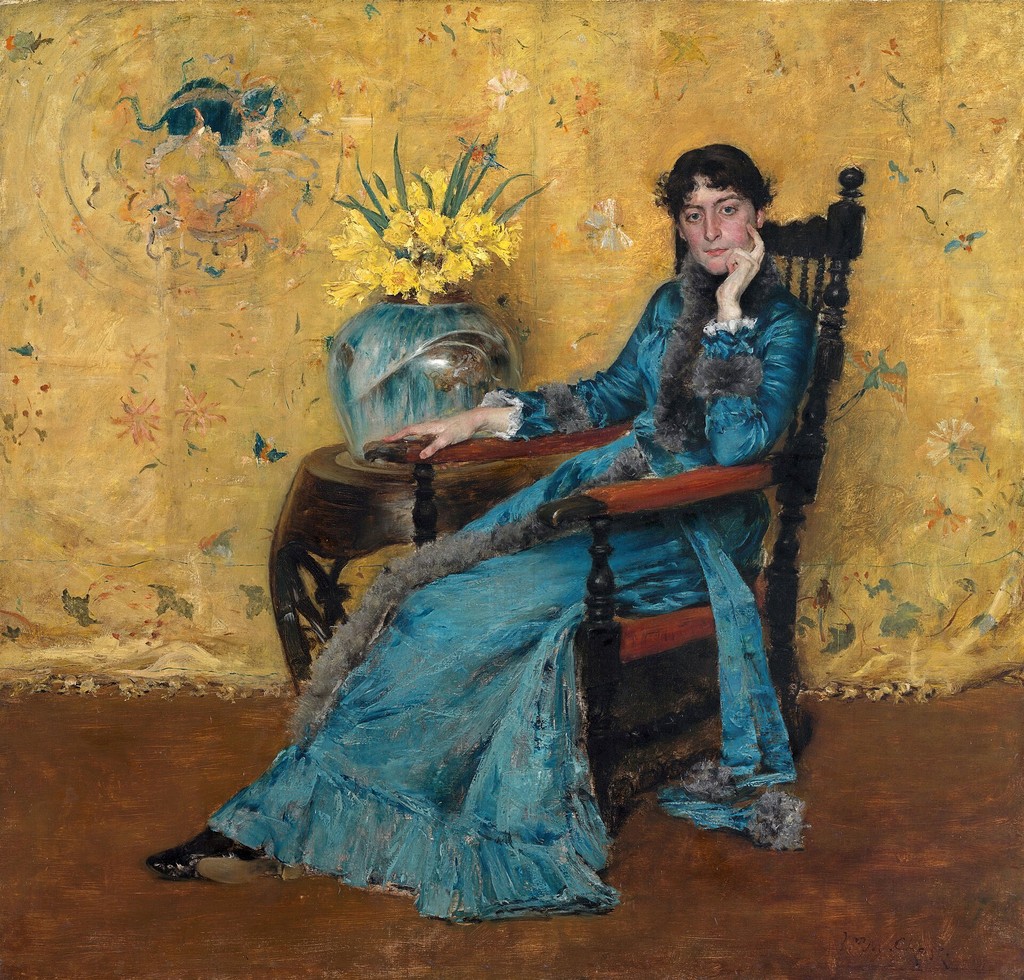
1875Portrait of Dora Wheeler
1882–83Terrace, Prospect Park
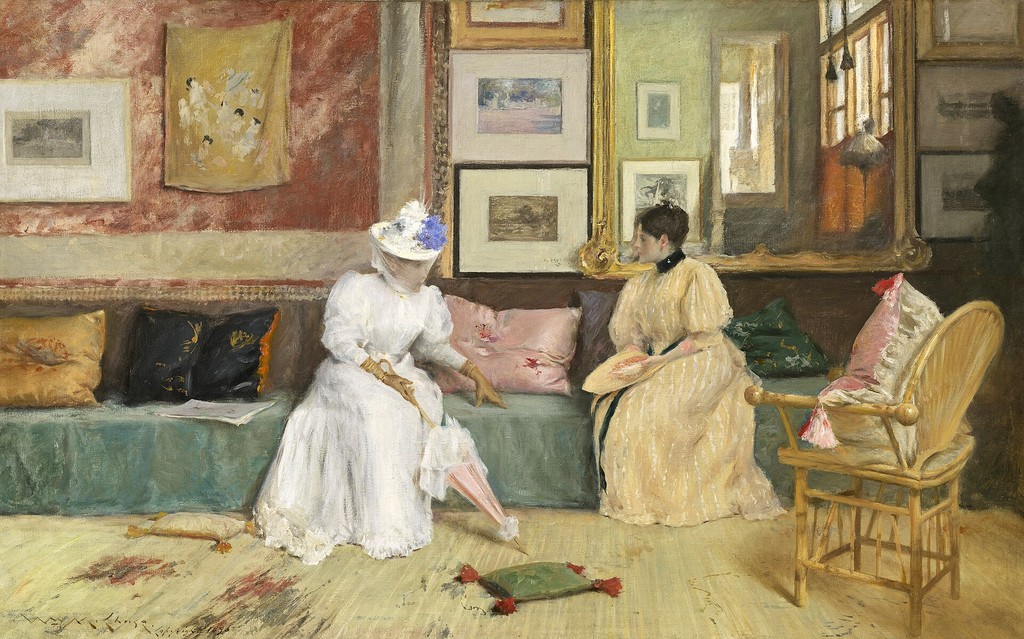
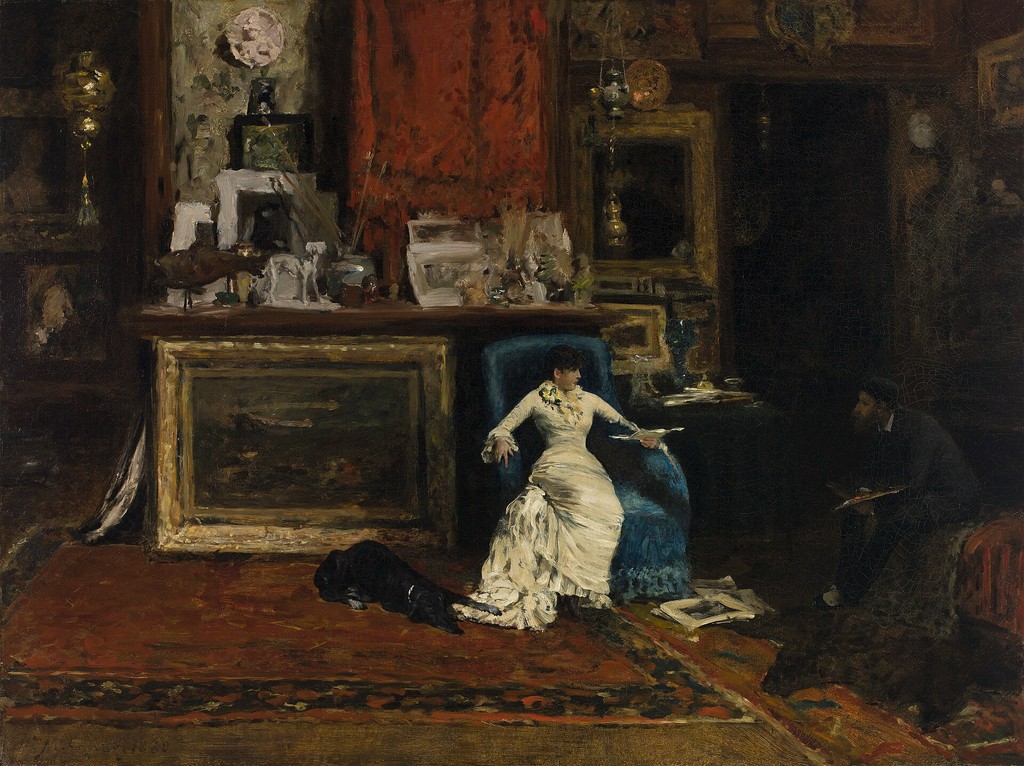
c. 1887A Friendly Call
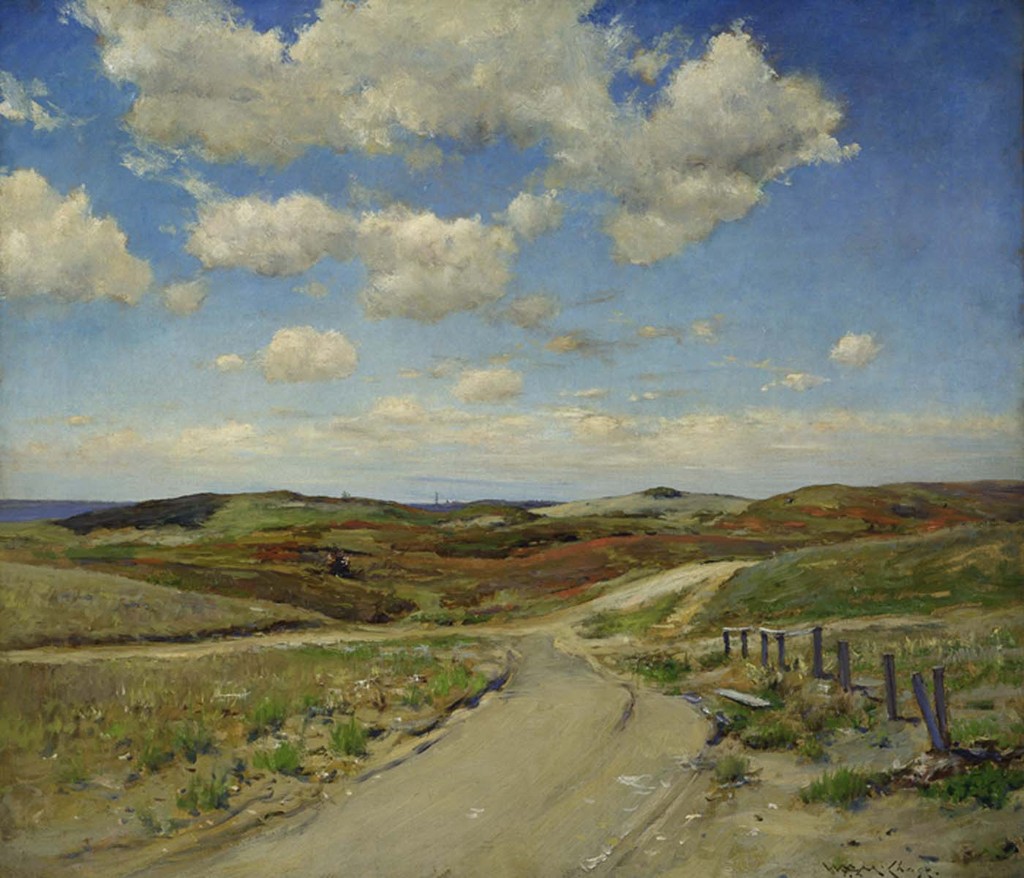
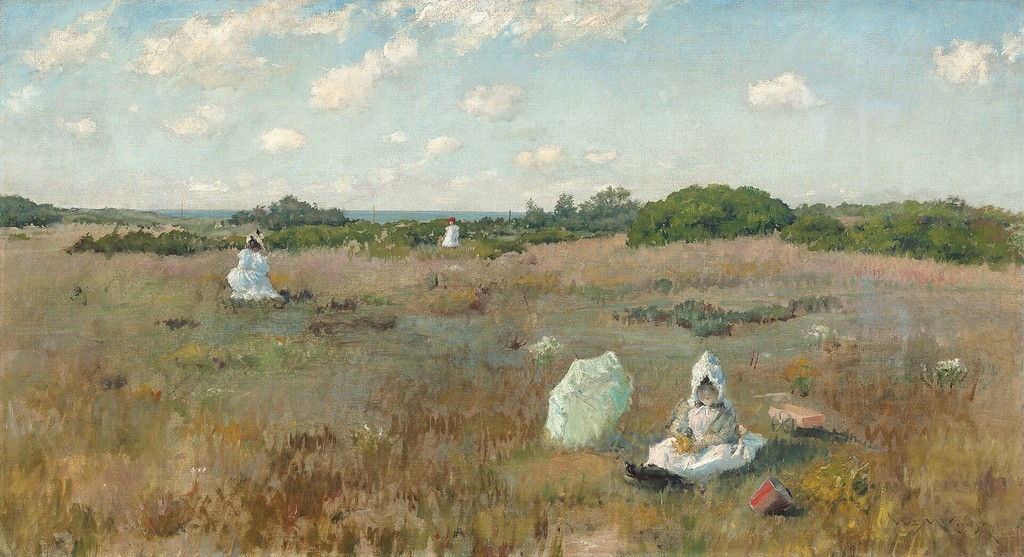
1895Shinnecock Hills
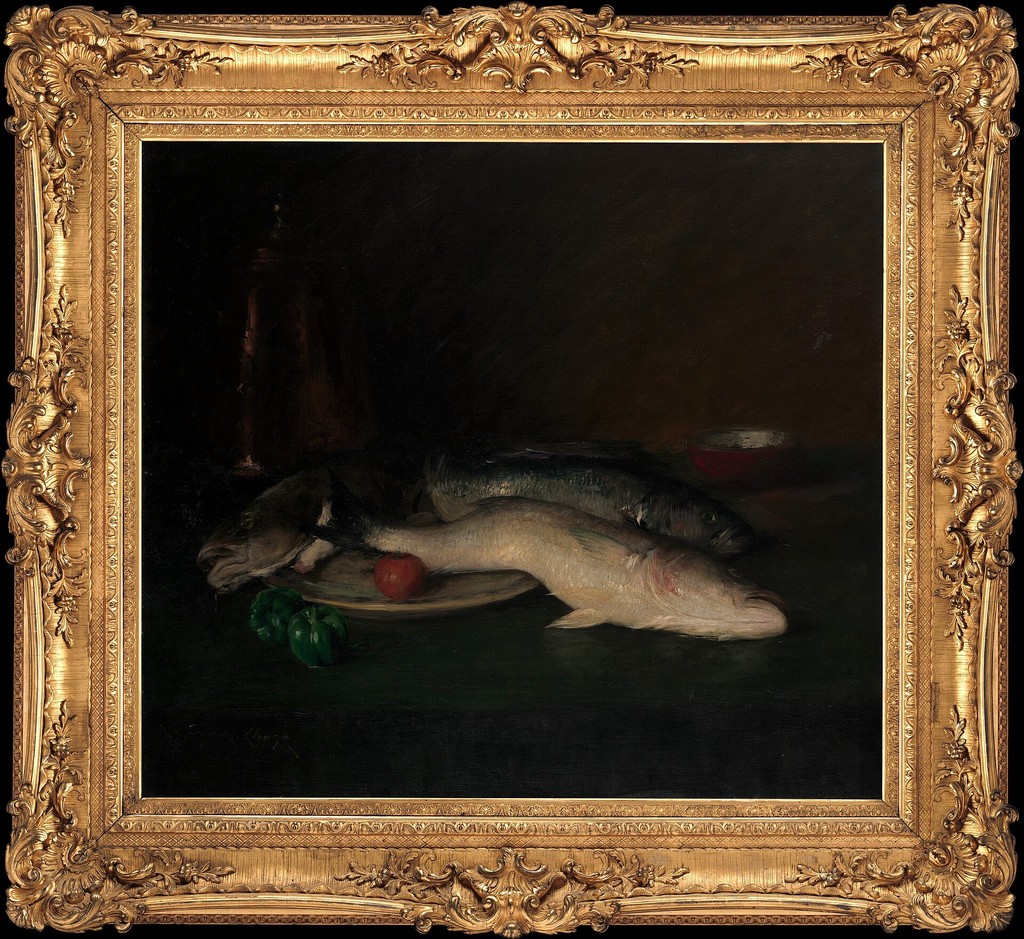
c. 1895Still Life: Fish
by 1908Contents
- Introduction
- A Terrace Encountered in Passing
- Horizontal Design and Shallow Architecture
- Pastel: Line, Layer and Touch
- How Colour Constructs the Light
- A Finished Pastel in a Drawing Collection
- Park Space Without Invented Biography
- Comparing Study of Flesh Color and Gold
- Brooklyn and Shinnecock Are Not Interchangeable
A Terrace Encountered in Passing
Pale pink-grey ground occupies much of the lower half, animated by white, yellow, green and brown strokes. Some marks read as light crossing the path; others suggest fallen leaves or irregularities underfoot. The surface is open but never inert.
The view gathers around a flight of steps just beyond the centre. A low kerb approaches diagonally from the lower right, while terrace walls and balustrades stretch across the middle distance. Red flowers burn against light masonry. Above, loosely massed greens and yellows form a leafy ceiling, with small blue intervals allowing air through the foliage.
A dark figure moves towards the steps. Farther shapes indicate other people, but they are too small to identify. Chase uses them as measures of distance and signs of passage rather than portrait subjects.
The Smithsonian American Art Museum dates the pastel to about 1887, records its dimensions as 23.3 × 35.2 centimetres and identifies it as accession 1929.6.12.[1] Those compact measurements reinforce the intimacy of the encounter. This is not a panoramic declaration about the city; it is a concentrated observation within it.
Horizontal Design and Shallow Architecture
The format is wider than it is high, but Chase does not open a distant vista. He stacks shallow bands: foreground path, diagonal kerb, steps and flowerbeds, pale terrace architecture, then vegetation. Overlap and changing scale create depth.
The kerb’s slant invites the eye in, then the steps redirect attention upwards. Horizontal walls resist that motion. The dark figure connects the near ground to the architecture, while bright strokes recur on both sides.
Cropping makes this a partial view: the terrace continues beyond the right edge, the path arrives from outside and the canopy is cut at the top. The large foreground slows entry, counterbalanced by the densely worked upper half.
That combination is central to his New York park scenes. Paths, borders and terraces are not neutral backgrounds. They choreograph how people move and how a viewer reads the picture.
Pastel: Line, Layer and Touch
Pastel allowed Chase to shift among several marks: a narrow accent from the tip, a broader patch from the side, or a soft veil made by rubbing. Here, slender lights cross the ground, thicker strokes build foliage and blended blue-green passages suggest depth.
Layering gives the small work density. Red touches sit against cool green and pale stone; darker lines sharpen the kerb and steps; light marks skim the warm ground. Architecture becomes firm where direction matters, while foliage and scattered illumination stay mutable.
The surface looks quick, but appearance does not establish duration. The record does not prove one-sitting or wholly outdoor execution. “Rapid-looking” is safer: the marks preserve force and direction while the arrangement shows sustained judgement.
Chase’s wider pastels and works on paper demonstrate why the medium should be considered independently. It offered painterly colour without requiring the smooth closure that viewers sometimes mistake for finish.
How Colour Constructs the Light
Colour differences separate one zone from another. The pale walkway advances against the saturated middle band. Red planting punctuates the terrace, and a dark upright figure holds the centre. Greens broken by yellow and blue suggest sun filtered through leaves.
White recurs on paving, steps, walls and foliage, while red appears in separate clusters. These repetitions bind the spatial divisions and keep attention circulating beyond the figure.
The Metropolitan Museum of Art places Chase’s park subjects within a lighter, outdoor strand of a career also embracing darker portraits, interiors and still lifes.[2] Here, differences of value and hue make atmosphere and architecture legible together.
A Finished Pastel in a Drawing Collection
The Smithsonian records pastel as the medium and drawing as the classification.[1] The descriptions are compatible. A museum category neither turns the picture into pencil work nor proves that it prepared an oil.
The National Gallery of Art includes pastels within Chase’s career record.[3] Its account of a major pastel exhibition also stresses the medium’s colour and painterly effects, placing Chase in a longer history of ambitious work in dry pigment.[4]
Completion lies in pictorial resolution rather than polished uniformity. Format, intervals, repeated colours and the balance of open and crowded areas work together. The grain of loose strokes belongs to the statement.
This distinction helps when navigating Chase’s paintings and artworks. Oil and pastel offer different kinds of edge, saturation and surface. Neither needs to imitate the other to count as a complete work.
Park Space Without Invented Biography
Stairs, walls, planting beds and a maintained path mark Prospect Park as designed rather than isolated nature. Small figures make human circulation one element among vegetation, architecture and light.
This is public park space, but the marks cannot reveal who the figures were, why they came or how different communities experienced the grounds. The nearest figure has no recoverable face; occupations, class identities and relationships remain unknown.
Cultivated planting, built routes and anonymous movement nevertheless identify a modern metropolitan landscape. Chase finds pictorial interest where looking and walking occur together.
The biography of William Merritt Chase places the work within his New York career after his return from Europe in 1878. By the later 1880s, the city offered him subjects far beyond the formal studio without severing his connection to artistic display and teaching.
Comparing Study of Flesh Color and Gold
The National Gallery’s Study of Flesh Color and Gold, dated 1888, provides a useful near-contemporary comparison. It is a pastel on prepared paper, accession 2007.94.2.[5] Its vertical field is dominated by the back of a seated figure, with dark hair, pale skin, green cloth and a gold-toned surrounding space.
In that work, modelling follows gradual shifts across the body while stronger strokes enliven fabric and setting. Terrace, Prospect Park distributes broken marks across paving, flowers, masonry and leaves. One concentrates colour around a nearby figure; the other makes people small accents in a spatial weave.
There is no standard Chase pastel effect. Dry pigment describes continuous flesh and emphatic cloth in one work, flickering vegetation and architectural direction in the other. The figure study concentrates attention; the Brooklyn view disperses it through space.
Neither picture should be demoted to rehearsal. Each organises colour, touch and format as an independent pictorial argument.
Brooklyn and Shinnecock Are Not Interchangeable
Chase’s later Shinnecock landscapes explore outdoor colour and changing light in another place and history. Civic architecture bounds Prospect Park and compresses depth; Shinnecock pictures more often extend across fields, roads and broader horizons.
Medium sharpens the difference. This Brooklyn work is a small pastel; prominent Shinnecock landscapes include larger oils. Broken colour does not make the locations one generic outdoors.
The Shinnecock landscapes and teaching require recognition that Chase’s summer school operated on ancestral and present Shinnecock land. That history cannot be transferred to Prospect Park, just as park planning cannot explain Shinnecock. Within the William Merritt Chase overview, comparison is most useful when it preserves those differences of land, medium and function.
Researched works directory
This searchable evidence census contains 208 distinct records assembled from public collection data and a reproducible Wikidata snapshot. It is not a catalogue raisonné, not a claim of complete oeuvre coverage, and it keeps works with repeated titles as separate objects.
| Name | Date | Medium |
|---|---|---|
| A City Park | 1887 | Painting |
| A Corner of My Studio | Date unknown | Painting |
| A Dutch Landscape | 1884 | Painting |
| A Friendly Call | 1895 | Painting |
| A Gray Day | 1886 | Painting |
| A Modern Magdalen | 1888 | Painting |
| A Spanish Gypsy | 1905 | Painting |
| Albert Harkness (1822–1907) | 1908 | Painting |
| Alice | 1892 | Painting |
| An Afternoon Stroll | 1895 | Painting |
| An English Cod | 1904 | Painting |
| At the Seaside | 1890 | Painting |
| August B. Loeb | 1905 | Painting |
| Baron Hugo von Habermann | 1875 | Painting |
| Beach | 1895 | Painting |
| Bessie Potter | 1895 | Painting |
| Big Copper Kettle and Fish (Fish) | Date unknown | Painting |
| Bildnis Hugo von Habermann | 1875 | Painting |
| Brass Kettle and Catfish | Date unknown | Painting |
| Carmencita | 1890 | Painting |
| Courtyard in Venice | 1877 | Painting |
| Crucifixion | 1875 | Painting |
| Der japanische Holzschnitt | 1888 | Painting |
| Dieudonnée | 1899 | Painting |
| Dorothy | 1902 | Painting |
| Dr. Eduardo San Giovanni | 1906 | Drawing |
| Duveneck Painting "The Turkish Page | 1876 | Painting |
| Edward Everett Hale (1822-1909) | 1884 | Painting |
| Edward Guthrie Kennedy | 1895 | Painting |
| Edward Steichen | 1903 | Painting |
| Female Figure Study (front view) | Date unknown | Painting |
| Female Figure Study (side view) | Date unknown | Painting |
| First Touch of Autumn | 1898 | Painting |
| Fish | 1910 | Painting |
| Fish and Still Life | 1906 | Painting |
| Fish and Still Life | 1908 | Painting |
| Florence | 1907 | Painting |
| For the Little One | 1896 | Painting |
| Garden of the Orphanage, Haarlem, Holland | 1883 | Painting |
| Gathering Autumn Flowers | 1894 | Painting |
| Gathering Flowers, Shinnecock, Long Island | 1897 | Drawing |
| Girl at a Bureau | Date unknown | Painting |
| Girl in a Japanese Costume | 1890 | Painting |
| Girl in Ciociaro costume | 1876 | Painting |
| Girl in White | 1890 | Painting |
| Girl with Doll | 1910 | Painting |
| Gray Day on the Bay | 1886 | Painting |
| Gray Day on the Lagoon | 1913 | Painting |
| Harbor Scene, Brooklyn Dock | 1886 | Painting |
| Harriet Hubbard Ayer | 1880 | Painting |
| Head of a Man | 1875 | Painting |
| Hide and Seek | 1888 | Painting |
| I Think I'm Ready Now | 1883 | Painting |
| Idle Hours | 1894 | Painting |
| In the Park (A By-path) | 1889 | Painting |
| In the Studio Corner | 1881 | Painting |
| In Venice | 1877 | Painting |
| James Abbott McNeill Whistler | 1885 | Painting |
| John Butler Talcott | 1900 | Painting |
| Just Onions (Onions; Still Life) | Date unknown | Painting |
| Keying Up" - The Court Jester | 1875 | Painting |
| Keying Up: The Court Jester | 1875 | |
| L'Éventail de plumes | Date unknown | Painting |
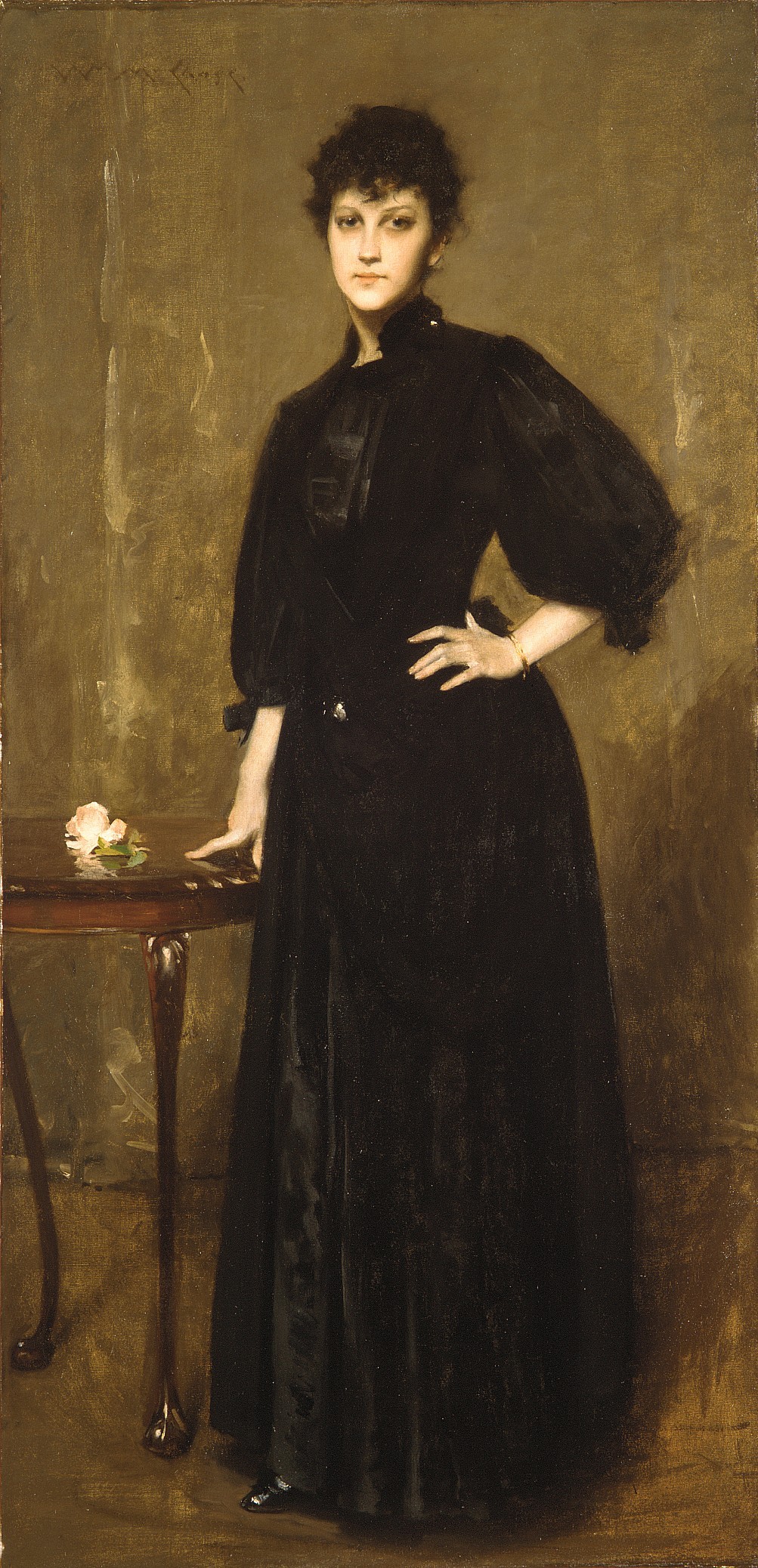
| Lady in Black | 1888 | Painting |
| Lady Playing Guitar | Date unknown | Painting |
| Landscape- Shinnecock, Long Island | 1896 | Painting |
| Long Island Landscape after a Shower of Rain (After the Shower) | 1889 | Painting |
| Lydia Field Emmet | 1892 | Painting |
| Man Wearing Gold Rimmed Glasses | 1892 | Painting |
| Marine | 1888 | Painting |
| Monkeying with Literature | 1877 | Painting |
| Moses Swaim | Date unknown | Painting |
| Mother and Child (The First Portrait) | 1887 | Painting |
| Mrs. Charles Scott | Date unknown | Painting |
| Mrs. Chase | 1890 | Painting |
| Mrs. Chase in Prospect Park | 1886 | Painting |
| Mrs. William Clark | 1915 | Painting |
| Mrs. William Merritt Chase | 1890 | Painting |
| My Little Daughter Dorothy | 1894 | Painting |
| My Palette | 1875 | Painting |
| Myra Reynolds | 1898 | Painting |
| Near the Beach, Shinnecock | 1895 | Painting |
| Near the Beach, Shinnecock | Date unknown | Painting |
| North River Shad | 1910 | Painting |
| Nude | 1901 | Painting |
| Open Air Breakfast | 1888 | Painting |
| Outskirts of Madrid | 1882 | Painting |
| Pablo de Sarasate: Portrait of a Violinist | 1875 | Painting |
| Park Bench | 1890 | Painting |
| Peace, Fort Hamilton | 1888 | Painting |
| Pink Azalea—Chinese Vase | 1885 | Painting |
| Portrait Head | 1882 | Painting |
| Portrait of a Boy in Van Dyck Costume | 1875 | Painting |
| Portrait of a Child | 1884 | Painting |
| Portrait of a Lady in Black | 1895 | Painting |
| Portrait of a Lady in Black (Annie Traquair Lang) | 1911 | Painting |
| Portrait of a Lady in Pink | Date unknown | Painting |
| Portrait of a Man | 1874 | Painting |
| Portrait of a Man | 1875 | Painting |
| Portrait of a Woman | Date unknown | Painting |
| Portrait of Artist Beck Wenzell | 1900 | Painting |
| Portrait of Baroness Ida-Gro van Dahlerup | 1907 | Painting |
| Portrait of Dora Wheeler | 1882 | Painting |
| Portrait of Lavinia Borden Cook | Date unknown | Painting |
| Portrait of Louis Betts | Date unknown | Painting |
| Portrait of Master Otis Barton and his Grandfather | 1903 | Painting |
| Portrait of Miss D. | Date unknown | Painting |
| Portrait of Mrs. C. (Lady with a White Shawl) | 1893 | Painting |
| Portrait of Mrs. George B. Ely (Caroline Boies Ely) | Date unknown | Painting |
| Portrait of My Daughter Alice | 1895 | Painting |
| Portrait of My Father (David Hester Chase) | Date unknown | Painting |
| Portrait of My Mother (Sarah Swaim Chase) | 1892 | Painting |
| Portrait of William Francklyn Paris | Date unknown | Painting |
| Portrait of William Gurley Munson | 1868 | Painting |
| Ready for the Ride | 1877 | Painting |
| Red Snapper | Date unknown | Painting |
| Robert Frederick Blum | Date unknown | Painting |
| Roland | 1902 | Painting |
| Roses | 1883 | Drawing |
| Seaside Flowers | 1897 | Painting |
| Selbstbildnis | 1875 | Painting |
| Selbstporträt | 1915 | Painting |
| Self-Portrait | 1909 | Drawing |
| Self Portrait | 1914 | Painting |
| Self-Portrait | 1915 | Painting |
| Self-portrait dressed as Johan Claesz Loo by Frans Hals | 1903 | Painting |
| Seventeenth Century Lady | 1895 | Painting |
| Shell Beach at Shinnecock | 1892 | Painting |
| Shinnecock Hills | 1892 | Painting |
| Shinnecock Hills | 1893 | Painting |
| Shinnecock Hills | 1895 | Painting |
| Shinnecock Hills | 1895 | Painting |
| Shinnecock Hills Landscape | 1890 | Painting |
| Shinnecock Studio Interior | 1892 | Drawing |
| Sketch for a Picture--Columbus before the Council of Salamanca (A) (Christopher Columbus before the Council of Salamanca) | 1876 | Painting |
| Sketch for a Picture--Columbus before the Council of Salamanca (B) (Christopher Columbus before the Spanish Council) | 1876 | Painting |
| Sketch of a Child:Helen | 1898 | Painting |
| St. Jerome | 1875 | Painting |
| Still Life | 1912 | Painting |
| Still Life | Date unknown | Painting |
| Still Life | Date unknown | Painting |
| Still Life | Date unknown | Painting |
| Still Life (Brass Bowl) | Date unknown | Painting |
| Still Life (Brushes, Books and Pottery) | 1904 | Painting |
| Still Life: Fish | 1900 | Painting |
| Still Life: Fish | 1903 | Painting |
| Still Life: Fish | 1908 | Painting |
| Still Life: Fish | 1912 | Painting |
| Still-life: Fish and Bowl | 1895 | Painting |
| Still Life (Fruit and Copper Pot) | Date unknown | Painting |
| Still Life (Fruit and Pottery) | Date unknown | Painting |
| Still Life--Striped Bass | 1907 | Painting |
| Still Life with Fish | 1800 | Painting |
| Still Life with Fish | 1910 | Painting |
| Still Life with Fish | 1912 | Painting |
| Still Life with Fish | Date unknown | Painting |
| Still life with fruit | 1871 | Painting |
| Still Life with Hummingbird | 1870 | Painting |
| Still Life with Watermelon | 1869 | Painting |
| Studio Interior | 1882 | Painting |
| Study Head | Date unknown | Painting |
| Study of a Girl in Japanese Dress | 1895 | Painting |
| Study of a Young Woman | 1883 | Painting |
| Study of Flesh Color and Gold | 1888 | Drawing |
| Summer at Shinnecock Hills | 1891 | Painting |
| Sunlight and Shadow, Shinnecock Hills | 1893 | Painting |
| Tenth Street Studio | 1880 | Painting |
| Terrace at the Mall | 1890 | Painting |
| Terrace, Prospect Park | 1887 | Drawing |
| The Antiquary Shop | 1879 | Painting |
| The Apprentice (Boy with Apple) | 1876 | Painting |
| The Big Brass Bowl | Date unknown | Painting |
| The Blue Kimono | 1915 | Painting |
| The Boat Harbor (Gowanus Pier) | 1888 | Painting |
| The Coast of Holland | 1884 | Painting |
| The Emerald Lady | Date unknown | Painting |
| The Family Cow (Calf's Head) | 1869 | Painting |
| The Keynote | 1915 | Painting |
| The Kimono | 1895 | Painting |
| The Mirror | 1900 | Painting |
| The Model | 1888 | Drawing |
| The Moorish Warrior | 1878 | Painting |
| The Old Road to the Sea | 1893 | Painting |
| The Patrician | 1875 | Painting |
| The Song | 1907 | Painting |
| The Stately Model | 1898 | Painting |
| The Tenth Street Studio | 1880 | Painting |
| The Tow Path | 1880 | Painting |
| The Turkish Page (Unexpected Intrusion) | 1876 | Painting |
| The Whistling Boy | 1875 | Painting |
| The Wounded Poacher | 1878 | Painting |
| The Yield of the Waters | 1878 | Painting |
| The Young Orphan | 1884 | Painting |
| Thomas E. Kirby | 1900 | Painting |
| Thomas Moran | Date unknown | Painting |
| Under a French Sky | 1882 | Painting |
| Venetian Lace Making | Date unknown | Drawing |
| View from Central Park | 1889 | Painting |
| View near Polling | 1875 | Painting |
| William A. Clark | 1915 | Painting |
| William Andrews Clark | 1915 | Painting |
| William Nimick Frew | 1915 | Painting |
| William Rockhill Nelson | 1907 | Painting |
| Wind-Swept Sands | 1894 | Painting |
| Woman in White | 1902 | Painting |
| Woman Seated | 1885 | Drawing |
| Woman Standing in a Landscape | Date unknown | Painting |
| Worthington Whittredge | 1890 | Painting |
Frequently Asked Questions
It is a pastel. The Smithsonian American Art Museum classifies the object as a drawing, which describes its collection category rather than changing its stated medium.[1]
Chase made it around 1887. The Smithsonian American Art Museum holds it as accession 1929.6.12; the sheet measures 23.3 × 35.2 centimetres.[1]
Their identities are not established by the institutional record. They are best understood visually as anonymous park users who provide scale and movement, not as named relatives or documented sitters.
The broad path delays the viewer’s arrival at the steps and terrace. Scattered strokes activate that interval, while the diagonal kerb leads the eye towards the denser middle and upper zones.
Its outdoor subject, light palette and discrete touches make that comparison useful. The label is not sufficient on its own, however, because Chase also relies on deliberate architectural structure and a wider practice shaped by several artistic traditions.[2]
Discussion
Use this evidence-led guide as a starting point for close looking rather than a final verdict.
Share an observation about Terrace, Prospect Park or a source that adds useful context.
Reader Insights
Which visible detail most changes your reading of Terrace, Prospect Park?
How do medium, scale, setting and current museum evidence shape the encounter?
What remains uncertain once documented fact is separated from visual inference?
Join the Conversation
Add your reading below, keeping observations specific and evidence clear.
References
- Terrace, Prospect Park — Smithsonian American Art Museum, accessed 31 August 2026, accessed 31 August 2026.
- William Merritt Chase (1849–1916) — Metropolitan Museum of Art, accessed 31 August 2026, accessed 31 August 2026.
- William Merritt Chase — National Gallery of Art, accessed 31 August 2026, accessed 31 August 2026.
- The Touch of Color: Pastels at the National Gallery of Art — National Gallery of Art, accessed 31 August 2026, accessed 31 August 2026.
- Study of Flesh Color and Gold — National Gallery of Art, accessed 31 August 2026, accessed 31 August 2026.