 by Tom Gurney
Tom Gurney BSc (Hons) is an art history expert with over 20 years experience
Page Created on August 31, 2026 / Page Updated on November 6, 2026
Email: tomgurney1@gmail.com / Phone: +44 7429 011000
From Munich to Tenth Street: Introduction
William Merritt Chase’s career did not move neatly from a dark German apprenticeship to a bright American maturity. Between the Munich Royal Academy and New York’s Tenth Street Studio Building, he learnt to make technique, teaching, collecting, display and sociability reinforce one another. Munich gave him durable ways of organising tone and handling paint; Tenth Street gave those resources an unmistakably public setting. The result was a practice able to accommodate sombre still lifes, commanding portraits and, later, open-air landscapes without requiring Chase to abandon one manner whenever he adopted another.[1]
At a Glance
- European studyChase entered the Munich Royal Academy in 1872.
- Formative resourcesDark tonal structure, vigorous brushwork and sustained attention to old-master painting.
- International circleAmerican colleagues in Europe included Frank Duveneck and John Twachtman.
- New York returnChase returned in 1878 and began teaching at the Art Students League.
- Tenth Street yearsHe occupied the Studio Building from 1878 until relinquishing the costly space in 1895.
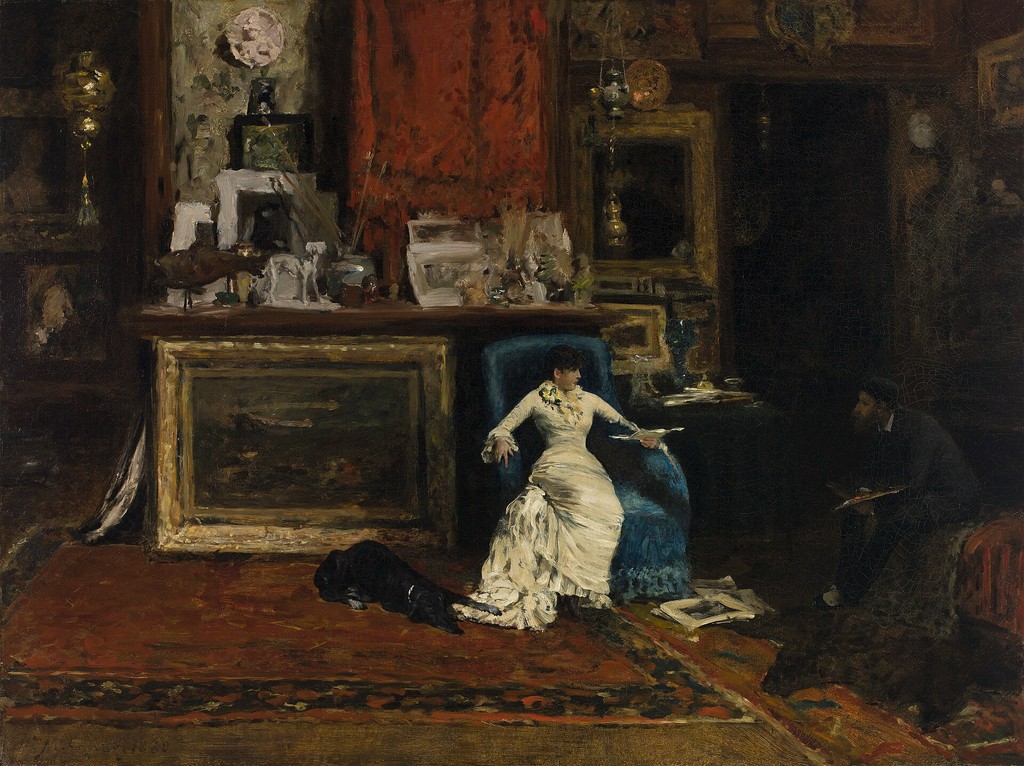
- Key paintingThe Tenth Street Studio, 1880, oil on canvas, Saint Louis Art Museum, 48:1933.
Contents
- Introduction
- Before Munich: Training and Professional Ambition
- Munich: Academy, Old Masters and the Worked Surface
- Venice and an International Peer Network
- New York: Teaching and an Artists’ Building
- Reading The Tenth Street Studio
- A Studio for Work, Display and Encounter
- Whistler and the Uses of Emulation
- What Lasted, and What Changed
Before Munich: Training and Professional Ambition
Chase’s route to Europe began far from the established academies of Munich and Paris. Born in Williamsburg, Indiana, in 1849, he received early instruction from Barton S. Hays in Indianapolis, then studied at the National Academy of Design in New York. Work in St Louis, including professional still-life painting, placed him in a commercial art world as well as an educational one. In 1872, support from a group of St Louis businessmen allowed him to continue his studies abroad.[1]
That sequence matters because Chase arrived in Munich with more than a student’s curiosity. He had already encountered the need to make pictures legible, persuasive and saleable. Patronage also made advancement inseparable from public confidence: other people had invested in his promise. The flamboyant professional identity he later developed in New York was not simply a costume put on after Europe. It grew from a career in which skill had to be demonstrated before teachers, patrons, fellow artists and buyers. A fuller chronology appears in the biography, but the central point here is that technique and professional ambition developed together.
Munich: Academy, Old Masters and the Worked Surface
Chase entered the Munich Royal Academy in 1872. The city offered an alternative to Paris and brought him into a culture of disciplined figure study, emphatic tonal contrasts and admiration for seventeenth-century painting. The Metropolitan Museum of Art identifies two important attractions: the forceful realism associated with Wilhelm Leibl, and the example of painters such as Peter Paul Rubens and Frans Hals.[1] Those resources encouraged an art in which a form could be built through values and decisive strokes rather than polished into an evenly finished surface.
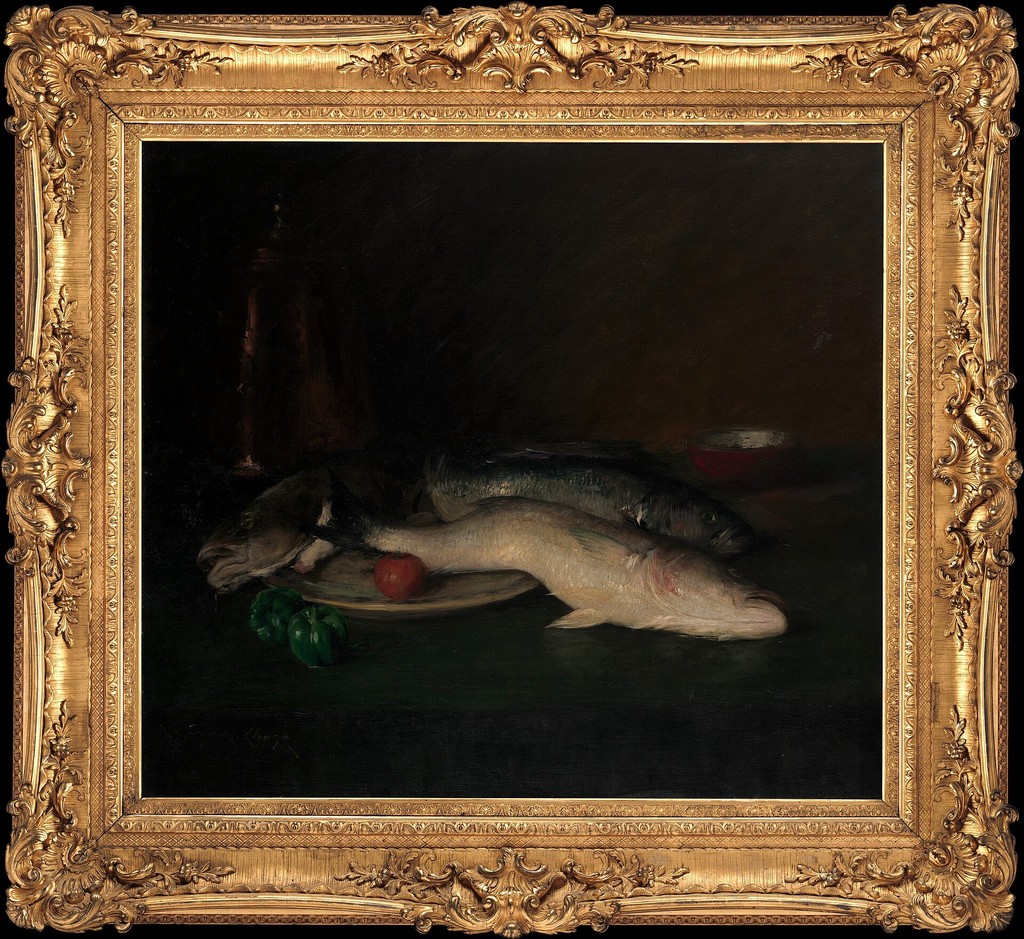
“Munich” should therefore be understood as a group of usable methods, not a formula that explains everything Chase painted afterwards. Dark grounds could intensify a pale face, a flash of metal or the wet surface of a fish. Broad handling could signal command while still describing texture. Chiaroscuro could organise attention across a crowded composition. These habits remained available when Chase later painted fashionable sitters and still lifes, yet they did not prevent him from working with a higher key outdoors.
The breadth of the 2016–17 retrospective William Merritt Chase: A Modern Master is instructive here. Its institutional account emphasised stylistic experimentation, varied working methods and an international context across four decades.[2] Chase’s eclecticism was active rather than indecisive: he selected and recombined techniques according to subject, setting and audience.
Venice and an International Peer Network
After Munich, Chase worked in Venice alongside American artists including Frank Duveneck and John Twachtman. Venice extended the education beyond a single academy. Historic painting, contemporary exhibition culture, travel and daily exchange with other artists all widened the field in which technique could be tested. Duveneck and Twachtman were colleagues within that international environment, not merely names in a chain of influence.
These European years also complicate the idea that American art developed in isolation. Chase returned with habits formed through German training, old-master study and contact among artists working away from home. He would continue to travel and cultivate such exchanges. Yet the decisive date is 1878: that was when he returned to New York, not 1898. The Archives of American Art chronology confirms the 1878 return and his subsequent teaching at the Art Students League.[3]
New York: Teaching and an Artists’ Building
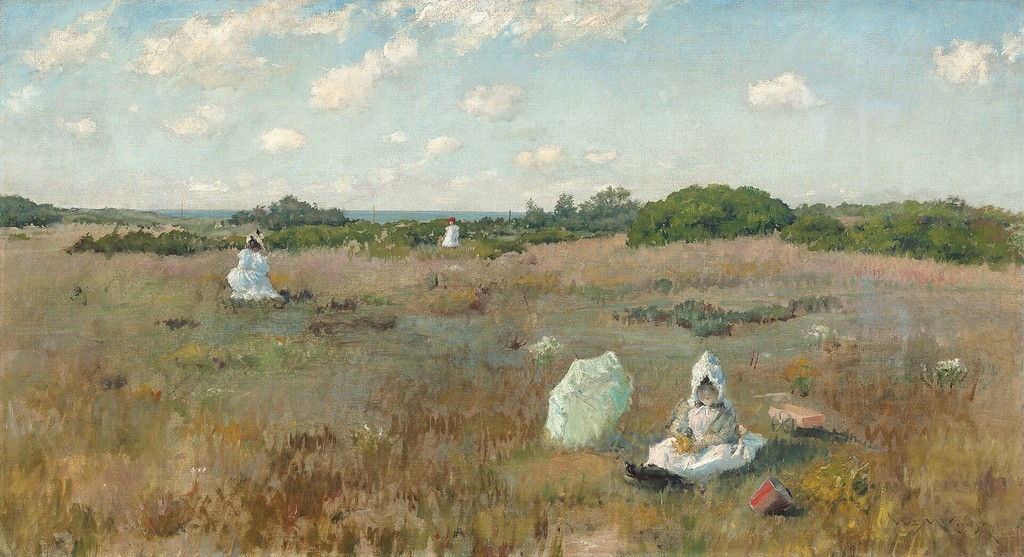
Teaching gave Chase an immediate role in the city’s art world. The Art Students League position joined demonstration, criticism and institutional life to his own studio practice. It was the beginning of a long teaching career that would eventually extend to other organisations and to the summer school at Shinnecock. The Shinnecock landscapes and teaching belong to a later setting, but their combination of instruction and personal work had an important New York precedent.
Chase first rented a small room in the Tenth Street Studio Building after his 1878 return, then occupied the large gallery originally intended for the building’s artists to use collectively. Designed by Richard Morris Hunt and opened in 1856, the building made professional art visible in architectural form: studios were not incidental rooms but its reason for existing.[1] Chase occupied the building from 1878 to 1895, when he relinquished the expensive space.
The large gallery allowed several activities to coexist. It was a place to paint, arrange objects, receive sitters, teach, host visitors and display completed work. None of these functions was secondary. A prospective patron could encounter pictures within an environment that demonstrated taste; a student could see artistic labour joined to decisions about presentation; another painter could meet Chase as both colleague and host. Tenth Street helped him turn professional identity into something spatial and repeatable.
Reading The Tenth Street Studio
Chase’s 1880 The Tenth Street Studio is the clearest surviving painted statement of this early New York environment. The oil on canvas measures 92.1 × 122.6 cm and is held by the Saint Louis Art Museum as 48:1933.[4] The composition is not an inventory. It is a selective arrangement in which a seated woman in white occupies a blue-green chair, another figure withdraws into shadow, and a dark dog rests across the warm carpet.
Around them, paintings overlap or lean against furniture. Metallic vessels, ceramics, textiles and framed objects register in flashes rather than through evenly distributed description. A red hanging creates a broad vertical field, while the woman’s dress and the chair form a concentrated light-and-colour event below it. The room seems abundant, but the image is tightly controlled: large dark passages make the bright figure, gilt frames and reflective surfaces appear more intense.
Those are visible features. Their social meaning requires a further step. The Saint Louis Art Museum interprets such fine objects and elegantly presented visitors as cultural markers for artists and patrons, and describes Chase’s studio receptions as highly sought-after New York events.[4] The painting therefore presents the room as both workplace and display environment. It does not prove that every depicted possession held private symbolic meaning, nor does it provide transparent autobiography. Its strongest evidence concerns how Chase wanted artistic work, cultivated looking and modern sociability to appear together. The dedicated study of the painting follows that construction in closer detail.
A Studio for Work, Display and Encounter
The Tenth Street studio’s theatricality did not make it false. Painting itself depends on framing, selection and attention, and Chase extended those operations into the room. Textiles altered colour relationships; metal and ceramics supplied varied surfaces; paintings within the painting connected collecting to making. Visitors were not outside the artistic process, because their looking helped establish the studio’s social force.
At the same time, it remained a working environment. The Archives of American Art finding aid describes a modest body of Chase papers containing lecture notes, photographs of the artist, his family, homes and studios, and images of works of art.[3] That description establishes the scope of the holding; it should not be treated as access to every personal meaning behind the room. The archive and the 1880 painting together indicate repeated attention to studios as lived and represented spaces, while leaving many individual motives unresolved.
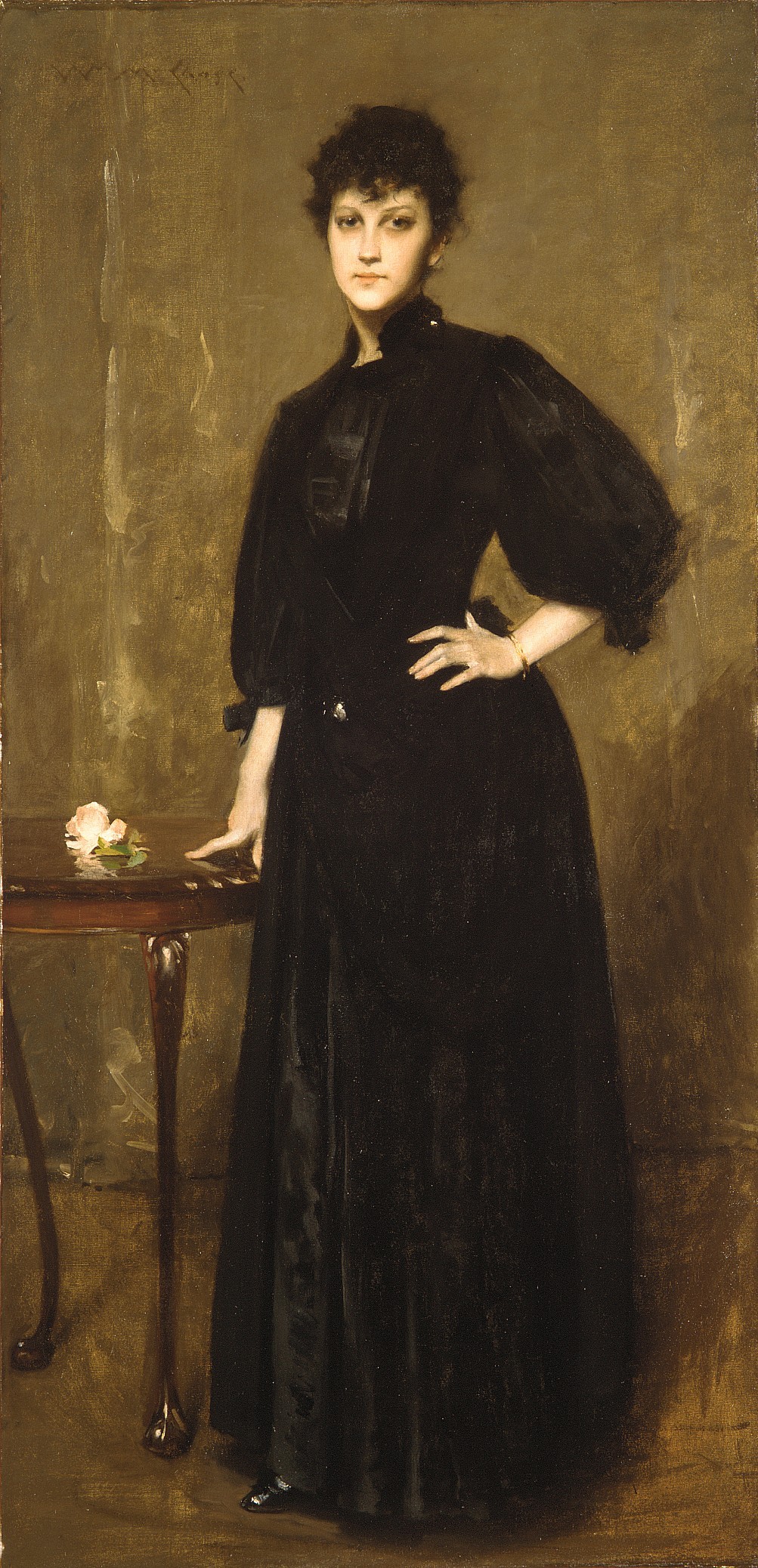
The later Lady in Black shows how teaching, modelling and portraiture could meet there. The Metropolitan Museum records that Marietta Benedict Cotton came to the Tenth Street studio as a pupil and became the model for the 1888 painting. Its monochrome emphasis also participates in Chase’s dialogue with Whistler and Sargent.[5] This is more specific than saying that the studio simply expressed his personality. It shows a setting where a teaching encounter could become a major portrait, and where international visual ideas could be tested against a present sitter.
Whistler and the Uses of Emulation
Chase’s 1885 portrait James Abbott McNeill Whistler makes his cosmopolitan method unusually visible. On his way to Spain, Chase introduced himself to Whistler in London, and the two planned reciprocal portraits. In Chase’s picture, the elongated figure, muted palette, fluid handling and ambiguous space deliberately engage Whistler’s own portrait language. Whistler disliked the result, and the exchange ended badly, but the painting remains evidence of emulation used as a form of professional encounter.[6]
The episode resists a tidy account of stylistic progress. Chase did not leave dark painting behind when he sought modernity, nor did he merely copy a fashionable model. He could use monochrome to acknowledge another artist, translate it through his own handling and risk disagreement in the process. Tenth Street functioned within this wider network: its furnishings announced international awareness, while the works made there tested how imported ideas might operate in New York.
What Lasted, and What Changed
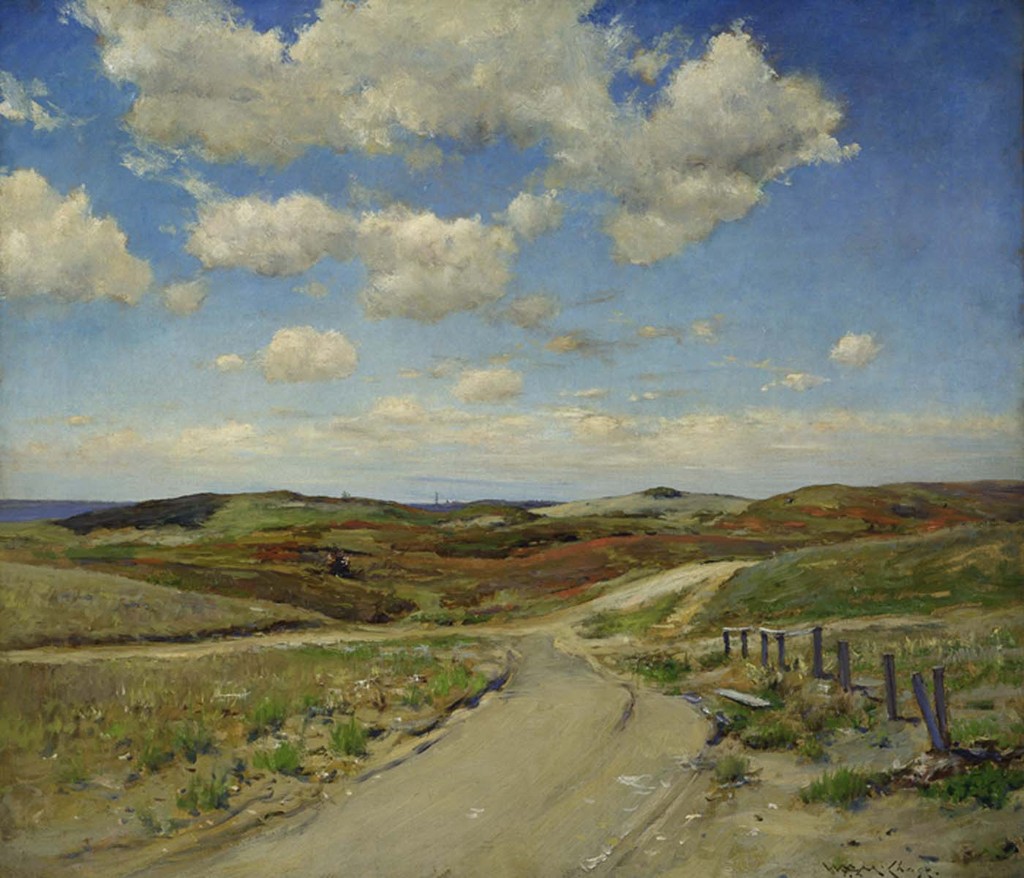
Munich’s tonal discipline remained conspicuous in Chase’s still-life paintings and in many portraits. Dark fields, rapid accents and strongly modelled forms continued to serve him when the subject called for weight, concentration or display. His later high-keyed outdoor pictures did not cancel those resources. In the New York park scenes, lighter colour and open-air observation answered different sites and social subjects; at Shinnecock, landscape and teaching generated another set of demands.
What changed was not a single palette but the range Chase could command. Munich supplied a rigorous tonal and painterly foundation. Venice and continued European travel expanded his professional network. New York placed those resources before students, sitters, collectors and fellow artists. The Tenth Street studio made that synthesis visible: a room in which art could be produced, staged, discussed and judged.
This is why Chase is poorly served by the label “American Impressionist” when it is used as a complete explanation. His practice was plural by design. The sombre studio interior of 1880, the monochrome portrait experiments of the later decade and the lighter park views belong to one career because he treated style as a repertoire. From Munich to Tenth Street, continuity lay less in a uniform look than in an insistence that technical control and public presence could strengthen each other.
Researched works directory
This searchable evidence census contains 208 distinct records assembled from public collection data and a reproducible Wikidata snapshot. It is not a catalogue raisonné, not a claim of complete oeuvre coverage, and it keeps works with repeated titles as separate objects.
| Name | Date | Medium |
|---|---|---|
| A City Park | 1887 | Painting |
| A Corner of My Studio | Date unknown | Painting |
| A Dutch Landscape | 1884 | Painting |
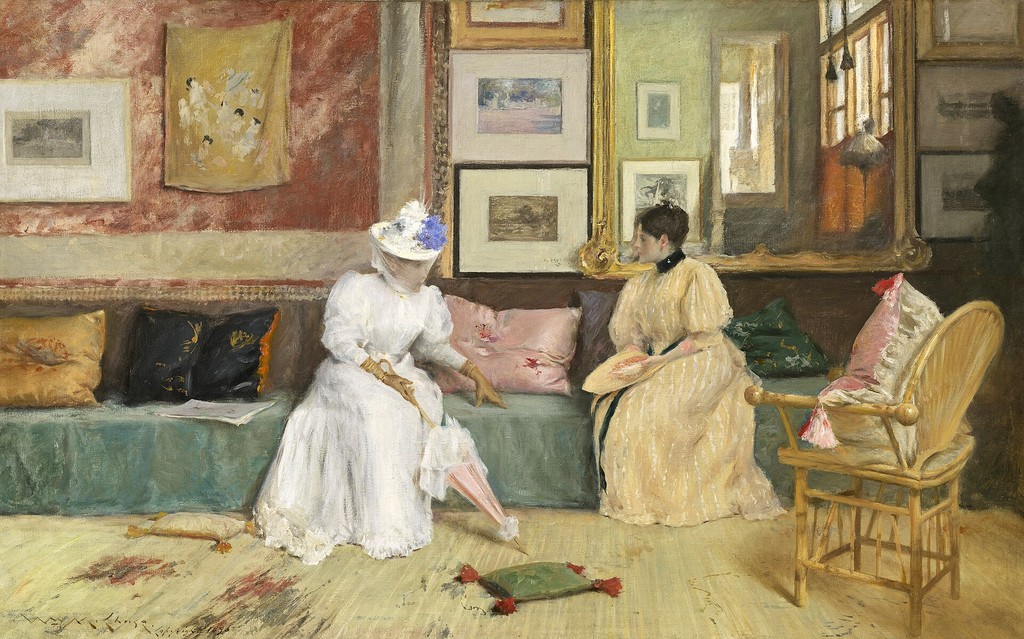
| A Friendly Call | 1895 | Painting |
| A Gray Day | 1886 | Painting |
| A Modern Magdalen | 1888 | Painting |
| A Spanish Gypsy | 1905 | Painting |
| Albert Harkness (1822–1907) | 1908 | Painting |
| Alice | 1892 | Painting |
| An Afternoon Stroll | 1895 | Painting |
| An English Cod | 1904 | Painting |
| At the Seaside | 1890 | Painting |
| August B. Loeb | 1905 | Painting |
| Baron Hugo von Habermann | 1875 | Painting |
| Beach | 1895 | Painting |
| Bessie Potter | 1895 | Painting |
| Big Copper Kettle and Fish (Fish) | Date unknown | Painting |
| Bildnis Hugo von Habermann | 1875 | Painting |
| Brass Kettle and Catfish | Date unknown | Painting |
| Carmencita | 1890 | Painting |
| Courtyard in Venice | 1877 | Painting |
| Crucifixion | 1875 | Painting |
| Der japanische Holzschnitt | 1888 | Painting |
| Dieudonnée | 1899 | Painting |
| Dorothy | 1902 | Painting |
| Dr. Eduardo San Giovanni | 1906 | Drawing |
| Duveneck Painting "The Turkish Page | 1876 | Painting |
| Edward Everett Hale (1822-1909) | 1884 | Painting |
| Edward Guthrie Kennedy | 1895 | Painting |
| Edward Steichen | 1903 | Painting |
| Female Figure Study (front view) | Date unknown | Painting |
| Female Figure Study (side view) | Date unknown | Painting |
| First Touch of Autumn | 1898 | Painting |
| Fish | 1910 | Painting |
| Fish and Still Life | 1906 | Painting |
| Fish and Still Life | 1908 | Painting |
| Florence | 1907 | Painting |
| For the Little One | 1896 | Painting |
| Garden of the Orphanage, Haarlem, Holland | 1883 | Painting |
| Gathering Autumn Flowers | 1894 | Painting |
| Gathering Flowers, Shinnecock, Long Island | 1897 | Drawing |
| Girl at a Bureau | Date unknown | Painting |
| Girl in a Japanese Costume | 1890 | Painting |
| Girl in Ciociaro costume | 1876 | Painting |
| Girl in White | 1890 | Painting |
| Girl with Doll | 1910 | Painting |
| Gray Day on the Bay | 1886 | Painting |
| Gray Day on the Lagoon | 1913 | Painting |
| Harbor Scene, Brooklyn Dock | 1886 | Painting |
| Harriet Hubbard Ayer | 1880 | Painting |
| Head of a Man | 1875 | Painting |
| Hide and Seek | 1888 | Painting |
| I Think I'm Ready Now | 1883 | Painting |
| Idle Hours | 1894 | Painting |
| In the Park (A By-path) | 1889 | Painting |
| In the Studio Corner | 1881 | Painting |
| In Venice | 1877 | Painting |
| James Abbott McNeill Whistler | 1885 | Painting |
| John Butler Talcott | 1900 | Painting |
| Just Onions (Onions; Still Life) | Date unknown | Painting |
| Keying Up" - The Court Jester | 1875 | Painting |
| Keying Up: The Court Jester | 1875 | |
| L'Éventail de plumes | Date unknown | Painting |
| Lady in Black | 1888 | Painting |
| Lady Playing Guitar | Date unknown | Painting |
| Landscape- Shinnecock, Long Island | 1896 | Painting |
| Long Island Landscape after a Shower of Rain (After the Shower) | 1889 | Painting |
| Lydia Field Emmet | 1892 | Painting |
| Man Wearing Gold Rimmed Glasses | 1892 | Painting |
| Marine | 1888 | Painting |
| Monkeying with Literature | 1877 | Painting |
| Moses Swaim | Date unknown | Painting |
| Mother and Child (The First Portrait) | 1887 | Painting |
| Mrs. Charles Scott | Date unknown | Painting |
| Mrs. Chase | 1890 | Painting |
| Mrs. Chase in Prospect Park | 1886 | Painting |
| Mrs. William Clark | 1915 | Painting |
| Mrs. William Merritt Chase | 1890 | Painting |
| My Little Daughter Dorothy | 1894 | Painting |
| My Palette | 1875 | Painting |
| Myra Reynolds | 1898 | Painting |
| Near the Beach, Shinnecock | 1895 | Painting |
| Near the Beach, Shinnecock | Date unknown | Painting |
| North River Shad | 1910 | Painting |
| Nude | 1901 | Painting |
| Open Air Breakfast | 1888 | Painting |
| Outskirts of Madrid | 1882 | Painting |
| Pablo de Sarasate: Portrait of a Violinist | 1875 | Painting |
| Park Bench | 1890 | Painting |
| Peace, Fort Hamilton | 1888 | Painting |
| Pink Azalea—Chinese Vase | 1885 | Painting |
| Portrait Head | 1882 | Painting |
| Portrait of a Boy in Van Dyck Costume | 1875 | Painting |
| Portrait of a Child | 1884 | Painting |
| Portrait of a Lady in Black | 1895 | Painting |
| Portrait of a Lady in Black (Annie Traquair Lang) | 1911 | Painting |
| Portrait of a Lady in Pink | Date unknown | Painting |
| Portrait of a Man | 1874 | Painting |
| Portrait of a Man | 1875 | Painting |
| Portrait of a Woman | Date unknown | Painting |
| Portrait of Artist Beck Wenzell | 1900 | Painting |
| Portrait of Baroness Ida-Gro van Dahlerup | 1907 | Painting |
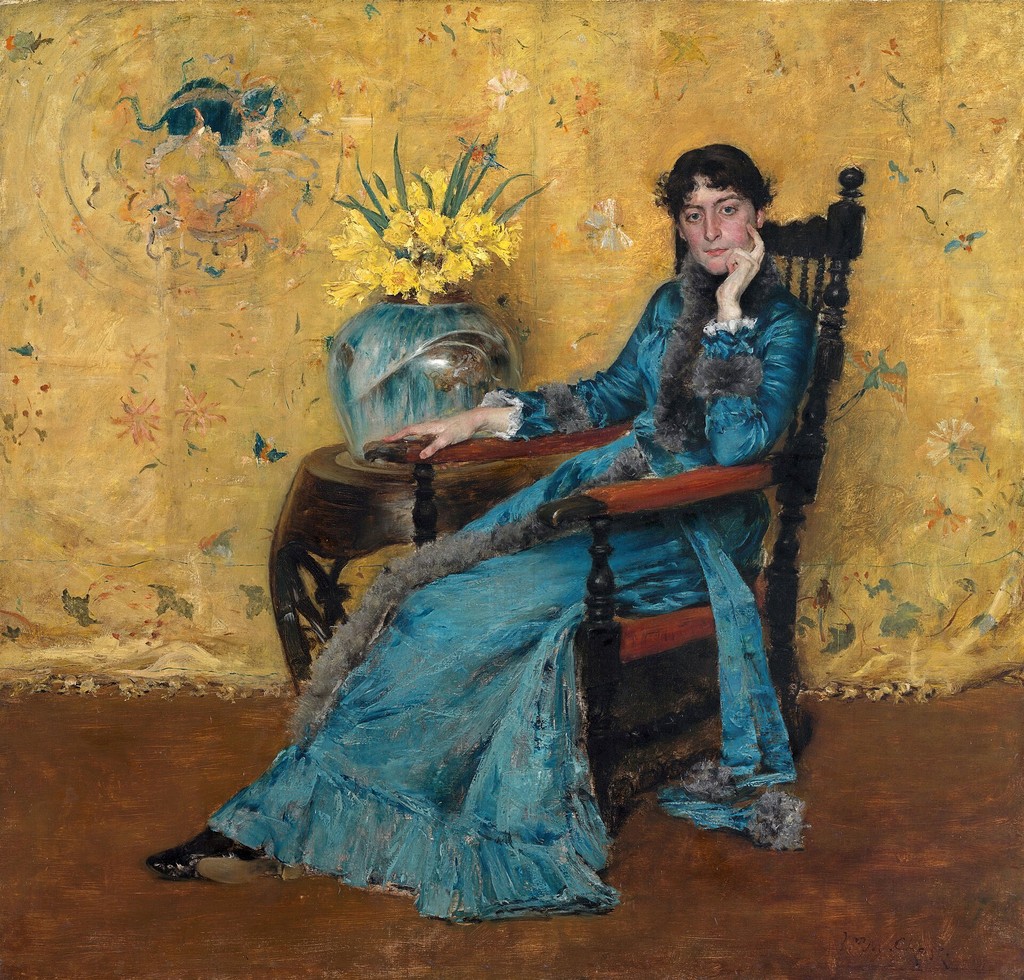
| Portrait of Dora Wheeler | 1882 | Painting |
| Portrait of Lavinia Borden Cook | Date unknown | Painting |
| Portrait of Louis Betts | Date unknown | Painting |
| Portrait of Master Otis Barton and his Grandfather | 1903 | Painting |
| Portrait of Miss D. | Date unknown | Painting |
| Portrait of Mrs. C. (Lady with a White Shawl) | 1893 | Painting |
| Portrait of Mrs. George B. Ely (Caroline Boies Ely) | Date unknown | Painting |
| Portrait of My Daughter Alice | 1895 | Painting |
| Portrait of My Father (David Hester Chase) | Date unknown | Painting |
| Portrait of My Mother (Sarah Swaim Chase) | 1892 | Painting |
| Portrait of William Francklyn Paris | Date unknown | Painting |
| Portrait of William Gurley Munson | 1868 | Painting |
| Ready for the Ride | 1877 | Painting |
| Red Snapper | Date unknown | Painting |
| Robert Frederick Blum | Date unknown | Painting |
| Roland | 1902 | Painting |
| Roses | 1883 | Drawing |
| Seaside Flowers | 1897 | Painting |
| Selbstbildnis | 1875 | Painting |
| Selbstporträt | 1915 | Painting |
| Self-Portrait | 1909 | Drawing |
| Self Portrait | 1914 | Painting |
| Self-Portrait | 1915 | Painting |
| Self-portrait dressed as Johan Claesz Loo by Frans Hals | 1903 | Painting |
| Seventeenth Century Lady | 1895 | Painting |
| Shell Beach at Shinnecock | 1892 | Painting |
| Shinnecock Hills | 1892 | Painting |
| Shinnecock Hills | 1893 | Painting |
| Shinnecock Hills | 1895 | Painting |
| Shinnecock Hills | 1895 | Painting |
| Shinnecock Hills Landscape | 1890 | Painting |
| Shinnecock Studio Interior | 1892 | Drawing |
| Sketch for a Picture--Columbus before the Council of Salamanca (A) (Christopher Columbus before the Council of Salamanca) | 1876 | Painting |
| Sketch for a Picture--Columbus before the Council of Salamanca (B) (Christopher Columbus before the Spanish Council) | 1876 | Painting |
| Sketch of a Child:Helen | 1898 | Painting |
| St. Jerome | 1875 | Painting |
| Still Life | 1912 | Painting |
| Still Life | Date unknown | Painting |
| Still Life | Date unknown | Painting |
| Still Life | Date unknown | Painting |
| Still Life (Brass Bowl) | Date unknown | Painting |
| Still Life (Brushes, Books and Pottery) | 1904 | Painting |
| Still Life: Fish | 1900 | Painting |
| Still Life: Fish | 1903 | Painting |
| Still Life: Fish | 1908 | Painting |
| Still Life: Fish | 1912 | Painting |
| Still-life: Fish and Bowl | 1895 | Painting |
| Still Life (Fruit and Copper Pot) | Date unknown | Painting |
| Still Life (Fruit and Pottery) | Date unknown | Painting |
| Still Life--Striped Bass | 1907 | Painting |
| Still Life with Fish | 1800 | Painting |
| Still Life with Fish | 1910 | Painting |
| Still Life with Fish | 1912 | Painting |
| Still Life with Fish | Date unknown | Painting |
| Still life with fruit | 1871 | Painting |
| Still Life with Hummingbird | 1870 | Painting |
| Still Life with Watermelon | 1869 | Painting |
| Studio Interior | 1882 | Painting |
| Study Head | Date unknown | Painting |
| Study of a Girl in Japanese Dress | 1895 | Painting |
| Study of a Young Woman | 1883 | Painting |
| Study of Flesh Color and Gold | 1888 | Drawing |
| Summer at Shinnecock Hills | 1891 | Painting |
| Sunlight and Shadow, Shinnecock Hills | 1893 | Painting |
| Tenth Street Studio | 1880 | Painting |
| Terrace at the Mall | 1890 | Painting |
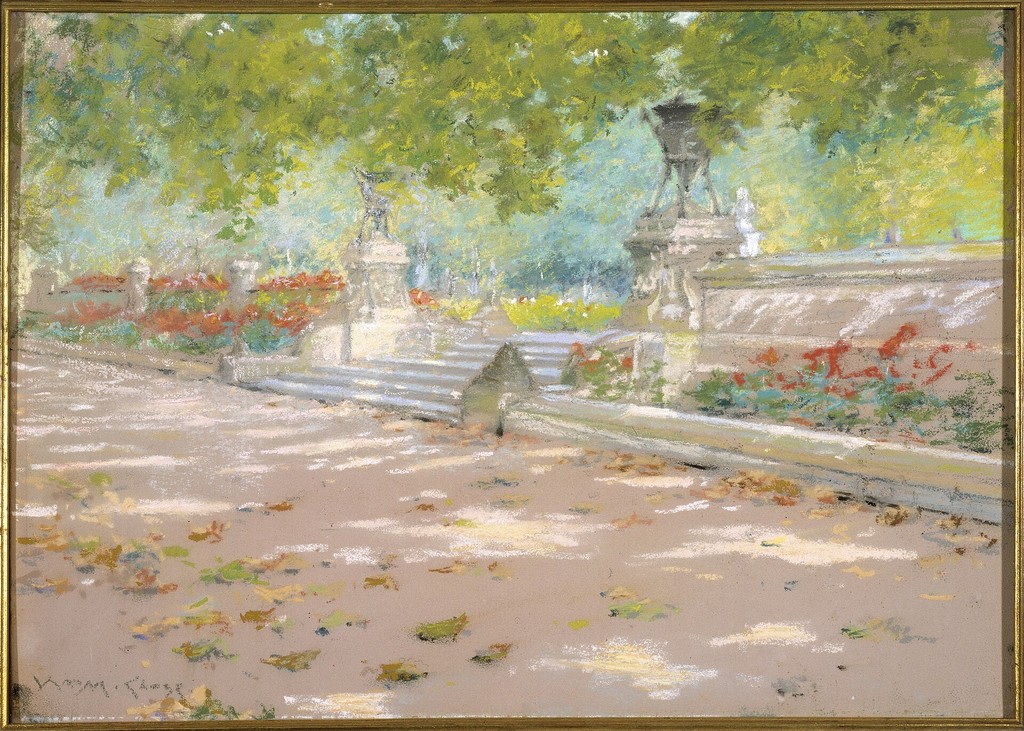
| Terrace, Prospect Park | 1887 | Drawing |
| The Antiquary Shop | 1879 | Painting |
| The Apprentice (Boy with Apple) | 1876 | Painting |
| The Big Brass Bowl | Date unknown | Painting |
| The Blue Kimono | 1915 | Painting |
| The Boat Harbor (Gowanus Pier) | 1888 | Painting |
| The Coast of Holland | 1884 | Painting |
| The Emerald Lady | Date unknown | Painting |
| The Family Cow (Calf's Head) | 1869 | Painting |
| The Keynote | 1915 | Painting |
| The Kimono | 1895 | Painting |
| The Mirror | 1900 | Painting |
| The Model | 1888 | Drawing |
| The Moorish Warrior | 1878 | Painting |
| The Old Road to the Sea | 1893 | Painting |
| The Patrician | 1875 | Painting |
| The Song | 1907 | Painting |
| The Stately Model | 1898 | Painting |
| The Tenth Street Studio | 1880 | Painting |
| The Tow Path | 1880 | Painting |
| The Turkish Page (Unexpected Intrusion) | 1876 | Painting |
| The Whistling Boy | 1875 | Painting |
| The Wounded Poacher | 1878 | Painting |
| The Yield of the Waters | 1878 | Painting |
| The Young Orphan | 1884 | Painting |
| Thomas E. Kirby | 1900 | Painting |
| Thomas Moran | Date unknown | Painting |
| Under a French Sky | 1882 | Painting |
| Venetian Lace Making | Date unknown | Drawing |
| View from Central Park | 1889 | Painting |
| View near Polling | 1875 | Painting |
| William A. Clark | 1915 | Painting |
| William Andrews Clark | 1915 | Painting |
| William Nimick Frew | 1915 | Painting |
| William Rockhill Nelson | 1907 | Painting |
| Wind-Swept Sands | 1894 | Painting |
| Woman in White | 1902 | Painting |
| Woman Seated | 1885 | Drawing |
| Woman Standing in a Landscape | Date unknown | Painting |
| Worthington Whittredge | 1890 | Painting |
Frequently Asked Questions
Chase entered the Munich Royal Academy in 1872, after earlier training in Indianapolis and New York and professional work in St Louis. Financial support from St Louis patrons made the European study possible.[1]
He returned in 1878. That date fits the documented sequence of his Art Students League teaching and his move into the Tenth Street Studio Building, and it is confirmed by the Archives of American Art chronology.[3]
It was a New York building designed by Richard Morris Hunt and opened in 1856 specifically to provide studios for artists. Chase initially rented a small studio, then took over its large shared gallery and made it a prominent workplace and reception setting.[1]
It was both. Chase painted, taught, received sitters and arranged works there, while the room’s objects and receptions presented artistic cultivation to visitors. The Tenth Street Studio shows how closely those practical and social functions could be composed.[4]
Discussion
Use this evidence-led guide as a starting point for close looking rather than a final verdict.
Share an observation about From Munich to Tenth Street or a source that adds useful context.
Reader Insights
Which work most clearly complicates the familiar label of American Impressionist?
Where do training, display, family, place or teaching most productively alter your reading?
Which source or surviving object would you investigate next?
Join the Conversation
Add your reading below, keeping observations specific and evidence clear.
References
- William Merritt Chase (1849–1916) — Metropolitan Museum of Art, accessed 31 August 2026, accessed 31 August 2026.
- William Merritt Chase: A Modern Master — Terra Foundation for American Art, accessed 31 August 2026, accessed 31 August 2026.
- A Finding Aid to the William Merritt Chase Papers — Archives of American Art, Smithsonian Institution, accessed 31 August 2026, accessed 31 August 2026.
- The Tenth Street Studio — Saint Louis Art Museum, accessed 31 August 2026, accessed 31 August 2026.
- Lady in Black — Metropolitan Museum of Art, accessed 31 August 2026, accessed 31 August 2026.
- James Abbott McNeill Whistler — Metropolitan Museum of Art, accessed 31 August 2026, accessed 31 August 2026.