 by Tom Gurney
Tom Gurney BSc (Hons) is an art history expert with over 20 years experience
Page Created on August 31, 2026 / Page Updated on November 6, 2026
Email: tomgurney1@gmail.com / Phone: +44 7429 011000
Portrait of Dora Wheeler: Introduction
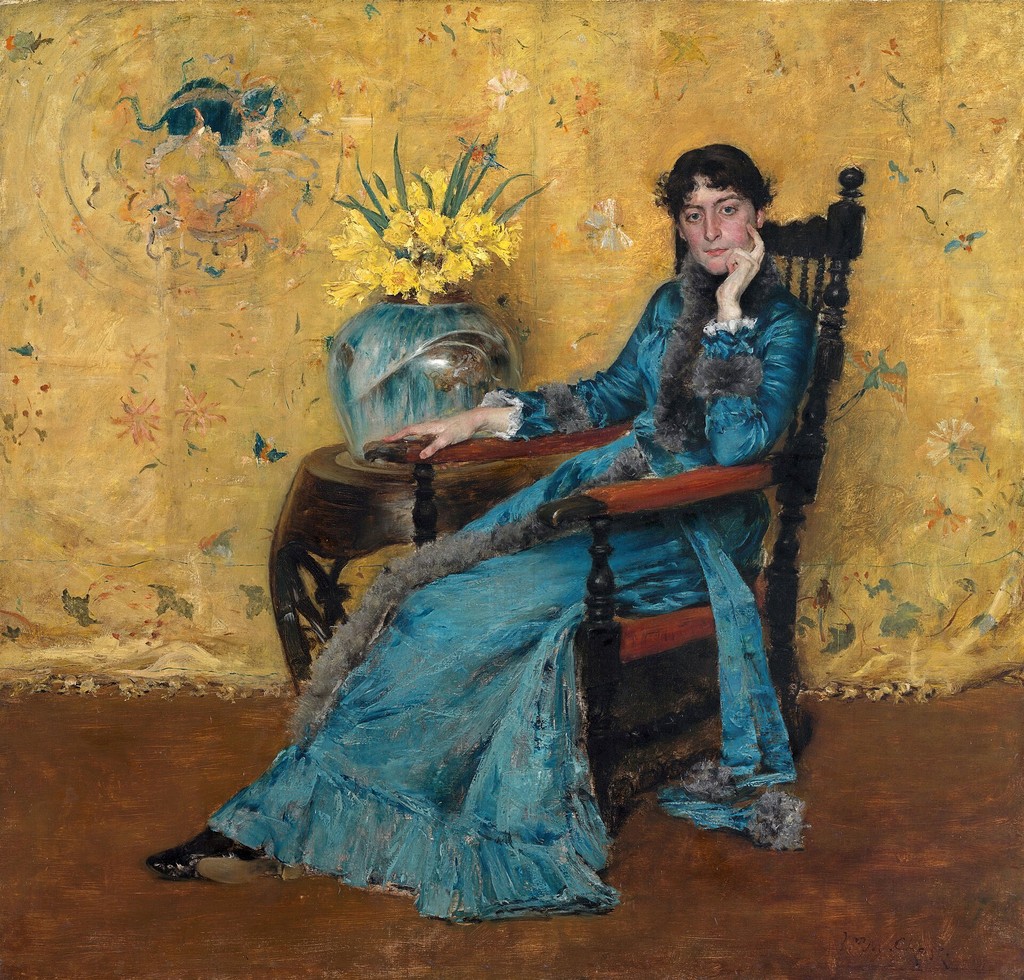
William Merritt Chase’s Portrait of Dora Wheeler presents an artist and designer amid colour, fabric and cultivated display. Painted in 1882–83, it is both a commanding likeness and a record of a professional relationship. Wheeler had studied with Chase before helping to establish a decorating business with her mother, and the textile behind her belongs to that working history rather than serving as anonymous ornament. The portrait’s unusual breadth gives her, her chair and the designed setting comparable visual weight.
At a Glance
- ArtistWilliam Merritt Chase
- TitlePortrait of Dora Wheeler
- Date1882–83
- MediumOil on canvas
- Dimensions159.8 × 166.4 cm, unframed
- CollectionCleveland Museum of Art, accession 1921.1239
William Merritt Chase in context
Keying Up – The Court Jester
1875Portrait of Dora Wheeler
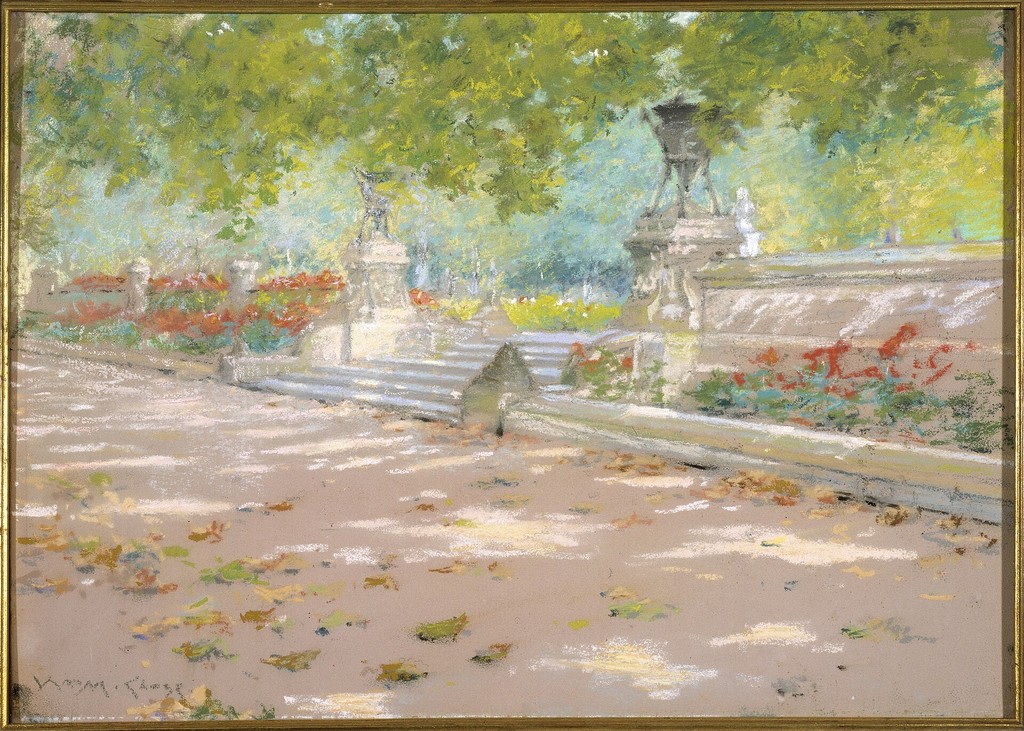
1882–83Terrace, Prospect Park
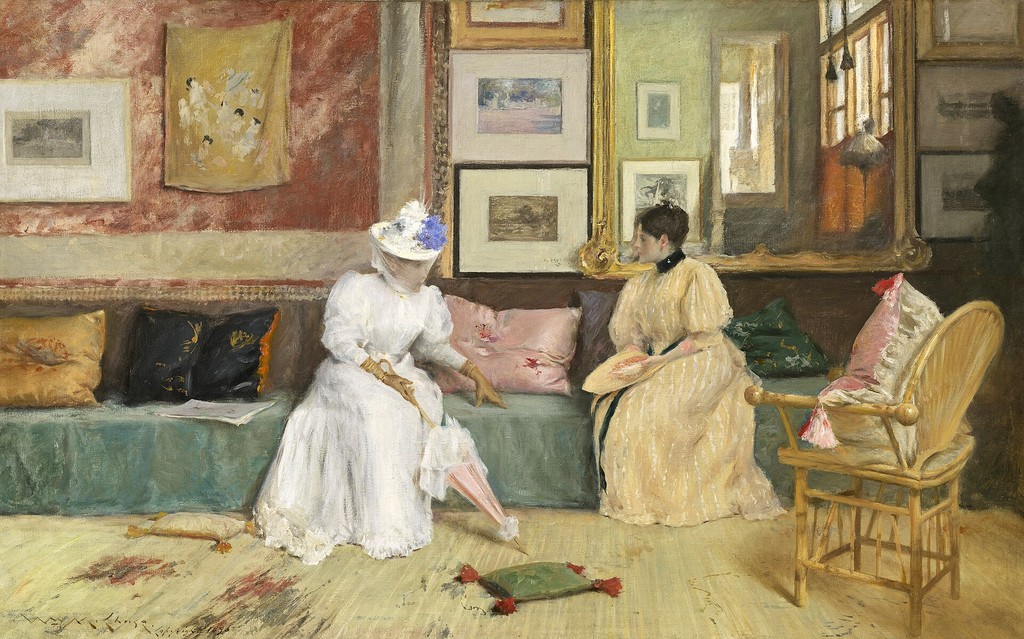
c. 1887A Friendly Call
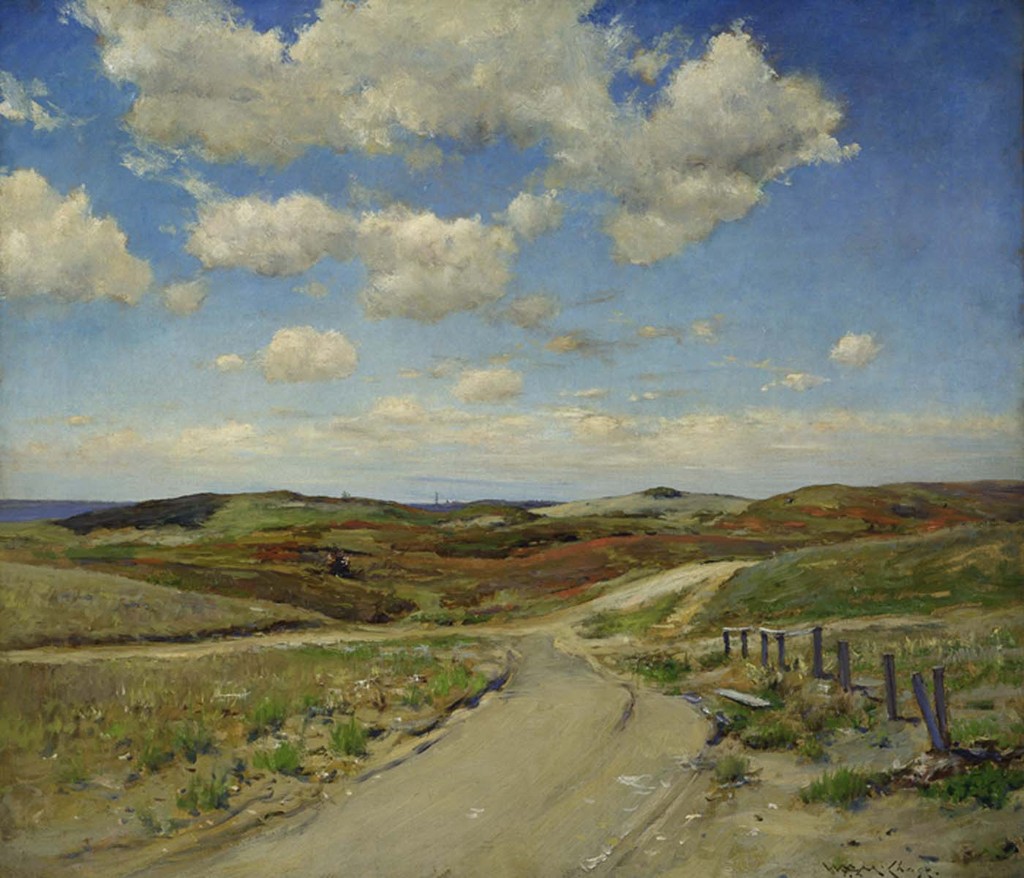
1895Shinnecock Hills
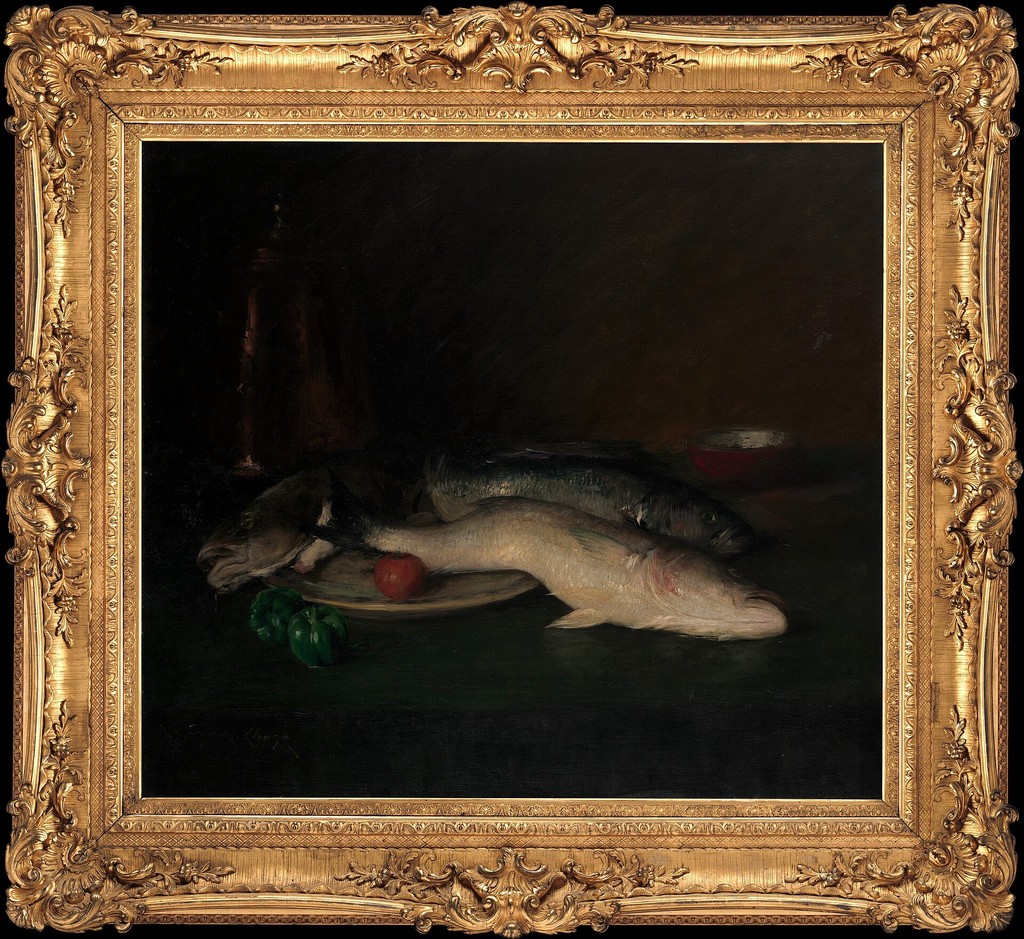
c. 1895Still Life: Fish
by 1908Contents
- Introduction
- A Portrait with a Named Professional Subject
- A Nearly Square Field
- Pose without a Fixed Story
- Dress, Tapestry and Vivid Colour
- Painterly Handling and Material Difference
- Early New York and International Ambition
- Dora Wheeler, Lady in Black and Mrs C
- Exhibition History and the Sitter’s Agency
A Portrait with a Named Professional Subject
Dora Wheeler is not an unidentified model enlisted to carry a costume or a mood. Cleveland records her as Chase’s earliest pupil after his Munich studies and as a designer of luxurious textiles for the decorating firm she founded with her mother. The museum describes that enterprise as one of the earliest businesses in the United States run entirely by women. It also records their joint fundraising for the Statue of Liberty’s pedestal.[1]
Those facts change how the painting is read. Wheeler’s name, training and occupation anchor it in a relationship between two creative professionals, although Chase remained teacher and portraitist. The woven field behind her can be connected to her design practice through institutional evidence. There is no need to turn her expression into a story about private feeling. What the picture offers is more concrete: a poised sitter in an environment whose strongest feature speaks directly to her work.
This emphasis places the painting at the centre of Chase’s wider portraiture, where identity, dress and painterly display take different forms from sitter to sitter.
A Nearly Square Field
The unframed canvas is 159.8 centimetres high and 166.4 centimetres wide.[1] That makes it only slightly broader than it is tall, an unexpected format for a seated portrait at close to life size. A narrow upright might have isolated Wheeler as a columnar figure. Chase instead gives her room to extend diagonally across a square-like field. Her skirt travels down and left, while the chair, table, vase and flowers expand the composition across the remaining width.
The format balances person and setting. Wheeler’s body occupies the lower and right portions of the canvas; the gold textile spreads across almost the entire backdrop. The large vase and yellow flowers make a secondary vertical near the centre. They are substantial accessories, yet Wheeler’s face remains the point to which the surrounding contrasts lead.
From a distance, blue-green clothing, warm gold and dark furniture form substantial blocks. Closer looking breaks them into shifting strokes and patterns. The portrait works both as a public statement and as a demonstration of handling.
Pose without a Fixed Story
Wheeler sits in a carved wooden chair, her body angled across its arms. One hand supports her face; the other rests beside the vase. Her gaze passes outward rather than meeting the viewer squarely. Bent elbow, tilted head and descending skirt make a sequence of diagonals.
It is tempting to label the pose dreamy, bored or melancholy, but such terms claim knowledge the painting cannot supply. More securely, the arrangement slows the body while keeping it structurally active. The extended arm carries the eye towards the centre, and the long fall of fabric takes it towards the lower edge. Wheeler is given physical ease within an emphatically constructed design.
That distinction matters. Chase’s portrait invites attention to bearing without turning a gesture into a diagnosis. Wheeler’s professional history supplies a firmer context than invented psychology does.
Dress, Tapestry and Vivid Colour
The dress reads as dark around the bodice and fur-like trim, yet its blue-green fabric becomes intensely coloured where it catches the light. Chase varies it from near-black passages to turquoise and bright blue. Red-brown chair arms cut across this cool mass, while the floor forms a broad, warm base. The strongest counterweight is the embroidered silk tapestry, whose ochres and golds surround both sitter and furnishings.[1]
Scattered motifs, loose marks and changes of tone make the background visibly patterned. Cleveland connects the textile to Wheeler’s work as a designer.[1] Pattern is therefore an attribute of her professional world, not merely a sign of the painter’s taste. The vase repeats the dress’s blues through a harder, rounded surface; yellow flowers gather the gold into a brighter cluster.
Rather than separating figure from decoration, Chase makes them interact. Blue presses against gold; tiny coloured incidents in the hanging answer more forceful strokes in the costume; smooth skin is framed by dark hair and trim. Quieter intervals in the tapestry keep the larger forms legible.
Painterly Handling and Material Difference
Chase’s brushwork does not describe every textile thread or carved detail with equal finish. The skirt is assembled from directional strokes that suggest sheen, weight and folds without hiding the movement of paint. The trim is rougher and softer, the chair firmer and darker, the vase more reflective. Behind them, the tapestry’s imagery often approaches coloured notation rather than exact illustration.
Oil paint performs different jobs across the surface: it models Wheeler’s face, flashes across satin, thickens a flower and abbreviates embroidery. Instead of simply copying a designed interior, Chase translates fabric, skin, ceramic, wood and fur-like edging into differences of touch.
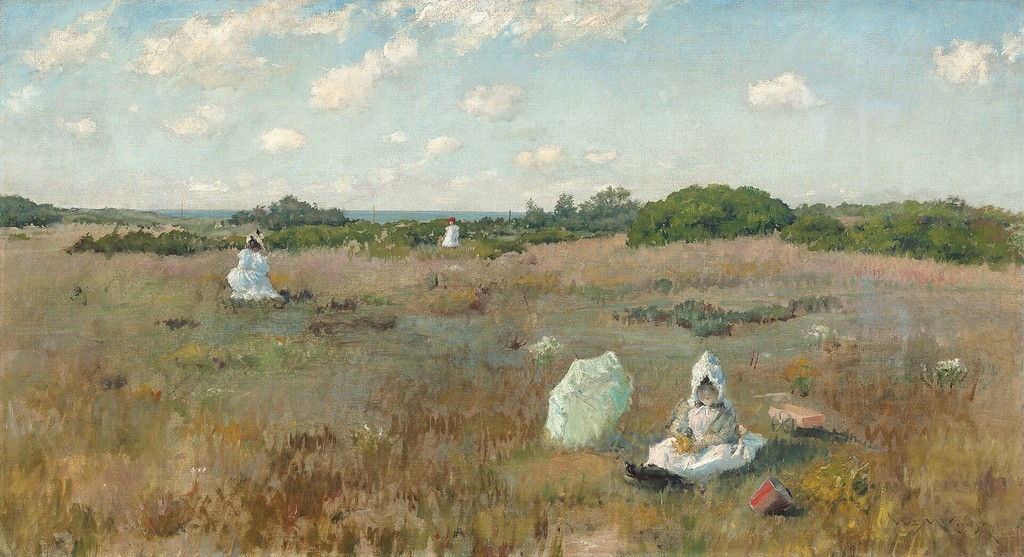
The result fits the technical breadth emphasised in the retrospective William Merritt Chase: A Modern Master, which treated Chase as an eclectic painter who experimented across subjects and methods rather than following one consistent formula.[2] Readers exploring his other paintings and artworks can see that variety extending from portraits and interiors to still lifes and open-air landscapes.
Early New York and International Ambition
The painting belongs to the first years after Chase returned to New York in 1878. His Munich training had strengthened his command of dark tonal structure and vigorous handling. In New York, teaching joined exhibition and artistic self-presentation: he took up duties at the Art Students League and transformed his Tenth Street rooms into a conspicuous arena for work and sociability.[3]
Wheeler’s status as his first student after the return is part of a larger shift: Chase was establishing himself as a teacher as well as a painter. Cleveland notes that few American artists then accepted women as private pupils.[1] The biography and account of his path from Munich to Tenth Street trace this transition further.
The portrait received a gold medal in Munich in 1883 and appeared in Paris that year.[1] These exhibitions reconnect the young New York portraitist to the European arena in which his ambitions had formed. Its cosmopolitan character does not depend on one foreign master: scale, colour, decorative density and mobile handling combine for a particular sitter.
Dora Wheeler, Lady in Black and Mrs C
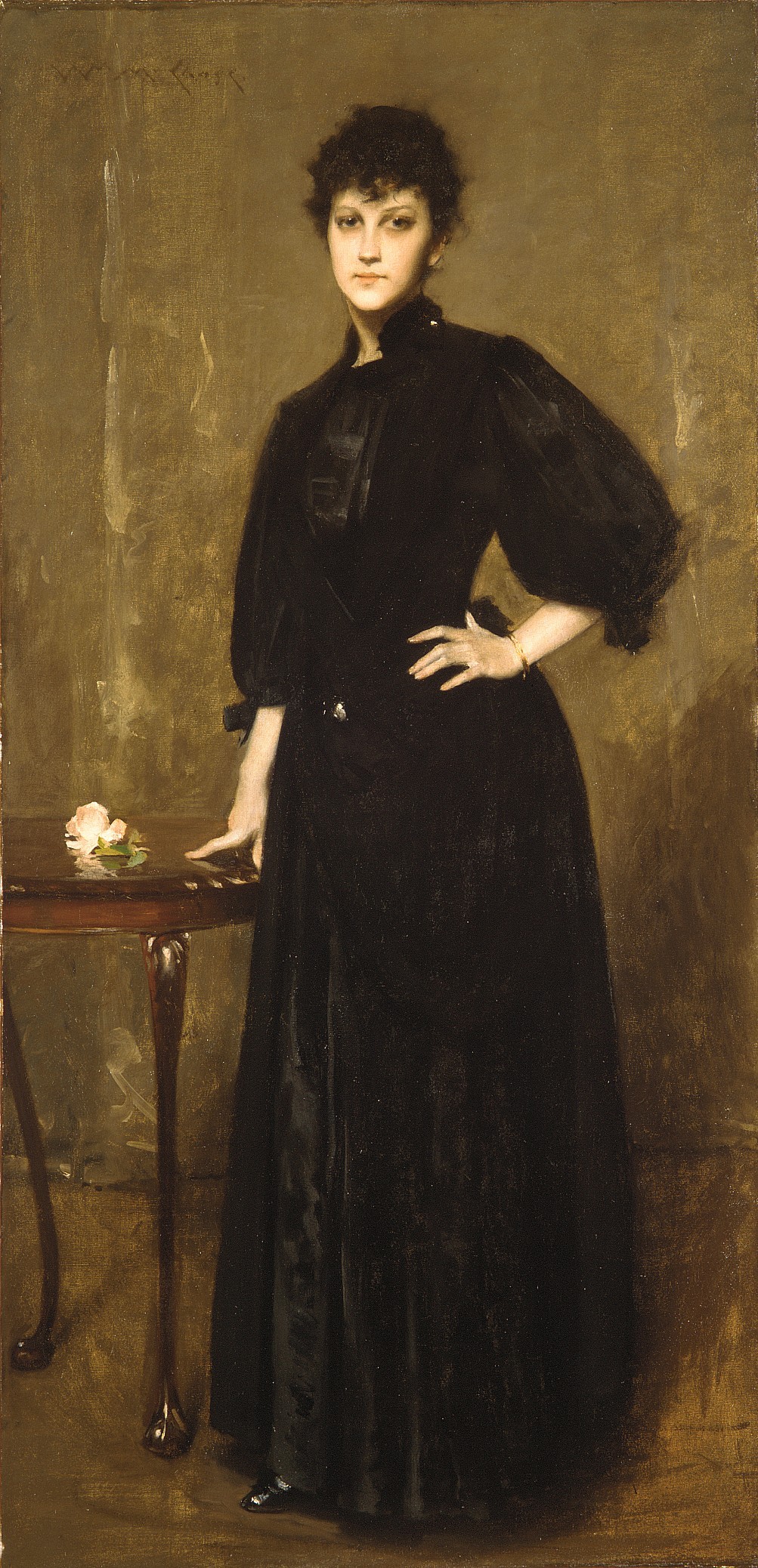
Later portraits clarify how naming shapes interpretation. In Lady in Black of 1888, the model was Marietta Benedict Cotton, a Chase student who became a society portraitist. The Met relates its narrow, predominantly dark arrangement to his awareness of Whistler and Sargent.[4] His 1885 portrait of Whistler adopted a muted palette, fluid handling and ambiguous space associated with its subject’s recent work.[5] These exchanges do not completely explain Wheeler’s earlier portrait.
The differences are instructive. Lady in Black stretches its standing figure through a tall vertical format; Portrait of Dora Wheeler opens sideways and embeds a seated figure in brilliant pattern. Both women had professional connections to art, yet each painting sets a different problem of colour, scale and social presentation.
Portrait of Mrs. C. (Lady with a White Shawl) of 1893 presents another issue. The Pennsylvania Academy of the Fine Arts lists proposed identities without confirming one.[6] That uncertainty should remain. Wheeler’s current title and documented career keep her identity in view: one image asks how a known designer is represented; the other shows how an initial can loosen a portrait from biographical certainty.
Together, the comparisons resist a single formula for Chase’s women sitters. They also show why names matter. A known professional history can direct attention towards labour and design, while an uncertain identity requires explicit restraint.
Exhibition History and the Sitter’s Agency
The Munich medal and Paris showing establish that this was more than a private likeness. Its monumentality, colour and conspicuous textile suited international display. Yet its later history returns attention to Wheeler. Cleveland records that she acquired the painting and donated it to the museum; the 1921 credit identifies her as Mrs Boudinot Keith.[1]
That movement—from collaboration, to exhibition object, to the sitter’s possession and gift—complicates any account centred solely on Chase. Wheeler was the represented subject, a former pupil, a working designer, an owner and ultimately a donor. The painting’s survival in a public collection is part of her history as well as his.
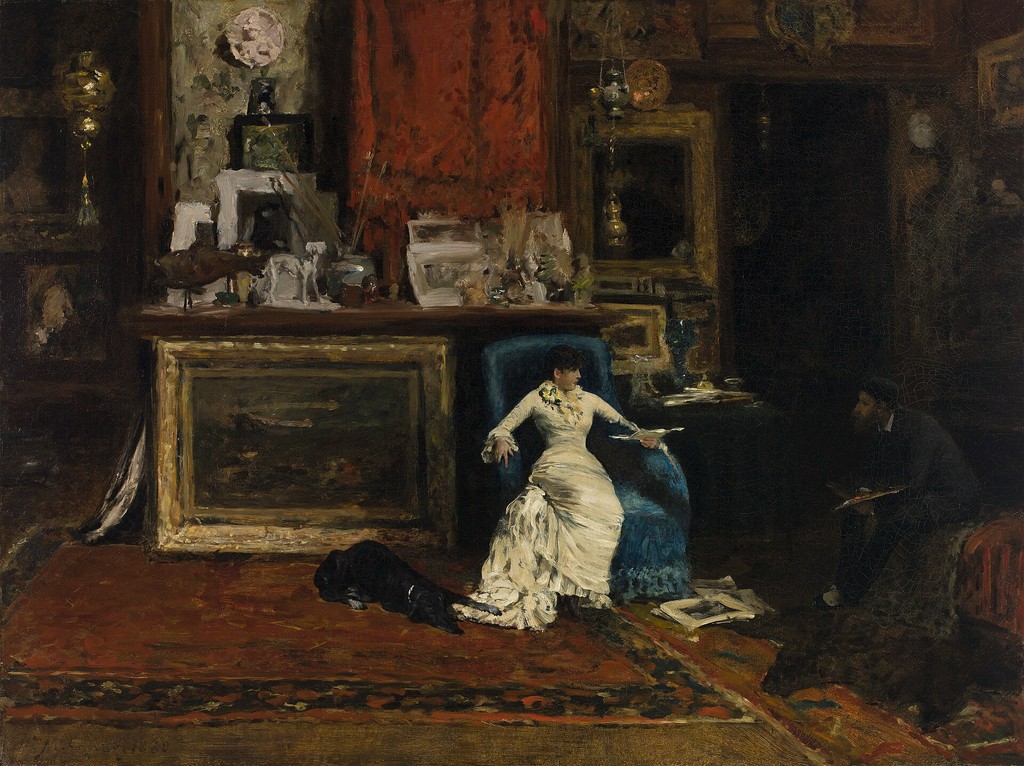
Within William Merritt Chase’s work, the portrait is especially revealing because its decorative force is inseparable from a documented creative life. His celebrated Tenth Street Studio provided one arena for artistic display; Wheeler’s textile makes this canvas another, one in which the subject’s own profession remains visible.
Researched works directory
This searchable evidence census contains 208 distinct records assembled from public collection data and a reproducible Wikidata snapshot. It is not a catalogue raisonné, not a claim of complete oeuvre coverage, and it keeps works with repeated titles as separate objects.
| Name | Date | Medium |
|---|---|---|
| A City Park | 1887 | Painting |
| A Corner of My Studio | Date unknown | Painting |
| A Dutch Landscape | 1884 | Painting |
| A Friendly Call | 1895 | Painting |
| A Gray Day | 1886 | Painting |
| A Modern Magdalen | 1888 | Painting |
| A Spanish Gypsy | 1905 | Painting |
| Albert Harkness (1822–1907) | 1908 | Painting |
| Alice | 1892 | Painting |
| An Afternoon Stroll | 1895 | Painting |
| An English Cod | 1904 | Painting |
| At the Seaside | 1890 | Painting |
| August B. Loeb | 1905 | Painting |
| Baron Hugo von Habermann | 1875 | Painting |
| Beach | 1895 | Painting |
| Bessie Potter | 1895 | Painting |
| Big Copper Kettle and Fish (Fish) | Date unknown | Painting |
| Bildnis Hugo von Habermann | 1875 | Painting |
| Brass Kettle and Catfish | Date unknown | Painting |
| Carmencita | 1890 | Painting |
| Courtyard in Venice | 1877 | Painting |
| Crucifixion | 1875 | Painting |
| Der japanische Holzschnitt | 1888 | Painting |
| Dieudonnée | 1899 | Painting |
| Dorothy | 1902 | Painting |
| Dr. Eduardo San Giovanni | 1906 | Drawing |
| Duveneck Painting "The Turkish Page | 1876 | Painting |
| Edward Everett Hale (1822-1909) | 1884 | Painting |
| Edward Guthrie Kennedy | 1895 | Painting |
| Edward Steichen | 1903 | Painting |
| Female Figure Study (front view) | Date unknown | Painting |
| Female Figure Study (side view) | Date unknown | Painting |
| First Touch of Autumn | 1898 | Painting |
| Fish | 1910 | Painting |
| Fish and Still Life | 1906 | Painting |
| Fish and Still Life | 1908 | Painting |
| Florence | 1907 | Painting |
| For the Little One | 1896 | Painting |
| Garden of the Orphanage, Haarlem, Holland | 1883 | Painting |
| Gathering Autumn Flowers | 1894 | Painting |
| Gathering Flowers, Shinnecock, Long Island | 1897 | Drawing |
| Girl at a Bureau | Date unknown | Painting |
| Girl in a Japanese Costume | 1890 | Painting |
| Girl in Ciociaro costume | 1876 | Painting |
| Girl in White | 1890 | Painting |
| Girl with Doll | 1910 | Painting |
| Gray Day on the Bay | 1886 | Painting |
| Gray Day on the Lagoon | 1913 | Painting |
| Harbor Scene, Brooklyn Dock | 1886 | Painting |
| Harriet Hubbard Ayer | 1880 | Painting |
| Head of a Man | 1875 | Painting |
| Hide and Seek | 1888 | Painting |
| I Think I'm Ready Now | 1883 | Painting |
| Idle Hours | 1894 | Painting |
| In the Park (A By-path) | 1889 | Painting |
| In the Studio Corner | 1881 | Painting |
| In Venice | 1877 | Painting |
| James Abbott McNeill Whistler | 1885 | Painting |
| John Butler Talcott | 1900 | Painting |
| Just Onions (Onions; Still Life) | Date unknown | Painting |
| Keying Up" - The Court Jester | 1875 | Painting |
| Keying Up: The Court Jester | 1875 | |
| L'Éventail de plumes | Date unknown | Painting |
| Lady in Black | 1888 | Painting |
| Lady Playing Guitar | Date unknown | Painting |
| Landscape- Shinnecock, Long Island | 1896 | Painting |
| Long Island Landscape after a Shower of Rain (After the Shower) | 1889 | Painting |
| Lydia Field Emmet | 1892 | Painting |
| Man Wearing Gold Rimmed Glasses | 1892 | Painting |
| Marine | 1888 | Painting |
| Monkeying with Literature | 1877 | Painting |
| Moses Swaim | Date unknown | Painting |
| Mother and Child (The First Portrait) | 1887 | Painting |
| Mrs. Charles Scott | Date unknown | Painting |
| Mrs. Chase | 1890 | Painting |
| Mrs. Chase in Prospect Park | 1886 | Painting |
| Mrs. William Clark | 1915 | Painting |
| Mrs. William Merritt Chase | 1890 | Painting |
| My Little Daughter Dorothy | 1894 | Painting |
| My Palette | 1875 | Painting |
| Myra Reynolds | 1898 | Painting |
| Near the Beach, Shinnecock | 1895 | Painting |
| Near the Beach, Shinnecock | Date unknown | Painting |
| North River Shad | 1910 | Painting |
| Nude | 1901 | Painting |
| Open Air Breakfast | 1888 | Painting |
| Outskirts of Madrid | 1882 | Painting |
| Pablo de Sarasate: Portrait of a Violinist | 1875 | Painting |
| Park Bench | 1890 | Painting |
| Peace, Fort Hamilton | 1888 | Painting |
| Pink Azalea—Chinese Vase | 1885 | Painting |
| Portrait Head | 1882 | Painting |
| Portrait of a Boy in Van Dyck Costume | 1875 | Painting |
| Portrait of a Child | 1884 | Painting |
| Portrait of a Lady in Black | 1895 | Painting |
| Portrait of a Lady in Black (Annie Traquair Lang) | 1911 | Painting |
| Portrait of a Lady in Pink | Date unknown | Painting |
| Portrait of a Man | 1874 | Painting |
| Portrait of a Man | 1875 | Painting |
| Portrait of a Woman | Date unknown | Painting |
| Portrait of Artist Beck Wenzell | 1900 | Painting |
| Portrait of Baroness Ida-Gro van Dahlerup | 1907 | Painting |
| Portrait of Dora Wheeler | 1882 | Painting |
| Portrait of Lavinia Borden Cook | Date unknown | Painting |
| Portrait of Louis Betts | Date unknown | Painting |
| Portrait of Master Otis Barton and his Grandfather | 1903 | Painting |
| Portrait of Miss D. | Date unknown | Painting |
| Portrait of Mrs. C. (Lady with a White Shawl) | 1893 | Painting |
| Portrait of Mrs. George B. Ely (Caroline Boies Ely) | Date unknown | Painting |
| Portrait of My Daughter Alice | 1895 | Painting |
| Portrait of My Father (David Hester Chase) | Date unknown | Painting |
| Portrait of My Mother (Sarah Swaim Chase) | 1892 | Painting |
| Portrait of William Francklyn Paris | Date unknown | Painting |
| Portrait of William Gurley Munson | 1868 | Painting |
| Ready for the Ride | 1877 | Painting |
| Red Snapper | Date unknown | Painting |
| Robert Frederick Blum | Date unknown | Painting |
| Roland | 1902 | Painting |
| Roses | 1883 | Drawing |
| Seaside Flowers | 1897 | Painting |
| Selbstbildnis | 1875 | Painting |
| Selbstporträt | 1915 | Painting |
| Self-Portrait | 1909 | Drawing |
| Self Portrait | 1914 | Painting |
| Self-Portrait | 1915 | Painting |
| Self-portrait dressed as Johan Claesz Loo by Frans Hals | 1903 | Painting |
| Seventeenth Century Lady | 1895 | Painting |
| Shell Beach at Shinnecock | 1892 | Painting |
| Shinnecock Hills | 1892 | Painting |
| Shinnecock Hills | 1893 | Painting |
| Shinnecock Hills | 1895 | Painting |
| Shinnecock Hills | 1895 | Painting |
| Shinnecock Hills Landscape | 1890 | Painting |
| Shinnecock Studio Interior | 1892 | Drawing |
| Sketch for a Picture--Columbus before the Council of Salamanca (A) (Christopher Columbus before the Council of Salamanca) | 1876 | Painting |
| Sketch for a Picture--Columbus before the Council of Salamanca (B) (Christopher Columbus before the Spanish Council) | 1876 | Painting |
| Sketch of a Child:Helen | 1898 | Painting |
| St. Jerome | 1875 | Painting |
| Still Life | 1912 | Painting |
| Still Life | Date unknown | Painting |
| Still Life | Date unknown | Painting |
| Still Life | Date unknown | Painting |
| Still Life (Brass Bowl) | Date unknown | Painting |
| Still Life (Brushes, Books and Pottery) | 1904 | Painting |
| Still Life: Fish | 1900 | Painting |
| Still Life: Fish | 1903 | Painting |
| Still Life: Fish | 1908 | Painting |
| Still Life: Fish | 1912 | Painting |
| Still-life: Fish and Bowl | 1895 | Painting |
| Still Life (Fruit and Copper Pot) | Date unknown | Painting |
| Still Life (Fruit and Pottery) | Date unknown | Painting |
| Still Life--Striped Bass | 1907 | Painting |
| Still Life with Fish | 1800 | Painting |
| Still Life with Fish | 1910 | Painting |
| Still Life with Fish | 1912 | Painting |
| Still Life with Fish | Date unknown | Painting |
| Still life with fruit | 1871 | Painting |
| Still Life with Hummingbird | 1870 | Painting |
| Still Life with Watermelon | 1869 | Painting |
| Studio Interior | 1882 | Painting |
| Study Head | Date unknown | Painting |
| Study of a Girl in Japanese Dress | 1895 | Painting |
| Study of a Young Woman | 1883 | Painting |
| Study of Flesh Color and Gold | 1888 | Drawing |
| Summer at Shinnecock Hills | 1891 | Painting |
| Sunlight and Shadow, Shinnecock Hills | 1893 | Painting |
| Tenth Street Studio | 1880 | Painting |
| Terrace at the Mall | 1890 | Painting |
| Terrace, Prospect Park | 1887 | Drawing |
| The Antiquary Shop | 1879 | Painting |
| The Apprentice (Boy with Apple) | 1876 | Painting |
| The Big Brass Bowl | Date unknown | Painting |
| The Blue Kimono | 1915 | Painting |
| The Boat Harbor (Gowanus Pier) | 1888 | Painting |
| The Coast of Holland | 1884 | Painting |
| The Emerald Lady | Date unknown | Painting |
| The Family Cow (Calf's Head) | 1869 | Painting |
| The Keynote | 1915 | Painting |
| The Kimono | 1895 | Painting |
| The Mirror | 1900 | Painting |
| The Model | 1888 | Drawing |
| The Moorish Warrior | 1878 | Painting |
| The Old Road to the Sea | 1893 | Painting |
| The Patrician | 1875 | Painting |
| The Song | 1907 | Painting |
| The Stately Model | 1898 | Painting |
| The Tenth Street Studio | 1880 | Painting |
| The Tow Path | 1880 | Painting |
| The Turkish Page (Unexpected Intrusion) | 1876 | Painting |
| The Whistling Boy | 1875 | Painting |
| The Wounded Poacher | 1878 | Painting |
| The Yield of the Waters | 1878 | Painting |
| The Young Orphan | 1884 | Painting |
| Thomas E. Kirby | 1900 | Painting |
| Thomas Moran | Date unknown | Painting |
| Under a French Sky | 1882 | Painting |
| Venetian Lace Making | Date unknown | Drawing |
| View from Central Park | 1889 | Painting |
| View near Polling | 1875 | Painting |
| William A. Clark | 1915 | Painting |
| William Andrews Clark | 1915 | Painting |
| William Nimick Frew | 1915 | Painting |
| William Rockhill Nelson | 1907 | Painting |
| Wind-Swept Sands | 1894 | Painting |
| Woman in White | 1902 | Painting |
| Woman Seated | 1885 | Drawing |
| Woman Standing in a Landscape | Date unknown | Painting |
| Worthington Whittredge | 1890 | Painting |
Frequently Asked Questions
Dora Wheeler was an artist and textile designer. She was Chase’s earliest New York pupil after his European study, then joined her mother in founding a successful decorating firm run entirely by women.[1]
Chase painted it in 1882–83, early in his New York career. It received a Munich gold medal and appeared in Paris during 1883.[1]
An embroidered silk tapestry fills the background. Cleveland connects it to Wheeler’s professional interest in textile design. Its warm gold field and scattered coloured motifs also provide the main contrast with her blue-green dress.[1]
At 159.8 × 166.4 centimetres unframed, the canvas is nearly square rather than conventionally narrow and upright. Its breadth accommodates Wheeler’s diagonal seated pose as well as the chair, vase, flowers and expansive textile backdrop.
It is in the Cleveland Museum of Art, accession 1921.1239. The museum records that Wheeler, later Mrs Boudinot Keith, owned the portrait and donated it to the collection.[1]
Discussion
Use this evidence-led guide as a starting point for close looking rather than a final verdict.
Share an observation about Portrait of Dora Wheeler or a source that adds useful context.
Reader Insights
Which visible detail most changes your reading of Portrait of Dora Wheeler?
How do medium, scale, setting and current museum evidence shape the encounter?
What remains uncertain once documented fact is separated from visual inference?
Join the Conversation
Add your reading below, keeping observations specific and evidence clear.
References
- Portrait of Dora Wheeler — Cleveland Museum of Art, accessed 31 August 2026, accessed 31 August 2026.
- William Merritt Chase: A Modern Master — Terra Foundation for American Art, accessed 31 August 2026, accessed 31 August 2026.
- William Merritt Chase (1849–1916) — Metropolitan Museum of Art, accessed 31 August 2026, accessed 31 August 2026.
- Lady in Black — Metropolitan Museum of Art, accessed 31 August 2026, accessed 31 August 2026.
- James Abbott McNeill Whistler — Metropolitan Museum of Art, accessed 31 August 2026, accessed 31 August 2026.
- Portrait of Mrs. C. (Lady with a White Shawl) — Pennsylvania Academy of the Fine Arts, accessed 31 August 2026, accessed 31 August 2026.