 by Tom Gurney
Tom Gurney BSc (Hons) is an art history expert with over 20 years experience
Page Created on August 31, 2026 / Page Updated on November 6, 2026
Email: tomgurney1@gmail.com / Phone: +44 7429 011000
William Merritt Chase Paintings and Artworks: Introduction
William Merritt Chase worked across portraiture, interiors, still life, landscape and pastel with unusual fluency. “Paintings” is therefore a convenient way into his art, but it does not encompass everything he made. Following the subjects, places and materials in turn reveals a practice that could be darkly tonal, brilliantly coloured, socially staged or quietly observational—sometimes within the same decade.
At a Glance
- ArtistWilliam Merritt Chase (1849–1916)
- Principal mediaOil, pastel, drawing and printmaking
- Recurring subjectsPortraits, interiors, still lifes, city parks and Shinnecock landscapes
- Useful starting pointCompare one figure painting, one still life and one outdoor scene
- Directory scope208 distinct records in a dated researched online works census
- Census breakdown197 paintings, 10 drawings or pastels and 1 print
Contents
- Introduction
- Why “Paintings” Is a Practical Entrance
- Portraits and Interiors: Making a Modern Presence
- Still Life: Tradition Made Present
- New York Parks and the Art of the Everyday
- Shinnecock: Landscape, Family and Teaching
- Pastel as a Painterly Medium
- Six Works for a Comparative View
- How to Use the Researched Online Works Census
Why “Paintings” Is a Practical Entrance
Oil paintings form the largest and most visible part of Chase’s surviving reputation. They include the shadowed Munich-period pictures that first established him, the cultivated interiors of his Tenth Street years, commissioned and exhibition portraits, fish still lifes, New York park scenes, and the sunlit landscapes associated with Shinnecock. A major retrospective at the Museum of Fine Arts, Boston, stressed both this range of subject and his achievement in oil and pastel.[1] The variety matters because it resists a single label. Chase responded to painterly realism, Aestheticism and Impressionism, yet he did not simply exchange one manner for another.
His choices often depended on the work at hand. Dark grounds and vigorous handling could lend weight to a portrait or still life, while a park or coastal landscape invited a higher-keyed palette and quicker notation of light. The Metropolitan Museum of Art characterises him as an eclectic who combined international and historical models.[2] That judgement helps explain why apparently opposed qualities coexist across his career. Chase treated tradition as a working resource, not a rule that prevented experiment.
Painting remains the most practical organising term, but pastel deserves equal attention as a finished medium. The pastels and works on paper section restores that dimension, while the researched online works census makes its limited online representation visible rather than folding every object into oil painting.
Selected William Merritt Chase paintings
Portraits and Interiors: Making a Modern Presence
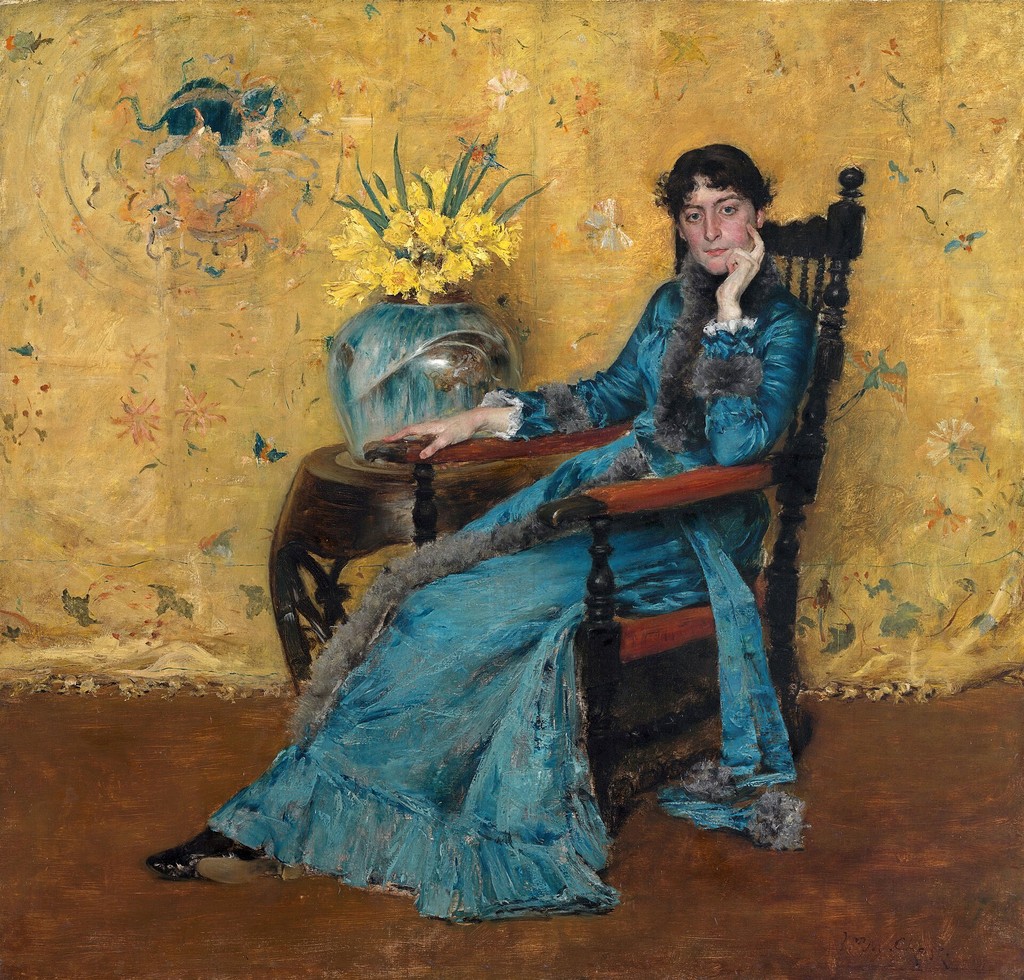
Chase’s portraits join close observation to deliberate presentation. Dress, furnishings, posture and tonal arrangement help locate sitters within a social world; they are active components rather than incidental decoration. In Portrait of Dora Wheeler (1882–83), Dora Wheeler reclines against an embroidered textile connected with her work as a designer. The Cleveland Museum of Art identifies her as Chase’s first student after his return from Munich and records the portrait’s exhibition success in Munich and Paris.[3] The picture can therefore be read at once as likeness, display of artistic skill and recognition of Wheeler’s professional identity.
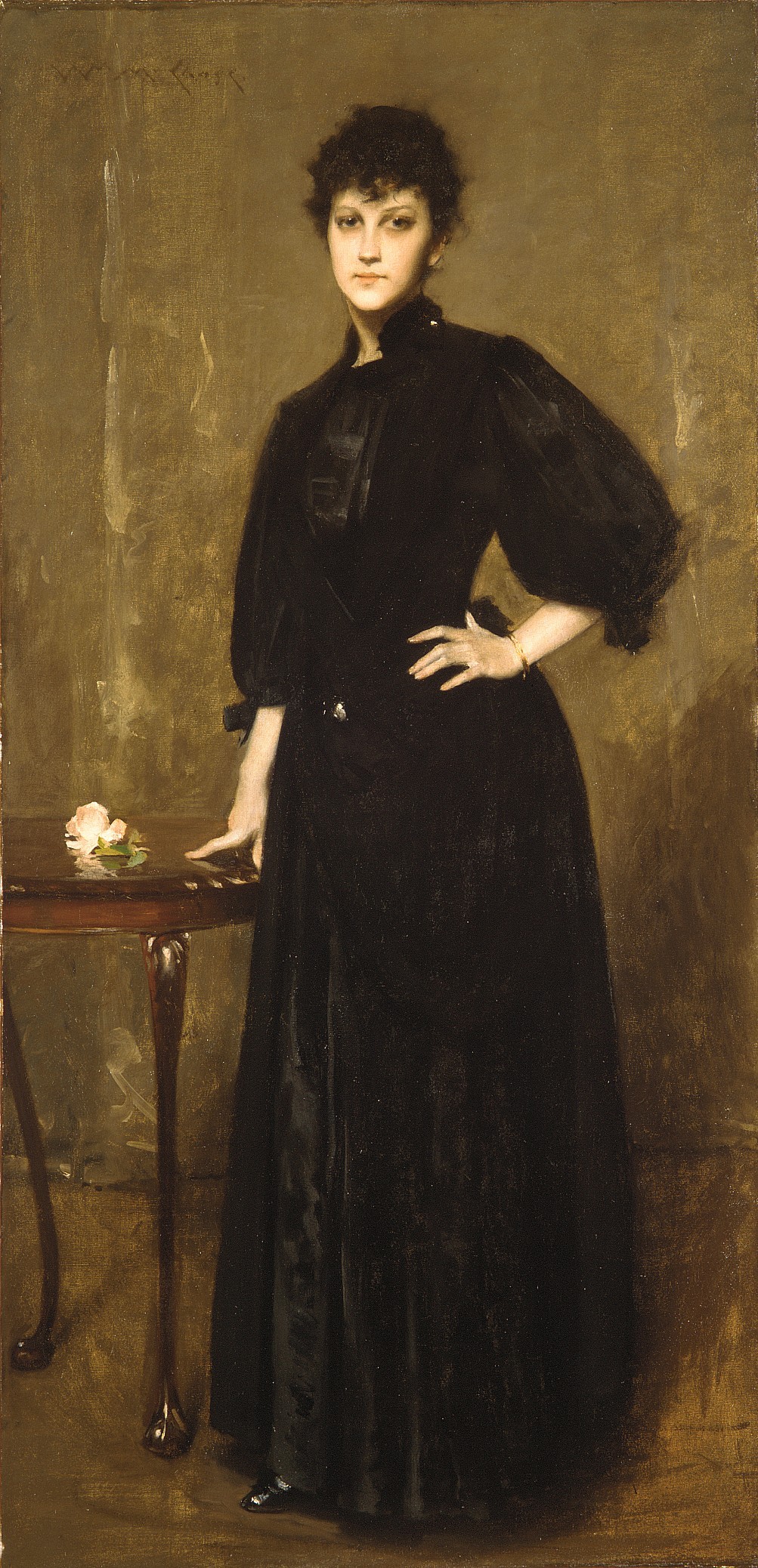
The portraiture survey places such works beside society commissions, family images, self-portraits and studies of studio models. This breadth warns against treating every richly dressed figure as the same kind of encounter. A named sitter, a family member and an unidentified model each raise different questions about purpose and agency.
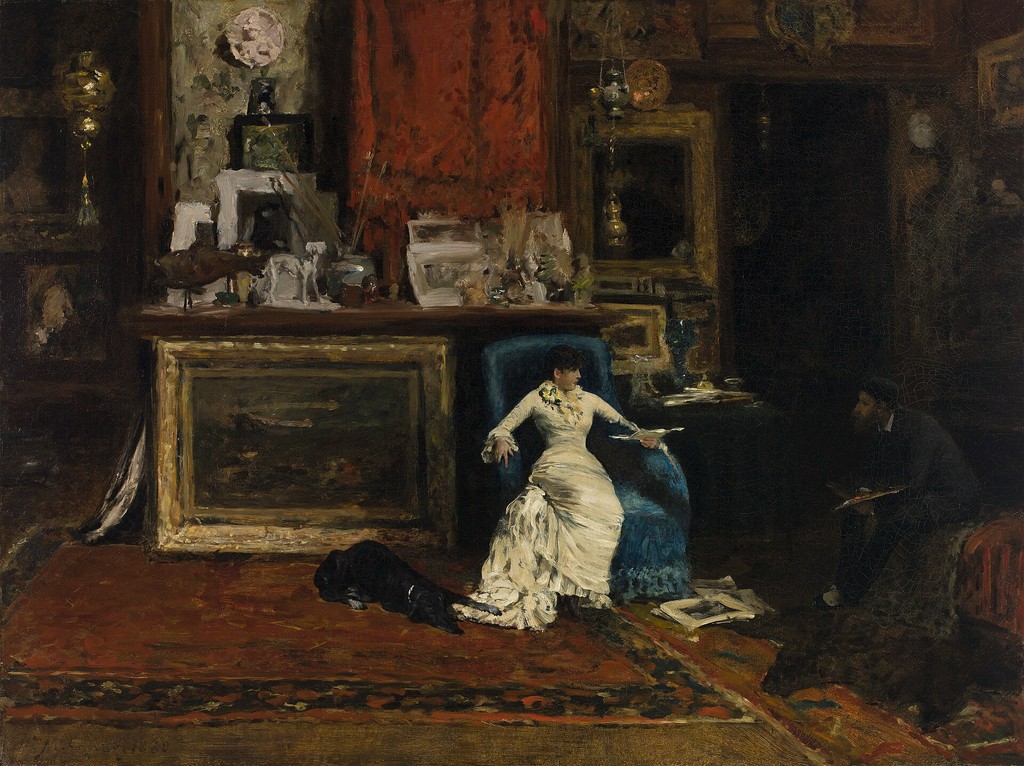
Interiors likewise operate as social constructions. The Tenth Street Studio (1880) shows figures among tapestries, metalwork, pictures and other collected objects. The Saint Louis Art Museum connects this display to the cultural status of both artist and patron.[4] Yet the room is more than autobiography: Chase arranges objects, people, openings and areas of darkness as pictorial material. The studio becomes a stage on which looking itself is performed.
Still Life: Tradition Made Present
Chase repeatedly returned to still life, from flowers and vessels to the fish paintings of his later career. These works preserve the dark tonal structures and energetic brushwork associated with his Munich training even when his landscapes had become much lighter. That continuity makes the still-life paintings essential to understanding his range: the older manner was not merely an abandoned early phase.
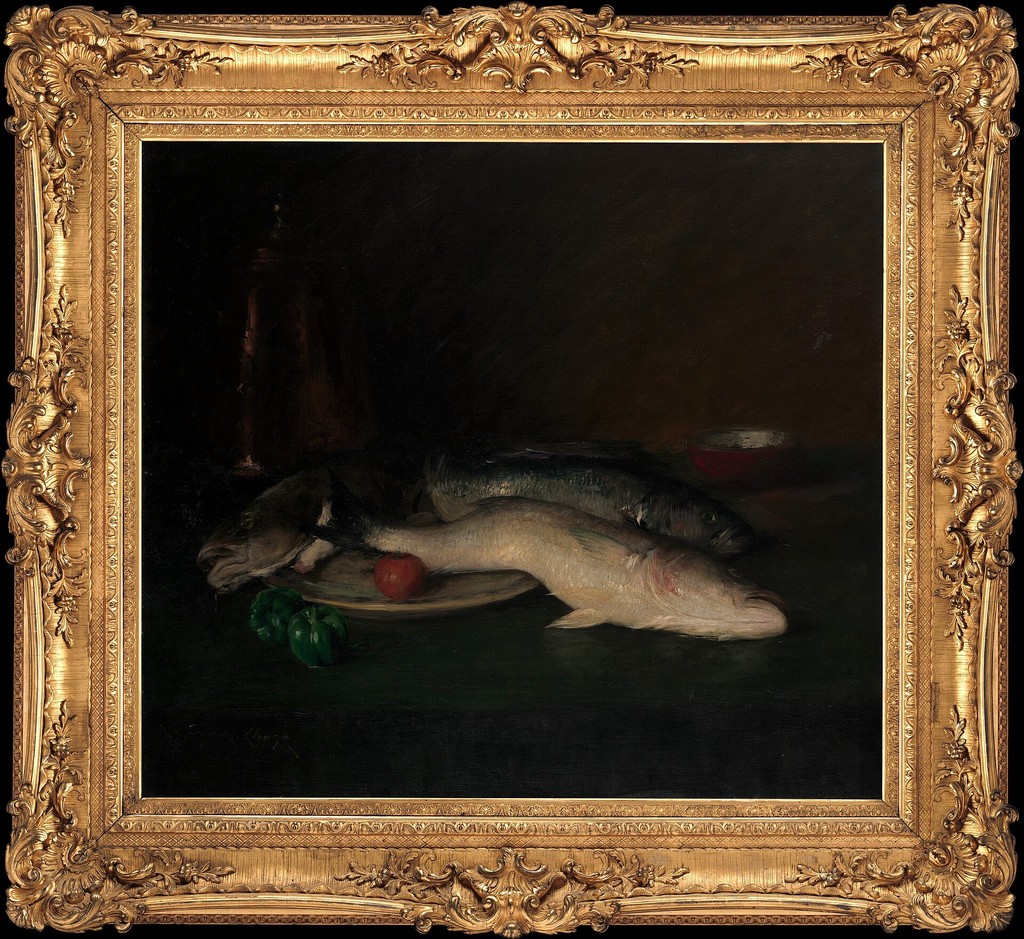
The Metropolitan Museum’s Still Life: Fish, made by 1908, sets striped bass, salmon and weakfish across a table. Its object record relates the forceful handling and subdued palette to Chase’s Munich experience, Antoine Vollon and seventeenth-century Spanish still life.[5] Rather than building a narrative around the catch, the painting makes weight, sheen, curve and loaded paint carry the encounter. This is virtuosity directed towards material presence.
Titles must be handled carefully. The Met canvas, accession 08.139.2, is not the Brooklyn Museum’s 1912 fish picture, accession 13.54, nor is it interchangeable with other similarly named works. Chase painted the subject repeatedly. Distinct objects may share a conventional title without being versions of one record, and the census preserves those identities separately.
New York Parks and the Art of the Everyday
During the later 1880s Chase found modern subjects in Prospect Park, Tompkins Park and Central Park. These landscapes do not present untouched nature. Paths, terraces, planting and figures disclose designed urban spaces used for leisure. The change in setting encouraged a lighter register of colour and touch, but it did not erase the artist’s habit of careful arrangement. A bench, stair, patch of lawn or distant walker can establish the entire rhythm of a scene.[2]
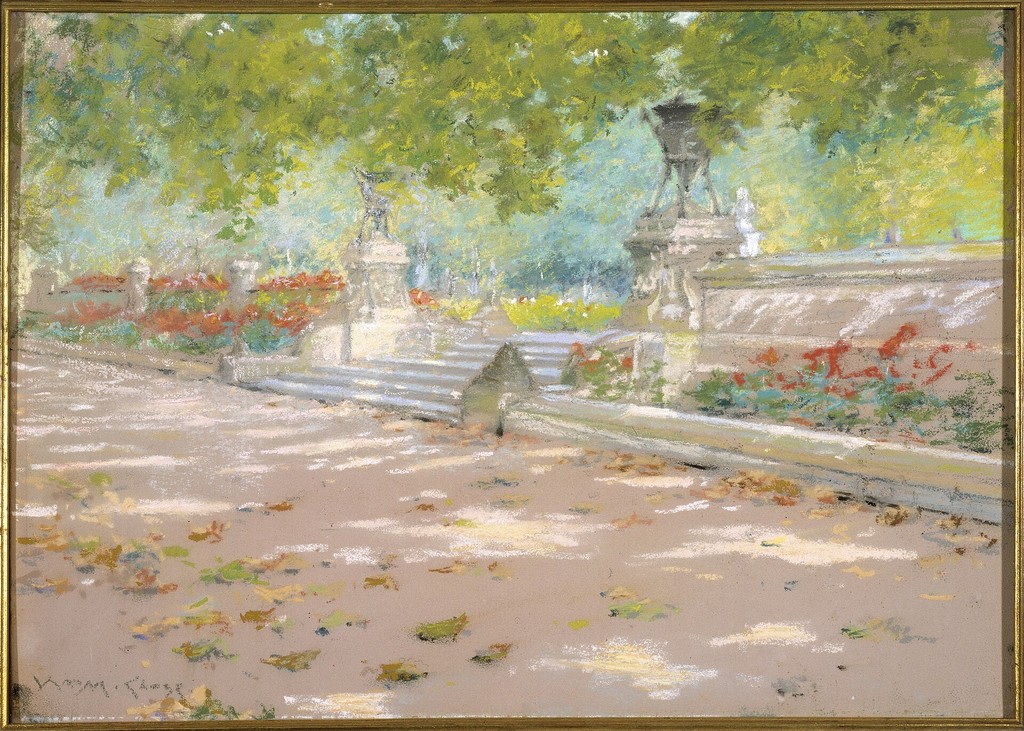
Terrace, Prospect Park, about 1887, offers a particularly useful correction to the assumption that every park view is an oil. The Smithsonian American Art Museum records the work as pastel, 23.3 by 35.2 centimetres, and classifies it as a drawing.[6] The distinction is productive rather than contradictory: it places the object within a works-on-paper collection while retaining its specific material identity.
The New York park scenes also show why “American Impressionist” is only a partial description. Broken touches and outdoor light matter, but so do the social uses and constructed design of these metropolitan grounds. Chase’s parks are modern because of where and how people encounter nature in the city, not only because of their handling.
Shinnecock: Landscape, Family and Teaching
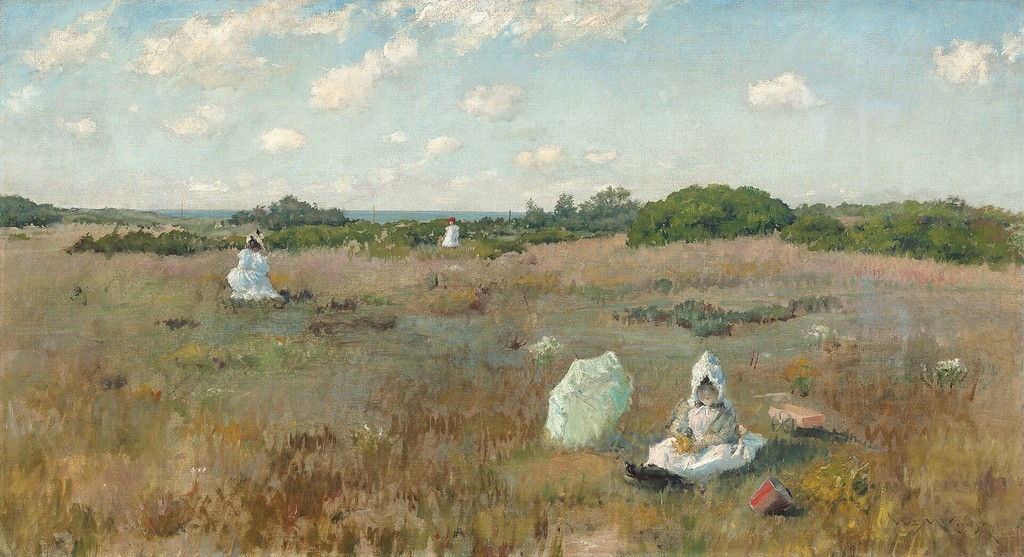
Across the summers of 1891–1902, Chase led the Shinnecock Hills Summer School of Art on Long Island. The surrounding landscape became one of his central subjects, and works such as Gathering Autumn Flowers (1894/95) connect open ground, distant water and small family figures. The National Gallery of Art’s record identifies the foreground child, a more distant woman and another figure set across a broad, richly varied field.[7] Their scale lets colour and terrain dominate without making the landscape uninhabited.
The place must also be understood beyond the summer colony’s picturesque appeal. The school and its resort economy occupied ancestral and present Shinnecock land. Parrish Art Museum research describes relations among the Chase family, the school community and members of the Shinnecock Indian Nation, while noting that Chase travelled past the Reservation between his home and the Art Village.[8] That history belongs beside formal discussion of grass, sky and coastal light.
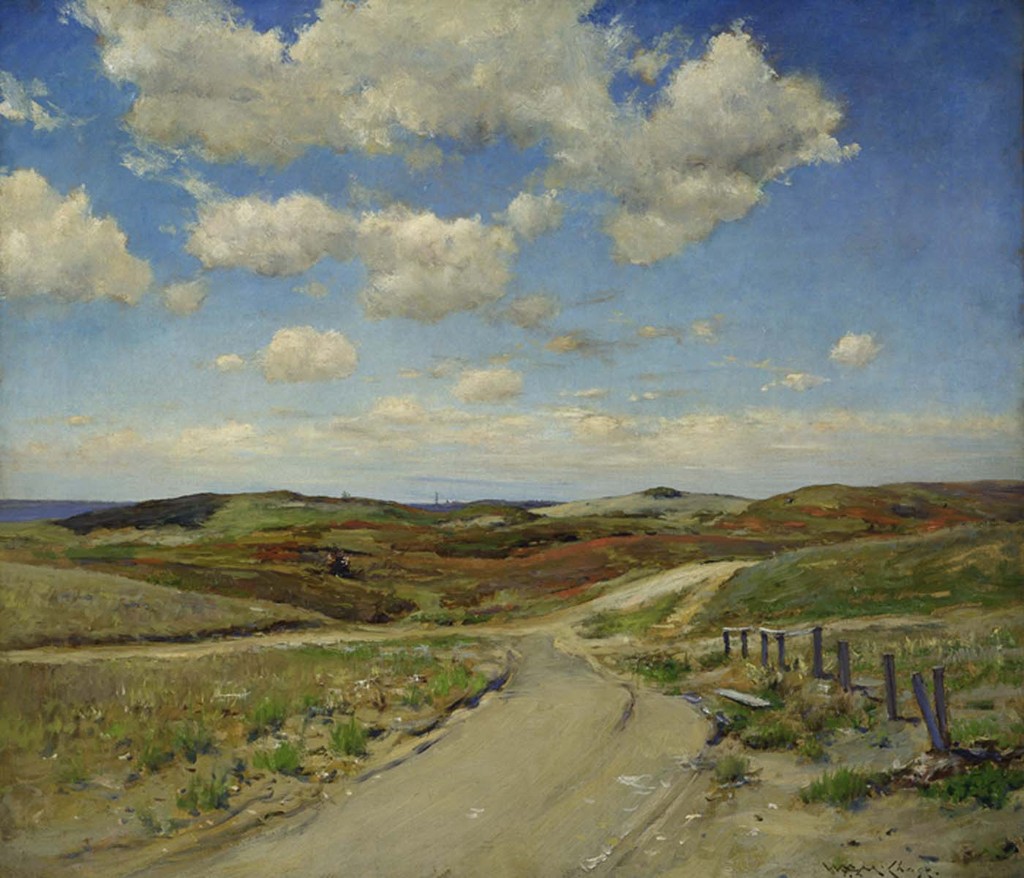
The Shinnecock landscapes and teaching section develops these intertwined settings. Its exact-work study, Shinnecock Hills, concerns the Smithsonian canvas of about 1895, accession 1909.7.11.[9] Other paintings have the same title. Keeping them distinct prevents an apparently simple landscape name from obscuring separate objects.
Pastel as a Painterly Medium
Chase did not use pastel only to prepare ideas for oil paintings. He exploited its direct deposit of coloured pigment, capacity for blending and combination of line with soft tone. The National Gallery of Art describes his late nineteenth-century approach as painterly and points to the blended passages of Study of Flesh Color and Gold (1888).[10] Its support—paper coated with mauve-grey grit—also reminds us that “works on paper” includes materially complex surfaces rather than a uniform class of sketches.[11]
Pastel could answer different subjects: a figure study might build flesh and fabric through dense colour, while a compact park view could register an outdoor motif with great economy. Chase’s advocacy of the medium and participation in the American pastel revival placed these objects within exhibition culture, not at the margins of his output. For readers accustomed to equating scale or oil paint with importance, the pastels reset the terms of comparison.
The census currently includes ten records grouped as drawings, among them pastels classified institutionally within that category. This small figure describes the present dataset, not Chase’s total production on paper. It is an invitation to inspect the recorded medium field and institutional description rather than infer importance from a count.
Six Works for a Comparative View
Six exact-object studies offer a compact route through Chase’s changes of subject, place and material. Begin with The Tenth Street Studio to see how an interior converts collecting and sociability into composition. Move to Portrait of Dora Wheeler for the relation between sitter, textile and professional identity. Then compare the dark, materially emphatic Still Life: Fish with the airy pastel Terrace, Prospect Park.
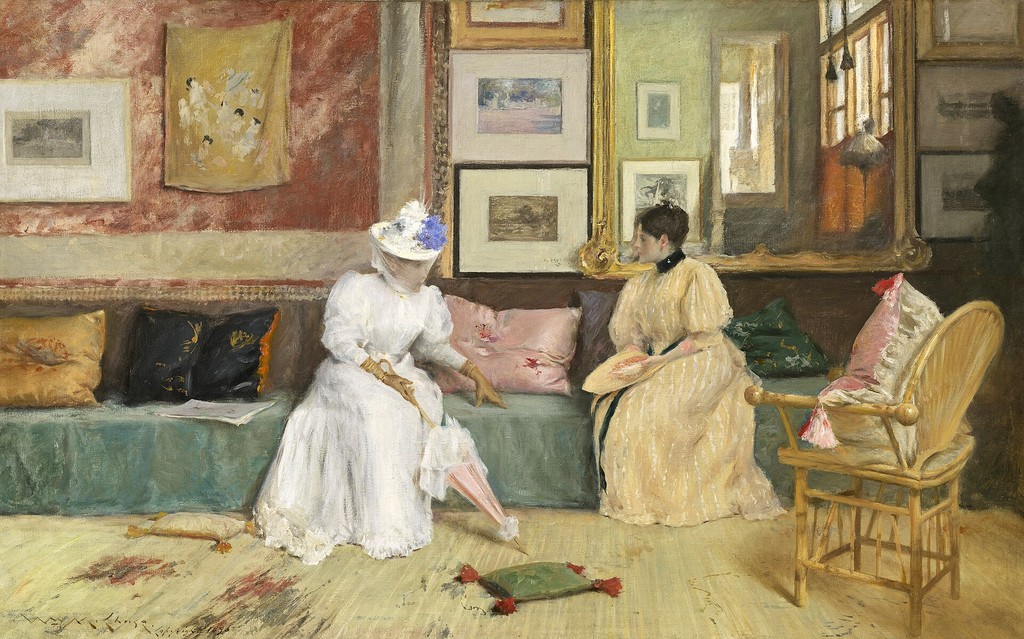
The pair of Shinnecock works expands the comparison. Shinnecock Hills makes a road carry the eye through a coastal landscape, whereas A Friendly Call (1895) turns an interior meeting into a study of distance, reflection and aligned figures. The National Gallery of Art identifies the latter as an oil on canvas measuring 76.5 by 122.5 centimetres, accession 1943.1.2.[12] Both belong to the Shinnecock years, but shared date and place do not impose a single pictorial solution.
Read together, the six objects make Chase’s plurality concrete. Changes in palette need not indicate a straight progression from darkness to light, nor should outdoor colour recast every portrait or still life as Impressionist. Subject, commission, medium and intended effect all informed the visual decision.
How to Use the Researched Online Works Census
The directory is a dated researched online works census derived from Wikidata statements that identify Chase as creator. Its 208 distinct records comprise 197 paintings, 10 drawings or pastels and one print; 30 records currently lack a date. These totals describe the captured data as checked on 31 August 2026.[13] They are not a catalogue raisonné, a definitive chronology or a claim about the absolute size of Chase’s oeuvre.
Each record remains attached to its Wikidata identity. That rule is especially important for repeated titles such as Shinnecock Hills and Still Life: Fish. Records are not merged merely because their normalised titles match. Where an exact study exists, only the locked institution and accession receive that link; another work with the same words in its title remains independent.
Use filters as questions rather than conclusions. A medium count may reveal where digitised information is plentiful or sparse, while an undated record signals missing structured data rather than a work made outside history. Follow institutional links when available, compare dimensions and accessions, and treat creator statements as a discovery layer that can lead to deeper object research.
Researched works directory
This searchable evidence census contains 208 distinct records assembled from public collection data and a reproducible Wikidata snapshot. It is not a catalogue raisonné, not a claim of complete oeuvre coverage, and it keeps works with repeated titles as separate objects.
| Name | Date | Medium |
|---|---|---|
| A City Park | 1887 | Painting |
| A Corner of My Studio | Date unknown | Painting |
| A Dutch Landscape | 1884 | Painting |
| A Friendly Call | 1895 | Painting |
| A Gray Day | 1886 | Painting |
| A Modern Magdalen | 1888 | Painting |
| A Spanish Gypsy | 1905 | Painting |
| Albert Harkness (1822–1907) | 1908 | Painting |
| Alice | 1892 | Painting |
| An Afternoon Stroll | 1895 | Painting |
| An English Cod | 1904 | Painting |
| At the Seaside | 1890 | Painting |
| August B. Loeb | 1905 | Painting |
| Baron Hugo von Habermann | 1875 | Painting |
| Beach | 1895 | Painting |
| Bessie Potter | 1895 | Painting |
| Big Copper Kettle and Fish (Fish) | Date unknown | Painting |
| Bildnis Hugo von Habermann | 1875 | Painting |
| Brass Kettle and Catfish | Date unknown | Painting |
| Carmencita | 1890 | Painting |
| Courtyard in Venice | 1877 | Painting |
| Crucifixion | 1875 | Painting |
| Der japanische Holzschnitt | 1888 | Painting |
| Dieudonnée | 1899 | Painting |
| Dorothy | 1902 | Painting |
| Dr. Eduardo San Giovanni | 1906 | Drawing |
| Duveneck Painting "The Turkish Page | 1876 | Painting |
| Edward Everett Hale (1822-1909) | 1884 | Painting |
| Edward Guthrie Kennedy | 1895 | Painting |
| Edward Steichen | 1903 | Painting |
| Female Figure Study (front view) | Date unknown | Painting |
| Female Figure Study (side view) | Date unknown | Painting |
| First Touch of Autumn | 1898 | Painting |
| Fish | 1910 | Painting |
| Fish and Still Life | 1906 | Painting |
| Fish and Still Life | 1908 | Painting |
| Florence | 1907 | Painting |
| For the Little One | 1896 | Painting |
| Garden of the Orphanage, Haarlem, Holland | 1883 | Painting |
| Gathering Autumn Flowers | 1894 | Painting |
| Gathering Flowers, Shinnecock, Long Island | 1897 | Drawing |
| Girl at a Bureau | Date unknown | Painting |
| Girl in a Japanese Costume | 1890 | Painting |
| Girl in Ciociaro costume | 1876 | Painting |
| Girl in White | 1890 | Painting |
| Girl with Doll | 1910 | Painting |
| Gray Day on the Bay | 1886 | Painting |
| Gray Day on the Lagoon | 1913 | Painting |
| Harbor Scene, Brooklyn Dock | 1886 | Painting |
| Harriet Hubbard Ayer | 1880 | Painting |
| Head of a Man | 1875 | Painting |
| Hide and Seek | 1888 | Painting |
| I Think I'm Ready Now | 1883 | Painting |
| Idle Hours | 1894 | Painting |
| In the Park (A By-path) | 1889 | Painting |
| In the Studio Corner | 1881 | Painting |
| In Venice | 1877 | Painting |
| James Abbott McNeill Whistler | 1885 | Painting |
| John Butler Talcott | 1900 | Painting |
| Just Onions (Onions; Still Life) | Date unknown | Painting |
| Keying Up" - The Court Jester | 1875 | Painting |
| Keying Up: The Court Jester | 1875 | |
| L'Éventail de plumes | Date unknown | Painting |
| Lady in Black | 1888 | Painting |
| Lady Playing Guitar | Date unknown | Painting |
| Landscape- Shinnecock, Long Island | 1896 | Painting |
| Long Island Landscape after a Shower of Rain (After the Shower) | 1889 | Painting |
| Lydia Field Emmet | 1892 | Painting |
| Man Wearing Gold Rimmed Glasses | 1892 | Painting |
| Marine | 1888 | Painting |
| Monkeying with Literature | 1877 | Painting |
| Moses Swaim | Date unknown | Painting |
| Mother and Child (The First Portrait) | 1887 | Painting |
| Mrs. Charles Scott | Date unknown | Painting |
| Mrs. Chase | 1890 | Painting |
| Mrs. Chase in Prospect Park | 1886 | Painting |
| Mrs. William Clark | 1915 | Painting |
| Mrs. William Merritt Chase | 1890 | Painting |
| My Little Daughter Dorothy | 1894 | Painting |
| My Palette | 1875 | Painting |
| Myra Reynolds | 1898 | Painting |
| Near the Beach, Shinnecock | 1895 | Painting |
| Near the Beach, Shinnecock | Date unknown | Painting |
| North River Shad | 1910 | Painting |
| Nude | 1901 | Painting |
| Open Air Breakfast | 1888 | Painting |
| Outskirts of Madrid | 1882 | Painting |
| Pablo de Sarasate: Portrait of a Violinist | 1875 | Painting |
| Park Bench | 1890 | Painting |
| Peace, Fort Hamilton | 1888 | Painting |
| Pink Azalea—Chinese Vase | 1885 | Painting |
| Portrait Head | 1882 | Painting |
| Portrait of a Boy in Van Dyck Costume | 1875 | Painting |
| Portrait of a Child | 1884 | Painting |
| Portrait of a Lady in Black | 1895 | Painting |
| Portrait of a Lady in Black (Annie Traquair Lang) | 1911 | Painting |
| Portrait of a Lady in Pink | Date unknown | Painting |
| Portrait of a Man | 1874 | Painting |
| Portrait of a Man | 1875 | Painting |
| Portrait of a Woman | Date unknown | Painting |
| Portrait of Artist Beck Wenzell | 1900 | Painting |
| Portrait of Baroness Ida-Gro van Dahlerup | 1907 | Painting |
| Portrait of Dora Wheeler | 1882 | Painting |
| Portrait of Lavinia Borden Cook | Date unknown | Painting |
| Portrait of Louis Betts | Date unknown | Painting |
| Portrait of Master Otis Barton and his Grandfather | 1903 | Painting |
| Portrait of Miss D. | Date unknown | Painting |
| Portrait of Mrs. C. (Lady with a White Shawl) | 1893 | Painting |
| Portrait of Mrs. George B. Ely (Caroline Boies Ely) | Date unknown | Painting |
| Portrait of My Daughter Alice | 1895 | Painting |
| Portrait of My Father (David Hester Chase) | Date unknown | Painting |
| Portrait of My Mother (Sarah Swaim Chase) | 1892 | Painting |
| Portrait of William Francklyn Paris | Date unknown | Painting |
| Portrait of William Gurley Munson | 1868 | Painting |
| Ready for the Ride | 1877 | Painting |
| Red Snapper | Date unknown | Painting |
| Robert Frederick Blum | Date unknown | Painting |
| Roland | 1902 | Painting |
| Roses | 1883 | Drawing |
| Seaside Flowers | 1897 | Painting |
| Selbstbildnis | 1875 | Painting |
| Selbstporträt | 1915 | Painting |
| Self-Portrait | 1909 | Drawing |
| Self Portrait | 1914 | Painting |
| Self-Portrait | 1915 | Painting |
| Self-portrait dressed as Johan Claesz Loo by Frans Hals | 1903 | Painting |
| Seventeenth Century Lady | 1895 | Painting |
| Shell Beach at Shinnecock | 1892 | Painting |
| Shinnecock Hills | 1892 | Painting |
| Shinnecock Hills | 1893 | Painting |
| Shinnecock Hills | 1895 | Painting |
| Shinnecock Hills | 1895 | Painting |
| Shinnecock Hills Landscape | 1890 | Painting |
| Shinnecock Studio Interior | 1892 | Drawing |
| Sketch for a Picture--Columbus before the Council of Salamanca (A) (Christopher Columbus before the Council of Salamanca) | 1876 | Painting |
| Sketch for a Picture--Columbus before the Council of Salamanca (B) (Christopher Columbus before the Spanish Council) | 1876 | Painting |
| Sketch of a Child:Helen | 1898 | Painting |
| St. Jerome | 1875 | Painting |
| Still Life | 1912 | Painting |
| Still Life | Date unknown | Painting |
| Still Life | Date unknown | Painting |
| Still Life | Date unknown | Painting |
| Still Life (Brass Bowl) | Date unknown | Painting |
| Still Life (Brushes, Books and Pottery) | 1904 | Painting |
| Still Life: Fish | 1900 | Painting |
| Still Life: Fish | 1903 | Painting |
| Still Life: Fish | 1908 | Painting |
| Still Life: Fish | 1912 | Painting |
| Still-life: Fish and Bowl | 1895 | Painting |
| Still Life (Fruit and Copper Pot) | Date unknown | Painting |
| Still Life (Fruit and Pottery) | Date unknown | Painting |
| Still Life--Striped Bass | 1907 | Painting |
| Still Life with Fish | 1800 | Painting |
| Still Life with Fish | 1910 | Painting |
| Still Life with Fish | 1912 | Painting |
| Still Life with Fish | Date unknown | Painting |
| Still life with fruit | 1871 | Painting |
| Still Life with Hummingbird | 1870 | Painting |
| Still Life with Watermelon | 1869 | Painting |
| Studio Interior | 1882 | Painting |
| Study Head | Date unknown | Painting |
| Study of a Girl in Japanese Dress | 1895 | Painting |
| Study of a Young Woman | 1883 | Painting |
| Study of Flesh Color and Gold | 1888 | Drawing |
| Summer at Shinnecock Hills | 1891 | Painting |
| Sunlight and Shadow, Shinnecock Hills | 1893 | Painting |
| Tenth Street Studio | 1880 | Painting |
| Terrace at the Mall | 1890 | Painting |
| Terrace, Prospect Park | 1887 | Drawing |
| The Antiquary Shop | 1879 | Painting |
| The Apprentice (Boy with Apple) | 1876 | Painting |
| The Big Brass Bowl | Date unknown | Painting |
| The Blue Kimono | 1915 | Painting |
| The Boat Harbor (Gowanus Pier) | 1888 | Painting |
| The Coast of Holland | 1884 | Painting |
| The Emerald Lady | Date unknown | Painting |
| The Family Cow (Calf's Head) | 1869 | Painting |
| The Keynote | 1915 | Painting |
| The Kimono | 1895 | Painting |
| The Mirror | 1900 | Painting |
| The Model | 1888 | Drawing |
| The Moorish Warrior | 1878 | Painting |
| The Old Road to the Sea | 1893 | Painting |
| The Patrician | 1875 | Painting |
| The Song | 1907 | Painting |
| The Stately Model | 1898 | Painting |
| The Tenth Street Studio | 1880 | Painting |
| The Tow Path | 1880 | Painting |
| The Turkish Page (Unexpected Intrusion) | 1876 | Painting |
| The Whistling Boy | 1875 | Painting |
| The Wounded Poacher | 1878 | Painting |
| The Yield of the Waters | 1878 | Painting |
| The Young Orphan | 1884 | Painting |
| Thomas E. Kirby | 1900 | Painting |
| Thomas Moran | Date unknown | Painting |
| Under a French Sky | 1882 | Painting |
| Venetian Lace Making | Date unknown | Drawing |
| View from Central Park | 1889 | Painting |
| View near Polling | 1875 | Painting |
| William A. Clark | 1915 | Painting |
| William Andrews Clark | 1915 | Painting |
| William Nimick Frew | 1915 | Painting |
| William Rockhill Nelson | 1907 | Painting |
| Wind-Swept Sands | 1894 | Painting |
| Woman in White | 1902 | Painting |
| Woman Seated | 1885 | Drawing |
| Woman Standing in a Landscape | Date unknown | Painting |
| Worthington Whittredge | 1890 | Painting |
Frequently Asked Questions
He made portraits, figure studies, interiors, still lifes, urban park views, coastal landscapes, pastels, drawings and prints. Oil dominates the present census, but pastel was a substantial finished practice and should not be reduced to preparation.
The term illuminates aspects of his open-air landscapes and lighter handling, but it does not explain the whole career. Munich-trained tonal painting, old-master study, Aesthetic interiors, cosmopolitan portraiture and painterly pastel remained active resources.[2]
It uses a dated snapshot of Wikidata records carrying creator statements for Chase, retains one entry for each distinct item identity, and reports the structured medium and date information present at the time of checking.[13]
Chase used generic titles more than once, and different institutions may hold separate objects called Shinnecock Hills or Still Life: Fish. A shared title is not proof of shared identity, so separate records stay separate.
Start with one work from three contrasting groups: a portrait or studio interior, a fish still life, and a park or Shinnecock landscape. Then add a pastel. This sequence makes changes of material, palette and social setting easier to see.
Discussion
Use this evidence-led guide as a starting point for close looking rather than a final verdict.
Share an observation about William Merritt Chase Paintings and Artworks or a source that adds useful context.
Reader Insights
Which comparison best reveals the range of Chase's painting and works on paper?
Where do tonal structure and open-air colour coexist rather than replace one another?
Which object would you add to the selected group, and what would it change?
Join the Conversation
Add your reading below, keeping observations specific and evidence clear.
References
- William Merritt Chase exhibition — Museum of Fine Arts, Boston, accessed 31 August 2026, accessed 31 August 2026.
- William Merritt Chase (1849–1916) — Metropolitan Museum of Art, accessed 31 August 2026, accessed 31 August 2026.
- Portrait of Dora Wheeler — Cleveland Museum of Art, accessed 31 August 2026, accessed 31 August 2026.
- The Tenth Street Studio — Saint Louis Art Museum, accessed 31 August 2026, accessed 31 August 2026.
- Still Life: Fish — Metropolitan Museum of Art, accessed 31 August 2026, accessed 31 August 2026.
- Terrace, Prospect Park — Smithsonian American Art Museum, accessed 31 August 2026, accessed 31 August 2026.
- Gathering Autumn Flowers — National Gallery of Art, accessed 31 August 2026, accessed 31 August 2026.
- William Merritt Chase: The Shinnecock Years — Parrish Art Museum, accessed 31 August 2026, accessed 31 August 2026.
- Shinnecock Hills — Smithsonian American Art Museum, accessed 31 August 2026, accessed 31 August 2026.
- The Touch of Color: Pastels at the National Gallery of Art — National Gallery of Art, accessed 31 August 2026, accessed 31 August 2026.
- Study of Flesh Color and Gold — National Gallery of Art, accessed 31 August 2026, accessed 31 August 2026.
- A Friendly Call — National Gallery of Art, accessed 31 August 2026, accessed 31 August 2026.
- William Merritt Chase creator-statement works snapshot — Wikidata Query Service, accessed 31 August 2026, accessed 31 August 2026.