 by Tom Gurney
Tom Gurney BSc (Hons) is an art history expert with over 20 years experience
Page Created on August 31, 2026 / Page Updated on November 6, 2026
Email: tomgurney1@gmail.com / Phone: +44 7429 011000
William Merritt Chase Portraiture: Introduction
William Merritt Chase made portraits into encounters between people, paint and setting. A face might establish likeness, but dress, posture, furniture and the surrounding interval also reveal how a sitter wished to appear and how Chase wished to be seen as an artist. His portraits range from intimate family studies to imposing public pictures, and their shifting styles resist any single label.
At a Glance
- Central concernlikeness shaped through pose, dress, setting and painterly handling
- Formative resourceMunich-trained tonal structure and vigorous brushwork
- Key sitterDora Wheeler, Chase’s student and a professional textile designer
- Studio roleworkplace, teaching room, social setting and display environment
- International exchangeactive engagement with Whistler, Sargent and European precedents
- Persistent cautionsome sitter identities are documented; others remain uncertain
Contents
- Introduction
- Portraiture as a Flexible Practice
- Munich Bravura without a Fixed Formula
- The Studio as Stage and Argument
- Dora Wheeler: Student, Designer and Sitter
- Lady in Black and the Full-Length Portrait
- The Whistler Exchange
- Family, Pupils and Uncertain Names
- How to Look at a Chase Portrait
Portraiture as a Flexible Practice
Chase’s portraiture belongs within a deliberately varied career. He painted landscapes in light, open-air colour, arranged still lifes with dark tonal weight, and moved between oil and pastel. Portraits could likewise be brilliant or restrained, informal or ceremonial. The consistency lies less in a signature effect than in his attention to the social language of presentation.
That flexibility was part of his international outlook. Chase studied in Munich, travelled repeatedly in Europe and followed contemporary painting while remaining alert to older art. The Metropolitan Museum of Art describes him as an eclectic who drew openly on different periods and national traditions.[1] The Terra Foundation’s account of a major retrospective similarly stresses his stylistic experiment and international context across a four-decade career.[2] Neither description makes his portraits derivative. Instead, they show an artist selecting devices according to sitter, occasion and desired public effect.
Portraiture was also professional work. By the 1890s, fashionable full-length commissions brought high fees, while portraits of students could demonstrate Chase’s abilities to prospective patrons.[1] To explore the rest of that varied output, see Paintings and Artworks; the broader life sequence appears in the biography.
Munich Bravura without a Fixed Formula
At Munich’s Royal Academy from 1872, Chase encountered dark tonalities, forceful handling and the painterly realism associated with artists such as Frans Hals and Peter Paul Rubens. These resources remained useful after his return to New York in 1878. In a portrait, a dark field could heighten a face or hand, while a loaded stroke could make fur, satin or flesh feel immediate. Such effects announced technical command, yet they did not oblige him to repeat one Munich manner throughout his career.[1]
International examples helped him revise, rather than erase, that formation. His portraits sometimes exchange deep chiaroscuro for a shallower arrangement of tones; elsewhere, dark paint becomes a modern field against which a figure’s silhouette takes command. Chase’s strength lay in combining these possibilities. A portrait may recall old-master handling in one passage and contemporary ideas about decoration or elegant reserve in another.
This is why calling him simply an Impressionist obscures the evidence. His lighter landscapes form only one part of his work. Portraits often retain a sombre structure even when their edges loosen or colour flashes across fabric. The history traced in From Munich to Tenth Street shows how training became a repertoire, not a rulebook.
The Studio as Stage and Argument
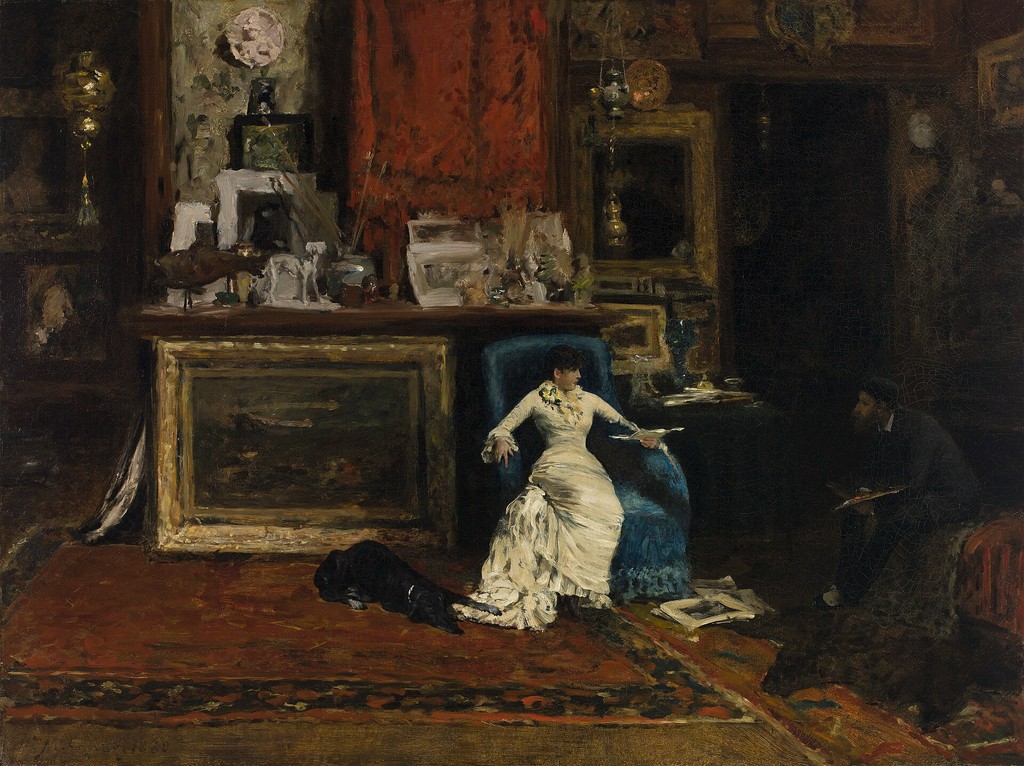
After returning to New York, Chase occupied space in the Tenth Street Studio Building. He soon transformed its large gallery into an elaborate environment filled with pictures, textiles, furniture and collected objects. It was a workplace and teaching space, but also a social destination through which he fashioned a cosmopolitan public identity.[1]
That setting matters for portraiture because a studio could frame both sitter and painter. Visitors encountered evidence of taste before seeing a finished canvas. Objects provided backdrops and props; the room itself suggested that portrait-making belonged to a cultivated world of art, conversation and display. Yet the sitter was not merely another possession in that room. The most convincing portraits turn the setting into a field of negotiation: fabric may speak to a sitter’s occupation, posture may resist easy access, and an uncluttered background may make bodily presence more forceful.
Chase’s 1880 painting of the gallery provides a useful companion to these portraits. The Tenth Street Studio examines how architecture, objects and human figures made artistic identity visible. Together, the interiors and portraits show self-presentation operating on both sides of the easel.
Dora Wheeler: Student, Designer and Sitter
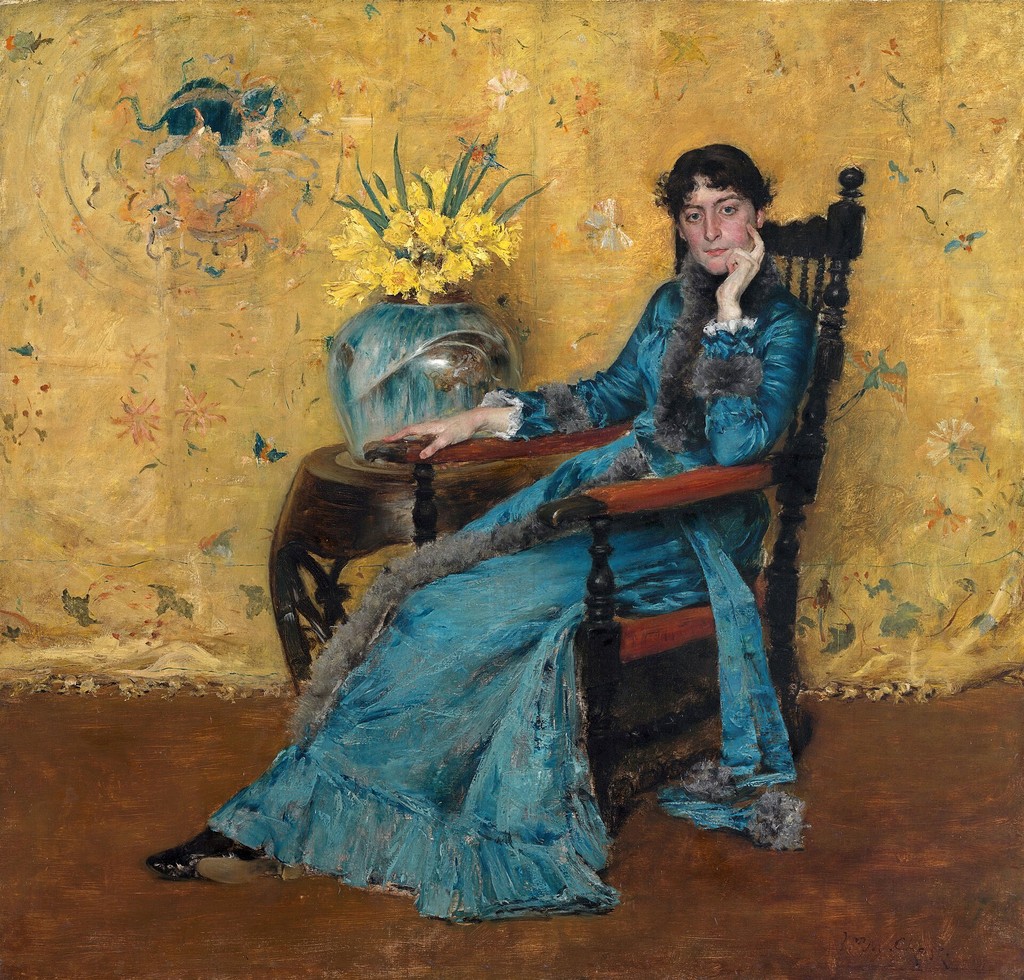
The Portrait of Dora Wheeler is the essential case for looking beyond costume. Painted in 1882–83, the oil on canvas measures 159.8 × 166.4 cm unframed and is held by the Cleveland Museum of Art as accession 1921.1239. Wheeler reclines in a carved chair, dressed in a deep blue, fur-trimmed gown. Behind her, flowers and an embroidered silk textile intensify the pattern of colour and surface.[3]
Wheeler was Chase’s first student after his European study, according to Cleveland’s record, at a time when few American artists accepted women as private pupils. She later worked with her mother in a successful decorating business run by women and designed luxurious textiles. The embroidered background therefore carries occupational meaning: it relates to Wheeler’s own design practice rather than serving as anonymous ornament.[3] Her placement within that field joins portraiture to artistic labour.
The sitter’s angled body and supported chin make the pose composed without becoming inert. Her gaze travels beyond the viewer rather than offering uncomplicated sociability. Chase balances the blue dress, golden textile and small flower accents across a near-square canvas, allowing identity to emerge through colour relationships as well as facial description. The painting’s gold medal at an international exhibition in Munich in 1883, followed by display in Paris, also made it an ambitious statement about both sitter and painter.[3]
Wheeler and Chase later worked together to raise funds for the pedestal of the Statue of Liberty.[3] That collaboration further unsettles any reading of her as a silent decorative presence. She was at once pupil, designer, colleague and the subject of a portrait that helped establish Chase internationally.
Lady in Black and the Full-Length Portrait
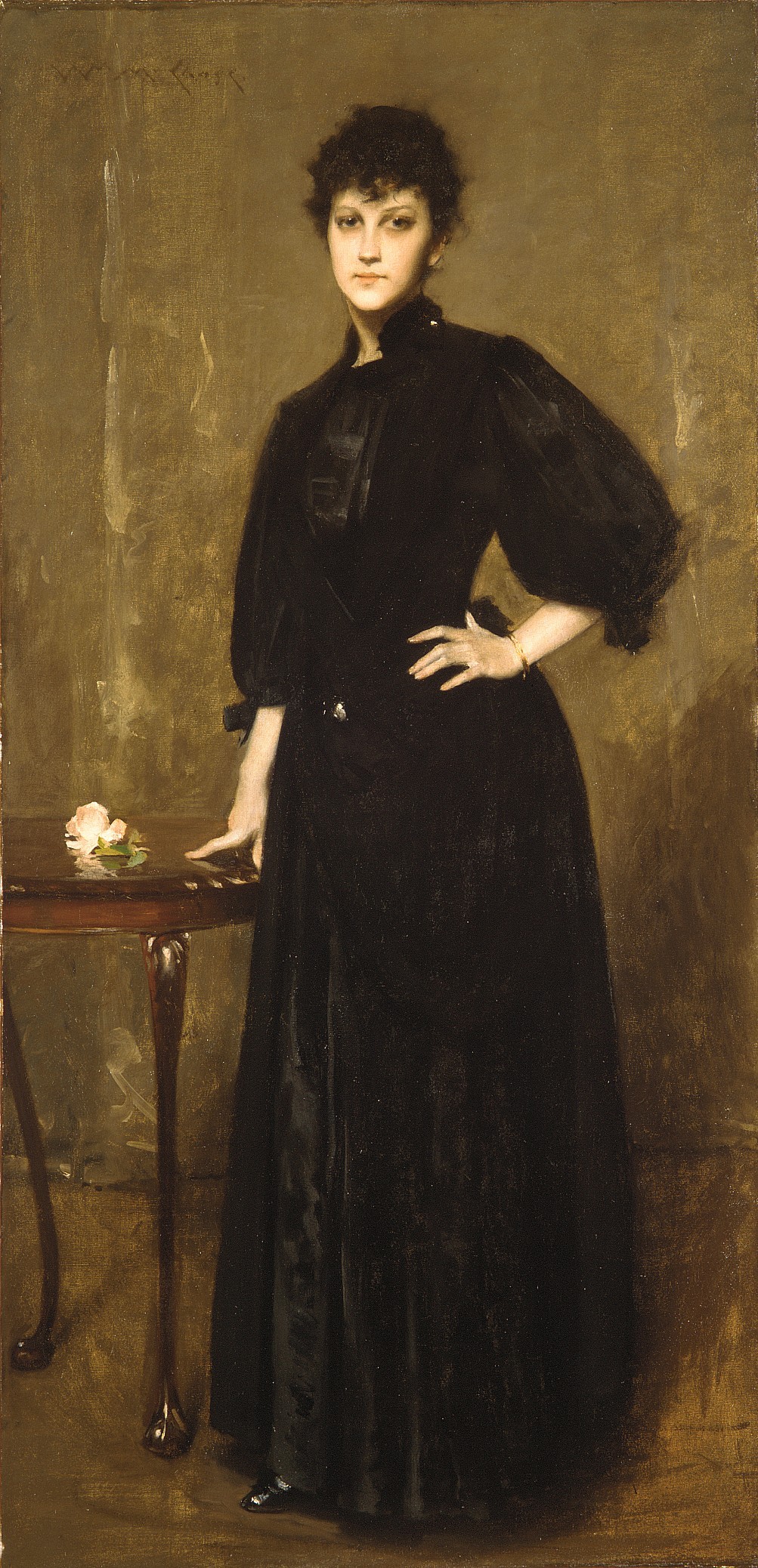
In Lady in Black (1888), Chase gave a student and model the commanding scale of fashionable full-length portraiture. The sitter was Marietta Benedict Cotton, who studied with him and became a society portraitist in New York and London. The canvas is tall and narrow—188.6 × 92.2 cm—and Chase donated it to the Metropolitan Museum in 1891.[4]
The black dress creates a long tonal mass, but it does not eliminate incident. Face and hands interrupt the darkness, while the figure’s silhouette, the adjacent table and the surrounding space establish a controlled rhythm. The Met identifies Chase’s engagement with Whistler’s monochromatic portraits and a table motif related to John Singer Sargent’s Madame X.[4] These references should be read as artistic conversation, not as proof that either painter supplied a complete style. Chase adjusted recognisable devices to the presence of Cotton and to his own exhibition ambitions.
The work also complicates the category of “society portrait”. Cotton’s later career matters: she was not only a model through whom Chase displayed skill, but a practising portraitist learning within the same professional world. His presentation of her and her subsequent practice belong to overlapping histories of teaching, modelling and artistic work.
The Whistler Exchange
Chase sought out James McNeill Whistler in London in 1885 after admiring his art for years. Whistler suggested that they paint one another. Chase’s surviving portrait adopts a muted palette, fluid handling, stylised figure and ambiguous setting associated with Whistler’s recent work.[5] The result is unusually direct evidence of one artist interpreting another artist’s self-presentation.
The exchange did not end harmoniously. The Met reports that Whistler disliked Chase’s picture and may have destroyed his own portrait of Chase.[5] That disagreement is more revealing than a simple story of influence. Chase’s allusions were intended as homage, yet Whistler read the likeness differently. A portrait’s meaning was not controlled by the painter alone; it could be contested by the person represented.
Chase’s canvas therefore records admiration, rivalry and misrecognition at once. It also demonstrates his capacity to change his handling in response to a particular subject. Whistler did not simply teach Chase a style. Their meeting gave Chase a live problem: how to portray an artist whose appearance and aesthetic programme were already inseparable.
Family, Pupils and Uncertain Names
After Chase married Alice Gerson in 1886, she and their children repeatedly appeared in his interiors, portraits and outdoor subjects.[7] Family models offered familiarity, but the resulting paintings should not be mistaken for transparent domestic documents. Clothes, props and poses still mediate what can be known. An intimate relationship may shape the conditions of sitting without explaining every pictorial decision.
Other portraits preserve different degrees of identification. Dora Wheeler and Marietta Benedict Cotton have documented careers that transform how their pictures can be read. By contrast, the identity of the woman in Portrait of Mrs. C. (Lady with a White Shawl), painted in 1893, remains unresolved. The Pennsylvania Academy of the Fine Arts records suggestions that she might have been Chase’s wife or the collector Emily Jewell Clark, but does not settle the matter. It also notes that the same unnamed woman appears in several other paintings from the period.[6]
The responsible reading is to preserve that uncertainty. The initial “C” and generic subtitle may indicate Chase’s interest in presenting an idealised social type, as PAFA proposes, but they do not authorise a firm identification.[6] A known sitter history can enrich visual analysis; an unknown one must not be replaced by speculation. The difference is fundamental to understanding how portraits carry both information and silence.
How to Look at a Chase Portrait
Begin with the figure’s scale and placement. Does the body command the canvas, lean into a furnished setting or withdraw into tonal space? Then follow the transitions: a sharply described face may meet loosely brushed cloth; a dark dress may depend on small changes of sheen; a textile may connect the sitter to work rather than luxury alone.
Next ask what kind of relationship the evidence supports. A commission, teaching connection, family bond or artistic exchange creates different expectations, but none makes the picture a neutral record. Separate what is visible from what an institution documents and from what remains interpretive. In the Dora Wheeler portrait, the textile’s relationship to her profession is documented; the emotional meaning of her distant gaze is not.[3]
Finally, compare rather than flatten. The assertive colour structure around Wheeler, the elongated darkness of Lady in Black and the muted Whistler portrait answer different social and pictorial situations. Together they show Chase treating portraiture as a flexible, public art of relationships.
Researched works directory
This searchable evidence census contains 208 distinct records assembled from public collection data and a reproducible Wikidata snapshot. It is not a catalogue raisonné, not a claim of complete oeuvre coverage, and it keeps works with repeated titles as separate objects.
| Name | Date | Medium |
|---|---|---|
| A City Park | 1887 | Painting |
| A Corner of My Studio | Date unknown | Painting |
| A Dutch Landscape | 1884 | Painting |
| A Friendly Call | 1895 | Painting |
| A Gray Day | 1886 | Painting |
| A Modern Magdalen | 1888 | Painting |
| A Spanish Gypsy | 1905 | Painting |
| Albert Harkness (1822–1907) | 1908 | Painting |
| Alice | 1892 | Painting |
| An Afternoon Stroll | 1895 | Painting |
| An English Cod | 1904 | Painting |
| At the Seaside | 1890 | Painting |
| August B. Loeb | 1905 | Painting |
| Baron Hugo von Habermann | 1875 | Painting |
| Beach | 1895 | Painting |
| Bessie Potter | 1895 | Painting |
| Big Copper Kettle and Fish (Fish) | Date unknown | Painting |
| Bildnis Hugo von Habermann | 1875 | Painting |
| Brass Kettle and Catfish | Date unknown | Painting |
| Carmencita | 1890 | Painting |
| Courtyard in Venice | 1877 | Painting |
| Crucifixion | 1875 | Painting |
| Der japanische Holzschnitt | 1888 | Painting |
| Dieudonnée | 1899 | Painting |
| Dorothy | 1902 | Painting |
| Dr. Eduardo San Giovanni | 1906 | Drawing |
| Duveneck Painting "The Turkish Page | 1876 | Painting |
| Edward Everett Hale (1822-1909) | 1884 | Painting |
| Edward Guthrie Kennedy | 1895 | Painting |
| Edward Steichen | 1903 | Painting |
| Female Figure Study (front view) | Date unknown | Painting |
| Female Figure Study (side view) | Date unknown | Painting |
| First Touch of Autumn | 1898 | Painting |
| Fish | 1910 | Painting |
| Fish and Still Life | 1906 | Painting |
| Fish and Still Life | 1908 | Painting |
| Florence | 1907 | Painting |
| For the Little One | 1896 | Painting |
| Garden of the Orphanage, Haarlem, Holland | 1883 | Painting |
| Gathering Autumn Flowers | 1894 | Painting |
| Gathering Flowers, Shinnecock, Long Island | 1897 | Drawing |
| Girl at a Bureau | Date unknown | Painting |
| Girl in a Japanese Costume | 1890 | Painting |
| Girl in Ciociaro costume | 1876 | Painting |
| Girl in White | 1890 | Painting |
| Girl with Doll | 1910 | Painting |
| Gray Day on the Bay | 1886 | Painting |
| Gray Day on the Lagoon | 1913 | Painting |
| Harbor Scene, Brooklyn Dock | 1886 | Painting |
| Harriet Hubbard Ayer | 1880 | Painting |
| Head of a Man | 1875 | Painting |
| Hide and Seek | 1888 | Painting |
| I Think I'm Ready Now | 1883 | Painting |
| Idle Hours | 1894 | Painting |
| In the Park (A By-path) | 1889 | Painting |
| In the Studio Corner | 1881 | Painting |
| In Venice | 1877 | Painting |
| James Abbott McNeill Whistler | 1885 | Painting |
| John Butler Talcott | 1900 | Painting |
| Just Onions (Onions; Still Life) | Date unknown | Painting |
| Keying Up" - The Court Jester | 1875 | Painting |
| Keying Up: The Court Jester | 1875 | |
| L'Éventail de plumes | Date unknown | Painting |
| Lady in Black | 1888 | Painting |
| Lady Playing Guitar | Date unknown | Painting |
| Landscape- Shinnecock, Long Island | 1896 | Painting |
| Long Island Landscape after a Shower of Rain (After the Shower) | 1889 | Painting |
| Lydia Field Emmet | 1892 | Painting |
| Man Wearing Gold Rimmed Glasses | 1892 | Painting |
| Marine | 1888 | Painting |
| Monkeying with Literature | 1877 | Painting |
| Moses Swaim | Date unknown | Painting |
| Mother and Child (The First Portrait) | 1887 | Painting |
| Mrs. Charles Scott | Date unknown | Painting |
| Mrs. Chase | 1890 | Painting |
| Mrs. Chase in Prospect Park | 1886 | Painting |
| Mrs. William Clark | 1915 | Painting |
| Mrs. William Merritt Chase | 1890 | Painting |
| My Little Daughter Dorothy | 1894 | Painting |
| My Palette | 1875 | Painting |
| Myra Reynolds | 1898 | Painting |
| Near the Beach, Shinnecock | 1895 | Painting |
| Near the Beach, Shinnecock | Date unknown | Painting |
| North River Shad | 1910 | Painting |
| Nude | 1901 | Painting |
| Open Air Breakfast | 1888 | Painting |
| Outskirts of Madrid | 1882 | Painting |
| Pablo de Sarasate: Portrait of a Violinist | 1875 | Painting |
| Park Bench | 1890 | Painting |
| Peace, Fort Hamilton | 1888 | Painting |
| Pink Azalea—Chinese Vase | 1885 | Painting |
| Portrait Head | 1882 | Painting |
| Portrait of a Boy in Van Dyck Costume | 1875 | Painting |
| Portrait of a Child | 1884 | Painting |
| Portrait of a Lady in Black | 1895 | Painting |
| Portrait of a Lady in Black (Annie Traquair Lang) | 1911 | Painting |
| Portrait of a Lady in Pink | Date unknown | Painting |
| Portrait of a Man | 1874 | Painting |
| Portrait of a Man | 1875 | Painting |
| Portrait of a Woman | Date unknown | Painting |
| Portrait of Artist Beck Wenzell | 1900 | Painting |
| Portrait of Baroness Ida-Gro van Dahlerup | 1907 | Painting |
| Portrait of Dora Wheeler | 1882 | Painting |
| Portrait of Lavinia Borden Cook | Date unknown | Painting |
| Portrait of Louis Betts | Date unknown | Painting |
| Portrait of Master Otis Barton and his Grandfather | 1903 | Painting |
| Portrait of Miss D. | Date unknown | Painting |
| Portrait of Mrs. C. (Lady with a White Shawl) | 1893 | Painting |
| Portrait of Mrs. George B. Ely (Caroline Boies Ely) | Date unknown | Painting |
| Portrait of My Daughter Alice | 1895 | Painting |
| Portrait of My Father (David Hester Chase) | Date unknown | Painting |
| Portrait of My Mother (Sarah Swaim Chase) | 1892 | Painting |
| Portrait of William Francklyn Paris | Date unknown | Painting |
| Portrait of William Gurley Munson | 1868 | Painting |
| Ready for the Ride | 1877 | Painting |
| Red Snapper | Date unknown | Painting |
| Robert Frederick Blum | Date unknown | Painting |
| Roland | 1902 | Painting |
| Roses | 1883 | Drawing |
| Seaside Flowers | 1897 | Painting |
| Selbstbildnis | 1875 | Painting |
| Selbstporträt | 1915 | Painting |
| Self-Portrait | 1909 | Drawing |
| Self Portrait | 1914 | Painting |
| Self-Portrait | 1915 | Painting |
| Self-portrait dressed as Johan Claesz Loo by Frans Hals | 1903 | Painting |
| Seventeenth Century Lady | 1895 | Painting |
| Shell Beach at Shinnecock | 1892 | Painting |
| Shinnecock Hills | 1892 | Painting |
| Shinnecock Hills | 1893 | Painting |
| Shinnecock Hills | 1895 | Painting |
| Shinnecock Hills | 1895 | Painting |
| Shinnecock Hills Landscape | 1890 | Painting |
| Shinnecock Studio Interior | 1892 | Drawing |
| Sketch for a Picture--Columbus before the Council of Salamanca (A) (Christopher Columbus before the Council of Salamanca) | 1876 | Painting |
| Sketch for a Picture--Columbus before the Council of Salamanca (B) (Christopher Columbus before the Spanish Council) | 1876 | Painting |
| Sketch of a Child:Helen | 1898 | Painting |
| St. Jerome | 1875 | Painting |
| Still Life | 1912 | Painting |
| Still Life | Date unknown | Painting |
| Still Life | Date unknown | Painting |
| Still Life | Date unknown | Painting |
| Still Life (Brass Bowl) | Date unknown | Painting |
| Still Life (Brushes, Books and Pottery) | 1904 | Painting |
| Still Life: Fish | 1900 | Painting |
| Still Life: Fish | 1903 | Painting |
| Still Life: Fish | 1908 | Painting |
| Still Life: Fish | 1912 | Painting |
| Still-life: Fish and Bowl | 1895 | Painting |
| Still Life (Fruit and Copper Pot) | Date unknown | Painting |
| Still Life (Fruit and Pottery) | Date unknown | Painting |
| Still Life--Striped Bass | 1907 | Painting |
| Still Life with Fish | 1800 | Painting |
| Still Life with Fish | 1910 | Painting |
| Still Life with Fish | 1912 | Painting |
| Still Life with Fish | Date unknown | Painting |
| Still life with fruit | 1871 | Painting |
| Still Life with Hummingbird | 1870 | Painting |
| Still Life with Watermelon | 1869 | Painting |
| Studio Interior | 1882 | Painting |
| Study Head | Date unknown | Painting |
| Study of a Girl in Japanese Dress | 1895 | Painting |
| Study of a Young Woman | 1883 | Painting |
| Study of Flesh Color and Gold | 1888 | Drawing |
| Summer at Shinnecock Hills | 1891 | Painting |
| Sunlight and Shadow, Shinnecock Hills | 1893 | Painting |
| Tenth Street Studio | 1880 | Painting |
| Terrace at the Mall | 1890 | Painting |
| Terrace, Prospect Park | 1887 | Drawing |
| The Antiquary Shop | 1879 | Painting |
| The Apprentice (Boy with Apple) | 1876 | Painting |
| The Big Brass Bowl | Date unknown | Painting |
| The Blue Kimono | 1915 | Painting |
| The Boat Harbor (Gowanus Pier) | 1888 | Painting |
| The Coast of Holland | 1884 | Painting |
| The Emerald Lady | Date unknown | Painting |
| The Family Cow (Calf's Head) | 1869 | Painting |
| The Keynote | 1915 | Painting |
| The Kimono | 1895 | Painting |
| The Mirror | 1900 | Painting |
| The Model | 1888 | Drawing |
| The Moorish Warrior | 1878 | Painting |
| The Old Road to the Sea | 1893 | Painting |
| The Patrician | 1875 | Painting |
| The Song | 1907 | Painting |
| The Stately Model | 1898 | Painting |
| The Tenth Street Studio | 1880 | Painting |
| The Tow Path | 1880 | Painting |
| The Turkish Page (Unexpected Intrusion) | 1876 | Painting |
| The Whistling Boy | 1875 | Painting |
| The Wounded Poacher | 1878 | Painting |
| The Yield of the Waters | 1878 | Painting |
| The Young Orphan | 1884 | Painting |
| Thomas E. Kirby | 1900 | Painting |
| Thomas Moran | Date unknown | Painting |
| Under a French Sky | 1882 | Painting |
| Venetian Lace Making | Date unknown | Drawing |
| View from Central Park | 1889 | Painting |
| View near Polling | 1875 | Painting |
| William A. Clark | 1915 | Painting |
| William Andrews Clark | 1915 | Painting |
| William Nimick Frew | 1915 | Painting |
| William Rockhill Nelson | 1907 | Painting |
| Wind-Swept Sands | 1894 | Painting |
| Woman in White | 1902 | Painting |
| Woman Seated | 1885 | Drawing |
| Woman Standing in a Landscape | Date unknown | Painting |
| Worthington Whittredge | 1890 | Painting |
Frequently Asked Questions
Many portraits preserve darker tonal structures and give sustained attention to dress, bodily presence and social presentation. His landscapes often use lighter open-air colour, but the division is not absolute: Chase changed his handling according to subject and purpose.
No. She was his student, became a professional textile designer, worked in a decorating business run by women and collaborated with Chase on fundraising for the Statue of Liberty’s pedestal.[3]
No. Chase already had extensive training and portrait experience. In 1885 he adapted features associated with Whistler while portraying him, but their contentious exchange was a meeting between established artists, not a simple lesson.[5]
Her identity is not securely known. PAFA records several suggestions, including Alice Chase and Emily Jewell Clark, while retaining the uncertainty. Any definite identification would go beyond the available institutional evidence.[6]
They communicate profession, taste, status and artistic choice. Dora Wheeler’s textile backdrop relates to her design work, while the controlled setting and dress in other portraits help establish how sitters enter public view.[3]
Discussion
Use this evidence-led guide as a starting point for close looking rather than a final verdict.
Share an observation about William Merritt Chase Portraiture or a source that adds useful context.
Reader Insights
Which work most clearly complicates the familiar label of American Impressionist?
Where do training, display, family, place or teaching most productively alter your reading?
Which source or surviving object would you investigate next?
Join the Conversation
Add your reading below, keeping observations specific and evidence clear.
References
- William Merritt Chase (1849–1916) — Metropolitan Museum of Art, accessed 31 August 2026, accessed 31 August 2026.
- William Merritt Chase: A Modern Master — Terra Foundation for American Art, accessed 31 August 2026, accessed 31 August 2026.
- Portrait of Dora Wheeler — Cleveland Museum of Art, accessed 31 August 2026, accessed 31 August 2026.
- Lady in Black — Metropolitan Museum of Art, accessed 31 August 2026, accessed 31 August 2026.
- James Abbott McNeill Whistler — Metropolitan Museum of Art, accessed 31 August 2026, accessed 31 August 2026.
- Portrait of Mrs. C. (Lady with a White Shawl) — Pennsylvania Academy of the Fine Arts, accessed 31 August 2026, accessed 31 August 2026.
- William Merritt Chase — Smithsonian American Art Museum, accessed 31 August 2026, accessed 31 August 2026.