 by Tom Gurney
Tom Gurney BSc (Hons) is an art history expert with over 20 years experience
Page Created on August 31, 2026 / Page Updated on November 6, 2026
Email: tomgurney1@gmail.com / Phone: +44 7429 011000
William Merritt Chase Still Life Paintings: Introduction
William Merritt Chase’s still lifes connect the beginning and end of his career. Fruit pictures helped him earn money before his European training; decades later, large fish paintings became some of his most sought-after works. Between those points, still life gave him a place to test dark tonal structure, loaded brushwork and the difficult art of making familiar objects hold attention.
At a Glance
- Early foundationChase painted still lifes professionally in St Louis before entering the Munich Royal Academy in 1872.
- Persistent languageDark grounds, strong contrasts and broad handling carried his Munich experience into his later work.
- Recurring subjectHe produced numerous large fish still lifes from 1904 onwards, often while teaching in Europe.
- Principal workThe Met’s Still Life: Fish, by 1908, is oil on canvas and measures 101.9 × 114.5 cm.
- Working methodA separate 1912 Brooklyn painting documents wet-into-wet execution built around planned lights and darks.
- Essential distinctionThe Met’s 08.139.2, Brooklyn’s 13.54 and the NGA’s An English Cod are three different paintings.
Contents
- Introduction
- Still Life Before Munich
- A Munich Grammar of Darkness and Light
- The Return to Fish after 1904
- Looking Closely at the Met’s Still Life: Fish
- Speed, Sequence and the Teaching Demonstration
- Three Paintings, Three Object Identities
- Why Still Life Mattered within a Plural Career
- How to Read the Fish Paintings
Still Life Before Munich
Still life was not a late diversion for Chase. After studying with Barton S. Hays in Indianapolis and at the National Academy of Design in New York, he moved to St Louis in 1871 and painted still lifes professionally. His first National Academy exhibition that year included two fruit pictures as well as a portrait. Local patrons then funded the European study that took him to Munich in 1872.[1]
This beginning places still life within the practical formation of an ambitious young painter. Fruit, vessels and other studio objects let him demonstrate finish, colour and observation to buyers, joining artistic training to the demands of a market before the fish paintings brought wider recognition.
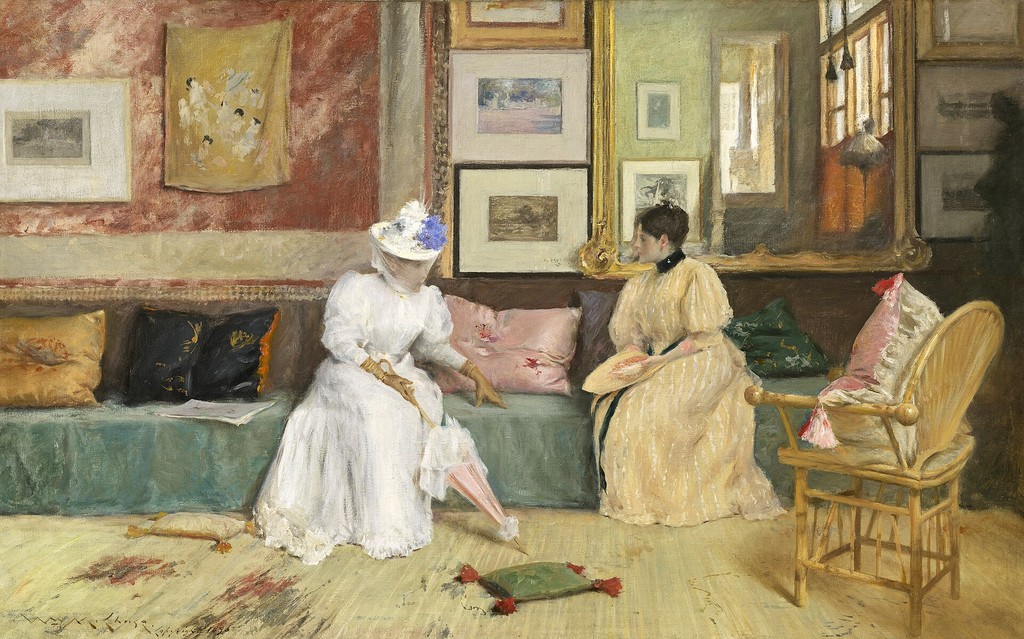
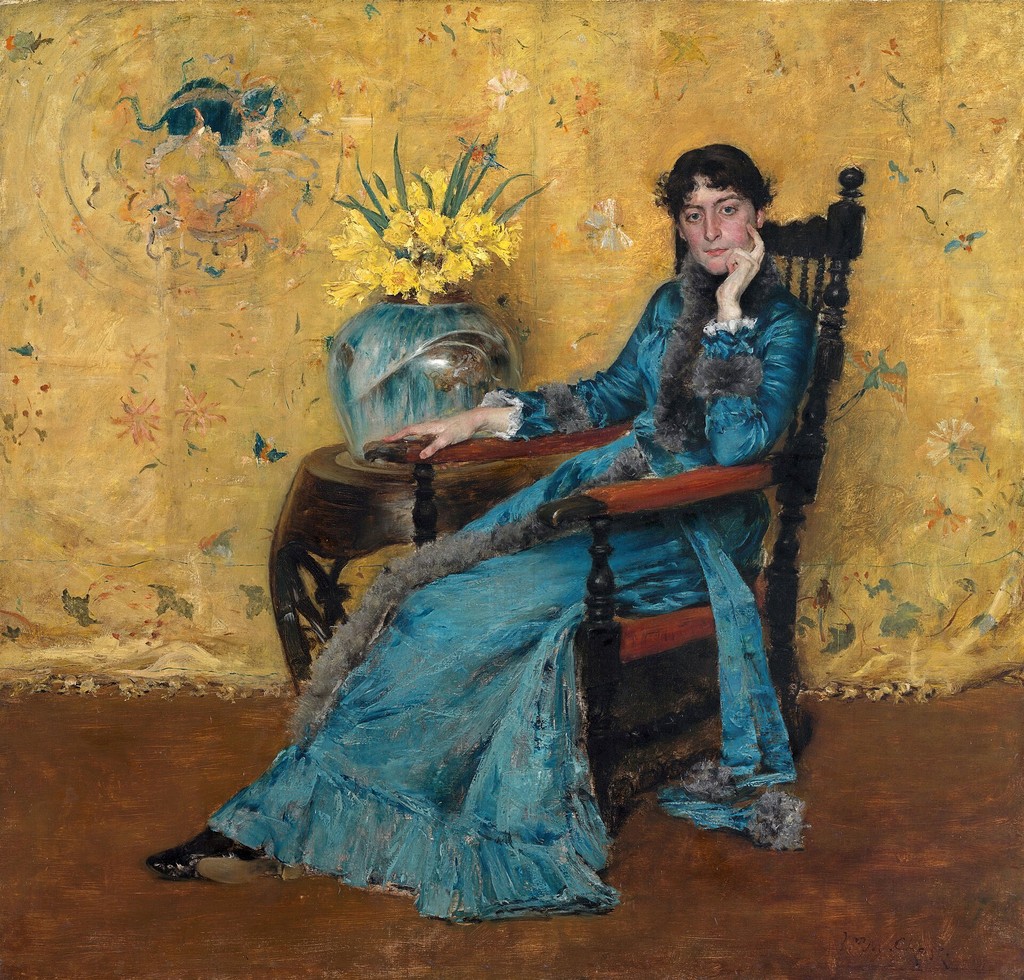
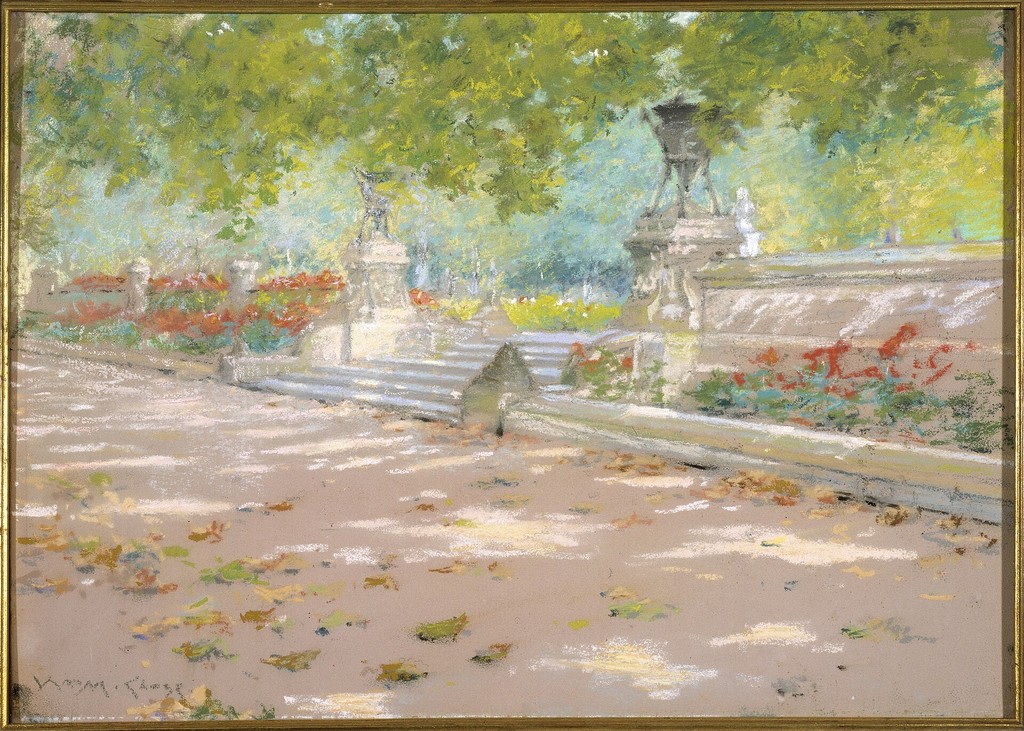
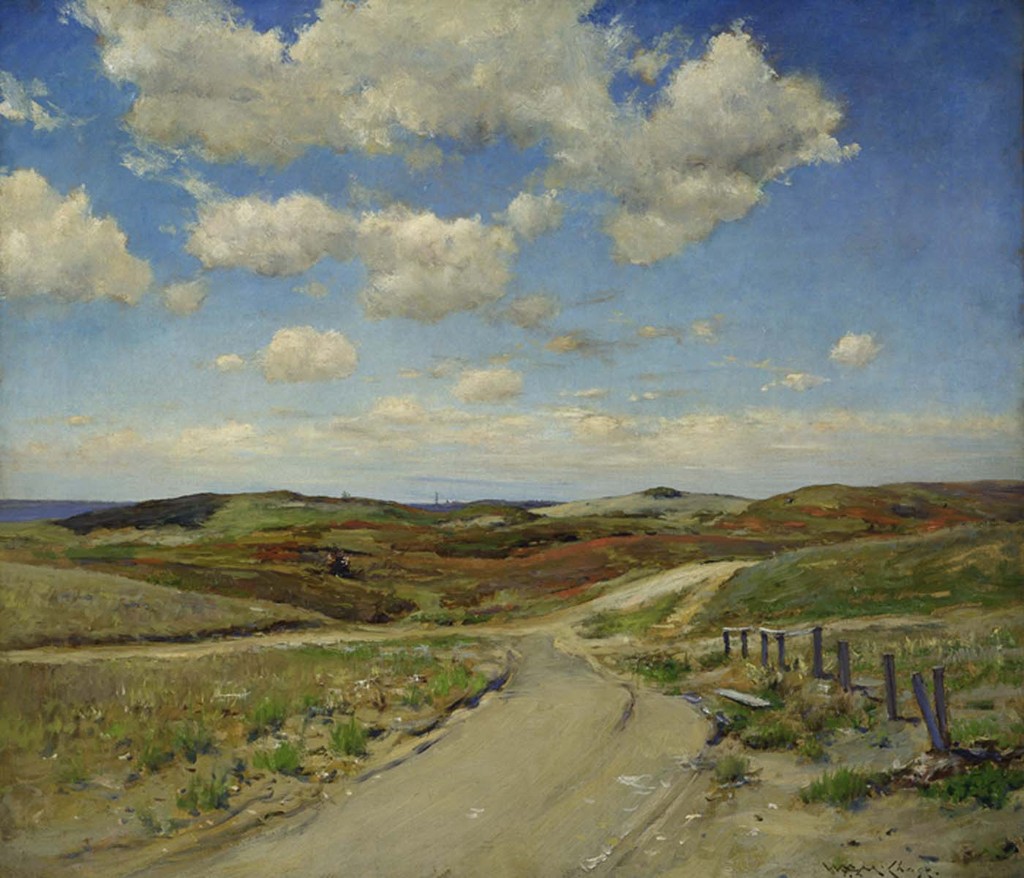
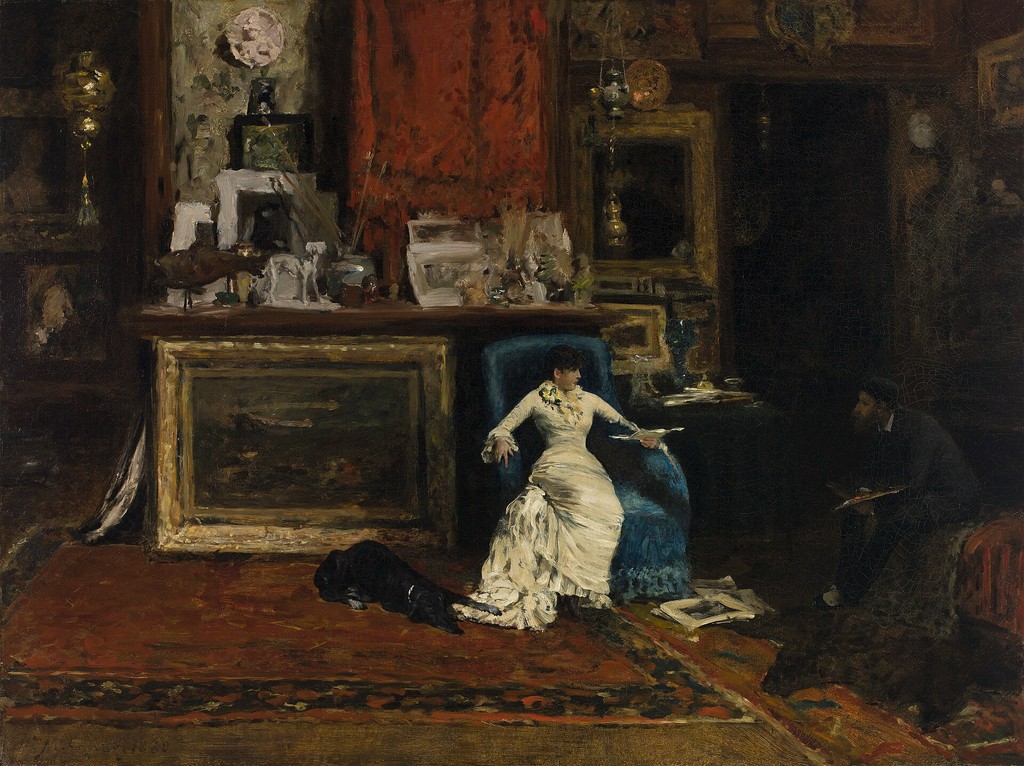
His later paintings and artworks encompassed cultivated interiors, portraits, city parks and Long Island landscapes. Yet still life remained available when he wanted concentrated material effects rather than a sitter’s presence or an outdoor motif.
A Munich Grammar of Darkness and Light
Chase entered a Munich culture that valued vigorous paint handling and dramatic chiaroscuro. He responded to the painterly realism associated with Wilhelm Leibl and to old masters including Rubens and Hals. When he returned to New York in 1878, he brought home more than a fashionable dark palette: he had learned to organise a picture through masses of shadow, selective illumination and strokes that announce the movement of the brush.[2]
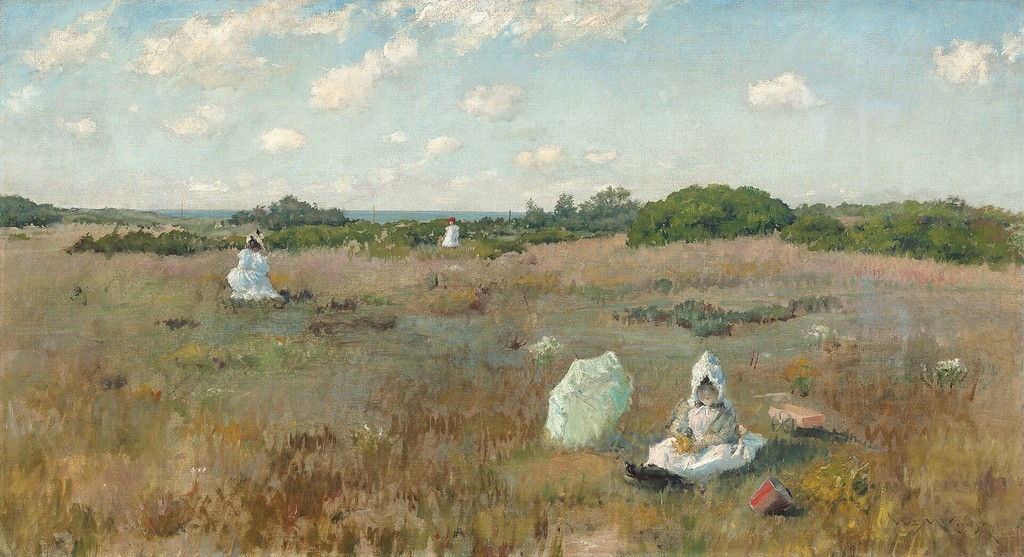
The journey from Munich to Tenth Street did not bind him permanently to one appearance. His park scenes and Shinnecock landscapes could become pale, airy and open. Still life, however, let him reactivate the dense tonal architecture of his training. A fish’s light belly, a metal vessel or the rim of a plate becomes legible because it presses against surrounding browns and blacks.
The Metropolitan Museum relates Chase’s late fish paintings both to seventeenth-century Spanish still life and to the French painter Antoine Vollon. This is artistic context, not evidence that Chase copied a particular composition. Vollon’s example offered a modern route into an older tradition of sweeping contours, concentrated highlights and visible paint.[3]
The Return to Fish after 1904
Beginning in 1904, Chase made many large-scale fish still lifes, commonly during summer teaching trips to Europe.[3] The recurrence is significant. At the same time that viewers associated him with elegant portraiture and light-filled outdoor subjects, he repeatedly chose a studio arrangement built from dark space, horizontal bodies and gleaming surfaces.
Fish gave him unusually forceful shapes. A long body could sweep across a plate, overlap another fish or press towards the canvas edge. Scales, wet skin, cut flesh, ceramic and metal each reflected light differently. The restricted setting intensified these distinctions: without landscape depth or an elaborate interior, small changes of temperature, sheen and thickness carried the image.
The Met notes that large fish paintings could command substantial prices, even as Chase worried that this success might narrow his identity to “a painter of fish”.[2] They were recognisable and saleable, but also demanding statements about what technique could make visible.
Looking Closely at the Met’s Still Life: Fish
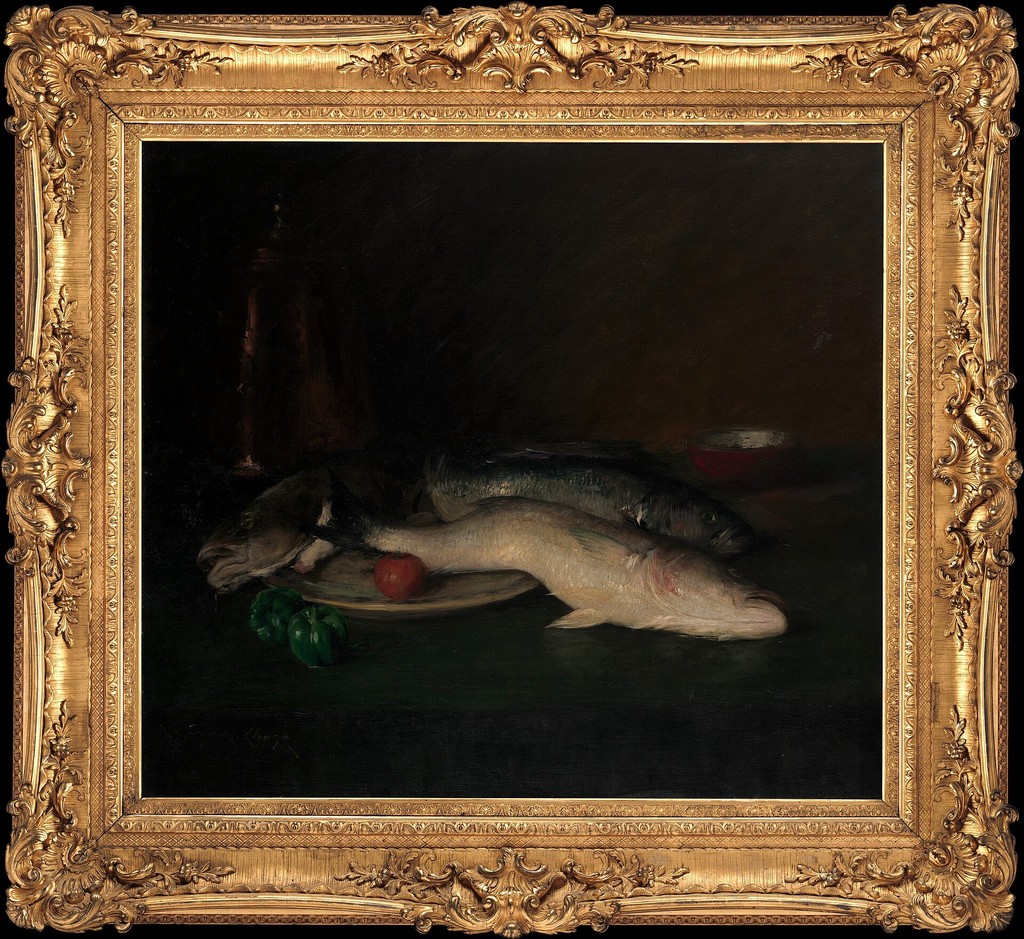
The cluster’s principal Still Life: Fish is the Metropolitan Museum of Art’s canvas, accession 08.139.2. Painted by 1908, it measures 101.9 × 114.5 cm. The arrangement includes a striped bass and salmon on a plate, a weakfish directly on the table, and a bowl receding into the background.[3]
The scene is shallow rather than expansive. Overlapping bodies establish the main intervals, while the tabletop provides a compressed field across which the fish lie. Chase does not describe every scale with an isolated mark. Broad strokes establish mass; smaller touches catch damp highlights, fins and changes in colour. Light moves across the curves, then falls quickly into the dark surrounding field.
The painting’s control is easiest to see at its boundaries. Pale flesh does not dissolve into glare, and the darker backs do not vanish into the ground. Each passage occupies a carefully judged tonal position. Even apparently quick accents depend upon the larger arrangement: a wet flash is effective because Chase has prepared a restrained area beside it. Bravura here means visible decisiveness within an ordered structure.
Speed, Sequence and the Teaching Demonstration
The Brooklyn Museum’s Still Life, Fish of 1912 records a related but separate act of painting. Chase made it in Bruges before American students and the museum’s then-director, William H. Fox. The account describes him working wet into wet over a preparation of silvery white and blue, identifying the brightest passage first, and then developing darks and lights together.[4]
That sequence corrects the idea that speed must be effortless improvisation. A public demonstration concentrates years of practice into a visible event. Choosing the brightest note at the outset establishes a limit against which subsequent values can be measured. Working lights and darks concurrently keeps the whole image in balance. Wet paint permits one stroke to merge with or pull through another, but each mark still answers decisions about shape, value and timing.
The demonstration made judgement observable. Chase could show how a broad stroke turns around a body, how a tinted white differs from untouched white, or how a dark gains depth. The spectacle rested on preparation, tonal anchors and sustained adjustment; performance and discipline were not opposites.
Three Paintings, Three Object Identities
Similar titles make careful identification essential. The Met work is Still Life: Fish, by 1908, 08.139.2. Brooklyn’s Still Life, Fish is a 1912 oil measuring 81 × 100.2 cm, accession 13.54. Its upturned skate or ray creates the brightest area, surrounded by dark fish and emphatic orange-red accents.[4] The Brooklyn canvas cannot stand in for the Met painting simply because both titles name fish.
The National Gallery of Art’s An English Cod is different again. Dated 1904 and accessioned as 2014.136.5, it measures 91.76 × 101.92 cm. A pale cod bends over a decorated plate beside a brass-coloured vessel; four smaller silvery fish are paired on the tabletop. Light enters from the left, catching the fish and pot against deep earth-brown shadow.[5]
Comparison is most useful when it respects these identities. The Met canvas distributes several fish across a broader horizontal field. An English Cod centres its pale body and sets ceramic, metal and smaller fish around it. Brooklyn’s later demonstration turns the ray’s belly into a conspicuous tonal pivot. The shared subject reveals recurring concerns, while dimensions, accessions, dates and arrangements prevent three objects from collapsing into one generic “fish picture”.
Why Still Life Mattered within a Plural Career
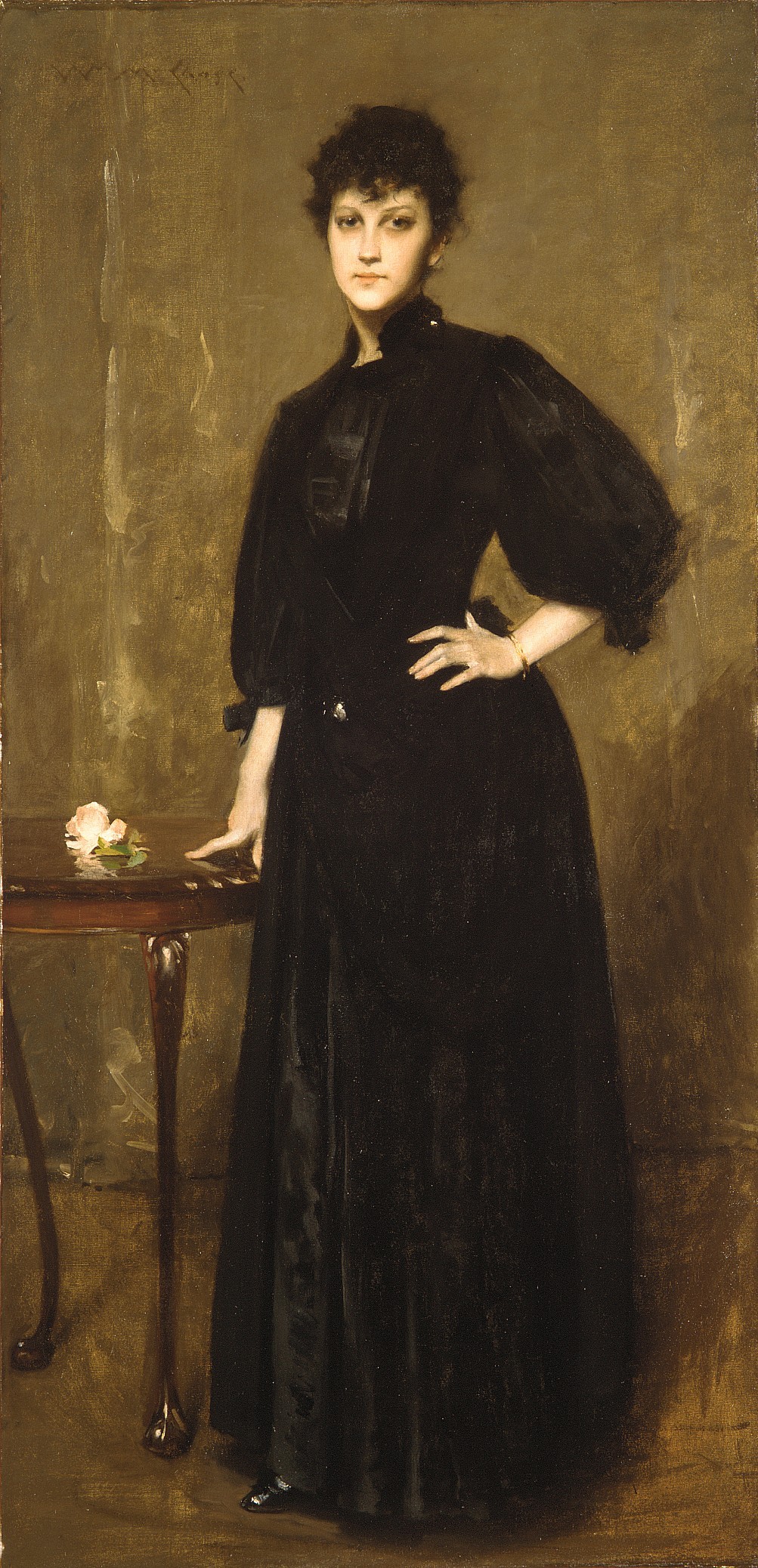
Chase’s still lifes clarify why it is misleading to describe him simply as an Impressionist. The lighter New York park scenes respond to outdoor light and modern public space. His portraits negotiate resemblance, dress and the social presence of a sitter. Fish paintings instead concentrate on weight, surface and the drama created by adjacent values.
These approaches coexist rather than forming a simple march from darkness to light. Chase could retain Munich-derived tonal habits for one task while using broken colour and a brighter range for another. The choice of still life therefore demonstrates adaptability. It allowed him to carry an older painterly language into the twentieth century without pretending that his intervening landscapes and portraits had never happened.
Still life also reduced narrative demands. Fish, plate and vessel did not require a biographical story. Their arrangement could address the viewer through scale, line and paint alone. That does not make the subject empty, nor does it require speculative symbolism. Its significance lies in what Chase visibly did: organise soft bodies into sweeping curves, distinguish surfaces with colour and pressure, and convert perishable material into a durable exercise in looking.
How to Read the Fish Paintings
Begin with the largest divisions of light and dark. Identify the brightest passage, then notice how many intermediate tones connect it to the deepest ground. Follow the long contour of a fish and observe where another body, plate or table edge interrupts it. These structural relationships reveal more than a search for individually rendered scales.
Next, compare substances. Chase varies the paint where slick skin, porous flesh, glazed ceramic, wood and metal meet. Some marks describe an edge; others merely register a flash of reflected light. A stroke that looks spontaneous at close range often locks into a controlled mass when seen from farther away.
Finally, place a fish picture beside a park view or portrait. The contrast shows how Chase matched handling to the visual problem before him. His still lifes are not minor pauses between more prestigious subjects. From St Louis fruit pictures to late teaching demonstrations, they form a continuous testing ground for tonal design, material distinction and deliberate speed.
Researched works directory
This searchable evidence census contains 208 distinct records assembled from public collection data and a reproducible Wikidata snapshot. It is not a catalogue raisonné, not a claim of complete oeuvre coverage, and it keeps works with repeated titles as separate objects.
| Name | Date | Medium |
|---|---|---|
| A City Park | 1887 | Painting |
| A Corner of My Studio | Date unknown | Painting |
| A Dutch Landscape | 1884 | Painting |
| A Friendly Call | 1895 | Painting |
| A Gray Day | 1886 | Painting |
| A Modern Magdalen | 1888 | Painting |
| A Spanish Gypsy | 1905 | Painting |
| Albert Harkness (1822–1907) | 1908 | Painting |
| Alice | 1892 | Painting |
| An Afternoon Stroll | 1895 | Painting |
| An English Cod | 1904 | Painting |
| At the Seaside | 1890 | Painting |
| August B. Loeb | 1905 | Painting |
| Baron Hugo von Habermann | 1875 | Painting |
| Beach | 1895 | Painting |
| Bessie Potter | 1895 | Painting |
| Big Copper Kettle and Fish (Fish) | Date unknown | Painting |
| Bildnis Hugo von Habermann | 1875 | Painting |
| Brass Kettle and Catfish | Date unknown | Painting |
| Carmencita | 1890 | Painting |
| Courtyard in Venice | 1877 | Painting |
| Crucifixion | 1875 | Painting |
| Der japanische Holzschnitt | 1888 | Painting |
| Dieudonnée | 1899 | Painting |
| Dorothy | 1902 | Painting |
| Dr. Eduardo San Giovanni | 1906 | Drawing |
| Duveneck Painting "The Turkish Page | 1876 | Painting |
| Edward Everett Hale (1822-1909) | 1884 | Painting |
| Edward Guthrie Kennedy | 1895 | Painting |
| Edward Steichen | 1903 | Painting |
| Female Figure Study (front view) | Date unknown | Painting |
| Female Figure Study (side view) | Date unknown | Painting |
| First Touch of Autumn | 1898 | Painting |
| Fish | 1910 | Painting |
| Fish and Still Life | 1906 | Painting |
| Fish and Still Life | 1908 | Painting |
| Florence | 1907 | Painting |
| For the Little One | 1896 | Painting |
| Garden of the Orphanage, Haarlem, Holland | 1883 | Painting |
| Gathering Autumn Flowers | 1894 | Painting |
| Gathering Flowers, Shinnecock, Long Island | 1897 | Drawing |
| Girl at a Bureau | Date unknown | Painting |
| Girl in a Japanese Costume | 1890 | Painting |
| Girl in Ciociaro costume | 1876 | Painting |
| Girl in White | 1890 | Painting |
| Girl with Doll | 1910 | Painting |
| Gray Day on the Bay | 1886 | Painting |
| Gray Day on the Lagoon | 1913 | Painting |
| Harbor Scene, Brooklyn Dock | 1886 | Painting |
| Harriet Hubbard Ayer | 1880 | Painting |
| Head of a Man | 1875 | Painting |
| Hide and Seek | 1888 | Painting |
| I Think I'm Ready Now | 1883 | Painting |
| Idle Hours | 1894 | Painting |
| In the Park (A By-path) | 1889 | Painting |
| In the Studio Corner | 1881 | Painting |
| In Venice | 1877 | Painting |
| James Abbott McNeill Whistler | 1885 | Painting |
| John Butler Talcott | 1900 | Painting |
| Just Onions (Onions; Still Life) | Date unknown | Painting |
| Keying Up" - The Court Jester | 1875 | Painting |
| Keying Up: The Court Jester | 1875 | |
| L'Éventail de plumes | Date unknown | Painting |
| Lady in Black | 1888 | Painting |
| Lady Playing Guitar | Date unknown | Painting |
| Landscape- Shinnecock, Long Island | 1896 | Painting |
| Long Island Landscape after a Shower of Rain (After the Shower) | 1889 | Painting |
| Lydia Field Emmet | 1892 | Painting |
| Man Wearing Gold Rimmed Glasses | 1892 | Painting |
| Marine | 1888 | Painting |
| Monkeying with Literature | 1877 | Painting |
| Moses Swaim | Date unknown | Painting |
| Mother and Child (The First Portrait) | 1887 | Painting |
| Mrs. Charles Scott | Date unknown | Painting |
| Mrs. Chase | 1890 | Painting |
| Mrs. Chase in Prospect Park | 1886 | Painting |
| Mrs. William Clark | 1915 | Painting |
| Mrs. William Merritt Chase | 1890 | Painting |
| My Little Daughter Dorothy | 1894 | Painting |
| My Palette | 1875 | Painting |
| Myra Reynolds | 1898 | Painting |
| Near the Beach, Shinnecock | 1895 | Painting |
| Near the Beach, Shinnecock | Date unknown | Painting |
| North River Shad | 1910 | Painting |
| Nude | 1901 | Painting |
| Open Air Breakfast | 1888 | Painting |
| Outskirts of Madrid | 1882 | Painting |
| Pablo de Sarasate: Portrait of a Violinist | 1875 | Painting |
| Park Bench | 1890 | Painting |
| Peace, Fort Hamilton | 1888 | Painting |
| Pink Azalea—Chinese Vase | 1885 | Painting |
| Portrait Head | 1882 | Painting |
| Portrait of a Boy in Van Dyck Costume | 1875 | Painting |
| Portrait of a Child | 1884 | Painting |
| Portrait of a Lady in Black | 1895 | Painting |
| Portrait of a Lady in Black (Annie Traquair Lang) | 1911 | Painting |
| Portrait of a Lady in Pink | Date unknown | Painting |
| Portrait of a Man | 1874 | Painting |
| Portrait of a Man | 1875 | Painting |
| Portrait of a Woman | Date unknown | Painting |
| Portrait of Artist Beck Wenzell | 1900 | Painting |
| Portrait of Baroness Ida-Gro van Dahlerup | 1907 | Painting |
| Portrait of Dora Wheeler | 1882 | Painting |
| Portrait of Lavinia Borden Cook | Date unknown | Painting |
| Portrait of Louis Betts | Date unknown | Painting |
| Portrait of Master Otis Barton and his Grandfather | 1903 | Painting |
| Portrait of Miss D. | Date unknown | Painting |
| Portrait of Mrs. C. (Lady with a White Shawl) | 1893 | Painting |
| Portrait of Mrs. George B. Ely (Caroline Boies Ely) | Date unknown | Painting |
| Portrait of My Daughter Alice | 1895 | Painting |
| Portrait of My Father (David Hester Chase) | Date unknown | Painting |
| Portrait of My Mother (Sarah Swaim Chase) | 1892 | Painting |
| Portrait of William Francklyn Paris | Date unknown | Painting |
| Portrait of William Gurley Munson | 1868 | Painting |
| Ready for the Ride | 1877 | Painting |
| Red Snapper | Date unknown | Painting |
| Robert Frederick Blum | Date unknown | Painting |
| Roland | 1902 | Painting |
| Roses | 1883 | Drawing |
| Seaside Flowers | 1897 | Painting |
| Selbstbildnis | 1875 | Painting |
| Selbstporträt | 1915 | Painting |
| Self-Portrait | 1909 | Drawing |
| Self Portrait | 1914 | Painting |
| Self-Portrait | 1915 | Painting |
| Self-portrait dressed as Johan Claesz Loo by Frans Hals | 1903 | Painting |
| Seventeenth Century Lady | 1895 | Painting |
| Shell Beach at Shinnecock | 1892 | Painting |
| Shinnecock Hills | 1892 | Painting |
| Shinnecock Hills | 1893 | Painting |
| Shinnecock Hills | 1895 | Painting |
| Shinnecock Hills | 1895 | Painting |
| Shinnecock Hills Landscape | 1890 | Painting |
| Shinnecock Studio Interior | 1892 | Drawing |
| Sketch for a Picture--Columbus before the Council of Salamanca (A) (Christopher Columbus before the Council of Salamanca) | 1876 | Painting |
| Sketch for a Picture--Columbus before the Council of Salamanca (B) (Christopher Columbus before the Spanish Council) | 1876 | Painting |
| Sketch of a Child:Helen | 1898 | Painting |
| St. Jerome | 1875 | Painting |
| Still Life | 1912 | Painting |
| Still Life | Date unknown | Painting |
| Still Life | Date unknown | Painting |
| Still Life | Date unknown | Painting |
| Still Life (Brass Bowl) | Date unknown | Painting |
| Still Life (Brushes, Books and Pottery) | 1904 | Painting |
| Still Life: Fish | 1900 | Painting |
| Still Life: Fish | 1903 | Painting |
| Still Life: Fish | 1908 | Painting |
| Still Life: Fish | 1912 | Painting |
| Still-life: Fish and Bowl | 1895 | Painting |
| Still Life (Fruit and Copper Pot) | Date unknown | Painting |
| Still Life (Fruit and Pottery) | Date unknown | Painting |
| Still Life--Striped Bass | 1907 | Painting |
| Still Life with Fish | 1800 | Painting |
| Still Life with Fish | 1910 | Painting |
| Still Life with Fish | 1912 | Painting |
| Still Life with Fish | Date unknown | Painting |
| Still life with fruit | 1871 | Painting |
| Still Life with Hummingbird | 1870 | Painting |
| Still Life with Watermelon | 1869 | Painting |
| Studio Interior | 1882 | Painting |
| Study Head | Date unknown | Painting |
| Study of a Girl in Japanese Dress | 1895 | Painting |
| Study of a Young Woman | 1883 | Painting |
| Study of Flesh Color and Gold | 1888 | Drawing |
| Summer at Shinnecock Hills | 1891 | Painting |
| Sunlight and Shadow, Shinnecock Hills | 1893 | Painting |
| Tenth Street Studio | 1880 | Painting |
| Terrace at the Mall | 1890 | Painting |
| Terrace, Prospect Park | 1887 | Drawing |
| The Antiquary Shop | 1879 | Painting |
| The Apprentice (Boy with Apple) | 1876 | Painting |
| The Big Brass Bowl | Date unknown | Painting |
| The Blue Kimono | 1915 | Painting |
| The Boat Harbor (Gowanus Pier) | 1888 | Painting |
| The Coast of Holland | 1884 | Painting |
| The Emerald Lady | Date unknown | Painting |
| The Family Cow (Calf's Head) | 1869 | Painting |
| The Keynote | 1915 | Painting |
| The Kimono | 1895 | Painting |
| The Mirror | 1900 | Painting |
| The Model | 1888 | Drawing |
| The Moorish Warrior | 1878 | Painting |
| The Old Road to the Sea | 1893 | Painting |
| The Patrician | 1875 | Painting |
| The Song | 1907 | Painting |
| The Stately Model | 1898 | Painting |
| The Tenth Street Studio | 1880 | Painting |
| The Tow Path | 1880 | Painting |
| The Turkish Page (Unexpected Intrusion) | 1876 | Painting |
| The Whistling Boy | 1875 | Painting |
| The Wounded Poacher | 1878 | Painting |
| The Yield of the Waters | 1878 | Painting |
| The Young Orphan | 1884 | Painting |
| Thomas E. Kirby | 1900 | Painting |
| Thomas Moran | Date unknown | Painting |
| Under a French Sky | 1882 | Painting |
| Venetian Lace Making | Date unknown | Drawing |
| View from Central Park | 1889 | Painting |
| View near Polling | 1875 | Painting |
| William A. Clark | 1915 | Painting |
| William Andrews Clark | 1915 | Painting |
| William Nimick Frew | 1915 | Painting |
| William Rockhill Nelson | 1907 | Painting |
| Wind-Swept Sands | 1894 | Painting |
| Woman in White | 1902 | Painting |
| Woman Seated | 1885 | Drawing |
| Woman Standing in a Landscape | Date unknown | Painting |
| Worthington Whittredge | 1890 | Painting |
Frequently Asked Questions
Still life belonged to his earliest professional activity. He painted the genre in St Louis in 1871–72, before patrons supported his studies in Munich, and his first National Academy exhibition included two fruit still lifes.[1]
Fish offered large, sweeping shapes and sharply contrasting surfaces that suited his dark palette and broad handling. From 1904 he returned to the subject repeatedly, and the paintings also attracted buyers.[2][3]
The Brooklyn Museum documents a 1912 painting made quickly as a demonstration, using wet-into-wet paint and a planned sequence of tonal decisions.[4] That evidence describes a practised performance, not every fish painting he produced.
No. Brooklyn’s painting is the 1912 canvas numbered 13.54. The Met’s Still Life: Fish was completed by 1908 and is numbered 08.139.2. They have different compositions, measurements and collection histories.[3][4]
Discussion
Use this evidence-led guide as a starting point for close looking rather than a final verdict.
Share an observation about William Merritt Chase Still Life Paintings or a source that adds useful context.
Reader Insights
Which work most clearly complicates the familiar label of American Impressionist?
Where do training, display, family, place or teaching most productively alter your reading?
Which source or surviving object would you investigate next?
Join the Conversation
Add your reading below, keeping observations specific and evidence clear.
References
- American Paintings of the Nineteenth Century, Part I — National Gallery of Art, accessed 31 August 2026, accessed 31 August 2026.
- William Merritt Chase (1849–1916) — Metropolitan Museum of Art, accessed 31 August 2026, accessed 31 August 2026.
- Still Life: Fish — Metropolitan Museum of Art, accessed 31 August 2026, accessed 31 August 2026.
- Still Life, Fish — Brooklyn Museum, accessed 31 August 2026, accessed 31 August 2026.
- An English Cod — National Gallery of Art, accessed 31 August 2026, accessed 31 August 2026.