 by Tom Gurney
Tom Gurney BSc (Hons) is an art history expert with over 20 years experience
Published on June 19, 2020 / Updated on November 18, 2026
Email: tomgurney1@gmail.com / Phone: +44 7429 011000
Hanako
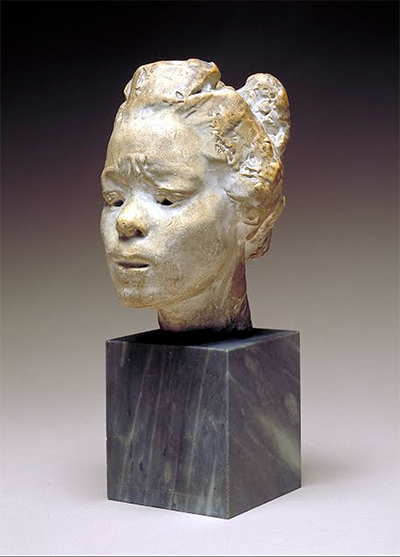
Auguste Rodin portrayed the Japanese actor and dancer Ōta Hisa, known professionally as Hanako, in a series of heads, masks, busts and drawings. The photograph shows a head inclined slightly forward, its eyes lowered and its lips parted. The rough surface along the crown and around the hair contrasts with the cheeks and the dark rectangular support. Other studies give the same sitter a more strained expression or end at the edge of the face. The works originated in sittings that followed Rodin’s encounter with Hanako in Marseille in 1906. [1] [2] [3]
The head in the photograph
The angle of the photograph gives a clear view of the nearer side of the face. The brow forms an uneven line across the forehead. Below it, the openings at the eyes are narrow and receive relatively little light. The cheeks are broadly lit, and the light continues across the bridge and tip of the nose. Under the nose, the darker opening of the mouth is small enough to miss at first glance. These three parts of the face have quite different amounts of depth. The strongest dark accents are concentrated in the eyes and mouth, while the intervening planes remain open and easy to read. [2] [3]
The hair gives the top of the head a much less regular outline. Several forms project at the crown and above the back of the head. Along the nearer temple, shallow marks describe a change from skin to hair. They become more abrupt as they approach the outer edge. The warm colour across those higher surfaces is visible where the light is strongest. Below the face, the neck enters the shadow beside the support. A viewer could move sideways to see more of the back, including parts of the head whose size is difficult to estimate from a frontal angle. That possibility distinguishes the experience of looking at a head in the round from studying the line or relief of the face alone. [2] [4]
The dark block under the neck has two clearly visible vertical faces. Fine diagonal streaks run across those planes while the corners remain straight. This gives the head a relatively simple base against which the different textures and changing outlines stand out. Near the back of the jaw, the dark tone of the neck also makes the pale cheek appear to project. The support therefore affects how the viewer reads the lower edge of the sculpture as well as the height at which the face is seen. [2] [4]
Ōta Hisa on stage and in the studio
Hanako was a stage name, meaning little flower. She was an actor and dancer in touring theatre, and Rodin met her when she appeared at the 1906 Colonial Exhibition in Marseille. Tate sets that performance within an event intended to bolster support for French colonial expansion. For Rodin the encounter also opened an opportunity to study a performer who could sustain markedly different expressions. Museum accounts draw attention to the death scenes that ended some of her performances and to her ability to hold her face under tension. The long series of studies demonstrates how much could change around the eyes and mouth while the dimensions of the face remained recognisable. [1] [2] [3]
The Courtauld dates the series of more than 50 sculpted studies to 1907–11. Its example of the Type E mask offers a comparatively settled expression. This is one of several types recorded by the Musée Rodin and the French national collections database. The designation helps keep different models apart, particularly where a museum has several objects made from related models. A museum record may also distinguish the form that Rodin developed from the material in which an individual example was made. The recorded materials for the Type E masks include plaster, terracotta and glass paste. The bronze now catalogued by the Musée d’Orsay was purchased by the French state in 1910. [2] [5] [6]
A portrait in several media
The Metropolitan Museum of Art’s drawing shows two versions of Hanako’s face on the same sheet. It uses graphite, pen and brown ink, red crayon and gouache wash. In one rendering, the lines of the face are kept relatively clear. In the other, smudging and rubbed passages make the face harder to separate from the paper around it. Both retain something of the concentration of a sculpted mask. The juxtaposition lets the viewer see one artist reconsidering where the expression lies. An accent at the eyebrow can be carried by a drawn line, a darker accumulation of material or the shadow beneath a ridge in sculpture. [3] [7]
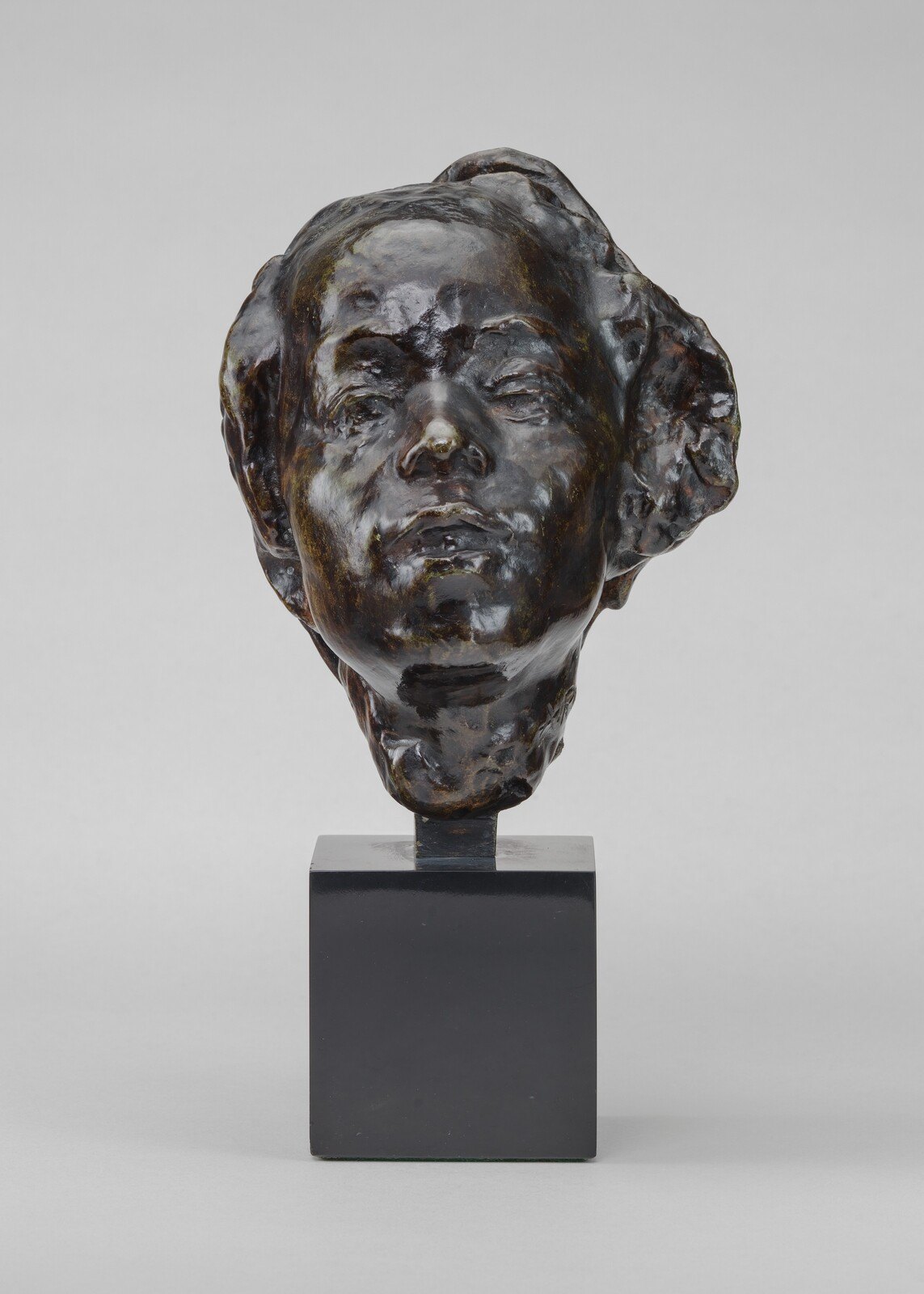
The Washington bronze was cast in 1965 from a model the gallery dates to about 1908. National Gallery of Art, Washington, Collection of Mr. and Mrs. Paul Mellon, 1995.47.21. Image source. CC0 / Public domain.
There are equally instructive differences between three-dimensional examples. The Musée Rodin catalogues a Type A head in plaster, S.00548, as a foundry model. Tokyo’s National Museum of Western Art holds a bronze head about 17 centimetres high. Its catalogue transcribes Rodin’s signature on one side of the neck and the Alexis Rudier foundry mark at the back. These marks supply evidence that is usually invisible in a photograph taken from the front. Tokyo also catalogues a separate Mask of Hanako. In a collection that holds both forms, the distinct entries help a viewer follow the relationship between a portrait with visible depth at the back of the head and one conceived around the front of the face. [4] [8] [9]
A conservation study of the Musée Rodin’s larger Hanako, S.02242, found that the front and back of its head were made differently. The front incorporates a plaster impression of the face. At the rear, plaster pieces were held together with fresh plaster. The construction helps explain why looking at the back of a portrait can reveal stages of work that the expression in front leaves concealed. [10]
The illustrated head shares the low eyes, small parting of the lips and raised hair found in documented studies of Hanako. Its light surface and dark mount are features of the pictured object. A close match to a collection photograph or additional object details would support a more precise identification. The separate records for heads, masks and materials also show why the likeness alone offers only part of the evidence. In this view, the inclined forehead and the small opening at the mouth are enough to give the face an expression even before the eye has taken in the head’s rougher planes. [2] [3] [4] [8]
Watch Rodin’s sculpture up close
Five films explore Rodin’s sculpture, from his use of classical models and the figures on his monumental doorway to the work of his studio.
Auguste Rodin – Challenging Beauty
Six sculptures show how Rodin adapted classical models.
Watch on YouTubeThe scale of the Type D bronze
The Shizuoka Prefectural Museum of Art catalogues a Type D bronze, traditionally titled Head of Death’s Anguish. It stands 55 centimetres high. One side of the base carries Rodin’s name, the number 3 and the Musée Rodin copyright dated 1973. The opposite side bears the Susse foundry mark. The museum dates the work to about 1908–12 and records buying the bronze in 1991. Those dates locate the development of the portrait, an inscription on this casting and its entry into the collection. [11]
The title refers to the kind of expression Rodin saw Hanako produce onstage. The scale gives that expression a different presence from the smaller Tokyo portraits. The eyes and mouth can be read from farther away, while a close view lets the viewer follow the contractions around them. Tokyo’s Type E mask offers a comparison at the level of expression as well as dimensions. Presented together in the catalogues, the two types show how much could change across studies of one performer, from the intensity of the face to the space the bronze occupies. [1] [2] [9] [11]
A small head with a history after Rodin
The National Gallery of Art dates the model for its Head of Hanako to about 1908 and records that the Musée Rodin cast this bronze in 1965. It measures 15.5 centimetres high without its base. The base gives the face a position to be looked at from below, but the catalogue measure isolates the head itself. At that scale, the difference between a downcast gaze and closed eyes can be hard to see until the viewer comes close. The parted lips are easier to notice from a slight angle, where their outline can be separated from the shadow beneath the nose. [12]
The accession record follows the cast through the Dominion Gallery in Montreal, a London sale in 1967, and the Paris dealer Hector Brame, through whom the Mellons acquired it. It entered the National Gallery of Art in 1995. That sequence belongs to this individual bronze. The model date connects the form to the period in which Rodin worked with Hanako, and the casting date helps explain how this particular object entered a later market. The portrait series can therefore be studied at two levels. Its expressions belong to the encounters with the sitter and the decisions Rodin made around them. The collected bronzes and plasters have material histories of their own. [12] [3]
Comparing a sustained expression with a drawing
The Metropolitan Museum’s Hanako includes a resting pose with the hands near the chin, alongside other studies on the same sheet. Its account draws attention to the more strained expression in another part of the drawing. Readers can follow the different treatment of the brows and mouth without supposing that the recorded moments took place in a particular order. In the bronze, closed eyes and parted lips remain visible together as the head turns away from the viewer. In the drawing, Rodin had the means to put changes of expression into adjacent areas of paper, where the eye can move between them directly. [12] [3]
The comparison also helps distinguish a record of a pose from an account of a performance. Hanako’s control of expression supplied the sculptor with something to study for more than an instant. The portraits retain the effects of that control. Identifying a gesture with a particular dramatic role would take other evidence. The face in the bronze can be described from what the casting preserves, and the resemblance between its expression and a drawn face can then be judged on the basis of visible features. [12] [3]
The mask that travelled to Japan
The Courtauld’s Mask of Hanako (Type E) is catalogued on long-term loan from a private collection. Its record names the sculptor Clare Sheridan as a former owner and gives February 1928 for Samuel Courtauld’s purchase from the Leicester Galleries. He left it to a private collection in 1947. That provenance is separate from the Mellon bronze’s passage through Montreal, London and Paris. In the Courtauld case the history of ownership helps identify the mask even where the date of casting is less exact. The museum records a conception around 1908 and a cast made in 1910 or later. [12] [2]
The object also travelled separately from its owner. The exhibition record places it in Tokyo in 2019 and lists subsequent venues at Nagoya and Kobe in 2020. This itinerary gives the mask a documented public history in Japan, where Hanako was born. It also identifies a specific object among the many versions of her face that an exhibition title might otherwise leave difficult to distinguish. A label reading Hanako establishes the sitter. The type, dimensions and ownership record tell a researcher which of the portraits was being shown. [2]
Rodin artworks directory
Discussion
Look again at the images and ideas explored in Hanako. These editorial prompts invite your observations.
Reader Insights
After reading “The head in the photograph”, what detail would you look for in the object or image?
What extra evidence would help you distinguish the artist’s choices from the effects of material, viewpoint or later display?
Join the Conversation
Share a detail, comparison or question about Hanako below.
References
- Tate. The Making of Rodin, exhibition guide, Hanako section. View source.
- Courtauld Gallery. Mask of Hanako, Type E. View source.
- Metropolitan Museum of Art. Rodin’s Portraits of His Contemporaries. View source.
- Musée Rodin. Tête de Hanako, type A, S.00548. View source.
- French Ministry of Culture. Hanako, masque, type E, Joconde. View source.
- Musée d’Orsay. Masque d’Hanako. View source.
- Metropolitan Museum of Art. Hanako, drawing. View source.
- National Museum of Western Art, Tokyo. Head of Hanako, S.1959-0026. View source.
- National Museum of Western Art, Tokyo. Mask of Hanako, S.1959-0025. View source.
- Langlois et al. Analysis and conservation of modern modeling materials found in Auguste Rodin’s sculptures, S.02242. View source.
- Shizuoka Prefectural Museum of Art. Hanako, Type D, S-046. View source.
- National Gallery of Art. Head of Hanako (Ohta Hisa), 1995.47.21. View source.

 Auguste Rodin.jpg)