 by Tom Gurney
Tom Gurney BSc (Hons) is an art history expert with over 20 years experience
Published on November 6, 2026 / Updated on November 6, 2026
Email: tomgurney1@gmail.com / Phone: +44 7429 011000
Introduction
“Christian humanism” can sound like a vague modern label applied to almost any Renaissance religious art. In Fra Angelico’s case, the phrase has a much firmer foundation. The Vatican Museums use it explicitly for the Niccoline Chapel, describing the fresco cycle as probably the summit of the Florentine painter’s Christian humanism. The Vatican also explains why. Pope Nicholas V was one of the greatest humanists of his age.
The chapel’s architecture and figure poses contain numerous references to antiquity. The people possess the heroic dignity associated with protagonists of classical history. The lives of Saints Stephen and Lawrence are organised rhetorically in parallel. The Four Evangelists transmit scriptural authority to eight Doctors of the Church. Religious and humanistic thought are therefore structurally joined. The phrase is most useful when grounded in that specific evidence rather than treated as a vague description of Angelico’s personality.
Fra Angelico did not become a “humanist painter” simply because his figures became more realistic. Christian humanism in his late work means something deeper: the intellectual, rhetorical, architectural and ethical culture of classical antiquity is absorbed into a Christian account of history. Ancient form serves Christian memory. Human dignity serves martyrdom. Rhetoric serves preaching. Classical architecture serves papal sacred space. The result is one of the defining syntheses of the Early Renaissance. [1]
At a Glance
- Key patronPope Nicholas V [2]
- Principal workNiccoline Chapel, Vatican [1]
- Dateprincipally 1448–50 [1]
- Vatican descriptionpeak of Fra Angelico’s “Christian humanism” [1]
- Humanist elementsclassical architecture, antique poses, rhetoric, heroic dignity, historical consciousness [1]
- Christian structureEvangelists, Doctors, deacons, martyrs, scripture and charity [1]
- Core synthesisantiquity used to dignify and interpret Christian history [1]
- Important cautionhumanism does not mean secularisation [1]
- Florentine precedentSan Marco library, Dominican study, Medici intellectual patronage [1]
- Key themefaith and learned culture as mutually reinforcing rather than opposing [1]
Contents
- Introduction
- What Was Renaissance Humanism?
- Nicholas V
- San Marco as Prelude
- Dominican Intellectual Culture
- Antiquity in the Niccoline Chapel
- Rhetoric
- Charity and Human Dignity
- Humanism Is Not Secularism
- Why Christian Humanism Matters to Fra Angelico
What Was Renaissance Humanism?
Renaissance humanism grew from renewed engagement with ancient literature, language, history, rhetoric and moral philosophy. Humanists studied classical texts. They recovered manuscripts. They refined Latin. They admired Roman history and Greek learning. This intellectual culture did not automatically reject Christianity. Many leading humanists were clerics. Popes patronised humanist scholarship. Christian thinkers used classical learning for Christian purposes. Nicholas V is one of the clearest examples. [1]
Nicholas V
Tommaso Parentucelli became Pope Nicholas V in 1447. The Vatican calls him one of the greatest humanists of the time. His interests included books, architecture and the cultural renewal of Rome. In the first year of his pontificate, he called Fra Angelico to decorate his private chapel. The commission therefore begins with a humanist pope selecting a Dominican painter. [2]
Angelico was unusually well suited to such a project. He was theologically literate through Dominican culture. He was a sophisticated Renaissance painter. He had mastered perspective. He could organise large narrative systems. He understood manuscript culture. He had already worked inside a Medici-sponsored environment where humanist books and monastic life coexisted. Rome expanded rather than invented the synthesis. [5]
San Marco as Prelude
San Marco provides an important Florentine precursor. Cosimo de’ Medici funded Michelozzo’s library. The collection served friars and lay scholars. Illuminated manuscripts occupied the same convent as Angelico’s meditative frescoes. Humanist learning and Dominican observance therefore coexisted architecturally. The Niccoline Chapel later gives this coexistence a papal and classical form. [4]
Dominican Intellectual Culture
The Dominicans were an intellectual order. Preaching required study. Thomas Aquinas represented one of the greatest achievements of scholastic theology. Angelico therefore came from a religious culture that already valued disciplined thought. Humanism entered an environment prepared to engage intellectually rather than a world hostile to learning. [6]
Scholastic theology and Renaissance humanism are sometimes described as opponents. In practice, fifteenth-century culture could combine them. Angelico’s late Armadio degli Argenti draws upon Thomistic interpretive structures. The Niccoline Chapel draws upon humanist rhetoric and classical history. The same painter can serve both. [6]
Antiquity in the Niccoline Chapel
The Vatican specifically notes references to antiquity in architecture and poses. This is crucial evidence. The classical world appears visually. Columns. Arcades. Monumental civic spaces. Heroic stances. Early Christian saints therefore inhabit a reconstructed antique environment. [1]
The chapel does not treat ancient Rome as a pagan culture to be erased. It reclaims Roman grandeur for Christian memory. Lawrence’s martyr story is especially important. He belongs to the ancient Roman Church. Classical architecture becomes the setting in which Christian sanctity confronts imperial power. The city’s two pasts coexist. [1]
The Vatican compares the varied humanity of the frescoes with protagonists of classical history. This changes the status of saints. They are not fragile holy symbols detached from public life. They preach. Administer. Distribute wealth. Argue. Suffer. Their Christian virtue becomes historical heroism. [1]
Rhetoric
The two saint cycles are organised according to a rhetorical law of correspondence. This language is unusually revealing. Rhetoric is not only depicted when Stephen preaches. It structures the entire room. One saint’s life is arranged against another. Consecration answers consecration. Service answers service. Martyrdom answers martyrdom. The chapel thinks rhetorically. [1]
This method recalls the humanist interest in comparative biography and moral exempla. Stephen and Lawrence become parallel historical subjects. The viewer learns through comparison. The saints’ biographies turn into arguments about office and virtue. [1]
The Four Evangelists occupy the vault. They represent scriptural authority. Their high position makes written revelation the conceptual foundation. Humanist culture therefore does not replace scripture. It exists beneath and around it. [1]
Eight Doctors occupy niches below the Evangelists. They represent learned interpretation. Scripture transmits authority to theology. The programme visualises intellectual continuity. This is Christian learning made architectural. [1]
Humanists valued history partly because examples from the past could teach moral action. The Niccoline Chapel applies this principle to Christian saints. Stephen and Lawrence are not simply objects of cult. Their actions teach. Office. Charity. Courage. Witness. The chapel turns sacred biography into moral history. [1]
Stephen’s preaching allows Christian rhetoric to assume classical visual dignity. He stands before listeners. Gesture establishes authority. The public space gives his speech civic importance. The preacher becomes a Renaissance historical protagonist. [1]
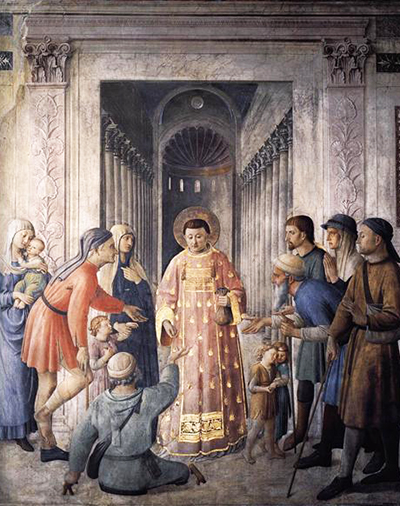
Lawrence’s story centres another humanist concern: ethical public action. He receives Church treasure. He distributes resources to the poor. He confronts state authority. Christian virtue operates inside administration and civic life. [1]
Charity and Human Dignity
The poor in Lawrence’s almsgiving scene are represented as real human recipients. They occupy the same monumental architecture as clergy and officials. This is a powerful form of Christian humanism. Human dignity extends across social rank. The classical city becomes a setting for charity. [1]
Humanism Is Not Secularism
This distinction is essential. Nothing in the Niccoline Chapel suggests that classical culture has displaced Christian belief. The opposite occurs. Classical form is appropriated. The heroes are martyrs. The highest authority is scriptural. The architecture serves a chapel. Humanism operates inside Christian purpose. [1]
Renaissance humanism also encouraged renewed attention to the human figure. Angelico’s mature bodies possess weight and dignity. This is not merely naturalism. Human bodies become morally expressive. Gesture reveals character. Physical presence supports spiritual meaning. [5]
Christian theology itself gives strong reason to value the body. The Incarnation states that divine Word becomes flesh. Angelico’s naturalism can therefore serve theological meaning deeply. A physically convincing Christ is not less sacred. Embodiment is part of the doctrine. [1]
Martyrdom intensifies this relationship between body and spirit. The saint’s body can be harmed. Moral identity survives. Angelico’s heroic bodies therefore create a powerful humanist-Christian synthesis. The body has dignity precisely because its suffering can become witness. [1]
Perspective
Perspective is often treated as a secular rationalisation of sacred space. Angelico demonstrates another possibility. Measured space makes sacred history believable. The Niccoline Chapel’s architecture gives saints historical presence. Reasoned spatial order can serve faith. [5]
Nicholas V’s architectural ambitions for Rome belonged to a broader programme of papal renewal. The chapel’s painted architecture therefore participates in real cultural politics. A renewed Christian Rome lays claim to the grandeur of ancient Rome. Angelico’s frescoes visualise that claim inside private devotion. [2]
Nicholas V was deeply associated with books and scholarship. Angelico’s own early formation in manuscript illumination creates another point of contact. Both patron and painter understood sacred culture through texts as well as images. The chapel’s intellectual density therefore fits both biographies. [4]
The transition from San Marco to Rome is not as abrupt as it appears. At San Marco: Dominican study and Medici humanism share a building. At the Vatican: Christian doctrine and papal humanism share a chapel. The scale changes. The principle continues. [4]
Gold and Humanism
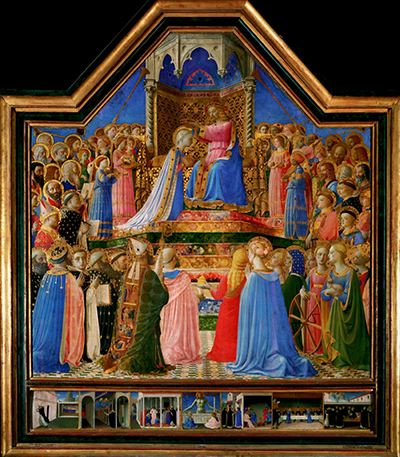
Angelico’s continued use of gold elsewhere also complicates the idea that humanism requires stylistic rejection of medieval materials. The Uffizi Glorification remains gold-ground while using Renaissance spatial organisation. Humanism is an intellectual orientation, not a ban on sacred material traditions. [6]
Angelico’s engagement with Masaccio likewise belongs to a broader Renaissance interest in human presence. Bodies gain weight. Emotion gains immediacy. Yet Angelico incorporates these discoveries into a theological system. The human figure becomes more convincing without becoming autonomous from sacred meaning. [5]
Benozzo’s collaboration shows how this visual culture passed into a younger generation. He absorbed Angelico’s narrative and spatial systems, then developed a more courtly and expansive language. Christian humanism therefore participates in workshop transmission as well as patronage. [1]
It would be too strong to label every earlier Angelico work explicitly “Christian humanist.” The term is most securely anchored in the Vatican’s interpretation of the Niccoline Chapel. Yet earlier works prepare the synthesis. Perspective. Dominican study. Medici library culture. Masaccian bodies. Classical architectural awareness. Rome brings these strands together. [5]
The Chapel as Culmination
This is why the Niccoline Chapel feels like culmination rather than departure. Angelico has spent decades reconciling inherited sacred tradition with new Renaissance form. Nicholas V gives him a patron for whom that reconciliation becomes an explicit cultural project. The result is unusually coherent. [3]
The chapel’s humanism is not only aesthetic. It is ethical. Stephen uses speech responsibly. Lawrence uses wealth responsibly. Both use office as service. Both accept suffering. Human dignity is shown through moral action. This is perhaps the deepest synthesis in the room. [1]
Papal authority is also subjected to this ethical framework. Sixtus II appears as an ancient pope. Nicholas V occupies the modern chapel. The visual history implies continuity. But continuity carries responsibility. Christian office is legitimate when it serves truth, charity and witness. [3]
Why Christian Humanism Matters to Fra Angelico
Christian humanism matters because it allows us to describe Fra Angelico’s Renaissance identity without falsely separating it from religion. He does not become modern by becoming less Christian. He becomes modern partly through finding new visual languages for Christian history. Perspective gives sacred events coherent space. Classical architecture gives martyrs historical dignity. Rhetoric organises biography. Humanist learning supports papal devotion. The body becomes morally expressive.
The Vatican’s description of the Niccoline Chapel as the summit of Angelico’s Christian humanism is therefore unusually precise. It identifies a genuine synthesis. Fra Angelico’s career demonstrates that the Early Renaissance was not simply the story of secular culture escaping medieval faith. It was also the story of religious institutions learning to use humanist culture creatively. Few artists show that process more clearly. [1]
Frequently Asked Questions
Discussion
Does the Niccoline Chapel’s use of classical form make Fra Angelico’s art less religious, or does it create a new Renaissance language for Christian ethics and history?
Reader Insights
How does Saint Lawrence’s charity give monumental classical space an explicitly Christian moral purpose?
What continuity connects Dominican study at San Marco with Nicholas V’s papal humanism in Rome?
How do the parallel lives of Stephen and Lawrence define responsible religious and civic office?
Join the Conversation
Share your reading of Fra Angelico and Christian humanism below.
References
- Vatican Museums, Niccoline Chapel. Vatican Museums Niccoline Chapel.
- Vatican Museums, History: Nicholas V and Fra Angelico. Vatican Museums History: Nicholas V and Fra Angelico.
- Vatican Museums, Department of XV–XVI Century Art. Vatican Museums Department of XV–XVI Century Art.
- Museo di San Marco, Michelozzo Library and illuminated manuscript research. Direzione regionale Musei nazionali Toscana Michelozzo Library and Illuminated Manuscripts.
- Museo Nacional del Prado, Fra Angelico and the Rise of the Florentine Renaissance. Museo Nacional del Prado Fra Angelico and the Rise of the Florentine Renaissance.
- Museo di San Marco, Armadio degli Argenti and Thomistic programme. Museo di San Marco Fra Angelico as Painter and Illuminator.
.jpg)
 Fra Angelico.jpg)