 by Tom Gurney
Tom Gurney BSc (Hons) is an art history expert with over 20 years experience
Published on July 28, 2026 / Updated on October 16, 2026
Email: tomgurney1@gmail.com / Phone: +44 7429 011000
Gustave Dore Bible Illustrations
Gustave Dore's Bible illustrations are among the most widely travelled images of the nineteenth century. They belong to a book, but they also exceed the limits of book illustration. Readers encountered them in large printed volumes, later Bible galleries, translated editions, sermons, religious teaching, popular reproductions and the visual memory of film. For many people, Dore did not simply illustrate scripture. He gave the Bible a dramatic visual language: deep skies, crowded processions, steep architecture, exposed bodies, vast landscapes and moments when light seems to break into the world from outside it.
This page is a guide to that series. It is not a list of every plate. It explains why the Bible became central to Dore's reputation, how the 1866 French edition was made, what kinds of scenes he returned to, and why the images kept moving through public culture long after their first publication. It also connects the series to individual Dore pages already available here, including The Creation of Light, The Deluge, Saul and the Witch of Endor, The Burial of Sarah and The Fall of the Rebel Angels.
Dore had already built a powerful reputation through illustrated classics. His Dante, Cervantes, La Fontaine and other literary projects had shown how ambitious a printed image cycle could become. The Bible gave him something larger: a complete sacred history, moving from creation to catastrophe, patriarchs, kings, prophets, Christ's ministry and apocalyptic vision. The project allowed him to combine nearly every strength that made him famous. He could stage masses of people, picture supernatural events, use landscape as a moral atmosphere, and turn black-and-white engraving into a form of spectacle.
The result is one of the key achievements of Dore's career. Musee d'Orsay's account of Dore describes the 1866 Holy Bible as a decisive point in his later career and as a body of imagery that helped shape religious art and popular imagination. The Morgan Library records the project in practical bibliographic terms: Dore designed 241 vignettes for a luxury two-volume Vulgate Bible published by Alfred Mame et Fils in Tours in 1866. The same record notes that Heliodore Pisan translated Dore's designs into wood engravings and that the Bible became one of the nineteenth century's most popular publications, circulating in many languages.
That combination matters. The Bible illustrations are not important only because they are beautiful, or only because they are famous. They are important because they join artistic ambition, industrial publishing, religious culture and international circulation. Dore imagined scripture at monumental scale, but he did so for a printed book that could move across countries and denominations. The images were intimate enough for reading and grand enough to feel architectural.
At a Glance
- PublicationLa Sainte Bible selon la Vulgate, Mame, Tours, 1866
- ScaleA major illustrated Bible cycle, recorded by the Morgan as 241 vignettes
- MediumDoré's designs translated into wood engraving for wide circulation
- Internal anchorsCreation of Light, Deluge, Saul, Burial of Sarah and Fall of the Rebel Angels
- Why it mattersThe Bible series made Doré's religious imagination internationally portable
Contents
- Why the Bible Became Dore's Central Series
- The 1866 Mame Bible
- Drawing, Wood Engraving and the Printed Image
- How the Series Is Built
- Genesis: Beginnings, Catastrophe and the Scale of Creation
- Kings, Prophets and the Theatre of Fear
- The New Testament and Sacred Crowds
- Dore's Bible and His Other Series
- From Book to Gallery and Public Memory
- Existing Bible Pages in This Doré Section
- How to Look at the Bible Illustrations
- Why the Bible Illustrations Still Matter
Why the Bible Became Dore's Central Series
Dore's career is sometimes described through single spectacular images, but he is best understood through series. His imagination worked cumulatively. He took major texts and built visual worlds around them, often in dozens or hundreds of images. Dante gave him Hell, Purgatory and Paradise as a sequence of spaces. Cervantes gave him comic travel, fantasy and social observation. La Fontaine gave him moral fables. Milton gave him cosmic rebellion. London gave him the modern city. The Bible gave him the largest possible narrative arc.
That scale suited him. Dore's strongest illustrations often turn a page into a stage, but not a small theatrical stage. They open into depth: a cliff face, a procession, a city wall, a sky, a chasm, a flood, a temple or a wilderness. In Bible subjects, that scale becomes more than technical bravura. It makes the images feel appropriate to stories of creation, covenant, judgement and revelation. The scene is rarely only a moment. It seems to belong to a world whose history extends before and after the image.
The series also let Dore join the biblical past to nineteenth-century visual habits. He did not simply make archaic costume studies. He often gave scenes the high drama of Romantic painting and the spatial power of stage design. The figures are arranged so that readers can understand the event quickly, but the surrounding world usually feels larger than the immediate action. That is why many Dore Bible images remain memorable even when the viewer cannot immediately name the exact verse. They create atmosphere before they ask for textual precision.
The Bible was therefore both a subject and a career instrument. It placed Dore inside a religious tradition that already had centuries of art behind it, but it also gave him a modern publishing vehicle. A large illustrated Bible could move through homes, libraries, churches and schools. It could be translated, reprinted, excerpted and mined for later visual projects. Dore's images were not locked inside the original French edition. They became a portable image-bank for biblical imagination.
That portability helps explain the series' long afterlife. Musee d'Orsay notes that Dore's Bible images affected religious art and popular imagination beyond the book, including later forms of spectacle and screen culture. The Bibliotheque nationale de France likewise frames the Bible as a source of international notoriety and notes its deep embedding in collective memory. The claim is easy to understand when looking at the images: Dore offered instantly legible grandeur. His Bible was dramatic enough to be remembered, flexible enough to be reused, and numerous enough to become a visual world rather than a set of isolated illustrations.
The 1866 Mame Bible
The core publication is La Sainte Bible selon la Vulgate, issued by Alfred Mame et Fils in Tours in 1866. The Morgan Library's record for The Finding of Moses gives the essential framework: Dore designed 241 vignettes for a luxury edition of the Old and New Testaments, based on a French translation of the Vulgate. The Metropolitan Museum of Art records an 1866 Mame volume of La Sainte Bible with Dore as illustrator, confirming the institutional footprint of the original edition.
The publisher matters. Alfred Mame et Fils was not a minor printer casually attaching images to a devotional book. The Mame operation in Tours was associated with high-quality religious publishing, and a large illustrated Bible suited that market. Dore's images gave the book visual prestige; the publisher's format gave Dore's images a prestigious home. The project joined sacred text, luxury production and mass cultural ambition.
The phrase "Dore Bible" can sometimes flatten the complexity of the object. It was not only Dore sitting alone with scripture and sending finished images into the world. It was a published production involving translation, editorial decisions, drawing, engraving, printing, binding, marketing and later reissue. Dore's name became the public magnet, but the images depended on a workshop and publishing chain.
The Morgan's note on Heliodore Pisan is especially important. Pisan was a major engraver who translated Dore's designs into wood engravings. In an illustrated book of this scale, that translation was not a mechanical afterthought. The public saw printed images, not Dore's original drawings. Light, darkness, texture, crowds, architecture and atmosphere had to be carried through engraved marks that could survive printing. The Bible's authority as an image-cycle depended on that conversion from design to reproductive medium.
The Louvre's record for Laissez venir a moi les petits enfants gives a useful glimpse of the preparatory side of that process. The drawing is connected with Dore's Bible work and with the New Testament subject of Christ and the little children. Its materials, including graphite, ink, wash and white gouache, remind us that Dore's printed Bible images often began as sophisticated works on paper. The Walters Art Museum's Study for "Jacob's Dream" makes the same point from another angle: it records a preliminary or variant composition related to a full-page wood-engraved Bible illustration and notes differences between the study and the published engraving.
Those object records are valuable because they keep the Bible series from becoming only a set of anonymous black-and-white reproductions. They show Dore thinking through composition before the image reached the page. They also show that the final printed Bible was one stage in a larger process of invention, translation and circulation.
Drawing, Wood Engraving and the Printed Image
Dore's Bible illustrations are often described as engravings, but the word can hide several different roles. Dore was the designer. He created the visual concept: the figures, spaces, gestures, landscape, lighting and dramatic arrangement. Engravers such as Heliodore Pisan converted those designs into printable images. The published plate carried Dore's imagination through another artist's technical interpretation.
This distinction does not diminish Dore's authorship. It clarifies how nineteenth-century illustrated books worked. The power of the Bible series lies partly in the way Dore's compositions were made reproducible. A painting can command a room, but an illustrated book can multiply. A drawing can be singular, but an engraving can travel. Dore's Bible became influential because its imagery could be printed, bound, translated and sold.
Wood engraving was especially suited to this kind of ambition. It allowed detailed tonal work, complex surfaces and dramatic contrast in book form. Dore's Bible depended on those possibilities. His scenes often require a wide range of darkness: cavernous shadows, storm clouds, night skies, deep interiors, crowded masses and sharp bursts of light. In colour painting those effects might depend on pigments; in the Bible illustrations they depend on line, density and tonal translation.
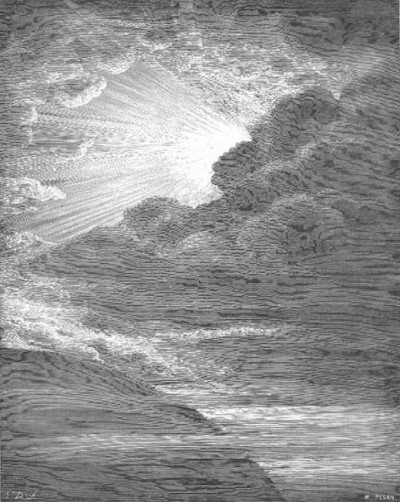
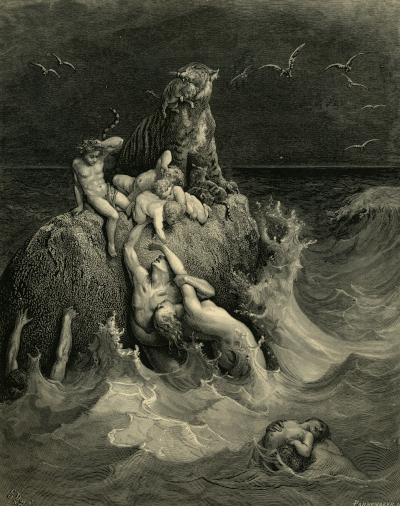
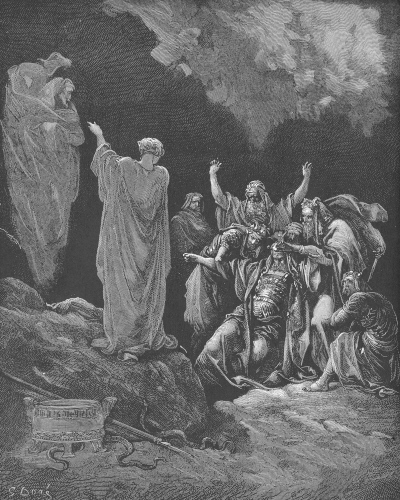
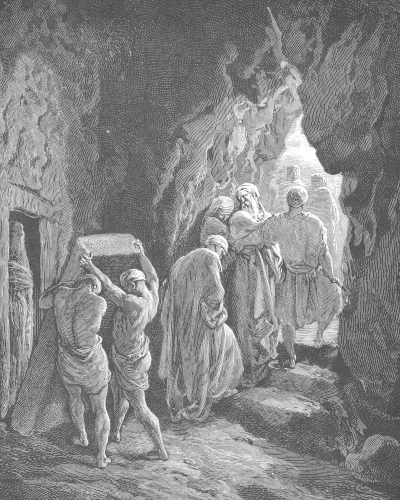
The Creation of Light is a perfect example. The subject is not a person or a building but the first visible division between darkness and light. The image has to make an abstract act feel spatial. That means the engraved surface carries the drama. Dark mass, bright opening and cloud movement become the action. The Deluge asks the medium to do something different: water, bodies, panic and scale have to be made legible in a single catastrophic scene. Saul and the Witch of Endor turns darkness into psychological pressure, while The Burial of Sarah uses stillness, procession and ritual gravity.
These images show why the Bible belongs with both the Illustrations and Engravings pages. It is a narrative cycle, but it is also a demonstration of print culture. Dore's designs needed engravers, publishers, editions and readers. Their power is not separable from the medium that carried them.
The distinction is also useful for modern viewers. When looking at a Dore Bible plate online or in a book, the viewer is often looking at a printed image after Dore, not necessarily an autograph drawing. That does not make it less important. It means the object belongs to the nineteenth-century world of collaborative illustration, where fame could be built through images that many hands helped bring to print.
How the Series Is Built
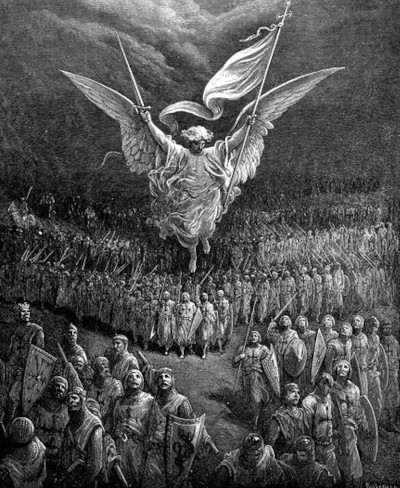
Dore's Bible illustrations are vast, but they are not random. The series moves through scripture as a visual sequence, and different kinds of scenes recur. Creation and catastrophe establish cosmic scale. Patriarchal stories bring the drama closer to family, exile, covenant and mourning. Kings and prophets introduce political power, violence, vision and fear. The New Testament turns toward Christ's ministry, crowds, compassion, trial and sacrifice. Later apocalyptic imagery returns the viewer to visionary scale.
That range is one reason the series works as a flagship page rather than as a simple gallery. It is not enough to say that Dore illustrated the Bible. The achievement lies in how he organizes different biblical modes: the cosmic, the historical, the intimate, the theatrical, the devotional and the visionary.
The Library of Congress Dore Bible Gallery makes the sequence visible as a public-domain path into the tradition. Its list of illustrations includes Genesis subjects, Old Testament episodes, royal and prophetic scenes, and New Testament scenes. Even in a later gallery format, the range is striking. Dore is not concentrating only on the most famous episodes. He gives the Bible a broad visual map.
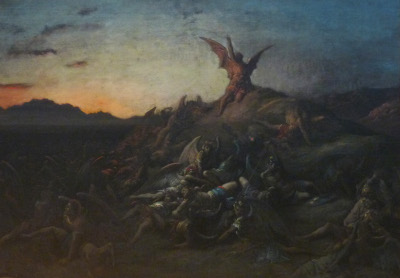
The existing Bible-related pages already show several of those modes. The Creation of Light introduces the cosmic beginning. The Deluge offers catastrophe and human desperation. Saul and the Witch of Endor turns to fear, kingship and forbidden consultation. The Burial of Sarah is quieter, centered on death, mourning and ancestral memory. The Fall of the Rebel Angels is more complicated because it also belongs near Milton's Paradise Lost; it works best as a religious and literary bridge rather than as an image folded simplistically into one source tradition.
Together, those pages allow the Bible Illustrations page to act as a hub. It explains the series as a whole, then sends readers outward to close readings of individual images. The flagship page gives the architecture; the artwork pages give depth.
Genesis: Beginnings, Catastrophe and the Scale of Creation
Genesis gave Dore some of his most powerful visual problems. How does an illustrator show creation before human witnesses? How does darkness become visible? How does a flood become more than a crowd scene with water? How can a family story feel ancient without becoming static? These questions suit Dore because he is at his best when the subject forces him to invent scale.
The Creation of Light is almost severe compared with his denser compositions. There are no bodies to anchor the viewer. The drama lies in the separation of light from darkness. The scene becomes a test of tone and atmosphere: a bright force emerges within a mass of shadow, and the viewer witnesses the beginning of visibility. It is one of the clearest examples of Dore using black-and-white print to imagine a cosmic event.
The Deluge moves from cosmic beginning to human catastrophe. Here scale is no longer empty. It is crowded with bodies, fear and the pressure of rising water. Dore's flood imagery is memorable because it refuses to make disaster distant. The viewer sees the catastrophe through human desperation, but the scene still feels larger than any single figure. The flood becomes both a biblical event and a composition about survival, judgement and the collapse of ordinary ground.
Genesis also contains quieter forms of drama. The Burial of Sarah belongs to a different emotional register. It is not about spectacle in the obvious sense. Its power comes from mourning, ritual and the gravity of ancestral story. That matters for understanding the Bible series as a whole. Dore did not only chase the most sensational subjects. He also understood that scripture includes pauses, ceremonies and moments of human loss.
The Walters record for Study for "Jacob's Dream" adds another Genesis example, even though that specific image is not yet a dedicated page here. The study is connected to a full-page illustration in the 1866 Bible and shows how Dore worked through variations before publication. Jacob's ladder is an ideal Doré subject: earth and heaven joined by a steep ascent, human sleep placed beneath supernatural architecture, angels moving through a vertical field. It belongs to the same visual world as The Creation of Light and The Deluge, but its rhythm is different. It turns Genesis into a dream of passage between realms.
These Genesis scenes show Dore's flexibility. He could picture the world before people, the world overwhelmed by judgement, the family ritual of burial and the dream of heaven opening above earth. The Bible series begins not with one visual formula but with a set of problems: light, water, mourning, ascent, covenant and survival.
Kings, Prophets and the Theatre of Fear
Dore's Old Testament scenes often become theatres of fear, authority and revelation. He had a gift for arranging figures so that power becomes visible before the viewer even knows the full story. A king stands isolated, a crowd presses forward, a prophet gestures, soldiers fill the background, a supernatural presence appears in darkness. The images work because they make relationships legible: ruler and subject, prophet and audience, living and dead, human fear and divine judgement.
Saul and the Witch of Endor is one of the strongest examples in the existing Doré pages. The biblical episode already has dramatic force: Saul, afraid and abandoned, seeks forbidden counsel from the medium at Endor and confronts the apparition of Samuel. Dore turns that narrative into a nocturnal scene of psychological pressure. Darkness is not merely setting. It becomes the atmosphere of fear. The figures are arranged around revelation, but the revelation is terrifying rather than consoling.
This is where Dore's Bible overlaps with nineteenth-century taste for drama and the supernatural. He does not make the scene mild or purely instructional. He gives it theatrical gravity. The image asks the viewer to feel the king's dread and the charged silence around the apparition. At the same time, it remains attached to a biblical source, not a free Gothic fantasy. Dore's skill lies in allowing the supernatural to feel visually powerful without abandoning the narrative frame.
Other Old Testament subjects in the broader Bible Gallery sequence work through comparable oppositions: crowds and solitary figures, divine command and human resistance, public authority and private terror. Dore's compositions often make space itself expressive. A steep stair, a cavernous interior, a city entrance or an enormous sky can dominate the human figures. The viewer feels that biblical history is taking place inside a world too large to control.
This is one reason Dore's Bible images became so adaptable. They are specific enough to illustrate scripture, but broad enough to function as archetypal scenes of fear, judgement, mourning, obedience or awe. They can be read devotionally, historically, theatrically or visually. That range helped them travel beyond their original edition.
The New Testament and Sacred Crowds
The New Testament gave Dore a different set of visual challenges. Instead of only cosmic beginnings, patriarchal narrative or royal fear, he had to picture Christ among people: teaching, healing, blessing, suffering and being watched. The crowd becomes central. Dore's crowds are rarely neutral background. They create pressure around the central event.
The Louvre's Laissez venir a moi les petits enfants is especially helpful here because it connects a surviving preparatory drawing to a New Testament subject from Mark: Christ and the little children. The Louvre record notes that the composition is very close to the definitive wood engraving used in the 1866 Bible. That object lets us see Dore's process at the boundary between drawing and published illustration. It also points to a gentler part of the Bible series, where the drama is not catastrophe or apparition but encounter.
Even in gentler subjects, Dore often thinks in terms of spatial drama. Christ may be calm, but the surrounding crowd creates narrative tension. Children, disciples, onlookers and supplicants organize the image. The viewer reads the event through gesture and grouping: who approaches, who resists, who watches, who receives attention. The New Testament images therefore depend on choreography as much as on individual expression.
This gives the Bible series an important emotional range. If Genesis gives Dore cosmic scale and the Old Testament gives him fear, kingship and prophetic drama, the New Testament gives him proximity. Bodies press near one another. Faces turn toward the central figure. Compassion, suspicion, curiosity and violence all become visible through the crowd.
That is not to say the New Testament images lack grandeur. Dore could make scenes from Christ's life feel monumental, especially when architecture, landscape or massed figures expand the frame. But the centre of gravity often shifts from vast natural catastrophe to human encounter. The sacred event takes place among people, and the crowd becomes the visual means of showing how the event is received.
The New Testament side of the series deserves substantial attention. The Louvre drawing and the Library of Congress Dore Bible Gallery provide a strong source basis for describing this part of Dore's Bible work without pretending that every individual plate has the same level of object-specific documentation.
Dore's Bible and His Other Series
The Bible sits at the centre of Dore's illustrated-book career, but it does not isolate him from his other projects. One of the most important things about him is how often his series talk to one another. Dante, Milton, Cervantes, Perrault, La Fontaine and London are not side notes around the Bible. They are parallel arenas where Dore tested different kinds of image-making.
Dante helped Dore build a visual language for descent, darkness, judgement and supernatural architecture. Milton gave him rebellion, angels, cosmic space and the drama of fall. Those concerns sit very close to parts of the Bible series, but they are not the same. The Fall of the Rebel Angels is useful precisely because it shows the bridge. It belongs near biblical and Miltonic imagination, and the relationship is strongest when explained carefully.
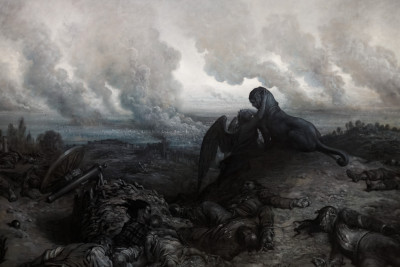
Cervantes and La Fontaine may seem further away, but they matter to the Bible pages because they show Dore's range as a storyteller. Don Quixote required comic timing, travel, fantasy and social detail. La Fontaine required animals, moral situations and condensed narrative. Perrault's fairy tales required childhood, threat and forest darkness. London: A Pilgrimage required a modern documentary eye. The Bible gathers some of these abilities into sacred history: drama, journey, crowd, landscape, symbol, danger and spectacle.
This is why Dore rewards a Series-led reading. The existing individual artwork pages can show his brilliance in close focus, but the larger publishing projects explain how his fame was built. Bible Illustrations belongs first because it has the strongest existing artwork anchors and the clearest institutional source spine. Dante, Paradise Lost, London, Don Quixote, Perrault and La Fontaine belong beside it as separate flagships rather than as compressed notes inside a general illustrations page.
A reader can move naturally from an overview of Dore's career into the works that made him internationally visible: the Bible, Dante, Milton, Cervantes, Perrault, La Fontaine and London. Readers who want an overview can stay with the broad career story; readers who want depth can move into each flagship series.
From Book to Gallery and Public Memory
Dore's Bible illustrations did not stay inside the 1866 Mame edition. Their later life is part of their meaning. The Library of Congress Dore Bible Gallery, published in Philadelphia around 1890, shows how the imagery could be repackaged for an English-language public in gallery form. The LOC record identifies the work as Bible illustrations by Dore and provides public-domain digital access. That later format is important because it shows how Dore's images could be separated from the full original Bible and circulated as a visual anthology.
Musee d'Orsay and the Bibliotheque nationale de France both point to the Bible's wider afterlife. The images became embedded in religious and popular imagination. They were used in teaching and spectacle, and they helped establish visual templates that later media could draw from. This does not mean every later biblical image or film scene comes directly from Dore. It means Dore's Bible helped standardize a dramatic, high-contrast, monumental way of imagining scripture.
The Dore Gallery in London is part of that story. Orsay notes that the success of the Bible illustrations helped lead toward Dore's large religious paintings and gallery ambitions. The printed Bible and the gallery were different forms, but they reinforced one another. The book established a public appetite for Dore's religious imagination; the gallery offered a larger-scale environment for that imagination.
The relationship between print and spectacle is one of the most interesting parts of Dore's career. He made images for books, yet those images often want the scale of murals, theatre or cinema. They are printed objects with monumental ambitions. That tension is especially visible in the Bible, where a reader turns pages but repeatedly encounters scenes that feel too large for the page.
This also explains why Dore remained popular beyond academic art history. His images are easy to remember because they are built around dramatic visual situations: a flood, a burst of light, a king before an apparition, a burial procession, a fall from heaven, a crowd around Christ. The images can be reproduced at different sizes and still retain their basic force. They were made in a reproducible medium, and their compositions were designed to survive reproduction.
Existing Bible Pages in This Doré Section
Bible Illustrations acts as the parent guide for the existing Bible-related artwork pages. The Creation of Light appears first because it gives the series its Genesis opening and introduces Dore's ability to make light and darkness into a subject. The Deluge follows as the strongest catastrophe anchor, connecting creation history to human desperation and judgement.
Saul and the Witch of Endor belongs as an Old Testament drama of kingship, fear and forbidden revelation. It is one of the best examples of Dore using darkness psychologically. The Burial of Sarah offers a quieter counterweight, showing that the Bible cycle is not only spectacle but also ceremony, grief and ancestral memory.
The Fall of the Rebel Angels needs careful wording because it belongs to Dore's religious imagination and to the Bible/Milton corridor. It is safer to describe it as a bridge between biblical themes of rebellion and Dore's Miltonic imagination than to claim every version or title belongs straightforwardly to the 1866 Bible sequence.
The flagship also connects to Illustrations and Engravings. Those pages explain Dore's larger practice and the medium through which many readers encountered him. Paintings matters where the text discusses the Dore Gallery and monumental religious works, while Lithographs and Sculptures remain secondary support areas for medium context.
How to Look at the Bible Illustrations
A reader approaching Dore's Bible images for the first time can begin with three questions. First, what is the scale of the scene? Dore often makes scale carry meaning. A small human figure beneath an enormous sky or beside a vast architectural setting tells the viewer how much larger the event is than ordinary life.
Second, where does the light come from? Light in Dore is rarely neutral. It may reveal, judge, bless, terrify or divide. In The Creation of Light, light is the subject. In Saul and the Witch of Endor, darkness and sudden apparition shape the emotional force of the image. In many New Testament scenes, light helps separate Christ from the crowd without removing him from human contact.
Third, how are crowds organized? Dore's crowd scenes can look chaotic at first, but they usually have a strong internal order. Bodies are arranged in waves, diagonals, groups and lines of attention. A crowd may surge toward a centre, recoil from it, witness it or threaten it. The crowd gives the sacred event a public life.
Those three questions keep the viewing grounded in the image rather than in general admiration. They also help distinguish the Bible series from Dore's other projects. Dante's spaces often pull the viewer downward or upward through moral architecture. London images pull the viewer into social observation. The Bible images repeatedly ask how human beings appear before divine history.
At its best, a guide to the Bible illustrations combines readable history with close looking. It is not only a devotional page, a bibliographic page or a simple image list. Its job is to explain why Dore's Bible matters as art, book history, religious visual culture and a central Series in his career.
Why the Bible Illustrations Still Matter
Dore's Bible illustrations still matter because they made scripture visually dramatic for a mass public without reducing it to a single style. The series contains cosmic abstraction, disaster, family grief, royal terror, prophetic authority, tenderness, violence, architecture, wilderness and crowd psychology. Few nineteenth-century illustration projects offered such range in a single publication.
They also matter because they show how powerful a printed image could be. Dore did not need oil paint to create scale. Through drawing, engraving and publication, he made black-and-white images that could feel vast. The Bible series is therefore central not only to Dore's religious art, but also to the history of illustration and reproduction.
As a guide, Bible Illustrations becomes one of the main entrances into Dore. It can gather existing artwork pages into a coherent path, guide readers toward other Series flagships, and explain why the artist's fame cannot be separated from the books he illustrated. It is large enough to carry real research and structured enough that visitors can scan it, follow internal links and choose which images to study next.
The Bible was not Dore's only great subject. Dante, Milton, Cervantes, Perrault, La Fontaine and London all deserve their own flagship pages. But the Bible is the right place to begin because it shows Dore at his most public, ambitious and widely disseminated. It begins with light, moves through flood and fear, and ends by demonstrating how a printed book could shape visual memory across generations.
That is the enduring power of the Dore Bible. It is not just an illustrated edition. It is a nineteenth-century visual world: made by drawing, carried by engraving, expanded by publishing and kept alive by readers who continued to see biblical history through Dore's dramatic imagination.
Related Bible Pages
Use these artwork pages as close-reading anchors for Doré's Bible series. They give the flagship series page a practical route through Genesis, Kings, burial, rebellion and supernatural drama.
FAQ
Discussion
Which part of Doré's Bible series feels most powerful to you: the cosmic scenes, the crowded dramas or the quieter moments of grief?
Reader Insights
Read the Bible images as a sustained publishing project, not as isolated prints.
Watch how Doré's drawings depend on expert wood engraving to carry tone, scale and dramatic detail.
Follow how the images moved from the 1866 French Bible into later books, galleries and public memory.
Join the Conversation
Share your reading of Doré's Bible illustrations below.
References
- Musee d'Orsay, Gustave Dore (1832-1883): Master of Imagination, accessed 28 July 2026.
- The Morgan Library & Museum, Death on the Pale Horse, accessed 28 July 2026.
- The Metropolitan Museum of Art, The Dore Gallery of Bible Illustrations, accessed 28 July 2026.
- Library of Congress, The Dore Bible Gallery, accessed 28 July 2026.
- Library of Congress, The Dore Bible Gallery digital resource list, accessed 28 July 2026.
- Musee du Louvre, Le Christ quittant le pretoire, accessed 28 July 2026.
- The Walters Art Museum, The Triumph of Christianity over Paganism, accessed 28 July 2026.
- Bibliotheque nationale de France, La Sainte Bible selon la Vulgate, accessed 28 July 2026.
- Bibliotheque nationale de France / CNAC, La Sainte Bible selon la Vulgate avec les dessins de Gustave Dore, accessed 28 July 2026.