 by Tom Gurney
Tom Gurney BSc (Hons) is an art history expert with over 20 years experience
Published on July 28, 2026 / Updated on October 16, 2026
Email: tomgurney1@gmail.com / Phone: +44 7429 011000
Gustave Dore and Cervantes' Don Quixote
Gustave Dore's illustrations for Cervantes' Don Quixote belong among his greatest series because they gave him a literary world built on movement, comedy, delusion, dignity and defeat. Dante offered a moral journey through the afterlife. The Bible offered sacred history. Milton offered cosmic rebellion. Don Quixote offered a journey through Spain in which fantasy and ordinary life constantly collide. Dore understood that this collision was not only comic. It was visual, emotional and philosophical.
The key edition is the French L'ingenieux hidalgo Don Quichotte de la Manche, published in Paris by Librairie de L. Hachette et Cie. in 1863, translated by Louis Viardot, with drawings by Dore engraved by Heliodore Pisan. The BnF records the edition as two folio volumes, with plates and engraved vignettes. The Cervantes Project at Texas A&M identifies it as the first Don Quixote edition with Dore's designs and gives a detailed illustration count: 377 wood engravings, including 120 chapter illustrations, 128 headpieces and 129 tailpieces. The Strasbourg museum record similarly describes the 1863 Hachette edition as two volumes with 377 drawings by Dore, engraved on wood by Pisan, including 120 full-page images and 257 vignettes.
Those numbers matter because Dore did not merely add a few famous scenes to Cervantes. He made a complete visual reading of the novel. The knight, Sancho, the inn, the road, the windmills, the cage, the mountains, the puppet theater, the ducal entertainments and the final return home become a sustained image-world. The reader meets the story not as a sequence of isolated jokes but as a long movement through landscapes, rooms, crowds and illusions.
Musee d'Orsay explains why the project had such force. Dore travelled in Spain, returned there in 1861 with Baron Jean Charles Davillier, and made the journey in part to prepare for illustrating Don Quixote. Orsay quotes Dore saying that he travelled to the homeland of the famous hidalgo to study the places associated with his feats so that he could produce something with local flavour. That sentence is the key to the series. Dore wanted his Quixote to feel rooted in a country, not merely in a book.
At a Glance
- Publication contextA major illustrated Cervantes project in Doré's literary-classics career
- Visual problemBalancing comedy, delusion, landscape and sympathy
- Principal figuresDon Quixote and Sancho Panza as recurring bodies in motion
- Cluster roleThe comic-travel counterweight to Bible, Dante and Milton
- Why it mattersIt shows Doré's range beyond catastrophe and the sublime
Contents
- Why Don Quixote Suited Dore
- The 1863 Hachette Edition
- Dore's Spain
- Don Quixote and Sancho
- Comedy, Cruelty and Sympathy
- The Windmills and the Barber's Basin
- The Caged Knight
- Basil, Quiteria and Dore the Painter
- Wood Engraving and Heliodore Pisan
- Outdoing Earlier Don Quixotes
- Don Quixote in Dore's Larger Architecture
- The Road as Narrative Structure
Why Don Quixote Suited Dore
Don Quixote suited Dore because Cervantes' novel is already about the power of images. The knight reads chivalric romances until his imagination transforms the world around him. Inns become castles, windmills become giants, a barber's basin becomes Mambrino's helmet, ordinary travelers become knights or enemies, and theatrical play becomes lived reality. The novel turns perception into action.
Dore was one of the nineteenth century's great artists of altered perception. His Dante images make spiritual places feel physically real. His Milton images make invisible rebellion and divine order visible. His Bible illustrations give sacred narrative the force of vast public spectacle. In Don Quixote, he applies that ability to a comic and tragic mind. The landscape is real, but the knight sees it through books. The comedy depends on the gap between what he imagines and what others see.
This gave Dore two visual tasks at once. He had to show the ordinary world clearly enough that the joke worked. He also had to show Don Quixote's grandeur clearly enough that the joke did not become cruel. If the knight is only ridiculous, Cervantes' novel shrinks. If he is only heroic, the satire disappears. Dore's achievement is that he keeps both states alive.
The figure of Don Quixote is therefore central. Tall, thin, armored, intense and often isolated, he becomes a line of aspiration moving through a world that resists him. Sancho Panza, lower, rounder, practical and responsive, anchors the image in bodily reality. The two figures together create one of Dore's richest visual pairs: idealism and appetite, fantasy and common sense, motion and hesitation, speech and muttering aside.
Dore's finest Don Quixote images do not simply illustrate incidents. They stage the conditions of the novel: misrecognition, theatricality, companionship, social embarrassment, stubborn dignity and the painful beauty of impossible belief.
The 1863 Hachette Edition
The 1863 Hachette Don Quixote was a major illustrated-book enterprise. BnF records the work as L'ingenieux hidalgo Don Quichotte de la Manche, by Miguel de Cervantes Saavedra, translated by Louis Viardot, with drawings by Gustave Dore engraved by H. Pisan, published in Paris by L. Hachette in 1863. It describes the work as two folio volumes with plates and engraved vignettes, the first volume containing xxiii and 459 pages, the second 515 pages.
The Cervantes Project adds the most detailed illustration structure. It records the 1863 Paris Hachette edition as the first edition of Don Quixote with Dore's designs and lists 377 wood engravings: 120 chapter illustrations, 128 headpieces and 129 tailpieces. The project also notes that Heliodore Joseph Pisan engraved the images. Strasbourg's museum record corroborates the two-volume 1863 Hachette structure and describes 377 drawings by Dore engraved on wood by Pisan, including 120 images hors texte and 257 vignettes.
This quantity changes the reading experience. A 120-plate Don Quixote is not a token illustrated edition. It is an ambitious visual interpretation of the entire novel. The headpieces and tailpieces keep Dore present even between major scenes. The reader moves through the book with images marking chapters, moods, exits, pauses and comic turns.
The edition also belongs to Dore's wider ambition in the 1860s. Musee d'Orsay describes him as pursuing outsize editions of great works of epic, comic and tragic literature. Don Quixote was a natural part of that ambition because Cervantes' novel was already one of the most illustrated works in Europe. Dore was entering a crowded visual tradition, not an empty field.
That competition mattered. Orsay states that Cervantes' novel ranked among the most illustrated works of European literature, but Dore was determined to outdo his predecessors. The scale of the 1863 edition shows what that meant. Dore did not respond with a handful of memorable plates. He responded with a total campaign of images.
Dore's Spain
Dore's Don Quixote cannot be separated from his idea of Spain. Musee d'Orsay describes Spain, unlike London, as a wild and picturesque land in Dore's imagination: gothic, Moorish, Catholic, inhabited by bandits and beggars, and fascinating to French artists and writers as a pre-revolutionary and pre-industrial world. Orsay also notes Dore's trips to Spain, including the 1861 journey with Baron Jean Charles Davillier for the periodical Le Tour du monde.
The important point is not that Dore simply recorded Spain accurately. It is that he sought what Orsay calls local flavour. He wanted the novel's world to feel inhabited by Spanish roads, costumes, horizons, interiors, villages and distances. That effort gave his illustrations a different texture from his Dante or Milton work. Don Quixote's world is not supernatural, but it can appear just as strange because the knight's imagination transforms it.
Landscape becomes especially important. The road is not background; it is the condition of the novel. Don Quixote and Sancho move through open country, from inn to field, from mountain to village, from public road to private deception. Dore's Spain gives the pair room to appear absurd, brave, lonely or exposed. A rider in a wide landscape can be both comic and noble.
The same is true indoors. Inns, rooms, courts, barns and improvised stages become arenas of misunderstanding. Dore's interiors often gather witnesses around Don Quixote. People stare, laugh, indulge, deceive or assist. The knight's fantasy becomes public theater, and the surrounding faces tell the reader how society responds.
Spain, for Dore, is therefore not only scenic colour. It is the stage on which chivalric fantasy meets ordinary life. The setting lets the novel's central conflict become visible at every scale, from a distant road to a crowded room.
Don Quixote and Sancho
The visual success of the series depends above all on Don Quixote and Sancho Panza. Cervantes gives them one of literature's most durable partnerships, and Dore turns that partnership into image after image of contrast and attachment. The knight is gaunt, angular, forward-looking and possessed by books. Sancho is compact, earthy, watchful and practical. Their bodies make their philosophies visible.
This contrast could easily become too simple, but Dore gives it range. Sancho is not merely comic ballast. He is witness, companion, skeptic, negotiator and sometimes the only person who understands the ordinary danger of a scene. Don Quixote is not merely foolish. He is ridiculous, but he is also loyal to an idea of honour that the world has forgotten or outgrown.
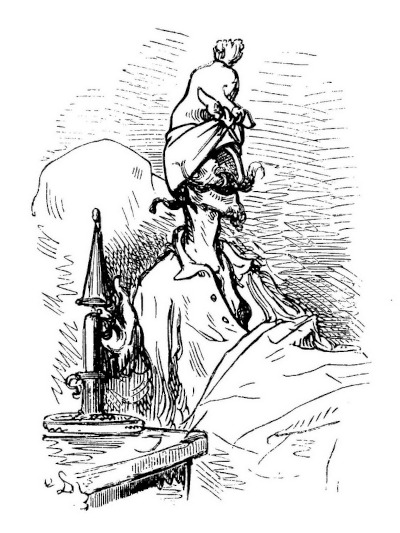
The Morgan Library's Don Quixote Charging Through Rain record shows how precisely Dore could handle their relationship. The drawing illustrates the episode in which rain falls, Don Quixote sees a man with something glittering on his head and imagines Mambrino's helmet, while Sancho recognizes a barber protecting himself with a basin. The episode is comic because two perceptions occupy the same road. Dore's image can hold both: the knight's charge and Sancho's knowledge.
That is the essence of Dore's Quixote. The viewer sees the ordinary world and the knight's fantasy together. The image does not need to choose between them. This dual vision is why the illustrations work so well across cultures. They let readers laugh at Don Quixote while feeling the pathos of his courage.
Sancho's role is equally visual. He often stands at the edge of the knight's action, dragged into it but never wholly absorbed by it. His body registers fear, doubt, hunger, loyalty or exasperation. Without Sancho, Don Quixote might become a symbol. With Sancho, he remains part of a human pair.
Comedy, Cruelty and Sympathy
Don Quixote is funny, but its comedy is rarely painless. Dore understood that. The knight is beaten, caged, deceived, mocked and exhausted. His fantasies create trouble for others, but they also expose the meanness of those who exploit him. A shallow illustrator could turn the whole book into slapstick. Dore often lets comedy darken into sympathy.
The Cervantes Project's record for the scene in which Don Quixote begs the innkeeper to knight him describes Dore's treatment as comical realism, with the stable, cows and innkeeper's expression making the joke clear. That phrase is useful because it names one of Dore's strengths. The scene is absurd, but it is not empty. The ordinary stable world remains stubbornly visible while Don Quixote conducts a ceremony of knighthood in his mind.
Another Cervantes Project record, for the caged Don Quixote carried away as if enchanted, notes Dore's original vision of the scene and the remarkable figure of Don Quixote. This episode is one of the series' great tests. The knight's delusion has become confinement. The joke exists, but so does humiliation. Dore's composition makes the viewer see the absurd theater and the human cost together.
The best Dore Quixote images therefore depend on tonal balance. Cervantes' novel is comic, satirical, tender, cruel and philosophical. Dore's illustrations move among those registers through posture, crowd response, scale and setting. A crowd can laugh; a landscape can isolate; an interior can become a trap; a road can become the path of a dream.
This balance explains why the series became so influential. It gave readers a Don Quixote who could be immediately recognized: thin knight, round squire, exhausted horse, comic weaponry, vast landscape. But it also gave readers an emotional structure. The knight is ridiculous because he believes too much; he is moving because he believes at all.
The Windmills and the Barber's Basin
The most famous Don Quixote scenes endure because they are visual arguments about perception. The windmills episode turns common machinery into giants. The barber's basin episode turns a rain shield into a legendary helmet. These are not random mistakes. They are transformations produced by reading, desire and heroic imagination.
Dore's illustrations give those transformations physical energy. In the windmills episode, the knight's attack can be staged as mad courage against a landscape that refuses his interpretation. In the Mambrino episode, as the Morgan drawing shows, rain, movement and glinting metal create the opportunity for misrecognition. Dore does not need to explain the error; he lets the scene produce it.
These episodes also show how Cervantes' comedy works through scale. Don Quixote enlarges the world. Windmills become giants; a basin becomes a helmet; an inn becomes a castle. Dore enlarges the image in response. He gives the knight's fantasy the visual seriousness it has in the knight's mind while letting the viewer see its mismatch with reality.
That double scale is crucial. If the windmills look only silly, the knight is merely foolish. If they look only monstrous, Cervantes' satire disappears. Dore's art thrives in the middle. He can make the charge feel dynamic and absurd at once.
The same principle applies across the series. Puppet shows, processions, disguised figures, staged deceits and rural encounters become chances for Dore to show two worlds at once. The world as it is, and the world as Don Quixote's imagination makes it.
The Caged Knight
The episode of Don Quixote in the cage is one of the darkest comic images in the story. He is being managed by others, carried as if under enchantment, trapped by a fiction arranged around him. It is funny because the deceit works. It is painful because the deceit depends on his vulnerability.
The Cervantes Project record for Dore's Chapter 46 image places the scene in Part I and describes Don Quixote as taken in a cage, believing that he is surrounded by ghosts of the castle, while Sancho observes. The note calls Dore's vision of the scene very original and emphasizes the remarkable figure of the knight. This is exactly the kind of moment that makes the series more than comic illustration.
Dore understood that confinement changes the meaning of delusion. Earlier adventures send the knight outward. The cage arrests him. The movement of romance becomes the management of madness by others. The viewer sees a man enclosed within a physical structure that matches his mental condition, but also sees the social arrangement that placed him there.
Sancho's presence matters again. He is not free of fantasy, but he is closer to ordinary reality. His observation of the scene gives the viewer another register: concern, confusion, helplessness or wary loyalty. Dore often uses Sancho to keep the image from becoming purely cruel.
The caged knight also connects Don Quixote to Dore's larger interest in bodies under pressure. Across his career he drew prisoners, pilgrims, exiles, the damned, the poor and the fallen. Don Quixote in the cage is not one of those figures in a literal theological sense, but visually he belongs to Dore's vocabulary of constrained human dignity.
Basil, Quiteria and Dore the Painter
Dore's Don Quixote was not confined to book illustration. The Metropolitan Museum of Art records his painting Don Quixote and Sancho Panza Entertained by Basil and Quiteria, dated around 1863, as an oil on canvas corresponding to an engraving made for the 1863 French edition of Cervantes' Don Quixote. The Met notes that Dore often based paintings on compositions originally created for book illustrations.
This painting is an important bridge for the future page because it links the Don Quixote series to Dore's ambitions as a painter. Dore often wanted recognition beyond illustration, and the Met object shows how a book composition could become a painting. The scene is not only literary; it is also a statement that illustrated subjects could support easel painting.
The episode itself involves Basil and Quiteria, a young couple whose marriage follows Don Quixote's intervention. It is a social and comic scene rather than a battlefield or supernatural vision. That makes it useful for understanding the range of Dore's Quixote. He could handle intimate interiors and human theatricality as well as roads, charges and large outdoor episodes.
The Met's note also helps clarify the relation between illustration and painting in Dore's career. Illustration was not a lower reservoir from which painting occasionally borrowed. For Dore, book illustration generated powerful compositions, characters and narrative arrangements. Painting could return to those compositions at a different scale and with different prestige.
A Don Quixote Series page can therefore link naturally to the Paintings page as well as to Illustrations and Engravings. The Basil and Quiteria painting gives a clear institutional anchor for that connection.
Wood Engraving and Heliodore Pisan
The 1863 Don Quixote was a triumph of wood engraving as much as drawing. BnF, the Cervantes Project, Morgan and Strasbourg all identify Heliodore Pisan as the engraver of Dore's designs. This matters because the public image of Dore often came through collaborative translation. Dore designed the images, but skilled engravers made them printable at scale.
Wood engraving suited Don Quixote because the novel requires quick changes of scene and mood. The same edition had to carry broad landscapes, comic interiors, animals, crowds, weapons, rustic architecture, expressive faces and small narrative details. The medium could handle both full-page drama and dense vignettes embedded in the text.
The Cervantes Project's count of 120 chapter illustrations, 128 headpieces and 129 tailpieces shows how carefully the edition's rhythm was planned. Full-page images gave major scenes visual authority. Headpieces and tailpieces kept the story moving through smaller moments. The result was a book where illustration did not interrupt reading; it structured it.
Pisan's engraving also helped standardize Dore's Don Quixote for later reuse. The Morgan Library notes that the same plates were used for the 1870 English translation, The History of Don Quixote, published by Cassell, Petter and Galpin. That reuse helped bring Dore's visual interpretation to British and American audiences.
The English afterlife is important because it shows how quickly Dore's Quixote became international. Cervantes was Spanish, the 1863 edition was French, the engravings travelled into English publishing, and the images became part of a broader visual memory of the novel.
Outdoing Earlier Don Quixotes
Musee d'Orsay states that Cervantes' novel was among the most illustrated works of European literature and that Dore was determined to outdo his predecessors. That ambition is visible in both scale and interpretation. He did not simply add another visual version to a long line. He tried to make the definitive nineteenth-century Don Quixote.
The Cervantes Project's bibliographic notes place Dore among a crowded field of illustrated Don Quixote editions, including earlier and later French, English, Spanish, Danish, German and other editions. This context is useful because it prevents a false impression that Dore invented Don Quixote imagery. He inherited a tradition.
His achievement was to intensify and reorganize that tradition. Dore made the knight's body unforgettable: stretched, angular, dignified, fragile. He made Sancho equally memorable through shape, gesture and earthiness. He made Spain a sustained setting rather than a generic backdrop. He made the comic episodes feel large enough to hold pathos.
Orsay's Zola quotation, praising Dore's publication as almost a rewriting of Cervantes, captures the force of the reception. The praise is extravagant, but it reveals how contemporaries understood the edition. Dore's images were not treated as minor decorations. They were understood as a second imaginative act.
That is why a dedicated Don Quixote Series page is necessary. General pages on illustrations and engravings cannot fully explain the scale of the 1863 Hachette project, its relation to Spain, its place in European book history and its later reuse in English-language publishing.
Don Quixote in Dore's Larger Architecture
Don Quixote occupies a distinct place among Dore's major series. Dante and Milton are vertical works: descent, ascent, cosmic hierarchy, Heaven and Hell. The Bible is historical and sacred, moving through time. Don Quixote is horizontal. It moves along roads, into inns, across plains, through villages and into staged social encounters.
That horizontal movement changes Dore's art. The series depends less on supernatural architecture and more on travel, human bodies and social misrecognition. It is one of the places where Dore's talent for caricature and his talent for grandeur meet most naturally. The young caricaturist and the mature illustrator of epics are both present.
Musee d'Orsay's career framing is useful here. Dore began in caricature and illustrated publishing, then became internationally famous through Dante and the Bible. Don Quixote connects those worlds. The novel is comic and popular, but also canonical and profound. It allowed Dore to be funny without becoming small.
The series also prepares readers to understand Perrault and La Fontaine. Like those works, Don Quixote contains popular narrative energy, animals, fools, tricksters, appetite and social types. But it also belongs with Dante and Milton because of its literary weight and long visual tradition. It is a bridge between Dore's high epic projects and his comic/popular storytelling.
For the site architecture, Don Quixote can become one of the most useful Series pages. It links naturally to Illustrations and Engravings through the 1863 book, to Paintings through the Met Basil and Quiteria canvas, and to the broader Series section through Dore's ambition to remake European classics in images.
The Road as Narrative Structure
The road is the true architecture of Dore's Don Quixote. In Dante, architecture is moral: circles, terraces, spheres. In Milton, architecture is cosmic: Heaven, Hell, Eden, chaos. In Don Quixote, the governing structure is travel. The knight and Sancho leave, meet, misread, suffer, argue and continue. The road allows Cervantes to connect episodes that vary wildly in tone, and it allows Dore to build a visual rhythm that alternates distance, encounter and aftermath.
This is one reason the 1863 edition needed so many images. A smaller selection could capture the most famous episodes, but it would not capture the experience of wandering. The Cervantes Project's 377-image count is therefore more than a statistic. It reveals an editorial and artistic commitment to the novel's movement. Headpieces, tailpieces and chapter illustrations keep the eye travelling with the characters, through both major incidents and quieter transitions.
Dore's roads often make Don Quixote look exposed. A mounted figure in a wide landscape can be heroic, but it can also be absurdly small. That ambiguity is perfect for Cervantes. The knight believes himself to be entering romance; the viewer sees a thin man on a difficult horse, moving through a world that is not arranged for him. Sancho's presence changes the scene again. He makes the road practical: there is weather, hunger, fatigue, animals, conversation and doubt.
The road also lets Dore stage suspense before comedy arrives. A distant figure approaches. Something shines in the rain. A group appears ahead. A building is mistaken for something grander. The viewer often understands that the scene is about to split into two interpretations. Dore's composition prepares the joke by making perception unstable.
This unstable perception is one of the series' deepest themes. Don Quixote's imagination is not random. It is trained by books, by old romances, by an ideal of chivalric order. The road gives him endless raw material for that imagination. Every ordinary object can become a sign from romance if seen with enough desire.
Dore's image-making is sympathetic to that transformation. He is too theatrical an artist to mock imagination entirely. His Don Quixote illustrations know that fantasies can be foolish, but they also know that fantasy gives the world intensity. The road is therefore both comic route and spiritual test. It reveals how hard it is to live inside a vision when the surrounding world refuses to confirm it.
International Circulation and the English Reader
Dore's Don Quixote quickly moved beyond the 1863 French edition. The Morgan Library notes that the same plates were used for the 1870 English translation, The History of Don Quixote, published in London by Cassell, Petter and Galpin. It also states that the English edition helped popularize Cervantes' tale among British and American audiences. This is a crucial part of the series' importance.
The international movement of the images shows how nineteenth-century illustrated books carried visual interpretations across languages. Cervantes wrote in Spanish; Dore's major illustrated edition appeared in French; the plates then served English readers. The images could travel more easily than the exact words of a translation. A reader in London or New York could come to Cervantes through Dore's knight and Sancho even before forming an independent visual idea of the characters.
This circulation also helps explain why Dore's Don Quixote became so influential. The images were not confined to a specialist French publication. They entered a broader publishing market and helped establish a common visual memory of the novel. Later artists, filmmakers and readers encountered Don Quixote through a world partly shaped by Dore's compositions.
The English reuse also links Don Quixote to Dore's British publishing success. Cassell, Petter and Galpin later appear in relation to other Dore projects, and London audiences were central to his reputation through the Dore Gallery and English editions of major works. Don Quixote therefore belongs not only to French illustrated publishing but to Dore's transnational career.
That transnational character is especially apt for Cervantes. Don Quixote had already become European property by the nineteenth century: translated, abridged, illustrated, staged and debated in many countries. Dore's series entered that long circulation with unusual force because it supplied such a complete visual world. It could accompany different translations while retaining a recognizable identity.
For modern readers, this afterlife is part of the work itself. Dore's 1863 designs are not only responses to Cervantes. They are agents in the later history of Cervantes reception. They shaped how the knight and Sancho looked in the minds of readers far from Spain and far from the first Spanish editions.
Key Images and Themes
Several source-backed images show the range of Doré's Don Quixote visually. The Morgan Library's Don Quixote Charging Through Rain is especially useful because its record explains the Mambrino episode and the relation between the 1863 French edition and the 1870 English reuse. The Met's Don Quixote and Sancho Panza Entertained by Basil and Quiteria is a public-domain painting that connects the book illustrations to Dore's painting practice. The Cervantes Project includes individual indexed images from the 1863 Hachette edition, including Don Quixote asking the innkeeper to knight him and the caged knight episode.
The BnF catalogue also offers individual print records, including the frontispiece Son imagination se remplit de tout ce qu'il avait lu, after Dore and engraved by Pisan, tied to the 1863 Hachette edition. That image is a powerful candidate because it represents the origin of the knight's imaginative condition: reading filling the mind until the world changes.
A full reading can treat these as a sequence: the frontispiece of imagination, a road scene, a comic misrecognition, the caged knight, and the Basil and Quiteria painting. That range would show the whole series rather than reducing Don Quixote to windmills alone.
Existing internal artwork links are limited because no active Doré route is dedicated to a Don Quixote plate. The guide can still link to Illustrations, Engravings and Paintings immediately, while individual Don Quixote artwork pages remain a later expansion.
Legacy and Afterlife
Dore's Don Quixote became one of the great visual interpretations of Cervantes. The Morgan Library notes that the English edition using the same plates helped popularize the tale among British and American audiences. Musee d'Orsay goes further, placing Dore in the long visual afterlife of Don Quixote and noting that film adaptations have used him as a model.
This legacy is not surprising. Dore gave the novel a visual grammar that could travel: the thin knight, the loyal squire, the road, the comic charge, the lonely landscape, the crowd of observers, the balance between ridiculous action and dignity. Once seen, that grammar is hard to forget.
The series also shaped how readers imagine the emotional centre of the novel. Don Quixote is not merely a fool on horseback. He is a figure caught between failed reality and necessary illusion. Dore's images make that condition visible again and again. They let the viewer recognize the absurdity and still feel the pull of the dream.
That is why the page belongs in the new Series section as a flagship. It is not a support note under illustration. It is one of the largest and most influential projects in Dore's career, rooted in a major 1863 publication, supported by a vast illustration program, connected to travel in Spain, and carried into international editions.
Don Quixote gave Dore a subject as large as any epic: not because its world is supernatural, but because its imagination changes everything it touches.
Related Don Quixote and Story Pages
Use these pages to place Doré's Cervantes work beside the story-led, comic and printmaking routes already active in this section.
FAQ
Discussion
Where does Doré make Don Quixote feel most alive: on the road, in comic error, in humiliation or in stubborn dignity?
Reader Insights
Read Don Quixote and Sancho as one of Doré's strongest visual partnerships.
Look for scenes where ordinary objects and chivalric fantasy occupy the same image.
Follow how full-page plates, headpieces and tailpieces turn the novel into a sustained visual journey.
Join the Conversation
Share your reading of Doré's Don Quixote below.
References
- Texas A&M Cervantes Project, Iconography of Don Quixote, accessed 28 July 2026.
- BnF catalogue, L ingenieux hidalgo Don Quichotte de la Manche, accessed 28 July 2026.
- Strasbourg museum record, L ingenieux hidalgo Don Quichotte de la Manche, accessed 28 July 2026.
- Morgan Library & Museum, Don Quixote Charging Through Rain, accessed 28 July 2026.
- Metropolitan Museum of Art, Don Quixote and Sancho Panza Entertained by Basil and Quiteria, accessed 28 July 2026.
- Musee d Orsay, Gustave Dore (1832-1883): Master of Imagination, accessed 28 July 2026.