 by Tom Gurney
Tom Gurney BSc (Hons) is an art history expert with over 20 years experience
Published on July 28, 2026 / Updated on October 16, 2026
Email: tomgurney1@gmail.com / Phone: +44 7429 011000
Gustave Dore and Perrault's Fairy Tales
Gustave Dore's illustrations for Perrault's fairy tales are among his most important popular works because they reveal a different side of his imagination. The Bible, Dante and Milton gave him sacred history, Hell, Heaven and cosmic rebellion. Don Quixote gave him comic travel and delusion. London gave him the modern city. Perrault gave him childhood stories that are also stories of danger, prohibition, appetite, forest darkness, domestic threat and transformation.
The Perrault project belongs in a Series section because it is not just a group of pleasant children's pictures. It is one of the great nineteenth-century encounters between a canonical text and a modern illustrator. The BnF describes the edition as an extraordinary Hetzel publication illustrated by Dore. Its educational pages explain that Hetzel presented the book as a counterpart to Dore's Dante: a marvelous, amusing and moving project set against the darker wonder of the Inferno. The same BnF account describes the book as a very large and expensive volume for children, published in 1862, with forty full-page plates and a frontispiece illustrating nine tales.
That contrast with Dante is crucial. Dore did not treat fairy tales as lightweight material after serious epic. He treated them as another kind of wonder. The fairy tale is smaller in plot than Dante or Milton, but it can be just as intense. A child meets a wolf. A wife receives a set of keys. A prince climbs toward a sleeping princess. A boy drops stones at the edge of a forest. A cat engineers social ascent. A slipper decides a life. Dore understood that these simple narrative objects and scenes could carry fear, humour, elegance and dread.
His Perrault images became part of the modern memory of fairy tales. BnF states that generations of children were marked by the black-and-white pictures and names Little Red Riding Hood, Hop-o'-My-Thumb, Sleeping Beauty and Cinderella among images that became inseparable from the tales in the collective imagination. That afterlife makes the Perrault series a flagship, not a side corridor.
At a Glance
- Publication contextDoré's illustrated Perrault fairy-tale project
- Visual modeSuspense, thresholds, domestic danger, forests and theatrical interiors
- Internal anchorsLittle Red Riding Hood and Bluebeard
- Cluster roleThe danger-and-fairy-tale branch of the illustration cluster
- Why it mattersIt makes familiar tales visually adult, atmospheric and unnerving
Contents
- A Fairy-Tale Counterpart to Dante
- Hetzel, Album Scale and the Modern Children's Book
- The Tales and Their Visual Logic
- Little Red Riding Hood
- Bluebeard
- Sleeping Beauty, Cinderella and the Palace World
- Puss in Boots and Comic Cunning
- Hop-o'-My-Thumb and the Forest of Tests
- Wood Engraving, Pannemaker and Printed Darkness
- Fear, Childhood and the Adult Reader
- Moral Endings and Visual Memory
- Perrault in Dore's Larger Series Architecture
A Fairy-Tale Counterpart to Dante
The BnF's educational account gives the best starting point for understanding the project. It reports Hetzel's claim that Dore conceived the plan to illustrate Perrault at the same time as the Inferno, making it a counterpart to Dante's dark and tragic wonder. That pairing may sound surprising, but it explains the power of the fairy-tale images. Dore understood that Perrault and Dante both deal in threshold worlds.
Dante's thresholds are theological: entrances, circles, terraces, celestial spheres. Perrault's are domestic and narrative: a forest path, a bed, a locked room, a castle stair, a kitchen, a doorway, a pair of boots, a slipper. The settings are smaller, but the stakes are often severe. A child can be devoured. A wife can be killed. A family can abandon children in the forest. A spell can hold an entire court in sleep.
Dore's art thrives on that tension between familiar setting and extreme consequence. He can make a bedroom feel dangerous without turning it into a battlefield. He can make a forest edge feel like the border of another world. He can make the gesture of handing over keys carry the force of fate.
This is why the Perrault series belongs beside his major literary series. It is not a retreat from high ambition. It is a change in scale. Dore takes the same eye for drama that he brought to Dante and uses it inside childhood tales where the frightening and the comic are never entirely separate.
The BnF account also emphasizes family reading. The frontispiece presents a book culture in which Perrault's tales are not only read by solitary children but shared across generations. Dore's images therefore stand at an important meeting point: luxury folio publishing, children's literature, family memory and the adult memory of childhood fear.
Hetzel, Album Scale and the Modern Children's Book
The BnF research programme on Les Contes de Perrault illustres par Gustave Dore describes the Perrault-Dore publication as a landmark in editorial history. It stresses the very large format, the presence of large plates outside the text and the book's importance for the conception of the modern children's album. That statement is one of the strongest reasons to make this a Series flagship page.
The volume was not a small nursery book. BnF's educational page calls it a very large and expensive book, and BnF's catalogue records a folio Hetzel edition with a preface by P.-J. Stahl and plates. BnF Editions describes a modern publication inspired by the 1862 original in the rare books reserve and notes that it gathers the Perrault tales with nearly eighty Dore illustrations. Across these records, the same picture emerges: Perrault-Dore was a major illustrated-book object, not a disposable children's item.
The scale of the book changed the status of fairy-tale illustration. Fairy tales had long circulated in print, oral retelling, chapbooks and smaller illustrated formats. Dore and Hetzel gave them the prestige of a luxury illustrated volume. That prestige matters because it asks the reader to look slowly. The fairy tale becomes a visual world, not only a moral anecdote.
The large plates also allowed Dore to work with mood and composition. In Little Red Riding Hood, the forest and bed scenes can become psychological spaces. In Bluebeard, the key and the forbidden room can become charged objects. In Sleeping Beauty, architecture and sleep can become a dream of suspended time. In Hop-o'-My-Thumb, the forest becomes a place of abandonment and intelligence.
The BnF research programme states that the library holds not only editions and reissues but also the original prints and many related documents, including correspondence, notebooks, photographs and drawings. That archival richness confirms the importance of the project. It is not merely a famous book; it is a sustained research field in the history of illustration, publishing and children's literature.
The Tales and Their Visual Logic
Perrault's tales are brief, but their visual logic is strong. They are built around thresholds, tests and charged objects. A path leads into the woods. A forbidden room waits behind a door. A slipper identifies the bride. A spindle causes sleep. Boots create cunning mobility. Stones and crumbs mark the effort to return home. Dore's illustrations work because he understands these objects as narrative engines.
The fairy tale often seems simple because its language is direct. The picture complicates that simplicity. Dore can make a scene feel older, darker and stranger than the words alone. He gives weight to the rooms, forests, costumes and bodies through which the tale moves. His black-and-white language makes the world feel enchanted without making it soft.
This is especially clear in the forest tales. The BnF educational site explains that fairy-tale space often moves through three symbolic zones: departure, passage and arrival. Forests belong to passage, the zone of test and uncertainty. Dore's forests are never just decorative woodland. They are places where small figures meet forces larger than themselves.
The domestic tales work differently. Bluebeard's danger is not in the wilderness but in the house. The key, the room, the command and the wife's curiosity turn domestic wealth into threat. Cinderella's spaces are also domestic, but they move from humiliation to recognition. Sleeping Beauty gives the palace itself a magical condition, suspended between death and life. Puss in Boots turns costume, speech and performance into social power.
Across the volume, Dore does not give every tale the same emotional key. Some scenes are comic, some frightening, some elegant, some tender, some grotesque. That range is one reason the series holds up. It lets Perrault's tales remain various rather than reducing all fairy tales to sweetness.
Little Red Riding Hood
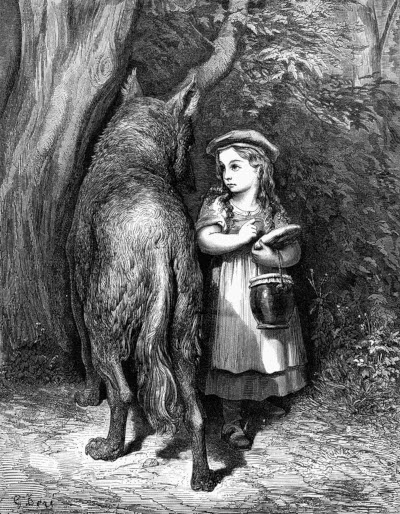
Little Red Riding Hood is the strongest active internal anchor for the Perrault series because it already has a dedicated Dore page. BnF's fairy-tale resources describe the tale as one of the most continually transformed stories in the tradition, with illustrators repeatedly reimagining the child, the wolf, the forest encounter and the bed scene. Dore enters that long visual history with unusual force.
The BnF image record for Little Red Riding Hood meeting the wolf identifies the illustration as Dore's work for the 1862 Hetzel Perrault edition, engraved on wood by Adolphe-Francois Pannemaker. It describes the print as a working proof pulled from a blackened block. That production detail is valuable because it links the scene not only to story but to wood-engraving practice.
Dore's Little Red Riding Hood images are powerful because they refuse a harmless fairy-tale world. The child and wolf are visually unequal. The path through the woods is not neutral. The story's famous simplicity becomes a problem of distance, attention and danger. Dore makes the viewer feel how little protection the child has once the path opens into the forest.
The bed scene has a different kind of unease. The BnF educational account names Little Red Riding Hood discovering the wolf in the grandmother's bed as one of the black-and-white images that became inseparable from the tale. The scene condenses Perrault's warning structure into a visual confrontation. The familiar place of care has become a trap.
As a Series page, Perrault's Fairy Tales can link directly to Little Red Riding Hood while letting that artwork page remain focused. The flagship page explains the wider Hetzel/Dore project; the artwork page can concentrate on the specific image, the wolf, the forest, the bed and the production history.
Bluebeard
Bluebeard is the second major active internal anchor for the Perrault series. It shows how different Dore's fairy-tale intelligence can be from Little Red Riding Hood. The danger is no longer a wolf in the forest. It is wealth, marriage, prohibition and curiosity inside a house.
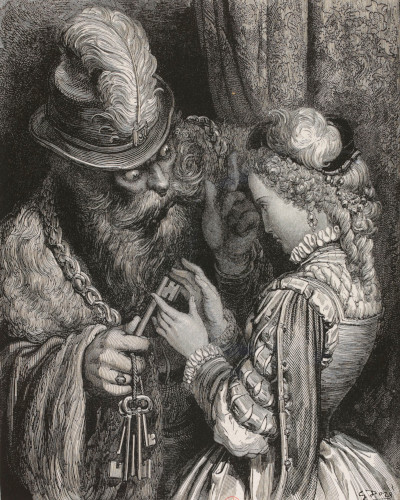
The existing Bluebeard page research anchors the image in BnF, Gallica and Utpictura18 records. Utpictura18 records the key-handover plate as a wood engraving tied to the Hetzel Perrault edition, and Françoise Bombard's essay on objects in Perrault and Dore treats the Bluebeard key as the starting point for the movement from prohibition to discovery and threatened death.
The key is the visual centre. It is small, but it controls the story. Dore understands that the object is not a prop; it is a rule made visible. Bluebeard gives his wife access and restriction at the same time. The scene of handing over the keys is therefore already dangerous before the forbidden chamber appears.
This makes Bluebeard a darker companion to Little Red Riding Hood. In Little Red Riding Hood, danger enters through a meeting on the road and then a deceptive domestic scene. In Bluebeard, danger is already built into the domestic order. The husband, the house, the keys and the rooms create suspense before violence is shown.
The Perrault Series page can use Bluebeard to show that Dore's fairy-tale work is not only about childhood. These tales address adult fears as well: marriage, property, secrecy, power, curiosity, obedience and survival. Dore's images make that adult pressure visible without needing to abandon the tale's concise form.
Sleeping Beauty, Cinderella and the Palace World
Little Red Riding Hood and Bluebeard provide the strongest current internal anchors, but the Perrault series is broader. BnF's educational account names Sleeping Beauty and Cinderella among the Dore images that entered collective memory: the prince climbing toward the sleeping princess, and Cinderella trying on the slipper. These tales show Dore working with elegance, suspension and recognition rather than immediate physical threat.
Sleeping Beauty is a tale of arrested time. The palace sleeps; the princess waits; the prince approaches. Dore can make architecture carry enchantment. Stairs, rooms, curtains and still bodies become signs of suspended life. The image does not need violent action. Its drama lies in delay and approach.
Cinderella works through humiliation and recognition. The slipper is the tale's decisive object, just as the key is decisive in Bluebeard. But the emotional movement is different. Bluebeard's key proves transgression; Cinderella's slipper reveals identity. Dore's challenge is to make a small object feel socially transformative.
The palace tales also show Dore's sensitivity to theatrical arrangement. Fairy tales often move from low status to high status, from kitchen to palace, from hidden identity to public recognition. Dore's large plates allow those social spaces to feel distinct. The reader can feel the difference between obscurity, ceremony and magical transition.
This matters because Perrault is often remembered only through the darkest tales. Dore's series is richer than that. It includes terror, but also spectacle, courtliness, metamorphosis, social ascent and comic cunning. A flagship page needs to keep the full range in view.
Puss in Boots and Comic Cunning
Puss in Boots gives Dore a different kind of fairy-tale energy. Here the central force is not helplessness or dread but performance. The cat uses costume, speech and strategy to transform his master's social position. The tale is about invention, appearance and verbal power.
Musee d'Orsay gives Puss in Boots a striking afterlife note: it says the cat chosen as the emblem for the Dore exhibition directly inspired the character of the cat in Shrek. Orsay also places Dore's Perrault imagery within a broader cinematic and animated legacy, including debts owed by Disney and other film traditions. This shows how far Dore's fairy-tale images travelled beyond the original book.
Puss in Boots is especially useful for explaining why Dore mattered to later visual culture. The tale's hero is already a performer. He wears boots, stages deception, manages appearances and engineers transformation. Dore's visual version supplies a theatrical animal figure that later culture could easily remember and adapt.
This also links Perrault to Dore's early comic and caricatural gifts. Musee d'Orsay describes Dore's beginnings in caricature, periodicals and storytelling through pictures. Puss in Boots lets that early comic intelligence operate inside a luxury fairy-tale album. The artist of Dante's Hell is also the artist of a calculating cat.
The Series page can use Puss in Boots to prevent the Perrault route from becoming only a corridor of danger. Dore's fairy tales are dark, but they are also witty and performative. The cat belongs to the side of Dore that loves disguise, timing and theatrical intelligence.
Hop-o'-My-Thumb and the Forest of Tests
Hop-o'-My-Thumb is one of the most important tales for understanding Dore's forest imagination. The BnF educational account notes that Dore gave unusual space to the tale, with eleven plates for Hop-o'-My-Thumb. It also names the image of the child dropping stones at the edge of the forest as one of those that became inseparable from Perrault in collective memory.
The tale gives Dore a perfect structure: small children, abandonment, forest passage, danger, intelligence and survival. The forest is not only a backdrop; it is a test. BnF's general fairy-tale resources describe the symbolic structure of departure, passage and arrival. Hop-o'-My-Thumb uses that structure with particular clarity.
Dore was one of the great artists of scale, and this tale lets him make smallness dramatic. A child in a forest can seem almost lost in the image. That smallness is frightening, but it also sets up the child's cleverness. The smallest figure may see, remember and act more effectively than adults.
The tale also connects Perrault to La Fontaine and Don Quixote in the wider Series architecture. Like La Fontaine's fables, it uses a compact narrative to stage intelligence under pressure. Like Don Quixote, it depends on movement through a world where interpretation matters. Unlike both, it places children at the centre of danger.
That child-centred danger is one of the Perrault series' defining contributions to Dore's work. It shows how he can make vulnerability monumental.
Wood Engraving, Pannemaker and Printed Darkness
Dore's Perrault images depend on wood engraving. The BnF Little Red Riding Hood image record identifies the plate as a wood engraving by Adolphe-Francois Pannemaker after Dore. The existing Bluebeard research also records wood-engraving routes through Utpictura18 and BnF/Gallica material. This production history matters because the tales' mood depends on black-and-white contrast.
The BnF educational page says Dore renewed wood engraving through tonal wood engraving, which rendered nuances and contrasts beautifully. That point is important for Perrault. Fairy tales need atmosphere. Forest darkness, candlelit interiors, palaces, curtains, fur, hair, stone, shadow, animal bodies and frightened faces all require tonal control.
In Perrault, black and white can be more powerful than colour. The absence of colour removes prettiness. It lets shadow, line and texture carry dread or wonder. The wolf becomes an arrangement of fur, muzzle, eyes and posture. The key becomes a glinting object within a dark interior. The forest becomes a field of verticals and obscurity.
The engravers' work also made the images widely reproducible. Dore's drawings entered public memory through printed translation. Pannemaker and other wood engravers helped turn the drawings into images that could circulate in books, reissues, proofs and later reproductions. The Perrault series is therefore as much a triumph of print culture as of invention.
For internal navigation, this is why the page needs strong links to Engravings. The fairy-tale scenes are not only narrative images; they are printed objects. Their lasting power depends on how Dore's dramatic designs survived the discipline of the engraved block.
Fear, Childhood and the Adult Reader
Perrault's tales are often called children's stories, but Dore's illustrations make clear that children are not the only audience. The BnF educational account describes the volume as a very large book for children, yet also emphasizes the family-reading frame. Adults and children meet around the tales, and the images speak differently to each.
For children, Dore's pictures can be thrilling, frightening and unforgettable. For adults, they recover the seriousness of stories that familiarity can soften. The wolf is dangerous. Bluebeard is terrifying. The forest is not merely scenic. The palace is not merely decorative. Dore gives old tales their edge back.
That edge is central to Perrault. Many of the stories are moral or cautionary, but their power is not only in the stated lesson. It lies in the image of threat. A child meets a predator. A wife opens a forbidden door. A family abandons children. A heroine is tested by humiliation. The tale condenses fear into a few scenes. Dore expands those scenes just enough for the viewer to feel them.
The adult reader also sees how the tales organize social knowledge: danger from strangers, danger inside marriage, danger from poverty, danger from hunger, danger from desire, danger from power. Dore does not turn these into essays. He lets objects and settings carry them.
This is one reason the Perrault page needs to be researched and substantial. Fairy tales look simple until one tries to explain why their images remain so durable. Dore's series is a major answer: he gave the tales visual forms that could haunt memory long after the plot was known.
Moral Endings and Visual Memory
Perrault's tales often end with morals, but Dore's illustrations usually work before the moral is stated. They seize the instant when the story has not yet settled into a lesson. The child has met the wolf but has not yet reached the bed. The keys have changed hands but the forbidden room has not yet been opened. The prince has not yet completed the ascent. The stones have only begun to mark a possible return.
This is one reason the images remain vivid. A moral can close a tale by explaining it. An illustration can reopen the tale by holding the moment of danger, desire or recognition in suspense. Dore repeatedly chooses scenes where the viewer knows more than the character, or fears more than the character understands. That distance between viewer and figure creates the emotional pressure.
In Little Red Riding Hood, the lesson may be stated as warning, but the image lives as encounter. In Bluebeard, the lesson may involve curiosity and obedience, but the image lives through the glamour and threat of the keys. In Cinderella, the moral may favour grace or virtue, but the image of the slipper remains a scene of public recognition. In Hop-o'-My-Thumb, the moral may honour cleverness, but the image of stones at the forest edge fixes intelligence in a physical gesture.
Dore's genius is that he does not flatten the tales into their morals. He makes the world before the moral feel dangerous and alive. That is why the pictures can speak to adult memory as well as childhood reading. The viewer may know the ending, but the image restores uncertainty.
This also helps explain the link between Perrault and later film. Cinema often depends on the same suspended moment: the door before it opens, the forest before the attack, the stair before discovery, the object before recognition. Dore's fairy-tale plates provide nineteenth-century versions of those charged instants. They are still pictures, but they feel as if something is about to happen.
Perrault in Dore's Larger Series Architecture
Perrault's Fairy Tales occupies a different place from Bible Illustrations, Dante, Paradise Lost, London and Don Quixote. It is smaller in textual scale, but not smaller in visual importance. It gives Dore a world where threat enters through familiar spaces and where a single object can decide the story.
The series also connects to Dore's earliest habits. Musee d'Orsay describes his childhood and early albums as linked to animal fable traditions and storytelling through pictures. Perrault lets that storytelling intelligence operate in a grander publishing form. The child illustrator, the caricaturist, the luxury-book illustrator and the visionary artist all meet here.
Perrault also prepares the way for La Fontaine's Fables. Both involve concise narratives, animals, moral pressure and popular memory. But they differ sharply. La Fontaine's fables often turn on wit, social intelligence and moral compression. Perrault's fairy tales turn on wonder, peril, transformation and family memory. Together they show Dore's range in short narrative forms.
The page also creates stronger pathways for existing artwork pages. Little Red Riding Hood and Bluebeard no longer sit as isolated fairy-tale pages. They become anchors inside a full Perrault route. Readers can move from the series overview to the specific artwork, then outward to Engravings for medium, Illustrations for book practice, and other Series pages for the wider career.
This is exactly why the new Series section matters. Dore's fame was built through large visual worlds. Perrault's world is not as long as the Bible or Don Quixote, but it is among the most culturally persistent. A dedicated page lets that persistence become visible.
Legacy and Later Visual Culture
Dore's Perrault images did not remain confined to nineteenth-century books. Musee d'Orsay states that Jean Cocteau was indebted to Dore's illustrations for Perrault's Fairy Tales in Beauty and the Beast, that George Lucas drew on Dore in relation to Chewbacca, and that the animated cat in Shrek was directly inspired by Dore's Puss in Boots. It also describes Disney's broader debt to Dore in animation.
These afterlife claims are striking because they show how Dore's fairy-tale imagination travelled into cinema, fantasy and animation. His images gave later makers a vocabulary of forests, creatures, theatrical animals, dark interiors and enchanted scale. The Perrault series is therefore not only historical; it is part of the visual genealogy of modern fantasy.
The influence makes sense. Dore's fairy-tale images are already cinematic in the broad sense. They stage entrances, confrontations, reveals and thresholds. A prince climbs. A wolf waits. A cat performs. A key changes hands. A child marks the path. These are not static decorations; they are scenes ready to move.
Musee d'Orsay's wider account of Dore calls attention to his visionary eye and his effect on film. Perrault is one of the clearest examples because fairy-tale cinema repeatedly returns to the same materials: the forest, the castle, the animal helper, the enchanted sleep, the forbidden room, the child in danger. Dore gave those materials a powerful black-and-white precedent.
This legacy helps modern readers understand why Perrault belongs among the flagships. It is a relatively compact book compared with Don Quixote or the Bible, but its images reached far into later visual culture. Dore's fairy tales helped shape how danger and wonder look.
Key Works and Image Candidates
A future image plan for the Perrault Series page can begin with three secure anchors. First, Little Red Riding Hood meeting the wolf, recorded by BnF as a Dore illustration for the 1862 Hetzel Perrault edition and engraved by Pannemaker. Second, Little Red Riding Hood discovering the wolf in the grandmother's bed, named by BnF as one of the images inseparable from the tale in collective memory. Third, Bluebeard handing over the keys, already supported by Utpictura18 and the existing Bluebeard research.
The page can then broaden to Sleeping Beauty, Cinderella, Puss in Boots and Hop-o'-My-Thumb. The BnF educational account supplies strong image-language for these: the prince climbing the castle stairs, Cinderella trying the slipper, Hop-o'-My-Thumb dropping stones at the forest edge. These scenes collectively show Dore's range: fear, suspended enchantment, recognition, cunning and child survival.
The safest first internal image links are Little Red Riding Hood and Bluebeard because those routes already exist. Later expansion can add individual Perrault plates if source-verified images are selected from BnF/Gallica, BnF image records, Utpictura18 or local public-domain candidates.
The page can also link to Engravings for Pannemaker and wood-engraving context, and to Illustrations for Dore's illustrated-book career. That keeps the Perrault page from becoming only tale summary. It remains a serious page about publication, image-making and visual memory.
Why the Series Page Matters
Perrault's Fairy Tales needs a dedicated page because without it Little Red Riding Hood and Bluebeard look like separate curiosities. They are stronger as part of a major Dore fairy-tale project. The Hetzel edition, the oversized album format, the full-page plates, the family-reading frame, the BnF research corpus and the later cultural afterlife all point to a flagship treatment.
The page also helps correct a common misunderstanding of Dore. He is often remembered as an artist of darkness, biblical spectacle and infernal grandeur. That is true, but incomplete. Perrault shows him handling childhood, wit, fear, domestic suspense, magical objects and popular storytelling. It makes his range more legible.
The fairy-tale series also gives readers an accessible entry into Dore. Some visitors may arrive through Little Red Riding Hood or Bluebeard before they care about Dante or Milton. A strong Perrault page can then lead them outward: to the Bible for scale, Dante for Hell, Milton for cosmic drama, Don Quixote for comic travel, London for modern society and La Fontaine for fable.
That movement is the value of Series architecture. It lets each project remain itself while showing how Dore's imagination adapted to different kinds of text. Perrault is the place where fairy tale becomes monumental without losing its concise sting.
Related Perrault and Fairy-Tale Pages
Use these pages to place Doré's fairy-tale illustrations beside the active artwork, illustration and printmaking routes in this section.
FAQ
Discussion
Which Doré fairy-tale image feels most powerful to you: the forest encounter, the forbidden key, the sleeping palace or the performing cat?
Reader Insights
Watch how Doré turns doors, paths, beds and stairways into places of danger or transformation.
Follow the key, slipper, boots and stones as small things that decide large stories.
Read the black-and-white atmosphere as part of the series, not merely as reproduction.
Join the Conversation
Share your reading of Doré's Perrault fairy-tale illustrations below.
References
- BnF, Les Contes de Perrault, illustrés par Gustave Doré, accessed 28 July 2026.
- BnF research programme, Les Contes de Perrault illustrés par Gustave Doré, accessed 28 July 2026.
- BnF Classes, Illustrations de contes par Gustave Doré, accessed 28 July 2026.
- BnF image page, Le petit Chaperon rouge rencontre compère le Loup, accessed 28 July 2026.
- BnF catalogue, Les contes de Perrault, accessed 28 July 2026.
- BnF Editions, Perrault. Contes illustrés par Doré, accessed 28 July 2026.
- Musee d'Orsay, Gustave Dore (1832-1883): Master of Imagination, accessed 28 July 2026.