 by Tom Gurney
Tom Gurney BSc (Hons) is an art history expert with over 20 years experience
Published on July 28, 2026 / Updated on October 16, 2026
Email: tomgurney1@gmail.com / Phone: +44 7429 011000
Gustave Dore and Milton's Paradise Lost
Gustave Dore's illustrations for Milton's Paradise Lost belong to the same ambitious decade as his Bible and Dante projects, but they have a different imaginative temperature. The Bible gave him sacred history across creation, covenant, prophecy and the life of Christ. Dante gave him a guided journey through Hell, Purgatory and Paradise. Milton gave him cosmic rebellion: Heaven at war, Satan in defeat, Eden under threat, temptation, fall and the enormous drama of spiritual pride.
The 1866 Paradise Lost edition made Dore answer one of the hardest problems in literary illustration. Milton's poem is not a sequence of simple episodes. It moves between narrated memory, angelic warfare, divine council, Satanic ambition, pastoral innocence and theological argument. The illustrator has to make invisible conflict visible without reducing the poem to spectacle. Dore's answer was scale. He made Heaven, Hell and Eden feel like spaces the eye could enter, while keeping the figures charged with pride, awe, fear or vulnerability.
Several institutional records anchor the project. Utpictura18 records a 50-notice series for John Milton's Paradise Lost, edited by Robert Vaughan and published in London by Cassell, Petter and Galpin. The Metropolitan Museum of Art records Now Night Her Course Began as an 1866 wood engraving from the Paradise Lost series, engraved by Ad Ligny after Dore. The British Museum records a Cassell Paradise Lost volume from 1866 with whole-page wood engravings after Dore, related verse sheets and a frontispiece showing Lucifer and other angels falling from Heaven. Christ's College Cambridge records later editions and stresses the importance of Dore's fifty plates to the poem's visual afterlife.
Dore's Paradise Lost is therefore not a minor offshoot of the Bible pages. It is a flagship literary series. It sits beside Dante's Divine Comedy and the Bible Illustrations because all three gave Dore enormous supernatural worlds to build. But Paradise Lost has its own structure and needs its own guide. It is the place where Dore's art turns most intensely toward rebellion, hierarchy, cosmic space and the tragedy of a fall chosen before it is suffered.
At a Glance
- PublicationCassell-associated illustrated Paradise Lost, 1860s
- Plate countCommonly recorded around 50 full-page plates
- Visual languageAngelic bodies, cosmic distance, darkness and theatrical fall
- Internal anchorFall of the Rebel Angels
- Series roleThe closest literary neighbour to Doré's Bible and Dante imagination
Contents
- Dore and the English Epic
- The 1866 Cassell Edition
- Rebellion as Visual Architecture
- Satan, Lucifer and the Problem of Grandeur
- Angels, Armies and the Crowd
- Heaven, Hell and Eden
- Book VI and Now Night Her Course Began
- The Fall of the Rebel Angels as a Bridge
- Milton Beside Dante
- The Printed Surface
- Eden, Temptation and Human Scale
- Line, Light and Silence
Dore and the English Epic
Paradise Lost gave Dore a subject that matched his appetite for extremes. Milton's poem is built around vast oppositions: obedience and rebellion, Heaven and Hell, innocence and corruption, speech and silence, light and darkness, freedom and ruin. Dore's strongest images often live inside just such oppositions. He was drawn to thresholds, falling bodies, crowded masses, exposed landscapes and scenes where a single figure is dwarfed by a world too large to master.
The poem also gave Dore a specifically English epic to place beside Dante and the Bible. Musee d'Orsay notes his work on major classics and places Milton among the literary worlds through which Dore circulated widely in Europe and the United States. The British Museum's Dore Gallery volume confirms that Milton sat alongside the Bible, Dante, La Fontaine, Don Quixote and other Dore series in later anthology form. The public did not encounter Dore only through one book at a time; his major projects were repeatedly gathered, reissued and compared.
That context matters because Paradise Lost belongs to Dore's broader effort to become the illustrator of monumental texts. He was not interested only in supplying attractive pictures. He repeatedly took on works that already had cultural weight and tried to make them visually immediate for modern readers. Milton's poem was a natural test: difficult, elevated, theological, dramatic and full of scenes that strain ordinary representation.
The temptation is to treat Paradise Lost as an extension of the Bible because it draws on Genesis and Christian cosmology. That is too simple. Milton's poem is a literary epic with its own voice, structure and arguments. Dore's illustrations respond to that poetic structure. They may share imagery with religious art, and they may sit close to the Bible pages, but their immediate source is Milton's poem and the nineteenth-century edition built around it.
This distinction makes the series stronger. Dore's Bible images show scripture as a sequence of grand scenes. His Milton images show a poet's theological imagination transformed into printed drama. The overlap is real, but the difference is crucial.
The 1866 Cassell Edition
The key edition for this page is Milton's Paradise Lost, illustrated by Gustave Dore and edited with notes and a life of Milton by Robert Vaughan. Utpictura18 gives the title-page framework for the London Cassell, Petter and Galpin edition and lists 50 notices in the series. The National Library of New Zealand's indexed record describes an 1866 Vaughan, Dore and Cassell edition as an early printing with engraved plates and guard sheets. UWM Libraries' indexed record likewise identifies an 1866 Cassell, Petter and Galpin edition with two volumes and 50 leaves of plates.
Other accessible sources reinforce the publication facts. Open Library records an 1866 Cassell, Petter, Galpin & Co. Paradise Lost with Dore as illustrator, Robert Vaughan as editor and 50 leaves of black-and-white plates. Christ's College Cambridge describes Dore as commissioned by Cassell and Co. to make 50 plates for a new edition of Paradise Lost first printed in New York and London in 1866. The British Museum records a Cassell Paradise Lost volume associated with 1866, whole-page wood engravings after Dore and verse sheets preceding plates.
There is one important caution. Institutional records describe plate counts and formats in slightly different ways. Utpictura18, UWM, Open Library and Christ's College use the familiar 50-plate framework. The British Museum record for one volume describes 49 whole-page wood engravings while also noting a frontispiece of falling Lucifer and angels. The safest public language is to describe Dore's Paradise Lost as a 50-plate illustrated project while allowing individual catalogue records to carry their exact phrasing.
The edition's structure shaped reading. Plates were not simply inserted as loose pictures. The British Museum notes related verse sheets before plates, and Utpictura18 links individual images to book and line references. That format made image and text speak to each other. A reader paused at the image with a line, scene or book in mind.
This is especially important for Paradise Lost because Milton's poem is dense. The reader needs orientation: which book, which speaker, which heavenly or infernal setting, which stage of the fall. Dore's images give the poem visible stations, but the edition's captions and verse references keep those stations connected to the text.
Rebellion as Visual Architecture
Paradise Lost begins after the fall of the rebel angels, but it repeatedly returns to the war in Heaven. Dore had to picture both aftermath and memory: Satan on the burning lake, fallen angels gathering, infernal councils, celestial armies and the later battle described by Raphael. This is not simple action illustration. It is epic memory made visible.
Utpictura18's series list gives a useful sense of the early sequence: The Fallen Angels Vainquished, Satan Rises from a Burning Lake, Satan Talks to the Council of Hell, The Fallen Angels Explore Hell, The Fallen Angels Gather in Pandemonium, Satan Takes his Throne in Hell and related images. Even the titles show Dore thinking in spatial and political terms. Hell is not only punishment. It is a place where defeated power reorganizes itself.
Dore's recurring visual problem is hierarchy. Who is above? Who is below? Who stands, who falls, who addresses the crowd, who is diminished by the surrounding space? The poem is obsessed with rank, pride and lost order, and Dore turns those themes into composition. Height matters. Distance matters. Crowds matter. The body of Satan matters because it has to carry grandeur and defeat at once.
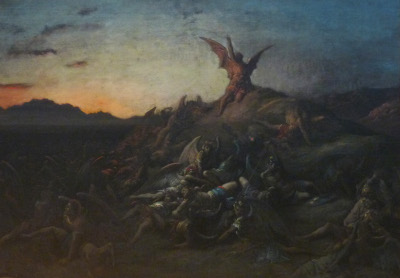
The Fall of the Rebel Angels, as recorded by Utpictura18 for Book VI line 871, gives one of the clearest examples. The image shows the rebel host cast down after the intervention of the Son. The description places the scene inside Raphael's narration to Adam and Eve: a memory of cosmic war. Dore's image concentrates on falling and broken bodies rather than on a neat diagram of doctrine. Rebellion becomes weight.
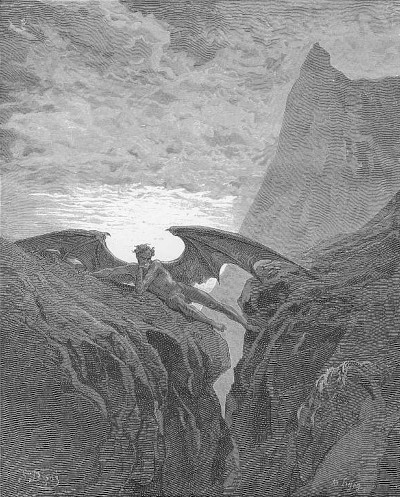
Now Night Her Course Began offers a different point in the war-in-heaven material. Utpictura18 places it at Book VI line 406, after the first day's battle, when Lucifer's army is routed and Lucifer lies humiliated. The Met records the same title as a wood engraving after Dore, engraved by Ad Ligny. The scene is not the maximum spectacle of battle. It is aftermath, and that is why it is powerful. Night becomes moral atmosphere.
Together, these images show Dore's Milton at its best. He does not only draw armies. He pictures the condition of defeat: fallen height, scattered force, broken pride, darkened space.
Satan, Lucifer and the Problem of Grandeur
Satan is the hardest figure in Paradise Lost to illustrate because the poem gives him grandeur and ruin at the same time. He speaks with force, leads armies, resists, deceives and suffers defeat. A weak illustration would make him only monstrous or only heroic. Dore's best Milton images keep the contradiction alive.
In scenes such as Satan Rises from a Burning Lake or Satan Takes his Throne in Hell, the figure must retain command even in loss. In Now Night Her Course Began, he is reduced. In The Fall of the Rebel Angels, he belongs to a broader catastrophe of bodies thrown down from Heaven. Dore changes the visual status of Satan according to the moment in the poem.
That flexibility matters. Milton's Satan is not static. He moves from defeated commander to infernal orator, from solitary voyager to tempter, from rebel angel to agent of human fall. Dore's series follows those changes through posture, scale and setting. Satan can be monumental against a burning void, small before divine space, surrounded by followers or isolated in darkness.
The visual language is often physical. Wings, armour, gesture, rock, flame, cloud and shadow give the figure weight. Dore does not make Satan a purely symbolic sign. He makes him present as a body in a place. That bodily presence is one reason the illustrations continue to command attention.
But Dore also prevents easy admiration. Even when Satan appears grand, the surrounding world often carries loss. Hell is vast but broken. Crowds gather but remain fallen. Height returns as memory, not possession. The viewer can feel the drama of rebellion without forgetting its consequence.
Angels, Armies and the Crowd
Dore was one of the nineteenth century's great arrangers of crowds, and Paradise Lost gave him some of his largest supernatural crowds. Angels gather, fall, march, listen, fight and recoil. The challenge is to make crowds legible without making them dull.
He solves that challenge through movement and hierarchy. Figures are arranged in waves, ranks, diagonals and masses. Some bodies define the foreground; others dissolve into distance. The crowd becomes atmosphere as much as population. It tells the viewer that the event is not private. Rebellion, judgement and fall involve hosts.
Christ's College Cambridge's discussion of the Book VI.871 illustration is useful for understanding this effect. It emphasizes grounded broken forms in the foreground and a low viewpoint that intensifies the descending threat from above. In other words, Dore makes the scene work through viewpoint and mass. The viewer is not safely detached at a neutral distance. The composition places the eye near the wreckage.
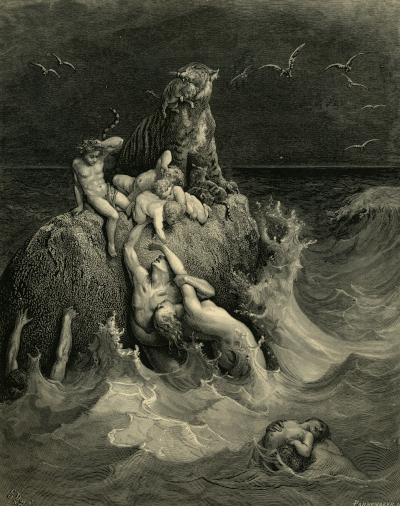
This kind of staging connects Paradise Lost to Dore's Bible and Dante images. The Deluge uses bodies in crisis against overwhelming force. Dante's Inferno uses crowds and spaces of punishment. Paradise Lost uses angelic hosts to picture conflict before human history. Dore repeats the formal problem across series, but each time the narrative pressure changes.
The crowd in Paradise Lost is also political. Hell is a fallen kingdom; Satan speaks to followers; armies organize and disintegrate; power seeks new forms after defeat. Dore's crowds can therefore suggest more than spiritual catastrophe. They also suggest command, persuasion, spectacle and the dangerous charisma of rebellion.
Heaven, Hell and Eden
The three central spaces of Paradise Lost are Heaven, Hell and Eden, and Dore has to make each one visually distinct. Hell is dark, rocky, fiery, crowded and vast. Heaven is ordered, luminous and hierarchic. Eden is pastoral, vulnerable and charged with innocence before rupture.
Hell is the easiest to remember because it suits Dore's love of darkness. Burning lakes, broken ground, cavernous space and crowded rebels give him strong materials. But the series becomes richer when Hell is not the only focus. Paradise Lost is also about what is lost, and Eden has to carry that loss in advance.
Eden asks for a different visual intelligence. Adam and Eve are not yet figures of ruin at the poem's beginning. They belong to a world of order, beauty and vulnerability. Dore's challenge is to show innocence without making it sentimental, and danger without making it obvious too soon. The viewer has to feel that the garden is a real place and a threatened condition.
Heaven poses another problem. It cannot be only bright clouds and distant figures. It must carry authority and scale. Dore's Heaven is often defined by radiance, height and ordered hosts, in contrast to Hell's broken terrain and rebellious masses. The distinction is visual theology: the eye understands rank and relation through space.
The movement between these settings gives the series its shape. The reader moves from Hell's aftermath to heavenly explanation, from Eden's innocence to temptation, from human fall to future promise. Dore's images help the poem feel navigable without simplifying its arguments.
Book VI and Now Night Her Course Began
The existing Plate No. 26 Book VI page is the most precise internal Milton anchor. Its long inherited title preserves the line "Now Night her course began," associated with Book VI line 406. Utpictura18 identifies the image as Satan is Brought low, dated 1866, with Lucifer's forces routed after the first day's battle. The Met records a related object as Now Night Her Course Began, plate 41 from Paradise Lost, engraved by Ad Ligny after Dore.
This is a perfect example of why the Series page is needed. The individual artwork page can explain the title, numbering caution and close reading. The flagship page can place the image inside Milton's larger war-in-heaven sequence. Without that context, a reader may see only a dark winged figure in a rocky landscape. With the context, the image becomes a moment in Raphael's narration: defeat after rebellion, night after battle, pride confronted by weakness.
The image also shows Dore's attraction to aftermath. He does not always choose the noisiest instant. He often chooses the moment after a force has done its work. In Paradise Lost that matters because consequence is central to the poem. Rebellion has consequences; temptation has consequences; the fall has consequences. Dore's dark spaces often feel like places where consequence has settled.
Now Night Her Course Began also belongs near The Fall of the Rebel Angels. The two images handle related material differently. One is an artwork page tied to a Milton wood engraving; the other is an existing painting page with a Strasbourg object route and a Milton/religious bridge. This Milton guide can connect them without confusing their object histories.
The Fall of the Rebel Angels as a Bridge
The Fall of the Rebel Angels is one of the most useful existing pages for the Milton path, but it requires careful framing. The Strasbourg painting is not automatically the same as a Paradise Lost plate, and its Bible connection works best as a neighboring religious context rather than as a replacement for Milton. The strength of the page lies in its position between religious painting and Miltonic imagination.
Utpictura18 records a Paradise Lost image under the same subject, linked to Book VI line 871. That series route confirms Dore's explicit engagement with rebel angels in Milton. The existing painting page can therefore support a Milton corridor, while still preserving the painting's museum-object identity.
This bridge is valuable because Paradise Lost itself is built from biblical and Christian material transformed into epic poetry. Milton writes from scriptural and theological traditions, but his poem has its own structure, speeches, inventions and dramatic pacing. Dore's images have to respect that literary structure. A responsible guide keeps the Bible and Milton close, but not identical.
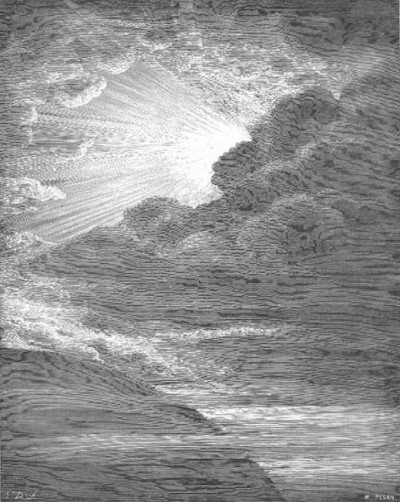
The bridge also helps readers understand Dore's wider visual language. Creation of Light shows divine division at the beginning of the world. The Deluge shows judgement overwhelming human space. The Fall of the Rebel Angels shows rebellion becoming descent. Plate No. 26 Book VI shows the defeated rebel after battle. These works are not all from the same edition, but they reveal recurring Dore themes: light, darkness, height, fall, bodies and moral space.
Milton Beside Dante
Dore's Paradise Lost belongs naturally beside Dante's Divine Comedy. Both series ask him to picture the afterlife, spiritual hierarchy and supernatural space. Both involve descent and ascent. Both use darkness as a visual pressure. Yet the two projects are different in structure.
Dante gives Dore a journey led by two recurring figures, Dante and Virgil, later transformed by Beatrice and the ascent toward Paradise. The viewer follows the pilgrim through a mapped afterlife. Milton gives Dore epic narration, not pilgrimage in the same sense. The poem moves through speeches, remembered battles, council scenes, Edenic temptation and divine explanation.
That difference changes the images. In Dante, the small travellers often anchor the scale. In Milton, armies, angelic hierarchies and Satanic presence often dominate. Dante's spaces are places to pass through; Milton's spaces are arenas of power, conflict and moral choice.
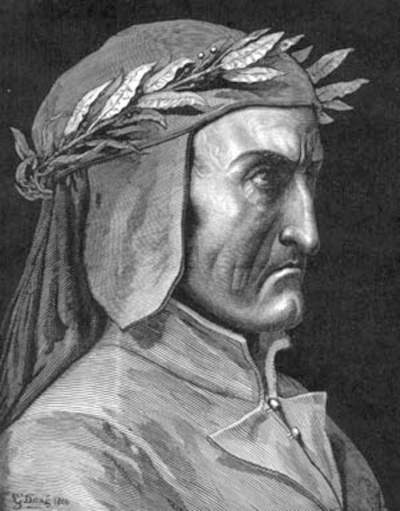
The existing Portrait of Dante Alighieri page is therefore a useful comparison. It shows a frontispiece threshold into Dante's poem. Plate No. 26 Book VI shows a textual moment inside Milton's epic. One starts with the poet's face; the other with Lucifer in defeat. Both are literary, both are engraved, and both reveal Dore's talent for turning a written world into a sequence of memorable images.
The Printed Surface
Paradise Lost also belongs with Dore's Engravings page because its public form is wood engraving. The Met records Now Night Her Course Began as a wood engraving, and the British Museum records the Cassell volume as wood engraving and letterpress. Utpictura18 identifies individual notices as wood engravings from the series.
This medium is not incidental. Dore's Milton depends on tonal contrast. Hell must feel dark but readable. Angelic bodies must be both luminous and solid. Flames, clouds, wings and rocks must carry drama through black-and-white marks. Engravers translated Dore's designs into printed surfaces that could be repeated across editions.
Christ's College Cambridge describes Dore's Paradise Lost plates as being sketched on wood and then cut by a team of engravers with whom he worked closely. The detail is useful because it clarifies the collaborative nature of the project. Dore's name belongs at the centre, but the finished book came from a network of drawing, engraving, printing and publishing.
That process also explains the series' reach. A painting exists in one place. A wood-engraved book can move through libraries, homes, editions and languages. Dore's Paradise Lost became powerful not only because the images were dramatic, but because they were reproducible. The printed surface carried the epic into a wider visual culture.
Eden, Temptation and Human Scale
Paradise Lost is often remembered through Satan and the rebel angels, but the poem finally turns on Adam and Eve. That gives Dore a second visual task after the infernal and heavenly scenes. He has to picture innocence before loss, persuasion before catastrophe, and the moment when epic conflict enters domestic human space.
Eden changes the scale of the series. In Hell, figures are overwhelmed by cavernous darkness, fire and broken terrain. In Heaven, the viewer sees hierarchy, radiance and ordered power. In Eden, the visual pressure becomes quieter. Bodies stand within a garden, and the danger is not always visible as violence. Temptation depends on speech, attention and trust.
That change makes the Eden plates essential to the series even when the rebel-angel images are more immediately spectacular. Milton's poem gives Satan enormous rhetorical energy, but the fall of humankind happens through persuasion. Dore's task is to make that persuasion visible. Gesture, distance, facial direction and the arrangement of Adam and Eve become crucial. The eye has to read vulnerability before it sees ruin.
Eden also gives Dore a chance to set beauty against consequence. A garden scene can seem calm at first, but the reader knows that innocence is temporary. That knowledge changes the image. The viewer looks at pastoral space with dramatic hindsight. Dore's best Eden images carry that double feeling: beauty present, loss approaching.
The human figures also help balance the series. Without Adam and Eve, Paradise Lost could become only a supernatural war epic. With them, the poem returns to human choice and human consequence. Dore's illustrations preserve that movement. The cosmic conflict matters because it reaches the garden. The fall of angels becomes the prelude to the fall of man.
Line, Light and Silence
Dore's Paradise Lost is full of dramatic action, but some of its most effective moments depend on silence. After battle, after judgement, before temptation, or at the edge of revelation, Dore often lets stillness do the work. Now Night Her Course Began is powerful for that reason. The scene is not battle in motion; it is the quiet after defeat.
In wood engraving, silence has to be made through line. Empty space, dense shadow, distant light and the posture of a figure can slow the reader down. Dore's line is not only descriptive. It controls pace. Closely worked darkness can feel heavy; a break of light can feel like distance, hope or exposure; an isolated figure can make a page feel suddenly quiet after the pressure of crowds.
This matters because Milton's poem itself moves between tremendous sound and formal stillness. Armies clash, councils speak, Satan persuades, angels narrate, but the poem also pauses for vision, reflection and loss. Dore's series has to follow that rhythm. It cannot be only a portfolio of explosions, falls and grand gestures.
The engraved medium gives him a limited palette, but that limitation becomes expressive. Without colour, he builds a world from black, white and gradations of mark. Hell darkens through density. Heaven opens through light. Eden becomes readable through softer spatial order. Fallen bodies emerge from shadow. The whole series depends on the emotional control of contrast.
This is why Dore's Milton images remain legible even in reproduction. The major forms are strong. A winged figure against a void, a host descending, a solitary body on rocks, a garden scene before temptation: these compositions survive changes in scale because they are built around clear tonal architecture. The eye understands the drama before it reads the details.
Later Editions and Public Memory
The continued appearance of Dore's Paradise Lost in later editions helps explain its public life. Christ's College Cambridge records late nineteenth-century examples after the 1866 first printing, including illustrated bindings and individual exhibition items tied to Book VI. Open Library likewise records later editions built from the Cassell/Dore/Vaughan framework. The images remained useful because publishers and readers continued to see them as an authoritative visual accompaniment to Milton.
Later editions can complicate bibliography. Dates, publishers, plate counts and formats vary across catalogue records. Some books are London editions, some New York editions, some later reissues. That variation is not a defect in the series; it is evidence of circulation. Dore's plates did not belong only to one pristine moment. They entered a publishing afterlife.
For a public guide, the best approach is to keep the 1866 Cassell, Petter and Galpin project as the anchor, then acknowledge that later editions carried the images forward. That protects the history while allowing the reader to understand why Dore's Milton became familiar in many forms.
Public memory also depends on the subjects Dore chose. Fallen angels, Satan rising, infernal councils, Eden, temptation and the fall are all images that can be remembered without the full poem in front of the reader. Like the Bible and Dante illustrations, Paradise Lost became powerful because individual plates can stand as scenes while still belonging to a long sequence.
That double quality is the mark of Dore's best series. Each image has enough force to survive alone; the full project has enough structure to reward reading in order.
Reading the Series
A reader approaching Dore's Paradise Lost can begin with four questions. First, what stage of the fall is this? Is the image showing rebellion, defeat, infernal organization, Satan's journey, Eden before temptation, the temptation itself or the aftermath of human disobedience? Milton's poem moves through stages, and Dore's images make those stages visible.
Second, where is authority located? Paradise Lost is full of contested authority: God, the Son, Satan, angelic hosts, Adam, Eve and the persuasive force of speech. Dore often turns authority into height, light, throne, gesture or crowd arrangement. The viewer can read power spatially.
Third, what has happened to the body? Fallen angels are not only ideas; in Dore they are bodies in postures of force or collapse. Adam and Eve are vulnerable bodies in a garden. The series uses anatomy and gesture to make spiritual states visible.
Fourth, how does darkness behave? Dore's darkness can be punishment, atmosphere, concealment, drama or distance from divine light. In Now Night Her Course Began, darkness marks defeat after battle. In rebel-angel imagery, darkness receives the fallen host. In Eden, shadow can suggest threat approaching innocence.
Those questions make the series more readable without flattening it. Paradise Lost is complex, but Dore gives the eye a path through its complexity.
Why Paradise Lost Still Matters
Dore's Paradise Lost still matters because it shows him making epic poetry visible without turning it into simple illustration. The images are dramatic, but the best of them are not merely loud. They understand aftermath, hierarchy, scale and moral distance.
The series also matters because it clarifies Dore's relation to religion and literature. He is not only illustrating biblical subjects, and he is not only creating Gothic spectacle. He is responding to Milton's poem as a literary structure built from theological materials. That makes this Paradise Lost guide essential to the Doré Series section.
For readers who already know Dore through the Bible, Milton explains why his religious imagination cannot be contained by one book. For readers who know him through Dante, Milton shows another way of picturing the afterlife and cosmic order. For readers who know only isolated images, the series reveals Dore's deeper method: he builds visual worlds across sequences.
The best internal starting points are Plate No. 26 Book VI and The Fall of the Rebel Angels. One gives a specific Milton plate tied to Book VI; the other provides a religious painting and Miltonic bridge. From there, readers can move to Dante, the Bible pages, Engravings and Paintings to see how Dore's imagery crosses media and texts.
Paradise Lost gave Dore one of his grandest subjects: the story of pride before human history, the drama of disobedience, and the fragile beauty of a world before loss. His illustrations meet that subject with darkness, height, crowd, flame and silence. They remain powerful because they make the poem's cosmic argument feel physically present on the printed page.
Related Milton and Literary Pages
Use these pages to place Doré's Milton beside the existing literary, religious and printmaking routes in this section.
FAQ
Discussion
Which part of Doré's Paradise Lost feels strongest: rebellion, defeat, Eden, temptation or the silence after battle?
Reader Insights
Read the falling angels as a study in hierarchy, force and the collapse of pride.
Notice how Doré makes Heaven, Hell and Eden feel like spaces the eye can enter.
Follow how engraved linework turns flame, wings, rocks and silence into black-and-white drama.
Join the Conversation
Share your reading of Doré's Paradise Lost illustrations below.
References
- Utpictura18, John Milton, Paradise Lost, ed. Robert Vaughan, Londres [1866], accessed 28 July 2026.
- Utpictura18, Satan is Brought low (Milton's Paradise Lost, 1866) - Gustave Dore, accessed 28 July 2026.
- Utpictura18, The Fall of the Rebel Angels (Milton's Paradise Lost, 1866) - Gustave Dore, accessed 28 July 2026.
- The Metropolitan Museum of Art, Now Night Her Course Began, plate 41 from Paradise Lost, accessed 28 July 2026.
- British Museum, Milton's Paradise Lost, accessed 28 July 2026.
- British Museum, The Dore Gallery, accessed 28 July 2026.
- Open Library, Milton's Paradise Lost, accessed 28 July 2026.
- Musee d'Orsay, Gustave Dore (1832-1883): Master of Imagination, accessed 28 July 2026.