 by Tom Gurney
Tom Gurney BSc (Hons) is an art history expert with over 20 years experience
Published on July 28, 2026 / Updated on October 16, 2026
Email: tomgurney1@gmail.com / Phone: +44 7429 011000
Gustave Dore and La Fontaine's Fables
Gustave Dore's illustrations for La Fontaine's Fables show how much drama he could find in small narratives. The Bible gave him creation, flood, prophecy and sacred spectacle. Dante and Milton gave him Hell, Heaven and cosmic rebellion. Don Quixote gave him comic travel. Perrault gave him fairy-tale danger. La Fontaine gave him moral compression: animals, humans, wit, appetite, fear, power, folly and judgement packed into short fables.
That difference makes the series essential. Dore is often remembered for vast scenes, but his talent was not only scale. In La Fontaine he had to make brief stories immediately legible. A wolf and lamb, fox and crow, hare and frogs, oak and reed, town rat and country rat, lion and mouse, ant and grasshopper: each fable asks the artist to choose a decisive moment. The image has to carry action, character and moral reversal at once.
The Hachette La Fontaine project was large enough to deserve flagship treatment. The BnF catalogue records Illustrations des Fables as a Paris Hachette publication of 1868, with 546 black-and-white wood engravings. Its note states that the work includes 546 illustrations, with Dore responsible for 87 plates and title figures, alongside other contributors to frontispiece, bandeaux and vignettes. Hachette/BNF identifies the original edition as Fables de La Fontaine, with drawings by Gustave Dore, from 1868. BnF Editions describes the La Fontaine-Dore pairing as a fertile meeting between one of the greatest poets and an exceptional artist, and says Dore's fantastic realism gives dramatic force to La Fontaine's masterpiece.
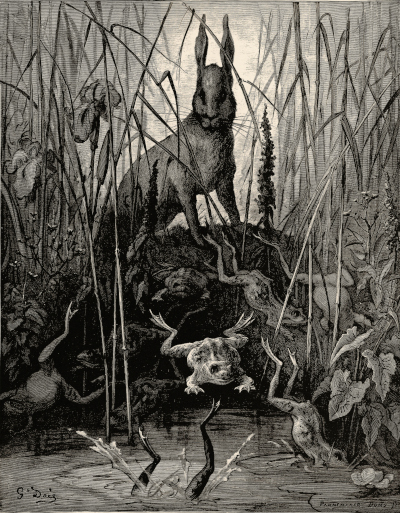
The current site already has one direct artwork anchor: The Hare and the Frogs. That page shows the series at its most concise. A frightened hare discovers that the frogs fear him more than he fears the world. Dore turns that moral into a pond, reeds, movement and sudden reversal. The flagship page needs to place that image inside the larger La Fontaine-Dore book world.
At a Glance
- Publication contextDoré's illustrated La Fontaine fable project
- Visual modeAnimal theatre, moral contrast and compact narrative reversal
- Internal anchorThe Hare and the Frogs
- Cluster roleThe short-form moral storytelling branch of the series section
- Why it mattersIt shows how Doré could build drama without epic scale
Contents
- Why La Fontaine Suited Dore
- The 1868 Hachette Edition
- Plates, Title Figures and Reading Rhythm
- The English Afterlife
- Animal Fable and Moral Theatre
- The Hare and the Frogs
- Wolf, Lamb, Fox, Crow, Oak and Reed
- Fantastic Realism
- Wood Engraving and Collaborative Print
- La Fontaine and Perrault
- Power, Labour and Social Satire
- Dore in the History of La Fontaine Illustration
Why La Fontaine Suited Dore
La Fontaine suited Dore because fables are theatrical machines in miniature. They begin quickly, stage a conflict and turn toward a moral recognition. The characters may be animals, but the situations are human: hunger, fear, vanity, flattery, power, weakness, prudence, pride, debt, labour, leisure, deceit and survival.
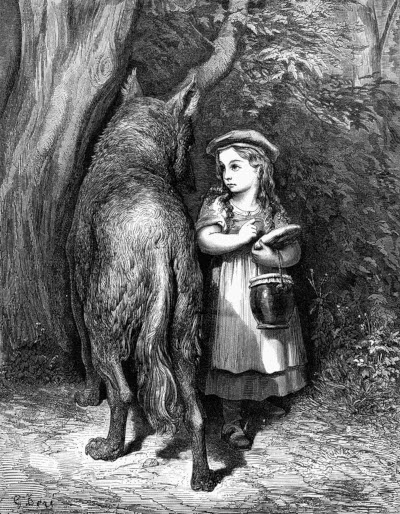
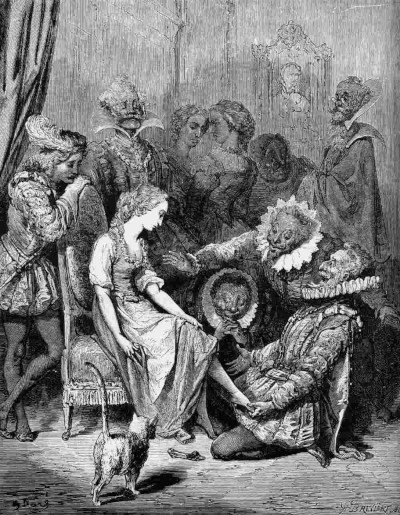
Dore understood theatrical pressure. In Dante, he used it to arrange bodies in infernal space. In London, he used it to arrange crowds and class contrast. In Perrault, he used it to stage a child, wolf, key or slipper at the point of danger. In La Fontaine, the stage is smaller, but the pressure is just as sharp. A single animal gesture can explain a whole moral world.
Fables also let Dore combine humour and severity. A frog trying to become as large as an ox is comic, but the fable carries a warning about vanity and self-destruction. A fox flattering a crow is amusing, but the lesson is about susceptibility to praise. A wolf confronting a lamb can be staged with all the force of political violence, because the fable is about power inventing reasons to consume the weak.
This is where Dore's range becomes visible. He is not simply drawing cute animals. He gives animals posture, scale, setting and social force. The fable world is full of bodies that desire, threaten, calculate, flee or endure. Dore makes those bodies readable without turning them into cartoons detached from the moral situation.
The result is a series that belongs between Perrault and Don Quixote. Like Perrault, La Fontaine belongs to popular memory and childhood reading. Like Don Quixote, it carries satire, comedy and social observation. But La Fontaine is more compressed than either. Dore's task is to make compression feel complete.
The 1868 Hachette Edition
The bibliographic scale of the Hachette La Fontaine project is central to the page. Hachette/BNF identifies Fables de La Fontaine, with drawings by Gustave Dore, as an original 1868 edition. The CCFr record describes a Paris Librairie Hachette 1868 folio with lx and 864 pages, a portrait of La Fontaine and engraved plates. The BnF catalogue records Illustrations des Fables as 546 black-and-white wood engravings, tied to the 1868 Paris Hachette Fables edition.
The BnF catalogue note is especially useful because it separates the labour behind the book. It states that the work includes 546 illustrations, with Rigaud responsible for the frontispiece, Dore for 87 plates and title figures, and Fellmann for five title bandeaux and vignettes. It also lists many engravers whose signatures appear across the set, including Pannemaker, Pisan, Prunaire, Ligny, Hildibrand, Jonnard, Bertrand, Huyot and others.
That information prevents a common simplification. A La Fontaine-Dore volume is not only a pile of images by a single hand. It is a major collaborative illustrated-book enterprise. Dore's designs dominate the large plates and major title figures, but the printed object depends on designers, engravers, publishers and the structure of the edition.
The 546-image framework also explains the reading experience. A fable collection is naturally episodic. The reader moves from one moral scene to another. The illustrated edition answers that structure with visual density: plates, title figures, vignettes and decorative elements. The book becomes a theatre of small moral dramas.
The scale also clarifies why La Fontaine deserves a Series page. If the project were only one or two prints, it could live comfortably under an artwork page. The Hachette edition is much larger. It turns La Fontaine into a sustained visual world, just as Dore's Dante, Bible, Milton, Don Quixote, Perrault and London projects do in different ways.
Plates, Title Figures and Reading Rhythm
La Fontaine's Fables asks for a different page rhythm from a continuous epic. Dante can be illustrated as a journey through successive regions. Don Quixote can be illustrated as a road narrative. La Fontaine is a chain of short, pointed episodes. The reader begins again and again: new animal, new situation, new test, new turn. The illustrated edition has to honour that repeated restart.
The BnF catalogue's distinction between plates, title figures, frontispiece, bandeaux and vignettes helps explain the solution. Full plates can give a fable weight. A title figure can announce the fable's main relation before the text unfolds. A vignette can close or punctuate the action. Decorative bands and introductory images give the book ceremonial structure around the poems.
This layered format makes the collection feel abundant without making every fable carry the same visual pressure. Some stories need a large plate because the moral turn is dramatic or widely recognized. Others can be handled through smaller figures. The variety of scale matches the variety of La Fontaine's art.
Dore's 87 plates and title figures therefore function as a map through the collection. They do not replace the text. They select moments where the moral action becomes most visible. The reader may remember the image before remembering the exact phrasing of the fable, and that is part of the illustrated book's power.
The format also rewards returning readers, because familiar fables can be rediscovered through a different visual accent: a larger plate, a small title image, a closing vignette or a newly noticed engraved detail.
This also makes La Fontaine a useful comparison with Perrault. The Perrault album uses large plates to monumentalize a smaller group of tales. La Fontaine needs repeated visual interventions across a much larger body of short poems. Dore's work has to be both memorable and economical, grand enough for the famous fables but quick enough to keep the book moving.
The English Afterlife
The British Museum records an English-language volume titled The Fables of La Fontaine translated into English Verse by Walter Thornbury, with Illustrations by Gustave Dore, published in Paris by Cassell, Petter and Galpin. Its description says the book contains 86 whole-page wood engravings after Dore illustrating the fables, along with a frontispiece portrait, headpieces, tailpieces, a table of contents, list of illustrations, biographical material, dedication and preface.
That record matters for two reasons. First, it shows that the La Fontaine-Dore images travelled beyond French-language publishing. As with Don Quixote, Dore's visual interpretation could cross linguistic borders. English readers encountered La Fontaine through Dore's animals, landscapes, interiors and moral scenes.
Second, the British Museum's book description confirms the material richness of the English form: whole-page wood engravings, letterpress, decorated binding, gilded edges and a cover illustration of a hare looking at frogs. This is not an incidental reprint. It is a carefully produced illustrated book meant to carry the dignity of La Fontaine and Dore into another market.
The hare-and-frogs cover detail is especially useful for the site. The current internal artwork anchor, The Hare and the Frogs, was not a marginal fable in the book's afterlife. The British Museum description places the hare looking at a pond with frogs on the original cover and spine. That makes the existing page an excellent doorway into the larger series.
This English afterlife also places La Fontaine in Dore's broader international career. Musee d'Orsay describes Dore's work as disseminated widely in Europe and the United States and names La Fontaine among the major classics he illustrated. The fables therefore belong to the same public circulation that made Dore famous across countries.
Animal Fable and Moral Theatre
La Fontaine's fables are not zoological stories. The animals carry human pressures. Dore's challenge is to keep them animal enough to remain vivid and human enough to carry moral meaning. A fox has to be a fox, but also a flatterer. A wolf has to be a wolf, but also an image of predatory power. A hare has to be timid, but also a vehicle for a human idea about fear.
Dore solves this through posture and setting. He often lets the animal body carry the moral relation. A predator's height, a victim's smallness, a tilted head, a sudden leap, a body crouched by water, a bird perched out of reach: these are visual forms of argument. The reader understands the lesson because the bodies are arranged in a moral space.
This is different from Perrault. In Perrault, danger often enters through tale objects and thresholds: keys, beds, forests, slippers, doors. In La Fontaine, danger and comedy often enter through relation: stronger and weaker, clever and foolish, hungry and complacent, proud and practical. Dore adapts accordingly. He gives fable the clarity of encounter.
The fable also lets Dore work with quick wit. A whole story can turn on one look or one movement. The fox waits for the crow's mistake. The frogs flee before the hare can understand his accidental power. The reed bends where the oak resists. These are small actions, but in La Fontaine they expose whole systems of judgement.
This moral theatre is why the series can sit beside Dore's larger projects. The scale is different, not the ambition. The Bible asks how image can carry revelation. Dante asks how image can map justice. La Fontaine asks how image can make a moral turn visible in a single scene.
The Hare and the Frogs
The Hare and the Frogs is the strongest current internal anchor for the La Fontaine series. The BnF identifies Le lievre et les grenouilles as Book II, fable XIV, with Jean de La Fontaine as author, Dore as designer and Adolphe Francois Pannemaker and Albert Doms as wood engravers. The BnF places the image in Paris, Louis Hachette, 1867, and describes it as a separate pull from a wood engraving measuring 24 by 19 cm.
The Met records The Hare and the Frogs, from Jean de La Fontaine's Fables, as an 1868 wood-engraving proof after Dore, engraved by Jean Delduc. The Met object page gives the series/portfolio as Jean de La Fontaine's Fables and confirms La Fontaine as the related author. The date difference between BnF and Met is best handled source by source: BnF records the 1867 Hachette context for its impression, while the Met records an 1868 proof.
The fable is ideal for Dore because it turns fear inside out. A hare is tormented by anxiety. When it approaches a pond, frogs leap into the water. The hare realizes that even a timid creature can frighten others. Dore makes the turn visible. The hare becomes the dominant figure, the frogs scatter, and the pond becomes a stage for reversal.
This is fable illustration at its most economical. There is no need for an elaborate palace, crowd or supernatural landscape. Reeds, water, animal posture and movement are enough. Dore makes the moral legible through scale. The animal usually associated with fear discovers that fear is relative.
For the future page, The Hare and the Frogs can act as the entry image. It connects the large La Fontaine-Dore publishing project to an active internal artwork page, an exact BnF object route and a Met process cross-check. It also shows Dore's fable method without needing the reader to know the whole 1868 edition.
Wolf, Lamb, Fox, Crow, Oak and Reed
The BnF catalogue subnotices show how thoroughly the Hachette edition moved through La Fontaine's familiar opening fables. It lists early entries for La Cigale et la Fourmi, Le Corbeau et le Renard, La Grenouille qui se veut faire aussi grosse que le boeuf, Les deux Mulets, Le Loup et le Chien, Le Loup et l'agneau, Le Rat de ville et le Rat des champs and Le Chene et le Roseau. These titles alone reveal the breadth of Dore's challenge.
Each fable requires a different visual structure. The Grasshopper and the Ant turns on labour, need and refusal. The Crow and the Fox turns on vanity and flattery. The Frog and the Ox turns on impossible self-inflation. The Wolf and the Lamb turns on power that invents guilt. The Town Rat and Country Rat contrasts two modes of life. The Oak and the Reed contrasts strength and flexibility.
Dore could not solve all of them in the same way. Some need comic gesture. Some need confrontation. Some need landscape. Some need stillness. Some need the visible difference between two ways of being. This variety is what BnF Editions means when it describes Dore's interpretation as masterly and extremely varied.
The famous animals also help readers understand La Fontaine's social reach. These fables are not only about individual behaviour. They speak to hierarchy, court culture, labour, wealth, predation, intelligence and survival. Dore's images give those themes bodies and places.
A future Series page can use these tales as internal sections without overloading the page with plot summary. The key is to show how each fable type asks for a different image: predator and victim, flatterer and fool, labourer and supplicant, proud body and flexible body, animal pair and moral contrast.
Fantastic Realism
BnF Editions uses a phrase that fits Dore's La Fontaine beautifully: "realisme fantastique." In English, fantastic realism names the quality that makes the fables feel both grounded and heightened. The animals live in recognizable settings, but the situations are sharpened into moral drama. The image is not fantasy in the sense of escaping reality. It is fantasy as a way of revealing reality.
This is one reason Dore's La Fontaine does not feel like natural history. The animals have weight, texture and presence, but they also operate as actors. They carry the intensity of human motives without ceasing to be animals. Dore's realism keeps the fable concrete; his fantasy gives it charge.
The same phrase helps connect La Fontaine to Dore's larger career. In Dante and Milton, Dore makes impossible worlds physically persuasive. In La Fontaine, he makes ordinary animals morally theatrical. Both acts depend on the same underlying gift: giving visible form to a poetic world.
Fantastic realism also helps explain why Dore's fables work for both children and adults. Children can read the animal action. Adults can read the social analogy. The image meets both readers at once because it does not reduce itself to either animal picture or moral diagram.
This dual address is one of the series' strengths. Like Perrault, La Fontaine belongs to childhood memory, but the work is not childish. It is a sophisticated world of condensed moral intelligence.
Wood Engraving and Collaborative Print
The La Fontaine edition was a print-making enterprise. The BnF catalogue describes the set as black-and-white wood engravings and lists many engravers. The British Museum likewise identifies the English volume as wood-engraving and letterpress, with whole-page images after Dore and a long list of printmakers including Pisan, Pannemaker, Doms, Bertrand, Jonnard, Gauchard, Laplante, Hildibrand, Ligny and others.
This matters because Dore's designs reached readers through engraved translation. The fable image had to remain readable in black and white, at book scale, across many scenes. Fur, feathers, reeds, branches, water, stone, cloth, gesture and expression all had to survive the cut of the block and the pressure of the press.
Wood engraving suited the fable because it can combine clarity and texture. A small animal can be sharply silhouetted. A landscape can hold tonal atmosphere. A page can include both large dramatic plates and smaller title figures or vignettes. The medium could support both Dore's theatricality and La Fontaine's brevity.
The collaborative nature of the book also links it directly to the Engravings page. A La Fontaine Series page must not treat every printed image as if it were an untouched drawing by Dore alone. It is more accurate and more interesting to explain the division of labour: Dore as designer for the major plates and title figures, other artists for some decorative structures, and engravers translating the designs for print.
This does not reduce Dore's importance. It shows how a major nineteenth-century illustrated book worked. His imagination depended on a publishing and engraving system capable of carrying it to readers.
La Fontaine and Perrault
La Fontaine and Perrault belong near each other in the Series section, but they are not interchangeable. Both are associated with childhood reading and popular memory. Both were transformed by Dore's black-and-white imagination. Both include animals, danger and moral pressure. Yet they operate differently.
Perrault's fairy tales often move through magic, transformation and perilous thresholds. La Fontaine's fables move through argument, encounter and moral turn. Perrault asks what happens when a child meets a wolf, a wife opens a forbidden room or a sleeping palace waits for a prince. La Fontaine asks what happens when pride meets reality, power meets weakness, flattery meets vanity or fear discovers a more fearful creature.
Dore adapts his visual language to that difference. In Perrault, the atmosphere can become gothic, enchanted or domestic. In La Fontaine, the scene often has to be quicker and sharper. The fable does not need a whole enchanted castle; it needs the right relation between two figures.
The two pages can therefore strengthen each other. Perrault shows Dore's fairy-tale danger and image-memory. La Fontaine shows his fable intelligence and animal theatre. A reader who arrives through one can move naturally to the other, then onward to Don Quixote for comic travel, Dante and Milton for epic worlds, the Bible for sacred spectacle and London for modern social observation.
This is the value of making La Fontaine a flagship rather than a note under Illustrations. It gives the short-form literary Dore a proper place.
Power, Labour and Social Satire
La Fontaine's fables are often remembered through animals, but their social imagination is sharp. The wolf and lamb do not simply represent two species. They represent power and vulnerability. The ant and grasshopper do not only describe seasonal behaviour. They raise questions about labour, foresight, hunger and refusal. The town rat and country rat stage social contrast through appetite and danger. The oak and reed turn strength and flexibility into a political image.
Dore's illustrations can make these social pressures visible without turning the fables into prose commentary. A predator can occupy more space than its victim. A weak figure can be placed at the edge of danger. A small animal can carry cleverness in posture or gaze. A landscape can show exposure, refuge or hierarchy. These decisions let the image carry the moral argument before the reader reaches the final lines.
This makes La Fontaine an important counterweight to London: A Pilgrimage. London gives Dore modern social contrast through streets, poverty, leisure and crowds. La Fontaine gives him social contrast through animal theatre. Both projects are concerned with power, but they work at different scales. One is urban and documentary in tone; the other is poetic and emblematic.
The fables also connect to Dore's origins in caricature. Musee d'Orsay describes Dore as a draughtsman, caricaturist and illustrator whose talents ranged from satire to religion. La Fontaine's animals allow that satirical gift to remain active inside a major classic. A fox can be a social type. A lion can be authority. A crow can be vanity. A lamb can be innocence before force.
The point is not that each animal has only one meaning. The best fables are flexible. Their meanings shift with context, translation, teaching and memory. Dore's images preserve that flexibility by making the scene dramatic rather than merely explanatory. The viewer sees a relation under pressure and understands why the fable continues to matter.
Dore in the History of La Fontaine Illustration
La Fontaine was already a canonical French author before Dore. The Fables had centuries of schoolroom, courtly, literary and illustrated life behind them. Dore entered a tradition rather than inventing one. The importance of his edition lies in the force with which he renewed that tradition for nineteenth-century illustrated publishing.
The BnF catalogue's scale, BnF Editions' modern framing and the British Museum's English volume all point to a project that made La Fontaine newly visual for a large readership. Dore did not replace the text. He gave it a nineteenth-century theatre of animals, landscapes, gestures and moral confrontation.
The fables also allowed Dore to display what Musee d'Orsay describes as his ability to move across satire, religion, literature and spectacle. La Fontaine sits close to his caricatural gifts because fable often depends on social type and comic exposure. But it also belongs to his serious literary ambition because La Fontaine is a major classic.
Dore's fables therefore resist a hierarchy that treats his Bible and Dante as serious while La Fontaine is merely charming. The moral intelligence of the fables is severe. The visual intelligence required to illustrate them is exacting. If anything, the smallness of the fable makes the challenge sharper.
For a modern reader, the La Fontaine-Dore series offers one of the best tests of Dore's versatility. Can the artist of cosmic darkness make a fox, crow, hare, frog, wolf, lamb, oak or reed feel necessary? The answer is yes, and the Hachette project proves it at large scale.
Image Candidates and Future Artwork Links
The strongest immediate internal artwork link is The Hare and the Frogs. It has a dedicated page, a local image, a BnF object record and a Met process record. It also appears in the British Museum's English volume description through the binding image of a hare looking at a pond with frogs. That makes it more than a minor example.
Future image candidates can be selected from the major familiar fables documented in the BnF catalogue subnotices. The Grasshopper and the Ant, The Crow and the Fox, The Wolf and the Lamb, The Town Rat and Country Rat, The Oak and the Reed, and The Frog Who Wanted to Be as Big as the Ox all offer strong reader recognition and clear visual logic.
An image-led La Fontaine page can use one or two high-recognition plates and one current internal anchor. The page does not need to reproduce all the edition's richness at once. It needs to make the scale and variety of the series legible, while linking to Engravings for process and to The Hare and the Frogs for close reading.
Annotated-detail candidates include animal posture, predator/prey scale, pond/reed framing, wood-engraved texture, title-figure composition and moral contrast expressed through placement. The best details will be those where the visual turn of the fable can be understood without a long caption.
Later expansion can create individual artwork pages for selected La Fontaine plates, but the Series flagship is the foundation. It establishes the publication, source map, theme and internal architecture.
Why the Series Page Matters
La Fontaine's Fables needs a dedicated page because it completes the short-narrative side of Dore's major work. Perrault gives him fairy-tale danger. La Fontaine gives him fable, animal theatre and moral compression. Together they prevent the Dore section from becoming only Bible, Dante, Milton and paintings.
The page also gives The Hare and the Frogs a proper parent. The existing artwork page is useful, but without a La Fontaine flagship it can seem isolated. With the Series page, the hare and frogs become an entry into a much larger Hachette-Dore project.
The La Fontaine page also helps readers understand Dore's public reach. The BnF, Hachette/BNF and British Museum records show the series moving through French and English book culture, through whole-page plates, vignettes, bindings, proofs and later selections. This was not a minor episode.
Most importantly, La Fontaine reveals Dore's discipline. He could make huge worlds, but he could also make one small scene carry a complete moral reversal. That ability is central to his art. The fable page lets readers see it clearly.
Related La Fontaine and Fable Pages
Use these pages to place Doré's fable illustrations beside the active artwork, illustration, printmaking and short-narrative routes in this section.
FAQ
Discussion
Which Doré fable image best captures La Fontaine: a frightened hare, a predatory wolf, a flattering fox or a bending reed?
Reader Insights
Look at how Doré makes small animal encounters carry large moral pressure.
Follow predator and victim, clever and vain, strong and flexible as visual pairs.
Read the wood-engraved texture as part of the fables' moral clarity and atmosphere.
Join the Conversation
Share your reading of Doré's La Fontaine fable illustrations below.
References
- BnF catalogue, Illustrations des Fables, accessed 28 July 2026.
- BnF Editions, La Fontaine-Dore, accessed 28 July 2026.
- Hachette/BNF, Fables de La Fontaine (Ed.1868), accessed 28 July 2026.
- CCFr/BnF collective catalogue, Fables de La Fontaine, accessed 28 July 2026.
- British Museum, The Fables of La Fontaine illustrated book, accessed 28 July 2026.
- BnF, Le lievre et les grenouilles, accessed 28 July 2026.
- Metropolitan Museum of Art, The Hare and the Frogs, accessed 28 July 2026.
- Musee d'Orsay, Gustave Dore (1832-1883): Master of Imagination, accessed 28 July 2026.