by Tom Gurney
Tom Gurney BSc (Hons) is an art history expert with over 20 years experience
Email: tomgurney1@gmail.com / Phone: +44 7429 011000
Beer Street and Gin Lane by William Hogarth: Introduction
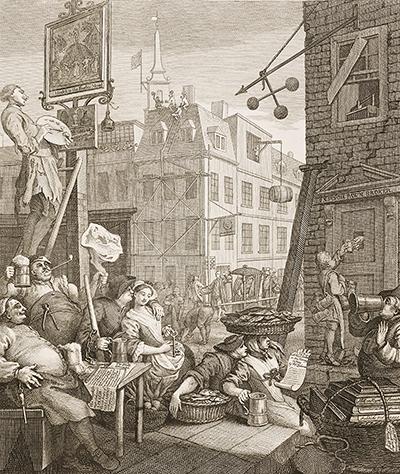
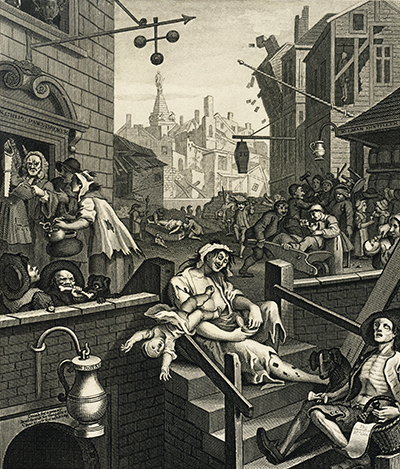
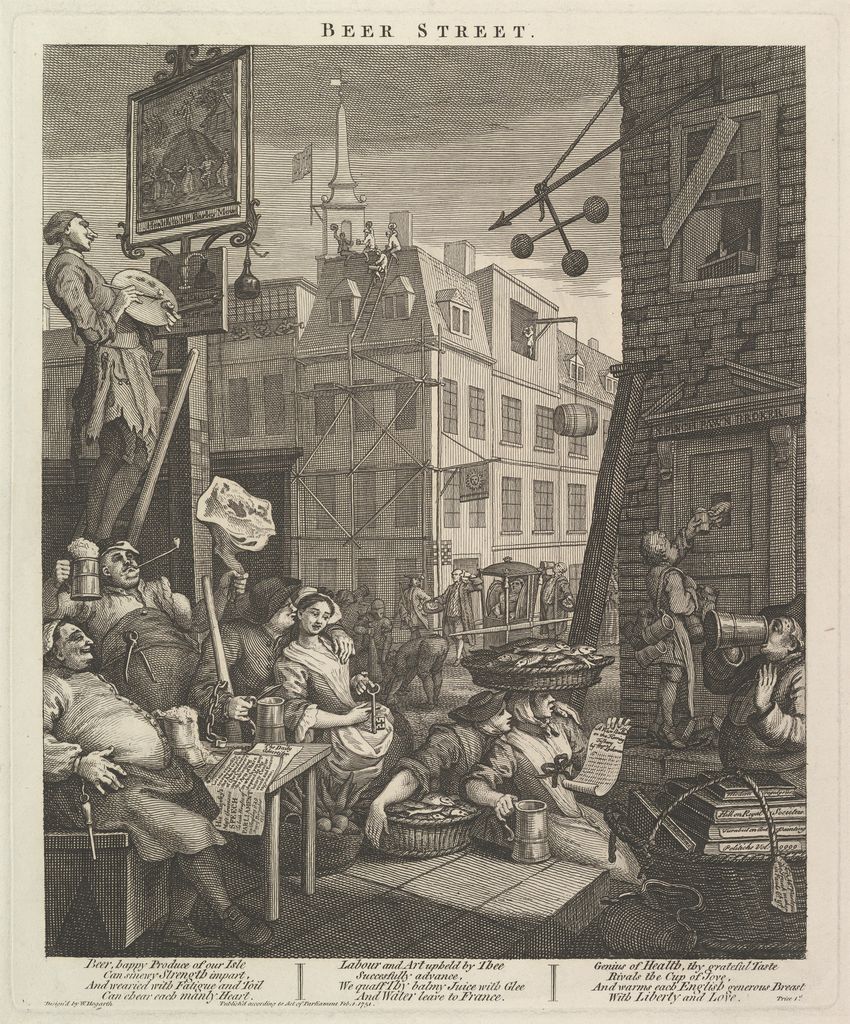
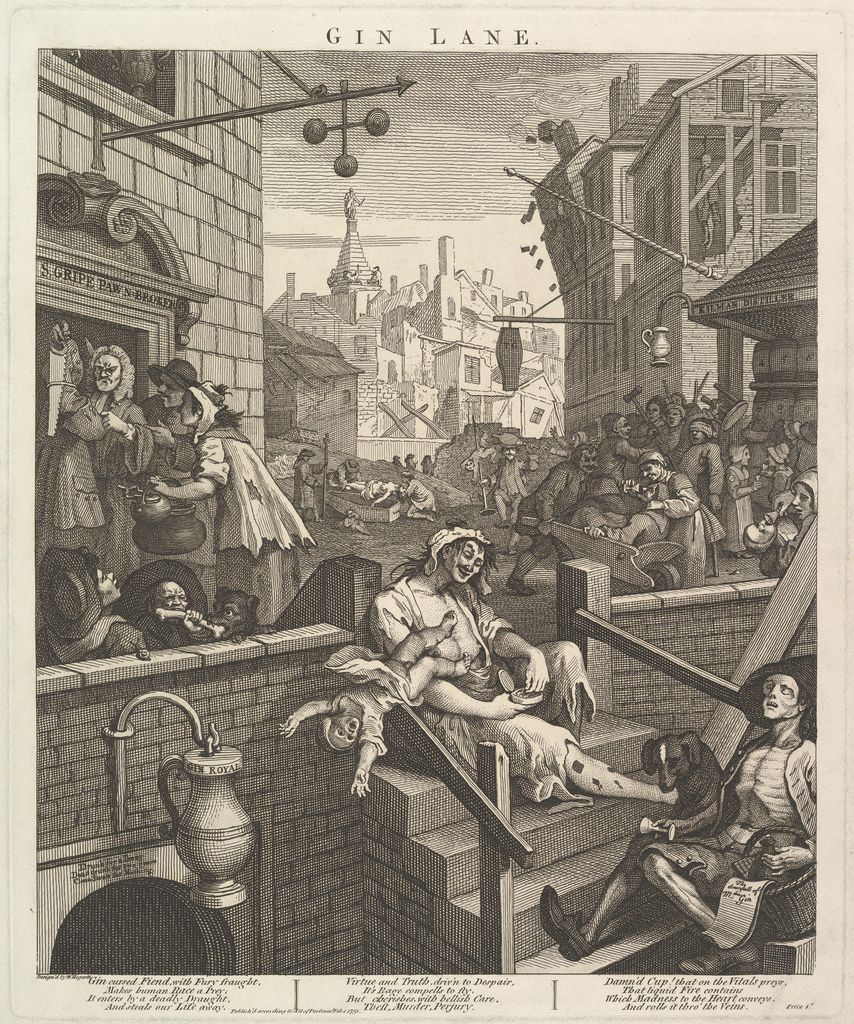
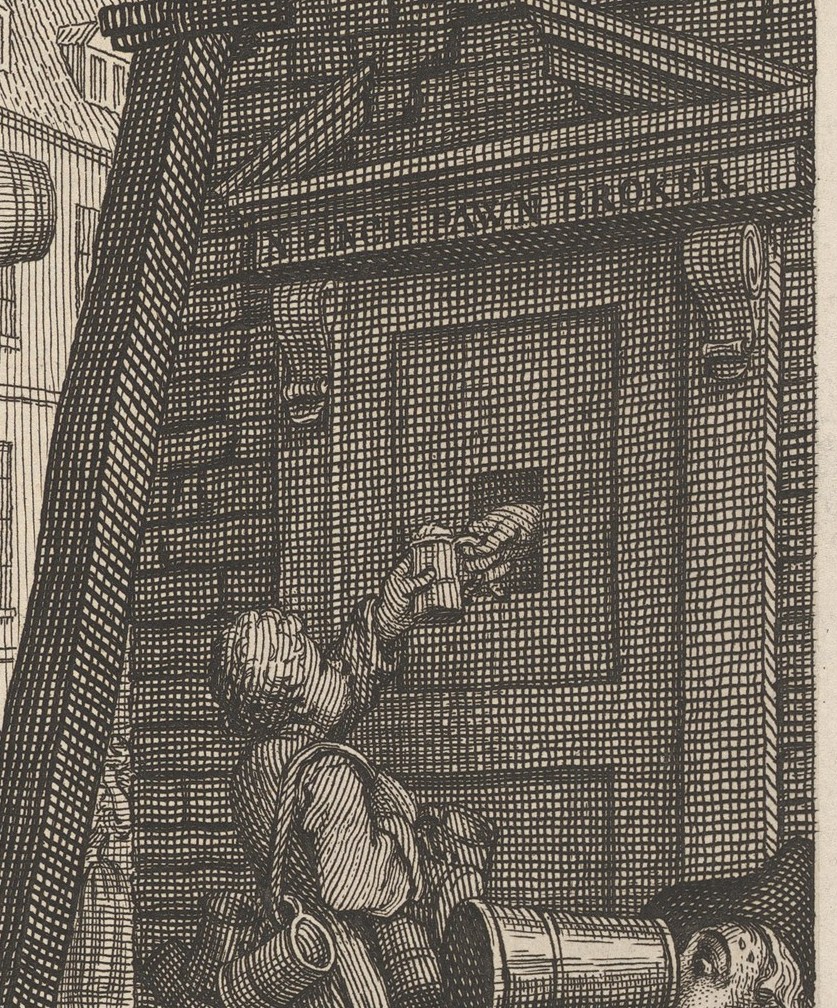
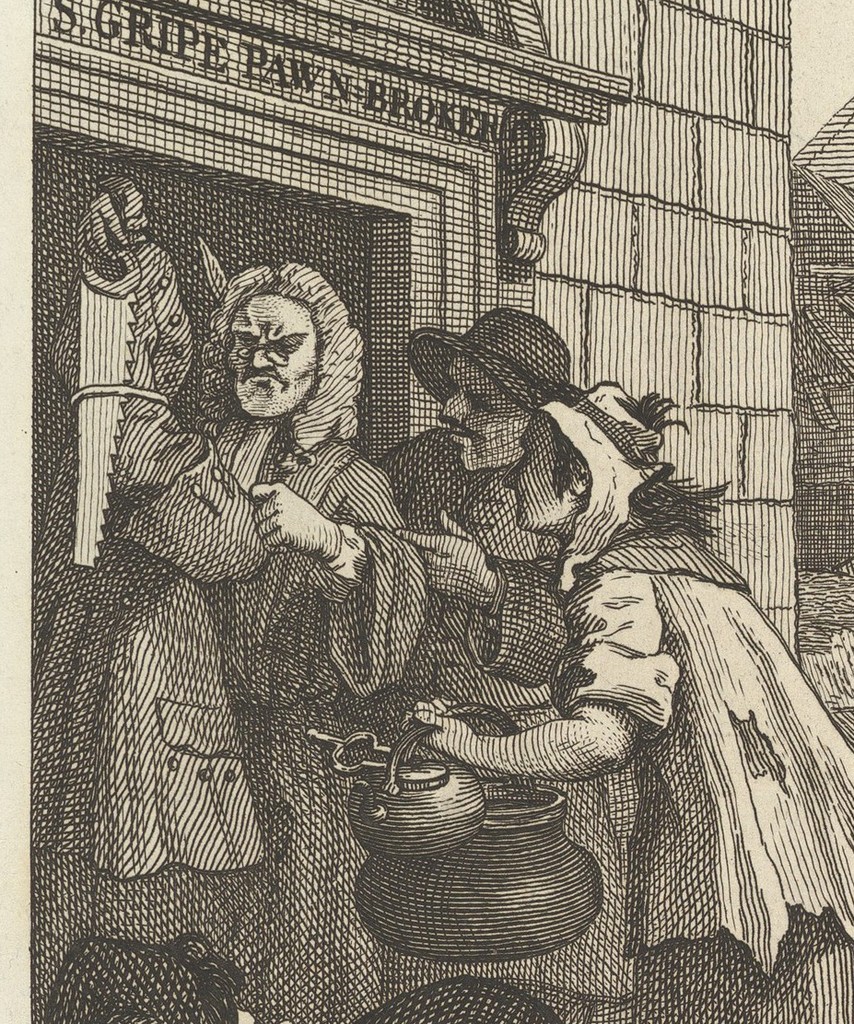
Look first at the three metal balls hanging over each street. In William Hogarth’s Beer Street, the pawnbroker’s sign projects from a building that needs a prop to keep it standing. A boy passes the pawnbroker a drink through a small opening. Across the pair, the same kind of sign hangs above an open shop with customers offering a saw, clothing and a pot. The well-built frontage in Gin Lane is conspicuous because so much around it is falling apart. One trade can barely keep its premises upright in a prosperous street and thrives in a street full of hardship. Hogarth gave that reversal as much space as he gave the difference between a tankard of beer and a glass of gin. [1] [2]
The two large prints went on sale together in London in February 1751. Hogarth made each street intelligible on its own, then used the pair to ask what happens to work, money and care when businesses profit from different habits. The drink sellers, their customers and the other people who depend on them occupy an entire street in each case. Comparison across the sheets makes the argument. It also brings out details that complicate it, among them a ragged man painting a sign in the prosperous street and a tradesman in the ruined lane who has plenty of work. Hogarth revised the beer plate substantially after the first issue. For a reader who bought the prints when they were new, England’s supposed superiority could take the shape of a well-fed man hoisting a Frenchman in the air. Later readers saw a joint of meat held aloft and a couple beneath it. [1] [2] [3]
The street comparisons here follow the Rijksmuseum’s companion impressions, RP-P-OB-18.791 and RP-P-OB-18.792. The comparable plate marks are just under 39 centimetres high and about 32 centimetres wide, giving each street and its verse room to be read at the same scale. The Metropolitan Museum of Art’s impressions from the 1891 gift of Sarah Lazarus show the same broad arrangements and give separately catalogued examples of the revised Beer Street and the finished Gin Lane. The illustrated subjects date to 1751. The date in their lettering and the date when any particular sheet passed through the press are different pieces of evidence. [1] [2] [3] [4] [5]
At a Glance
- ArtistWilliam Hogarth
- TypeTwo companion etchings and engravings
- AdvertisedFebruary 1751
- Surviving matricesThe Metropolitan Museum of Art, New York
Contents
- Two streets with different centres of gravity
- Newspapers, ballads and the verses under the pictures
- What the drawings tell us about making a pair
- The early Beer Street and the recut copperplate
- What Hogarth offered at the Golden Head
- Henry Fielding and the public argument about gin
- How the Act treated distillers, retailers and debts
- What the records can tell us about drinkers and enforcement
- The prints after 1751
Two streets with different centres of gravity
In Beer Street the working city can be read upward. From the men resting at the tavern and the fish sellers in front, the eye reaches the people on the scaffold and at the roofline. Farther back a barrel is being hoisted to an upper storey. The ladders and the upright lines of the buildings give work a place at almost every height. A woman being carried in a sedan chair crosses the middle distance, above the foreground drinkers and below the men on the roof. Identifying what she is doing also means noticing the people doing the carrying. Hogarth gives that group and the stationary figures at the front room to inhabit the same piece of street. The activity reaches beyond the beer drinkers closest to us. [1] [3] [4]
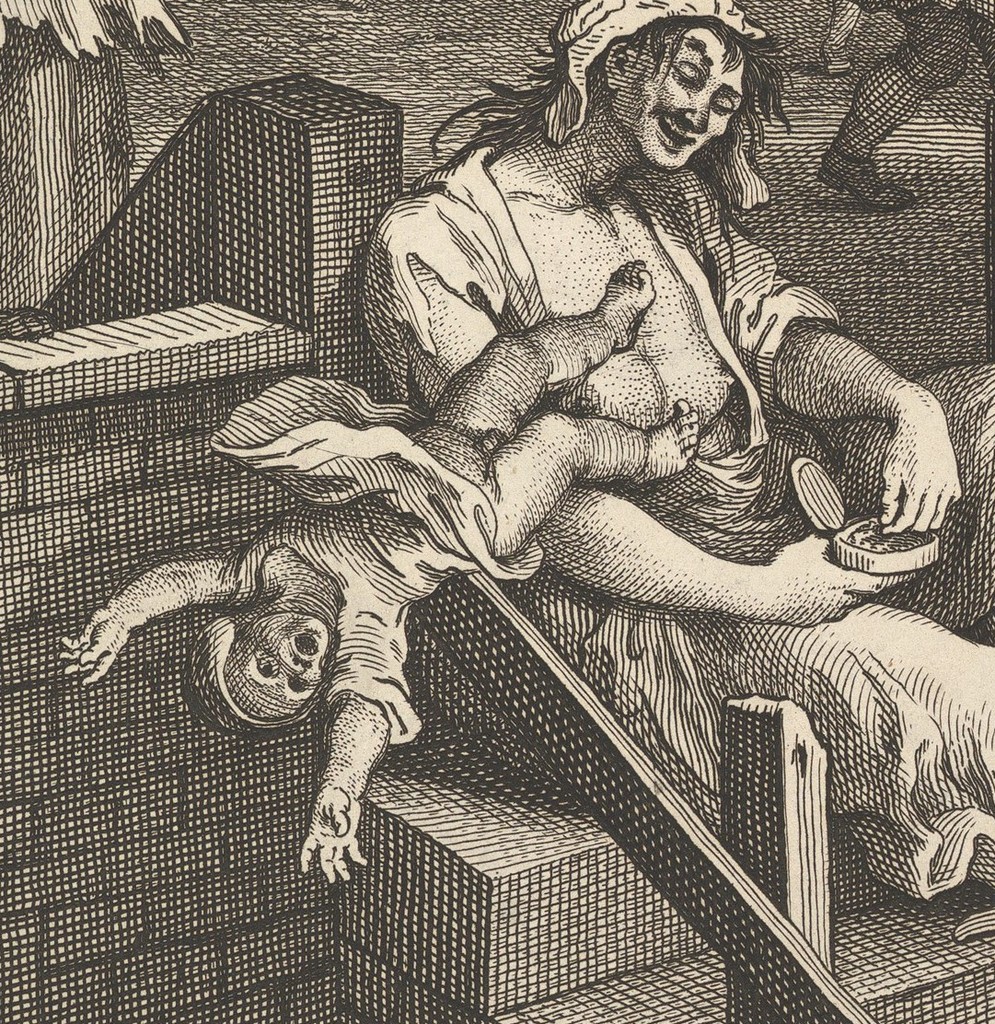
The centre of Gin Lane is a flight of steps. A woman’s body, the rail and the child falling over it take the eye into the space below street level. Other lines pull towards the collapsing buildings and crowded distiller’s side of the street. Both prints have a distant spire, but the way to it is different. In Beer Street scaffolding and roofs carry the eye in stages towards the flag. In Gin Lane a spire rises beyond irregular roofs, timber braces and the narrow route into the distance. The light in the sky makes the shapes of a toppling wall and scattered pieces of masonry easy to read. The same devices that allow the viewer to find a way into a crowded street make the second scene feel hazardous to move through. [1] [2] [3]
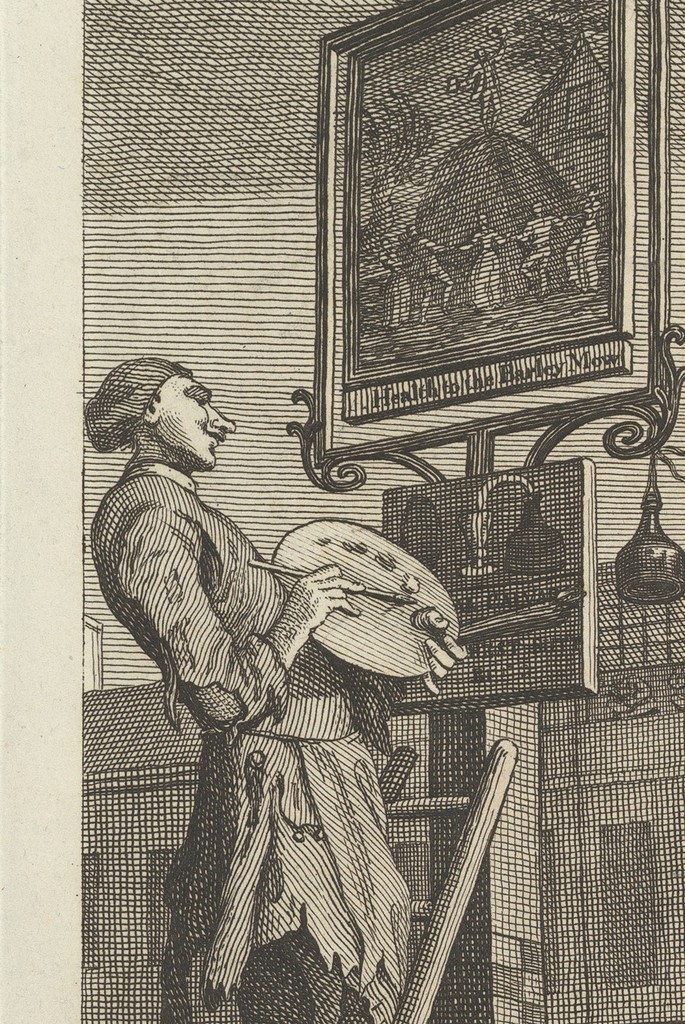
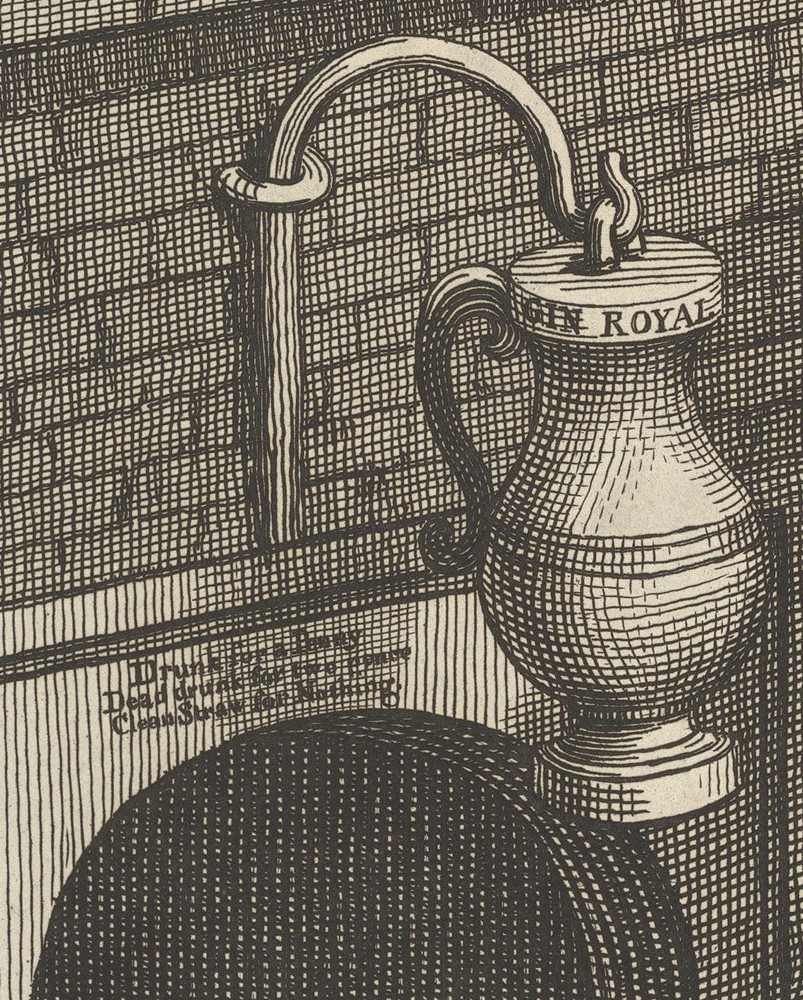
The signboards are small pictures in their own right. The tavern sign in Beer Street sits high at the left where the painter on his ladder can look directly at it. The pawnbroker’s balls at the right hang high enough to stand clear of the buildings behind. Turn to Gin Lane and the balls occupy the upper left, while a coffin-shaped sign farther down the lane and a vessel over the cellar entrance present a succession of signs at different distances and heights. An eye moving from one print to the other sees changes in the businesses that claim the most conspicuous positions. The artist has made advertising part of what organises the city. [1] [2] [3]
Consider the two kinds of support. Scaffolding on Beer Street points to materials and labour being put into a building. At the pawnbroker’s a heavy beam is holding the old wall in place and boards interrupt an already dark window. On Gin Lane, where timbers shore up several buildings, the pawnbroker’s masonry and large doorway stand firm at the front. The cut stone and the sign make the business easy to find even in the jostle at the bottom of the picture. Each exception draws attention to the kind of business that can afford to maintain a frontage. [1] [2]
Two signs alone would establish the trade. What gives it opposite meanings is the activity at the doors. In Beer Street, the boy’s raised arm comes between a stout drinker at the right edge and the withdrawn man behind the opening. A little of the street’s plenty reaches the building, with the beer passing inward through an opening barely big enough for the tankard. In Gin Lane, the vendor can examine what a customer has brought him while people hold more articles within reach. The raised saw and the pot give the transaction stakes that a coin would leave obscure. Objects in regular use for work and meals are now available to be turned into cash. Little about the people’s means has to be supplied by the verse for that difference to register. [1] [2] [3]
The bodies also reveal how much room each street allows for ordinary activity. A heavy man can sit back at the corner table in Beer Street, while women with heavy baskets have a broad platform on which to put them down. Beer is present both for companions who share a pause and for a man at the edge who drinks the contents of his tankard with his head tipped back. At the bottom of Gin Lane a man with a hollow chest has the steps to lean on. The woman at the centre sits across the way down, and the child tips out into a void. Both streets contain bodies temporarily at rest. The setting helps a reader imagine the work waiting for one group and the immediate dangers facing the other. [1] [2] [4] [5]
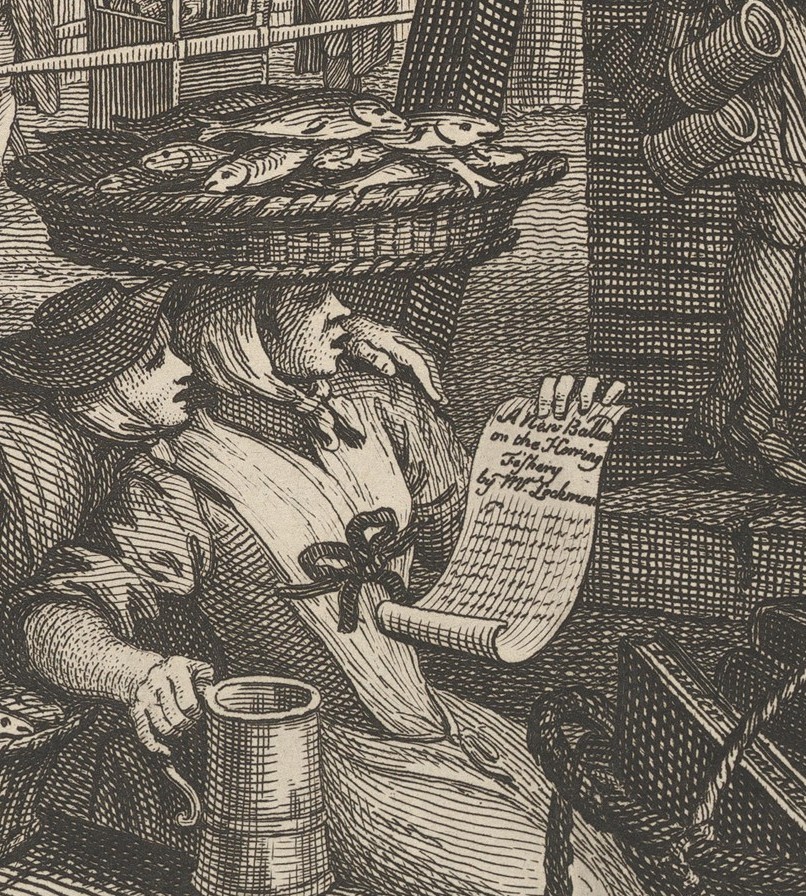
The women give this comparison an unexpected precision. The fish sellers’ hats, elbows and baskets form a compact group around a printed song. They have a marketable load and a subject of their own to attend to. In Gin Lane a woman at the pawnshop presents goods that have uses beyond resale. Another woman is burdened with the most visible act of failed care in either print. The satirical pair makes economic competence and jeopardy depend on what each woman is shown handling. A reader who takes its hardest image as evidence about women’s drinking in London would be quoting the very accusation the print was designed to make. The activity on both sheets shows the care with which Hogarth created that difference. [1] [2] [3]
The abundance of Beer Street depends on delivery boys, roofers, traders and people who carry others for a living. The best-equipped businesses on Gin Lane have work to do precisely because so many of its inhabitants are in distress. Coffin manufacture and burial are signs of gainful work there, as are distilling and lending. Hogarth’s division is about whose labour sustains other people, whose business prospers from their setbacks, and which kind of buying or selling customers can keep up. The recurring pawnshop lets readers see how the fortunes of a single trade depend on those of its neighbours. [1] [2] [3]
The distant architecture sharpens that claim without making the pair a survey of London. Tonkovich locates Beer Street in the more prosperous vicinity of St Martin-in-the-Fields and identifies Gin Lane with St Giles. The spires give each print the scale and the parish geography of a recognisable city. They sit among drawn arrangements where an architecturally convenient wall or a conveniently placed sign can carry a moral judgement. The quarter of St Giles provides a setting, while the image condenses the poverty, decay and injuries that Hogarth wants a viewer to associate with the lane. Buildings sufficiently particular to invite identification are part of that persuasive work. [2] [3]
John Nichols compared Hogarth’s prints to two pictures designed by Pieter Bruegel the Elder. Pieter van der Heyden’s engravings of The Fat Kitchen and The Thin Kitchen, issued in Antwerp in 1563, use the arrival or departure of a guest to put two ways of living beside each other. In the first, a thin man with a bagpipe is driven out of a plentiful kitchen. In the second, thin figures try to bring a well-fed man inside, and he struggles to leave. Both rooms have people tending a fire, eating and caring for children. The foods on the table and the bodies of the people at it make the fortunes of each household readily visible. [6] [7] [8]
Hogarth gives a similar role to the body that is visibly out of place. The early Beer Street makes a joke of a thin foreigner in the hands of a strong Englishman. The comparison with Gin Lane extends the contrast from the conspicuous outsider to a group of neighbours. People with too little food occupy the bottom of the lane, at the same distance from the viewer as the drinkers taking their ease beside the Beer Street table. Nichols’s discussion shows an eighteenth-century reader recognising how an older pair of engravings had arranged fullness and want through a matching situation. In Hogarth, the scene can expand from a table to a route through the city. Differences in stature and strength lead the eye from one neighbourhood’s spare food and drink to another’s need for loans. The major revision frees the foreground of Beer Street to tell a new story while the two streets are still compared through the bodies at their edges. [1] [2] [3] [6] [7] [8] [9]
Annotated Details from Beer Street and Gin Lane
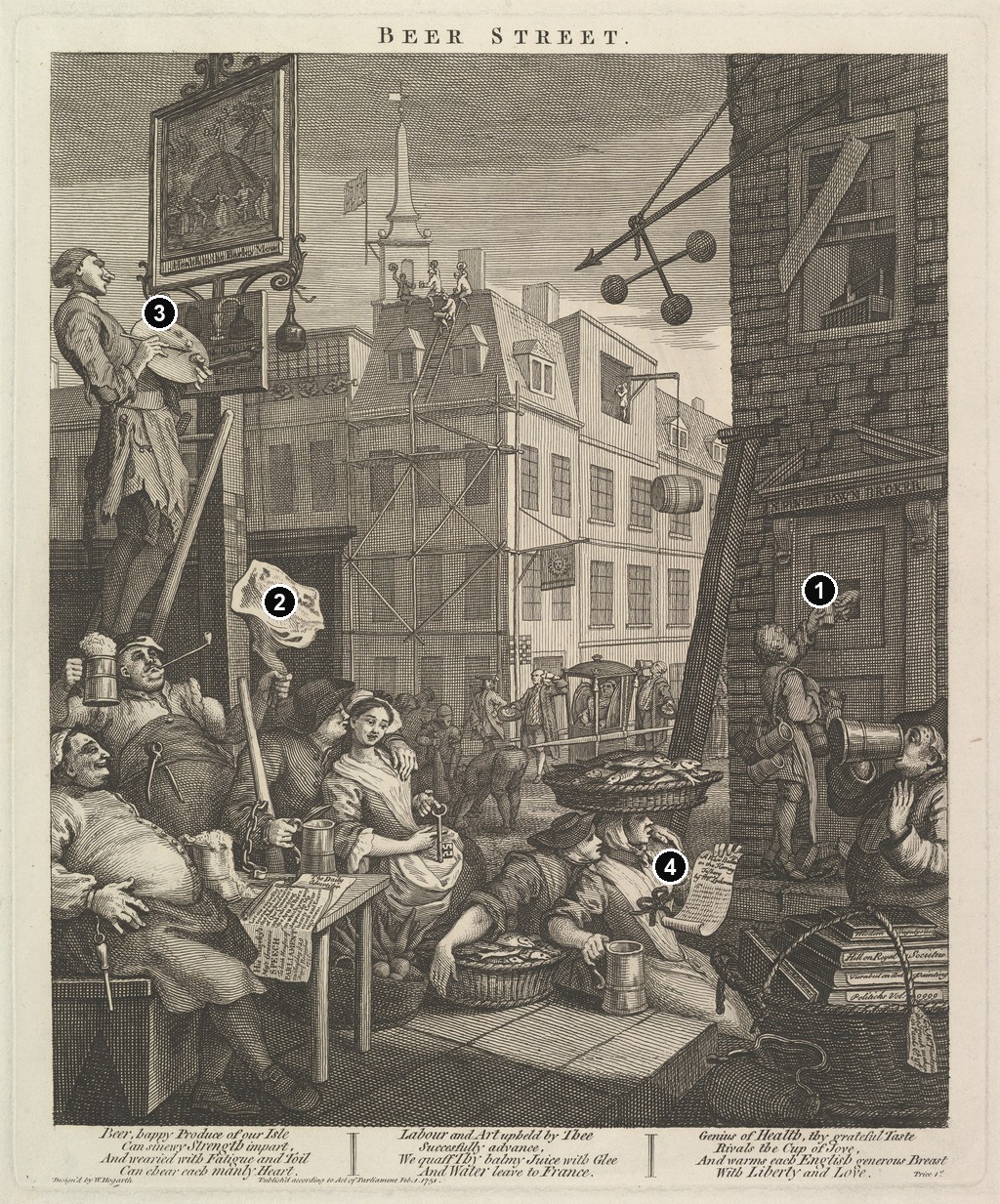
Use the numbered points to compare the two streets.
Beer Street
Beer Street, William Hogarth. The Metropolitan Museum of Art, 91.1.141. Collection record.
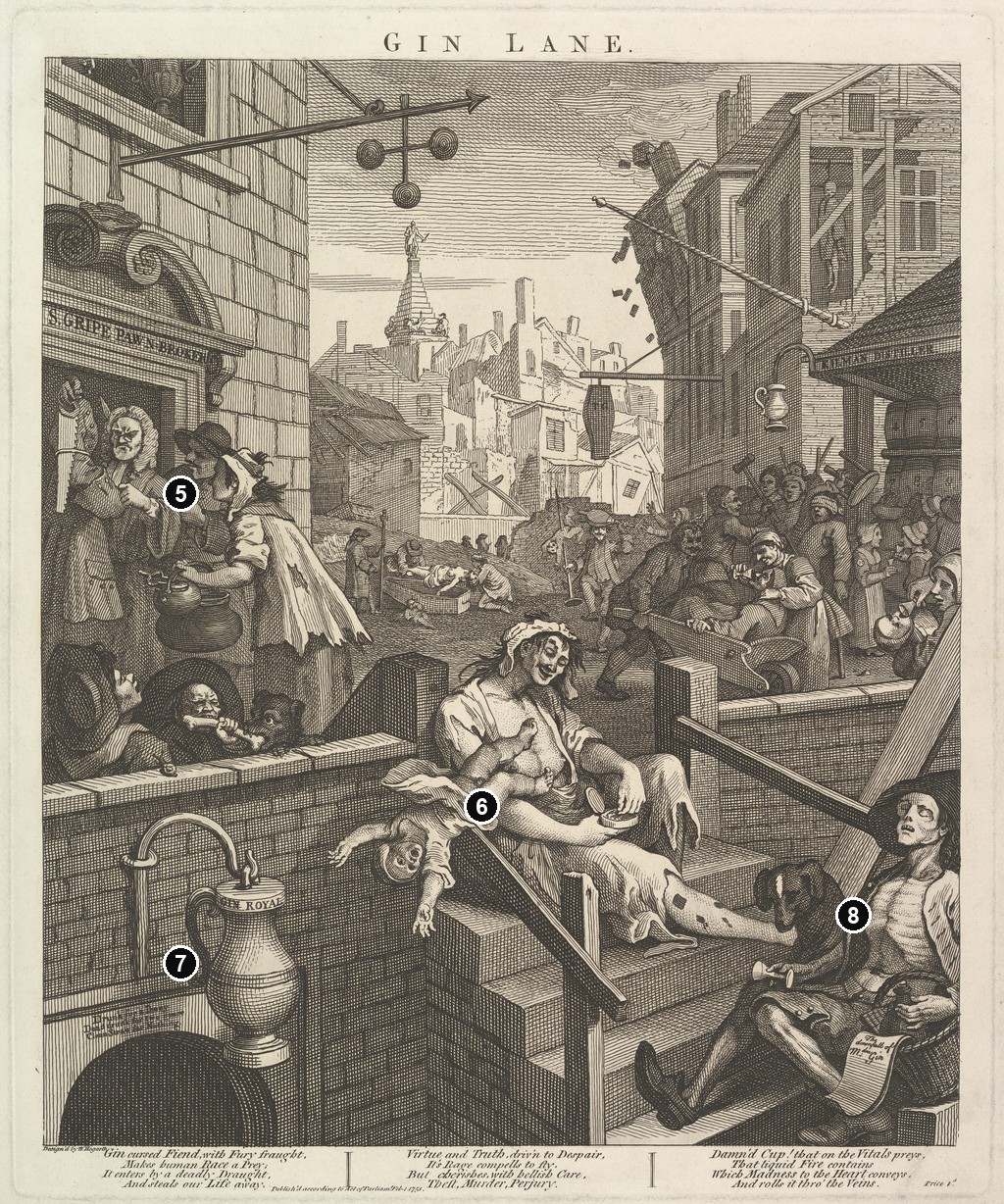
Gin Lane
Gin Lane, William Hogarth. The Metropolitan Museum of Art, 91.1.140. Collection record.
Details from BEER STREET AND GIN LANE
Select a numbered point for a closer look.
Beer Street
The pawnbroker’s door
A boy reaches toward a hand at the wicket. The pawnshop needs a timber prop, and the three-ball sign hangs over an empty entrance. Compare the people waiting to pawn goods in Gin Lane.
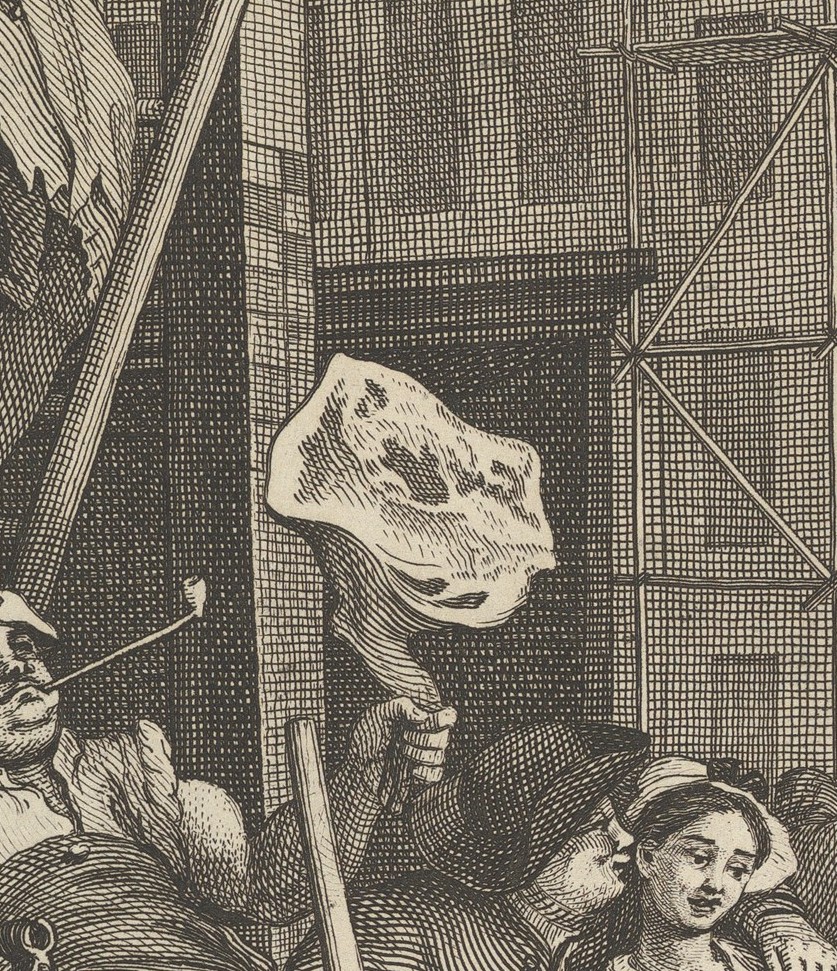
The raised joint
One of the drinkers lifts a joint of meat. In an earlier impression the same raised arm holds a small Frenchman. The figure and the meat belong to different versions of the copperplate.
The sign painter
The painter balances on a ladder beside the Barley Mow sign. His worn clothes and narrow frame stand out above the broad figures at the tavern table.
The herring ballad
The fish sellers read a ballad advertising the herring fishery. The sheet brings a national commercial project into contact with the women who carry its catch.
Gin Lane
Gripe’s pawnshop
A saw and household objects are brought to the shop under the three-ball sign. The saw is also a means of earning a living. Compare the building work in Beer Street.
The falling child
Hogarth sets the descent of the child against the mother’s splayed legs and the line of the steps. Their faces point in different directions as the child slips out of her reach.
The cellar sign
The sign by the cellar entrance gives a price for drunkenness and offers straw. The steps and opening take the street’s trade below pavement level.
The ballad seller
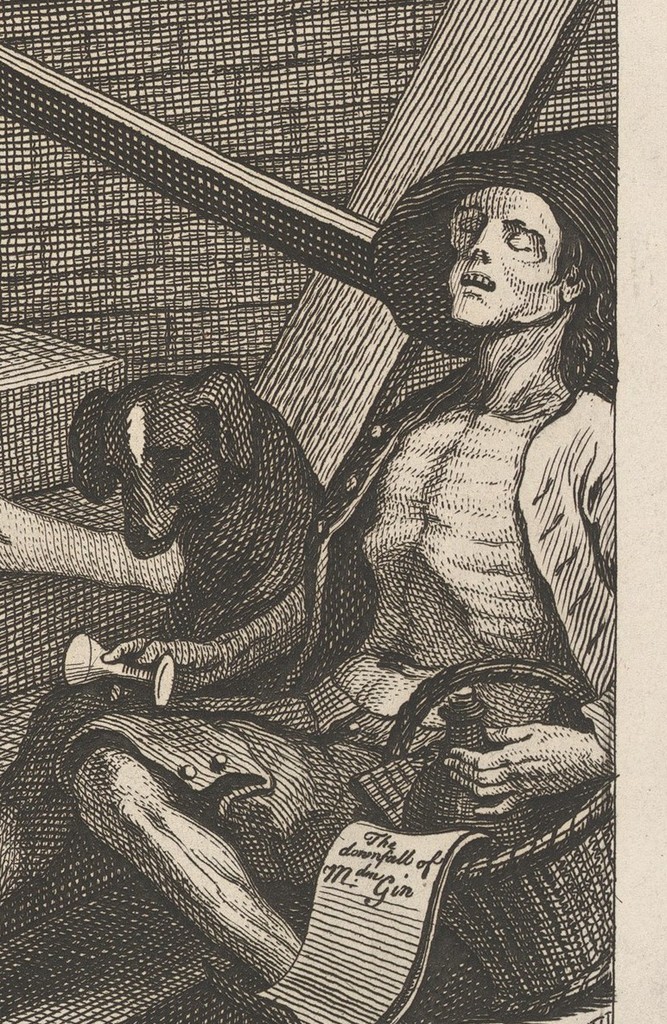
The thin man’s printed sheet names the downfall of Madam Gin. Notice how the explanation is carried into the street by someone who is himself in distress.
Newspapers, ballads and the verses under the pictures
At the front of Beer Street, part of a king’s speech and other printed news sit at the drinkers’ table. Across from them a ballad about the herring fishery occupies the attention of women who directly handle the catch. Those two pieces of paper bring national commerce into the street from opposite directions. Words from Parliament turn up within reach of working men. A subject that can be discussed as public policy also exists in a song that its readers can take particular interest in. Behind them, men lift their hats or tankards above the roofline in what the Morgan reads as a salute to the king. Speech, song and toast can be pictured in a single scene through the objects or gestures that carry them. [1] [3] [10] [11]
Paula McDowell points out how many forms of printed matter collect around the drinkers, from the Daily Advertiser to books marked for use as waste paper. The fish sellers’ ease with a printed song is important to her reading of the picture. They can be represented as workers making choices about what they read or hear at leisure. At the edge of the design, the books in the porter’s load have a destination quite different from the ballad. A trade that puts texts in the hands of some readers also puts a market value on the paper of books intended to line a trunk. Hogarth can make fun of particular writing while still representing reading as an ordinary part of a productive neighbourhood. [1] [4] [11]
Gin Lane shows the commercial word at work with comparable ingenuity. The distiller and the pawnbroker have their names at the places where a customer might usefully look for them. The written matter on the ballad seller’s sheet is an account of the downfall of Mrs Gin. Its presence a few inches from the falling child gives it a grim point. Someone has already put a warning about gin into a form portable enough to sell from one street to another, yet the man with the copy is part of the ruin it describes. The image invites the viewer to work out what a piece of paper can do in circumstances where the person entrusted to circulate it can hardly hold himself upright. [2] [3] [5]
Hogarth was selling a warning printed on paper himself. The ballad seller serves as a reminder that a warning’s legibility and its availability are two separate conditions. In the companion street paper passes between people who appear absorbed by its contents, and other writing is valuable for the use a tradesman can make of it. Both prints have something to say about the chances of a written message finding a reader. The maker put enough visual information into the scene for a viewer to start with the images. For someone looking closely, the small letters give newspaper reports, songs, pricing and trades their own places in the argument. [1] [2] [11]
Below each image there are three quatrains arranged in the same way. The beer verse begins by praising a product of the island. It credits beer with sustaining strength and giving pleasure after toil, then turns that replenished strength into a public good for labour and the arts. Praise of English liberty and love comes at the end. The gin verse gives the beverage an active part in the suffering above it. Gin cheats the drinker with an immediate pleasure, steals life, and drives its victim towards despair and crime. The form supplies equivalent units for comparison even as the emotional register switches from praise to denunciation. John Nichols’s eighteenth-century catalogue credits the verses under both prints to the Reverend James Townley, master of Merchant Taylors’ School. [1] [2] [6]
One line promises that the English will leave water to France. That reference sits beside a beholder’s memory of the raised joint of meat in the revised Beer Street, even if the reader has never seen the raised Frenchman in the earlier impression. In both versions, the poem finds something particularly English about the strength and happiness that follow a drink. The verse under Gin Lane curses a substance that it imagines as a fire attacking the body from within. The proud association between a country and a drink in one margin can therefore be read against a fear about what its domestic businesses are able to make or sell in the other. [1] [2] [3] [6]
What the drawings tell us about making a pair
The Morgan Library & Museum holds the worked-up red-chalk designs. Its Beer Street, III, 37, includes graphite and some pen and ink. Its companion, III, 36, is lettered Gin Street in the lower margin. That title shows Hogarth trying out a more exact verbal pair before he named the printed version Gin Lane. Once the scenes acquired their published names, a broad way and a narrower one became part of the comparison. The titles give names to a spatial difference already visible between the buildings. [3] [10] [12]
Both drawings are of a scale that allowed Hogarth to work out much of the spacing of a future print. The view of Gin Street on the drawing is the reverse of the published impression. A pawnbroker at the right in the chalk design is at the left on a printed sheet. The printing process explains why that much of the difference was predictable. Paper receives an impression from the inked recesses in the copper, reversing the image, so an inscription put on the plate has to read backwards if it is to read forwards on the sheet. The copper for Gin Lane at the Met still shows the right-hand pawnbroker and the reversed lettering. The three objects preserve different physical stages, even when a digital viewer renders them all at a similar height. [2] [3] [5] [12] [13]
A conservator’s examination of the drawings points to more than their finished-looking images. The Beer Street drawing was incised with a stylus and chalk was rubbed onto its back. When a line is traced through a sheet so prepared, pressure can transfer the corresponding mark to a surface beneath. Under angled light, incisions and small pinholes become visible. Tonkovich reports clear offset of chalk from the reverse in a relatively small area corresponding to the sedan-chair group, while a similarly clear loss of pigment is hard to find behind much of the tracing. That apparent mismatch is useful evidence. The pressure marks show which lines were followed, while the reverse preserves a much less complete record of which marks moved and where they went. [3] [10]
The Beer Street drawing also contains a small, disembodied hand. Tonkovich relates it to the raised Frenchman in the first published print. A scrap of the man’s bundle and a nearby repositioned arm support the connection. Marks at the edge of the intervening space suggest that parts of this new design were drawn on a separate piece of paper superimposed on the main sheet. Pinholes occur in that area and around a second group of drawing changes. There is a practical advantage to a loose overlay. A large design can be tested with a change to one group while the rest of the street stays available for judging its effect. Once a group is cut into copper, removing it takes more work. [3] [10]
The Morgan drawing of Gin Street contains its own evidence of continued work. A small study in the margin near the pawnbroker considers how a figure grips the offered goods. The turn of the hand in the study differs from the more claw-like grip in the printed scene. Hogarth carried most of the disposition of this street into the plate, where a grasp of the fingers could make the transaction more emphatic. The greater visual stability of Gin Lane across the surviving stages is therefore a matter of degree. Important decisions about gestures, signs and where to place the scene’s sharpest accents remained open even after the main drawing had been laid out. [2] [3] [12]
An unfinished proof of Gin Lane in the Royal Collection, RCIN 811913, provides a check between drawing and finished impression. Tonkovich follows the proof’s letters and details through to a subsequent print. The high-set pawnshop sign and the group around the steps can already organise the image before every contour and detail takes its published form. The differences are useful because they belong to a sheet actually pulled from the plate in progress. A proof can be inspected for the effects of work already done on the metal. It leaves the artist free to deepen passages, make lettering readable, and alter a detail whose importance only becomes clear when he sees it printed. [3] [14]
The paper links those two streets to another enterprise at Hogarth’s shop. The Morgan records a fleur-de-lis watermark and the countermark IV in Beer Street. Tonkovich and Laurel O. Peterson match the Strasbourg lily and IV on both drink-print drawings with the paper for the Morgan design of the second of The Four Stages of Cruelty. A watermark is made in the sheet during manufacture. It can connect drawings by the stock on which Hogarth worked even when the subjects give few indications of shared production. The three drawings support overlapping work around 1750–51. The date on which one of them was drawn, the order of the sketches and the days the prints went on offer depend on other evidence. [3] [10] [12] [15]
There was a commercial use for work that had reached this degree of finish. Tonkovich suggests that the large chalk drawings may have been shown at Hogarth’s shop to encourage interest. A surviving notice invites prospective subscribers to view drawings for two history prints there a few months later, showing that he could use drawings to explain and sell a future publication. For the drink subjects, the physical clues on the sheets tell us more securely about his design work than about any visitor who saw them. The market history after his lifetime is better documented. The Beer and Gin drawings passed through albums associated with the Reverend Michael Lort and later the Dublin collector Jasper Robert Joly, before Charles Fairfax Murray sold the pair to J. Pierpont Morgan in 1909. Their years in albums help account both for their preservation and, Tonkovich suggests, for some flattening and smudging of the chalk. [3] [10] [12] [15]
The early Beer Street and the recut copperplate
An early Beer Street at the Met, 32.35(122), shows what the raised arm was doing in the first published design. Look beneath the tavern sign. A well-fed, seated man suspends a long, thin figure by the back of his clothes. The figure’s dark coat and horizontal bundle interrupt the view across the street. One hand opens in alarm and the legs hang out at an angle. Nichols calls the man a Frenchman and the man lifting him a blacksmith. The bright ruffles, the awkward posture and the disproportion between the two bodies supply the joke. The blacksmith has enough strength to hold up an entire person with one hand and uses it at a moment of leisure. Tonkovich reproduces another example of that early lettered form at the British Museum, S,2.119. [3] [6] [9] [16]
In the Rijksmuseum Beer Street and the Met’s later example, the raised object is a joint of meat. It is pale, small enough to leave more of the scene behind it legible, and held up beside a courting couple. Compare the dark bundle and the projecting limbs of the Frenchman with the piece of meat and the two adjacent heads. The new figures gather around the table and turn towards one another. The earlier version gives the verse about France a substantial figure to ridicule. The revision lets the gestures of sharing food, looking and touching govern the foreground exchange. The verse still presents liberty, love and commercial advantage as effects of a national drink. [1] [3] [4] [6] [9]
The ragged sign painter appears in both published forms compared here. The substantial difference lies between the smiling, hat-doffing figure in the Morgan drawing and the painter looking up at his sign on the printed page. In the prints he occupies a high and visible position, with a torn coat that catches the eye when he is compared with the prosperous drinkers below. The revisions that introduced the Frenchman also deprived the painter of the easy engagement with the company that he has in the drawing. By keeping him in the recut design, Hogarth let another exception to general plenty survive alongside the failing pawnbroker. The image praises the arts in its verse while showing a working artist whose clothes bear out a more uneven share of prosperity. [1] [3] [4] [9] [10]
Hogarth had to change the printing surface to bring about the more convivial scene. The dark lines that made the Frenchman’s coat and luggage visible could hold ink long after a change of mind. Tonkovich and Met conservators examined the surviving Beer Street plate, 21.55.2. She describes the thinning where the older figure was removed and reconstructs how burnishing the grooves and raising the thinned area from the back would prepare it to take new lines and withstand printing. Support underneath the worked area could help it bear the pressure. She identifies the bent line from the Frenchman’s elbow and sleeve as material Hogarth used to help shape the joint of meat. Comparing the two impressions makes the new use of old work visible, even without an opportunity to inspect the thickness of the plate. [3] [4] [9] [17]
Both plates remain at the Met. The lettered Beer Street matrix shows the revised scene in reverse and the Gin Lane matrix shows the corresponding finished arrangement of the lane. The thin area in the beer plate records an intervention. The marks on each paper sheet show how lines held ink when that particular impression was made. An earlier impression can therefore preserve a part of the plate’s history that is no longer readable as an image on the copper. The surviving metal and the two paper versions are evidence of different kinds, the first for the work the plate underwent and the others for the visual arguments it made available in successive forms. [3] [4] [5] [9] [13] [17]
Watch Hogarth’s paintings and prints
Five films on Hogarth’s painted stories, prints, drawing methods and work for the Foundling Hospital.
In 60 seconds: Hogarth's 'Gin Lane' & 'Beer Street'
A short introduction to the contrasting streets, the shops and the people in Hogarth’s paired prints.
Watch on YouTubeTonkovich calls the unlettered Cambridge trial the proof state, the lettered Frenchman design the second state and the form with the joint the third. Tonkovich identifies the British Museum’s S,2.119 as Paulson 185 II. The museum catalogues its Crace impression of the recut design, 1880,1113.4473, as 185 IV. The Met calls its Lazarus Beer Street third of three. A reader comparing those two later sheets can identify the lifted joint and the courting figures before trying to reconcile the numbering. This is why the object number and a description of the composition travel more reliably between collections than a bare state number. [3] [4] [16] [18]
A notice in the Public Advertiser of 13 December 1759 offered the pair again. Tonkovich thinks this was very likely the occasion of the altered prints, while Paulson was less certain for the major Beer Street revision. The newspaper establishes that both titles were back before buyers by that December. Tonkovich also suggests that the wartime context may have made the depiction of an Englishman manhandling a Frenchman liable to be read in a different way than Hogarth intended. This is a possible reason for the change. The two prints preserve a shift that can be seen regardless of the motive. In the first published state, mistreatment of an outsider interrupts the pleasures of the street. In the revised one, the man lifting his dinner and the couple beside him hold attention closer to the social life of the street itself. [1] [3] [4] [9]
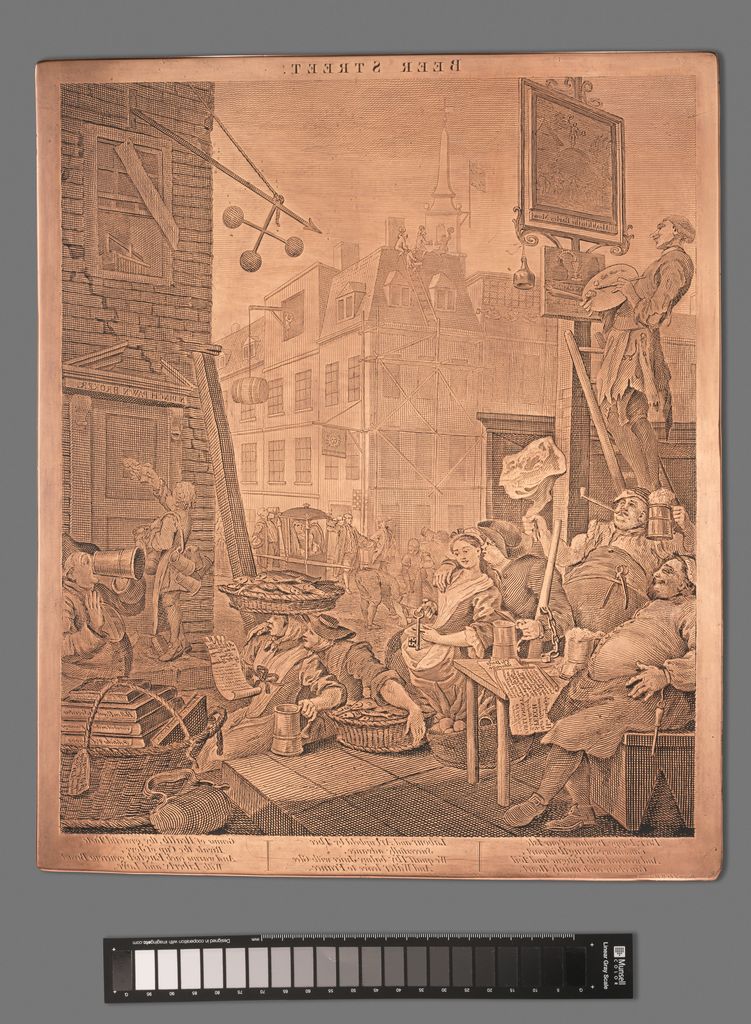
Beer Street, William Hogarth, 1751. Engraved copper plate. 21.55.2. Rogers Fund, 1921. Image source. CC0 / Public domain.
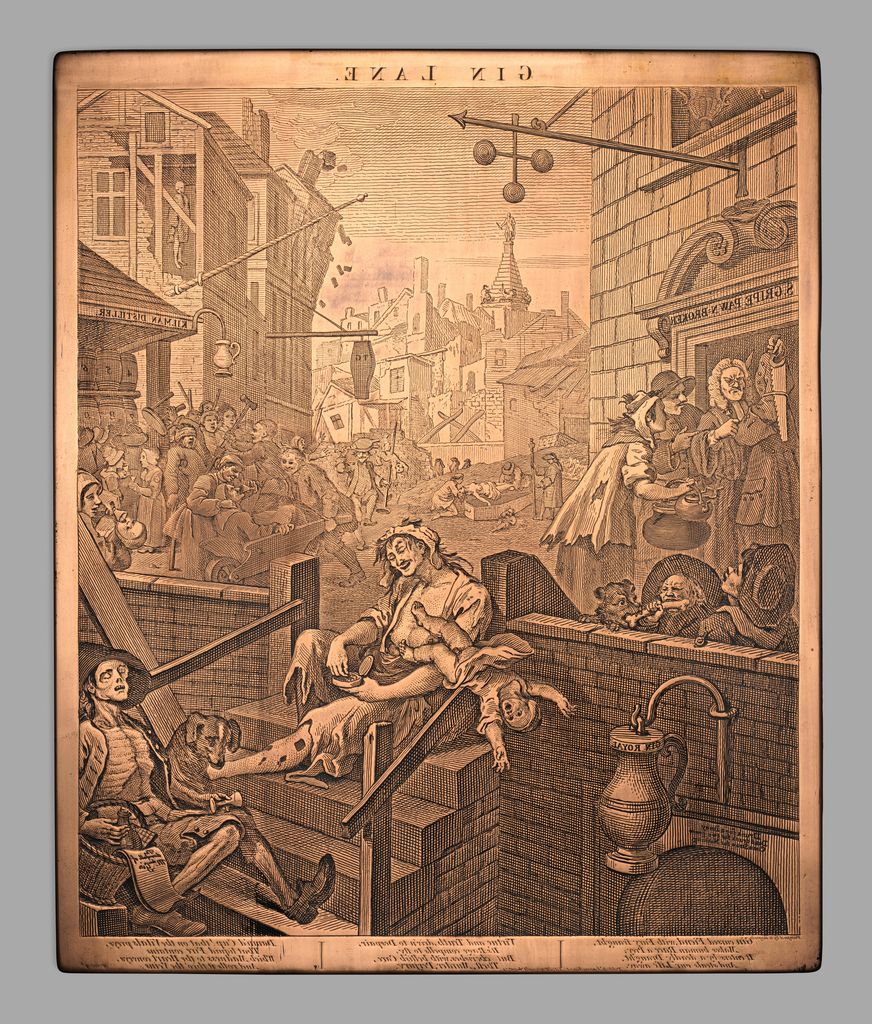
Gin Lane, William Hogarth, 1751. Engraved copper plate. 21.55.3. Rogers Fund, 1921. Image source. CC0 / Public domain.
What Hogarth offered at the Golden Head
The London Evening Post of 14–16 February 1751 announced two large prints designed and etched by Hogarth, at one shilling each. It also advertised an edition printed to a higher standard for one shilling and sixpence each. They were obtainable at the sign of the Golden Head in Leicester Fields, where a customer could buy Hogarth’s other works as well. John Nichols transcribes the corresponding notice in the General Advertiser of 13 February 1750/51. That notice says the two prints will be available on Friday, followed on Thursday by the four prints on cruelty at the same size and price. The year in early-year English sources can be 1750 using the old civil reckoning. The usual modern account reckons the year from January and gives 14 February 1751 for the drink pair and 21 February for the four Cruelty engravings. [3] [6] [15] [19] [20]
The date 1 February in the plates’ margins belongs to their publication inscriptions. The text invokes an Act of Parliament, as an assertion of the kind of protection granted to makers of prints. The Sale of Spirits Act became law later in the year. Reading the inscription as a declaration that the drink bill had passed would put the picture and the law in the wrong order. It would also give buyers in 1751 the wrong interval between the announcement of the two titles and the next introduction at the Golden Head. The newspaper gives the timetable for someone who wanted to go to Hogarth’s shop. [3] [4] [5] [6] [19] [21]
At the ordinary advertised price, purchasing both drink prints cost two shillings. A buyer taking the four Cruelty engravings at the same rate would pay four. Paying for the proposed better impressions would make the corresponding totals three and six shillings. Those are comparisons between directly comparable offers in the same notice. The phrasing addresses a customer who values the manner of printing enough to pay more for it. It also invites a customer with a shilling to buy a single subject. A merchant could sell a moral comparison in two pieces, and readers who saw one could be led to look for the other. [3] [6] [15]
The two-price scheme explains what Hogarth advertised. Evidence for what he carried through is less clear. Paulson thought he probably dropped separate prices for the drink sheets while retaining them for the Cruelty series, as Tonkovich relates. Nichols also says early copies of the two sets were printed on very thin paper and that thicker paper followed complaints. His account describes a change in the paper buyers might encounter. The price of an individual sheet would have to be established separately. Tonkovich and Peterson report a 1754 price list offering the pair for three shillings and the four Cruelty prints for six. An early notice, a later price list and an impression on a particular paper each answer a different question about the trade. [3] [6] [15]
Hogarth used the notice to explain why he had sought the cheapest way of producing the subjects, assigning the vices that he wished to reform to people lower down the social order. A shilling tells us the terms he named, while the explanation tells us whose conduct drew his attention. The person who bought a sheet, a person who saw it as someone else’s property and a person whose habits it represented could all be different. A customer drawn to the latest work by a named artist had a reason to buy both sheets irrespective of whether he or she regarded gin as a public problem. A person brought over to inspect a print could make out the central figures and signs without ever handling its purchase. The very small lettering, in turn, rewards someone who has time to linger close to the paper. [1] [2] [3] [6]
The price can also be compared with a publication that set out to explain the pictures. The General Advertiser of 26 March 1751 advertised a shilling pamphlet, A Dissertation on Mr. Hogarth’s Six Prints lately publish’d. The title presents the pamphlet as a key to all six images. The dedication names the Lord Mayor and aldermen and praises their efforts to suppress the excessive use of spirits. Purchasers could thus spend the price of one print on a reader’s guide to both February projects. The advertisement documents a bid for readers interested in the connection between the designs within weeks of their separate launches. [6] [22] [23]
The same piece of paper could acquire other functions over time. The 1790 Boydell publication in the National Library of New Zealand contains the revised Beer Street. Its record transcribes the 1751 imprint and the shilling price as they appear on the subject, while identifying the print’s place in a volume assembled and published much later. A sheet could therefore show how Hogarth priced a design and still belong to a markedly different transaction. A bound presentation invites a reader to encounter the street as part of an artist’s accumulated work. It supplies a concrete case of circulation beyond the occasion of reform that had made the two subjects timely. [24]
Henry Fielding and the public argument about gin
Henry Fielding, a London magistrate as well as a novelist, took up distilled spirits in section II of his 1751 Enquiry into the Causes of the Late Increase of Robbers. He described waiting until people accused of theft or robbery had sobered up before he could question them, and attributed some of their actions to gin. The personal authority of the magistrate, who says he repeatedly sees defendants in this condition, matters to the form of the argument. Hogarth gives readers a scene they can inspect. Fielding draws authority from incidents he says he witnessed at work. Estimating how often theft followed a drink across London would require evidence covering many more cases. [2] [25]
Fielding’s essay also makes childhood a public concern. He asks how children exposed to gin before and after birth could grow up strong enough to labour or serve as soldiers and sailors. The composition of Gin Lane makes a comparable appeal through the falling child and, in the finished print, through another adult with a vessel at the mouth of a baby. Tonkovich traces the introduction of the latter group between proof and published image. That change helps show how deliberate the emphasis on children was. The picture offers an immediate danger and Fielding imagines an impaired future population. Each links the welfare of a child to the future availability of people on whose work and care a country depends. [2] [3] [14] [25]
Fielding considered restricting distilled liquor to sale for medicinal purposes or using taxes to put it beyond the financial reach of the mass of purchasers. He knew restrictions on one particular spirit might be evaded by selling another. The range of suggestions shows how many decisions lay between condemning what he saw and agreeing on a way to change the trade. The harder question was which actions ought to be changed first. Hogarth makes the continued purchase of gin seem deeply destructive. Fielding’s discussion turns from the drinker to the means by which a type of drink could be made much more difficult to obtain. [2] [25]
A reply of 1751 advertised under Ben. Sedgly’s name and with additional observations under Timothy Beck’s name promised to reconsider how Fielding assigned vices to the poor and to point out the follies and vices of polite society. Its title also promised an account of the harmful consequences of gin. The two positions can coexist. Someone could accept that spirit drinking could cause great harm and still dispute whether those most in need of correction were the people singled out by reformers. The title of the reply advertises that disagreement in the same idiom of print commerce Hogarth used to sell his pictures, with different kinds of customers invited to see whose habits an author means to examine. [3] [25] [26]
The print pair itself gives grounds for seeing social rank as part of the argument. Wearing respectable clothes, buying with money to spare, and being at leisure in public are marks of security in Beer Street. In Gin Lane undress and debility are exposed in public alongside the possessions people are about to surrender to the pawnbroker. By selecting acute distress as the most visible sign of a drinking habit, the artist encourages the reader to imagine that distress and habit always occur together. The production process offers a way to see that selection being made. The addition of drinkers of a different age or the stronger articulation of a hand in a sale can intensify a public accusation even when a whole street already stands drawn on paper. [1] [2] [3]
How the Act treated distillers, retailers and debts
The legislation usually called the Gin Act of 1751 is 24 Geo. II c. 40. Its preamble, in the collected Statutes at Large, singled out the immoderate drinking of distilled spirits among people of low rank. It connected the problem to retailing under distillers’ licences and to unlicensed sales, naming London, Westminster, Southwark and other places covered by the weekly Bills of Mortality. It also expressed a concern that restricting the trade could reduce income used for public funds. Public health, public morals and the Exchequer were already present in the opening explanation of the Act. [27]
One corner of Hogarth’s lane shows the place where buyers congregate. Section I of the Act dealt with a stage before the drink reached them. From 1 July 1751 it imposed additional excise duties with separate rates according to what was distilled and at which stage. For malt, corn and specified related materials, it added one and a half pence per gallon on the first extraction and four and a half pence per gallon on strong waters made for sale. Distillers or makers owed the duties. Readers can thus distinguish a tax at manufacture from a retail price attached to any one vessel or sign in Hogarth’s lane. A manufacturer, publican and final buyer had different positions in that chain. [2] [27]
Section III removed a route from distilling into retail. It recited that under the 1747 arrangement a distiller in the named London areas could obtain an annual retail licence for five pounds through the Excise. Parliament claimed that some distillers had let their customers drink in their shops despite earlier restrictions. The 1751 Act ended that licence duty and barred distillers from licensed or otherwise permitted retail after 24 June 1751. Section V specified an additional annual duty of twenty shillings on retail licences to begin on 25 March 1752. Read together, these sections show two different changes, one to who was allowed to retail at all and one to what an eligible retailer would pay. [27]
The Act also put a value on the place where business could be done. Section VIII provided that within the area administered by the London head office of Excise, licensees for spirits had to occupy premises worth at least ten pounds annually and be rated for them in parish rates. It applied a requirement to be assessed and pay church and poor rates in other areas where those rates existed. Section XI penalised knowingly supplying distilled spirits to an unlicensed retailer or for unlawful retailing. A provision for an offending retailer who disclosed and successfully prosecuted the supplier shows how Parliament proposed to get information about transactions that might otherwise remain private. A law about access to spirits therefore reached from ownership or occupation of premises to communication between people trading beyond the authorised market. [27]
The types of premises specified in section VII included taverns, victualling houses, inns, coffeehouses and alehouses, reciting a restriction under the earlier law. A spirits licence was also tied to the place where the licensee lived when it was granted. The rules leave room for a customer to buy spirits in the very type of establishment whose owner serves beer in Hogarth’s comparison. A licensed house and a distiller who sells from his own shop were distinct cases under the Act. For an excise officer or a justice of the peace, the questions were who supplied a product, how it was sold, and where the transaction took place. For the viewer of Hogarth’s pair, the signs help persuade us that each street is identified with one drink. The statutory list gives a glimpse of how much actual drinking establishments could have in common. [1] [2] [27]
The connection with the pawnshops is closest in section XII. From 1 July the law barred recovery through courts of spirits debts under twenty shillings incurred on any single occasion. The rule also applied to individual items in an account where a delivery had been worth less than twenty shillings. Putting a total on a bill left the underlying transactions subject to that rule. In a further clause, a retailer who accepted a pawn or pledge as security for what a person owed for spirits incurred a penalty of forty shillings for each pledge. That applied to licensed and unlicensed retailers alike. Half the penalty went to the parish poor and half to the informer. The owner retained a remedy to recover the object or its value. [27]
Hogarth’s figures are shown bringing a saw and household objects to a pawnbroker whose sign names him as such. The Act prices a different transaction, in which the spirits retailer itself takes an object as security for its customer’s debt. It leaves the independent trade of a pawnbroker outside that particular penalty. The resemblance lies in the way both picture and provision bring drink into contact with household assets. The print makes readers picture the sacrifice of implements and goods behind the next purchase. The law removes a legal means of collecting small debts and attaches a cost to securing spirits debts with goods. That comparison is more precise than assuming the law shut down every shop that Hogarth made look prosperous. [2] [27]
There are still more kinds of place in the statute. Section XIII voided licences to retail spirits in prisons, houses of correction, workhouses and houses for the parish poor from 1 July. It also imposed penalties on officials who tolerated the supply or use it specified, with a tightly described medical exception. Further provisions dealt with authorised searches and the registration and marking of distilling vessels. Parliament tried to make an officer’s account of the trade more dependable from what he could see and document in a shop, place of confinement or stillhouse. Hogarth had been free to show on one sheet several troubling effects of easily available drink. To legislate about those effects meant spelling out which establishment, which class of transaction and whose duty to act. [2] [27]
The Act’s title includes an allowance on exports of British-made spirits. The law treated British distilling as an industry to be taxed and supervised, with an allowance for products going abroad. The damaging drink in Gin Lane could therefore come from the same country's industry that the Beer Street verse praises. English beer and foreign water make a simple opposition in the verse. English brewing and British spirits production lived alongside each other in the economy on which Parliament was trying to act. [1] [2] [6] [27]
What the records can tell us about drinkers and enforcement
Counting sellers sounds easier than establishing how much their customers drank. In their historical study of the legislation, Jessica Warner, Minghao Her, Gerhard Gmel and Jürgen Rehm note that a survey of greater London in 1725–26 enumerated 8,659 brandy shops, around one for every eleven houses, with some other kinds of establishment excluded. They also report that a survey a decade later counted 7,044 places selling spirits in a different geographical area, substantially what is now East London. The figures describe different areas and potentially different groups of sellers. A trend in Londoners’ drinking would require a comparable measure of what residents were buying or consuming. [28]
Licences also omit some of the people doing the work. Vita Unwin’s study of women in the gin retail trade uses licensing records alongside other sources. In 1749, Ann Crow made a statement about gin and caraway liquor stolen from her husband’s shop at the corner of Drury Lane. Unwin uses it to show her managing and defending the business even though the relevant licence was in her husband’s name. A street scene where women appear as customers or as people giving a drink to children is full of telling detail, but cannot reveal how many were conducting the trade. Even an official record that names a licensee tells little about the work done during the day by other people at the same address. [2] [29]
Evidence of consumption has a comparable problem of scale. Warner and her colleagues analysed annual data from 1700 to 1771. Their central measure was the excise record of British spirits output, divided by an estimate of the population aged fifteen or over. They used output as a proxy for consumption on the grounds that exports and home production contributed little and that the series concerned British-made spirits. They also examined strong beer output and variables including wheat and malt prices, taxes, licensing and an index of the real wages of certain building trades. The wage series gives a picture of conditions for certain workers, and excise totals give a broad view of what manufacturers produced. The people ordering or sharing particular drinks are visible in other kinds of record. [28]
Warner and her colleagues report an immediate fall associated with each of the three major Acts they examined, including that of 1751, followed by some recovery. Their model found evidence of a short effect in the year of the 1751 Act and much weaker evidence for a distinct sustained effect in the following years. They discuss the state’s limited capacity to enforce regulations locally and the later interruption to distilling after a bad harvest. Distillers’ output, short-lived effects of laws, wider changes in demand and harvest pressures can all enter the account. Assigning the whole long-term decline to the single year in which Hogarth made his prints would miss this sequence and mistake an illustration of a reform argument for a measurement of its results. [3] [27] [28]
The relatively severe approach taken in 1736 supplies a test of what an Act could promise on paper. Warner and her colleagues note that Parliament imposed a fifty-pound annual licence fee and a retail duty of twenty shillings a gallon. The restrictive retail arrangements were repealed in 1743, when the licence charge fell. The parliamentary choices of 1751 came after years of practical experience with earlier restrictions and after a separate arrangement for distillers. An image as stark as Gin Lane could make sweeping action seem possible. In practice the later statute revised a system already making distinctions among wholesale production, retail outlets and unlicensed sellers. [3] [27] [28]
The fact that Parliament passed a law after the prints appeared gives each a place in the same public episode. The advertisement, the contemporary guide and Fielding’s text establish different ways in which gin was made a subject for public discussion. The statute documents the interventions Parliament chose. A claim about votes changed or a lasting drop in gin consumption caused by the prints would require evidence of how people acted after seeing them. The most specific connection the documents support concerns credit and property. The prints make visible what people might bring to a shop counter, and the Act defines what a spirits retailer could take to secure a debt. [2] [3] [6] [22] [25] [27] [28]
The Old Bailey proceedings offer a different view of people choosing drinks. In Tyler Rainford’s study of the published trial accounts, gin, beer, rum and other drinks appear in the same parts of London and sometimes in the same establishments. In the trial of Mary Hoden in 1743, John Davey reported asking for a pint of beer at a Holborn public house. When the landlady brought gin, Hoden said she disliked it. In a 1724 theft trial, Thomas Miller recalled being asked for a pint and proposing a measure of gin because he cared little for beer. These accounts survive because a tribunal was hearing about a crime. The exchanges are valuable because they record people expressing a preference in company. Each choice takes place within a market where another drink is available. The strength of Hogarth’s contrast depends on how completely his buyers and drinkers appear to inhabit a world arranged around the choice already made for them. [1] [2] [30]
The prints after 1751
John Trusler’s Hogarth Moralized brought the pair before readers again in 1768. The Morgan’s copy of the first edition names Jane Hogarth’s approval on its title page and lists the Golden Head among the places the book could be obtained. It proposes to instruct young people through an entertaining account of the pictures. The two streets could therefore be read, in a volume of other subjects, as a lesson for purchasers and readers with new reasons to look. The author of the 1751 pamphlet had addressed London officials and praised their action against excessive consumption. Trusler’s title page locates the value of reading Hogarth in the reader’s own formation. [6] [22] [31]
In Trusler’s interpretation as reprinted in 1831, the contrast between the pawnshops is evidence that certain trades live on other people’s poverty. His commentary on the revised Beer Street also assigns an immediate motive to the woman with the courting man. He supposes that she is a servant sent out for porter, and uses her pause to develop a lesson about neglect of work. The suggestion gives a moral commentator something to disapprove of in the street that celebrates work and refreshment. A reader can see the resulting shifts in emphasis. The reworked plate supplies a group in a moment of flirtation, while Trusler makes a story about whose time is being spent. The printed commentary gains a voice of its own through these additions. [1] [4] [32]
The 1831 edition added another layer. A bracketed note under the opening of Beer Street says that the contrast of the prints has particular force in light of a recent law making beer easier to buy. The words belong to the later edition. They show a reader using Hogarth’s pair to support a fresh public measure long after the circumstances of 1751. A case for restricting the trade in spirits could become a case for making another drink more widely available. The comparison was portable enough for an editor to enlist both streets without changing anything in the argument about how a viewer should move from one print to the other. [27] [32]
In 2016 the Royal Society for Public Health commissioned Thomas Moore to remake Gin Lane for its 160th anniversary. The Wellcome Collection’s numbered impression preserves the upper title, a dense street and a verse below, while the University of the Arts London identifies obesity and mental health among the concerns of the new design. A central figure absorbed by a phone updates the shape of the street’s most recognisable group. Here an institution found that Gin Lane could be cited by its visual arrangement alone, even when the particular trade used to explain the street had changed. It is a documented later use of the print’s power to give a public-health argument human figures, a place and a point of view. [2] [33] [34]
Hogarth built both streets so that details in one send the eye back to the other. A tankard held up to the roof, a shoulder bent under a burden and a printed song all have something to answer across the pair. Follow those details in the closer accounts of Beer Street and Gin Lane. The guide to Hogarth’s series takes up the same practice of looking across sheets in his longer sequences. [1] [2] [3]
Browse Hogarth’s artworks
All 54 individual artworks and series stages in the approved English cluster
Frequently Asked Questions
Discussion
Look again at the images and ideas explored in Beer Street and Gin Lane by William Hogarth. These editorial prompts invite your observations.
Reader Insights
What changes most when you compare the pawnbrokers’ doorways across the two prints?
How does seeing the early Frenchman design affect your reading of the revised Beer Street?
Join the Conversation
Share a detail, comparison or question about Beer Street and Gin Lane by William Hogarth below.
References
- Rijksmuseum, William Hogarth, Beer Street, RP-P-OB-18.791, plate mark 387 × 322 mm, companion record and impression. View source.
- Rijksmuseum, William Hogarth, Gin Lane, RP-P-OB-18.792, plate mark 386 × 319 mm, companion record and impression. View source.
- Jennifer Tonkovich, “Hogarth and the Making of Beer Street and Gin Lane,” Master Drawings 60, no. 2 (2022), pp. 201–218, figs. 1–4 and 11–26, especially pp. 203, 206–214 and nn. 9, 23–32. View source.
- The Metropolitan Museum of Art, William Hogarth, Beer Street, 91.1.141, etching and engraving, catalogued third state of three. View source.
- The Metropolitan Museum of Art, William Hogarth, Gin Lane, 91.1.140, etching and engraving, catalogued third state of three. View source.
- John Nichols, Biographical Anecdotes of William Hogarth, with a Catalogue of His Works, 3rd ed. (London, 1785), catalogue year 1751, items 1–2 and notes. View source.
- Rijksmuseum, Pieter van der Heyden after Pieter Bruegel the Elder, Vette keuken (The Fat Kitchen), KOG-ZG-1-25-87, 1563. View source.
- Rijksmuseum, Pieter van der Heyden after Pieter Bruegel the Elder, Magere keuken (The Thin Kitchen), RP-P-1885-A-9290, 1563. View source.
- The Metropolitan Museum of Art, William Hogarth, Beer Street, 32.35(122), etching and engraving, catalogued second state of three. View source.
- The Morgan Library & Museum, William Hogarth, Beer Street, drawing III, 37, catalogue and watermarks. View source.
- Paula McDowell, The Invention of the Oral: Print Commerce and Fugitive Voices in Eighteenth-Century Britain (University of Chicago Press, 2017), discussion of Beer Street and the fishwives. View source.
- The Morgan Library & Museum, William Hogarth, Gin Street, drawing III, 36. View source.
- The Metropolitan Museum of Art, William Hogarth, Gin Lane, engraved copperplate, 21.55.3. View source.
- Royal Collection Trust, Gin Lane – unfinish’d proof, RCIN 811913. View source.
- Jennifer Tonkovich and Laurel O. Peterson, “Hogarth and the Making of the Four Stages of Cruelty,” Master Drawings 62, no. 1 (2024), pp. 21–40, watermark evidence and discussion of the prints’ marketing. View source.
- British Museum, William Hogarth, Beer Street, S,2.119, the earlier lettered design with the Frenchman. View source.
- The Metropolitan Museum of Art, William Hogarth, Beer Street, engraved copperplate, 21.55.2. View source.
- British Museum, William Hogarth, Beer Street, 1880,1113.4473, Crace impression, catalogued as Paulson 185 IV. View source.
- The Morgan Library & Museum, Hogarth: Cruelty and Humor, “First Stage of Cruelty [print],” account of the two launch dates. View source.
- London Evening Post, announcement of Beer Street and Gin Lane, 14–16 February 1751, issue 3639, transcribed in James Nicholls, Drink, Modernity and Modernism (Liverpool John Moores University, 2002), ch. 1, opening and n. 1. View source.
- Parliament of Great Britain, Engravers’ Copyright Act, 8 Geo. II c. 13 (1735), Durham University Library copy in Primary Sources on Copyright. View source.
- B. Dickinson, publisher, A Dissertation on Mr. Hogarth’s Six Prints lately publish’d (London, 1751), British Library copy. View source.
- The General Advertiser, notice for A Dissertation on Mr. Hogarth’s Six Prints, 26 March 1751, facsimile in Mark McNally, The Marketing Techniques of William Hogarth (1697–1764), Artist and Engraver (Durham University, 2014), p. 171, fig. 58. View source.
- National Library of New Zealand, William Hogarth, Beer Street, impression in The Original Works of William Hogarth, sold by John and Josiah Boydell (London, 1790). View source.
- Henry Fielding, An Enquiry into the Causes of the Late Increase of Robbers, 2nd ed. (London, 1751), section II, “Of Drunkenness.”. View source.
- Ben. Sedgly and Timothy Beck, Observations on Mr. Fielding’s Enquiry into the Causes of the Late Increase of Robbers (London, 1751), title page and edition record. View source.
- Parliament of Great Britain, 24 Geo. II c. 40 (1751), in Owen Ruffhead, ed., The Statutes at Large, vol. VII (London, 1764), pp. 367–375, especially sections I, III, V, VII–VIII, XI–XIV, XVIII–XIX and XXI. View source.
- Jessica Warner, Minghao Her, Gerhard Gmel and Jürgen Rehm, “Can Legislation Prevent Debauchery? Mother Gin and Public Health in 18th-Century England,” American Journal of Public Health 91, no. 3 (2001), pp. 375–384, especially pp. 376–382, fig. 1 and table 1. View source.
- Vita Unwin, ‘Ladies Delight’: Examining the Role and Status of Women in the Gin Retailing Trade 1751–1760 (University of Bristol, 2016), ch. 1, especially printed p. 14 and nn. 41–42. View source.
- Tyler Rainford, Distilled Spirits, the Self, and Society in Early Modern England (1660–1760) (University of Bristol doctoral thesis, 2024), pp. 181–185, especially pp. 183–185 and nn. 103 and 107. View source.
- The Morgan Library & Museum, John Trusler, Hogarth Moralized (London, 1768), first-edition record. View source.
- John Trusler, Hogarth Moralized (London, 1831 ed.), “Beer-Street and Gin-Lane,” pp. 145–154. View source.
- Wellcome Collection, Thomas Moore, Gin Lane 2016, 3147469i, impression 16 of 25. View source.
- University of the Arts London, Thomas Moore, Gin Lane 2016, UAC 894, digital print. View source.