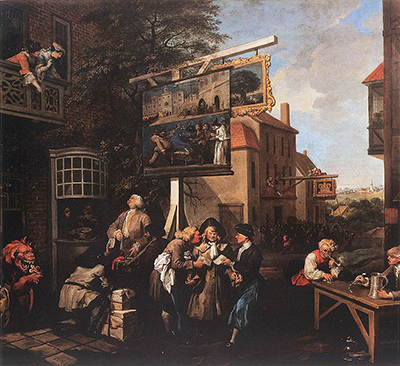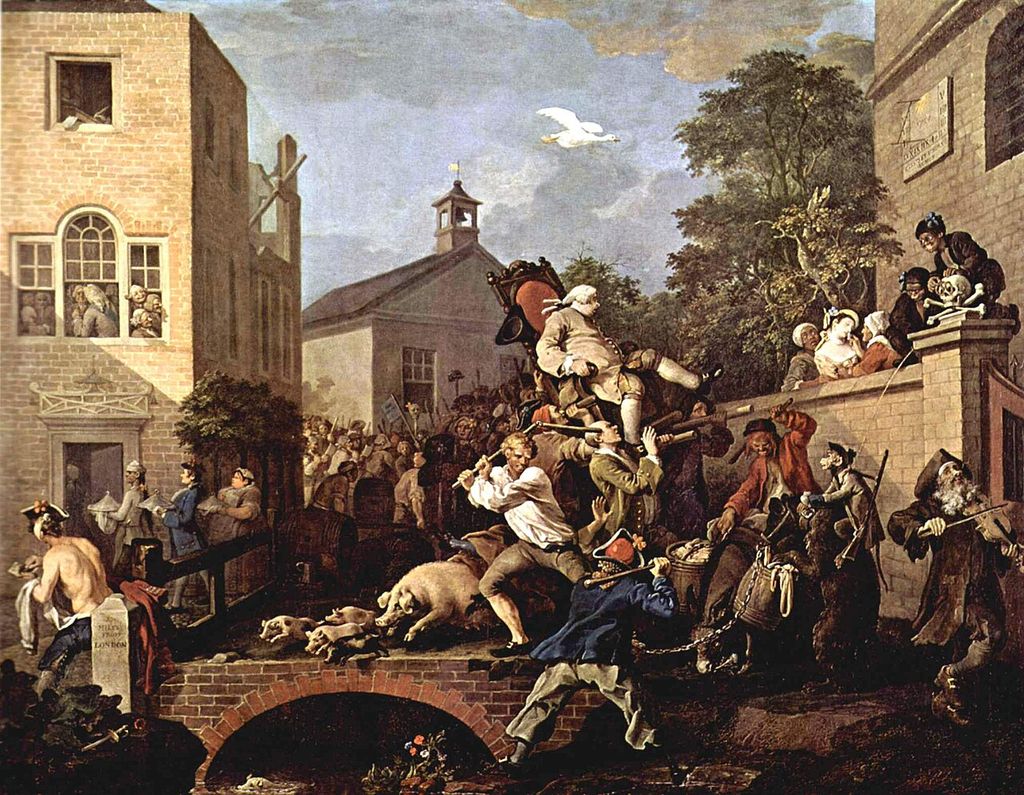
Chairing the Member, William Hogarth, 1755. Oil on canvas. SM P78. The Yorck Project via Wikimedia Commons. Image source. Public domain.
 by Tom Gurney
Tom Gurney BSc (Hons) is an art history expert with over 20 years experience
Email: tomgurney1@gmail.com / Phone: +44 7429 011000
Chairing the Member: Introduction
A newly elected member of Parliament is being carried through a market town when one of his bearers takes a blow to the head. The chair pitches, the member’s foot shoots out, and a white goose flies across the sky above him. William Hogarth puts the most elaborately dressed man in the street where everyone can see him and gives him almost no control over what happens next. Chairing the Member, an oil on canvas dated 1754–55 by Sir John Soane’s Museum, is the fourth and final painting in The Humours of an Election. The museum catalogues it as P78 and records its dimensions as 103 × 131.8 cm. [1]
In the preceding scene, The Polling, voters approach a raised booth where their choices are taken down. Here the platform is a padded chair on poles and the important business takes place below it. The shift from booth to street changes who can affect the outcome of a scene. People who have no business at the polling table can watch, cheer, heckle or get in the way. The candidate who has made it through the election still depends on four other men to carry him across a bridge. [1] [2]
At a Glance
- Painting1754–55, oil on canvas, Sir John Soane’s Museum, P78
- Painting dimensions103 × 131.8 cm
- PrintPlate IV, etching and engraving, Petit Palais, PPG6043
- Inscribed publication date1 January 1758
This work across William Hogarth’s career
Assembly at Wanstead House
1728–31The Heir
1734The Marriage Settlement
about 1743Gin Lane
1751Canvassing for Votes
1754–55Contents
- A victory procession at a standstill
- What chairing meant at an election
- A goose above the chair
- The painting and the Petit Palais print
A victory procession at a standstill
Start with the white shirt beneath the chair. The labourer wearing it has twisted his body to swing a threshing flail at a man with a wooden leg. The backswing catches a chair bearer at the temple. The bearer’s hands go up as the chair tips and the member slides towards the edge of its seat. The labourer faces his opponent, so the connection between his swing and the fall is clearer to the viewer than it is to him. Set against the soft upholstery and carved crest of the chair, the long carrying poles make it easy to see just how far a stumble below can travel. [1]
The bridge narrows the street just where the different movements converge. A sow and her piglets bolt past the labourer’s legs. Behind the sow, the feet of a woman she has knocked over stick into the air. Beyond the fight, a donkey has stopped and a muzzled bear is drawn to its load of offal. At the far right a ragged fiddler steps on, his bow still at the strings. Tinworth identifies him as blind. The musician who leads the procession keeps going while the people responsible for bringing the member along have lost their footing. [1]
Hogarth gives the spectators different views of the accident. Behind the churchyard wall on the right, two attendants support a woman whom Tinworth identifies as the member’s wife. They are occupied with her as the chair comes towards them. At the house on the opposite side, faces gather in the window above servants carrying covered dishes. Tinworth reads the group indoors as Whigs, with some enjoying the Tory member’s predicament. The food and the shelter matter to that reading. The people who have lost the election in this fictional town still have a gathering of their own, where they can watch the winner make a spectacle of himself. [1]
What chairing meant at an election
Chairing gave a parliamentary victory a visible form. Supporters took a successful candidate through the streets in a chair, and people who had no vote could join the procession or line its route. Historian Steve Poole shows how readily the same ceremony could turn into ridicule. At Lancaster in 1802, a successful candidate was carried past his defeated rival’s committee rooms, where the procession provoked a hostile crowd. That later example shows how the route itself could carry a challenge. Hogarth places the high windows of one side’s gathering directly above the other side’s public display. [1] [3]
The Oxfordshire county contest that helped inspire the series had a more protracted ending. The Tory pair, Lord Wenman and Sir James Dashwood, led at the close of the April 1754 poll. The returning officer made a double return for the two seats, naming both pairs of candidates and leaving the dispute to the House of Commons. The Whig candidates, Thomas Parker and Sir Edward Turner, were eventually seated after parliamentary hearings in 1755. Princeton University Library’s account says the disputed election had no chairing at the close of the poll. Hogarth gives the Tories a procession in the fictional town that Tinworth calls Guzzledown, where their immediate problem is getting through the street. The foreground member has sometimes been identified with George Bubb Dodington. Tinworth notes the difficulty with taking that association literally, since Dodington was a Whig who lost his seat in the general election. [1] [4] [5]
Watch Hogarth’s paintings and prints
Five films on Hogarth’s painted stories, prints, drawing methods and work for the Foundling Hospital.
William Hogarth, Marriage A-la-Mode (including Tête à Tête)
A close look at Tête à Tête and how its figures and furnishings advance the story of the marriage.
Watch on YouTubeA goose above the chair
Branches and spectators crowd the street below, leaving the bright goose conspicuous against the open sky. Tinworth compares it with the eagle in Charles Le Brun’s The Battle of Arbela. The Louvre identifies the eagle above Alexander as an omen of victory and describes how Le Brun lights Darius so he can be seen above the mêlée in a chariot that has come to a standstill. Together those details give the comparison its point. Hogarth puts a decidedly ordinary bird over an important man who is as exposed as a figure in a battle painting and has lost command of his own progress. [1] [6]
The church wall offers another measure of that triumph. An angled sundial carries the date 1755 and a Latin motto that describes human beings as dust and shadow. Below it, a skull and crossed bones sit on the gate pier beside two boys. Farther down the street the other chaired member appears as a shadow on the civic building. The shadow can be easy to pass over while following the turmoil at the bridge. Once seen, it ties a nearly faceless second victory to the words on the dial. The date belongs to the painted setting and falls within the museum’s range for the making of the canvas. It also happens to be the year Parliament settled the Oxfordshire seats. [1] [4]
The painting and the Petit Palais print
The Petit Palais holds an etching and engraving of the scene, PPG6043. Its title is Chairing the Members, in the plural, with the plate number printed beside it above the picture. The sheet presents the street in reverse. The church wall and the fiddler move from the right of the painting to the left of the print, while the house with the watching faces and the covered dishes moves to the right. The member’s extended foot accordingly points left. The reversal changes which crowd a reader encounters first when scanning the scene from left to right, while the flail, the bearer’s raised hands and the tilt of the chair still form a connected action at the centre. [1] [7]
On the canvas, the red chair back and the goose’s bright shape against a blue sky help pick out the member and the space around him. On paper, networks of fine lines give weight to the foliage and the brickwork. The distant shadow of the second chair is especially easy to pick out on the light wall just to the right of the civic building’s central window. The print’s plural heading gives the reader a reason to look for this second member. The lower margin adds another voice, with Hogarth’s formal dedication to George Hay, whom the lettering identifies as one of the Lords Commissioners of the Admiralty. The deference of the dedication sits immediately below a scene in which marks of rank offer a man little protection. [1] [7]
The Petit Palais records the print at 40.5 × 54 cm under its artwork dimensions and transcribes an engraved credit to W. Hogarth and F. Aviline. Princeton University Art Museum identifies the collaborator as François Antoine Aveline and gives separate plate and sheet measurements, 43.6 × 55.6 cm and 49 × 65.5 cm, for its own impression, x1988-78. The measurements therefore describe different objects under different catalogue headings. Paris supplies no state for PPG6043. The National Gallery of Art in Washington identifies its own impression, 1944.5.20, as the third of three states in Ronald Paulson’s 1965 catalogue. That label describes the stage of the plate from which the Washington sheet was printed. [7] [8] [9]
The publication line on the Paris impression of plate IV is dated 1 January 1758. The same collection’s plate III, The Polling, bears 20 February 1758. The earlier date belongs to the later scene. The inscriptions give the dates printed on the two objects, while the plate numbers place the tipping chair after the taking of votes. Hogarth ends the election at the moment when the man who has gained the most conspicuous place in town is about to slide out of it. [1] [7] [10]
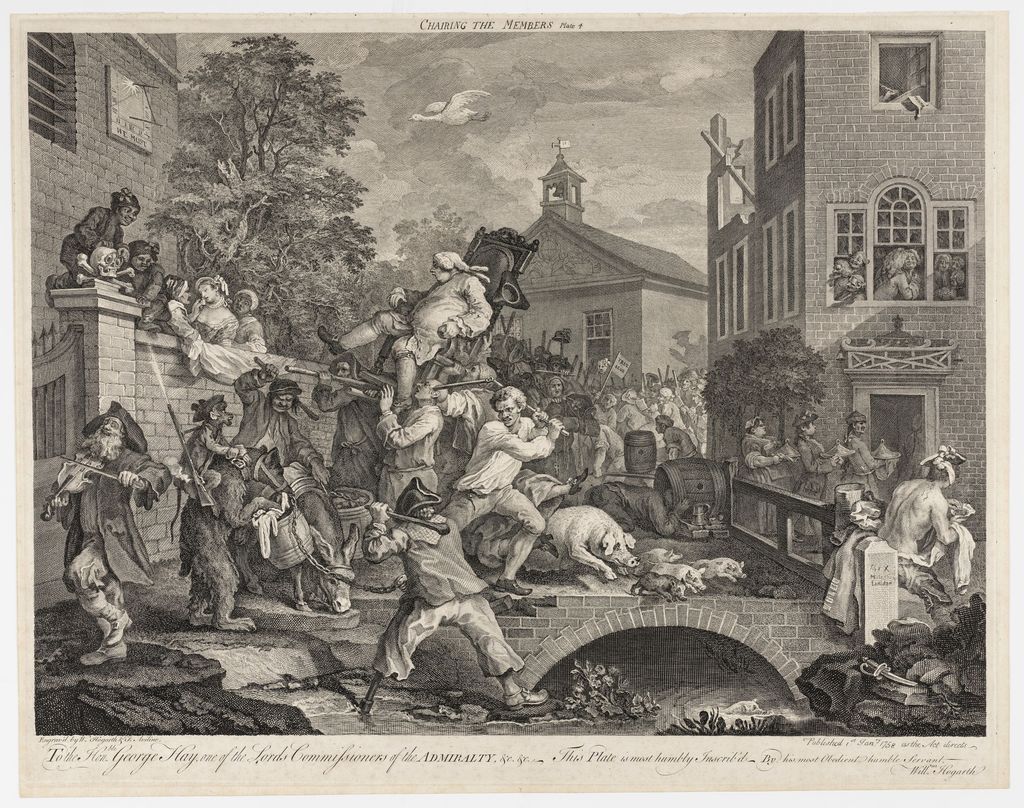
Chairing the Members, William Hogarth and François-Antoine Aveline, Plate dated 1 January 1758. Etching and engraving. PPG6043. Paris Musées / Petit Palais, Musée des Beaux-Arts de la Ville de Paris. Image source. CC0 / Public domain.
Browse Hogarth’s artworks
All 54 individual artworks and series stages in the approved English cluster
Frequently Asked Questions
His supporters are carrying him in a chair to celebrate the result. When a bearer is struck, the chair tips and the member loses his balance. [1]
It is scene 4 of 4 in The Humours of an Election. Sir John Soane’s Museum uses the same scene number for the original painting. [1]
Discussion
Look again at the images and ideas explored in Chairing the Member. These editorial prompts invite your observations.
Reader Insights
Which gestures connect the labourer’s swing to the member’s tilting chair?
How does the plural title of the print change the way you read the shadow on the civic building?
Join the Conversation
Share a detail, comparison or question about Chairing the Member below.
References
- Joanna Tinworth, Sir John Soane’s Museum, The Humours of an Election IV: Chairing the Member, P78, catalogue entry and notes, October 2021. View source.
- Sir John Soane’s Museum, The Humours of an Election III: The Polling, P73. View source.
- Steve Poole, Eighteenth-Century Political Participation and Electoral Culture, Chairing and Chair-Breaking, including the Lancaster example and notes 13–14. View source.
- Eighteenth-Century Political Participation and Electoral Culture, Newcastle University, Oxfordshire, April 1754, constituency case study and poll-book record. View source.
- Julie L. Mellby, Princeton University Library, Four Prints of an Election 1758, in honor of upcoming elections, Graphic Arts Collection, plate IV, 30 September 2010. View source.
- Musée du Louvre, Charles Le Brun, La bataille d’Arbelles, INV 2895, catalogue commentary. View source.
- Petit Palais, Paris Musées, Les Élus portés en triomphe [Chairing the Members. Plate IV], PPG6043, medium, dimensions and inscriptions. View source.
- Princeton University Art Museum, Chairing the Members, plate 4 from the series Four Prints of an Election, x1988-78, maker and dimensions. View source.
- National Gallery of Art, Washington, Chairing the Members, 1944.5.20, Paulson 1965, no. 201, state iii/iii. View source.
- Petit Palais, Paris Musées, Le Vote aux Hustings [The Polling. Plate III], PPG6042, publication inscription. View source.