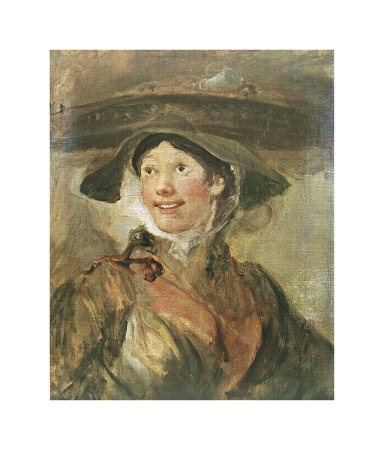
The Shrimp Girl, William Hogarth, about 1740–45. The National Gallery, London, NG1162.
 by Tom Gurney
Tom Gurney BSc (Hons) is an art history expert with over 20 years experience
Email: tomgurney1@gmail.com / Phone: +44 7429 011000
The Shrimp Girl: Introduction
A young woman looks to one side, her lips parted and the rim of a broad basket almost touching the top of her hat. William Hogarth gives her just enough room to turn her head. The basket of shellfish identifies her as a street seller. The eye goes first to the flicker of light on her teeth and the colour in her cheeks. The National Gallery, London, holds The Shrimp Girl as NG1162 and dates it to about 1740–45. The oil on canvas measures 63.5 × 52.5 centimetres. The sitter’s name is unknown. [1]
At a Glance
- ArtistWilliam Hogarth
- DateAbout 1740–45
- Medium and dimensionsOil on canvas, 63.5 × 52.5 cm
- CollectionThe National Gallery, London, NG1162
- AcquisitionBought in 1884
This work across William Hogarth’s career
Assembly at Wanstead House
1728–31The Heir
1734The Shrimp Girl (current article)
about 1740–45The Marriage Settlement
about 1743Gin Lane
1751Canvassing for Votes
1754–55Contents
- How Hogarth painted the turn of the head
- An unknown sitter and an approximate date
- The basket and the street cry
- From studio painting to printed cry
How Hogarth painted the turn of the head
The basket makes a broad arc across the upper part of the canvas. Below it, the irregular brim of the hat dips on one side and flares out on the other. Her shoulders turn across the picture and her eyes look towards the viewer’s left. That small shift of the eyes gives direction to a pose that might otherwise come across as a woman standing still to balance a load. Her parted lips admit several readings. She might be smiling at someone, about to speak or already calling out. The surrounding space gives us nobody to decide between them. [1]
The handling changes as the eye moves down from the face. Small shifts of tone shape the cheek and the corner of the mouth. The pale strokes around the jaw scarcely separate into individual folds. Lower down, broad, broken strokes suggest the cloak and the twist of the upper body. The reddish band across the front of her clothing is easy to follow for a moment, then dissolves into the darker paint. The attention lavished on the eyes and mouth makes it possible for the clothing to remain so loosely described. [1]
Judy Egerton’s catalogue explains how Hogarth made light part of the structure of the painting. He worked on a ground of lead white mixed with chalk. Beneath the hat, just to the left of the face, the light patch is exposed ground. The same pale preparation that can show through thin paint can also serve as a light area in its own right. It has greyed with age. Egerton also records Prussian blue in the hat paint, alongside black, white and a little yellow ochre. The dark brim can look almost black at first glance, but the pigment mixture points to a blue-grey. [2]
The canvas was cleaned and relined in 1966. Egerton describes the work as being in very good condition despite its thin paint, and notes slightly lighter strips at either side corresponding roughly to the width of the stretcher bars. The catalogue thus distinguishes two kinds of light area. The patch beside the face comes from the way Hogarth used the ground. The strips at the edges are changes in the paint. The painting’s sketch-like surface needs to be read with both its making and its condition in mind. [2]
An unknown sitter and an approximate date
The Gallery reads the work as a sketch painted from life. The sense of a person responding to something beyond the frame makes that reading persuasive, while leaving the circumstances of the sitting open. The tilt of the head and the loosely brushed clothing give an impression of speed. They provide little basis for estimating how long the sitting took, or where it happened. Egerton follows Mary Webster in giving about 1740–45 as the likeliest range. The evidence has yet to narrow it to a particular year. Whether Hogarth contemplated working up the sketch further also remains open. Egerton presents it as a study Hogarth valued in its own right, and it remained in his studio until his death. [1] [2]
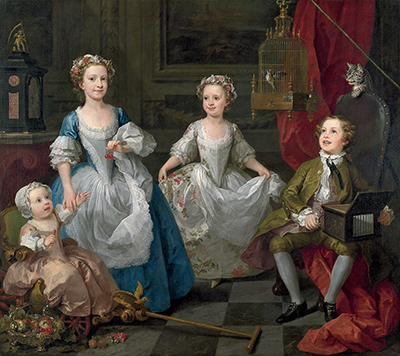
A comparison with The Graham Children shows how differently Hogarth could use objects to animate a portrait. That large oil, also in the National Gallery, is signed and dated 1742. Richard Robert sits with a bird organ while a cat climbs the back of a chair towards a caged goldfinch. The instrument, chair and cage draw the eye across the room and connect the children’s play to the cat’s movement. In The Shrimp Girl the basket and measure establish the woman’s occupation within the space of a head and shoulders. The glimpse of teeth has to carry much of the action that the family portrait distributes among four figures and the things around them. The comparison places the sketch within the range of Hogarth’s paintings while leaving its date approximate. [1] [2] [3]
Watch Hogarth’s paintings and prints
Five films on Hogarth’s painted stories, prints, drawing methods and work for the Foundling Hospital.
William Hogarth and the Foundling Hospital | HENI Talks
Caro Howell discusses Thomas Coram, Hogarth’s portrait of him and the artist’s work for the Foundling Hospital.
Watch on YouTubeThe basket and the street cry
The small vessel in the basket is identified by the National Gallery as a half-pint measure. It shows how the load might be divided into saleable portions as the woman made her rounds. Some darker shapes among the shellfish may be mussels, with cockles a further possibility. The hat resembles a sou’wester, and the Gallery suggests the clothing may include oilskin. These details give the figure the equipment of a mobile trade. Egerton connects the trade to Billingsgate, where itinerant sellers of shellfish, often women from fishmongers’ families, obtained their stock. That context gives the basket a practical meaning while leaving this particular woman’s household and route unknown. [1] [2]
Henry Mayhew’s nineteenth-century account gives a later example of how a measure and a call worked together. London sellers advertised the price and portion with the cry “a penny half-pint, fine fresh s’rimps”. Mayhew observed that the serving sold under that name in his day was smaller than a standard half-pint. One woman he interviewed moved between a stand and a round, sometimes exchanging places with her husband, and said that standing in the cold wore her down faster than walking. Her account belongs to the 1850s. It helps explain why the basket, protective clothing and ability to be heard mattered to the trade, while the eighteenth-century painting supplies no price or spoken words. [4]
Copies of Marcellus Laroon’s Cryes of the City of London made hawkers’ calls part of the printed image. An Amsterdam edition held by the Bibliothèque nationale de France gives the call “Crab, Crab, any Crab” with versions in French, Italian and Dutch. Those captions let readers outside London recognise the trade and imagine its sound. Hogarth may have known Laroon’s series, as Egerton suggests, and could also have encountered street sellers first-hand. Paul Sandby’s Shrimp girl, a 1759 watercolour and ink drawing in the London Museum, shows how differently another artist could depict the same trade. The museum describes Sandby’s seller as demure and identifies the drawing as a study for a further series of London Cries that remained unpublished. Hogarth’s figure, with her mouth open and her eyes tracking something to one side, makes the possibility of a call part of a particular encounter. [1] [2] [5] [6]
From studio painting to printed cry
The earliest known written reference appears to be John Nichols’s 1781 description of an oil sketch of a young fish seller in Jane Hogarth’s possession. On 24 December 1781, Richard Livesay published Francesco Bartolozzi’s stipple engraving after the painting, in a state before the addition of the title. On 25 March 1782, Jane Hogarth and Livesay published the version lettered Shrimps!. The Metropolitan Museum of Art holds an impression of that issue, 32.35(188), and the engraved copper plate, 21.55.1. It also holds a third-state impression reissued by Boydell and Co. in 1790. [2] [7] [8] [9]
The print reverses the painting, so the eyes now glance towards the right. The stippled dots translate the shifts of light and shadow around the face into ink. The clothing’s broad patches of colour become differences of tone. The exclamation beneath the figure makes an even more decisive change. In the painting, one can linger over whether she is smiling or speaking. In the lettered print, the word under the face supplies the call and gives the viewer a part in the exchange, as someone within earshot of the seller. [1] [2] [7]
The painting remained with Jane Hogarth until her death in 1789. At the sale of works she had kept, on 24 April 1790, Mathew Mitchell bought it under the title “The shrimp girl, a sketch”. His own sale at Christie’s in 1819 described the same canvas as An Oyster Woman, a Sketch. It later belonged to George Watson Taylor and then to the Miles family of Leigh Court near Bristol. Agnew’s bought it for the National Gallery at the Miles sale in 1884. In 2023 it was exhibited as The Shrimp Girl in Hogarth’s Britons at Derby Museum and Art Gallery. The changeable names in the sale catalogues tell us how owners and sellers described the picture. The print gives her a cry and the catalogues give her a trade. Her sidelong glance, still directed outside the frame, leaves her attention somewhere we cannot follow. [1] [2] [10]
Browse Hogarth’s artworks
All 54 individual artworks and series stages in the approved English cluster
Frequently Asked Questions
Her name is unknown. The basket and shellfish identify her as a street seller. [1]
Discussion
Look again at the images and ideas explored in The Shrimp Girl. These editorial prompts invite your observations.
Reader Insights
How do the direction of the seller’s eyes and the glimpse of her teeth shape your reading of her expression?
How does the addition of the word Shrimps! beneath Bartolozzi’s print change the way you read the seller’s open mouth?
Join the Conversation
Share a detail, comparison or question about The Shrimp Girl below.
References
- The National Gallery, London, The Shrimp Girl, William Hogarth, collection record NG1162. View source.
- Judy Egerton, The Shrimp Girl, in The British Paintings, National Gallery Company and Yale University Press, 2000, NG1162, provenance, engraved states, technical notes and discussion through p. 185. View source.
- The National Gallery, London, The Graham Children, William Hogarth, collection record NG4756. View source.
- Henry Mayhew, London Labour and the London Poor, vol. I, “Of Shrimp Selling in the Streets”, p. 76 and following, transcribed by The Dictionary of Victorian London. View source.
- Bibliothèque nationale de France, The Cryes of the City of London, drawne after the Life, designs by Marcellus Laroon, Amsterdam edition published by Jacob Gole, catalogue record cb46983705w. View source.
- London Museum, Shrimp girl, Paul Sandby, watercolour and ink on paper, 1759, 65.59/9. View source.
- The Metropolitan Museum of Art, Shrimps!, stipple engraving by Francesco Bartolozzi after William Hogarth, published by Jane Hogarth and Richard Livesay on 25 March 1782, 32.35(188). View source.
- The Metropolitan Museum of Art, Shrimps!, stipple-engraved copper plate by Francesco Bartolozzi after William Hogarth, 21.55.1. View source.
- The Metropolitan Museum of Art, Shrimps!, stipple engraving by Francesco Bartolozzi after William Hogarth, third state, reissued by Boydell and Co. in 1790, 21.72(3). View source.
- Derby Museums, “World-class Hogarth exhibition opens in Derby this March”, 6 March 2023, loan and exhibition dates for Hogarth’s Britons. View source.