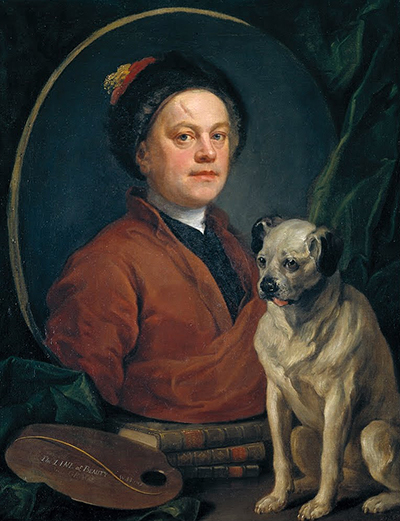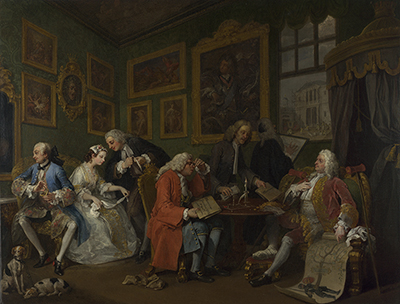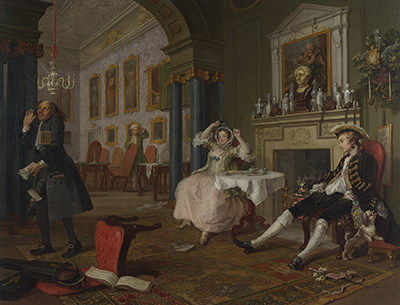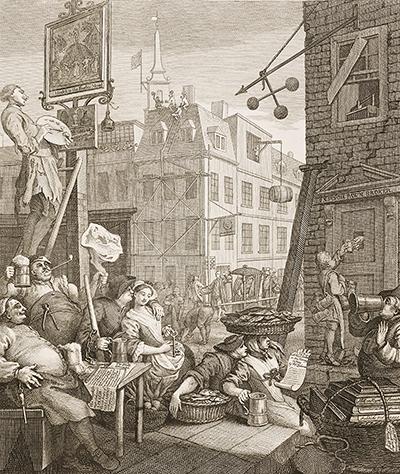
An Election Entertainment, William Hogarth, 1754–55. Oil on canvas. SM P53. The Yorck Project via Wikimedia Commons. Image source. Public domain.
 by Tom Gurney
Tom Gurney BSc (Hons) is an art history expert with over 20 years experience
Email: tomgurney1@gmail.com / Phone: +44 7429 011000
The Humours of an Election: Introduction
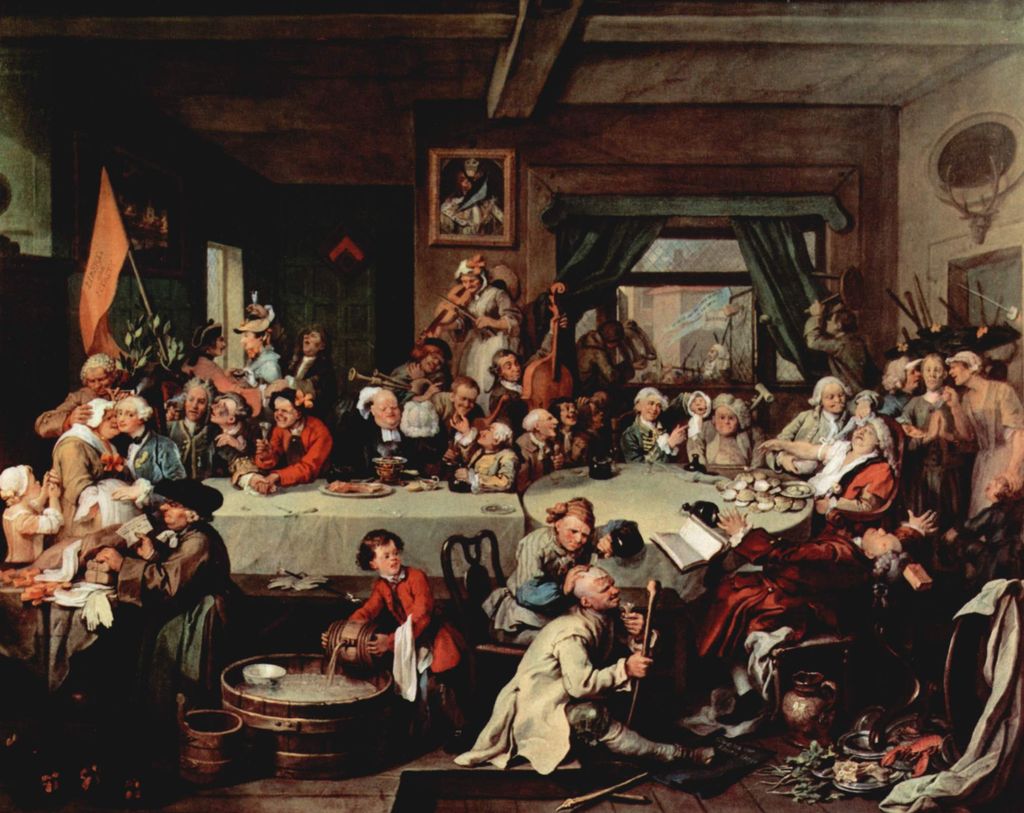
A brick comes through the window of an inn during an election dinner. The party secretary reels backwards with his ledger open, and his categories of sure and doubtful votes go tumbling with him. At the other end of the table, two candidates submit to the embraces and handshakes of people whose company they might ordinarily avoid. William Hogarth begins The Humours of an Election at the point where a party is still trying to turn a roomful of people into a reliable count. Three pictures later, a successful candidate is in the air, equally dependent on the people below him. [1] [2]
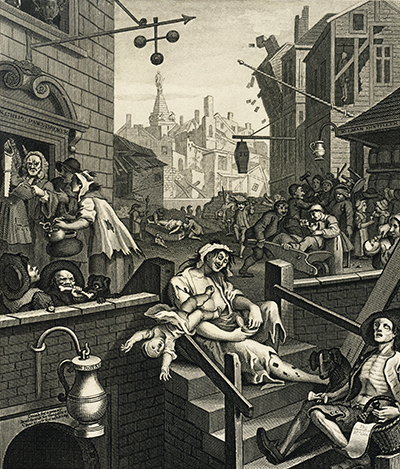
Hogarth took the fiercely contested Oxfordshire county election of 1754 as the starting point for his satire. The four oils on canvas, dated 1754–55 by Sir John Soane’s Museum, follow a feast, a canvass, a poll and a victory procession. Each is about a metre high and roughly 1.3 metres wide. Across that consistent format, Hogarth changes the arrangement of people and the obstacles between them. A window gives way to rival inn fronts, a raised platform and a bridge. The setting is Hogarth’s invented Guzzledown. In Four Prints of an Election, the related series of etchings and engravings, the scenes retain their narrative order even though the lettered dates on the sheets run differently. [1] [2] [3] [4] [5]
At a Glance
- SeriesFour paintings and four corresponding prints
- PaintingsAbout 1754–55
- Painted series held bySir John Soane’s Museum, London
- Historical contextThe 1754 Oxfordshire election
Contents
- From the dinner table to the victory chair
- The Oxfordshire campaign before the poll
- What the eleven days meant
- How the Tory lead became a Whig victory
- What changed on copper and paper
- Garrick, Soane and the series in public
The four scenes
An Election Entertainment
An Election Entertainment, William Hogarth, 1754–55. Oil on canvas. SM P53. The Yorck Project via Wikimedia Commons. Image source. Public domain.
The Polling
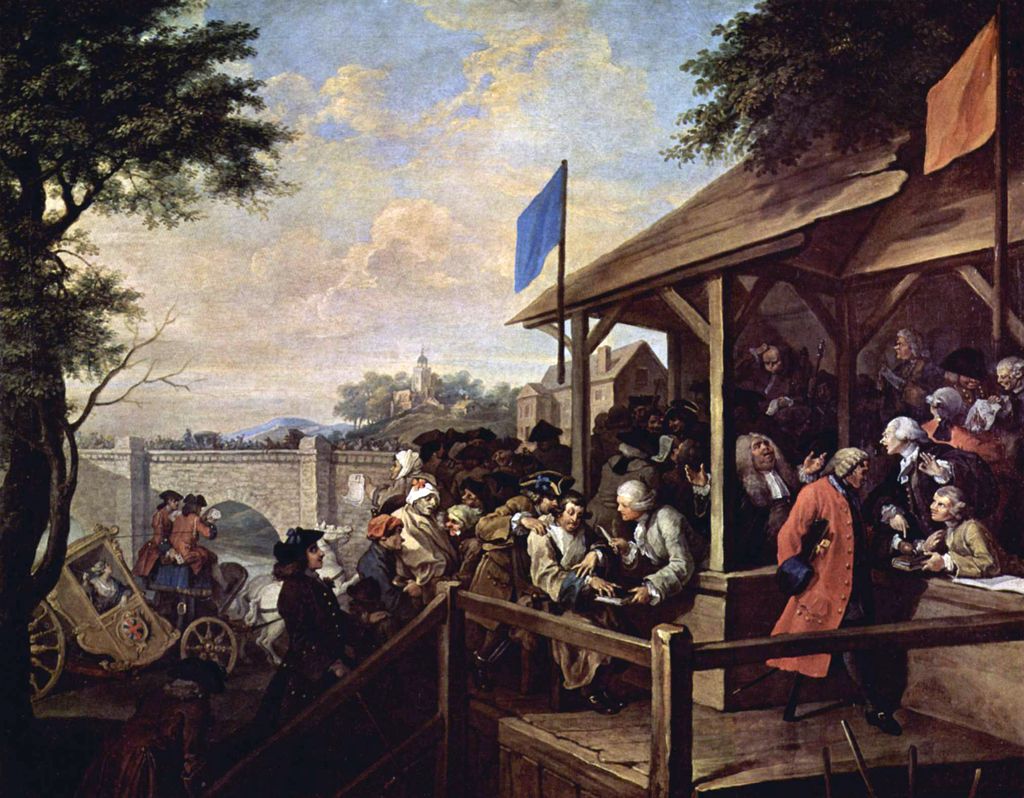
The Polling, William Hogarth, 1754–55. Oil on canvas. SM P73. The Yorck Project via Wikimedia Commons. Image source. Public domain.
Chairing the Member
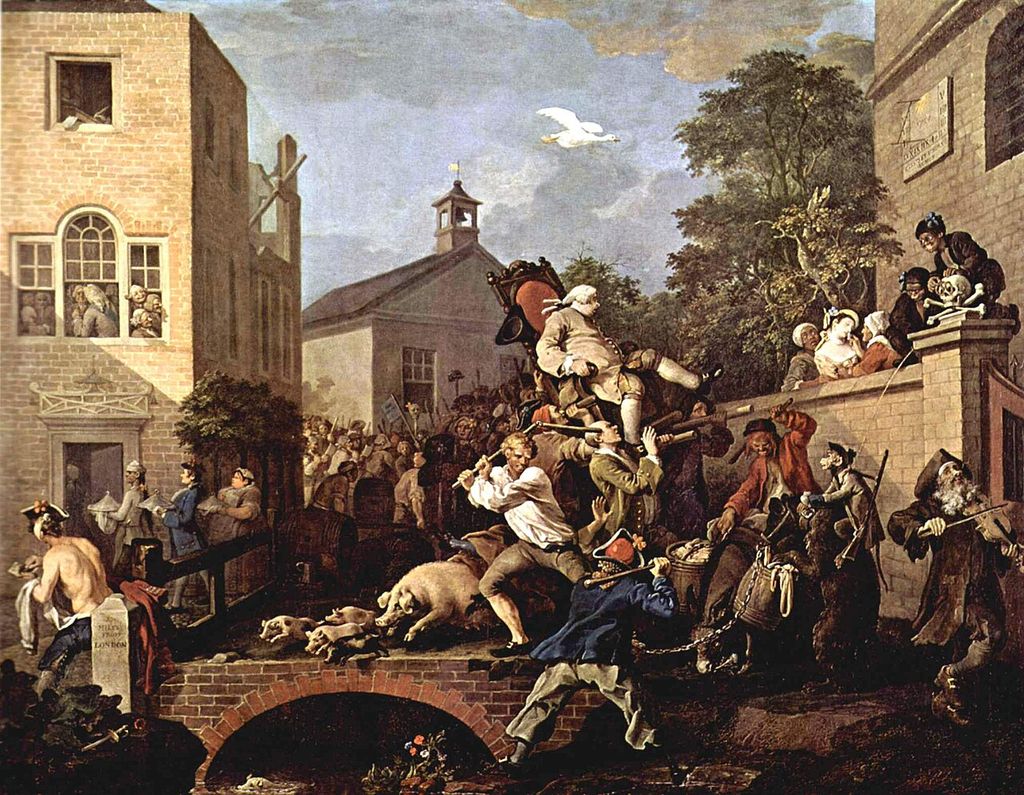
Chairing the Member, William Hogarth, 1755. Oil on canvas. SM P78. The Yorck Project via Wikimedia Commons. Image source. Public domain.
From the dinner table to the victory chair
I. An Election Entertainment
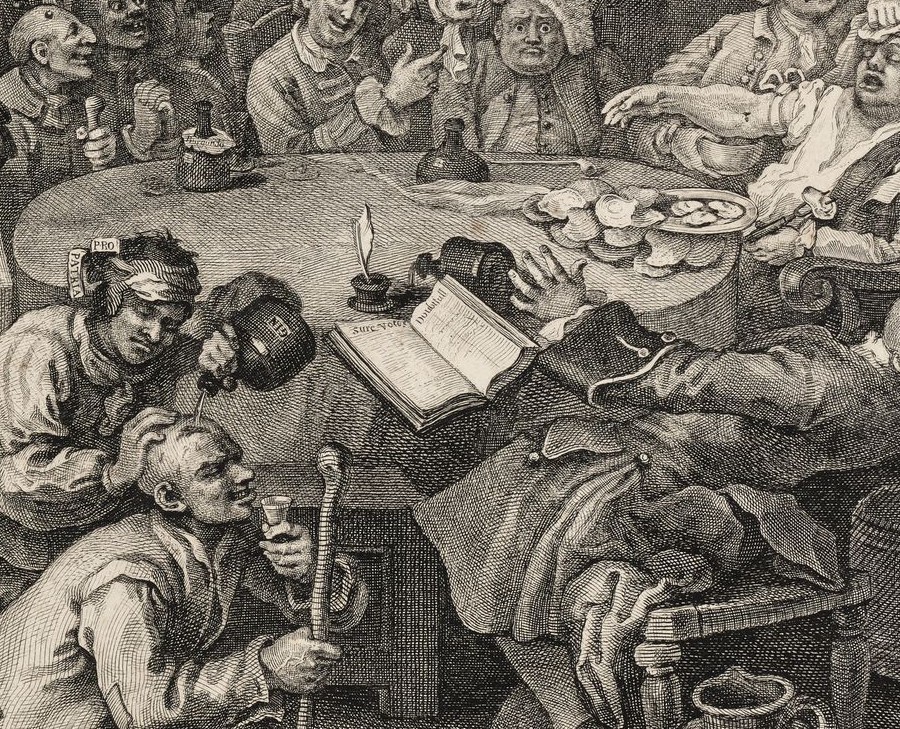
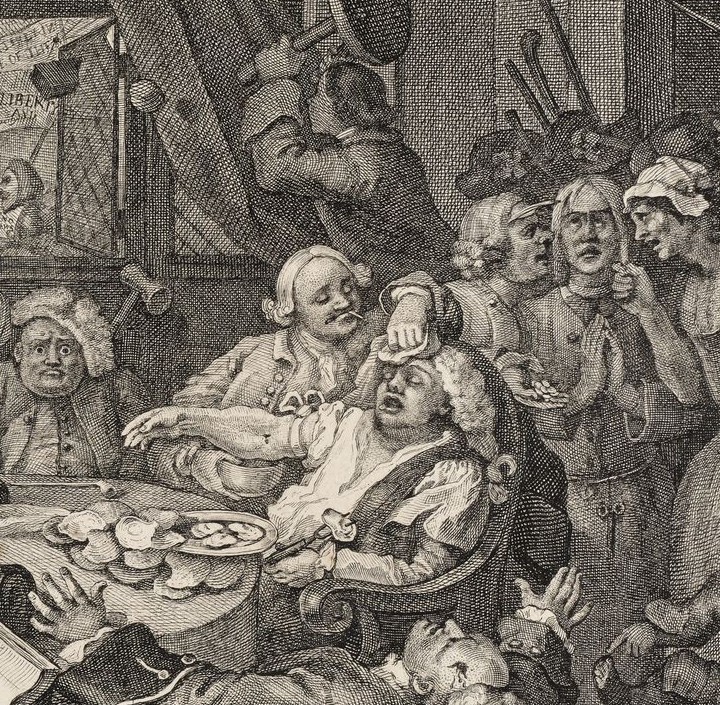
In An Election Entertainment, the Whigs have put on a feast. Follow the table from the candidates at one end to the mayor at the other. An elderly woman leans in to kiss one candidate, and a man in a leather apron clasps the hand of his running mate. The mayor has slumped so far into his chair that his robe is slipping off. The museum reads the bowl beneath his arm as evidence of an attempt to bleed him after a surfeit of oysters. A little arrangement of shellfish, plates and vegetables lies on the floor nearby. The food that attracts the eye also brings the consequences of the feast into the foreground. [1]
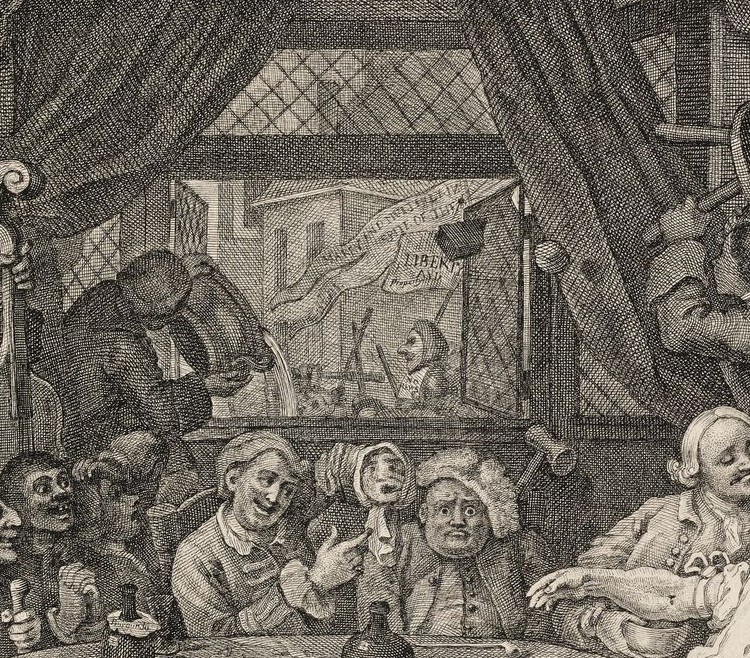
The window makes the feast a public affair. The Old Interest march outside, where their placards can be seen by the company inside. Bricks come one way and the contents of a chamber pot go the other. At ground level within the room an agent holds out money to a gaunt man who has clasped his hands. His child’s toes show through a shoe. The crowded room makes it possible to see the price of accepting a favour and the price of refusing one within the same gathering. [1]
II. Canvassing for Votes
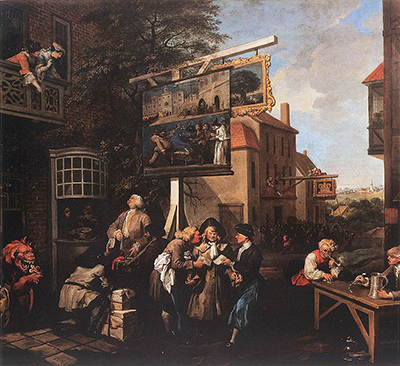
The space opens out in Canvassing for Votes. Hills and a distant church lie beyond the village street. Nearer to us, the dressier frontage of the Royal Oak and the rival Crown establish opposing stations in a contest for passing trade and passing voters. Under the Royal Oak sign, a man in a heavy coat is offered money and invitations to dine from both directions. His body is almost still, and his sideways look makes the two urgent approaches seem all the more calculated. The candidates who endured the voters’ attentions in the first scene can now leave an exchange to their intermediaries. [3]
Above the canvassers hangs an advertisement that makes the flow of money into the county visible. A wagon marked Oxford receives treasure from the Treasury, and farther down the cloth, a puppet-like Punch pushes a barrow of money as country people hold out their hats. Hogarth has put a little political cartoon inside the painting, where it can be read alongside the smaller transaction at street level. The Oak sign carries its own allusion to the tree in which Charles II hid after Worcester. A familiar sign of royal allegiance thus hangs above a satire on the use of government money to secure parliamentary influence. [3]
III. The Polling
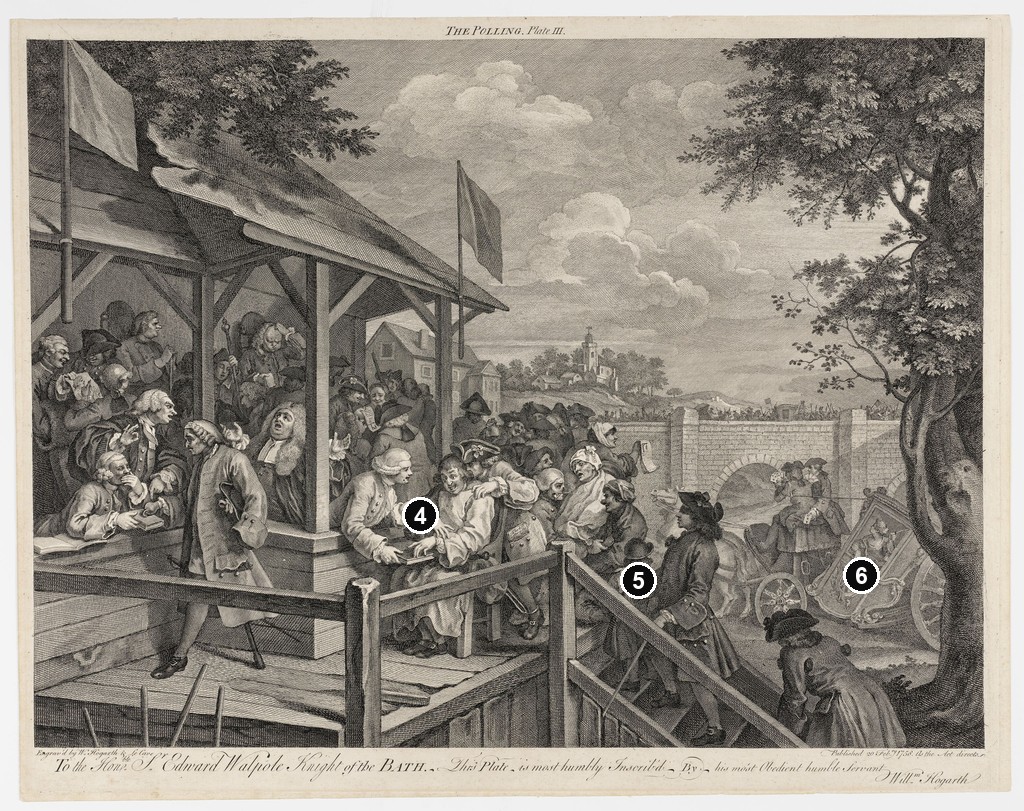
At The Polling two candidates sit on a wooden platform, watching a process they depend on other people to manage. An army veteran with a hook in place of a hand comes forward to swear his qualification. The figures arguing behind him direct the eye to the point where the hook meets the book. Farther down the approach, men carry voters to the poll, and the stairs turn the movement of the queue into a series of visible difficulties. In the distance the traffic on a bridge thickens into a struggle of its own. Hogarth makes the approach to the booth as important to the scene as the declaration that takes place there. [4]
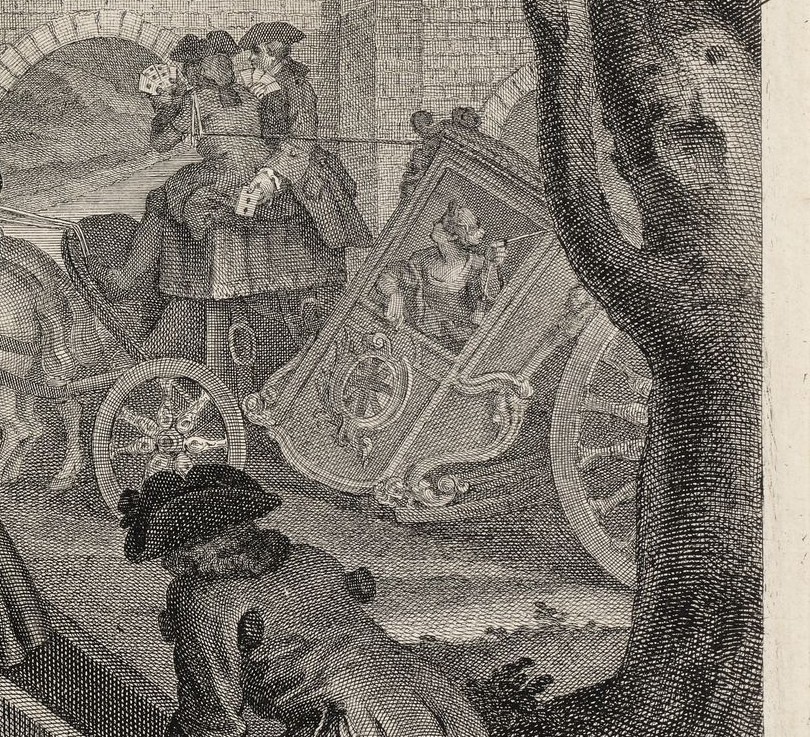
On the opposite side of the painted booth, a carriage has broken down. A woman inside tries to steady herself, and the coachmen are absorbed in cards. One conceals the three of clubs. The Union emblem on the coach door helps identify its passenger as Britannia. The emblem gives the neglected breakdown a national scale, while the hidden card brings the joke back to the ordinary conduct of two people who are supposed to get her safely to her destination. [4]
IV. Chairing the Member
In Chairing the Member, a ritual intended to display a winner creates a new problem of visibility. The winning candidate can be seen above the crowd, but his chair is pitching and his raised arm does little to steady it. Below him, a labourer’s backswing catches a bearer, and a sow and her piglets make for the stream. A second chaired figure is much farther away. People at the windows of the building on the left have a view across the commotion, and the church wall and the bridge divide the paying of public honours into a succession of collisions and stoppages. [2]
The painted sundial bears the year 1755 and a line from Horace about human beings amounting to dust and shadow. Its architectural stillness gives the spectator time to read a judgment that the man in the chair hardly has time to consider. Joanna Tinworth’s Soane catalogue entry also draws a comparison with Charles Le Brun’s The Battle of Arbela. The grand battle analogy suits a scene that gives a fight near a stream and an unsteady chair the scale of a public triumph. By the last canvas, the artist has found a way to make even the elevation of a successful candidate look like a temporary accident of crowd movement. [2]
The Oxfordshire campaign before the poll
For Oxfordshire’s two county seats the Old Interest fielded Philip, Viscount Wenman, and Sir James Dashwood. The New Interest put up Thomas, Viscount Parker, and Sir Edward Turner, with the support of the Duke of Marlborough and Lords Macclesfield and Harcourt. The Newcastle University electoral history project traces the challenge to 1752 and identifies help from Henry Pelham’s administration. It records Pelham’s promise of £7,000 for the New Interest and estimates Old Interest expenses at £20,000, with £8,000 raised by public subscription. The commitment and the expenditure estimate describe different things. The painted sacks show how a promise of support could be converted into a story about the Treasury emptying itself into a county contest. [6] [3]
There were ways to take part in that contest well beyond the electorate. Lady Susan Keck, a New Interest organiser, described dining with hundreds in the hall and staying up until five in the morning in a letter to her nephew, the Duke of Hamilton. The scale of drinking was part of her boast. In a letter about a planned Banbury treat in April 1753, she regretted that the candidates might miss a chance to appear among freeholders already angry with Dashwood. A well-timed visit, she suggested, might bring twenty or thirty votes. Elaine Chalus traces these judgments through Keck’s correspondence. They show how an organiser could watch both the disposition of a gathering and whether a candidate had made himself present at the right moment. [7]
A local comparison comes from Chipping Norton, where both interests used the September 1753 races for canvassing and held rival dinners. The Victoria County History’s account, based on newspaper and archival records, follows the rivalry to 1 February 1754. New Interest supporters meeting at the Talbot stormed an Old Interest dinner at the White Hart and assaulted the landlord, William Heynes, whom they accused of being a Catholic and a Jacobite. The recorded attack gives a close parallel for the combination of eating, allegiance and disruption in Hogarth’s opening. The factions are arranged differently. The attack at Chipping Norton came from New Interest supporters, while the assailants at Hogarth’s window belong to the Old Interest. [8] [1]
The competition also took place in print. The mock newspaper News, Boys, News! or the Electioneering Journal, dated 11 April 1753, used invented news and advertisements to ridicule Wenman, Dashwood and their supporters. The Oxfordshire History Centre identifies a rival version a fortnight later promoting the Old Interest. The newspaper format could make a partisan invention look like a dispatch from elsewhere, much as the advertisement on the Royal Oak gives Hogarth’s invented Punch the trappings of an actual candidate. In each case the form of a public announcement is part of the joke. [9] [10] [3]
What the eleven days meant
The captured banner on the floor of An Election Entertainment reads “Give us our Eleven Days.” September 1752 had passed from the second straight to the fourteenth as Britain adopted the Gregorian calendar. By putting the banner inside a Whig election dinner and showing a Tory procession beyond the window, Hogarth makes the calendar grievance one piece of party equipment. Viewers could recognise an attack on a reform associated with the government. Parker’s father, the Earl of Macclesfield, had helped bring the calendar change about, which gave the subject a particularly local political use in Oxfordshire. [1] [11]
Historian Robert Poole traced the familiar story that mobs believed Parliament had stolen eleven days of their lives. In 1820 the barrister James Scarlett cited Hogarth’s picture when recalling this supposed example of popular folly. Poole also examined a verse commentary from 1759 that understood the disturbance as part of the election. In the contemporary Oxford press, he found jokes tying the New Style to the New Interest, including a mock set of resolutions against both published in Jackson’s Oxford Journal on 12 May 1753. That gives the painted banner a context in the campaign. The later reading turned a message brandished in an electoral satire into testimony about a different occasion. [11]
Watch Hogarth’s paintings and prints
Five films on Hogarth’s painted stories, prints, drawing methods and work for the Foundling Hospital.
William Hogarth, Marriage A-la-Mode (including Tête à Tête)
A close look at Tête à Tête and how its figures and furnishings advance the story of the marriage.
Watch on YouTubePoole found evidence of responses to the new dates in the observance of holidays and customary festivities. People watched for the sacred thorn’s flowering around both the old and the new Christmas. At Glastonbury itself, reports put the flowering on the old date, and the vicar later said it had flowered nearer the new one. In Oxfordshire, the press mentioned games on Old Michaelmas Day and recorded a Whig correspondent complaining about maypoles erected on Old May Day. Keeping an old feast day could express attachment to a familiar local practice and, during an election, acquire a party meaning. These records document particular choices about when to celebrate. The case for widespread calendar riots in 1752 depends on evidence that the painted placard itself cannot supply. [11]
Annotated Details from The Humours of an Election
Compare the dinner and polling scenes in two impressions from the Petit Palais. Each crowd has its own practical business to conduct.
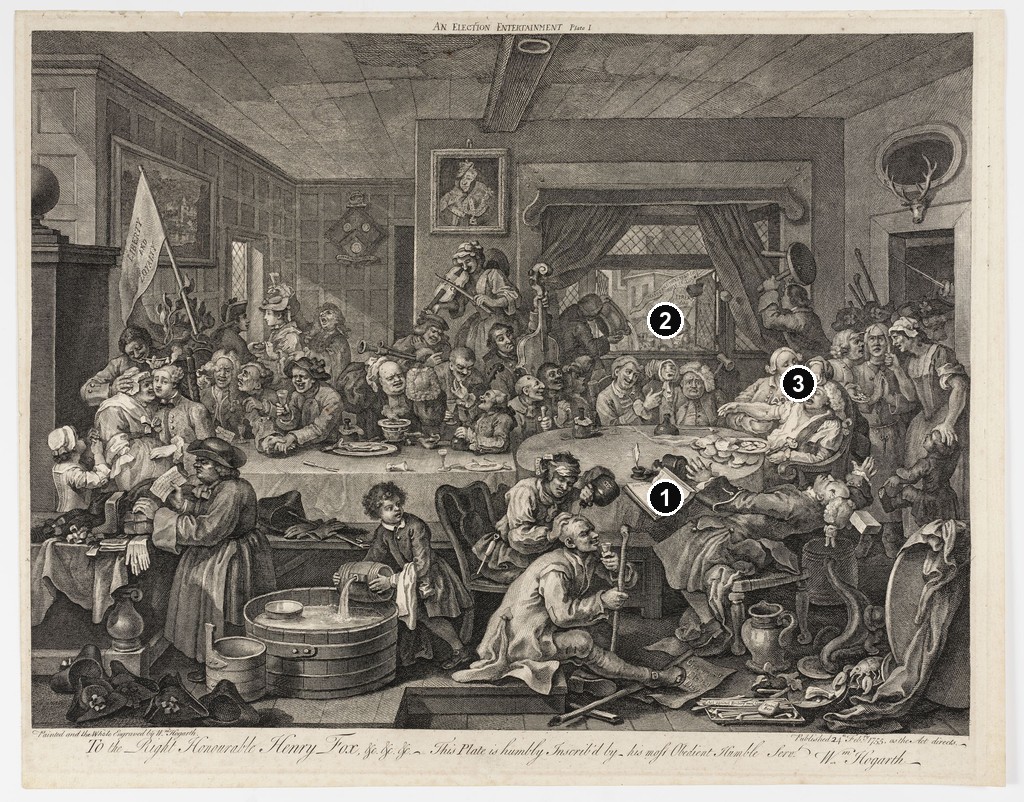
An Election Entertainment, Plate I
An Election Entertainment, Plate I, William Hogarth. Petit Palais, Paris, PPG6040. Collection record.
The Polling, Plate III
The Polling, Plate III, William Hogarth and François Morellon de La Cave. Petit Palais, Paris, PPG6042. Collection record.
Details from THE HUMOURS OF AN ELECTION
Select a numbered point for a closer look.
An Election Entertainment, Plate I
The secretary’s ledger
The secretary recoils, letting the open ledger tip towards the table. An election still has to be counted even while the dinner turns chaotic.
A crowd at the window
People are visible beyond the large window at the back of the room. The gathering outside takes part in the election from a different position.
A plate at the mayor’s elbow
A man leans back while a neighbour puts a hand near his head. Hogarth places this small crisis beside the food and the people who keep eating.
The Polling, Plate III
At the polling booth
Hands and papers cluster around the table where votes are recorded. Track the gestures to see how a formal oath can become a subject of argument.
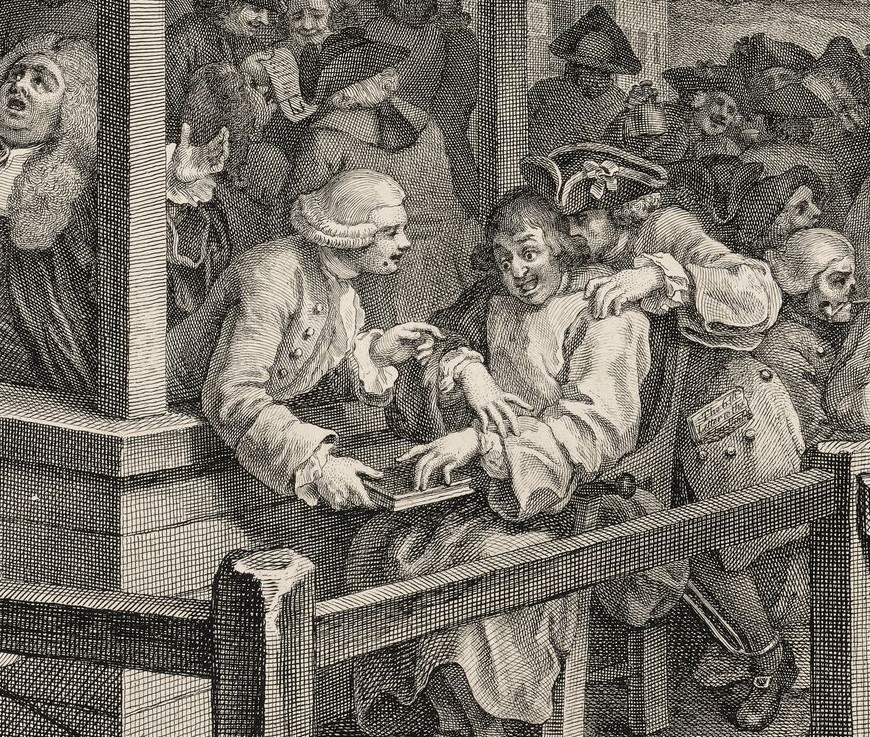
The steps up to the vote
People approach the booth along a raised passage. Compare the people who can move readily through it with those who need companions or help.
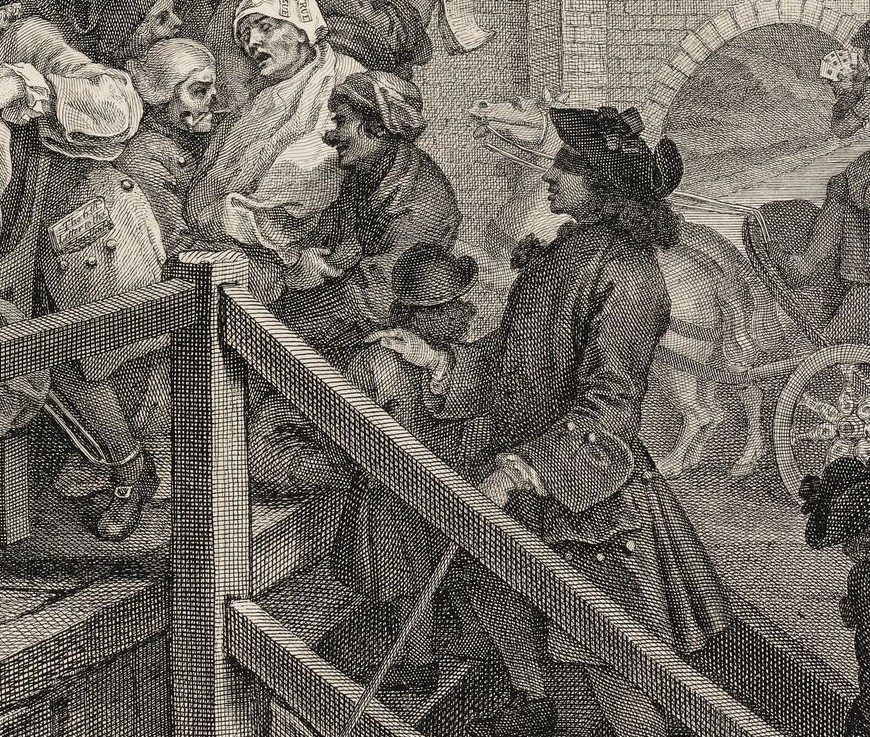
The broken-down coach
A coach carrying Britannia tilts at the right. The trouble in the distance gives the voting scene a wider political setting.
How the Tory lead became a Whig victory
The Poll of the Freeholders of Oxfordshire, printed at the Theatre in Oxford in 1754, names the high sheriff Thomas Blackall and specifies the six days of polling, 17, 18, 19, 20, 22 and 23 April. The Oxfordshire History Centre reproduces a page on which one elector occupies one row and the candidates have four separate columns. The county vote depended on a qualifying freehold worth at least forty shillings a year. Votes were given openly, and an elector could support two candidates for the two seats. The Newcastle project counts 3,938 electors who voted. The names in the book and the marks in the candidate columns answer distinct questions about the scale of the poll. [12] [10] [6]
A surviving printed notice that may have been displayed at the booths warns copyholders and customary tenants against swearing that they were freeholders. It threatens a £20 penalty or having their ears nailed to the pillory. Its concern is the qualification claimed by a person taking an oath. In Hogarth’s booth, the men disputing an oath fasten on the way the veteran touches the book. The notice helps explain why the apparently small gesture is politically consequential. The painting turns a procedure for testing a claim into an argument over a voter’s body. [13] [4]
Access mattered before anyone could swear. Newcastle’s study records that Old Interest supporters obstructed the Broad Street poll, and that Exeter College let New Interest voters reach it from behind by a side entrance. In the painting the bridge and the stairs supply Hogarth with their own points of pressure. The historical obstruction is sufficiently specific to explain what a crowd could do to an open poll without requiring the bridge or the booth to reproduce Oxford’s layout. [6] [4]
The contemporary Political arithmetick records the numbers at the close of polling on 23 April. Wenman had 2,033 votes, Dashwood 2,014, Parker 1,919 and Turner 1,890. The next day Blackall declared the Old Interest ahead. Parker and Turner demanded a scrutiny, or review of the votes. The pamphlet dates it from 9 to 30 May and says the sheriff then returned all four names. Newcastle’s account records 347 Old Interest votes disqualified at the scrutiny. The “double return” sent the rival claims to Parliament for two seats, and both sides petitioned. [14] [6]
The dispute outlasted the campaign and the poll. Newcastle’s account records that more than a thousand votes were challenged from 1755 as the Commons took up the case. On 23 April 1755 the House resolved in favour of Parker and Turner. The Old Interest could nevertheless put its own reading of the crisis into an object to be used at a table. A surviving salt-glazed stoneware mug names Wenman and Dashwood and calls for the Old Interest to endure and for there to be no double return. The mug makes the disputed procedure part of an expression of party allegiance. Hogarth’s chairing shows an apparent Tory victory already turning precarious, an apt fiction beside a contest in which the initial leaders and the men finally seated were different pairs. [6] [15] [16] [2]
What changed on copper and paper
The first painted scene and the Petit Palais impression PPG6040 keep the candidates and the slumped mayor on the same respective sides. The later three impressions reverse their painted compositions. The first plate also revises one small document at the front of the room. In the oil, the Soane catalogue reads the amount as twenty pounds. In the engraved version the sum is fifty, payable after six months, and the recipient acquires a name, Abel Squat. So does the man who signs it, Richard Slim. The instrument puts an exact sum and two parties to an obligation into the viewer’s hands. It also puts a delay on a reward in a scene in which the food and drink are available at once. With the new wording, a viewer can trace who owes whom and when the money is due. [1] [17] [18] [19] [20]
In The Polling, the effect of reversal is especially clear because the two main actions remain at opposite ends of the picture. Britannia’s coach is on the left of the Soane oil and on the right of Paris impression PPG6042. The oath and its disputants change sides too. The coach thus survives as a distinct incident even though its place in a left-to-right inspection has changed. In Chairing, a different kind of change occurs in the lettering. The Soane title names a single member, the figure who commands the foreground, while PPG6043 is lettered Chairing the Members. The plural draws attention back to the second chair in the distance. [4] [19] [2] [20]
The subscriber’s chronology begins earlier than the first completed print. Princeton’s surviving receipt is dated 20 March 1754, before the April poll, after the county campaign was already well under way. The Petit Palais copy of plate I bears the date 24 February 1755, credits Hogarth with both painting and engraving the whole, and dedicates it to the Right Honourable Henry Fox. Soane’s catalogue places the announcement that the first plate was ready in February 1755. In a February 1757 newspaper notice Hogarth attributed the delay of the remaining plates to difficulty finding suitable engravers and gave subscribers Christmas as the expected time. The museum dates their actual issue to 1758. [21] [17] [1]
The Paris impressions preserve the division of work across the delayed plates. Canvassing for Votes, dated 20 February 1757 in its margin, credits Hogarth as painter and Charles Grignion as engraver. It is dedicated to Sir Charles Hanbury Williams, identified there as ambassador to the Russian court. The Polling, dated 20 February 1758, names Hogarth and Le Cave as engravers and is dedicated to Sir Edward Walpole, Knight of the Bath. Chairing the Members, dated 1 January 1758, names Hogarth and the collaborator whose surname the Petit Palais transcribes as Aviline. Princeton identifies him as François Antoine Aveline. The dedicatee is the Honourable George Hay, one of the Lords Commissioners of the Admiralty. On the sheets, the story’s final act carries a date earlier than its third. The dated notice and the documented year of issue are better evidence for when a subscriber could expect to have a complete set. [18] [19] [20] [22] [1]
Some surviving prints preserve a less settled account of how their plates were made. The Morgan Library & Museum catalogues an impression of An Election Entertainment with part of the engraved credit heavily scored through. The Paris sheet’s declaration that Hogarth engraved the whole plate is the wording of that impression. Read together, the two records show why the inscription on one sheet cannot settle every question about work on the copper. The four dedications, meanwhile, make the ties to titled people and public office visible beneath pictures largely concerned with what such ties can buy. [23] [17] [18] [19] [20]
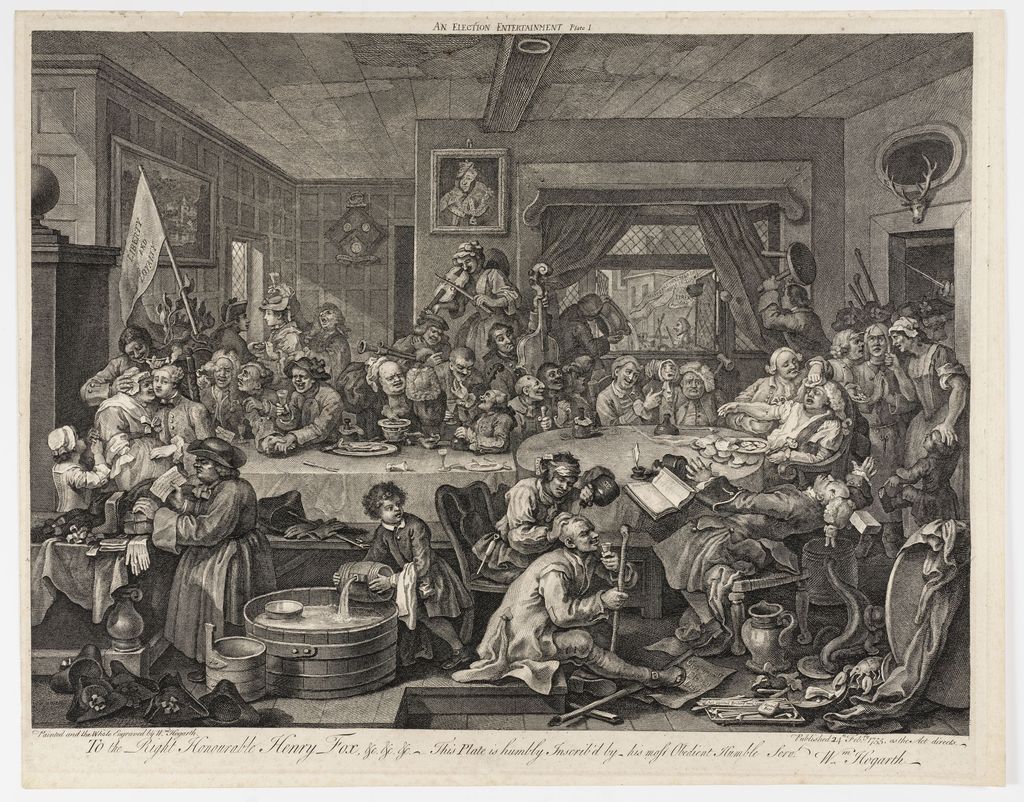
An Election Entertainment, William Hogarth, 1755. Etching and engraving. PPG6040. Paris Musées / Petit Palais, Musée des Beaux-Arts de la Ville de Paris. Image source. CC0 / Public domain.
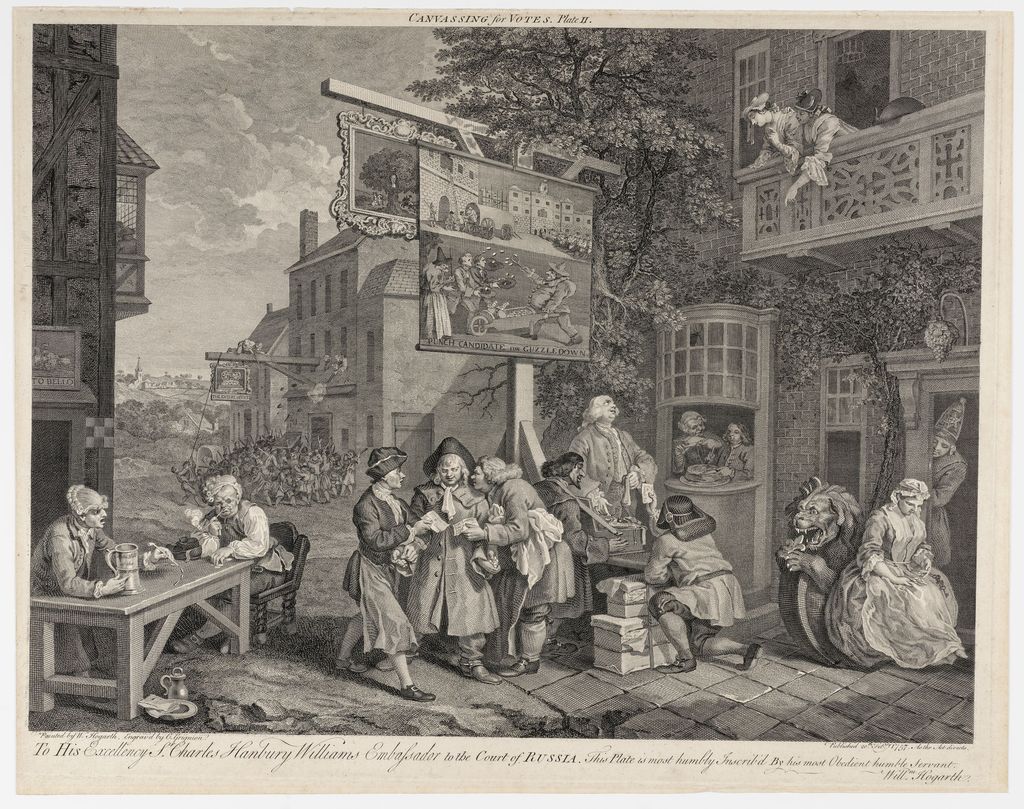
Canvassing for Votes, Charles Grignion after William Hogarth, Plate dated 20 February 1757. Etching and engraving. PPG6041. Paris Musées / Petit Palais, Musée des Beaux-Arts de la Ville de Paris. Image source. CC0 / Public domain.
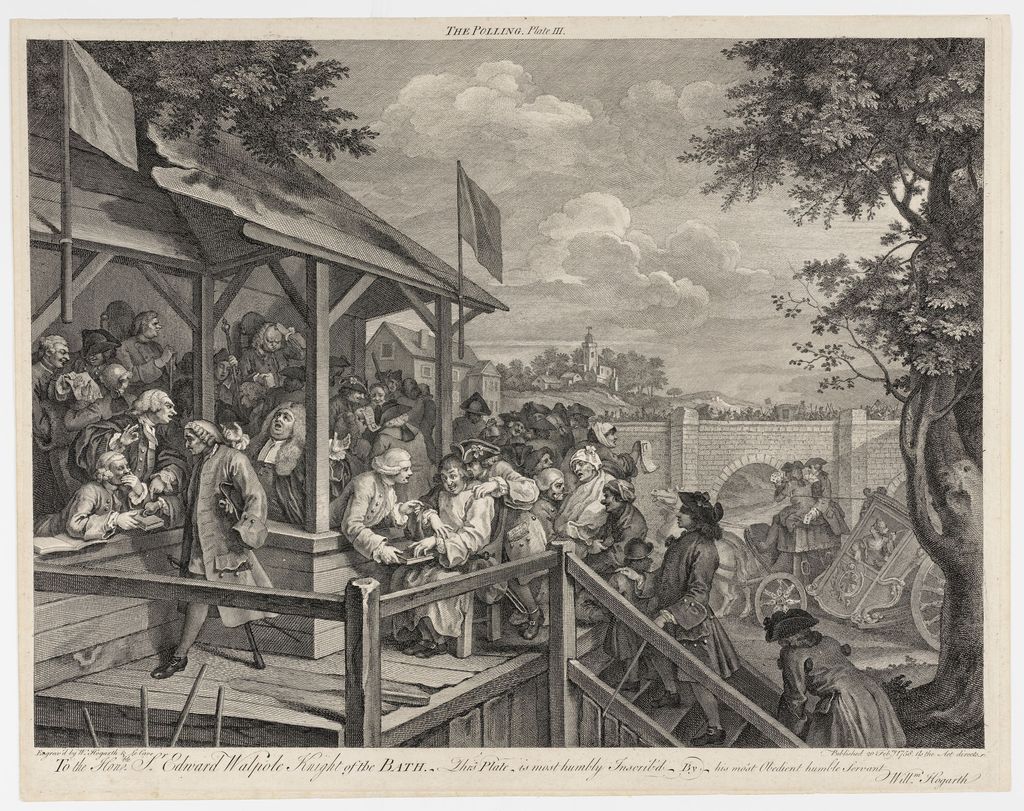
The Polling, William Hogarth and François Morellon de La Cave, Plate dated 20 February 1758. Etching and engraving. PPG6042. Paris Musées / Petit Palais, Musée des Beaux-Arts de la Ville de Paris. Image source. CC0 / Public domain.
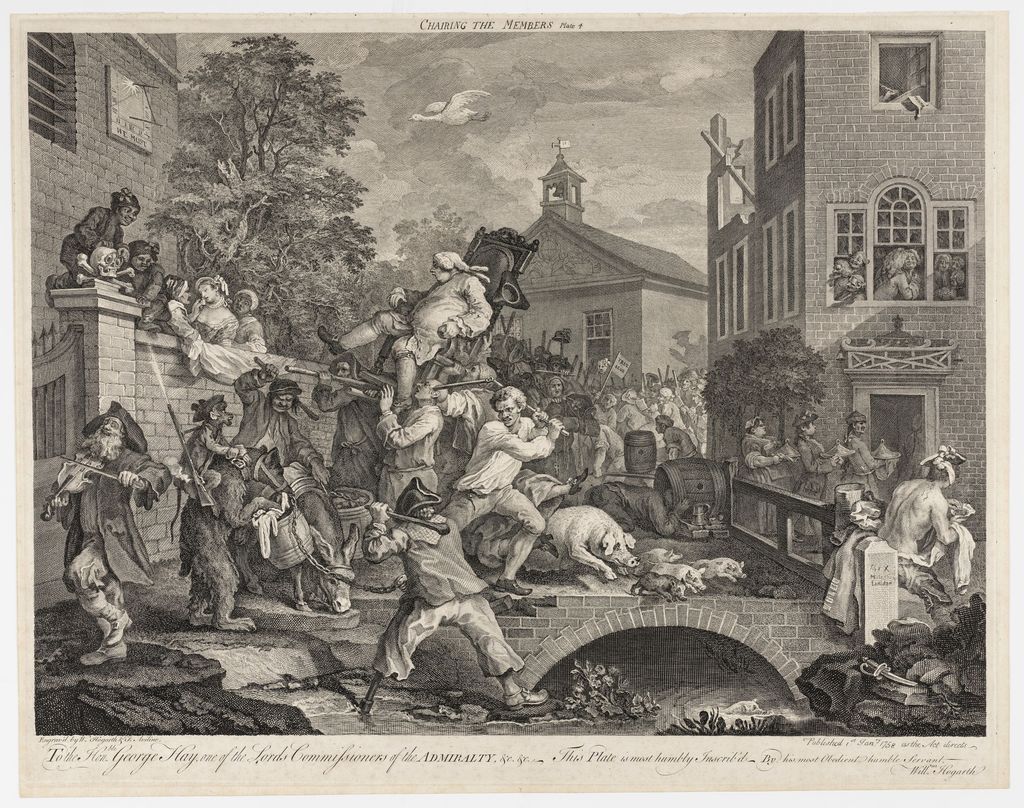
Chairing the Members, William Hogarth and François-Antoine Aveline, Plate dated 1 January 1758. Etching and engraving. PPG6043. Paris Musées / Petit Palais, Musée des Beaux-Arts de la Ville de Paris. Image source. CC0 / Public domain.
Garrick, Soane and the series in public
The paintings passed directly from Hogarth to the actor David Garrick, around 1762 according to the Soane provenance entries. The early price was remembered in different units. In 1802 the diarist Joseph Farington recorded Benjamin West’s recollection of Garrick telling how he had first put his name down for a raffle ticket at two guineas, then returned to give Hogarth a draft for 200 guineas and took the canvases. John Britton put the price at about £200 in his 1827 account. Farington’s entry preserves what West remembered Garrick saying decades earlier. The ownership has a firmer public anchor by 1814, when Mrs Garrick lent the set to the British Institution’s exhibition of Hogarth, Richard Wilson, Thomas Gainsborough and Johan Zoffany. [1] [24] [25] [26]
On 23 June 1823 Soane bought the oils at Christie’s sale of Mrs Garrick’s effects. His notebook records 1,650 guineas, equivalent to £1,732 10s. Britton recalls the auctioneer borrowing the language of the returning officer to declare Soane the successful candidate. The elaborate mid-eighteenth-century frames also belong to the history of the set, although their original commissioner is uncertain. Soane installed the pictures in his Picture Room at Lincoln’s Inn Fields, where movable planes let him gather far more pictures than the fixed walls could hold. The series had begun with the public display of rival allegiances. In Soane’s room the four large canvases became part of an architectural arrangement that invited a viewer to compare one sequence of pictures with another. [1] [25] [27]
Prints had a separate collecting life. The four named Petit Palais sheets, PPG6040–PPG6043, came from Frédéric Ogée as a gift recorded on 15 May 2023. Mrs William H. Walker II gave a separate impression of Chairing the Members, x1988-78, to Princeton University Art Museum. These are histories of particular impressions. The engraved titles and numbered plates allow a museum or collector to identify a single sheet’s place in the narrative even when its companions are elsewhere. The Garrick and Soane transactions account for the four canvases remaining together. [17] [18] [19] [20] [22] [1]
For the nineteenth-century election historian Joseph Grego, Hogarth’s work was a place to look for incidents from the Oxfordshire contest. Grego illustrated his history with the prints and observed how much more familiar they were to the public than the paintings in Soane’s museum. The modern Newcastle election project places the four scenes alongside contemporary artefacts and voter data, where each helps answer a different question about the campaign. The Soane’s 2019 Hogarth: Place and Progress brought several painted series together, making it possible to compare the Election’s wide, populous compositions with the stages of the Rake’s or the married couple’s lives. The poll book records whose votes could be counted. Hogarth gives the whole town a part in the affair. [28] [6] [29] [1]
The Soane has also traced a later artist’s use of this kind of crowd. Its Enlightened Turner exhibition links Hogarth’s series to J. M. W. Turner’s The Northampton Election, 6 December 1830. Turner made the watercolour around 1830–31, as parliamentary reform was being debated. An elevated candidate again gives a crowd scene its focus. Hogarth’s candidate has a precarious hold on apparent success in Guzzledown. Turner places the ritual in a named town on a named day, when the terms of political representation were again a matter of public contention. [30] [31]
Browse Hogarth’s artworks
All 54 individual artworks and series stages in the approved English cluster
Frequently Asked Questions
Discussion
Look again at the images and ideas explored in The Humours of an Election. These editorial prompts invite your observations.
Reader Insights
When does someone outside the formal election process gain the most influence in the series?
What changes between the crowd at the banquet and the people who carry the elected member?
Join the Conversation
Share a detail, comparison or question about The Humours of an Election below.
References
- Joanna Tinworth, Sir John Soane’s Museum, The Humours of an Election I: An Election Entertainment, P53, curatorial note, provenance and notes 17, 21–25, October 2021. View source.
- Joanna Tinworth, Sir John Soane’s Museum, The Humours of an Election IV: Chairing the Member, P78, October 2021. View source.
- Joanna Tinworth, Sir John Soane’s Museum, The Humours of an Election II: Canvassing for Votes, P56, October 2021. View source.
- Joanna Tinworth, Sir John Soane’s Museum, The Humours of an Election III: The Polling, P73, October 2021. View source.
- Princeton University Library, Graphic Arts Collection, William Hogarth Collection, GC113, listings for Four Prints of an Election. View source.
- Eighteenth-Century Political Participation and Electoral Culture, Oxfordshire Election, April 1754, Newcastle University project. View source.
- Elaine Chalus, “‘My Lord Sue’: Lady Susan Keck and the Great Oxfordshire Election of 1754,” Parliamentary History 32, no. 3 (2013), pp. 443–459, especially pp. 456–458. View source.
- Victoria County History of Oxfordshire, Chipping Norton: Social and Political History, September 2022, text and notes 186–188 on the 1753–54 election gatherings. View source.
- Oxfordshire History Centre and Eighteenth-Century Political Participation and Electoral Culture, Mock Newspaper, 11 April 1753, artefact record. View source.
- Marek Lewandowski, Oxfordshire History Centre, Going to the Polls in the 19th Century and Before, 28 June 2024, sections on poll books and campaign ephemera. View source.
- Robert Poole, “‘Give Us Our Eleven Days!’: Calendar Reform in Eighteenth-Century England,” Past & Present 149 (1995), pp. 95–139, especially pp. 95–96, 102–104 and 128–135. View source.
- Wellcome Collection, The Poll of the Freeholders of Oxfordshire, Taken at Oxford, on the 17th, 18th, 19th, 20th, 22d and 23d of April 1754, Oxford, printed at the Theatre, 1754, catalogue pzfy2exh. View source.
- Oxfordshire History Centre and Eighteenth-Century Political Participation and Electoral Culture, Printed Notice, 1754, QSX 1/21. View source.
- Wellcome Collection, Political arithmetick, or The Old and New Interest Numbers, catalogued as Oxford, 1755, title-page account of the poll and scrutiny of 1754, catalogue ty4hfuha. View source.
- William Retlaw Williams, The Parliamentary History of the County of Oxford, 1899, Oxfordshire county entry for 1754, recording the Commons order of 23 April 1755. View source.
- Robin Eagles, Eighteenth-Century Political Participation and Electoral Culture, How Contests Came About, including the British Museum’s Old Interest mug, 1874,1104.2. View source.
- Petit Palais, Paris Musées, Le Banquet électoral [An Election Entertainment. Plate I], PPG6040, inscriptions and acquisition. View source.
- Petit Palais, Paris Musées, La Brigue des votes [Canvassing for Votes. Plate II], PPG6041, inscriptions and acquisition. View source.
- Petit Palais, Paris Musées, Le Vote aux Hustings [The Polling. Plate III], PPG6042, inscriptions and acquisition. View source.
- Petit Palais, Paris Musées, Les Élus portés en triomphe [Chairing the Members. Plate IV], PPG6043, inscriptions and acquisition. View source.
- William Hogarth, Princeton University Library, Four Prints of an Election [Subscription Ticket], 20 March 1754, Graphic Arts Collection, GC113, GA 2024.00841. View source.
- Princeton University Art Museum, Chairing the Members, Plate 4 from the Series Four Prints of an Election, x1988-78, plate inscriptions, attribution and credit line. View source.
- The Morgan Library & Museum, An Election Entertainment, department of Drawings and Prints, record 279612, inscription notes. View source.
- Joseph Farington, The Farington Diary, ed. James Greig, vol. I, p. 341, entry for 7 March 1802. View source.
- John Britton, The Union of Architecture, Sculpture, and Painting, 1827, pp. 54–55, Getty Research Institute copy. View source.
- British Institution for Promoting the Fine Arts in the United Kingdom, Catalogue of Pictures by the Late William Hogarth, Richard Wilson, Thomas Gainsborough, and J. Zoffani, 1814, Sir John Soane’s Museum, B6262. View source.
- Sir John Soane’s Museum, The Picture Room. View source.
- Joseph Grego, A History of Parliamentary Elections and Electioneering in the Old Days, ch. V, pp. 89–99. View source.
- Sir John Soane’s Museum, Annual Report and Accounts 2019–2020, exhibition account for Hogarth: Place and Progress. View source.
- Sir John Soane’s Museum, Enlightened Turner, section on Hogarth and Turner. View source.
- Sam Smiles, ‘Social and Political Allusions in Turner’s Kirkby Lonsdale Churchyard’, British Art Studies, figure 8 and discussion of the Reform Bills, Tate T12321. View source.