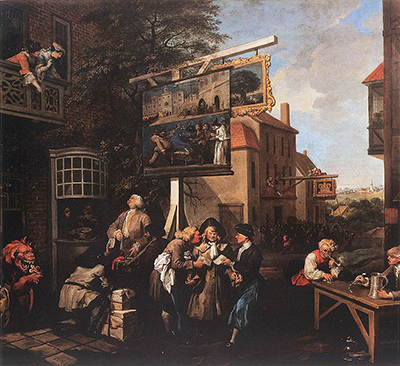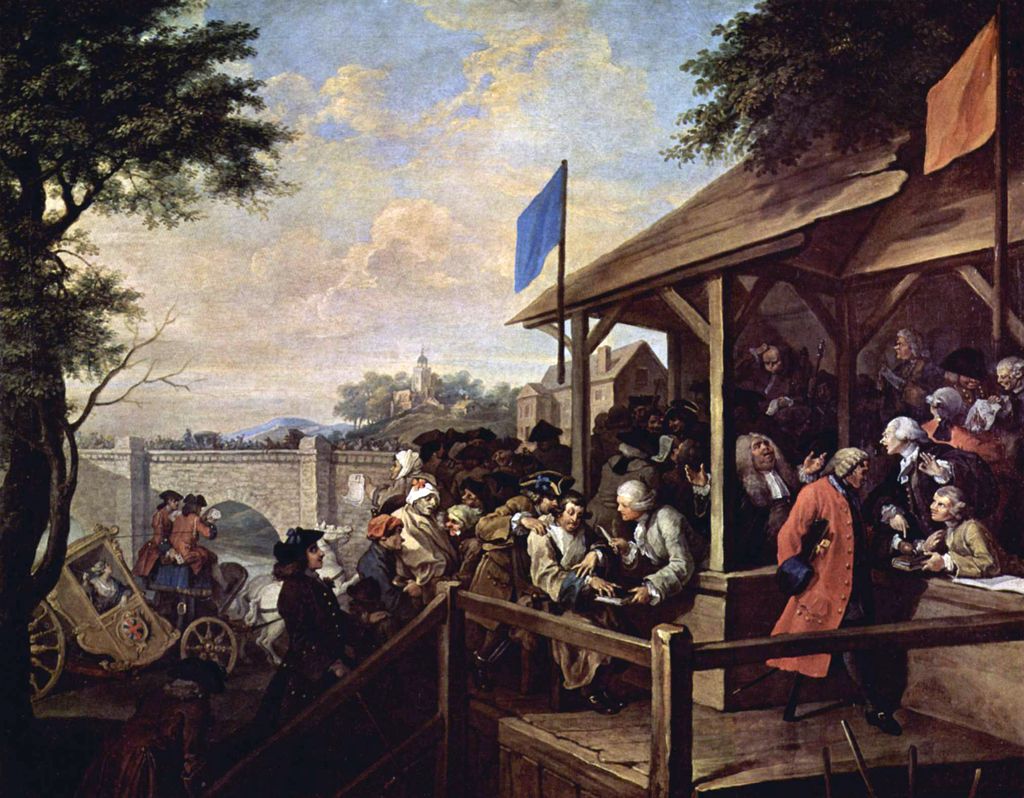
The Polling, William Hogarth, 1754–55. Oil on canvas. SM P73. The Yorck Project via Wikimedia Commons. Image source. Public domain.
 by Tom Gurney
Tom Gurney BSc (Hons) is an art history expert with over 20 years experience
Email: tomgurney1@gmail.com / Phone: +44 7429 011000
The Polling: Introduction
A veteran in a long red coat brings a metal hook down to a Bible. One man points at it, another throws up both hands, and the seated clerk holds the book steady. In William Hogarth’s The Polling, the veteran has reached the place where his vote can be heard and recorded, yet the form of his oath has become the business of everyone around him. Across the painting, a coach lies tilted by a tree while its drivers play cards. Hogarth gives the quarrel at the book the foreground and leaves the breakdown for the eye to discover. Sir John Soane’s Museum dates its oil on canvas, P73, to 1754–55 and measures it at 102.2 × 131.1 cm. [1]
This is the third scene of The Humours of an Election. In Canvassing for Votes, rival agents could approach the same man in the street. At the poll, that rivalry follows the voters up a flight of steps and into a procedure intended to establish who has the right to vote and for whom they are voting. The 1754 Oxfordshire county election gave Hogarth his starting point. His painted booth brings the procedure, the people trying to influence it and the people looking on into one field of view. [1] [2] [3]
At a Glance
- Painting1754–55, oil on canvas, Sir John Soane’s Museum, P73
- Painting dimensions102.2 × 131.1 cm
- PrintPlate III, etching and engraving, Petit Palais, PPG6042
- Inscribed publication date20 February 1758
This work across William Hogarth’s career
Assembly at Wanstead House
1728–31The Heir
1734The Marriage Settlement
about 1743Gin Lane
1751Canvassing for Votes
1754–55Contents
- Who gets to the book?
- What the Oxfordshire poll recorded
- Britannia’s broken coach
- The painting and the Petit Palais print
Who gets to the book?
The roof of the booth shelters two candidates, seated on opposite sides under a blue Tory flag and an orange Whig one. Joanna Tinworth, in the Soane catalogue, identifies the papers in the Tory’s hands as a bill and reads his scratched head as dismay at the cost of the campaign. Across from him, the Whig sits erect with his hands on his cane. Tinworth identifies a man in red as a caricaturist and reads the sketch that amuses two onlookers as his work. Between the candidates, the official charged with keeping order appears to be asleep. The raised seats make both men conspicuous. They sit where voters can see them, while the clerk and the party agents do the work of getting votes to the table. [1]
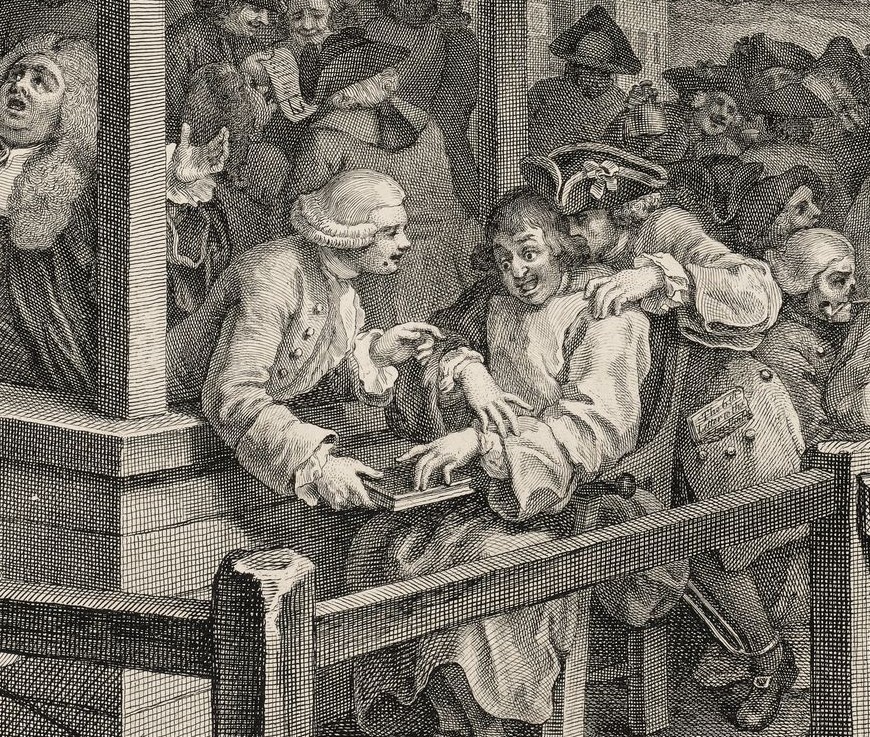
In the foreground, the red of the veteran’s coat brings him forward from the wigs and dark clothes behind him. A rail crosses in front of his legs, leaving the argument over his oath more prominent than the support on which he stands. The Soane catalogue identifies him as a former soldier who has lost both arms and one leg. His hook is on the Bible in place of the hand the oath would ordinarily require. The two men behind him appear to be opposing lawyers. Their gestures make competing cases out of the same physical fact. Hogarth leaves the clerk holding the book and the veteran waiting for the dispute to be settled. [1]
A little farther down the line a seated man slumps towards a second book. The man close to his ear wears blue in his hat. Tinworth reads him as a Tory supporter prompting the voter and draws attention to a barely visible orange rosette near the seated man’s feet. There is another orange favour on the pale, wrapped figure being brought up behind him. That man may be dying or dead in the fiction of the scene. An older man with a stick follows, guided by a boy. The older man steadies himself with a hand on the boy’s shoulder. The huddle around the seated man, by comparison, puts someone else’s mouth close to his ear at the moment when his own voice is needed. [1]
What the Oxfordshire poll recorded
At the actual county election, the right to vote generally belonged to men with qualifying freehold property worth at least forty shillings a year. Votes were declared openly. The Newcastle University election project reports that 3,938 people voted for four candidates contesting two seats. In Broad Street, supporters of the Tory Old Interest obstructed access for their opponents. Exeter College let New Interest voters use a side entrance to approach the poll from behind. A surviving plan shows fourteen booths and a passage railed off to keep crowds away from the coaches bringing voters. It gives a practical counterpart to Hogarth’s stairs and rail. Both make clear how much could depend on the last few yards of a voter’s journey. [1] [3] [4]
Watch Hogarth’s paintings and prints
Five films on Hogarth’s painted stories, prints, drawing methods and work for the Foundling Hospital.
William Hogarth, Marriage A-la-Mode (including Tête à Tête)
A close look at Tête à Tête and how its figures and furnishings advance the story of the marriage.
Watch on YouTubeA surviving notice, thought to have been displayed at the Oxfordshire booths, warned copyholders and customary tenants against swearing falsely that they were freeholders. It threatened a twenty-pound fine or the pillory. The warning concerns a claim about property. In the painted argument, the parties have seized on the veteran’s means of taking the oath, and his actual qualification goes unspoken. The notice helps explain why the book matters to everyone clustered around it. Telling the clerk who you supported was only one part of getting a vote entered. [1] [5]
The title of a poll book printed at the Theatre in Oxford names Thomas Blackall as high sheriff and lists the six April polling dates and all four candidates. On a page reproduced by Oxfordshire History Centre, the four columns at the right show which candidates received each elector’s vote. Entries like these gave a public declaration a durable form that could be examined after the crowd dispersed. In Hogarth’s booth, an open document lies beside the clerk. The viewer sees the pointing, prompting and waiting that can take place before a mark gets onto the page. [1] [6] [7]
Britannia’s broken coach
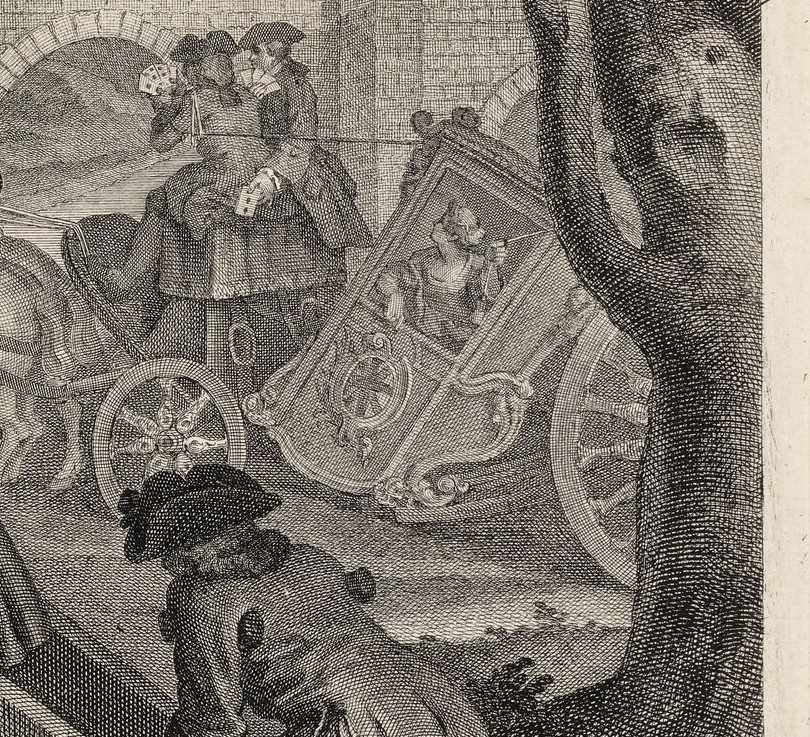
The road in the painting leads the eye out to a stone bridge crowded with people, horses and vehicles. The light on the distant buildings and the expanse of sky give the landscape an air of calm that the traffic has already broken. Tinworth suggests the tumult on the bridge may recall an incident at Oxford’s Magdalen Bridge during the 1754 contest. The foreground coach has its own pictorial argument. Its axle is broken and its passenger grasps for support. The Union emblem on the door identifies her as Britannia, the personification of Britain. Above her, the two men charged with driving are occupied with their game. One hides the three of clubs behind his companion’s back. [1]
The distance between coach and booth gives the joke time to work. At the booth, men examine the gesture of a veteran with an intensity that makes the rest of the crowd momentarily irrelevant. At the coach, two men watch their cards with similar concentration while the vehicle they are responsible for comes apart beneath them. Tinworth reads the drivers as parliamentary leaders and the white horses as a reference to the Hanoverian monarchy. The political force of the scene also comes from where Hogarth puts it. Britannia is down at the edge, partly enclosed by the tree, and the people who could help are within arm’s reach. [1]
Annotated Details from The Polling
These details follow the engraved scene. Compare how the booth and stairs are arranged in the painted version. The Polling, Plate III, William Hogarth and François Morellon de La Cave. Petit Palais, Paris, PPG6042. Collection record.
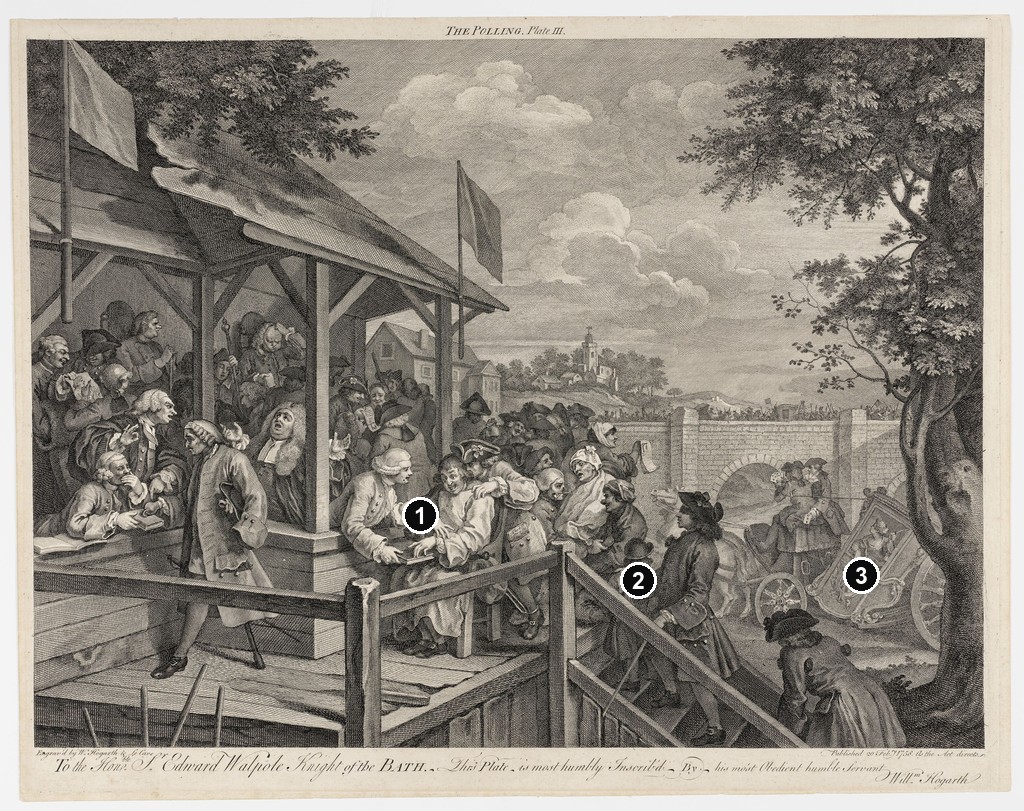
Details from THE POLLING
Select a numbered point for a closer look.
At the polling booth
Hands and papers cluster around the table where votes are recorded. Track the gestures to see how a formal oath can become a subject of argument.
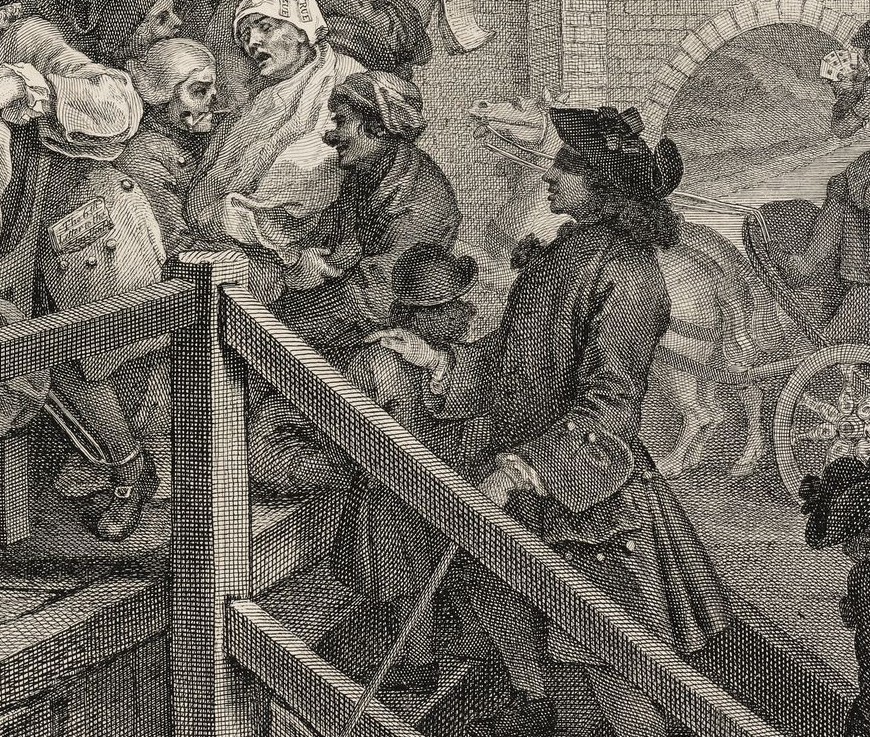
The steps up to the vote
People approach the booth along a raised passage. Compare the people who can move readily through it with those who need companions or help.
The broken-down coach
A coach carrying Britannia tilts at the right. The trouble in the distance gives the voting scene a wider political setting.
The painting and the Petit Palais print
The Soane painting puts the voting booth on the right and the coach on the left. In the Petit Palais impression, PPG6042, the booth occupies the left and the coach tips towards the tree on the right. The steep roof and the rail on the stairs reverse with them. In colour, the veteran’s red coat, blue and orange party emblems and the gold of the carriage pick out separate pockets of activity. The print builds its distinctions through line and tone. The pale book, faces and shirt cuffs draw the eye into the oath, and dark hatching around the tree frames the coach. The distant bridge still carries the crowd between these two ends of the composition. [1] [8]
The Petit Palais catalogues its etching and engraving at 40.5 × 54 cm and transcribes the engraved publication date as 20 February 1758. The margin names William Hogarth and Le Cave as engravers, and the dedication addresses Sir Edward Walpole, Knight of the Bath. Princeton’s impression, x1988-77, identifies the collaborator as François Morellon de la Cave. Princeton gives separate measurements of 44 × 56.1 cm for the plate and 49 × 65.5 cm for the sheet. The Paris record lists its dimensions under a single heading for the work and leaves the plate state unspecified. The Roman numeral in the title gives the scene’s place in the series. A state describes a stage in the working of the plate, as in the Fitzwilliam Museum’s separate impression, 22.K.3-32, catalogued as state III of III. [8] [9] [10]
The steps and rails in The Polling give the movement of voters a prescribed course, with the coach already stranded outside it. In Chairing the Member, the movement spills into the street, where the crowd lifts a successful candidate into view. Hogarth has already shown how precarious it can be to have other people carry you. [1] [11]
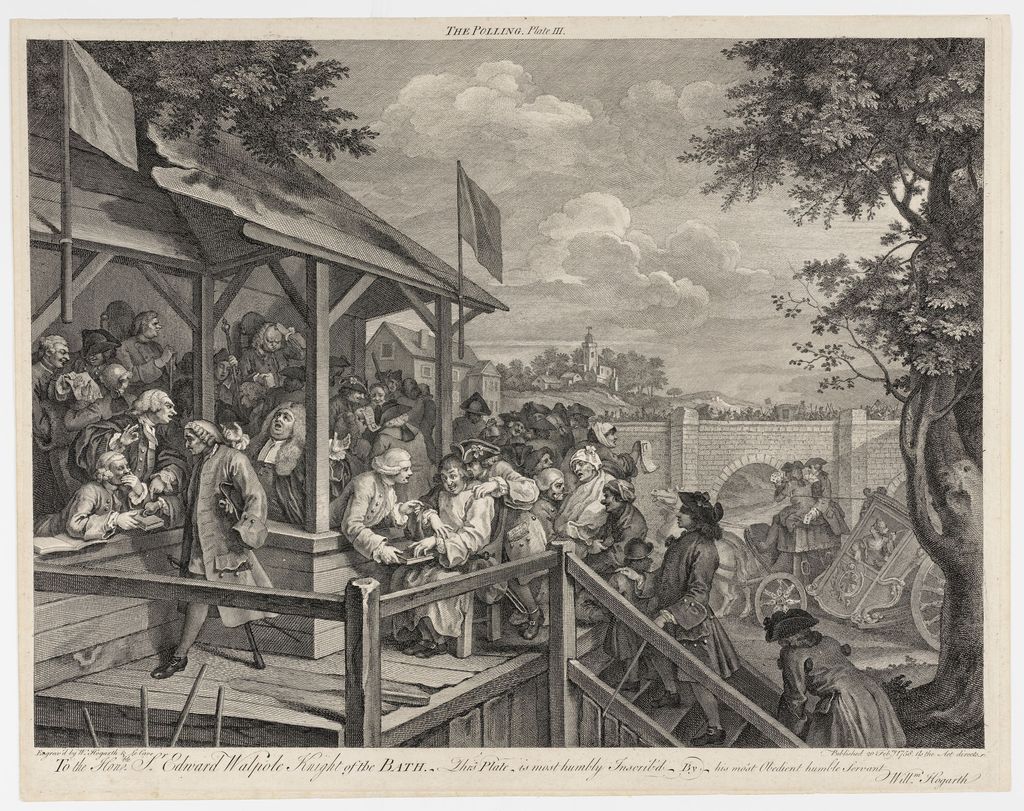
The Polling, William Hogarth and François Morellon de La Cave, Plate dated 20 February 1758. Etching and engraving. PPG6042. Paris Musées / Petit Palais, Musée des Beaux-Arts de la Ville de Paris. Image source. CC0 / Public domain.
Browse Hogarth’s artworks
All 54 individual artworks and series stages in the approved English cluster
Frequently Asked Questions
A veteran brings the end of his metal hook down on the Bible as he attempts to take the required oath. The men around him draw attention to the gesture. [1]
It is scene 3 of 4 in The Humours of an Election. Sir John Soane’s Museum uses the same scene number for the original painting. [1]
Discussion
Look again at the images and ideas explored in The Polling. These editorial prompts invite your observations.
Reader Insights
How do the two men’s gestures shape your reading of the veteran’s hook on the Bible?
How does seeing Britannia’s coach on the opposite side in the print change when you notice the card game?
Join the Conversation
Share a detail, comparison or question about The Polling below.
References
- Joanna Tinworth, Sir John Soane’s Museum, The Humours of an Election III: The Polling, P73, object record and October 2021 curatorial note. View source.
- Joanna Tinworth, Sir John Soane’s Museum, The Humours of an Election II: Canvassing for Votes, P56, October 2021 curatorial note. View source.
- Eighteenth-Century Political Participation and Electoral Culture, Newcastle University, Oxfordshire, April 1754 General Election, election summary, context and poll-book data. View source.
- Oxfordshire History Centre and Eighteenth-Century Political Participation and Electoral Culture, Plan of the Polling place, c. 1754, QSX 1/2. View source.
- Oxfordshire History Centre and Eighteenth-Century Political Participation and Electoral Culture, Printed Notice, 1754, QSX 1/21. View source.
- Wellcome Collection, The Poll of the Freeholders of Oxfordshire, Oxford, printed at the Theatre, 1754, title and imprint, record pzfy2exh. View source.
- Marek Lewandowski, Oxfordshire History Centre, Going to the Polls in the 19th Century and Before, 28 June 2024, Oxfordshire county poll-book extract. View source.
- Petit Palais, Paris Musées, Le Vote aux Hustings, planche III [The Polling. Plate III], PPG6042, dimensions and inscriptions (in French). View source.
- Princeton University Art Museum, The Polling, plate 3 from the series Four Prints of an Election, x1988-77, maker, dimensions and inscription fields. View source.
- The Fitzwilliam Museum, The Polling, 22.K.3-32, state note. View source.
- Joanna Tinworth, Sir John Soane’s Museum, The Humours of an Election IV: Chairing the Member, P78, October 2021 curatorial note. View source.