by Tom Gurney
Tom Gurney BSc (Hons) is an art history expert with over 20 years experience
Email: tomgurney1@gmail.com / Phone: +44 7429 011000
William Hogarth’s Series: Introduction
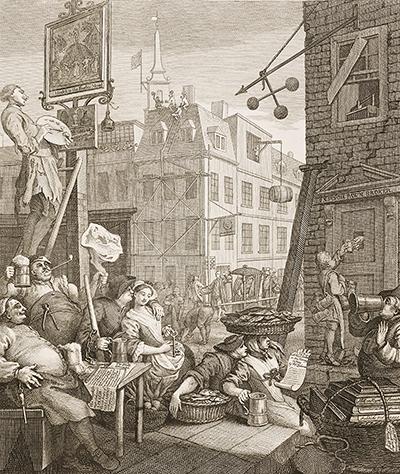
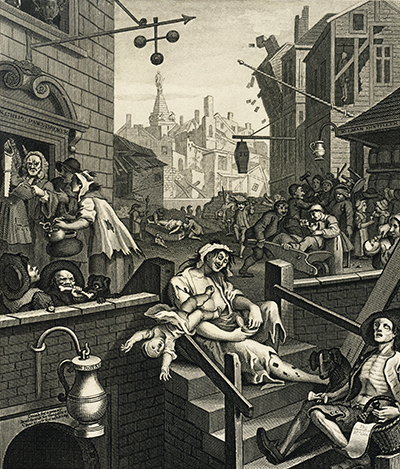
A pawnbroker’s premises are crumbling in William Hogarth’s Beer Street. In Gin Lane, people bring their belongings to a pawnbroker whose business seems to be thriving. Both prints appeared in February 1751. Seen together, they make the fortunes of one trade a way of measuring what is happening on two streets. That kind of comparison also helps with Hogarth’s longer series. A gesture, an occupation or a room that seems incidental in one scene can take on much greater significance when you see what Hogarth does with it elsewhere. [1] [2] [3]
At a Glance
- Series guidesSeven
- Individual scene and print pages42
- FormatsNarrative sequences, parallel lives and companion prints
Contents
- Begin with two streets
- Follow one person through changing places
- Follow a bargain or read two careers together
- Watch cruelty escalate or follow a public ritual
- Scene numbers, issue dates and the copies we see
Browse all seven series guides
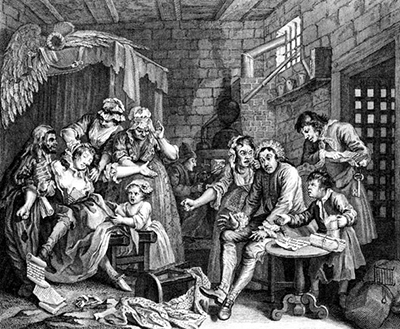
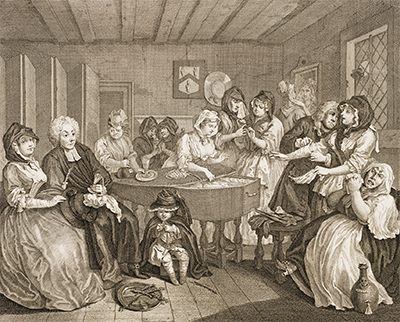
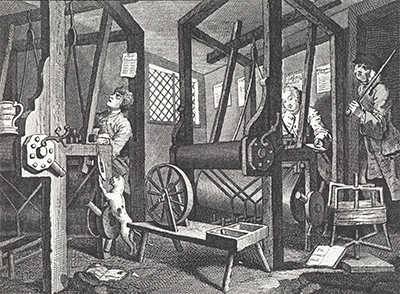

The Four Stages of Cruelty
The First Stage of Cruelty (The Four Stages of Cruelty), William Hogarth, February 1, 1751. Etching and engraving; first state of two. 91.1.136. Gift of Sarah Lazarus, 1891. Image source. CC0 / Public domain.
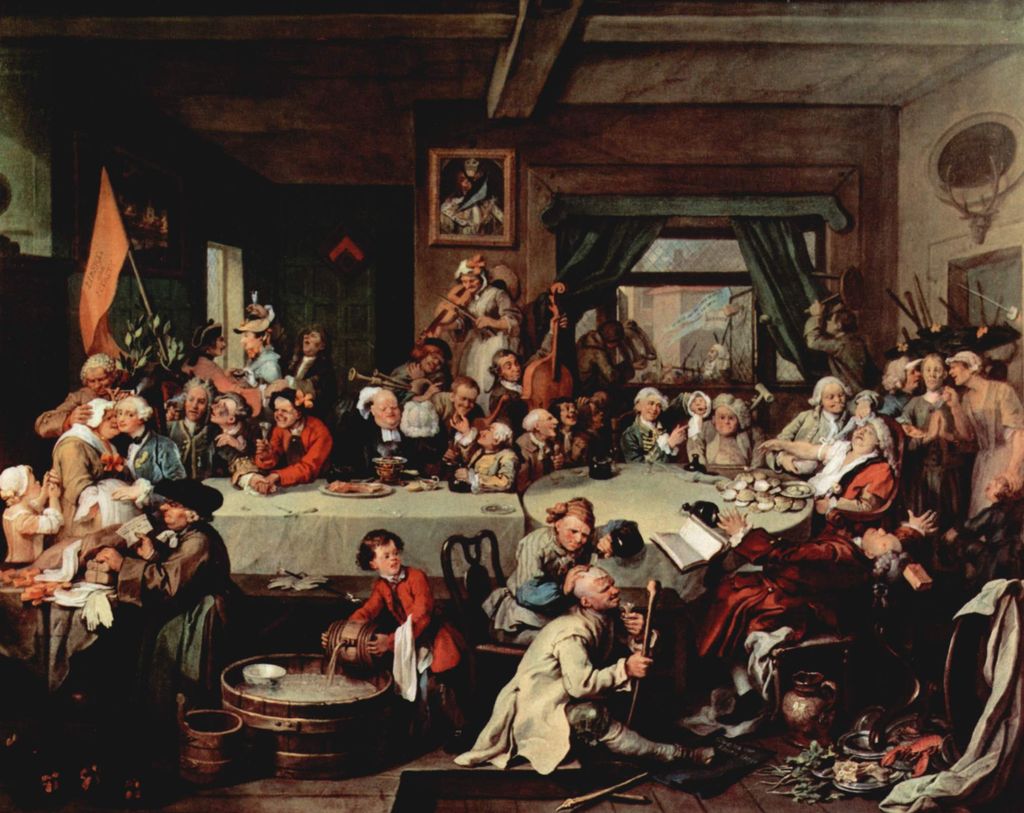
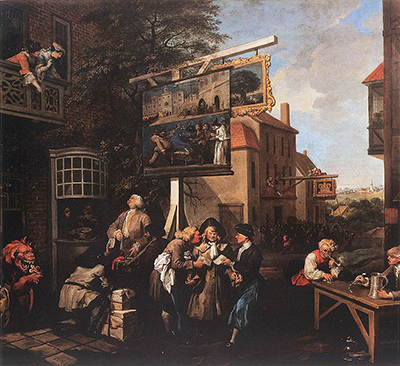
The Humours of an Election
An Election Entertainment, William Hogarth, 1754–55. Oil on canvas. SM P53. The Yorck Project via Wikimedia Commons. Image source. Public domain.
Begin with two streets
Set the two companion prints Beer Street and Gin Lane side by side and start with the buildings. In the British Museum’s impression of Beer Street, roofers are at work and scaffolding covers the front of a house. Find the neglected pawnbroker’s property among all this activity. Then turn to the National Gallery of Art’s Gin Lane, where the pawnbroker’s sign draws customers towards one of the street’s few thriving businesses. In one print, people who work with their hands can stop for a drink. In the other, a man carries his saw to the pawnshop. Look from the saw back to the building work in Beer Street. You can read the loss of a means of earning a living in the simple act of carrying a tool from one place to another. [2] [3]
Hogarth supplies several such points of comparison. There are crowds in both pictures, for instance, but the foreground drinkers in Beer Street gather around each other and their tankards, while in Gin Lane the woman on the steps and the child falling from her lap pull your eye in opposite directions. Move back and forth between the prints before looking closely at either crowd. No time has to pass between the scenes for the contrast to work. Each print offers a street full of activity, and the other changes what you notice about it. This is one way moral satire can make an argument through pictures. [2] [3]
If you already know the falling child in Gin Lane, open the paired guide to see how the published print relates to the Morgan Library & Museum’s preparatory drawing, titled Gin Street, and how revisions to Beer Street affect the comparison. The Morgan’s drawing for Beer Street has a conspicuous raised hand left over from a change to the design. The early print makes clear whose hand it was. In the British Museum impression discussed here, a raised joint of meat occupies the place of the little Frenchman seen in earlier impressions. Even a familiar pairing can look different when you put another impression beside it. [2] [4] [5]
After comparing the two streets, follow one person through A Rake’s Progress. Try Industry and Idleness next to see how Hogarth follows two lives at once. If a crowded scene such as The Polling drew you here, start one episode earlier with the canvass, then see what becomes of the contest in the final procession.
Follow one person through changing places
A Harlot’s Progress
Hogarth made six paintings for this story, which is known today through its six etched and engraved plates, issued in 1732. Begin at the Bell Inn, where the newly arrived Mary, or Moll, Hackabout is being sized up as other people carry on around her. In the Metropolitan Museum of Art’s published-state impression of plate I, she is standing in the open, within sight of a clergyman on horseback whose attention is elsewhere. Compare that opening with the sixth plate, where people crowd around her coffin. There, too, a group can be close to Moll and engrossed in its own affairs. The guide follows her across the thresholds between those two scenes and gives you a way to track who has access to her as her circumstances change. [6] [7] [8]
Read the opening twice. The first time, follow the encounter between Moll and the woman who stops her. The second time, take in the people who could see the meeting from where they stand. Hogarth gives someone on horseback, someone waiting at an inn and someone just off the wagon different reasons to be there. Carry that inquiry through the series, especially when the story moves indoors. A room limits who can witness an encounter and who can walk away. [6] [7] [8]
A Rake’s Progress
There are eight oil paintings and eight corresponding plates, issued as prints in 1735. Try reading the series through the places Tom Rakewell can enter, or hopes to enter. In the first canvas he can have a tailor attend to him at home. By the fourth, he is in the street on his way to St James’s Palace when he is arrested for debt. In the seventh, he is inside the Fleet Prison, where even the ordinary services a prisoner needs cost money. The geography makes his changing fortunes visible. Look at a doorway, street or division in a room and ask who can pass it freely. That gives you a thread to follow through the eight scenes, including the final encounter at Bethlem Hospital. [9] [10] [11] [12] [13]
The series also repays a second pass with Sarah Young in view. Tom offers her money when he turns her away in the first canvas, and Sarah comes forward with money to help him in The Arrest. The reversal is easy to lose in a crowded street scene. Once you see the first exchange, where Tom has the means to make Sarah go away, you can read the second exchange as a change in who has the freedom to act. [9] [10]
Watch Hogarth’s paintings and prints
Five films on Hogarth’s painted stories, prints, drawing methods and work for the Foundling Hospital.
William Hogarth and the Foundling Hospital | HENI Talks
Caro Howell discusses Thomas Coram, Hogarth’s portrait of him and the artist’s work for the Foundling Hospital.
Watch on YouTubeFollow a bargain or read two careers together
Marriage A-la-Mode
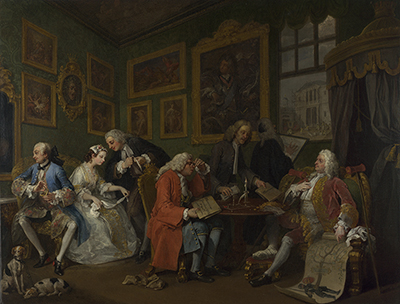
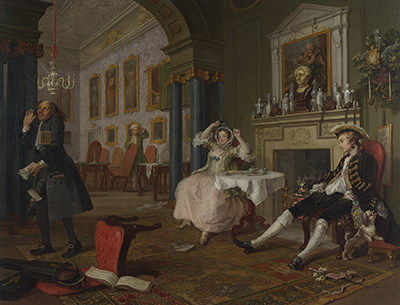
In six paintings and six engraved plates, Hogarth follows the consequences of a bargain between households. Start with the two kinds of evidence in The Marriage Settlement. The Earl points to his family tree while the Alderman examines the document, with cash already on the table. Then look for what survives of those hopes for the family by The Lady’s Death. The dying Countess is back in her father’s house, and his attention is on the ring he is taking from her hand. The guide lets you follow the choices about money, rank and appearances made between these two scenes. Put the National Gallery’s opening canvas next to Gérard Jean-Baptiste Scotin’s first plate at the Met. Find the family tree and the money again in the reversed composition. The two things retain their parts in the bargain even when your eye moves the other way across the room. [14] [15] [16] [17]
Industry and Idleness
Hogarth sets out twelve prints about two apprentices, Francis Goodchild and Thomas Idle. Before following either career, spend a moment at their neighbouring looms in the first plate. Their shared workplace makes the differences in conduct legible within a single picture. The narrative can then give each man a sheet of his own and ask the viewer to remember what the other is doing. In plate X they are together again. Goodchild is an alderman, and Idle is brought before him. The change from two adjoining workstations to two positions in a room where judgment is exercised makes civic power part of what the series has been tracing. Open the guide to follow the two careers in parallel and see where Hogarth puts their paths back in contact. [18] [19] [20]
Revisit the first plate after looking at the tenth. At the looms, the men's relation to the same task is the point. In the later print, their different positions determine whose account can be heard and who has the power to act on it. This is a longer version of the reading you can do with the drink pair. You hold two figures in mind and ask what each tells you about the other. The twelve plates give the contrast time to develop, and the reunion lets you see both outcomes inside one frame. [19] [20]
Watch cruelty escalate or follow a public ritual
The Four Stages of Cruelty
The four etched and engraved prints issued in 1751 follow Tom Nero from cruelty to animals to murder and its aftermath. In the first plate, try to take in the group around the injured dog. Some boys participate in the abuse and one child tries to intervene. In the last plate, Nero is himself the body around which a group assembles. The change in who can act is as sharp as the change in subject. The guide follows those shifts across four episodes and explains how another version of the two final designs reached paper through John Bell’s woodcuts. [1] [18] [21] [22]
The Humours of an Election
Read the four paintings and four corresponding prints as stages of an election in the fictional town of Guzzledown, inspired by the Oxfordshire contest of 1754. A campaign dinner is followed by canvassing, polling and the chairing of the successful candidate. The procedure binds together crowds with different jobs. Compare the guests at the dinner with the officials, voters and attendants at the polling booth. Now look at the people carrying the elected man above the street in the last scene. The ceremony gives him the highest place in the picture and leaves him dependent on the people beneath him. Read this guide to see how Hogarth changes the kinds of influence people can exert as the election moves from one setting to another. [23] [24] [25]
Scene numbers, issue dates and the copies we see
The story of the election puts polling before the chairing. The four prints appeared over a longer period. Sir John Soane’s Museum traces an advertisement for the first plate in February 1755 and places the issue of the last three in 1758. [23] Among the later prints, compare the engraved publication lines on two impressions at the Petit Palais. Plate IV, Chairing the Members, gives 1 January 1758, while its plate III, The Polling, gives 20 February 1758. To see why Hogarth’s crowd is carrying a winner, follow the scene numbers. [26] [27] The dates in Marriage A-la-Mode give another clue to how cautiously to read an inscription. Judy Egerton’s National Gallery catalogue records the engraved date of 1 April 1745 and finds that the six plates were issued in June. [15]
A state describes a version of the printing surface. The Met has two separate etchings and engravings of plate I of A Harlot’s Progress, catalogued as the first and fourth states. Both show the opening at the inn. Sarah Lazarus gave the fourth-state sheet to the Met in 1891. Her gift was a particular object with its own history. At 40.7 centimetres across, that sheet is wider than the Met’s first-state impression, which measures 38.4 centimetres across. This is a difference in the paper on which the viewer encounters the image. State is recorded separately, and both impressions are still plate I. [7] [28]
A painted set offers a different experience. Sir John Soane collected all eight Rake canvases and housed them in his Picture Room, where hinged picture planes could bring some scenes into view and conceal others. Soane himself described using the shutters to put distressing scenes out of sight once they had been considered. The museum has also used facsimiles during conservation to keep the series legible in the room. In July 2025 it documented a substitute for The Prison while the original was away. The succession of eight scenes can remain available even when one of the canvas surfaces cannot be studied in place. [9] [11] [29]
A modern selection of reproductions can create yet another encounter. In its online feature for Hogarth: Place and Progress, the Soane chose illustrations of An Election Entertainment, The Arrest and Gin Lane. Seen in that company, Gin Lane invites comparison with two other crowded scenes where the foreground action is only part of the story. Return to the drink pair to see how it answers Beer Street. When a single scene catches your eye, the paintings and engravings guides can help you establish which version you are looking at, and the series guides let you find its neighbours. [30]
Browse Hogarth’s artworks
All 54 individual artworks and series stages in the approved English cluster
Frequently Asked Questions
Discussion
Look again at the images and ideas explored in William Hogarth’s Series. These editorial prompts invite your observations.
Reader Insights
What changes between reading one person’s story and following two careers in parallel?
Which repeated object or gesture helps you find your way through a Hogarth series?
Join the Conversation
Share a detail, comparison or question about William Hogarth’s Series below.
References
- The Morgan Library & Museum, Hogarth: Cruelty and Humor, exhibition overview, especially the February 1751 issue of the two groups of prints. View source.
- British Museum, William Hogarth, Beer Street, etching and engraving, 1880,1113.4473, Paulson 185 IV. View source.
- National Gallery of Art, Washington, William Hogarth, Gin Lane, etching and engraving, 1944.5.87, Paulson 1965 no. 186, state iii of iv. View source.
- The Morgan Library & Museum, Jennifer Tonkovich, 002. Gin Lane, online exhibition entry for William Hogarth’s preparatory drawing Gin Street, III, 36. View source.
- The Morgan Library & Museum, William Hogarth, Beer Street, preparatory drawing III, 37. View source.
- Sir John Soane’s Museum, Hogarth: 101, account of the first six-scene series and its issue in 1732. View source.
- Metropolitan Museum of Art, William Hogarth, A Harlot’s Progress, Plate 1, fourth state of four, 91.1.128. View source.
- Princeton University Art Museum, William Hogarth, A Harlot’s Progress, Plate 6, etching and engraving, x1988-26. View source.
- Joanna Tinworth, Sir John Soane’s Museum, A Rake’s Progress I: The Heir, oil on canvas, P40, including the introduction to the series. View source.
- Joanna Tinworth, Sir John Soane’s Museum, A Rake’s Progress IV: The Arrest, oil on canvas, P43. View source.
- Joanna Tinworth, Sir John Soane’s Museum, A Rake’s Progress VII: The Prison, oil on canvas, P46, including the July 2025 conservation note and n. 2 on Soane’s folding shutters. View source.
- Joanna Tinworth, Sir John Soane’s Museum, A Rake’s Progress VIII: The Madhouse, oil on canvas, P47. View source.
- Metropolitan Museum of Art, William Hogarth, A Rake’s Progress, Plate 1, first state of three, 32.35(28). View source.
- National Gallery, London, William Hogarth, Marriage A-la-Mode: 1, The Marriage Settlement, oil on canvas, NG113. View source.
- Judy Egerton, National Gallery, Marriage A-la-Mode, in The British Paintings (2000), NG113–NG118, especially “Provenance” and “Engraved.”. View source.
- National Gallery, London, William Hogarth, Marriage A-la-Mode: 6, The Lady’s Death, oil on canvas, NG118. View source.
- Metropolitan Museum of Art, Gérard Jean-Baptiste Scotin after William Hogarth, Marriage A-la-Mode, Plate I, fifth state of five, 91.1.107. View source.
- Princeton University Library, Sin & the City, full exhibition checklist, Industry and Idleness (Paulson 168–179) and The Four Stages of Cruelty (Paulson 187–190). View source.
- Metropolitan Museum of Art, William Hogarth, The Fellow ’Prentices at their Looms (Industry and Idleness, plate 1), second state of two, 91.1.9. View source.
- Metropolitan Museum of Art, William Hogarth, The Industrious ’Prentice Alderman of London, The Idle One Brought Before Him and Impeached by his Accomplices (Industry and Idleness, plate 10), second state of two, 91.1.18. View source.
- Metropolitan Museum of Art, William Hogarth, The First Stage of Cruelty, first state of two, 91.1.136. View source.
- Jennifer Tonkovich and Laurel O. Peterson, “Hogarth and the Making of the Four Stages of Cruelty,” Master Drawings 62, no. 1 (2024), pp. 21–40, especially pp. 21–26 on the four episodes and pp. 26–33 on the woodcuts and engravings. View source.
- Joanna Tinworth, Sir John Soane’s Museum, The Humours of an Election I: An Election Entertainment, oil on canvas, P53, including the introduction to the series. View source.
- Sir John Soane’s Museum, The Humours of an Election III: The Polling, oil on canvas, P73. View source.
- Sir John Soane’s Museum, The Humours of an Election IV: Chairing the Member, oil on canvas, P78. View source.
- Petit Palais, Paris Musées, William Hogarth and F. Aviline as inscribed, Chairing the Members, Plate IV, PPG6043, with publication inscription. View source.
- Petit Palais, Paris Musées, William Hogarth and Le Cave as inscribed, The Polling, Plate III, PPG6042, with publication inscription. View source.
- Metropolitan Museum of Art, William Hogarth, A Harlot’s Progress, Plate 1, first state of four, 32.35(2). View source.
- Sir John Soane’s Museum, The Picture Room, architecture, collection and facsimile policy during conservation. View source.
- Sir John Soane’s Museum, Three key artworks from Hogarth: Place and Progress, exhibition feature with reproductions of An Election Entertainment, The Arrest and Gin Lane. View source.