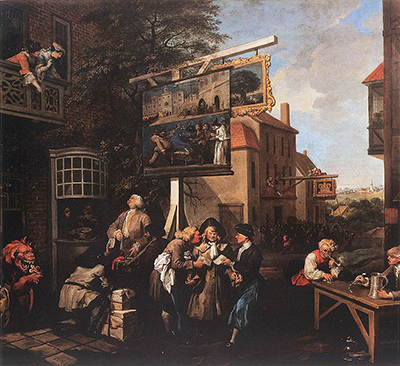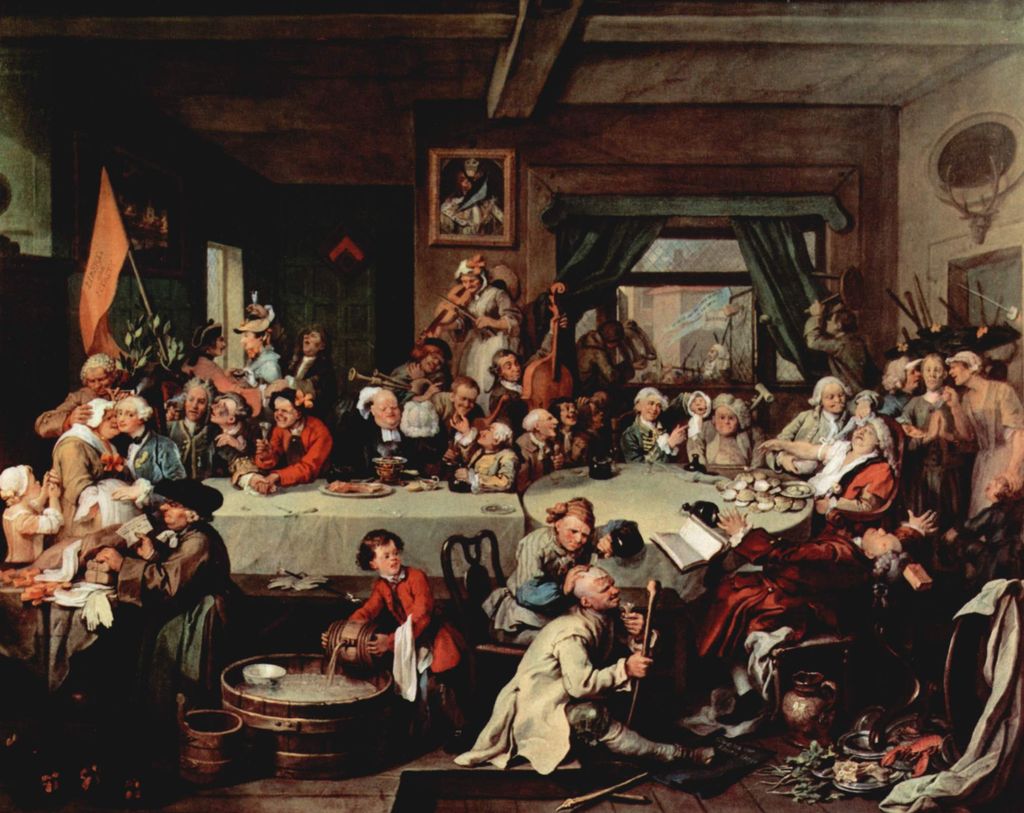
An Election Entertainment, William Hogarth, 1754–55. Oil on canvas. SM P53. The Yorck Project via Wikimedia Commons. Image source. Public domain.
 by Tom Gurney
Tom Gurney BSc (Hons) is an art history expert with over 20 years experience
Email: tomgurney1@gmail.com / Phone: +44 7429 011000
An Election Entertainment: Introduction
In William Hogarth’s An Election Entertainment, two Whig candidates sit beneath laurels at an inn. One leans away as a woman presses close to his face. The other has his hand clasped by a man in a leather apron. Across the room, a brick comes through the window and knocks the party secretary backwards. The dinner was laid on to win votes, and Hogarth makes the labour of winning them visible in the candidates’ strained politeness and the secretary’s open ledger. Sir John Soane’s Museum holds the oil on canvas, catalogued as 1754–55, measuring 101 × 128 cm and numbered P53. It opens the four scenes of The Humours of an Election. [1]
At a Glance
- ArtistWilliam Hogarth
- Painting1754–55, oil on canvas, 101 × 128 cm, Sir John Soane’s Museum, P53
- Petit Palais impressionEtching and engraving, 24 February 1755 inscribed, Petit Palais, Paris Musées, PPG6040
- Place in the seriesFirst of four scenes in The Humours of an Election
This work across William Hogarth’s career
Assembly at Wanstead House
1728–31The Heir
1734The Marriage Settlement
about 1743Gin Lane
1751Canvassing for Votes
1754–55Contents
- At the candidates’ end of the table
- What a dinner could buy
- What comes through the window
- Reading Plate I
At the candidates’ end of the table
The younger candidate’s blue velvet, gold braid and fine lace make him easy to pick out even as the people around him nearly swallow up his chair. The man above him brings a lit pipe dangerously close to his wig, while a girl looks at his ring. Farther along, the older candidate’s grey wig and darker coat give him a more sober appearance, but he has even less room to manoeuvre. A guest presses in from behind as the man in the apron takes his hand. Joanna Tinworth, writing for the Soane, suggests that the apron marks out a cobbler. Look at where their hands meet, low against the edge of the table. The guest can lean over it and hold the candidate in place. At a dinner given to win support, both gentlemen must let their guests decide how close to come. [1]
A flag bearing the Whig motto “Liberty and Loyalty” rises behind the candidates. Orange rosettes lie ready for distribution. Tinworth suggests that the colour refers to William of Orange, whose slashed portrait hangs near the window. She reads the damage as a possible sign that the Tories previously used the room. The scar makes an interesting companion to the bright ribbons. A rosette can be handed out to make a fresh allegiance visible, while damage to a picture can outlast the gathering that produced it. Even before the disturbance at the window, the walls suggest that the company has temporary possession of the room. [1]
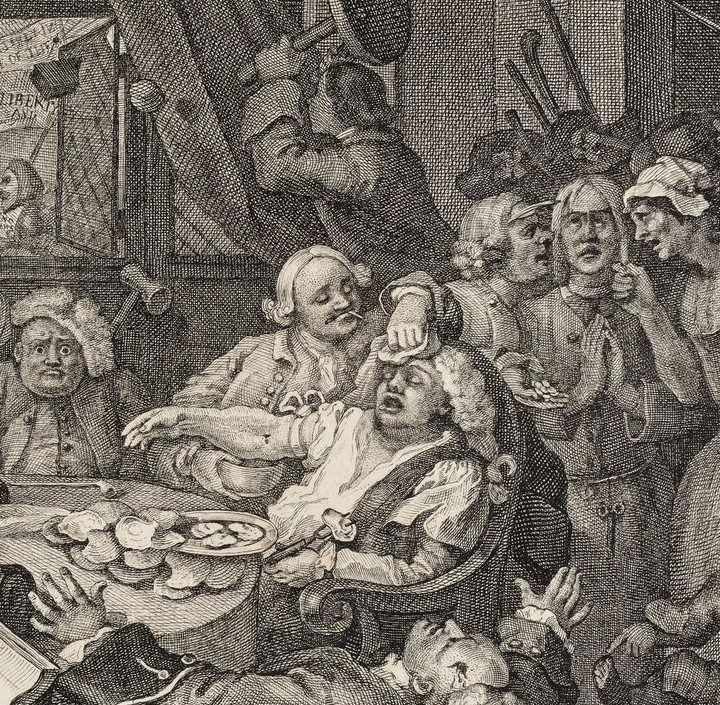
At the far end, the mayor has slipped low in his chair, with his robe falling from his shoulders. The oysters in front of him supply the Soane’s reading of his collapse as the result of overeating, and a bowl is held beneath his arm as a barber-surgeon attempts to bleed him. The chair that marks his place of honour now props him up. Lower down, Hogarth gives shellfish, root vegetables, pewter and a jug the attention of a small still life. Someone has taken care over the food, both in laying on the feast and in painting it. Seen from that level, the meal still looks inviting while the man who has had his fill has become an object of concern. [1]
What a dinner could buy
The setting is the invented town of Guzzledown. In the historical Oxfordshire contest of April 1754, Thomas Parker and Sir Edward Turner stood for the Whig New Interest, and Philip Wenman and Sir James Dashwood for the Tory Old Interest. The contest gave Hogarth a recognisable political setting for his inn. The Soane places the first scene in Hogarth’s studio for public viewing shortly before the April election. A viewer in London could thus have encountered the feast while the outcome of the Oxfordshire contest was still open. [1] [2]
Election hospitality was known as treating. As historian Mark Knights explains, statutes sought to restrain the use of meals, drink and gifts to secure votes, while campaigns faced an established expectation that they would entertain the community. The expectation extended beyond those who could cast a vote. In the county, the franchise depended on a qualifying freehold worth at least forty shillings a year and was limited to men. The Newcastle University election project documents women such as Lady Susan Keck canvassing for the New Interest. Her case makes it easier to see how much election work could take place outside the formal electorate. Hogarth’s room gives that wider company a place in the picture through the people who serve, perform, claim gifts and engage the candidates in conversation. [1] [2] [3]
The foreground gives two kinds of persuasion room to unfold. At the left, a seated man studies a signed promise of money by a pile of gloves and stockings. The gloves are already within reach, while the sum on the paper is due six months later. At the right, an agent offers a handful of coins to a thin man who holds his hands together. The museum reads him as a tailor who refuses the offer. Beside him, a child’s worn shoe shows why the choice matters. Hogarth puts evidence of a household’s immediate need close enough to the money for the viewer to grasp what the man could buy with it. The promise on the left and the open hand on the right invite a closer look at when payment comes and whether the intended recipient will take it. [1]
Watch Hogarth’s paintings and prints
Five films on Hogarth’s painted stories, prints, drawing methods and work for the Foundling Hospital.
William Hogarth, Marriage A-la-Mode (including Tête à Tête)
A close look at Tête à Tête and how its figures and furnishings advance the story of the marriage.
Watch on YouTubeWhat comes through the window
The fiddler sits high enough to be heard and seen above the diners. Tinworth notes a possible likeness to the Oxfordshire musician known as Fiddling Nan. Near her, a man holds up a hand puppet to amuse his neighbours. A later account, cited by Tinworth, identifies the performer as the Irish MP Sir John Parnell, who is said to have asked Hogarth to include him. The two identifications have different bases, and the visible actions carry their own weight. The musicians and the puppet provide the diversions promised by the title. The height of the fiddler’s perch puts her near the window, where a second spectacle competes with the one the party has laid on. [1]
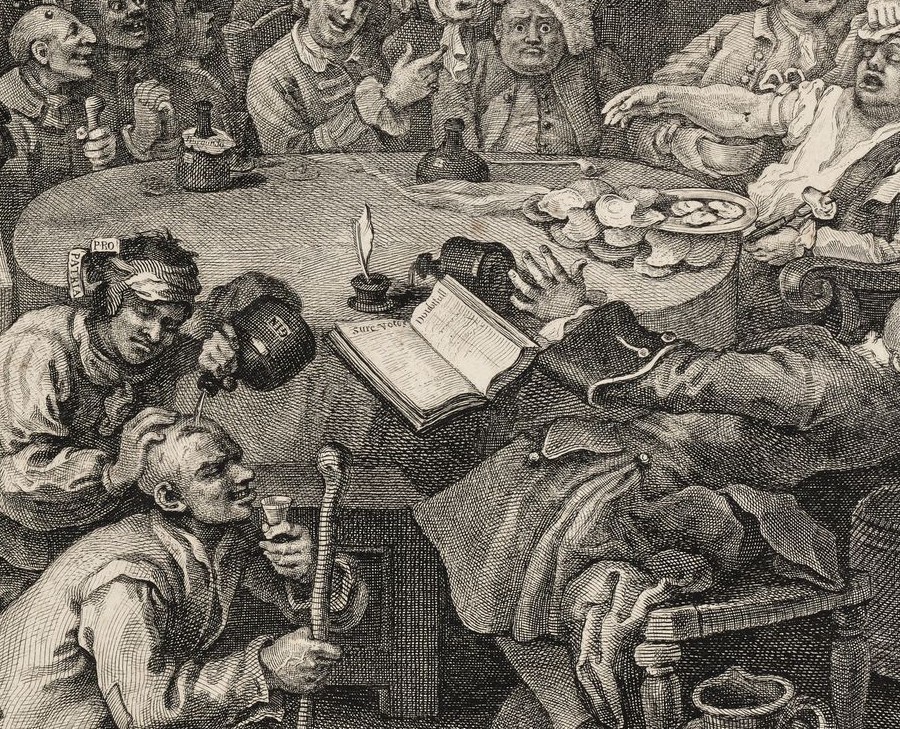
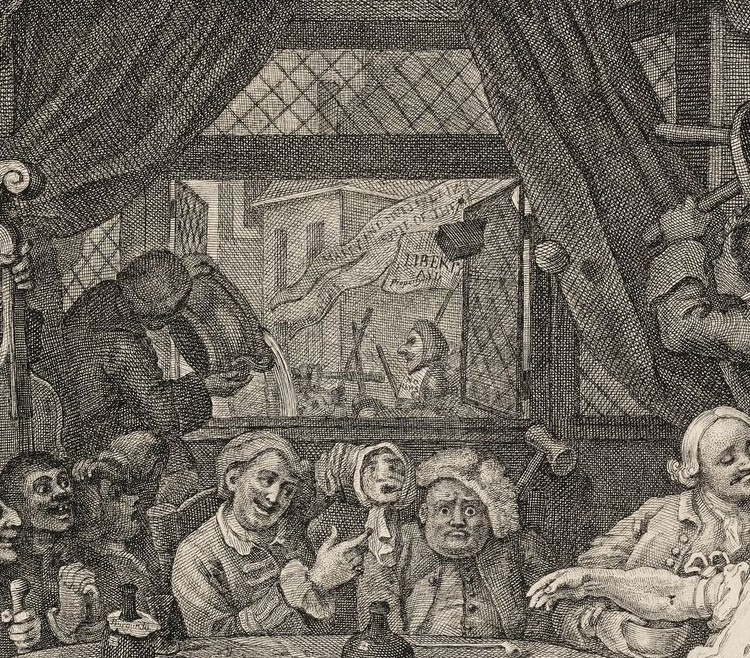
Tory supporters pass outside with banners. A man at the window tips a chamber pot towards them, and the brick that strikes the secretary brings the disturbance right to the table. The open ledger records far more doubtful votes than sure ones in the Soane’s reading. Hogarth lets the book tip into view at the instant the man can least attend to it. It is the room’s nearest thing to a measure of what the dinner has achieved. The candidates may have been able to fill their inn, but the two columns show how much uncertainty remains about the poll. [1]
The fallen banner near the two men in the foreground reads “Give us our Eleven Days.” It takes up the 1752 calendar change, when 2 September was followed by 14 September. Historian Robert Poole traces the use of calendar grievances in Oxfordshire election polemic and distinguishes that evidence from later stories of popular riots over the missing days. One Tory campaign song mocked Parker, whose father had helped steer calendar reform through Parliament, by imagining that the Man in the Moon had put him up for election. The song and the banner both make a matter of astronomy and legislation available for campaign ridicule. Hogarth gives that ridicule a physical fate. The banner lies on the floor beside a man nursing a head wound. [1] [4]
Annotated Details from An Election Entertainment
These details follow the engraved scene. Compare their position with the painting discussed above. An Election Entertainment, Plate I, William Hogarth. Petit Palais, Paris, PPG6040. Collection record.
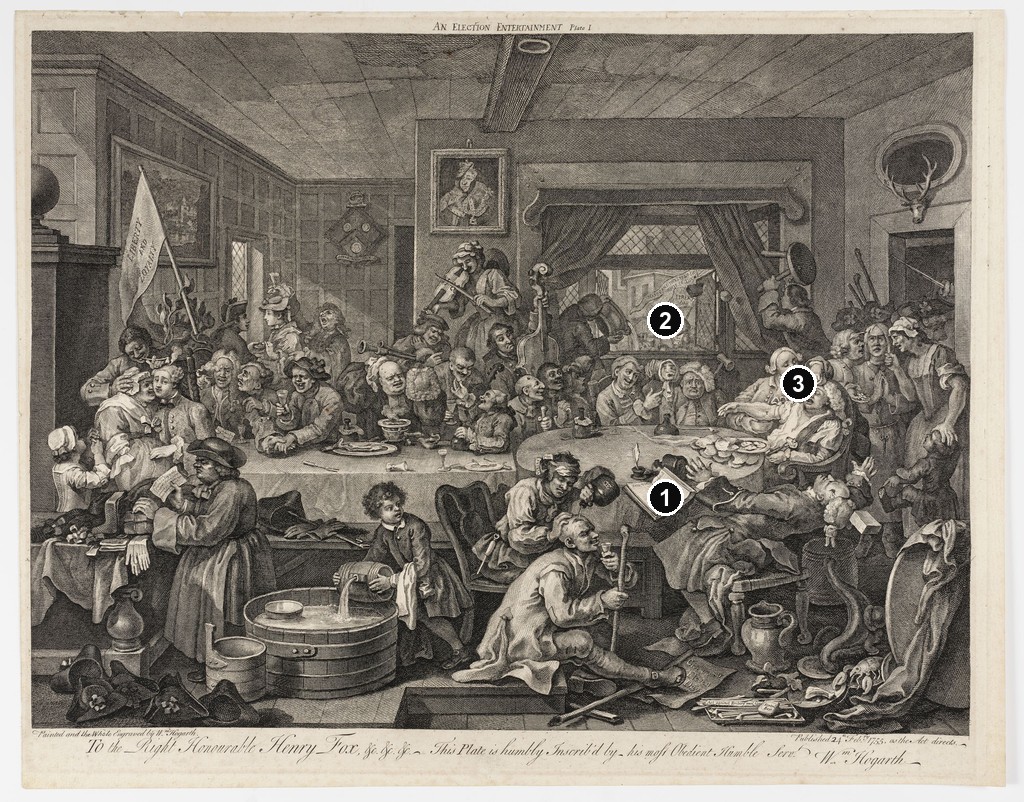
Details from AN ELECTION ENTERTAINMENT
Select a numbered point for a closer look.
The secretary’s ledger
The secretary recoils, letting the open ledger tip towards the table. An election still has to be counted even while the dinner turns chaotic.
A crowd at the window
People are visible beyond the large window at the back of the room. The gathering outside takes part in the election from a different position.
A plate at the mayor’s elbow
A man leans back while a neighbour puts a hand near his head. Hogarth places this small crisis beside the food and the people who keep eating.
Reading Plate I
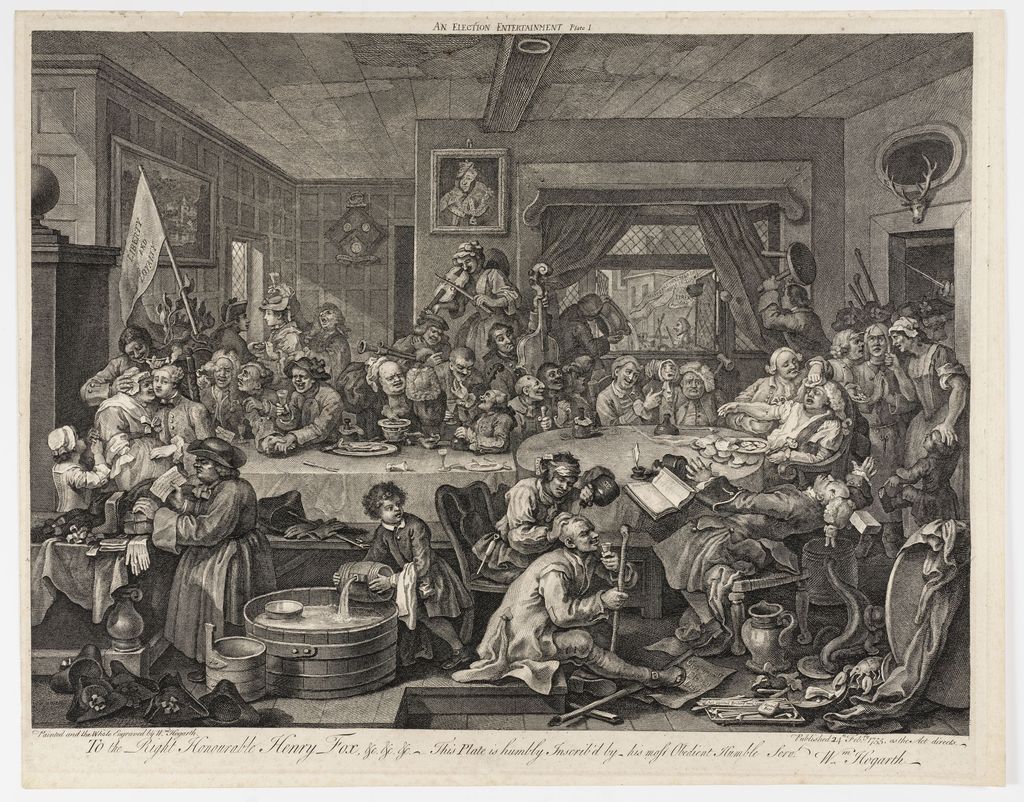
The Petit Palais holds a separately catalogued etching and engraving, PPG6040, measuring 40.5 × 54 cm in the museum’s object record. The date inscribed in its lower margin is 24 February 1755. The two candidates remain on the left and the mayor on the right, so the eye can follow the table in the same direction in print and paint. The London Museum reproduces Plate I in its account of Hogarth and identifies the food and drink as the candidates’ means of bribing potential voters. In the absence of painted party colours, the indoor flag and the banners at the window help the print reader follow the rival groups through the crowd. [1] [5] [6]
Some lettering in the print rewards a slower reading. The Soane catalogue reads twenty pounds and the signature R Pention in the painting. In the print the promise is for fifty pounds, names Abel Squat as the recipient and Richard Slim as the signer, and retains the six-month wait. A date of 1 April 1754 is written into the promise. It belongs to the pictured document, while the date in the margin belongs to the published plate. The joke is available even to a reader who has never seen the canvas. A man who is already studying the terms of his reward receives a promise dated on April Fools’ Day. [1] [5]
The Paris sheet credits Hogarth with painting and engraving the whole design and carries a dedication to Henry Fox. Paris Musées gives the sheet’s date and technique without assigning a numbered state. The Metropolitan Museum of Art identifies its own impression, 32.35(212), as the sixth of eight states and distinguishes the plate measurement of 40.3 × 54.1 cm from the sheet measurement of 42.4 × 54.7 cm. Colonial Williamsburg’s impression, 1972-409,107, has the claim about engraving the whole scored out. It retains the 1755 publication line even though the museum dates the impression to about 1822. The date cut into a plate could remain legible through revisions and later printings, and the measurements and state given for one impression belong to that particular object. [5] [7] [8]
In the next scene, Canvassing for Votes, Hogarth takes the campaign into the street. The meal that drew a crowd into one room gives way to rival invitations from two inns. Their landlords approach the same man, each with money as well as the prospect of dinner. At the feast, the candidates try to turn the enforced intimacy of a dinner into obligations. Outside, their intermediaries have to make an offer to someone who can hear what the other side is offering too. [1] [9]
An Election Entertainment, William Hogarth, 1755. Etching and engraving. PPG6040. Paris Musées / Petit Palais, Musée des Beaux-Arts de la Ville de Paris. Image source. CC0 / Public domain.
Browse Hogarth’s artworks
All 54 individual artworks and series stages in the approved English cluster
Frequently Asked Questions
A brick comes through the window and sends the party secretary backwards with his open ledger. The dinner was arranged to court the voters. [1]
It is scene 1 of 4 in The Humours of an Election. Sir John Soane’s Museum uses the same scene number for the original painting. [1]
Discussion
Look again at the images and ideas explored in An Election Entertainment. These editorial prompts invite your observations.
Reader Insights
What does the secretary’s falling ledger suggest about the candidates’ success in winning votes?
How does the six-month wait change the meaning of the promised money in Abel Squat’s note?
Join the Conversation
Share a detail, comparison or question about An Election Entertainment below.
References
- Joanna Tinworth, Sir John Soane’s Museum, The Humours of an Election I: An Election Entertainment, P53, object data, curatorial note and notes 17–29, October 2021. View source.
- Eighteenth-Century Political Participation and Electoral Culture, Oxfordshire Election, April 1754, Newcastle University project, poll book and constituency account. View source.
- Mark Knights, Electoral Corruption in the Long Eighteenth Century, Eighteenth-Century Political Participation and Electoral Culture, discussion of treating and electoral gifts. View source.
- Robert Poole, “Give Us Our Eleven Days!”: Calendar Reform in Eighteenth-Century England, Past & Present 149 (1995), pp. 95–139, especially pp. 95–96, 102–104 and 128–135. View source.
- Petit Palais, Paris Musées, Le Banquet électoral, planche I [An Election Entertainment. Plate I], PPG6040, object data and inscriptions (in French). View source.
- London Museum, William Hogarth Painted London Behaving Badly, reproduction and discussion of An Election Entertainment, Plate I. View source.
- The Metropolitan Museum of Art, An Election Entertainment, Plate I: Four Prints of an Election, 32.35(212), state and dimensions. View source.
- Colonial Williamsburg, An Election Entertainment, Plate I, 1972-409,107, impression date and engraved inscriptions. View source.
- Joanna Tinworth, Sir John Soane’s Museum, The Humours of an Election II: Canvassing for Votes, P56, curatorial note, October 2021. View source.