 by Tom Gurney
Tom Gurney BSc (Hons) is an art history expert with over 20 years experience
Published on June 19, 2020 / Updated on August 2, 2026
Email: tomgurney1@gmail.com / Phone: +44 7429 011000
Contents
- Introduction
- Rural Childhood And Leisure
- A Small Painting After The Civil War
- How This Work Connects
Introduction
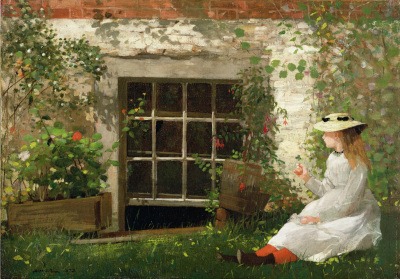
Winslow Homer's The Four-Leaf Clover is an 1873 oil painting in the collection of the Detroit Institute of Arts. The DIA records the work as oil on canvas, with unframed dimensions of 14 1/4 x 20 3/8 inches, or 36.2 x 51.8 cm. The museum lists it as part of American Art before 1950, accession number 70.150, bequest of Robert H. Tannahill, and notes that the painting is on view in the American galleries. [1]
Those object facts give this article its safest scale. The Four-Leaf Clover is not a flagship Homer page like The Gulf Stream, Breezing Up, or Prisoners from the Front. It is a smaller rural-childhood and figure subject from the early 1870s, useful because it helps readers see the gentle, outdoor side of Homer's postwar work. [2]
The painting shows a young girl seated in shade beside the wall of a house. She wears a pale dress and holds the small clover named in the title. Around her, Homer builds the scene out of summer growth: vines, flowers, a weathered barrel used as a planter, a makeshift window box, brick, wood, and sunlit garden detail. The subject is quiet, but the surface is active. The child's stillness is surrounded by leaves and flowers that make the corner feel alive. [3]
Rural Childhood And Leisure
The Detroit Institute of Arts connects the picture to a postwar turn toward leisure and rural life. That framing fits the broader Homer packets for this cluster, which identify women, children, rural subjects, and leisure scenes as central to his late 1860s and 1870s painting. The Four-Leaf Clover belongs in that corridor with Boys in a Pasture, Crossing the Pasture, Weaning the Calf, and Fresh Eggs. [4]
Each of those related pages gives the rural theme a different pressure. Boys in a Pasture is about rest and open field space. Crossing the Pasture turns childhood into cooperation and care. Weaning the Calf moves toward farm labor and animal handling. Fresh Eggs uses watercolor and mixed paper media for domestic rural work. The Four-Leaf Clover is more garden-bound and intimate. It holds the child at the edge of a house, between shelter and growth, idleness and attention. [1]
A Small Painting After The Civil War
Homer's early career included illustration for national magazines and Civil War subjects. By 1873, he was also making scenes of children, rural life, shore visits, gardens, games, chores, and leisure. The Four-Leaf Clover is best read inside that shift without forcing it into an explicit war-aftermath allegory. [2]
The safer point is that Homer was expanding the range of subjects that could matter in American painting. A girl in a shaded garden corner could be enough. A house wall, a barrel of flowers, and a clover could be enough. The painting does not make childhood heroic or sentimental in an elaborate way. It keeps the scene small and observable, which is part of its strength. [3]
The DIA also suggests that Homer probably based the scene on sketches made in 1873 during summer visits to Walden, New York, near the Catskills, or to Gloucester, Massachusetts. That location note remains tentative in public copy. It is useful because it places the work in Homer's summer looking rather than in a studio fantasy, but the record does not require choosing one site over the other. [4]
How This Work Connects
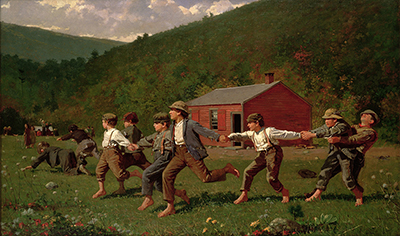
This article should function as a concise support page within Paintings. It gives the paintings hub a rural-childhood stop that is quieter than Snap the Whip, more garden-focused than Boys in a Pasture, and less work-centered than Crossing the Pasture or Weaning the Calf. [1]
The most useful internal links are Biography, Paintings, Boys in a Pasture, Crossing the Pasture, Weaning the Calf, and Fresh Eggs. If The Milk Maid is later source-tested and refreshed, it can join the same rural figure corridor. [2]
Handled at the right size, The Four-Leaf Clover becomes a useful small page: a shaded garden scene that helps the Homer cluster show childhood, rural leisure, summer observation, and the quiet seriousness of ordinary postwar subjects. [3]
Discussion
Winslow Homer rewards close looking because his strongest images rarely close down into one easy meaning. Use the prompts below to test how the work changes as you move between subject, place, medium and history.
Reader Insights
First Look
What detail in The Four-Leaf Clover changes how the whole work feels?
Homer's Method
Where do you see Homer's balance between clear observation and unresolved meaning?
Cluster Context
Which related Homer work helps you read this page more carefully?
Join the Conversation
Share a thoughtful observation below, especially if a detail, source connection or related Homer page changed the way you read the work.
References
- Detroit Institute of Arts object record, The Four-Leaf Clover, Winslow Homer, 1873, accession
70.150: https://dia.org/collection/four-leaf-clover/48265 - National Gallery of Art artist record: https://www.nga.gov/artists/1401-winslow-homer
- National Gallery of Art, Winslow Homer publication: https://www.nga.gov/research/publications/winslow-homer
- Local Winslow Homer Phase 1 approval brief, provisional URL decision matrix, medium-hub source packet, homepage/biography source packet, internal-link ledger, quote ledger, glossary ledger, and Tom image-policy ledger dated 2026-07-20.
 Winslow Homer.jpg)