 by Tom Gurney
Tom Gurney BSc (Hons) is an art history expert with over 20 years experience
Published on June 19, 2020 / Updated on August 2, 2026
Email: tomgurney1@gmail.com / Phone: +44 7429 011000
Contents
- Introduction
- A Rural Figure Painting From 1879
- Laurel, Looking And Everyday Beauty
- Why This Work Rewards A Concise Reading
Introduction
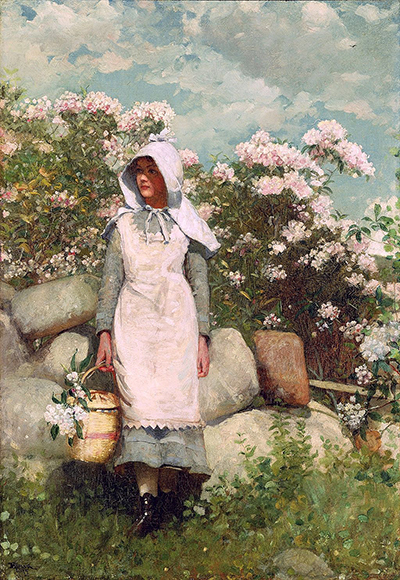
Winslow Homer's Girl and Laurel is an 1879 oil painting in the collection of the Detroit Institute of Arts. The DIA records the work as by Winslow Homer, American, 1836-1910, and lists it with accession number 40.56, the gift of Dexter M. Ferry, Jr. The museum's object page places the painting on view in the American galleries and identifies the subject as a young woman standing near mountain laurel with a basket of flowers. [1]
Those facts give the safest starting point for the article. Girl and Laurel is not one of Homer's large public narratives, not a Civil War picture, and not a late marine painting. It belongs to the quieter figure and rural-genre side of his 1870s work: a young woman, a stone wall, a flowering shrub, a basket, and a rural setting. [2]
The Smithsonian inventory record supports the basic reading of the subject. It describes a full-length female figure leaning near rocks by a laurel bush and holding a basket with laurel. It also records the medium as oil on canvas, the date as 1879, the DIA ownership and location, and Homer's signature and date at lower left. That independent inventory support is useful because the article does not need to depend on inherited web copy or unsupported assumptions about the sitter. [3]
A Rural Figure Painting From 1879
The painting's interest lies in how little drama Homer needs. The girl is not framed as a formal society portrait, and the direct sources do not identify her as a named sitter. She is presented through posture, dress, surrounding growth, and the basket she carries. The laurel is more than scenery because it gives the scene a seasonal and regional character. The DIA notes mountain laurel as a plant native to the eastern United States and connects the flowering shrub to Homer's practice of finding unexpected beauty in ordinary rural places during the 1870s. [4]
That 1870s setting matters within the Homer cluster. The local homepage and biography packets identify this period as one of broad experimentation after Homer's early work as an illustrator and Civil War artist. He was moving through rural subjects, children, leisure scenes, watercolors, resort settings, and figure studies before the later Cullercoats and Prouts Neck marine turn. Girl and Laurel fits that middle-career range because it is intimate, contemporary, and observational rather than grandly historical. [5]
The painting therefore be handled as a support page. Its value is connective. It helps the Paintings route show that Homer's painted career included quiet images of women, children, rural life, and outdoor leisure as well as the famous marine and war subjects. It also gives readers a bridge toward nearby figure pages such as Girl in the Hammock and On the Stile. [1]
Laurel, Looking And Everyday Beauty
The DIA object note includes one useful interpretive lead: the laurel may have functioned as a metaphor for unexpected beauty found in difficult or ordinary places. That idea is best used carefully. The painting does not need to be reduced to a single symbol, and the source record does not support a long symbolic program. The safer reading is that Homer uses the flowering shrub to sharpen the viewer's attention to contrast: a rough wall and rocks, a plain rural figure, and blossoms that are temporary, bright, and gathered into a basket. [2]
This restraint is part of the work's appeal. Homer does not turn the girl into a theatrical heroine. He lets the posture, setting, flowers, and costume create a calm but specific moment. The figure's blue dress, white apron, and white cap are recorded by the Smithsonian inventory and help the scene read as rural and practical rather than decorative only. The basket also matters because it makes the girl active. She is not simply posed among flowers; she has gathered them. [3]
The painting can also sit beside Fresh Eggs and The Milk Maid as part of a modest rural-woman corridor. Those pages does not need to be treated as a formal series unless stronger sources later support that claim, but they do let readers compare how Homer used young women, baskets, milk, eggs, flowers, work, and outdoor or farm settings to build figure subjects from ordinary materials. Fresh Eggs belongs more directly to the watercolor route, while Girl and Laurel is an oil painting. The connection is thematic rather than medium-specific. [4]
Why This Work Rewards A Concise Reading
Girl and Laurel is best retained as a concise support page if the URL remains active. It has a real institutional object route through the Detroit Institute of Arts and a useful supporting inventory record through the Smithsonian, but the direct source depth is not deep enough for a long essay. The strongest editorial path is to state the object facts clearly, explain its place among Homer's 1870s rural and figure subjects, and link it to the broader biography, paintings, and related genre pages. [5]
The article should avoid unsupported claims about Homer's love of women, Impressionist influence, exact sitter identity, or detailed local anecdote unless a stronger source packet later approves them. The DIA records an oral tradition about the laurel on a farmer's land, but that story stays out of public copy unless editorial review decides the object page's wording is sufficient and useful. It is not needed for the reader's basic understanding. [1]
At the right scale, Girl and Laurel becomes a clean small page in the Homer rescue: an 1879 oil painting that shows the artist's quiet attention to rural figures, flowers, seasonal beauty, and the everyday American subjects that sit between his early illustration career and his later sea pictures. [2]
Discussion
Winslow Homer rewards close looking because his strongest images rarely close down into one easy meaning. Use the prompts below to test how the work changes as you move between subject, place, medium and history.
Reader Insights
First Look
What detail in Girl and Laurel changes how the whole work feels?
Homer's Method
Where do you see Homer's balance between clear observation and unresolved meaning?
Cluster Context
Which related Homer work helps you read this page more carefully?
Join the Conversation
Share a thoughtful observation below, especially if a detail, source connection or related Homer page changed the way you read the work.
References
- Detroit Institute of Arts object record, Girl and Laurel, Winslow Homer, 1879, accession
40.56: https://dia.org/collection/girl-and-laurel/48270 - Smithsonian Institution, Inventory of American Painting and Sculpture record, Girl and Laurel, (painting), record siris_ari_272847: https://www.si.edu/object/girl-and-laurel-painting%3Asiris_ari_272847
- National Gallery of Art artist record: https://www.nga.gov/artists/1401-winslow-homer
- National Gallery of Art, Winslow Homer publication: https://www.nga.gov/research/publications/winslow-homer
- Local Winslow Homer Phase 1 approval brief, provisional URL decision matrix, medium-hub source packet, homepage/biography source packet, internal-link ledger, quote ledger, glossary ledger, image ledger, source leads ledger, and Tom image-policy ledger dated 2026-07-20.
 Winslow Homer.jpg)