 by Tom Gurney
Tom Gurney BSc (Hons) is an art history expert with over 20 years experience
Published on June 19, 2020 / Updated on August 2, 2026
Email: tomgurney1@gmail.com / Phone: +44 7429 011000
Contents
Introduction
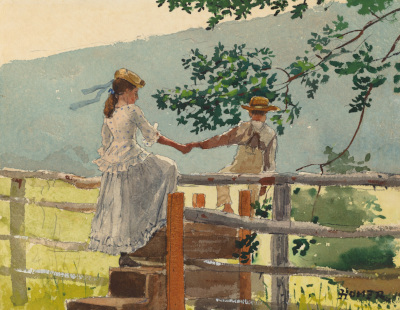
Winslow Homer's On the Stile is an 1878 watercolor in the National Gallery of Art, Washington. The NGA records the medium as watercolor, gouache, and graphite on wove paper, with a sheet size of 22 x 28.4 cm, or 8 11/16 x 11 3/16 inches. The work belongs to the Collection of Mr. and Mrs. Paul Mellon and carries accession number 1994.59.23. [1]
Those facts place the article in the right scale. On the Stile does not need to be rebuilt as a major oil-painting page or as a long symbolic essay. It is a compact work on paper from the rural and childhood side of Homer's 1870s production. Its value in the Winslow Homer cluster is connective: it gives readers a small but useful bridge between watercolor, farm settings, children outdoors, courtship, and the artist's quieter subjects of postwar American life. [2]
The scene is built around a simple rural crossing. A boy has stepped to the far side of a rail fence and leads a girl by the hand over the wooden stile. The girl remains on the viewer's side, one foot raised on the steps, while the boy moves ahead into the field beyond. Their bodies face away rather than out toward the viewer, so the picture avoids theatrical display. Homer turns the act of crossing a fence into the whole subject. [3]
That small action gives the watercolor its charge. A stile is practical farm architecture, but here it also becomes a threshold. The fence divides the foreground from the open field, while the joined hands soften that division. The article acknowledges the picture's gentle courtship feeling, especially since the NGA groups it with collection stories about love, but it does not need to overstate a romance narrative beyond what the object record supports. The safer reading is visual: two young figures, a fence, a step, a handhold, and a transition from one side of rural space to another. [4]
A Houghton Farm Watercolor Context
The Houghton Farm context is important but is best handled carefully. The NGA exhibition history records the work in 1915 under the title On the Stile, Houghton Farm, and the provenance begins with Lawson Valentine, whose country estate near Mountainville, New York, is central to Homer's 1878 rural watercolor activity. The Art Institute of Chicago's record for Apple Picking explains that Homer spent four months at Houghton Farm in 1878 and made numerous drawings and about 30 watercolors of farm children, orchards, and meadows during that stay. [5]
That context helps explain why On the Stile belongs near Homer's 1878 rural watercolors without requiring more than the sources give. It is not necessary to identify the children, invent a story, or claim a precise moment in the artist's biography. The important point is that Homer was using watercolor, gouache, and graphite to make rural childhood and outdoor movement visually serious. The fence, broad field, pale hill, fresh greens, straw hats, and summer clothing all matter because they keep the scene rooted in a specific farm environment rather than in generic sentiment. [6]
Relation To Rural Figure Pages
Within the site, On the Stile should sit beside Fresh Eggs, The Milk Maid, The Green Hill, Girl in the Hammock, Girl and Laurel, Crossing the Pasture, and Boys in a Pasture. Those links is best used as a rural figure corridor, not as a claim that Homer made a formal series. [1]
Compared with the farm-labor subjects, On the Stile is lighter and more social. Compared with Girl in the Hammock, it is more active: the viewer catches the figures mid-crossing rather than at rest. Compared with Crossing the Pasture or Boys in a Pasture, it places childhood and rural movement into a moment of shared contact rather than independent play or open wandering. [2]
That is enough for a useful support page. On the Stile broadens the Homer cluster by showing that the artist's watercolor practice could find interest in the smallest human actions. A fence crossing becomes a composition about touch, movement, boundary, and open air. Kept at this modest scale, the article strengthens the 1870s rural watercolor route without padding the work into a flagship it does not need to be. [3]
Discussion
Winslow Homer rewards close looking because his strongest images rarely close down into one easy meaning. Use the prompts below to test how the work changes as you move between subject, place, medium and history.
Reader Insights
First Look
What detail in On the Stile changes how the whole work feels?
Homer's Method
Where do you see Homer's balance between clear observation and unresolved meaning?
Cluster Context
Which related Homer work helps you read this page more carefully?
Join the Conversation
Share a thoughtful observation below, especially if a detail, source connection or related Homer page changed the way you read the work.
References
- National Gallery of Art object record, On the Stile, Winslow Homer, 1878, accession
1994.59.23: https://www.nga.gov/artworks/89667-stile - Art Institute of Chicago archived object record, Apple Picking, Winslow Homer, 1878, used only for nearby Houghton Farm / 1878 rural watercolor context: https://archive.artic.edu/homer/artwork/183669
- Brooklyn Museum object record, Fresh Air, Winslow Homer, 1878, used only as supporting institutional context for Houghton Farm watercolor subjects: https://www.brooklynmuseum.org/objects/2806
- National Gallery of Art artist record: https://www.nga.gov/artists/1401-winslow-homer
- National Gallery of Art, Winslow Homer publication: https://www.nga.gov/research/publications/winslow-homer
- Local Winslow Homer active URL baseline audit, provisional URL decision matrix, medium-hub source packet, internal-link ledger, quote ledger, glossary ledger, and Tom image-policy ledger dated 2026-07-20.
 Winslow Homer.jpg)