 by Tom Gurney
Tom Gurney BSc (Hons) is an art history expert with over 20 years experience
Published on June 19, 2020 / Updated on August 2, 2026
Email: tomgurney1@gmail.com / Phone: +44 7429 011000
Contents
- Introduction
- What The Watercolor Shows
- Homer In The 1870s
- Provenance, Title And Exhibition History
- Why This Work Belongs Here
Introduction
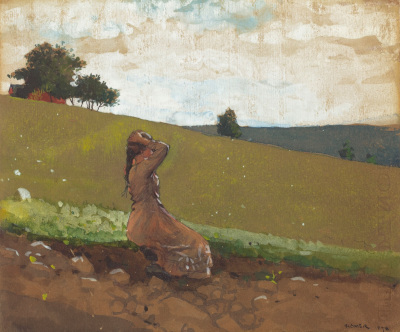
The National Gallery of Art records The Green Hill as a work in watercolor, gouache and graphite on gray-green wove paper, now faded to brown. It dates to 1878 and measures 17.5 by 20.9 centimeters, or 6 7/8 by 8 1/4 inches. The work belongs to the National Gallery of Art through the Collection of Mr. and Mrs. Paul Mellon, with accession number 1994.59.25. NGA also records its image media as free and in the public domain, making it a strong candidate for later image replacement after the image asset gate opens. [1]
Those facts immediately place the work in an important part of Homer's career. By the late 1870s, watercolor was no longer a side practice for him. It had become a flexible way to observe landscape, weather, rural labor and outdoor life. The Green Hill does not announce itself with dramatic action. Its value lies in the way Homer organizes a small landscape around a seated figure, a slope of green land, a red building, trees and a pale sky. The article can help readers understand how his quieter watercolors build meaning from placement, surface and restraint. [2]
What The Watercolor Shows
The scene is spare. NGA describes a green landscape with the horizon set high in the frame. Trees rise along the upper area, a dark green hill occupies much of the view, and a partly visible red building appears in the distance. Near the lower portion of the scene, a woman sits on what may be a brown stone wall. Above her, the sky is pale, worked with touches of gray and blue. [3]
The composition depends on scale. The figure is small, but she is not incidental. Homer lets the hill and trees dominate the sheet, then anchors the landscape with a single seated human presence. That choice changes the mood of the watercolor. Without the woman, the image might read simply as a rural view. With her, it becomes a place being inhabited, paused within and observed from close range. [4]
The red building also matters. It is only partly visible, but its color interrupts the greens and browns of the landscape. The building suggests settlement without turning the work into an architectural subject. Homer gives enough detail to imply human life around the hill while keeping the viewer's attention on the relation between land, figure and open air. [1]
The paper and mixed medium are part of that effect. Watercolor can carry transparency and atmosphere; gouache can add opacity and body; graphite can structure the observation beneath or within the color. NGA's material description helps keep the article grounded in the actual object rather than in a generic idea of a pastoral scene. This is a small sheet made through looking, layering and adjustment. [2]
Homer In The 1870s
The Green Hill belongs to the same decade in which Homer made many of the subjects that still define his public reputation: children at play, rural women, coastal scenes and images of American leisure and labor after the Civil War. The article should sit near works such as Fresh Eggs, The Milk Maid, On the Stile, Weaning the Calf and Peach Blossoms. [3]
That internal grouping is important. Homer's 1870s rural works can look simple if they are treated only as scenes of country life. In fact, they often show him testing how little narrative explanation an image needs. A figure may stand, sit, lean, gather, wait or look; the surrounding field, path, wall or sky does much of the emotional work. In The Green Hill, the action is nearly absent, but the composition still asks a reader to notice relation: the seated woman to the hill, the red building to the trees, the pale sky to the grounded foreground. [4]
This is also why the article belongs in the Watercolours pathway. The work is not merely a painting-like image made in a lighter medium. It is a watercolor that depends on paper tone, scale and economy. A good rebuild helps visitors see watercolors as a major part of Homer's practice, not as lesser versions of oil paintings. [1]
Provenance, Title And Exhibition History
NGA's object record gives The Green Hill a meaningful ownership and exhibition trail. The provenance runs through the Valentine and Pulsifer families before the work entered the Mellon collection and then the National Gallery of Art. That history helps explain why a small watercolor has a secure place in a major public collection. It also links the work to the broader Mellon holdings that shaped the NGA's representation of Homer. [2]
The record also preserves an alternate exhibition-title form, The Green Hill [On the Hill], connected with the 1995-1996 Homer exhibition. The active page title remains The Green Hill, since that is the direct object title and current URL treatment. The variant is useful only as a note for readers who may encounter it in catalogue or exhibition contexts. [3]
The exhibition history is longer than the size of the work might suggest. NGA records the watercolor in the 1911 Metropolitan Museum of Art Homer loan exhibition, early twentieth-century watercolor exhibitions, mid-century Homer exhibitions and the major 1995-1996 Homer exhibition shared by the National Gallery of Art, the Metropolitan Museum of Art and the Museum of Fine Arts, Boston. A later Mellon collection exhibition also included the work. This record supports retention of the URL: the article is not a stray image stub, but a documented object with a public exhibition history. [4]
Why This Work Belongs Here
The article remains modest. The Green Hill does not need a grand interpretive claim to justify itself. Its purpose is to help visitors understand one kind of Homer page that the old cluster handled poorly: a real, documented work with enough source support for a concise article, but not enough reason to become a flagship. That kind of repair matters in a large artist cluster. If only the famous works receive careful writing, the supporting pages remain thin and the whole cluster feels uneven. [1]
Here, the important claim is simple. Homer could make a small watercolor carry a sense of place through proportion, surface and stillness. The hill is large, the figure is small, and the scene resists anecdote. The result is not empty. It is a compact example of Homer's 1870s attention to rural setting and human presence. [2]
The Green Hill therefore be retained as an active page and rebuilt as a concise watercolor article. It belongs beside Homer's other rural and watermedia works, and it gives the cluster another way to show his range: not only dramatic seas, Civil War history and iconic American children, but also small sheets where a single seated figure can make a landscape feel observed, inhabited and quietly complete. [3]
Discussion
Winslow Homer rewards close looking because his strongest images rarely close down into one easy meaning. Use the prompts below to test how the work changes as you move between subject, place, medium and history.
Reader Insights
First Look
What detail in The Green Hill changes how the whole work feels?
Homer's Method
Where do you see Homer's balance between clear observation and unresolved meaning?
Cluster Context
Which related Homer work helps you read this page more carefully?
Join the Conversation
Share a thoughtful observation below, especially if a detail, source connection or related Homer page changed the way you read the work.
References
- National Gallery of Art, object record
1994.59.25, The Green Hill, 1878. - Local Winslow Homer Phase 1A empty-URL source test for The Green Hill and Three Fisher Girls, Tynemouth.
- Local Winslow Homer Phase 1A source-enrichment packet for The Green Hill.
- Local Winslow Homer internal-link ledger, image-rights review and feature-support pack.
 Winslow Homer.jpg)