



 by Tom Gurney
Tom Gurney BSc (Hons) is an art history expert with over 20 years experience
Page Created on / Page Updated on
Email: tomgurney1@gmail.com / Phone: +44 7429 011000
Alphonse Mucha Paintings
Alphonse Mucha's reputation began with posters, but he also painted portraits, large murals, religious and symbolic works, and the twenty canvases of The Slav Epic. The image above is his Madonna of the Lilies, a 1905 tempera painting on canvas. It was intended for a church decoration in Jerusalem that was later cancelled.[4] Its figures and lilies may look familiar to readers of his decorative prints, yet this work belongs to a different medium and commission.
That distinction matters on this page. The former image at the top of the inherited paintings route was a Moët & Chandon advertising lithograph, identified by its brand lettering and by a BnF catalogue record.[7] It has been replaced locally with an image of a catalogued painting. Mucha could use related visual habits across a canvas and a print, but a poster is not a painting because it depicts a finely rendered figure. This guide follows the painted works and their varied purposes, with links to individual articles where the evidence can be read in more detail.
At a Glance
- ArtistAlphonse Mucha (1860–1939)[1]
- HeroMadonna of the Lilies, 1905, tempera on canvas[4]
- Hero commissionplanned Jerusalem church decoration; project cancelled[4]
- Other painted formsoil portraits, exhibition murals, mixed-media canvases and the twenty Slav Epic paintings[1][3][5][6]
- Former hero correctionthe 1899 Moët & Chandon Grand Crémant Impérial image is a colour lithograph, not a painting[7]
- Image limitthe current 400 × 551-pixel inherited reproduction has no traced source master and is unsuitable for fine-detail crops
Contents
- Explore Mucha’s paintings
- What belongs in Mucha's painting story?
- Painting for a public pavilion
- A church painting that remained
- A portrait made for a home
- Painting for two performance and civic interiors
- The twenty canvases of The Slav Epic
- A Russian subject outside the Epic
- A literary painting with a long afterlife
- The candle and late painting
- Seeing the painted object through an image
Explore Mucha’s paintings
Browse the painted canvases and the posters, decorative panels and other works that appeared in the legacy gallery. Each image opens its artwork article.
Paintings and portraits


 in Naarden Alphonse Mucha.jpg)


Posters, panels and works on paper




 Alphonse Mucha.jpg)


What belongs in Mucha's painting story?
The Mucha Foundation's paintings catalogue moves from early portraits and academic work to public decoration, symbolic pictures and the Slav Epic.[1] It lists 55 selected works online at the time of review; that number describes the catalogue selection, not everything Mucha ever painted. The category encompasses several materials and scales. Oil on board, tempera on canvas, and oil and tempera on canvas are different descriptions of how an image was made. A useful account of paintings should not flatten them into the single term “oil painting.”[2][4][5]
The first test is the object record. A figure with flowing hair and ornamental framing might be a colour lithograph issued in many impressions, a unique canvas, or a study on paper. The image's style alone will not decide. A painted original and a printed reproduction of it can also look similar on a screen. The collection's medium, dimensions and purpose help establish what the object is. Those details belong to the catalogued work; they do not automatically describe the source of a small website JPEG.
Mucha's painting did not simply start after his Paris poster success. The Foundation points to academic training in Munich and Paris and to early oil portraits and historical subjects. His 1899 self-portrait, for example, is oil on board, only 32 × 21 cm in the Foundation's record.[1][2] In it he examines his own face in a mirror while wearing a Russian shirt associated in the Foundation's account with his growing sense of Slav identity. The work has its own painted surface and scale. His 1907 crayon self-portrait belongs to another medium and moment.
A Japanese museum checklist identifies two earlier canvases with particularity: Portrait of Katarina Bauer and Portrait of Johann Bauer, each dated 1882 and catalogued as oil on canvas, 54 × 43 cm.[13] The paired entries place portrait painting in Mucha's pre-Paris career, well before the 1899 self-portrait or the monumental historical cycle. The list does not identify the sitters' relationship, a commissioner, present owner or location of execution, so the matching dimensions alone should not be turned into a family or commission story. These are two catalogued paintings, not printed portraits or preparatory sheets.[13]
Painting for a public pavilion
At the Paris Exhibition of 1900, Mucha made a large historical decoration for the Bosnia-Herzegovina Pavilion. The Foundation catalogues The Roman Period and the Arrival of the Slavs as tempera and watercolour on canvas, measuring 345 × 692 cm for the held mural.[3] Those dimensions are far from the scale of a poster or an easel portrait. The work belonged to an interior scheme visitors encountered in a constructed public setting, rather than as a stand-alone sheet on a street wall.
The pavilion project has several kinds of surviving evidence. A drawing or cartoon could prepare a mural; an archival photograph could record part of the interior; a printed illustration could circulate a view of the scheme. None is the mural itself. The Foundation's painted-object record gives the mural's material and size, while its catalogue also lists distinct studies and documentation.[1][3] Keeping those records apart helps explain how a very large painting was planned, viewed and later remembered.
The commission also foreshadowed Mucha's sustained interest in the history of Slav peoples. The Foundation connects his research and travel for the pavilion with the eventual ambition of the Slav Epic.[6] This is a documented career relationship, not a claim that the 1900 mural was one of the twenty later canvases. The pavilion decoration and the Epic belong to different projects and settings.
A church painting that remained
Madonna of the Lilies offers another purpose for painting. The Foundation says Mucha was commissioned in 1902 to decorate a Jerusalem church dedicated to the Virgin Mary. The project was cancelled, but the 1905 final painting survives, along with earlier versions and a separate stained-glass design called Harmony.[4] A cancelled commission therefore need not mean an unfinished picture. The image above represents the final painted version named in the Foundation record.
The Virgin stands among white lilies, while a seated girl in Slavic dress holds a wreath. The Foundation identifies the lilies with purity and the ivy wreath with remembrance, drawing on Mucha's own description of the subject.[4] The two figures share one scene but have different visual weight: the higher figure is pale and distant, while the seated girl occupies the lower space with a direct presence. This contrast can be read at the scale of the inherited image. Claims about tiny brush or tempera marks would require a verified, much larger source.
The dedicated Madonna of the Lilies article follows the church commission, the final canvas and the separate earlier versions. The painting's 247 × 182 cm measurement applies to the Foundation's catalogued work, not to every version and not to the local image file.[4] It is a useful example of why shared titles require careful object identification.
A portrait made for a home
Mucha painted Portrait of Josephine Crane Bradley as Slavia in 1908. The Foundation says Charles Richard Crane commissioned it for the new house built for his daughter Josephine and Harold C. Bradley after their marriage.[5] It is oil and tempera on canvas in the Foundation's record and belongs to the National Gallery Prague. The portrait casts an identified person as Slavia, an allegorical figure. It therefore joins likeness, decoration and symbolism in one work.
The name Slavia also appears on a 1907 insurance poster, a colour lithograph with a related figure. Similar costume and iconography do not turn the printed advertisement into the portrait. The portrait article and Slavia poster article treat the two objects separately. The Foundation later records a reuse of the painted Josephine image on a 100-crown banknote, another stage in the motif's circulation rather than another version of the canvas itself.[5]
The contrast with Mucha's 1899 self-portrait is instructive. One painting studies the artist in a small format; the other was planned for a specific domestic interior and gives a sitter an allegorical identity. Both may be called portraits, but their commissioners, material combinations, scale and audiences differ. “Portrait” names a subject category, not a single fixed function.[2][5]
Painting for two performance and civic interiors
Between the pavilion mural and the Epic, Mucha accepted other schemes whose paintings were meant to work inside a building. The Foundation records a 1908 commission for the renovated German Theatre in New York, covering five large decorative panels, a stage curtain, and decorative elements across the foyer, corridor, staircase and auditorium.[14] Its catalogued Comedy is a 117 × 58 cm oil-on-canvas study for one of the vertical panels flanking a central image. The companion Tragedy study is catalogued separately as oil and tempera on canvas.[14][15] These were painted preparations for an interior design, not independently issued posters. The difference matters because a study's material and measurements cannot be assigned to the completed wall decoration without a record of that decoration.
The theatre's opening and loss give those studies a particular evidentiary weight. Art Gallery of New South Wales exhibition labels identify a separate pastel-on-paper study for the central panel, The Quest for Beauty. They date the German Theatre's public opening to 1 October 1908 and report that it became insolvent after one season and closed the next year.[23] The Mucha Foundation says the building was pulled down in 1929, leaving the preliminary designs as the surviving elements of the scheme.[24] A painted study and a pastel sketch can therefore document a vanished interior, but neither is the installed mural itself. Their different materials also resist treating the five panels as a single surviving painted object.
In Prague, Mucha decorated the Lord Mayor's Hall in the Municipal House in 1910–11. The Foundation describes a circular ceiling devoted to Slavic concord, eight pendentives personifying civic virtues through figures from Czech history, and three wall panels of Slavic youth declaring allegiance to the nation.[16] A viewer encounters this imagery by moving through a room, not by looking at one isolated canvas. The programme links the decorative surface to a political idea: unity is over the visitor's head, while historic examples and young figures surround the hall. That setting is an essential part of the painted commission's meaning.
Prague City Tourism's Czech account adds the commissioning history of the Municipal House room. It says Mucha had expressed interest in the decoration as early as 1902, was entrusted with the hall in 1909, and offered to work without a fee apart from the costs of designs, paint, canvases and scaffolding.[25] The same municipal account records criticism because the commission was awarded without a competition. This locates the painted programme within the city's decisions and its artistic debate; it does not reduce its meaning to a private aesthetic choice.
The room was designed more fully than the word “murals” suggests. Prague's account credits Mucha with details from radiator covers and windows to standing lamps and textile curtains, while naming other artists who contributed elsewhere in the Municipal House.[25] The ceiling, wall paintings and fittings formed one planned environment above the main entrance. A study for a pendentive can be analysed as a painting, but a visitor's experience of the hall also depends on how that painted part meets lighting, fabric and architecture. The related civic designs were not additional canvases in the Slav Epic.[16][25]
The Foundation also catalogues oil-on-canvas studies for the ceiling and individual pendentives, including Jan Hus, Jiří of Poděbrady and Jan Žižka.[16] Prague City Gallery's later Czech exhibition account identifies a group of 1910–11 designs for the hall as collection material.[17] Both records remind us that a preparatory painting can be held and exhibited apart from the finished room. The Slav Epic guide follows a different commission that grew from related national interests; the Municipal House programme is not an extra Epic panel.
The twenty canvases of The Slav Epic
Mucha's most ambitious painting project was The Slav Epic, a cycle of twenty monumental canvases about the history and aspirations of Slav peoples.[6] The Foundation says the idea formed while he was working on the Bosnia-Herzegovina Pavilion, and he devoted much of the later half of his career to its realization. Each canvas has its own event or theme, making the cycle guide a better starting point than treating the project as one giant image.
The individual Slavs in Their Original Homeland, The Holy Mount Athos and Apotheosis of the Slavs articles show how the project moves among origin stories, spiritual traditions and a final vision. They also keep depicted historical moments apart from the dates Mucha painted the canvases. A scene representing an earlier century was not itself painted in that century. Individual Foundation records govern each canvas's medium, date, title and measurements; no one set of dimensions describes the whole cycle.[6]
Studies, staged photographs and preparatory drawings contributed to Mucha's working process. The drawings guide follows one charcoal study for The Holy Mount Athos. A study can illuminate a compositional idea without being the completed painting. The Epic canvases are also distinct from the common montage used online to introduce the series. A montage is a web arrangement of reproductions, not an extra painted panel.
The cycle's physical construction also deserves attention. Conservator Tomáš Berger reported on a 2016 technical survey of selected Epic canvases using radiography, ultraviolet examination and material samples. His English summary describes strong Belgian canvas originally woven for sails, a very thin ground and generally two or three fine paint layers.[20] He relates this economical structure to the need to roll and transport the huge works. Those conclusions come from examined paintings and samples, not from judging a small online reproduction. They explain why the cycle's scale did not require thick paint buildup and why transport was considered while Mucha was making it.
Berger also reports a change in technique across the cycle: earlier works relied mainly on tempera, while later painting made more use of oil, with the transition visible between 1918 and 1924.[20] His study explicitly notes that only selected works received the full range of tests; a cycle-wide trend should not override an individual object's catalogue medium without examining that work's evidence. The Foundation's records call the individual Epic canvases “egg tempera on canvas” in several cases.[6] The technical survey and catalogue terminology answer related but different questions: one traces materials and later intervention across a long working process; the other provides a concise object label. A reader should keep both in view when “tempera” seems to describe the entire Epic uniformly.
Another monumental painting reached its intended room after Mucha made it. The Hlahol choir's Czech history says he painted the lunette Česká Píseň (Czech Song) in 1921, but it was installed in the Prague choir hall only in 1934.[21] Prague City Tourism identifies it as an allegory of song painted on canvas for the hall.[22] Painting date, commissioning institution and installation date are therefore three different facts. This later civic interior belongs beside the pavilion and Municipal House projects, although it is not part of the Epic.
A Russian subject outside the Epic
The 1923 Woman in the Wilderness is another large canvas but not one of the twenty Epic paintings. The Foundation catalogues it as oil on canvas, 201.5 × 299.5 cm, and notes the alternative titles Star and Siberia.[18] It interprets the Russian peasant woman as an emblem of national suffering and the star as hope. The Foundation cautiously proposes that the work may respond to suffering after the Bolshevik Revolution and the 1921 famine; that proposed connection should remain attributed, not become a proven commission or a dated eyewitness statement from Mucha.[18]
The related records show a painting's development without turning every related object into a painting. The Foundation links two oil-on-canvas studies dated about 1922–23 and a staged photograph of Mucha's wife Maruška posing as a Russian peasant woman to the finished canvas.[18][19] One study is recorded at 50.7 × 51.6 cm.[19] The photograph is evidence of a model and working process, not an edition of the final oil painting. The studies are painted objects, but their smaller dimensions and unfinished role are distinct from the 201.5 × 299.5 cm finished work. This is a useful case for reading medium, function and relationship together rather than counting every record under one title as another finished canvas.
A literary painting with a long afterlife
The large oil Quo vadis belongs to a different kind of commission. Art Gallery of New South Wales labels report that Polish novelist Henryk Sienkiewicz asked Mucha in 1902 for a painting based on his novel. The artist first approached the scene as Petronius and Eunice, prepared studies around 1903, completed a large oil in Chicago in 1906, and continued to revise it later.[26] The same account says the outbreak of the First World War broke contact with Sienkiewicz and that the painting was never delivered to him or paid for. “Completed” thus does not mean all later work on the canvas had stopped, and the name change does not make the early studies separate full-size paintings.
The canvas also has a documented later history. A 1986 United States appellate opinion recounts Mucha's consignment of Quo Vadis to a Chicago gallery in 1920, its disposal from that gallery in 1979, and a subsequent recovery dispute involving his son Jiří.[27] The court record establishes that the painting still existed decades after the failed delivery to the novelist; an account that calls it permanently lost would be misleading. The court describes it as painted “about 1904,” while the Australian exhibition gives 1906 for completion after a 1902 commission. Those are differently framed dates in a long-making history, not grounds to assign one precise year to every stage. The current location and condition are not established by either record.[26][27]
The candle and late painting
Mucha continued to paint after completing the Epic. Woman with a Burning Candle is catalogued as a 1933 oil on canvas in the 2024 Art Gallery of New South Wales exhibition text. The curators describe a woman as the embodiment of Czechoslovakia, tending a small flame. They read the buckle and shawl as carrying the national coat of arms, and the rising smoke as a map of Europe in which Germany threatens Czechoslovakia.[8] This is an attributed exhibition interpretation of a political allegory, not a documented likeness of a named sitter.
The same exhibition placed the painting beside the separate Light of Hope, also dated 1933. Its label links that study to Mucha's proposed larger canvas and to a girl guarding a flame in the final Slav Epic painting. It situates the project amid the fifteenth anniversary of Czechoslovak independence, Hitler's rise in Germany and refugees arriving at Czech borders.[8] The two 1933 canvases share a light motif and a political moment, but they have separate catalogue entries and are not alternate titles for one object.
Two exhibition lists, from the Hôtel de Caumont in French and a Japanese venue's English checklist, give Woman with a Burning Candle as 78 × 89 cm.[9][10] An Australian protected-loans register instead reports 98 × 98 × 8.5 cm for its Mucha Trust entry.[11] The sources do not explain whether they measure different boundaries or include a frame, so neither figure should silently replace the other. A separate Czech collection inventory lists a preparatory drawing; a study and an oil canvas need their own histories.[12]
Seeing the painted object through an image
For any work in this guide, read the title, medium, date and held object's dimensions together. These facts locate a picture in a commission and material history. Then ask what the online image permits you to see. At 400 pixels wide, the Madonna image above shows two figures and the field of lilies; it cannot settle subtle surface questions. Its original reproduction chain is untraced, so this page does not present enlarged details from it.
The former Moët hero is a helpful warning. The BnF calls Grand Crémant Impérial an 1899 colour lithograph made for advertising.[7] Rendering and ornament can make a print look “painterly,” while a photograph of a painting can look like a poster on a small screen. The posters and prints guides follow those printed forms. The works directory below opens the wider Mucha catalogue; each linked article can then explain the particular painting, drawing or print behind a familiar image.
Watch: Alphonse Mucha
Follow Mucha’s work from Art Nouveau Paris to his later Czech projects.
Alphonse Mucha: Plongez dans l’Art nouveau !
A French museum introduction to Mucha’s Art Nouveau years, poster work and decorative language.
Watch on YouTubeArtworks directory
| Name | Date | Medium |
|---|---|---|
| 'Accept Love and Enthusiasm from Your Son, Mother of the Holy Nation': study for the mural 'By Own Strength III' at the Lord Mayor's Hall, Obecní Dům, Prague | 1910-1911 | Pencil and charcoal on canvas |
| 'By force towards freedom, with love towards unity!': study for the mural 'By Own Strength II' at the Lord Mayor's Hall, Obecní Dům, Prague | 1910-1911 | Pencil and charcoal on canvas |
| 'The Passing Wind Takes Youth Away': design for a fan and the façade of the 'Pavilion of Man' (unrealised) | 1899 | Colour lithograph |
| 'Through humiliated and tortured, you will live again, my country!': study for the mural 'By Own Strength II' at the Lord Mayor's Hall, Obecní Dům, Prague | 1910-1911 | Pencil and charcoal on canvas |
| 1918-1928: Poster for the 10th Anniversary of the Independence of the Republic of Czechoslovakia | 1928 | Colour lithograph |
| 6th Sokol Festival | 1912 | Colour lithograph |
| 8th Sokol Festival | 1925 | Colour lithograph |
| After the Battle of Grunwald | 1924 | egg tempera on canvas |
| After the Battle of Vitkov Hill | 1923 | egg tempera on canvas |
| Age of Love | 1936–1938 | |
| Age of Reason | 1936–1938 | |
| Age of Wisdom | 1936–1938 | |
| Amants | 1895 | Colour lithograph |
| Apotheosis of the Slavs | 1926 | Egg tempera on canvas |
| As Hamlet | 1899 | colour lithograph |
| Au Quartier Latin | 1898 | Magazine cover |
| Banknotes of Czechoslovakia, designed by Mucha: 500 crown; 50 Crown; 10 Crown | 1929 | Banknotes |
| Bieres de la Meuse | 1897 | Colour lithograph |
| Biscuits Champagne Lefevre Utile | 1896 | Colour lithograph |
| Biscuits Lefevre Utile | 1896 design for 1897 calendar; Foundation object/Carnavalet 1897 | Colour lithograph |
| Blessed are the Pure in Heart | 1906 | Printed magazine illustration |
| Bleu Deschamps | 1903 (deposit) | Colour lithograph |
| Bosnia & Herzegovina Pavilion - illustration featured in 'Le Figaro Illustré' (1 March 1900) | 1900 | Reproduction from Le Figaro Illustré after watercolour original |
| Bosnia-Herzegovina Pavilion: cartoon for the mural 'The Roman Period and the Arrival of the Slavs' | 1899-1900 | ink and crayon on paper |
| Bosnia-Herzegovina Pavilion: fragment of the upper frieze featuring Ivo and Anica, characters from Bosnian legends | 1899-1900 | tempera and watercolour on canvas |
| Bosnian Legends: Death of Hasanaga's Bride | 1899 | Charcoal on paper |
| Bosnian Legends: Murcia - The Plague Lady | 1899 | Charcoal on paper |
| Bosnian Pavilion Restaurant at the Paris Exhibition 1900: design for the menu | 1900 | Pencil and watercolour on paper |
| Boutique Fouquet (interior design) | 1901 | Shop interior design |
| Boutique Fouquet: sketches of the shop's signboard and decorative details | c.1900 | Pencil, ink and watercolour on paper |
| Box for Lefèvre-Utile biscuits: Gaufrettes Vanille | c.1900 | Tin box covered with lithographed label |
| Box for Lefèvre-Utile biscuits: Madère | c.1900 | Tin box covered with lithographed label |
| Brightness of the Day | 1899 | Colour lithograph |
| Broach with Pendant | 1900 | Gold, ivory, mother-of-pearl and semi-precious stones |
| Byzantine Head - The Blonde | 1897 | Colour lithograph |
| Byzantine Heads (pair) | 1897 | Colour lithograph |
| Byzantine Heads: Brunette | 1897 | Colour lithograph |
| Bénédictine | 1898 (BnF deposit); Hamburg 1899; MNAC 1896 or 1898 | Colour lithograph |
| Champagne Ruinart | 1896 | Colour lithograph |
| Chocolat Ideal | before or in 1897 (catalogue conflict) | Colour lithograph |
| Chocolat Masson (1897 calendar) | 1896–1897 | Colour lithograph |
| Choirboys at Petrov Church, Brno | 1905 | Watercolour on cardboard |
| Cloches de Noel | 1900 | Illustrated book |
| Comedy: study for a mural for the German Theatre, New York | 1908 | Oil on canvas |
| Cours Mucha: poster advertising Mucha's art classes held at the Académie Colarossi, Paris | 1900 | colour lithograph |
| Creative Force - Jan z Pernštýna: study for a pendentive of the Lord Mayor’s Hall, Obecní Dům, Prague | 1910-1911 | Oil on canvas |
| Crucifixion | c.1868 | Pencil, crayon and watercolour on paper |
| Cycles Perfecta | 1897 or 1902 (catalogue conflict) | Colour lithograph |
| Dance | 1898 | Colour lithograph |
| Dead Couple - Abandoned | c.1899-1900 | Charcoal and pastel on blue paper |
| Defense of Sziget against the Turks by Nicholas Zrinsky | 1914 | egg tempera on canvas |
| Design for a champagne poster | c. 1896 | Charcoal and pastel on paper |
| Design for a display stand at the Paris Exhibition 1900 | c.1899-1900 | Pencil and wash on paper |
| Design for Champagne Ruinart | c. 1896 | Pencil, watercolour and gold leaf on paper |
| Design for the cover of the magazine 'Fantaz' | 1882 | Ink and watercolour on paper |
| Design for the heading of the cover of the magazine 'Krokodil' | 1885 | Pen and ink on cardboard |
| Design for the poster for the Mucha Exhibition at the Brooklyn Museum, New York, January-February 1921 | 1920 | Pen and ink and watercolour on paper |
| Designs for cutlery | c.1900 | Charcoal and white on card |
| Designs for tableware | c.1900 | Charcoal, coloured pencil and white on card |
| Diadem for 'La princesse lointaine' | 1895 | metal and pearls |
| Diploma of Ivančice: Mock diploma honouring a local celebrity, with illustration of the first line of 'May', a poem by Karel Hynek Mácha | 1882 | Pen and ink and watercolour on paper |
| Documents décoratifs: designs for a watch and accessories (unused) | 1901-1902 | Pencil, ink and white on paper |
| Documents décoratifs: final study for Plate 25, featuring studies of lily | 1901-1902 | Pencil on paper |
| Documents décoratifs: final study for Plate 43 | 1901-1902 | Pencil, ink and wash, heightened with white on paper |
| Documents décoratifs: final study for Plate 49 | 1901-1902 | Pencil and white on paper |
| Documents décoratifs: final study for Plate 50 | 1901-1902 | Pencil and white on paper |
| Documents décoratifs: final study for Plate 60 | 1901-1902 | Pencil, ink and wash, heightened with white on paper |
| Documents décoratifs: final study for Plate 63 | 1901-1902 | Pencil and white on paper |
| Documents décoratifs: final study for Plate 67 | 1901-1902 | Pencil and white on paper |
| Documents décoratifs: final study for Plate 71 | 1901-1902 | Pencil and white on paper |
| Documents décoratifs: final study for Plate 72 | 1901-1902 | Pencil and wash, heightened with white on paper |
| Documents décoratifs: line drawing for Plate 33, featuring lily motifs | 1901-1902 | Pencil, pen and ink on paper |
| Documents décoratifs: Plate 54 | 1902 | Lithograph |
| Dreaming of Freedom: study for a Panel of the Small Reception Room at the Lord Mayor’s Hall, Obecní Dům, Prague | 1910-1911 | Pen and ink and watercolour on paper |
| Dusk | 1899 | Colour lithograph |
| Evening | 1899 | Colour lithograph |
| F. Champenois (Rêverie imprint) | 1898 | Colour lithograph |
| F. Guillot-Pelletier calendar (1898) | 1897–1898 | Colour lithograph |
| Feather | 1899 | Colour lithograph |
| Figures décoratives: final study for Plate 2 | 1904-1905 | Pencil and white on paper |
| Figures décoratives: final study for Plate 3 | 1904-1905 | Pencil and white on paper |
| Figures décoratives: final study for Plate14 | 1904-1905 | Pencil with white on paper |
| Figures décoratives: sketch study for Plate14 | 1904-1905 | Blue pencil on paper |
| Flirt Lefevre Utile | 1899 (Foundation design); BnF legal deposit 1900 | Colour lithograph |
| Flower | 1897 | Colour lithograph |
| Flower: final study for decorative panel | 1897 | Pencil, ink and watercolour on paper |
| France Embraces Bohemia | 1918 | oil on canvas |
| Fruit | 1897 | Colour lithograph |
| Georges Fouquet (1858-1929), Paris, after design by Mucha: Ornamental Chain with pendants | 1900 | Gold, enamel, fresh-water pearls, mother of pearl and semi-precious stones |
| Georges Fouquet (1858-1929), Paris, after Mucha design: 'Peacock' Ring (Exhibited at the Paris Exhibition 1900) | 1900 | Opal and gold |
| Girl Weeping | c.1899-1900 | Black chalk and pastel on paper |
| Girl with Loose Hair and Tulips | 1920 | Oil on canvas |
| Gismonda | 1894 | Colour lithograph |
| Head of a Girl, statue for the stand of the Houbigant Perfumery at the Paris Exhibition 1900 | 1900 | Bronze, silver and parcel gilt |
| Head of Sarah Bernhardt: Study for 'Lorenzaccio' | 1896 | Pencil on paper |
| Heather from Coastal Cliffs | 1902 | Colour lithograph |
| Heidsieck & Co | 1901 | Colour lithograph |
| Holy Mount Athos | 1926 | Egg tempera on canvas |
| Ilsée, Princesse de Tripoli | 1897 | Illustrated book |
| In the Desert: Study for an illustration for the Světozor magazine | 1889 | Pencil, watercolour and gouache on paper |
| Incantation (Salammbô) | 1897 | Lithograph |
| Independence - Jiří z Poděbrad: study for a pendentive of the Lord Mayor’s Hall, Obecní Dům, Prague | 1910-1911 | Oil on canvas |
| Interior and furniture designs | c.1900 | Pencil on paper |
| Interior of Boutique Fouquet: design for a wall-mounted display cabinet with statuette and mirror | c.1900 | Pencil on paper |
| Interior of Boutique Fouquet: design for the fireplace with statuettes, mirror, and the ornamental details of the wall | c.1900 | Pencil and watercolour on cardboard |
| Interior of Boutique Fouquet: sketches of the fireplace with statue, mirror, display cabinet, and the ornamental details of the wall | c.1900 | Pencil, pen and ink on paper |
| Ivy | 1901 | Colour lithograph |
| Jan Milic of Kromeriz | 1916 | egg tempera on canvas |
| Jaroslava and Jiří, the Artist’s Children | 1918 | Oil on canvas |
| JOB poster | 1896 | Colour lithograph |
| Judgement of Paris (calendar for Vieillemard printing company) | 1895 | Colour lithograph |
| Justice - Master Jan Hus: study for a pendentive of the Lord Mayor's Hall, Obecní dům, Prague | 1910-1911 | Oil on canvas |
| L'Annee Qui Vient | 1897 | red chalk on paper |
| L'Illustration magazine - cover for Christmas 1896/1897 | 1896 | Magazine cover |
| L'Illustré Soleil du Dimanche | 1897 | Magazine cover |
| La Dame aux Camélias: designs for cover and interior of special programme | 1896 | Pencil and watercolour on paper |
| La Nature | 1899-1900 | Bronze and amethyst |
| La Plume | 1897 | Magazine cover |
| La Samaritaine | 1897 | colour lithograph |
| Lance Parfum Rodo | 1896; Albertina print c. 1900 | Colour lithograph |
| Laurel | 1901 | Colour lithograph |
| Le Monde Illustré | 1900 | Magazine cover |
| Le Pater | 1899 | Illustrated book |
| Le Pater: early study for the 1st allegorical scene 'Our Father who art in Heaven' (1899) (Mucha Foundation object 300) | 1899 | Pencil on paper |
| Le Pater: early study for the 1st allegorical scene 'Our Father who art in Heaven' (1899) (Mucha Foundation object 302) | 1899 | Pastel on paper |
| Le Pater: study for the 6th allegorical scene 'Forgive us our debts, as we forgive our debtors' | 1899 | Charcoal and ink wash on paper |
| Lefevre Utile | 1904 | Advertisement |
| Leslie Carter | 1908 | Colour lithograph |
| Letem Českým Světem | 1898 | Printed book |
| Lorenzaccio | 1896 | Colour lithograph |
| Luchon poster (attributed to Mucha) | 1895 | Colour lithograph |
| Madonna of the Lilies | 1905 | Tempera on canvas |
| Master Jan Hus Preaching at the Bethlehem Chapel | 1916 | egg tempera on canvas |
| Maude Adams | 1908 | Lithograph, hand-coloured in watercolour and gouache |
| Maude Adams as Joan of Arc | 1909 | Oil on canvas |
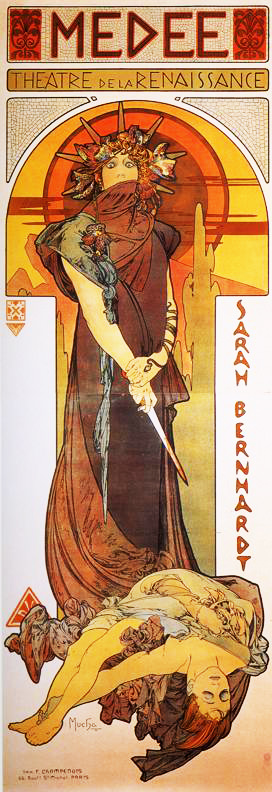
| Medea | 1898 | Colour lithograph |
| Menu for the Bosnian Pavilion Restaurant at the Paris Exhibition 1900 | 1900 | Colour lithograph |
| Militancy - Jan Žižka: study for a pendentive of the Lord Mayor's Hall, Obecní dům, Prague | 1910-1911 | Oil on canvas |
| Military Camp in Winter, near a City on Fire | c.1899-1900 | Pastel on paper |
| Moet et Chandon | 1899 | Colour lithograph |
| Monaco Monte Carlo | 1897 | Colour lithograph |
| Moon | 1902 | |
| Moravian Teachers' Choir | 1911 | Colour lithograph |
| Morning Alphonse Mucha Painting / AlphonseMucha.org | 1899 | Colour lithograph |
| Morning Star | 1902 | Colour lithograph |
| Moët & Chandon White Star | 1899 | Colour lithograph |
| Mrs Mucha’s Necklace | 1906 | gold, enamel and semi-precious stones |
| Mural for the Bosnia-Herzegovina Pavilion: The Roman Period and the Arrival of the Slavs | 1900 | tempera and watercolour on canvas |
| Murals by Mucha in the Lord Mayor's Hall, Obecní Dům (Municipal House), Prague (1910-1911) | ||
| Music | 1898 | Colour lithograph |
| Nativity | c. 1934 | oil on canvas |
| Nestle's Food for Infants | 1897 | Colour lithograph |
| Night | 1899 | Colour lithograph |
| Nude on a Rock | 1898-1899 | Bronze |
| Official Banquet of the Paris Exhibition 1900: design for the menu featuring a fashionable woman wearing a Mucha-style jewellery | 1900 | Pencil, gouache and wash on grey paper |
| Ornamental motifs designed for 'Combinaisons Ornementales se Multipliant à l'Infini à l'Aide du Miroir' (1901) | c.1900-1901 | Blue and red pencil on paper |
| Packaging for 'Savon Mucha Violette' | 1906 | Colour lithograph |
| Packaging for Lefèvre-Utile biscuits: Boudoir | 1901 | Colour lithograph |
| Page's Costume: study for an illustration for 'Le Costume au Théâtre' | 1890 | Pencil and watercolour on cardboard |
| Painting | 1898 | Colour lithograph |
| Peonies | 1897–1898 | Ink and watercolour |
| Petr Chelcicky at Vodnany | 1918 | egg tempera on canvas |
| Poetry | 1898 | Colour lithograph |
| Portrait of Jaroslava | c.1927-1935 | Oil on canvas |
| Portrait of Josephine Crane Bradley as Slavia | 1908 | Oil and tempera on canvas |
| Portrait of Marie Chytilová (Maruška), Mucha's Future Wife | 1903 | pastel on paper |
| Portrait of Mucha's Sister, Angela | c.1880 | Oil on canvas |
| Portrait of Mucha's Sister, Anna | c.1885 | Oil on canvas |
| Portrait of Mucha's Son, Jiří | 1925 | Oil on canvas |
| Portrait of Mucha's Wife, Maruška | 1908/17 | Oil on canvas |
| Portrait of Woman | c. mid 1910s - 1925 | Blue pastel on grey paper |
| Poster for 'Hommage Respectueux de Nestlé' (the Nestlé Company's tribute to Queen Victoria's 60th Jubilee) | 1897 | Colour lithograph |
| Poster for 'Imprimerie Cassan Fils' | 1896 | Colour lithograph |
| JOB poster (1898) | 1898 | Colour lithograph |
| Poster for 'La Dame aux Camélias' | 1896 | Colour lithograph |
| Poster for 'La Tosca' | 1899 | Colour lithograph |
| Poster for 'Regional Exhibition at Ivančice 1913' | 1912 | Colour lithograph |
| Poster for 'The Slav Epic Exhibition, Brno, 1930' | 1928-1930 | Colour lithograph |
| Poster for 'Waverley Cycles' | 1898 | Colour lithograph |
| Poster for the 'Lottery of the Union of Southwestern Moravia' | 1912 | Colour lithograph |
| Poster for the Austrian Pavilion at the Paris Exhibition 1900 | 1900 | Colour lithograph |
| Prague Subjugated: study for a Panel of the Small Reception Room at the Lord Mayor’s Hall, Obecní Dům, Prague | 1910-1911 | Pen and ink and watercolour on paper |
| Primrose | 1899 | Colour lithograph |
| Primrose and Feather (paired image) | 1899 | Colour lithographs (paired image) |
| Princess Hyacinth (Princezna Hyacinta) | 1911 | Colour lithograph |
| Print proof for the Biscuits Lefèvre-Utile tin | 1899 | Lithograph |
| Reverie | 1898 | Colour lithograph |
| Russia Restituenda [Russia Must Recover] | 1922 | Colour lithograph |
| Salome | 1897 | Colour lithograph |
| Salon des Cent | 1896 | Colour lithograph |
| Salon of the Hundred | 1897 | Colour lithograph |
| Sarah Bernhardt - La Princesse Lointaine - Lefevre Utile | 1903 | Colour lithograph |
| Sarah Bernhardt as La Princesse Lointaine: poster for 'La Plume' magazine | 1897 | Colour lithograph |
| Sarah Bernhardt in the role of the Duc de Reichstadt in L’Aiglon | 1900 | Pencil on paper |
| Sarah Bernhardt: study of her full-standing figure | c.1896 | Pen and ink on paper |
| Savonnerie de Bagnolet calendar | 1898 (calendar) | Printed advertising calendar |
| Self-portrait (1899) | 1899 | Oil on board |
| Self-portrait (1907) | 1907 | Blue and white crayon on blue Ingres paper |
| Self-portrait, sketching in his apartment, Paris | late 1880s | oil on canvas |
| Sketches of flowers for Documents décoratifs | c.1900-1901 | Pen and ink on paper |
| Slavia insurance poster | 1907 | Poster |
| Slavs in their Original Homeland | 1912 | Egg tempera on canvas |
| Snake Bracelet with a Ring | 1899 | Gold, enamel, opal, ruby and diamond |
| Société Populaire des Beaux Arts | 1897 | Colour lithograph |
| Song of Bohemia | 1918 | oil on canvas |
| St. Vitus Cathedral Stained-glass Window, Prague: final design for the central panels, featuring SS Cyril and Methodius | 1931 | Ink and watercolour on paper |
| St. Vitus Cathedral Stained-glass Window, Prague: final design for the central panels, featuring St. Ludmila | 1931 | Ink and watercolour on paper |
| St. Vitus Cathedral Stained-glass Window, Prague: final design for the central panels, featuring St. Wenceslas (Duke of Bohemia) kneeling next to his Grandmother, St. Ludmila | 1931 | Ink and watercolour on paper |
| St.Vitus Cathedral Stained-glass Window, Prague: final design for the bottom left panels | 1931 | Ink and watercolour on paper |
| St.Vitus Cathedral Stained-glass Window, Prague: final design for the bottom right panels | 1931 | Ink and watercolour on paper |
| Stained-glass Window designed by Mucha at St. Vitus Cathedral, Prague | Early 1930s | N/A |
| Study for 'The Age of Reason' | 1936-1938 | Pencil and watercolour on paper |
| Study for 'The Slav Epic cycle' No.19: The Abolition of Serfdom in Russia | 1913-1914 | Watercolour and gouache on paper |
| Study for 'The Slav Epic' cycle No.14: The Sacrifice at Szigetvár by Nikola Zrinski | c.1913-1914 | Photographed drawings stuck together, tinted with watercolour and gouache |
| Study for 'The Slav Epic' cycle No.17: The Holy Mount Athos (1926) | c.1925-26 | Charcoal heightened with white on cardboard |
| Study for 'The Slav Epic' cycle No.18: The Oath of Omladina under the Slavic Linden Tree | c.1925-1926 | Pencil and watercolour on paper |
| Study for 'The Slav Epic' cycle No.1: The Slavs in Their Original Homeland (1912) | c.1910-1912 | Oil on canvas |
| Study for 'The Slav Epic' cycle No.2: The Celebration of Svantovít | c.1910-1912 | Oil on canvas |
| Study for 'The Slav Epic' cycle No.7: Jan Milíč of Kroměříž | c.1915-1916 | Oil on canvas |
| Study for 'The Slav Epic' cycle No.9: Master Jan Hus Preaching at the Bethlehem Chapel. The Magic of the Word: Truth Prevails (1412). | c.1915-1916 | Oil on canvas |
| Study for 'The Three Ages' triptych: Reason, Wisdom and Love [unfinished project] | 1936-1938 | Pencil and watercolour on paper |
| Study for 'Woman in the Wilderness' (c. 1922-1923) (Mucha Foundation object 315) | c. 1922-1923 | oil on canvas |
| Study for 'Woman in the Wilderness' (c. 1922-1923) (Mucha Foundation object 316) | c. 1922-1923 | oil on canvas |
| Study for Savon Notre Dame | c. 1896 | pencil and watercolour on paper |
| Study for the poster 'Russia Restituenda [Russia Must Recover]' | 1922 | Pen and ink and watercolour on paper |
| Study of a Male Nude | 1885-1887 | Oil on canvas |
| The Abolition of Serfdom in Russia | 1914 | Egg tempera on canvas |
| The Arts (series) | 1898 | Colour lithograph |
| The Arts: study for 'Dance' | 1898 | Pencil and watercolour on paper |
| The Arts: study for 'Music' | 1898 | Pencil and watercolour on paper |
| The Arts: study for 'Painting' | 1898 | Pencil and watercolour on paper |
| The Arts: study for 'Poetry' | 1898 | Pencil and watercolour on paper |
| The Bohemian King Premysl Otakar II | 1924 | egg tempera on canvas |
| The Bulgarian Tsar Simeon | 1923 | egg tempera on canvas |
| The Burr McIntosh Monthly, 1907 | 1907 | Magazine cover |
| The Celebration of Svantovit | 1912 | egg tempera on canvas |
| The Coronation of the Serbian Tsar Stefan Dusan as East Roman Emperor | 1923 | egg tempera on canvas |
| The Devil and Mr Twardowsky: study for an illustration for 'The Tale of Pan Twardowsky' (a variation of 'Faust') | c.1887-1888 | Charcoal on paper |
| The Flowers (series) | 1898 | Colour lithographs |
| The Flowers: Carnation | 1898 | Colour lithograph |
| The Flowers: Iris | 1898 | Colour lithograph |
| The Flowers: Lily | 1898 | Colour lithograph |
| The Flowers: Rose | 1898 | Colour lithograph |
| The Hussite King Jiri of Podebrady | 1923 | Egg tempera on canvas |
| The Introduction of the Slavonic Liturgy | 1912 | egg tempera on canvas |
| The Last Days of Jan Amos Komensky (Comenius) in Naarden | 1918 | Egg tempera on canvas |
| The Light of Hope | 1933 | Oil on canvas |
| The Meeting at Krizky | 1916 | egg tempera on canvas |
| The Months (January-June) | 1899 | Colour lithograph |
| The Months (July-December) | 1899 | Colour lithograph |
| The Moon and the Stars (four-panel montage) | 1902 | Colour lithographs (four-panel montage) |
| The Moon and the Stars (series) | 1902 | Colour lithograph |
| The Moon and the Stars: study for 'The Evening Star' | 1902 | Ink and watercolour on paper |
| The Moon and the Stars: study for 'The Pole Star' | 1902 | Ink and watercolour on paper |
| The New York Daily News art supplement | 1904 | Printed art supplement |
| The Oath of Concord of the Slavs (unfinished) | 1939 | oil on canvas |
| The Oath of Omladina under the Slavic Linden Tree | 1926, unfinished | Egg tempera on canvas |
| The Precious Stones (four-panel montage) | 1900 | Colour lithographs (four-panel montage) |
| The Precious Stones (series) | 1900 | Colour lithograph |
| The Precious Stones: Amethyst | 1900 | Colour lithograph |
| The Precious Stones: Emerald | 1900 | Colour lithograph |
| The Precious Stones: Ruby | 1900 | Colour lithograph |
| The Printing of the Bible of Kralice in Ivancice | 1914 | egg tempera on canvas |
| The Seasons (series) | 1896 | Colour lithograph |
| The Seasons (series) (1900) | 1900 | Colour lithograph |
| The Seasons (variation in screen format) | 1896 | Colour lithograph |
| The Seasons: Autumn (1896) | 1896 | Colour lithograph |
| The Seasons: Autumn (1900) | 1900 | Colour lithograph |
| The Seasons: Spring | 1900 | Colour lithograph |
| The Seasons: Spring (1896) | 1896 | Colour lithograph |
| The Seasons: Summer | 1900 | Colour lithograph |
| The Seasons: Summer (1896) | 1896 | Colour lithograph |
| The Seasons: Winter | 1900 | Colour lithograph |
| The Seasons: Winter (1896) | 1896 | Colour lithograph |
| The Slavonic Concord: study for the ceiling painting for the Lord Mayor's Hall, Obecní Dům, Prague | 1910-1911 | Oil on canvas |
| The Threat | 1912 | Colour lithograph |
| The Times of the Day (series) | 1899 | Colour lithograph |
| The West End Review | 1897 (Foundation); 1898 promotional cover | Colour lithograph |
| Thistle from the Sands | 1902 | Colour lithograph |
| Théâtre de la Renaissance: design for poster advertising Sarah Bernhardt's theatre | c.1895 | Pen and ink on paper |
| Tin for Lefèvre-Utile biscuits | 1899 | Circular tin with lid and handle; colour print on metal |
| Topaz | 1900 | Colour lithograph |
| Tragedy - study for a mural for the German theatre New York | 1908 | Oil and tempera on canvas |
| Trappistine Liquors | 1897 | colour lithograph |
| Wiener Chic | 1905 | Magazine cover |
| Woman in the Wilderness | 1923 | Oil on canvas |
| Woman masked in white head-scarf - study for the illustration of the Bosnia & Herzegovina Pavilion featured in 'Le Figaro Illustré' (1 March 1900) | 1899 | Pencil and wash heightened with white on paper |
| Woman with a Daisy - textile designed by Mucha | 1900 | Printed upholstery fabric |
| Zdenka Cerny | 1913 | Colour lithograph |
| Zodiac (La Plume calendar) | 1896–97 | Colour lithograph |
| Zodiac (textless decorative panel) | 1896 | Colour lithograph |
| ‘At the sight of the two storks the owl rose.’ Study for an illustration for Contes de Grand-mères | 1891 | Watercolour and gouache on paper |
Frequently Asked Questions
Which painting appears at the top of this page?
Was the former Moët & Chandon image a painting?
How many paintings are in The Slav Epic?
Discussion
The page now uses the inherited Madonna of the Lilies image, catalogued as tempera on canvas.
The former Moët & Chandon hero was a colour lithograph and is documented in the source packet.
Reader Insights
How do the two figures and lilies organize your first view of Madonna of the Lilies?
What does the painting’s planned church setting add to your reading?
How does a painted portrait differ in purpose from a printed Slavia advertisement?
Join the Conversation
Share a visible detail and identify the record that supports your interpretation.
References
- Mucha Foundation, Paintings catalogue and introduction. Browse Paintings.
- Mucha Foundation, Self-portrait (1899), oil on board. Foundation object.
- Mucha Foundation, Mural for the Bosnia-Herzegovina Pavilion: The Roman Period and the Arrival of the Slavs (1900), tempera and watercolour on canvas. Foundation object.
- Mucha Foundation, Madonna of the Lilies (1905), tempera on canvas; church commission and earlier versions. Foundation object.
- Mucha Foundation, Portrait of Josephine Crane Bradley as Slavia (1908), oil and tempera on canvas. Foundation object.
- Mucha Foundation, Slav Epic thematic account and twenty-canvas catalogue. Foundation theme.
- Bibliothèque nationale de France, Moët & Chandon: Grand Crémant Impérial (1899), colour lithograph, FRBNF40461445. BnF catalogue.
- Art Gallery of New South Wales, Alphonse Mucha: Spirit of Art Nouveau, 2024 large-print labels, entries 104–105, Woman with a Burning Candle and The Light of Hope. Exhibition labels.
- Hôtel de Caumont, Mucha: Maître de l'Art nouveau, 2023–24 educational dossier, p. 31, French title, date, medium and size. Dossier.
- Mori Arts Center Gallery, Mucha exhibition checklist, no. 225, Woman with a Burning Candle. Checklist.
- Australian protected-loans register, Mucha Trust entry for Woman with a Burning Candle, 1933, oil on canvas, 98 × 98 × 8.5 cm. Loan register.
- Czech collection inventory, preparatory drawing for Woman with a Burning Candle, entry 172. Inventory.
- Contemporary Art Museum, Kumamoto, Japanese Mucha exhibition checklist, items 115–116, 1882 Bauer portraits, oil on canvas, 54 × 43 cm each. Work list.
- Mucha Foundation, Comedy: study for a mural for the German Theatre, New York, 1908, oil on canvas, 117 × 58 cm; description of the 1908 theatre commission.
- Mucha Foundation, Paintings catalogue, listing the separate Tragedy theatre study as oil and tempera on canvas.
- Mucha Foundation, murals for the Lord Mayor's Hall, Municipal House, Prague, 1910–11; ceiling, pendentives, wall programme and related studies.
- Prague City Gallery, 2017 annual report, Czech account identifying 1910–11 Municipal House design studies in an exhibition.
- Mucha Foundation, Woman in the Wilderness, 1923, oil on canvas, 201.5 × 299.5 cm, with related studies and model photograph.
- Mucha Foundation, Study for Woman in the Wilderness, c. 1922–23, oil on canvas, 50.7 × 51.6 cm.
- Tomáš Berger, “Alfons Mucha: Slovanská epopej. Technologický a restaurátorský průzkum,” Staletá Praha 35, no. 1 (2019), especially English summary pp. 135–137; 2016 technical survey, supports, layers and changing paint technique.
- Hlahol Praha, history of the choir and building, Czech account of Mucha's 1921 Česká Píseň and its 1934 installation.
- Prague City Tourism, Prague Hlahol, identifying the lunette as a canvas allegory of song painted for the choir.
- Art Gallery of New South Wales, Alphonse Mucha: Spirit of Art Nouveau (2024), large-print labels, p. 87, on the pastel Quest for Beauty study and the German Theatre's opening and closure. Exhibition labels.
- Mucha Foundation, artist timeline, 1908 German Theatre entry, on the five-panel scheme and 1929 demolition. Foundation timeline.
- Prague City Tourism, “Po stopách A. Muchy: Obecní dům,” Czech municipal account of the Lord Mayor's Hall commission, criticism, wall paintings and designed fittings. City account.
- Art Gallery of New South Wales, Alphonse Mucha: Spirit of Art Nouveau (2024), large-print labels, pp. 89–90, on the Sienkiewicz commission, studies, Chicago completion and later reworking of Quo vadis. Exhibition labels.
- United States Court of Appeals for the Seventh Circuit, Mucha v. King, 792 F.2d 602 (1986), historical account of the painting's 1920 consignment and later recovery dispute; cited for object history, not a current ownership conclusion. Opinion text.