from Amazon
* As an Amazon Associate I earn from qualifying purchases.
 by Tom Gurney
Tom Gurney BSc (Hons) is an art history expert with over 20 years experience
Page Created on / Page Updated on
Email: tomgurney1@gmail.com / Phone: +44 7429 011000
Caravaggio's Painting Technique: Grounds, Incisions, Revisions and Light
Caravaggio's pictures can look startlingly immediate. That effect did not mean that he simply improvised in front of a blank canvas. Examination of individual paintings reveals prepared grounds, brushed indications, incised marks, changed poses and carefully worked surfaces. The methods vary by object and date. The soundest way to describe his technique is to follow that physical evidence rather than repeat the legend that he never planned or drew.[1][2][3]
The Kimbell Art Museum's Cardsharps and London's National Gallery Supper at Emmaus are especially instructive because their custodians publish detailed findings. The earlier Odescalchi Conversion of Saint Paul adds a different support and a sequence of changes seen in infrared. Conservation of the Cleveland Crucifixion of Saint Andrew shows why the painting's present appearance must also be separated from later varnish and restoration.[1][2][4][5]
Caravaggio in context
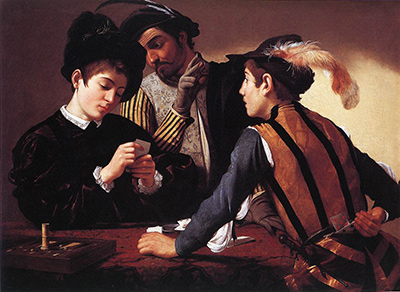
The Cardsharps
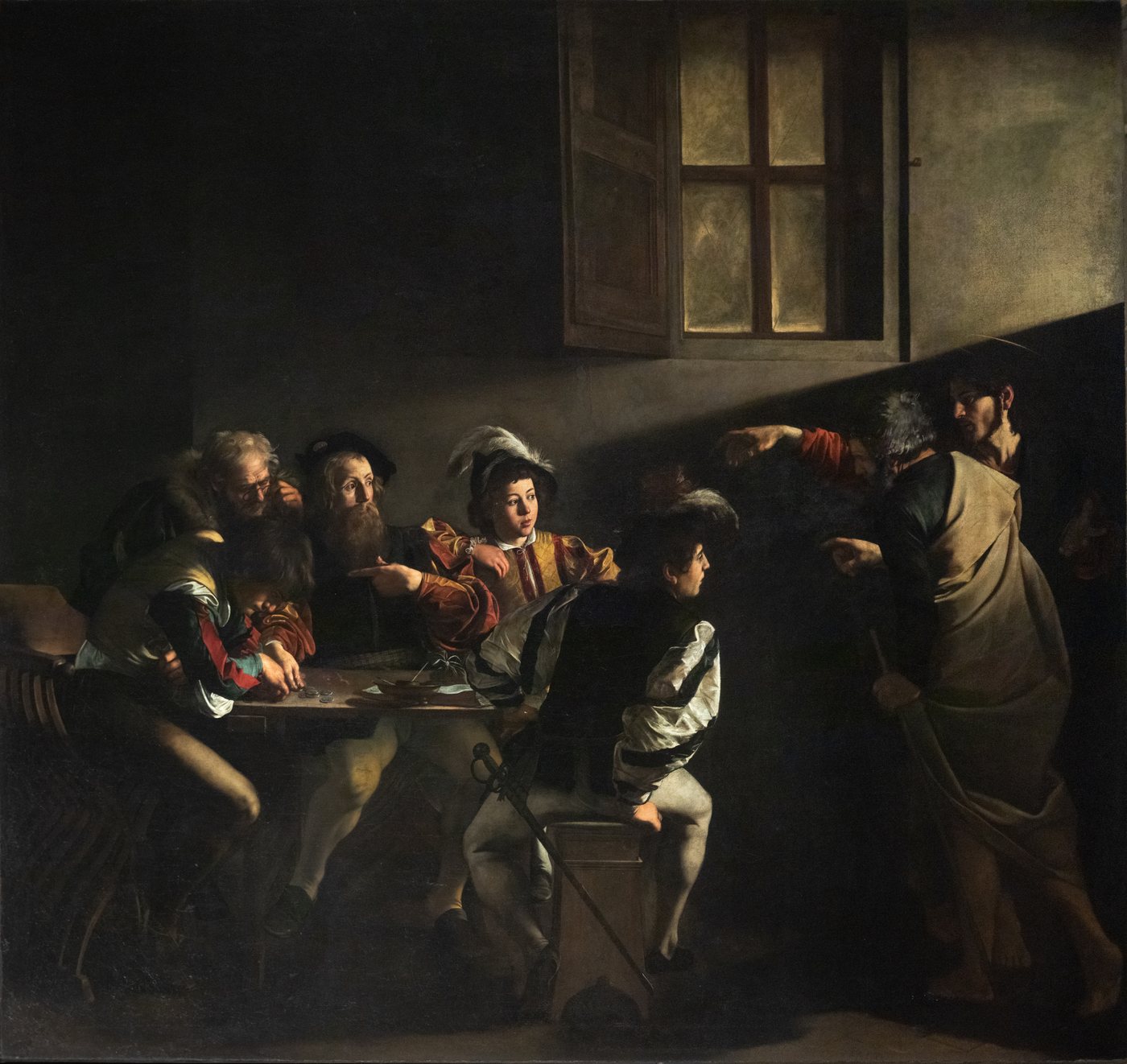
c.1595Calling of Saint Matthew
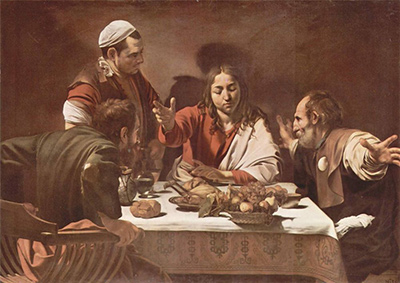
1599–1600Supper at Emmaus
1601At a Glance
- Surface beneath the imageprepared grounds differ among examined works; a gray early ground is documented in The Cardsharps, while warmer or darker grounds appear elsewhere.[1][3]
- Layoutsome works show brushed marks or incisions; their presence and absence must be reported painting by painting.[1][2]
- Changes while paintinginfrared and other examination reveal revisions, including hands and cards in The Cardsharps and figures in the first Conversion.[1][4]
- Light and darkchiaroscuro describes a visible contrast; technical study asks how layers, pigments and the exposed ground produced it.
- Drawingsno secure corpus of independent Caravaggio drawings survives. That is not proof that he never drew.[6]
Contents
- What Evidence Survives?
- Prepared Grounds and Support
- Drawing, Incisions and Placing Figures
- Changes Made During Painting
- Brushwork, Colour and Selective Light
- What Infrared and Conservation Can Show
- Myths and Limits
- Frequently Asked Questions
What Evidence Survives?
There are two kinds of evidence a reader can inspect. One is the visible painting: bodies pushed near the picture plane, colours, edges, shadow and light. The other comes from the physical object examined by conservators: support, ground, layer structure, incisions, subsurface marks, pigments and later interventions. A visual description can be convincing without proving a claim about what lies beneath the paint.[2][3]
Caravaggio worked at different scales and for different settings. A cabinet picture made for a collector is not automatically representative of a huge chapel canvas. The National Gallery's technical bulletin compares three works from different points in his career and identifies variations in ground and finish. Its findings help build a pattern, but no one painting can stand for every decade of the artist's practice.[3]
Prepared Grounds and Support
A painter generally prepared the support before applying the image. The colour and texture of this ground influence how later paint appears. In the Kimbell's Cardsharps, the museum identifies a light gray ground, related to northern Italian practice. Its conservation account says Caravaggio adopted a brownish ground around 1595–96, characteristic of Roman practice. The statement describes an observed shift, not a claim that every later surface is identical.[1]
In a National Gallery study, Larry Keith found warm transparent grounds in Boy bitten by a Lizard and the London Supper at Emmaus. The ground acts as a middle tone in flesh and hair. In the later Salome receives the Head of John the Baptist, the priming is darker. The study also identifies walnut oil and, in white passages of the first two paintings, egg tempera medium. These material differences matter because the drama of the final image comes from a built paint structure rather than darkness painted as a single black backdrop.[3]
Keith's examination of the London Boy bitten by a Lizard makes the middle tone tangible. The canvas is a single piece of plain-weave linen, prepared with a translucent reddish-brown mixture of calcite, earth pigments and a little lead white. Around the shoulder, collarbone, chin and cheek, the preparation is either visible or lightly veiled to form half-shadow. Lighter, more opaque paint and thin dark layers work against that middle value. But the balance a viewer sees today is not necessarily identical to the original: Keith notes that ageing can make oil paint more transparent and that wear has made the ground more prominent in parts of the hair and robe. Identifying original economy of paint therefore requires looking at condition as well as colour.[3]
The first Cerasi Conversion of Saul demonstrates a further exception. The Gallerie Nazionali Barberini Corsini describe seven horizontal cypress planks, a later perimeter addition and a light gray ground laid diagonally to suggest canvas grain. Its panel support differs from the final oil-on-canvas Conversion on the Way to Damascus in Santa Maria del Popolo. The material distinction is also an identity check when reproductions of the two versions circulate under nearly identical titles.[4]
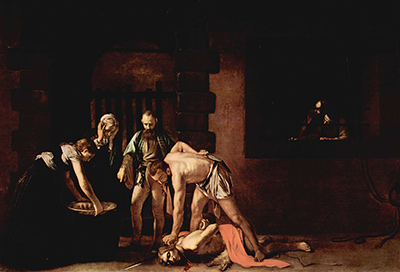
Geology can matter as well as artistic choice. David Hradil and colleagues examined microscopic ground samples from the Beheading of Saint John the Baptist in Malta, comparing them with grounds used by Caravaggio and Mattia Preti in Italy and Malta. Their mineral and microfossil analysis found an unusual alunite-and-hematite-rich component in the Beheading's preparation, alongside evidence relevant to Maltese limestone materials. The researchers argue that regional availability helped shape the materials used for grounds. This complicates any story in which a ground's colour is wholly Caravaggio's personal recipe: a red or brown surface may also record what a painter or canvas preparer could obtain locally. The study concerns sampled works, and its mineral profile is not a ready-made authorship test for an unexamined picture.[12][13]
The Uffizi Medusa makes an even sharper exception to a canvas-based account of support. A structural study drawing on its 1998–2002 conservation found, through computed tomography, two layers of poplar-wood slats joined into a convex shield, with grain running in different directions. The researchers built and tested a replica to investigate how humidity affects that shape; the replica models the support, not Caravaggio's painted image. A separate chemical study found an earlier gypsum layer beneath his paint, suggesting reuse of a prepared shield. These are distinct claims from two investigations: one explains the wooden structure, the other a possible earlier preparation.[14][15]
Drawing, Incisions and Placing Figures
The claim that Caravaggio worked without any preparation is too broad. The National Gallery identifies traces of dark brown brushed drawing above the finished contour of the wine glass in the London Supper at Emmaus. It also describes two quick, thick diagonal strokes near a disciple's sash as rough positional guides. There are no visible incisions in that painting, but the gallery explicitly allows that faint marks could have been obscured by later paint. This is a statement about what can be seen, not proof that a tool was never used there.[2]
In the Kimbell's Cardsharps, there are a few incisions in wet ground around fingertips and card edges. The museum suggests these may have helped place elements where drawn underlines do not survive. It observes that incision became more extensive in later works. A Metropolitan Museum publication characterises the broader practice as an evolving combination of incisions, brush drawing and blocked-in white forms, adapted in part from training in Milan. These methods could help locate a posed model's arm, leg or head on the canvas.[1][7]
The distinction between an independent paper drawing and a brushed or incised mark on a painting is crucial. The former is an object that could be catalogued on its own; the latter is evidence within the painted work. A guide to the drawings question treats the surviving attribution problem separately. No secure corpus of paper drawings does not make all preparatory acts impossible.[6]
Changes Made During Painting
The Kimbell's infrared images reveal that the gloved hand of the central cheat in The Cardsharps was painted before the figure overlapping it. The museum records changes to another cheat's hand, cards, belt and striped doublet. These pentimenti are not flaws. They show the artist solving figure relationships on the support as the composition developed.[1]
The London Supper at Emmaus presents a different balance. The National Gallery reports little substantial revision; one significant change moves the right disciple's left knee behind the carpet instead of in front, sharpening the forward reach of his arm and the projection of the fruit basket. This relative stability suggests careful planning. It should not be flattened into a rule that Caravaggio always painted without change.[2]
Infrared examination of the first Conversion of Saul found more revisions. The Barberini Corsini galleries report several changes to Paul's face; Christ was initially beardless; weapons, vegetation and decorative elements also changed. The institution calls the work's colours and materials unusually bright for Caravaggio, identifying azurite, gold and silver among them. The panel's energetic, crowded design and the more spare final canvas are separate completed solutions, not a draft and a mechanically corrected copy.[4]
The Madrid Ecce Homo adds a recently published case. Claudio Falcucci's investigation identifies preparatory brush marks and incisions that helped place faces and hands, along with changes to Christ's wrist, Pilate's hand and the attendant's face. The single-piece canvas carries two preparation layers; a reddish-brown upper ground contributes directly to the visible shadows. This is a particularly clear example of physical findings supporting an attribution and a reconstruction of method without acting as a simple test that names the painter.[9]
Brushwork, Colour and Selective Light
Caravaggio used paint handling to give textures presence. In The Cardsharps, the Kimbell reports that he blotted wet brocade paint with fingers or thumb and used the butt of a brush for black embroidery on a collar. These small procedures belong to a painting famous for psychological tension; its effect also depends on surface craft.[1]
The paint binder was not necessarily pure oil in every passage. An early technical investigation by James Greaves and Meryl Johnson of Detroit's Martha and Mary Magdalene reported a predominantly oil-bound picture with limited egg tempera in certain flesh and white passages. Its reddish-brown ground and scratched or incised marks are observations tied to that painting. Together with Keith's findings in the two earlier London pictures, the Detroit result cautions against calling “oil on canvas” a complete description of every layer. It does not show that all Caravaggios contain egg tempera or that the same mixture was used throughout any one painting.[16][3]
Light is both visual structure and narrative cue. In the Calling of Saint Matthew, it leads across the room toward a moment of recognition. In the Crucifixion of Saint Peter, lit flesh and work clothes emerge from a dark field. “Chiaroscuro” names the strong light-dark modelling; “tenebrism” commonly names the especially dark surrounding field. Neither term identifies a lamp in the studio or proves that every figure was painted from a single physical beam.[8]
The National Gallery's technical work gives a more material explanation for some passages: a warm ground can remain visible as a middle tone in flesh and hair, while lighter paint and thin darkening build the transitions. This does not exhaust the meaning of the light. The viewer still reads religious drama through selective illumination, but the technical claim and the interpretation answer different questions.[3]
Why the late Salome does not simply show bare ground
London's Salome receives the Head of John the Baptist offers a closer test of the assumption that broad handling means haste. Keith identifies pinkish-red painted indications for flesh features: the older woman's ear was incised and sketched, then covered by her headdress; broad indications for her hands became partly visible as later layers aged and wore. A pale mark around the executioner's shoulder was incorporated into the finished form, while another preliminary stroke can be seen through abraded dark paint. The picture retains evidence of layout even where its final effect looks exceptionally spare.[3]
Not every brown passage is the prepared ground showing through. Keith found ground-coloured paint applied late between the executioner's fingers and in parts of his face, neck, chest and arm. He also describes highlights on Salome's sleeve that look like initial layout strokes but were applied over the completed drapery. The gallery's current object account notes genuine exposed ground elsewhere in the picture. Both observations can be true: some brown is the support's preparation; some is a deliberate final paint layer of similar colour. This distinction matters before calling a passage unfinished or explaining the work's darkness as an automatic consequence of leaving the canvas bare.[3][10]
What Infrared and Conservation Can Show
Infrared reflectography can reveal some features hidden by visible paint, such as changes in placement. It does not uncover every mark or translate automatically into a complete sequence of artistic decisions. Its result depends on materials and the equipment used. The published images of The Cardsharps and the first Conversion are valuable precisely because they tie an observation to a named object and examination.[1][4]
X-rays need the same care. Keith describes an apparent change to the raised hand in London's Boy bitten by a Lizard that had been used to argue about which of two versions came first. In his reading, the radiograph instead records paint of varying thickness in the background surrounding the hand, not a repositioned hand. An X-ray shows differences in materials and density; interpretation still has to be checked against the visible painting, layer structure and other evidence. The Fondazione Longhi version's status as an autograph replica is itself qualified in the National Gallery's current record, so the scan should not be made to settle either the sequence or the attribution on its own.[3][11]
Conservation also changes the conditions of looking. The Cleveland Museum's treatment of The Crucifixion of Saint Andrew addressed later varnish and overpaint; its technical account describes dark outlines in infrared and a limited palette. A discoloured coating can mute differences between the lit body and surrounding darkness. The treatment record helps a reader distinguish Caravaggio's paint from later material without imagining that the picture has remained physically unchanged since the seventeenth century.[5]
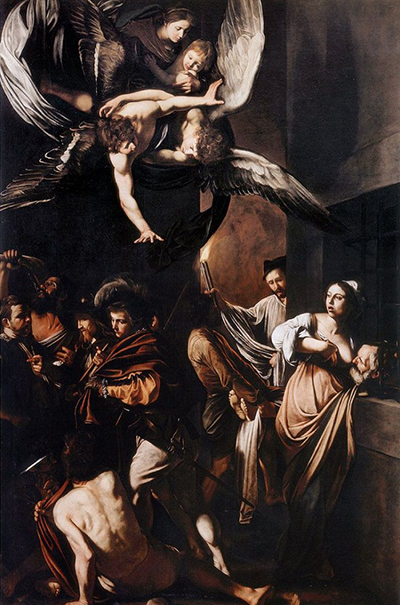
Other imaging methods can cover a large altar canvas without removing it. A 2019 mobile-laboratory campaign examined the Seven Works of Mercy in its Naples chapel with macro X-ray fluorescence: 25 scans mapped the distribution of elements including calcium, copper, iron and lead across the picture. The researchers reported a concealed, unfinished male figure and a later version of him in different clothing. Elemental maps help reconstruct a change in the composition, but do not themselves name the man, establish the scene's disputed identities or provide a complete pigment list without further analysis. This is a different kind of evidence from a tiny cross-section of the ground, and the two approaches answer different questions.[17]
Technical findings have limits. A revised face does not tell us what the artist thought about Paul. An incision does not prove a camera or mirror was used. A dark ground does not explain away the religious meaning of light. The strongest account moves from an observed feature to a modest conclusion and leaves larger claims open where the object cannot settle them.
Newly detected marks in named paintings
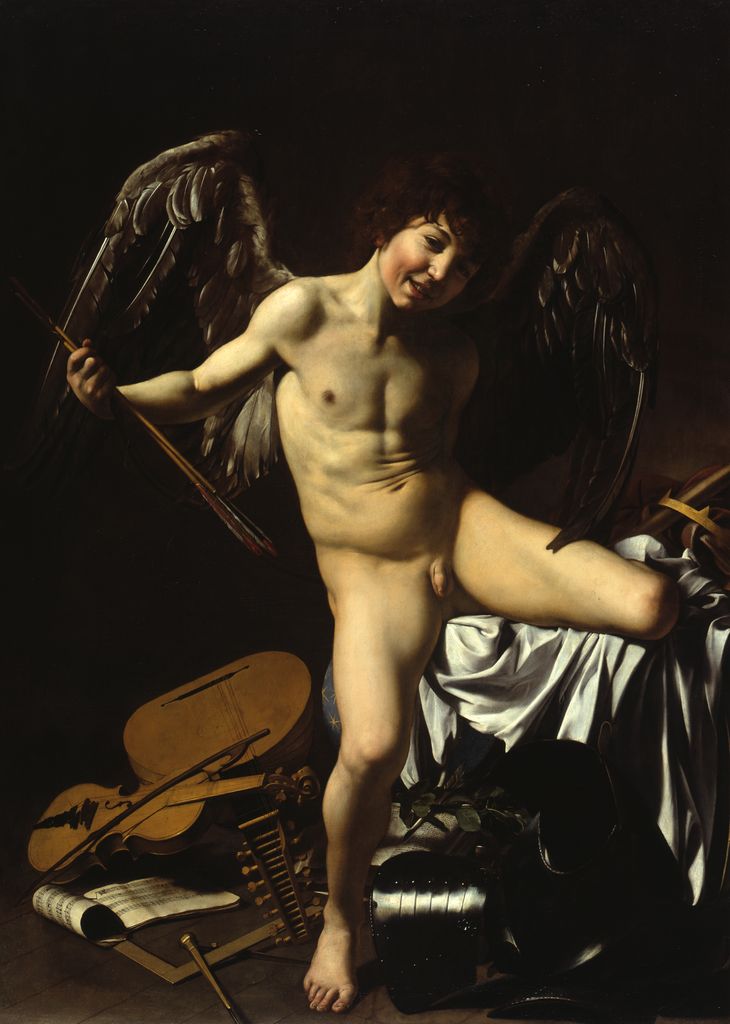
The National Gallery conference abstract offers a useful test of the old claim that no underdrawing exists. Roberto Bellucci and Cecilia Frosinini report marks beneath the paint of the Uffizi Bacchus and Berlin Amor Victorious, among other examined works. Their findings do not turn every trace into a finished cartoon. Some lines might have been transferred from a design, while others appear to have been made freely on the support. The distinction between a detectable preparatory mark and a surviving independent drawing remains essential.[6]
Different instruments answer different questions. An X-ray can disclose changes in dense paint or a buried form that an infrared image does not show clearly; infrared can reveal some dark drawing below later layers. In Amor Victorious, the conference researchers describe infrared evidence of drawing, while X-ray examination shows a change in the objects below the figure, from a ledge towards the globe in the final arrangement. The two findings belong to one painting but are not the same observation.[6]
Myths and Limits
“He never drew.” There is no securely attributed body of independent drawings, but brushed layout marks and incisions are documented on paintings. It is safer to describe what survives than infer a lifelong prohibition.[2][6]
“He painted every picture straight onto black.” The Kimbell's Cardsharps has a light gray ground; the first Conversion has another light gray ground; National Gallery works show different warm and dark preparations. A universal black-ground recipe conflicts with the examined objects.[1][3][4]
“A camera obscura explains the realism.” Evidence for an optical device must be specific. Realistic modelling, strong light or an unusual perspective are not, by themselves, proof of an apparatus. The source material used here supports working from posed models and material planning, without establishing a camera for these paintings.[2][7]
“Spontaneity means no revision.” The changes in The Cardsharps and the first Conversion are directly documented. An image can look immediate after many decisions.[1][4]
Explore the Caravaggio collection
| Name | Date | Type |
|---|---|---|
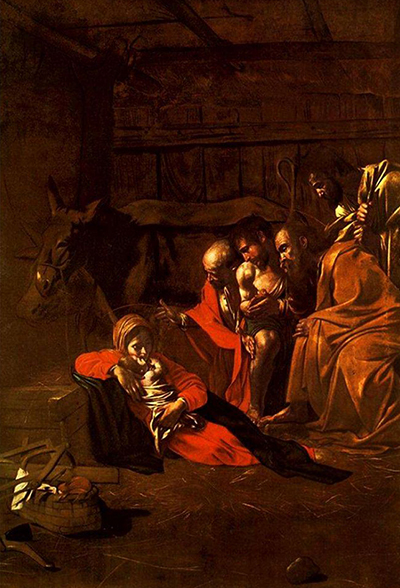
| Adoration of the Shepherds by Caravaggio: The Messina Nativity | 1608–09; precise order relative to Resurrection of Lazarus remains unresolved | Artwork |
| Amor Victorious by Caravaggio | 1601–02 in the Berlin owner record | Artwork |
| Bacchus by Caravaggio: The Uffizi Painting | about 1598, according to the Uffizi | Artwork |
| Basket of Fruit by Caravaggio | after 1597, probably around the turn of the seventeenth century, according to the Ambrosiana | Artwork |
| Boy Bitten by a Lizard: Caravaggio's London Painting | about 1594–95 in the National Gallery's current catalogue; URL suffix “1596” is inherited | Artwork |
| Boy Bitten by a Lizard: The Florence Version Attributed to Caravaggio | disputed; Longhi's catalogue record preserves historical 1592–93 and other proposed ranges, including c.1597 | Artwork |
| Boy Peeling Fruit by Caravaggio: The Royal Collection Painting | about 1592–93 in the owner's current exhibition record | Artwork |
| Boy Peeling Fruit in Florence: A Derivation from Caravaggio | — | Artwork |
| Boy with a Basket of Fruit by Caravaggio | about 1595 in the Galleria Borghese catalogue | Artwork |
| Caravaggio Paintings in Rome: Churches, Museums and a Practical Route | — | Guide |
| Caravaggio Quotes: What the Documents Actually Record | — | Guide |
| Caravaggio's Lute Player: The Del Monte Painting Once Shown at the Met | about 1596–97 in the Met catalogue | Artwork |
| Caravaggio's Painting Technique: Grounds, Incisions, Revisions and Light | — | Guide |
| Christ at the Column by Caravaggio: The Rouen Flagellation | c.1606 in the owner caption; owner prose gives 1606–07 | Artwork |
| Christ on the Mount of Olives by Caravaggio: The Lost Berlin Painting | — | Artwork |
| Conversion on the Way to Damascus by Caravaggio | about 1601 in the Roma Capitale church record | Artwork |
| Crowning with Thorns by Caravaggio: The Vienna Painting | about 1603 in the 2019 KHM record; “1607” is an inherited URL suffix | Artwork |
| Crowning with Thorns in Prato: Attributed to Caravaggio | about 1602–03 in the collection presentation | Artwork |
| David with the Head of Goliath by Caravaggio: The Borghese Painting | 1606–07 or 1609–10 in the Galleria Borghese catalogue; the later Naples period is favoured by many scholars, while the owner keeps the question open | Artwork |
| David with the Head of Goliath by Caravaggio: The Prado Painting | about 1600 in Prado material; “1599” survives only in the legacy URL | Artwork |
| David with the Head of Goliath by Caravaggio: The Vienna Painting | about 1600–01 in the KHM's 2019 exhibition record; “1607” is a legacy route label | Artwork |
| Did Caravaggio Make Drawings? What Survives and What Paintings Reveal | — | Guide |
| Ecce Homo: Caravaggio's Madrid Rediscovery and the Genoa Painting | — | Artwork |
| John the Baptist in Caravaggio's Paintings: A Guide to the Different Versions | — | Artwork |
| Judith Beheading Holofernes by Caravaggio | beginning of the seventeenth century in the owning museum's account; about 1599–1600 in the Kimbell's 2025 loan label; around 1602 in one specialist catalogue | Artwork |
| Jupiter, Neptune and Pluto: Caravaggio's Ludovisi Ceiling | about 1597; the archive connects the work with Cardinal del Monte's 1597 commission | Artwork |
| Madonna and Child with Saint Anne by Caravaggio: The Palafrenieri Altarpiece | 1605 in the Galleria Borghese object field; completed and delivered by 8 April 1606 | Artwork |
| Madonna of Loreto by Caravaggio: The Pilgrims at Sant'Agostino | broadly c.1604–06; institutional records differ slightly in their starting year | Artwork |
| Madonna of the Rosary by Caravaggio: The Vienna Altarpiece | around 1603 in the Kunsthistorisches Museum's object record | Artwork |
| Martha and Mary Magdalene by Caravaggio: The Detroit Painting | about 1598 in the Detroit Institute of Arts record | Artwork |
| Medusa by Caravaggio: The Uffizi Painted Shield | 1596–98 in the Uffizi's virtual exhibition; specialist research reports the shield delivered to the Medici wardrobe by 7 September 1598 | Artwork |
| Narcissus, Attributed to Caravaggio | dependent on attribution; the Zeri catalogue gives a broad 1610–50 range under Spadarino | Artwork |
| Nativity with Saint Francis and Saint Lawrence: Caravaggio's Missing Painting | somewhere in 1600–09 in the parliamentary report; a specific 1609 execution and place remain debated | Artwork |
| Penitent Mary Magdalene by Caravaggio | 1597 in the owner's catalogue, during Caravaggio's early Roman activity | Artwork |
| Portrait of a Courtesan: Caravaggio's Lost Berlin Portrait | Berlin's data field says c.1590, while its own text compares a Caravaggio work of c.1598; precise date unresolved | Artwork |
| Portrait of Alof de Wignacourt and His Page by Caravaggio | — | Artwork |
| Portrait of Fra Antonio Martelli? Caravaggio's Pitti Knight of Malta | 1608 in the Restituzioni object heading; within Caravaggio's Malta period | Artwork |
| Portrait of Maffeo Barberini: The Seated Corsini Painting | c.1596–97 in the national catalogue | Artwork |
| Portrait of Monsignor Maffeo Barberini: Caravaggio's Newly Acquired Painting | around the late 1590s / age thirty; “1598” in the inherited address is approximate, not an exact document date | Artwork |
| Portrait of Pope Paul V: A Caravaggio Attribution and a Borghese Copy | — | Artwork |
| Prints After Caravaggio: Who Made Them and What They Show | — | Guide |
| Reclining Saint John the Baptist: A Disputed Caravaggio Attribution | often proposed for the artist's final years; the later museum list does not give a precise year. | Artwork |
| Rest on the Flight into Egypt by Caravaggio | about 1597 in the owner's catalogue | Artwork |
| Saint Catherine of Alexandria by Caravaggio: The Thyssen Painting | about 1598–99 in the Museo Nacional Thyssen-Bornemisza catalogue | Artwork |
| Saint Francis in Meditation by Caravaggio: The Cremona Painting | 1603–06 in the owner account; c.1605–06 in a KHM exhibition caption | Artwork |
| Saint Francis in Prayer: Caravaggio's Carpineto Painting | 1606 in a 2016–17 exhibition work list | Artwork |
| Saint Francis of Assisi in Ecstasy by Caravaggio | c.1595–96 in the owner wall text | Artwork |
| Saint Jerome in Meditation: Caravaggio's Montserrat Painting | 1605 in the owner record; an owner publication reports scholarship placing it about 1605–06 | Artwork |
| Saint Jerome Writing by Caravaggio: The Borghese Painting | c.1606 in the owner catalogue; the “1605” URL suffix is inherited | Artwork |
| Saint Jerome Writing by Caravaggio: The Malta Painting | around 1607–08; foundation dates Malaspina's commission to 1608 | Artwork |
| Saint John in the Wilderness at Toledo Cathedral | exact 1598 not established by the cited cathedral account. | Artwork |
| Saint John the Baptist at Galleria Corsini, Rome | about 1606 in the national record; older proposals ranged from the late 1590s onward. | Artwork |
| Saint John the Baptist at the Capitoline Museums, Rome | 1602. | Artwork |
| Saint John the Baptist at the Galleria Borghese | 1609–10 in the current Borghese record. | Artwork |
| Saint John the Baptist at the Spring: The Bonello Painting in Malta | early seventeenth century in the institutional account; a precise 1608 is not established there. | Artwork |
| Saint Matthew and the Angel: Caravaggio's Lost First Altarpiece | — | Artwork |
| Salome Receives the Head of John the Baptist: Caravaggio's London Painting | about 1609–10, likely late Naples period in the Gallery's account | Artwork |
| Salome with the Head of John the Baptist: Caravaggio's Madrid Painting | — | Artwork |
| Sleeping Cupid by Caravaggio: The Painting Made in Malta | about 1608, Malta period | Artwork |
| Still Life with Fruit on a Stone Ledge: Is It by Caravaggio? | — | Artwork |
| Supper at Emmaus (1606): Caravaggio's Brera Painting | — | Artwork |
| The Annunciation by Caravaggio in Nancy | c.1607–10 in the collection record; 1608–10 in the museum's restoration account | Artwork |
| The Basel Saint John the Baptist: Once Labelled Caravaggio, Now Maíno | about 1608–10 in that schedule, rather than the legacy URL's 1600. | Artwork |
| The Beheading of Saint John the Baptist by Caravaggio | about 1608; installed in the Oratory on 29 August 1608 | Artwork |
| The Burial of Saint Lucy by Caravaggio in Syracuse | 1608, during Caravaggio's Syracuse stay | Artwork |
| The Calling of Saint Matthew by Caravaggio | about 1599–1600 | Artwork |
| The Calling of Saints Peter and Andrew by Caravaggio | about 1602–04 in the Trust's object text | Artwork |
| The Cardsharps by Caravaggio | about 1596–97 in the Kimbell's current object record | Artwork |
| The Conversion of Saint Paul: Caravaggio's Odescalchi Panel | commissioned in 1600; painted around 1600–01 | Artwork |
| The Crucifixion of Saint Andrew by Caravaggio | 1606–07 | Artwork |
| The Crucifixion of Saint Peter by Caravaggio | about 1601 | Artwork |
| The Death of the Virgin by Caravaggio | commissioned 1601; completed late 1605 or early 1606, according to the Louvre | Artwork |
| The Denial of Saint Peter by Caravaggio | 1610 | Artwork |
| The Doria Pamphilj Saint John the Baptist: A Second Youth with a Ram | linked compositionally to the Capitoline 1602 picture; an exact production year for this canvas is not established by the owner pages used here. | Artwork |
| The Entombment of Christ by Caravaggio: The Vatican Deposition | about 1600–04 in Vatican Museums publication material | Artwork |
| The Flagellation of Christ by Caravaggio: The Capodimonte Altarpiece | around 1607, in the first Naples period | Artwork |
| The Fortune Teller by Caravaggio: The Louvre Version and Its Roman Counterpart | — | Artwork |
| The Holy Family with the Infant Saint John the Baptist by Caravaggio | early 1600s in the Met catalogue; no more exact owner date asserted here | Artwork |
| The Incredulity of Saint Thomas by Caravaggio | about 1601 in the SPSG presentation | Artwork |
| The Inspiration of Saint Matthew by Caravaggio | usually 1602; also catalogued 1602–03, for the installed final altarpiece | Artwork |
| The Lute Player by Caravaggio: The Hermitage Painting | about 1596 in the Hermitage collection publication; the Hermitage Friends restoration page gives about 1595–96 | Artwork |
| The Magdalen in Ecstasy: Caravaggio, Copies and a Disputed Original | — | Artwork |
| The Martyrdom of Saint Matthew by Caravaggio | 1599–1600; unveiled with The Calling in 1600 | Artwork |
| The Martyrdom of Saint Ursula by Caravaggio | — | Artwork |
| The Musicians by Caravaggio | 1597 | Artwork |
| The Resurrection of Lazarus by Caravaggio in Messina | 1609; delivered 10 June 1609 in the owner account | Artwork |
| The Sacrifice of Isaac by Bartolomeo Cavarozzi: A Former Caravaggio Attribution | about 1615–17 in the Nicholas Hall catalogue; “1598” is an inherited URL label, not the accepted date | Artwork |
| The Sacrifice of Isaac by Caravaggio: The Uffizi Painting | about 1603 in the Uffizi catalogue | Artwork |
| The Seven Works of Mercy by Caravaggio | 1606–07, according to the Pio Monte | Artwork |
| The Supper at Emmaus by Caravaggio: The London Painting | 1601 | Artwork |
| The Taking of Christ by Caravaggio | 1602 | Artwork |
| The Toulouse *Judith Beheading Holofernes*: A Caravaggio Attribution Debate | c.1606–07 if identified with the recorded Naples work; that identification is debated | Artwork |
| Young Sick Bacchus by Caravaggio | about 1595 in the Galleria Borghese catalogue | Artwork |
| Youth with a Ram: Why Caravaggio's Saint John Looks So Unusual | — | Artwork |
No matching pages found.
Discussion
Share a close observation about Painting Technique or a source that clarifies its history.
Which detail changes your reading?
Is there a collection record or document worth comparing?
What remains uncertain?
Join the Conversation
Frequently Asked Questions
Did Caravaggio use underdrawing?
The London National Gallery identifies brushed drawing near the wine glass in The Supper at Emmaus. The precise layout methods vary by painting, and a lack of visible marks in one work cannot settle the question for the whole career.[2]
What are Caravaggio's incisions?
Did Caravaggio use a camera obscura?
References
- Kimbell Art Museum, The Cardsharps, collection and conservation account.
- National Gallery, London, The Supper at Emmaus, object and technical account.
- Larry Keith, “Three Paintings by Caravaggio,” National Gallery Technical Bulletin 19 (1998).
- Gallerie Nazionali Barberini Corsini, Conversion of Saul, technical exhibition account.
- Cleveland Museum of Art, Crucifixion of Saint Andrew, full conservation record.
- National Gallery, London, Studying Old Master Paintings: Technology and Practice, abstract on Caravaggio's underdrawing.
- Metropolitan Museum of Art, Valentin de Boulogne: Beyond Caravaggio, discussion of Caravaggio's technique.
- Smarthistory, “Tenebrism”.
- Claudio Falcucci, “The Diagnostic Investigations and the Study of the Painting Technique,” in The Ecce Homo Unveiled, 2024.
- National Gallery, London, Salome receives the Head of John the Baptist, object record.
- National Gallery, London, Boy bitten by a Lizard, object record.
- David Hradil and colleagues, “Clay and alunite-rich materials in painting grounds of prominent Italian masters – Caravaggio and Mattia Preti,” Applied Clay Science 185 (2020).
- ALMA Laboratory, Czech Academy of Sciences, ground-materials case study.
- Paola Mazzanti and colleagues, The Medusa Parade Shield by Caravaggio, structural-replica study, 2023.
- Monica Favaro and colleagues, “La Medusa by Caravaggio,” Journal of Cultural Heritage 6 (2005), scientific abstract.
- Smithsonian Museum Conservation Institute bibliography and abstract of Greaves and Johnson, “New Findings on Caravaggio's Technique in the Detroit ‘Magdalen’,” Burlington Magazine 116 (1974).
- Claudia Caliri and colleagues, “MOLAB: A European Mobile Laboratory Enabling Advanced Studies in Archaeometry,” Archeometriai Műhely 17, no. 3 (2020), Seven Works case study.