from Amazon
* As an Amazon Associate I earn from qualifying purchases.
 by Tom Gurney
Tom Gurney BSc (Hons) is an art history expert with over 20 years experience
Page Created on / Page Updated on
Email: tomgurney1@gmail.com / Phone: +44 7429 011000
Caravaggio Paintings in Rome: Churches, Museums and a Practical Route
Rome holds some of Caravaggio's most consequential paintings, but they are not gathered in one museum. The Calling of Saint Matthew is still in the chapel for which it was painted; the two final Cerasi pictures still face one another in Santa Maria del Popolo; other works belong to museum collections. Knowing that distinction makes a visit easier to plan and the paintings easier to understand.[1][2]
This guide follows the works, not a claim that every canvas is on view every day. Churches can restrict access for services, and museums can lend or move works. Check each venue's current visitor information before travelling. The earlier Odescalchi Conversion of Saul is privately owned and should not be added to a regular museum itinerary because it appeared at Palazzo Barberini only for a dated 2025 exhibition.[2][3]
Caravaggio in context
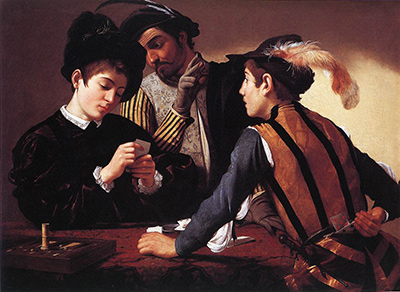
The Cardsharps
c.1595Calling of Saint Matthew
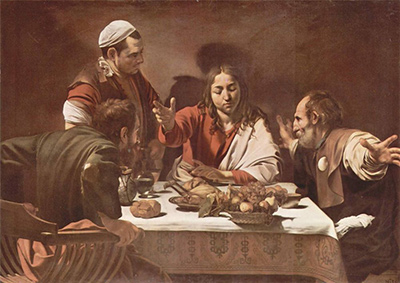
1599–1600Supper at Emmaus
1601At a Glance
- Three essential church stopsSan Luigi dei Francesi, Santa Maria del Popolo and Sant'Agostino.[1][2]
- Main collection stopsGalleria Borghese, Palazzo Barberini, Galleria Corsini, Musei Capitolini and Galleria Doria Pamphilj. The last gallery lists three Caravaggio paintings, though the status of its Saint John is disputed.[1][4][5][6][12][13]
- Best way to group the routehistoric centre churches and collections first, then Piazza del Popolo and the Borghese area. Allow time to look at each chapel rather than counting only paintings.
- Check before visitingopening, worship access, ticketing, temporary closure, loans and display status on the venue's own site.
Contents
- Why Location Matters
- Three Church Commissions
- Museums and Collections
- A Vatican City Extension
- A Sensible Walking Sequence
- Works Often Confused with Rome Holdings
- Frequently Asked Questions
Why Location Matters
Caravaggio's Roman career joined private collectors and public church commissions. A museum painting can be studied as one object among others. A chapel canvas was made for a particular wall, a neighbouring picture and a viewer entering a confined space. The difference is especially apparent in the Cerasi Chapel, where Caravaggio's Crucifixion of Saint Peter and final Conversion of Saint Paul flank Annibale Carracci's Assumption of the Virgin.[2][7]
The works are not all from the same year. Earlier pictures in Roman collections include the Fortune Teller and Boy with a Basket of Fruit. The public chapel commissions belong to Caravaggio's mature Roman period. The collection works let a visitor compare these stages without assuming that a present-day museum grouping reproduces the artist's original setting.[4][5]
The Borghese Madonna and Child with Saint Anne is a particularly clear case of a Roman church commission becoming a collection painting. The Palafrenieri confraternity ordered it for its chapel in St Peter's in 1605. The Borghese catalogue records its delivery on 8 April 1606, removal to Sant'Anna dei Palafrenieri on 16 April, and Scipione Borghese's purchase for 100 scudi after seeing it there that July. The picture's removal is certain; its cause is debated, with explanations ranging from the chapel's dimensions to concerns about the figures' treatment. Its present room in the Galleria Borghese is therefore neither the chapel for which it was ordered nor proof of any one explanation for its removal.[25]
Three Church Commissions
San Luigi dei Francesi: the Contarelli Chapel
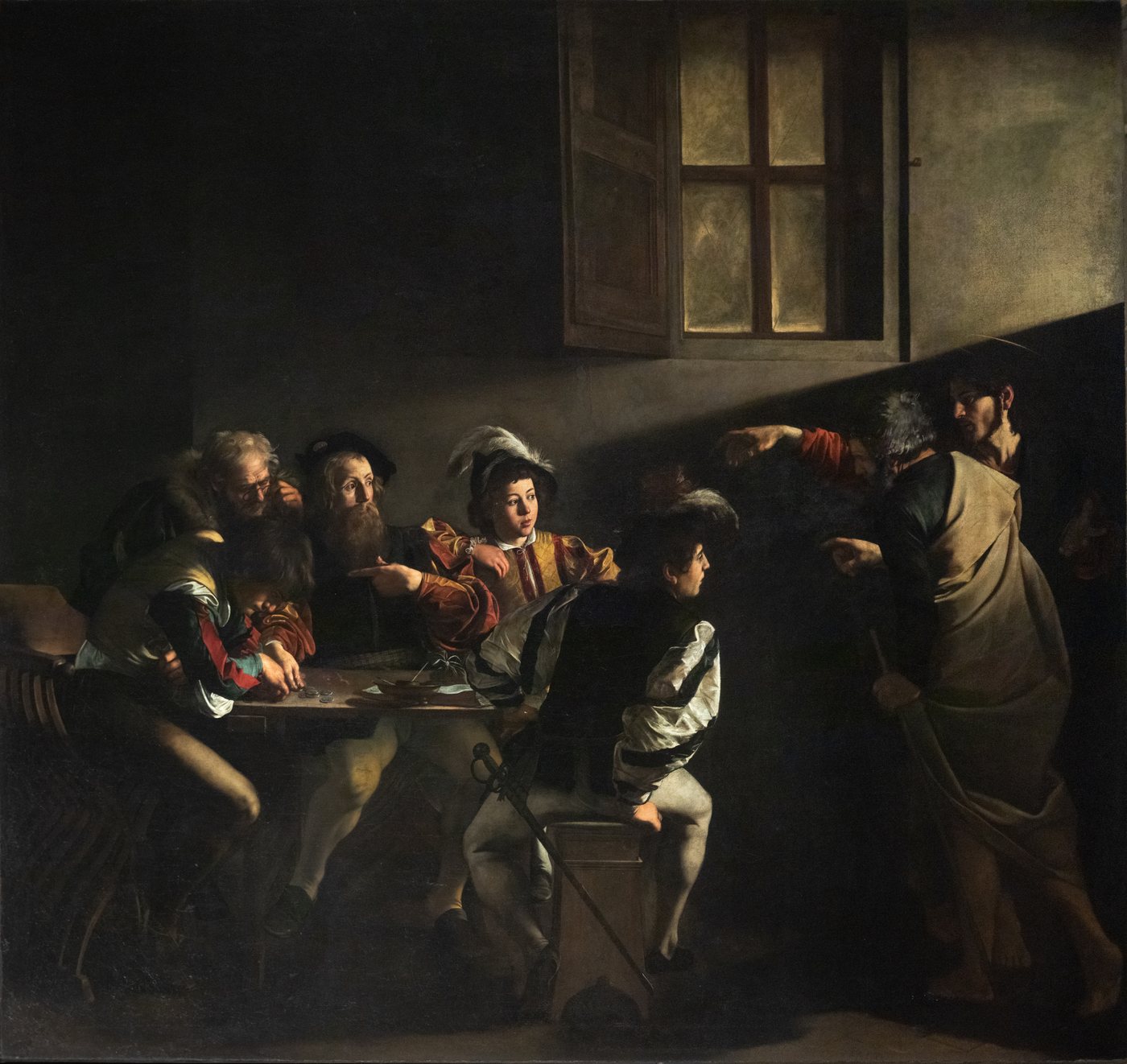
The church near Piazza Navona houses the three Saint Matthew paintings. The Calling of Saint Matthew and Martyrdom of Saint Matthew occupy the side walls; Saint Matthew and the Angel is the altarpiece. Read the two side scenes together: one finds Matthew among people at a table, the other shows the dangerous consequence of his vocation. The final altarpiece then presents the evangelist at work. These are three distinct objects, not three names for a single painting.[1][8]
The chapel rewards a slow look at its light and sight lines. In the Calling, the beam from the right guides attention across a dim room, but the choice of which seated figure is Matthew is still debated. The ambiguity invites a second look at the hands and faces. The chapel is also a useful starting point for the technique guide, which separates painted light from evidence found under paint layers.
For orientation inside the church, Roma Capitale identifies the Contarelli Chapel as the last chapel of the left aisle. Its record also notes Cavalier d'Arpino's paintings on the vault. A visitor can therefore distinguish the three Caravaggio canvases from the rest of the chapel's decoration, and see how the side-wall narratives address the altar painting within one setting. The city directs visitors to the church for current access arrangements; its location record is not a guarantee of uninterrupted viewing during services.[8]
Santa Maria del Popolo: the Cerasi Chapel
Near Piazza del Popolo, the left transept contains Tiberio Cerasi's chapel. Caravaggio's final Crucifixion of Saint Peter and Conversion on the Way to Damascus are the side canvases; Carracci's Assumption is at the altar. Rome's official church record dates the commission to September 1600 and the Caravaggio pictures to about 1601.[2]
Stand back enough to register the three-picture ensemble before concentrating on the two Caravaggios. On one wall men strain to lift Peter's inverted cross. Across the chapel, Paul lies under a horse while his arms open to a light whose divine source is not pictured as a figure. Both scenes use large bodies and a compressed field, yet the physical exertion of Peter's executioners differs from Paul's inward event. The pairing is a reason to see the works in place rather than as unrelated reproductions.[2][7]
The earlier Conversion of Saint Paul is a separate panel in private ownership. Palazzo Barberini displayed it temporarily in 2025 next to a high-resolution reproduction of the chapel canvas. That exhibition ended on 30 September 2025. The privately owned panel is not a third permanent Caravaggio picture in Santa Maria del Popolo.[3]
Sant'Agostino: the Madonna of Loreto
Sant'Agostino houses the Madonna of Loreto, also called the Madonna of the Pilgrims. Its threshold, mother and child, and kneeling pilgrims make the meeting feel immediate. The worn feet of the visitors and the modest doorway matter to the painting's devotional force. It is another work best read as an altarpiece in a church, not merely as a portable image of the Virgin.[1]
The basilica's own guide locates the painting in the first chapel of the left aisle, the Cavalletti Chapel. Ermete Cavalletti had asked in his will for a chapel dedicated to the Madonna of Loreto and for burial in Sant'Agostino; after his death in 1602, Caravaggio made the altarpiece for that setting. The church says entry is free but tourist visits stop during liturgical celebrations. This makes it a nearby complement to San Luigi dei Francesi, while keeping worship access distinct from museum ticketing.[17]
Museums and Collections
Galleria Borghese
The Borghese collection contains a concentrated group spanning Caravaggio's career. Its object records are the right place to verify which painting is on display. Among the works associated with the collection are Boy with a Basket of Fruit, Young Sick Bacchus, Madonna and Child with Saint Anne, Saint Jerome Writing, Saint John the Baptist and a late David with the Head of Goliath.[1][4]
The gallery's guide groups these six paintings in Room 8, the Silenus Room. It says the two youthful pictures, Boy with a Basket of Fruit and Young Sick Bacchus, entered the Borghese collection through Paul V's confiscation of works from Cavalier d'Arpino. The other four allow a comparison with Caravaggio's more mature work. Room 8 also contains Giovanni Baglione's Judith with the Head of Holofernes and Dirck van Baburen's Capture of Christ: useful points of comparison with artists working in and after Caravaggio's Roman orbit. The room description identifies the collection and its normal arrangement; a temporary loan can still interrupt that arrangement.[24]
Rome's official itinerary says Borghese admission requires a reservation. A time slot should therefore anchor this part of the route, with the churches fitted around it if access allows. Booking a museum visit does not guarantee that every painting in its collection will be hanging that day: the gallery's individual object pages are the better check for loans or temporary non-display.[1][4]
These are not interchangeable with versions in other cities. The Borghese David should be identified by owner and object record, because year-like route suffixes on older websites can imply a certainty that current scholarship does not support. The same caution applies to Saint John pictures. A visitor should compare the collection's labels with the paintings directory, which distinguishes versions by object and location.
Palazzo Barberini
Palazzo Barberini holds Judith Beheading Holofernes and a Saint Francis in Meditation attributed to Caravaggio. Its holdings and displays also include works by followers, so a visitor should read the attribution on each label rather than treating every Caravaggesque picture as an autograph work.[6][9]
Palazzo Barberini also preserves Narcissus, often associated with Caravaggio but disputed. The national galleries included it in their 2018 Eco e Narciso exhibition, while the Fondazione Zeri catalogue files the picture under Giovanni Antonio Galli, called Spadarino. It belongs on a Rome itinerary as a painting to compare and question, without silently increasing a count of secure Caravaggios.[19][20]
The palace itself was not the original setting of Judith. Specialist research documents banker Ottavio Costa as an early owner; the Gallerie Nazionali describe the Italian state's 1971 acquisition of the rediscovered picture. Seeing it at Palazzo Barberini offers access to the original canvas, but the gallery arrangement is a modern collection context. This is a useful contrast with the three church chapels, where the paintings remain at the sites for which they were commissioned.[21][23]
The Saint Francis at Barberini is the canvas found at San Pietro in Carpineto Romano and placed on deposit at the national gallery. In a 2017 exhibition, the Gallerie Nazionali and the Fondo Edifici di Culto compared it directly with a second Saint Francis in Meditation from the Capuchin church of Santa Maria della Concezione on Via Veneto. Their conservation and technical comparison recognised the Carpineto canvas as the original; the Capuchin picture had earlier carried Caravaggio's name. Rome's visitor guide also describes a Saint Francis in the Capuchin museum, but that is a separate object and visit, not another display of the Barberini deposit.[14][15]
In March 2026 the Italian state announced the acquisition of the Portrait of Monsignor Maffeo Barberini for the national galleries, with permanent assignment to Palazzo Barberini after administrative steps. That announcement establishes the acquisition plan; it does not, by itself, establish that the portrait will be on a particular wall on a visitor's date.[10] The earlier Odescalchi Conversion was a temporary 2025 loan, not a permanent holding.[3]
Rome's city listing records a separate public showing of the newly acquired portrait at the Sala Capitolare, Palazzo della Minerva, from 28 May to 21 June 2026, before its planned move to the national galleries. That dated appearance should not be mistaken for a continuing display there or for confirmation of its current room at Palazzo Barberini.[28]
Galleria Corsini
The national galleries have a second Rome site across the river in Trastevere. Galleria Corsini holds a horizontal Saint John the Baptist catalogued by Italy's national cultural-property record under Caravaggio, inventory 433, and dated to about 1606. The record also recounts past doubts about the attribution. This is neither the Capitoline youth embracing a ram nor the later Borghese Baptist. Looking for the low seated figure, reed and bowl is more reliable than relying on the old “1604 Rome” wording in some web addresses.[12]
Palazzo Barberini and Galleria Corsini belong to the same national museum organisation but are different buildings. The museum's visitor page locates Corsini at Via della Lungara 10. It can be paired geographically with a Trastevere visit; it should not be folded into a brief Palazzo Barberini stop simply because both carry the Gallerie Nazionali name. Check the gallery's own page for admission and display before crossing the river.[16]
The museum currently offers a ticket valid for both Palazzo Barberini and Galleria Corsini over a stated period, as well as a Corsini-only option. That can make the two-building comparison practical without forcing both stops into one day. Ticket terms and the display of particular works can change, so the museum's current visitor pages should settle the booking decision.[16][22]
Musei Capitolini and Galleria Doria Pamphilj
The Capitoline collections hold Caravaggio's Fortune Teller and the 1602 Saint John the Baptist. The Capitoline museum identifies them as its two Caravaggio paintings, a useful check against the many other John variants on the web.[5]
The Galleria Doria Pamphilj has Penitent Mary Magdalene and Rest on the Flight into Egypt. These earlier, quieter subjects make a valuable comparison with the later public chapel scenes. The gallery also calls a closely related Saint John the Baptist a Caravaggio and places the three together in its Salette sul Corso. That Saint John is a separate physical canvas from the securely documented Mattei painting in the Musei Capitolini; its exact relationship and authorship have been disputed. The gallery's three-work visitor listing and the attribution question can both be stated without merging the two versions.[13][5]
A temporary loan: Cremona's Saint Francis
For visits between 7 October 2026 and 10 January 2027, the Museo del Corso's Sulle tracce di Francesco exhibition at Palazzo Sciarra Colonna adds a time-limited Caravaggio-related stop. The Museo Civico Ala Ponzone in Cremona identifies its own Saint Francis in Meditation as the painting lent to that Rome exhibition; the host museum lists a Saint Francis in Prayer among the works on show. This is a loan from Cremona, not another permanent Roman holding.[26][27]
It is also not the Carpineto canvas deposited at Palazzo Barberini, or the separate Capuchin version discussed above. The similar titles make it easy to count one object twice or to send a visitor to the wrong venue. The owning museum's loan notice resolves which painting the temporary exhibition means. Check the host's current exhibition and visitor information before adding Palazzo Sciarra Colonna to a route; the published closing date does not guarantee uninterrupted access to an individual work.[14][26][27]
Casino Ludovisi
Rome's Caravaggio itinerary also includes the ceiling painting Jupiter, Neptune and Pluto at the Casino Ludovisi. It is an oil painting on plaster, a different kind of work from the framed canvases in the churches and collections. The site is not a casual drop-in museum stop; consult its current access arrangements before including it.[1]
At this review, Roma Capitale's site-specific listing says visits to the Casino are temporarily suspended. Its account places the painting on the vault of a small upper-floor room, separate from Guercino's better-known Aurora in the building. A traveller should therefore keep the casino off a confirmed itinerary until that listing or the venue announces renewed access. The older general Caravaggio route's “reservation required” note should not be mistaken for an active booking opportunity.[18][1]
A Vatican City Extension
For a visitor using Rome as a base, the Vatican Museums add the Entombment of Christ in the Pinacoteca. The Vatican's object record identifies it as the painting commissioned for the Vittrice family chapel in Santa Maria in Vallicella and explains its later transfer to Paris and return to Rome. The original is now in the Vatican Museums, not in its former chapel. This is a separate museum visit across an international boundary, so it makes more sense as an extension than as a quick stop between the historic-centre churches.[11]
A Sensible Walking Sequence
For a short visit, begin in the historic centre with San Luigi dei Francesi and Sant'Agostino. If time permits, add the Doria Pamphilj and Capitoline collections as separate museum visits. On another part of the day, see Santa Maria del Popolo and then the Borghese area, with the Borghese reservation as the fixed point. Palazzo Barberini lies toward Via delle Quattro Fontane; Galleria Corsini needs a separate crossing to Trastevere. The Vatican Museums warrant their own extension. This is a geographic suggestion, not a promise that every venue is open in one continuous circuit.[1][16][11]
During the dated 2026–27 Saint Francis exhibition, Palazzo Sciarra Colonna can be considered alongside the historic-centre stops. Keep it as an optional, temporary visit rather than making it part of the permanent Caravaggio circuit.[26][27]
If only one chapel is possible, choose by the question you want to answer. The Contarelli Chapel shows Caravaggio building a three-part story around Matthew. The Cerasi Chapel shows two last-version canvases in active dialogue across a narrow space. If the interest is the range of secular and devotional subjects, a collection such as the Borghese offers a different comparison. The artist guide places all of these stops in the broader career.
Works Often Confused with Rome Holdings
The London Supper at Emmaus is in the National Gallery; the later Brera Supper is in Milan. The Entombment of Christ was painted for a Roman chapel but belongs to the Vatican Museums; do not send a visitor to its old church site expecting the original canvas. The privately owned first Cerasi Conversion is a distinct work from the final canvas in Santa Maria del Popolo. The Corsini, Capitoline, Doria Pamphilj and Borghese Saint Johns also require collection names to avoid conflating different paintings or disputed versions.[3][11][12][13]
“In Rome” may mean painted there, commissioned for a Roman site, or currently held in the city. This guide uses the last meaning for visiting and states the original setting when it helps explain a work. A change of display or a loan can alter what is visible without changing the painting's identity.
Explore the Caravaggio collection
| Name | Date | Type |
|---|---|---|
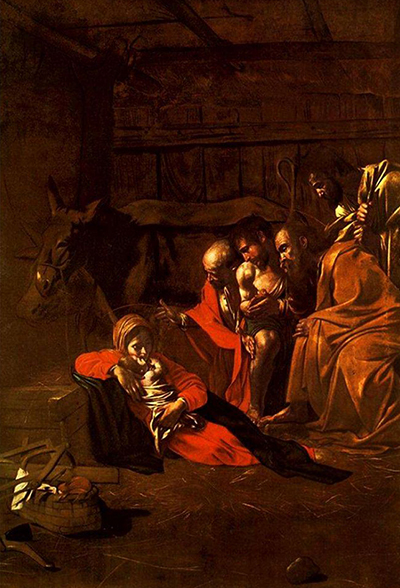
| Adoration of the Shepherds by Caravaggio: The Messina Nativity | 1608–09; precise order relative to Resurrection of Lazarus remains unresolved | Artwork |
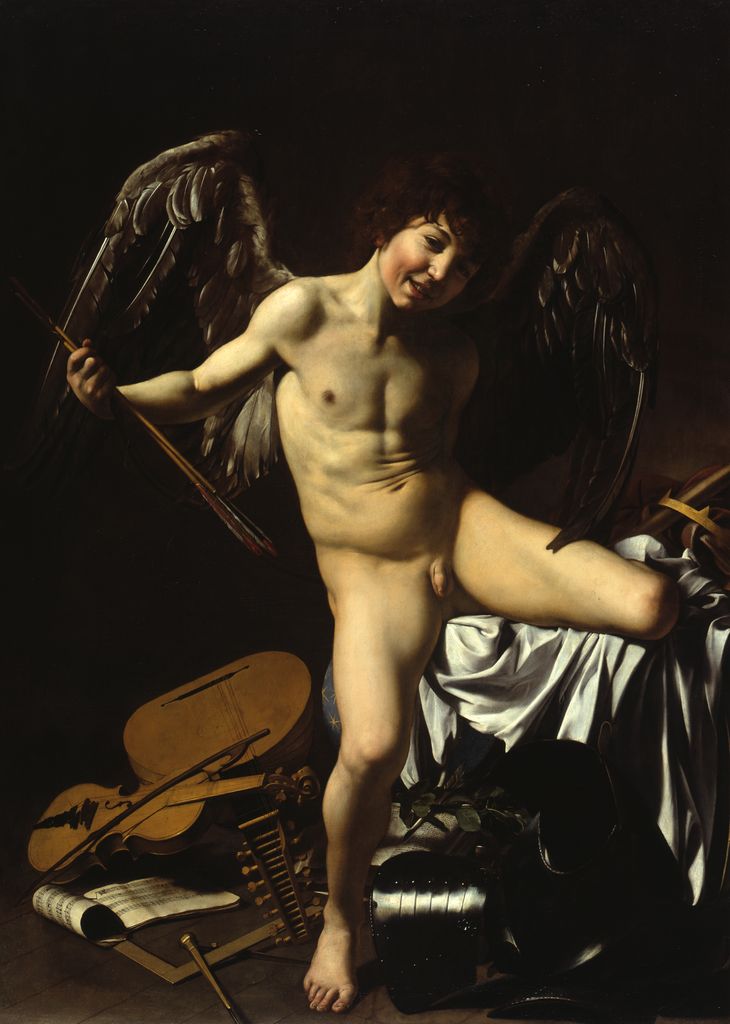
| Amor Victorious by Caravaggio | 1601–02 in the Berlin owner record | Artwork |
| Bacchus by Caravaggio: The Uffizi Painting | about 1598, according to the Uffizi | Artwork |
| Basket of Fruit by Caravaggio | after 1597, probably around the turn of the seventeenth century, according to the Ambrosiana | Artwork |
| Boy Bitten by a Lizard: Caravaggio's London Painting | about 1594–95 in the National Gallery's current catalogue; URL suffix “1596” is inherited | Artwork |
| Boy Bitten by a Lizard: The Florence Version Attributed to Caravaggio | disputed; Longhi's catalogue record preserves historical 1592–93 and other proposed ranges, including c.1597 | Artwork |
| Boy Peeling Fruit by Caravaggio: The Royal Collection Painting | about 1592–93 in the owner's current exhibition record | Artwork |
| Boy Peeling Fruit in Florence: A Derivation from Caravaggio | — | Artwork |
| Boy with a Basket of Fruit by Caravaggio | about 1595 in the Galleria Borghese catalogue | Artwork |
| Caravaggio Paintings in Rome: Churches, Museums and a Practical Route | — | Guide |
| Caravaggio Quotes: What the Documents Actually Record | — | Guide |
| Caravaggio's Lute Player: The Del Monte Painting Once Shown at the Met | about 1596–97 in the Met catalogue | Artwork |
| Caravaggio's Painting Technique: Grounds, Incisions, Revisions and Light | — | Guide |
| Christ at the Column by Caravaggio: The Rouen Flagellation | c.1606 in the owner caption; owner prose gives 1606–07 | Artwork |
| Christ on the Mount of Olives by Caravaggio: The Lost Berlin Painting | — | Artwork |
| Conversion on the Way to Damascus by Caravaggio | about 1601 in the Roma Capitale church record | Artwork |
| Crowning with Thorns by Caravaggio: The Vienna Painting | about 1603 in the 2019 KHM record; “1607” is an inherited URL suffix | Artwork |
| Crowning with Thorns in Prato: Attributed to Caravaggio | about 1602–03 in the collection presentation | Artwork |
| David with the Head of Goliath by Caravaggio: The Borghese Painting | 1606–07 or 1609–10 in the Galleria Borghese catalogue; the later Naples period is favoured by many scholars, while the owner keeps the question open | Artwork |
| David with the Head of Goliath by Caravaggio: The Prado Painting | about 1600 in Prado material; “1599” survives only in the legacy URL | Artwork |
| David with the Head of Goliath by Caravaggio: The Vienna Painting | about 1600–01 in the KHM's 2019 exhibition record; “1607” is a legacy route label | Artwork |
| Did Caravaggio Make Drawings? What Survives and What Paintings Reveal | — | Guide |
| Ecce Homo: Caravaggio's Madrid Rediscovery and the Genoa Painting | — | Artwork |
| John the Baptist in Caravaggio's Paintings: A Guide to the Different Versions | — | Artwork |
| Judith Beheading Holofernes by Caravaggio | beginning of the seventeenth century in the owning museum's account; about 1599–1600 in the Kimbell's 2025 loan label; around 1602 in one specialist catalogue | Artwork |
| Jupiter, Neptune and Pluto: Caravaggio's Ludovisi Ceiling | about 1597; the archive connects the work with Cardinal del Monte's 1597 commission | Artwork |
| Madonna and Child with Saint Anne by Caravaggio: The Palafrenieri Altarpiece | 1605 in the Galleria Borghese object field; completed and delivered by 8 April 1606 | Artwork |
| Madonna of Loreto by Caravaggio: The Pilgrims at Sant'Agostino | broadly c.1604–06; institutional records differ slightly in their starting year | Artwork |
| Madonna of the Rosary by Caravaggio: The Vienna Altarpiece | around 1603 in the Kunsthistorisches Museum's object record | Artwork |
| Martha and Mary Magdalene by Caravaggio: The Detroit Painting | about 1598 in the Detroit Institute of Arts record | Artwork |
| Medusa by Caravaggio: The Uffizi Painted Shield | 1596–98 in the Uffizi's virtual exhibition; specialist research reports the shield delivered to the Medici wardrobe by 7 September 1598 | Artwork |
| Narcissus, Attributed to Caravaggio | dependent on attribution; the Zeri catalogue gives a broad 1610–50 range under Spadarino | Artwork |
| Nativity with Saint Francis and Saint Lawrence: Caravaggio's Missing Painting | somewhere in 1600–09 in the parliamentary report; a specific 1609 execution and place remain debated | Artwork |
| Penitent Mary Magdalene by Caravaggio | 1597 in the owner's catalogue, during Caravaggio's early Roman activity | Artwork |
| Portrait of a Courtesan: Caravaggio's Lost Berlin Portrait | Berlin's data field says c.1590, while its own text compares a Caravaggio work of c.1598; precise date unresolved | Artwork |
| Portrait of Alof de Wignacourt and His Page by Caravaggio | — | Artwork |
| Portrait of Fra Antonio Martelli? Caravaggio's Pitti Knight of Malta | 1608 in the Restituzioni object heading; within Caravaggio's Malta period | Artwork |
| Portrait of Maffeo Barberini: The Seated Corsini Painting | c.1596–97 in the national catalogue | Artwork |
| Portrait of Monsignor Maffeo Barberini: Caravaggio's Newly Acquired Painting | around the late 1590s / age thirty; “1598” in the inherited address is approximate, not an exact document date | Artwork |
| Portrait of Pope Paul V: A Caravaggio Attribution and a Borghese Copy | — | Artwork |
| Prints After Caravaggio: Who Made Them and What They Show | — | Guide |
| Reclining Saint John the Baptist: A Disputed Caravaggio Attribution | often proposed for the artist's final years; the later museum list does not give a precise year. | Artwork |
| Rest on the Flight into Egypt by Caravaggio | about 1597 in the owner's catalogue | Artwork |
| Saint Catherine of Alexandria by Caravaggio: The Thyssen Painting | about 1598–99 in the Museo Nacional Thyssen-Bornemisza catalogue | Artwork |
| Saint Francis in Meditation by Caravaggio: The Cremona Painting | 1603–06 in the owner account; c.1605–06 in a KHM exhibition caption | Artwork |
| Saint Francis in Prayer: Caravaggio's Carpineto Painting | 1606 in a 2016–17 exhibition work list | Artwork |
| Saint Francis of Assisi in Ecstasy by Caravaggio | c.1595–96 in the owner wall text | Artwork |
| Saint Jerome in Meditation: Caravaggio's Montserrat Painting | 1605 in the owner record; an owner publication reports scholarship placing it about 1605–06 | Artwork |
| Saint Jerome Writing by Caravaggio: The Borghese Painting | c.1606 in the owner catalogue; the “1605” URL suffix is inherited | Artwork |
| Saint Jerome Writing by Caravaggio: The Malta Painting | around 1607–08; foundation dates Malaspina's commission to 1608 | Artwork |
| Saint John in the Wilderness at Toledo Cathedral | exact 1598 not established by the cited cathedral account. | Artwork |
| Saint John the Baptist at Galleria Corsini, Rome | about 1606 in the national record; older proposals ranged from the late 1590s onward. | Artwork |
| Saint John the Baptist at the Capitoline Museums, Rome | 1602. | Artwork |
| Saint John the Baptist at the Galleria Borghese | 1609–10 in the current Borghese record. | Artwork |
| Saint John the Baptist at the Spring: The Bonello Painting in Malta | early seventeenth century in the institutional account; a precise 1608 is not established there. | Artwork |
| Saint Matthew and the Angel: Caravaggio's Lost First Altarpiece | — | Artwork |
| Salome Receives the Head of John the Baptist: Caravaggio's London Painting | about 1609–10, likely late Naples period in the Gallery's account | Artwork |
| Salome with the Head of John the Baptist: Caravaggio's Madrid Painting | — | Artwork |
| Sleeping Cupid by Caravaggio: The Painting Made in Malta | about 1608, Malta period | Artwork |
| Still Life with Fruit on a Stone Ledge: Is It by Caravaggio? | — | Artwork |
| Supper at Emmaus (1606): Caravaggio's Brera Painting | — | Artwork |
| The Annunciation by Caravaggio in Nancy | c.1607–10 in the collection record; 1608–10 in the museum's restoration account | Artwork |
| The Basel Saint John the Baptist: Once Labelled Caravaggio, Now Maíno | about 1608–10 in that schedule, rather than the legacy URL's 1600. | Artwork |
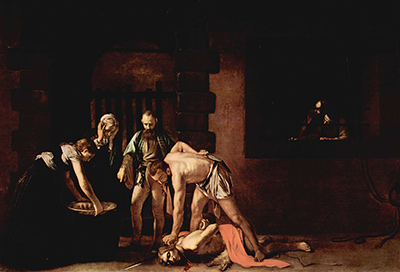
| The Beheading of Saint John the Baptist by Caravaggio | about 1608; installed in the Oratory on 29 August 1608 | Artwork |
| The Burial of Saint Lucy by Caravaggio in Syracuse | 1608, during Caravaggio's Syracuse stay | Artwork |
| The Calling of Saint Matthew by Caravaggio | about 1599–1600 | Artwork |
| The Calling of Saints Peter and Andrew by Caravaggio | about 1602–04 in the Trust's object text | Artwork |
| The Cardsharps by Caravaggio | about 1596–97 in the Kimbell's current object record | Artwork |
| The Conversion of Saint Paul: Caravaggio's Odescalchi Panel | commissioned in 1600; painted around 1600–01 | Artwork |
| The Crucifixion of Saint Andrew by Caravaggio | 1606–07 | Artwork |
| The Crucifixion of Saint Peter by Caravaggio | about 1601 | Artwork |
| The Death of the Virgin by Caravaggio | commissioned 1601; completed late 1605 or early 1606, according to the Louvre | Artwork |
| The Denial of Saint Peter by Caravaggio | 1610 | Artwork |
| The Doria Pamphilj Saint John the Baptist: A Second Youth with a Ram | linked compositionally to the Capitoline 1602 picture; an exact production year for this canvas is not established by the owner pages used here. | Artwork |
| The Entombment of Christ by Caravaggio: The Vatican Deposition | about 1600–04 in Vatican Museums publication material | Artwork |
| The Flagellation of Christ by Caravaggio: The Capodimonte Altarpiece | around 1607, in the first Naples period | Artwork |
| The Fortune Teller by Caravaggio: The Louvre Version and Its Roman Counterpart | — | Artwork |
| The Holy Family with the Infant Saint John the Baptist by Caravaggio | early 1600s in the Met catalogue; no more exact owner date asserted here | Artwork |
| The Incredulity of Saint Thomas by Caravaggio | about 1601 in the SPSG presentation | Artwork |
| The Inspiration of Saint Matthew by Caravaggio | usually 1602; also catalogued 1602–03, for the installed final altarpiece | Artwork |
| The Lute Player by Caravaggio: The Hermitage Painting | about 1596 in the Hermitage collection publication; the Hermitage Friends restoration page gives about 1595–96 | Artwork |
| The Magdalen in Ecstasy: Caravaggio, Copies and a Disputed Original | — | Artwork |
| The Martyrdom of Saint Matthew by Caravaggio | 1599–1600; unveiled with The Calling in 1600 | Artwork |
| The Martyrdom of Saint Ursula by Caravaggio | — | Artwork |
| The Musicians by Caravaggio | 1597 | Artwork |
| The Resurrection of Lazarus by Caravaggio in Messina | 1609; delivered 10 June 1609 in the owner account | Artwork |
| The Sacrifice of Isaac by Bartolomeo Cavarozzi: A Former Caravaggio Attribution | about 1615–17 in the Nicholas Hall catalogue; “1598” is an inherited URL label, not the accepted date | Artwork |
| The Sacrifice of Isaac by Caravaggio: The Uffizi Painting | about 1603 in the Uffizi catalogue | Artwork |
| The Seven Works of Mercy by Caravaggio | 1606–07, according to the Pio Monte | Artwork |
| The Supper at Emmaus by Caravaggio: The London Painting | 1601 | Artwork |
| The Taking of Christ by Caravaggio | 1602 | Artwork |
| The Toulouse *Judith Beheading Holofernes*: A Caravaggio Attribution Debate | c.1606–07 if identified with the recorded Naples work; that identification is debated | Artwork |
| Young Sick Bacchus by Caravaggio | about 1595 in the Galleria Borghese catalogue | Artwork |
| Youth with a Ram: Why Caravaggio's Saint John Looks So Unusual | — | Artwork |
No matching pages found.
Discussion
Share a close observation about Caravaggio Paintings in Rome or a source that clarifies its history.
Which detail changes your reading?
Is there a collection record or document worth comparing?
What remains uncertain?
Join the Conversation
Frequently Asked Questions
Where are the Caravaggio paintings still in Roman churches?
Is the Odescalchi Conversion of Saul on view at Palazzo Barberini?
Its documented Palazzo Barberini exhibition ran from July to September 2025. The panel belongs to Nicoletta Odescalchi. Do not assume the past display continues.[3]
Which Roman museum has the most Caravaggios?
The Galleria Borghese has a particularly concentrated group, while Palazzo Barberini, Galleria Corsini, the Musei Capitolini and the Galleria Doria Pamphilj hold other important works. A precise “most on view” count changes with loans, installations and the status of disputed attributions; consult current collection pages.[1][4][5][6][12][13]
References
- Roma Capitale, “Caravaggio's locations” (venue itinerary; interpretive claims checked separately).
- Roma Capitale, Basilica di Santa Maria del Popolo.
- Gallerie Nazionali Barberini Corsini, Conversion of Saul exhibition, 24 July–30 September 2025.
- Galleria Borghese, collection and object catalogue.
- Musei Capitolini, restoration of Caravaggio's Saint John the Baptist.
- Gallerie Nazionali Barberini Corsini, Caravaggio and the Palazzo Barberini collection.
- Smarthistory, “Baroque art, an introduction,” Cerasi Chapel ensemble.
- Roma Capitale, San Luigi dei Francesi.
- Gallerie Nazionali Barberini Corsini, Saint Francis in Meditation attribution.
- Gallerie Nazionali Barberini Corsini, 10 March 2026 acquisition announcement for Portrait of Monsignor Maffeo Barberini.
- Vatican Museums, The Deposition.
- Catalogo Generale dei Beni Culturali, Saint John the Baptist, Galleria Corsini inventory 433.
- Galleria Doria Pamphilj, gallery display and its three Caravaggio paintings.
- Gallerie Nazionali Barberini Corsini and Fondo Edifici di Culto, Il Doppio e la Copia, 2017.
- Roma Capitale, Museum and Crypt of the Capuchin Friars.
- Gallerie Nazionali Barberini Corsini, Galleria Corsini visitor information.
- Basilica di Sant'Agostino in Campo Marzio, Madonna dei Pellegrini and visitor guidance.
- Roma Capitale, Casino Boncompagni Ludovisi site-specific visitor listing.
- Gallerie Nazionali Barberini Corsini, Eco e Narciso exhibition account.
- Fondazione Zeri catalogue, Narciso alla fonte under Giovanni Antonio Galli.
- Gallerie Nazionali Barberini Corsini, Caravaggio and Artemisia: The Challenge of Judith exhibition account.
- Gallerie Nazionali Barberini Corsini, Palazzo Barberini visitor information.
- Michele Cuppone, research on Caravaggio's paintings for Ottavio Costa.
- Galleria Borghese, Room 8: Silenus Room (collection and room guide).
- Galleria Borghese, Madonna and Child with Saint Anne catalogue (Antonio Iommelli, May 2023).
- Museo Civico Ala Ponzone, collection and loan notice.
- Museo del Corso, Sulle tracce di Francesco exhibition and visitor information.
- Roma Capitale, Portrait of Monsignor Maffeo Barberini at Palazzo della Minerva (28 May–21 June 2026).