


 by
Tom Gurney
Tom Gurney BSc (Hons) is an art history expert with over 20 years experience
Published on October 6, 2016 / Updated on October 23, 2026
Email:
tomgurney1@gmail.com
/ Phone:
+44 7429 011000
The Artist's Garden in Argenteuil
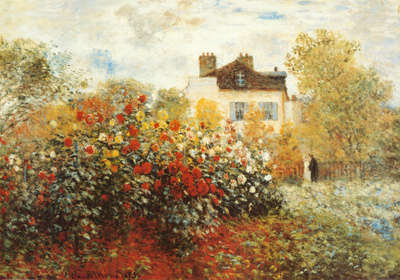
The Artist's Garden in Argenteuil, also called A Corner of the Garden with Dahlias, is Claude Monet's 1873 painting in the National Gallery of Art, Washington. [1] A dense mass of flowers occupies the foreground, while a pale house rises beyond them and two small figures stand near the fence. The garden's colour, rather than a family portrait or a detailed view of the building, commands attention.
At a Glance
- Artist Claude Monet
- Date 1873
- Medium Oil on canvas
- Dimensions 61 x 82.5 cm
- Collection National Gallery of Art, Washington
- Accession 1991.27.1
- Catalogue Wildenstein 286. [1]
Flowers before the house
The dahlias are not a small decorative addition to a house view. They spread across much of the left and centre, rising high enough to overlap the lower part of the building. Their irregular outline competes with the more definite geometry of roof, windows and shutters.
Red and orange flowers gather lower in the mass, while lighter yellow and white touches appear towards its upper edge. Dark green passages provide depth between the blossoms. The plants are readable as a dense hedge without every flower being separately outlined.
The foreground is also active. Small warm touches lie across the ground beneath the flowers, so the colour does not stop at the edge of the bed. The view seems full from the nearest marks to the distant trees.
The open area on the right offers a different rhythm. Instead of facing a continuous wall of flowers, the eye can follow lighter ground towards the small figures and fence. That interval gives the composition breathing space.
Argenteuil and the garden subject
Monet established a home at Argenteuil in late 1871. Gloria Groom's Art Institute of Chicago study places the family's first rental there between the end of that year and the summer of 1874, a period when Durand-Ruel's purchases helped support a more settled household. [4]
A garden gave Monet subjects close to home, but it also brought together cultivation and painting. Plants could be selected, arranged and allowed to grow before they became part of a view. The setting was familiar without being visually fixed.
The National Gallery of Art's Picturing France study places the dahlia picture within a wider enthusiasm for ornamental gardening. It distinguishes this cultivated nature from wilderness and notes that Monet, Manet and Renoir all painted the Argenteuil garden. [2]
The subject is therefore modern in a quieter way than a railway station or busy boulevard. It concerns how people shaped and enjoyed the spaces around their homes, and how those spaces could become material for ambitious art.
The blue-shuttered house
The house supplies a relatively stable form beyond the flowers. Its light facade makes the darker windows and roof conspicuous, while blue shutters introduce a cooler colour among the surrounding warm blossoms and yellow-green leaves.
The roof is not a simple symmetrical triangle. Different slopes and projecting parts give it a lively outline, with chimneys breaking into the sky. It is a recognisable building rather than a neutral block placed behind the garden.
Nevertheless, the scene does not invite a full architectural inspection. Plants conceal the lower walls, and trees overlap its edges. We see only the portion Monet allows the garden to reveal.
Nor should the building automatically be identified as his own house. Paul Hayes Tucker's NGA exhibition catalogue compares it with the same blue-shuttered building in Renoir's related view, while questioning the exact boundary of the planted area. [3] The title locates the subject in Monet's garden world; it does not settle every property line.
Small figures, large flowers
The two people near the fence are small, but they help establish the scale of the garden. One light costume and one dark costume stand out against the more muted background. Their bodies are suggested with a few marks rather than given the detailed treatment of portrait sitters.
Their position also changes the meaning of the surrounding space. The open ground is somewhere that people can occupy, not merely a coloured interval separating the plants from the house. The garden becomes accessible in imagination, even though the dense flowers block a direct passage through the centre.
No names are needed to make these figures effective. Assigning them confidently to Camille, Jean or Monet would turn a visual observation into a biographical assertion. Their contrasting clothes and proximity to the fence are clearer than their identities.
The relation of scale is unusual in emphasis: the flowers are immediate and imposing, while the people remain discreet. Monet makes a cultivated environment the main subject without removing human life from it altogether.
Colour and the painted surface
The picture's abundance depends on the variety of its marks. Small bright touches describe flower heads, darker strokes knot together into foliage, and looser passages suggest the ground and sky. Different parts of the scene ask for different kinds of attention.
The house can be recognised through a few larger planes and darker openings. The flowers require a more dispersed kind of looking, in which individual touches combine into a mass. Moving between these areas reveals how much of the picture is organised through colour rather than continuous outline.
Warm and cool passages help prevent the red blossoms from becoming isolated spots. Blue shutters and green leaves balance them, while pale cloud marks connect the sky with the lighter flowers. The whole canvas remains active, even where the subject changes from plant to building.
This visible handling does not prove a single rapid session. What it does show is Monet's willingness to let the brushstroke remain part of the experience. The garden is convincing at a distance, yet close looking continually returns attention to the painted surface.
Renoir's related view
Renoir's Monet Painting in His Argenteuil Garden, also dated 1873, shows Monet at an easel near a mass of flowers. Tucker identifies the blue-shuttered house and neighbouring tree as features shared with the Washington painting. He suggests that Renoir may even have represented Monet making this canvas, while leaving that possibility unconfirmed. [3]
The comparison also complicates the idea of a secluded retreat. Renoir includes more of the surrounding buildings; Monet's framing and foliage make the scene appear more enclosed. Tucker further cautions that the dahlias may have grown on neighbouring land rather than within Monet's rented property. [3]
These qualifications make the paintings more interesting, not less. Two artists could work around the same place while producing different accounts of it. Renoir makes the act of painting visible; Monet allows the flowers and their setting to dominate.
The National Galleries of Scotland's Impressionist Gardens interpretation describes the private garden as a place for sustained investigation of light, colour and atmosphere. [5] This painting demonstrates how that investigation could begin with a familiar suburban corner and still involve deliberate choices about what to include.
A different work from The Artist's House
Monet's The Artist's House at Argenteuil in Chicago is another painting of 1873, with a child on the garden path and a figure at the doorway. [4] Its pots, figures and technical history belong to that separate canvas, not to the Washington dahlia scene.
The distinction is important because similar titles can obscure different compositions. Here, the large flower hedge and distant pair are the identifying features. There is no central child playing with a hoop between large foreground planters.
Durand-Ruel bought this painting from Monet in December 1873. It later entered the Philip and Janice Levin collection; Janice Levin's 1991 partial and promised gift to the National Gallery of Art was completed in 2001. [1]
The painting preserves a specific way of seeing Argenteuil: cultivated flowers fill the immediate view, a house anchors the distance, and human figures remain part of a larger pattern of colour and growth.
Frequently Asked Questions
The National Gallery of Art in Washington, accession 1991.27.1. [1]
The NGA exhibition catalogue raises the possibility that they grew on neighbouring land. [3]
No. That is a separate painting with a different composition. [4]
That is a scholarly suggestion, not a securely established fact. [3]
Discussion
Look again at the images and ideas explored in The Artist's Garden in Argenteuil. These editorial prompts invite your observations.
Reader Insights
Do the flowers or the house first organise your view of the scene?
What changes when the two small figures are noticed?
How might a wider view of the surrounding buildings alter the garden's mood?
Join the Conversation
Share a detail, comparison or question about The Artist's Garden in Argenteuil below.
References
- National Gallery of Art , The Artist's Garden in Argenteuil (A Corner of the Garden with Dahlias), 1873, 1991.27.1. View source .
- National Gallery of Art , Picturing France, Monet's dahlias, p. 58. View source .
- Paul Hayes Tucker , The Impressionists at Argenteuil, National Gallery of Art, 2000, cats. 19-20, pp. 90-94, and p. 33. View source .
- Gloria Groom , The Artist's House at Argenteuil, 1873, Art Institute of Chicago scholarly catalogue, Cat. 15, a separate work and household context. View source .
- National Galleries of Scotland , Impressionist Gardens, 2010: private gardens, colour and atmosphere. View source .







