


 by
Tom Gurney
Tom Gurney BSc (Hons) is an art history expert with over 20 years experience
Published on October 6, 2016 / Updated on October 23, 2026
Email:
tomgurney1@gmail.com
/ Phone:
+44 7429 011000
The Cabin at Sainte-Adresse
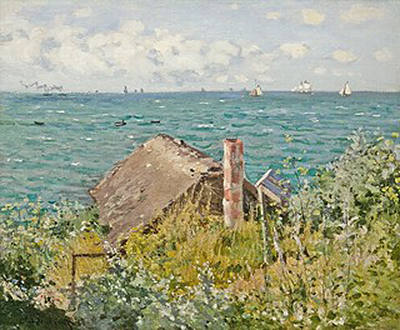
A thatched roof rises from thick coastal vegetation, with a red chimney standing against blue-green water. Beyond it, small sails and distant ships stretch along the horizon. Claude Monet's The Cabin at Sainte-Adresse is an oil painting of 1867 in the Musee d'art et d'histoire, Geneva. The museum records dimensions of 53 by 62.5 centimetres and inventory number 1990-0045; the catalogue raisonne identifies it as Wildenstein 94. [1] [2]
At a Glance
A roof between the garden and the sea
The cabin occupies an unusual position in the picture. Its roof is large enough to dominate the foreground, but much of the building beneath it is hidden. Vegetation crowds around its edges, leaving the viewer to imagine walls and ground that cannot be followed completely.
The result is not a conventional portrait of a house. There is no clear front entrance inviting an approach, and no carefully exposed facade. The eye meets a sloping plane of thatch and then moves directly towards the open water behind it.
The roof's ridge forms a strong diagonal, while the horizon runs almost straight across the width. These two directions give the painting a firm structure beneath its many small marks. The chimney adds a shorter upright, preventing the house from becoming merely another horizontal band.
The building also establishes the elevated viewpoint. We look across its roof rather than directly at a wall, with the sea visible beyond. This makes the foreground feel close and slightly below us, while the ships remain far away.
The small force of the red chimney
The chimney is one of the most effective accents in the scene. Its warm red and pink surfaces interrupt the surrounding greens, greys and pale browns. Because it is narrow, that change of colour does not overwhelm the quieter roof beside it.
Its top ends below the horizon. The upright therefore belongs to the near building without cutting into the distant sky. Water appears immediately behind it, making the warm-and-cool contrast especially easy to see.
A smaller roof shape is partly visible to the right. Its sharper angles repeat the larger cabin's geometry, though the vegetation breaks up the connection between them. The structures feel embedded in the setting rather than laid out for inspection.
The chimney and roof are also different kinds of painted surface. The thatch is suggested through broken, irregular touches; the chimney has a more continuous shape. Their meeting introduces variety within a very limited area of the composition.
Leaves, waves and distant sails
The foreground is busy with yellow-green, darker green and pale touches. Stems, stakes and fragments of fencing emerge among them, but the growth is not described leaf by leaf. Its density makes the open water behind it seem more expansive.
Across the sea, short horizontal strokes suggest waves and changes of light. These marks are smaller and more regularly aligned than those in the foreground. Monet gives the two areas different rhythms without needing a hard dividing outline between every plant and the water.
The sails are tiny triangular forms. Some are bright enough to catch the eye quickly, while darker shipping is compressed against the horizon. At the far left, a thin trail suggests smoke above the distant vessels.
There are no large, clearly described figures competing with the cabin. Human activity is instead present through buildings, boundaries and maritime traffic. The apparent quiet of the foreground coexists with movement across the water, joining a sheltered patch of land to a much larger working coast.
Sainte-Adresse in 1867
The date places the painting among Monet's early Normandy coastal works. It was made in the same year as the much larger Garden at Sainte-Adresse , also known as Terrace at Sainte-Adresse , now in New York. [2] [3]
The two paintings share a relationship between near land and distant shipping, but organise it differently. The terrace picture presents a more open social space with figures and flags; the cabin view gives the roof and vegetation most of the foreground. The sea remains important in both, though it is reached through different kinds of enclosure.
This smaller canvas should therefore be considered on its own terms rather than as a reduced version of the terrace. A roof partly lost in greenery offers a different visual problem from a garden occupied by people.
Monet's coastal subjects also varied greatly in mood. The sheltered appearance here contrasts with his rough-water views near Le Havre. Similar place-names do not imply the same weather, viewpoint or pictorial purpose.
A comparison with Hokusai
Genevieve Aitken's institutional study of Monet's interest in Japanese art compares the cabin painting with Hokusai's Lake Suwa in Shinano Province , from Thirty-six Views of Mount Fuji . [4] The comparison concerns the arrangement of a prominent roof near water and a more distant landscape.
The Metropolitan Museum's record dates its impression of Hokusai's print to about 1830-32 and notes the formal relationship between the thatched shrine and Mount Fuji. [5] That particular mountain-and-shrine dialogue belongs to Hokusai's design, not to Monet's Normandy view.
The comparison is useful as a way of looking, rather than proof that Monet copied a particular sheet while making this canvas. The French painting has its own colours, brushwork, shoreline setting and chimney. Those differences matter as much as the shared use of a conspicuous foreground roof.
It is also unnecessary to turn the cabin into a Japanese building. The interest lies in how a nearby structure can frame a view of water, not in changing the identity of the place Monet depicted.
Duret, exhibitions and a later drawing
The museum's provenance research records Theodore Duret's purchase from Monet in May 1873. [1] The painting was subsequently shown at the third Impressionist exhibition in 1877, ten years after its execution. It appeared again at La Vie moderne in 1880 and in the Monet-Rodin exhibition of 1889. [2]
This history shows that the canvas continued to circulate well beyond the summer in which it was painted. Its early date did not prevent Monet from including it in later presentations of his work.
For an article in La Vie moderne in 1880, Monet made a drawing after the painting on Gillot paper. [2] The drawing is therefore a later translation of the composition, not evidence of a preparatory sketch made before the oil.
The published auction catalogue for that sheet records graphite and scraping, together with an instruction to reduce the image by half. [6] Moving from coloured paint to a reproducible drawing involved another way of organising the roof, vegetation and distance. The existence of the sheet adds a second stage to the image's history without changing the oil painting's date.
How the painting reached Geneva
The museum's provenance report traces later ownership through the Van Horne family and the Schmidheiny collection before the painting entered the Garengo Foundation in 1971. It was deposited at Geneva's museum in 1990 and acquired by the museum in 2006 following the foundation's dissolution. [1]
Older publications still describe it as a Garengo loan. That wording reflects an earlier stage of the painting's history rather than the acquisition recorded in the museum's later research.
Its journey from a Normandy view to a Swiss public collection has not reduced the intimacy of its subject. A modest roof, an uneven patch of growth and distant sails are sufficient to make the coast feel inhabited. The painting's strength lies in their relationship: the near forms hold the eye briefly, then allow it to travel out across the green water.
Frequently Asked Questions
The canvas is signed and dated 1867. [2]
It belongs to the Musee d'art et d'histoire, Geneva, inventory 1990-0045. [1]
Aitken makes a scholarly comparison with Lake Suwa in Shinano Province. This does not by itself establish which particular print Monet saw while painting in 1867. [4]
Discussion
Look again at the images and ideas explored in The Cabin at Sainte-Adresse. These editorial prompts invite your observations.
Reader Insights
Follow the diagonal roof towards the horizontal sea.
Compare the warm chimney with the cool water directly behind it.
Notice how the foreground marks differ from the short strokes describing waves.
Join the Conversation
Share a detail, comparison or question about The Cabin at Sainte-Adresse below.
References
- Musee d'art et d'histoire, Geneva , Recherche de provenance - Rapport final, printed page 52 (PDF page 63), La Cabane de Sainte-Adresse, inventory 1990-0045; exact object facts, collection history and 2006 acquisition. View source .
- Daniel Wildenstein / Wildenstein Plattner Institute , Monet catalogue raisonne, volume II, 1996, entry 94, printed page 50; signature, date, exhibitions and the later drawing. View source .
- Alain Madeleine-Perdrillat / Societe Cezanne , Monet, Cezanne: deux marines, essay of April 2002, published online in 2021; comparison with Monet's contemporary terrace picture. Its older loan caption predates the museum's 2006 acquisition. View source .
- Genevieve Aitken / Institut national d'histoire de l'art , MONET Claude, 2022; scholarly comparison with Hokusai's Lake Suwa. View source .
- The Metropolitan Museum of Art , Hokusai, Lake Suwa in Shinano Province, object JP2965; exact comparative print identity and formal interpretation. View source .
- Millon , Art Moderne 1860-1960, 1 December 2025, lot 56, Cabane a Sainte Adresse; the later graphite drawing on Gillot paper, catalogue D436. View source .







