


 by
Tom Gurney
Tom Gurney BSc (Hons) is an art history expert with over 20 years experience
Published on October 6, 2016 / Updated on October 23, 2026
Email:
tomgurney1@gmail.com
/ Phone:
+44 7429 011000
Seacoast at Sainte-Adresse
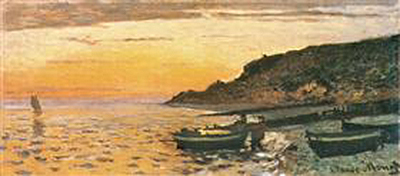
Golden light spreads across the water while the cliff and boats fall into shadow in Claude Monet's Seacoast at Sainte-Adresse . The Tochigi Prefectural Museum of Fine Arts catalogues this canvas as Beach of Sainte-Adresse , dated 1864. Its unusually wide format, 30.6 by 69.5 centimetres, suits the long meeting of shore, sea and evening sky. It is catalogued as Wildenstein 39a. [1] [3]
At a Glance
A very wide coastal view
The painting is more than twice as wide as it is high. That proportion makes the eye travel sideways, following the low horizon and the coast's gradual approach from the right. There is little sense of a tall, enclosing foreground.
The main masses are simple: illuminated water at the left, dark land at the right, and a sky extending above both. Yet their boundaries are not mechanically straight. The cliff descends in irregular steps, and the water breaks into many separate marks.
The shoreline narrows towards the middle distance. Its diagonal helps connect the near boats with the far end of the headland. The view is open, but not directionless: the coast offers a path through it.
The format also limits the amount of sky above the cliff. Instead of giving clouds overwhelming height, Monet stretches the evening atmosphere along the upper part of the canvas. The subject becomes a relationship between extended bands and sloping forms, rather than one isolated landmark.
Gold light interrupted by grey water
The brightest area lies towards the left horizon, where warm yellow and orange spread beneath a cooler cloud band. That warmth reaches into the water, but does not cover it evenly.
Short grey-blue strokes interrupt the reflected light. Their changing spacing suggests an uneven surface in which some facets catch brightness and others turn away from it. The water is luminous because these cooler interruptions remain visible.
Nearer the foreground, the strokes are broader and more separated. Farther away, they compress into thinner bands. This change of scale produces depth within a surface that is otherwise described with remarkably few kinds of mark.
The scene is a sunset view, as the MuMa's interpretation confirms. [2] It does not, however, require an exact clock time to be convincing. What matters visually is the meeting of a warm low light with darkening land, cool cloud and broken water.
The cliff as a dark silhouette
The right-hand cliff is one of the picture's strongest shapes. Its upper edge rises towards the corner, while the far end slopes down towards the water. It occupies a substantial area without being filled with sharply described geological detail.
Some warmer passages break through the dark mass. These hints prevent it from becoming an entirely flat black cut-out. They suggest uneven ground catching different amounts of light, while leaving much of the land in shadow.
The cliff also creates a contrast in pace. The water's many small touches invite restless scanning, whereas the land is read first as a broad continuous form. The eye can move between the two without losing the overall arrangement.
This is a different way of describing the headland from Monet's more brightly lit daytime views. Here, the receding contour and relative darkness matter more than a complete inventory of ledges, vegetation or buildings. The land is recognisable through its relationship with the light around it.
Boats at the water's edge
Several boats gather near the lower right. Their dark hulls are interrupted by small light edges, enough to distinguish rims and interiors without describing every construction detail. The nearest vessels are partly enclosed by the frame and the shadowed shore.
The MuMa identifies two fishermen drawing a boat onto the beach. [2] Their small figures give the scene an activity different from the distant sail, which appears to be moving away across open water.
The contrast is economical. One part of the view concerns a vessel being brought to land; another concerns a boat remaining offshore. The painting does not need a dramatic incident to make the coast feel used.
The distant sail is especially spare. A small dark shape and its reflection interrupt the broad field of light at the left. It balances the larger boats at the right without becoming their equal in size. Together, they connect the close shoreline with the wider sea.
Monet's return to Sainte-Adresse in 1864
The holding museum places the painting among works made during Monet's return to the coast in October 1864, following an earlier visit with Frederic Bazille that summer. [1] Sainte-Adresse was familiar territory near Le Havre, not a distant landscape encountered only once.
The National Gallery's account of its related 1864 La Pointe de la Heve, Sainte-Adresse describes the same early search for coastal subjects. [4] That canvas has a cooler atmosphere and a different foreground arrangement, demonstrating that a familiar stretch of shore could support very different effects.
Monet was also working between direct observation and the demands of exhibition painting. Hadrien Viraben's study of his Normandy visits describes the alternation of outdoor studies and Paris studio work during this period. [6]
The sunset canvas's rough handling is consistent with a close response to changing light, but it should not be treated as a stopwatch record of execution. Its wide arrangement, balances of dark and light, and carefully placed boats show decisions as well as speed.
From coastal studies to the Salon
The following year, Monet exhibited two large Normandy landscapes at the Salon. The Kimbell's La Pointe de la Heve at Low Tide was one of them, developed as a larger studio composition from a smaller coastal study. [5]
The Tochigi sunset belongs to this broader period of investigation, but it should not be confused with the large Salon canvas itself. Their dimensions, light and foreground details differ. A relationship within a campaign is not the same as identity between objects.
The comparison also challenges a simple division between conventional early work and entirely spontaneous later painting. Monet's coastal practice involved observing particular conditions, selecting compositions and reconsidering what a finished picture might be.
In the sunset, the evening colour is unusually concentrated. The boats are dark, the cliff is largely silhouetted, and much of the descriptive detail has been reduced. These choices allow the light to become the scene's principal organising force while preserving the specificity of a working shore.
Leon Monet and the painting's later history
The MuMa's recent research identifies Monet's brother Leon as an early purchaser of this painting. His acquisitions in 1864 formed part of an important family support network at a time when buyers for Claude's work were still scarce. [2]
The catalogue raisonne traces the canvas through Leon's ownership, Wildenstein and the Fujikawa Gallery in Tokyo before its acquisition by Tochigi. It also records its inclusion in the Monet-Rodin exhibition of 1889. [3]
That later exhibition gives the small early picture a life beyond its original coastal campaign. Its value was not confined to being an immediate study of one evening. The wide format and controlled contrast continued to make a coherent painting.
Today its modest size encourages close attention. The boats can almost disappear into the shore at first glance, while the golden water attracts the eye immediately. Looking longer reveals how precisely these unequal areas of light and darkness depend on one another.
Frequently Asked Questions
The holding museum dates it to 1864 and relates it to Monet's October return to the coast. [1]
It belongs to the Tochigi Prefectural Museum of Fine Arts, where it is titled Beach of Sainte-Adresse. [1]
Discussion
Look again at the images and ideas explored in Seacoast at Sainte-Adresse. These editorial prompts invite your observations.
Reader Insights
Compare the broken reflected light with the large dark cliff.
Follow the coast's diagonal towards the middle distance.
Notice how the small offshore sail balances the nearer boats.
Join the Conversation
Share a detail, comparison or question about Seacoast at Sainte-Adresse below.
References
- Tochigi Prefectural Museum of Fine Arts , Beach of Sainte-Adresse, 1864; exact title, medium, dimensions and visit chronology. View source .
- Musee d'art moderne Andre Malraux, Le Havre , Monet au Havre, exhibition route, 2026; exact sunset painting, fishermen, coastal setting and Leon Monet's early support. View source .
- Daniel Wildenstein / Wildenstein Plattner Institute , Monet catalogue raisonne, volume II, 1996, entry 39a, printed page 24; collection history and the 1889 exhibition. View source .
- National Gallery, London , La Pointe de la Heve, Sainte-Adresse, 1864; separate early coastal study and Normandy context. View source .
- Kimbell Art Museum , La Pointe de la Heve at Low Tide, 1865; separate large Salon canvas and its studio development. View source .
- Hadrien Viraben , 1864-1886: Quand Claude Monet visitait la cote normande, Etudes Normandes, 2020, pages 6-13; scholarly context for outdoor studies and studio work. View source .







