


 by
Tom Gurney
Tom Gurney BSc (Hons) is an art history expert with over 20 years experience
Published on October 6, 2016 / Updated on October 23, 2026
Email:
tomgurney1@gmail.com
/ Phone:
+44 7429 011000
Street in Sainte-Adresse
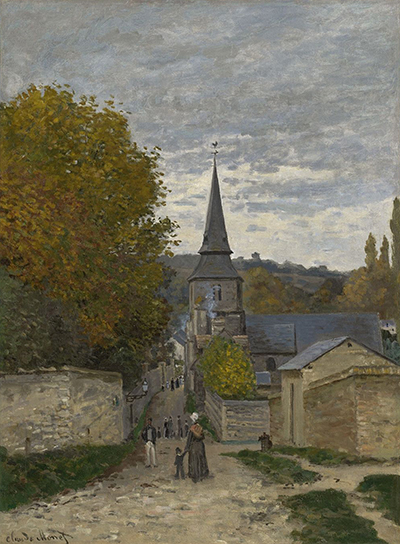
A narrow road drops between stone walls towards a church, while small figures pause or continue down the slope. Claude Monet's Street in Sainte-Adresse turns away from the sea towards the built fabric of the coastal town. The Clark Art Institute dates the oil painting to 1867 and gives its dimensions as 80 by 59.2 centimetres. It is accession 1955.523 and Wildenstein 98. [1] [3]
At a Glance
A street that falls away from the viewer
The road begins broadly at the bottom of the canvas and narrows sharply between the walls. Its uneven surface is described with small pale and darker marks, suggesting stones, worn ground and patches of shadow.
The descent is not a simple straight corridor. Farther down, the street shifts and bends out of sight. Figures become smaller along it, helping the eye follow a route that cannot be seen in full.
This partly concealed continuation gives the scene a particular kind of depth. The viewer is not offered a complete map of the town. Instead, the lane promises further space beyond the visible walls and buildings.
The near road also has an important shape on the surface of the canvas. Its pale area opens towards the bottom, balanced by darker foliage at the left and a block of masonry at the right. The sense of walking into the town grows from this arrangement of light and dark as much as from conventional perspective.
The church and its pointed spire
The church stands close to the centre. Its narrow spire rises into a substantial area of cloudy sky, giving the composition a clear upright around which the other forms gather.
Below the spire, the tower is divided into smaller rectangular and arched shapes. These are indicated rather than minutely drawn. The building is recognisable, yet remains part of the same visibly brushed surface as the walls, trees and road.
The lower roof extends towards the right, connecting the central tower with a wider cluster of buildings. Different roof angles overlap, so that architecture becomes a sequence of planes rather than one isolated monument.
The catalogue raisonne identifies the subject as Sainte-Adresse's old church near the Chemin des Phares, where Monet stayed during the summer of 1867. [3] That location makes this an inland view within his familiar coastal surroundings. The church is a specific landmark, but its central position need not be treated as evidence of a religious message.
Walls, roofs and small changes of direction
The walls are not symmetrical counterparts. At the left, a long pale surface slopes away beneath the foliage. At the right, a nearer building presents a more compact face and a small triangular roofline.
Their differences prevent the lane from looking like a perfectly regular avenue. Edges change direction, roof surfaces overlap, and bits of wall conceal what lies behind. The town appears to have grown through separate structures rather than according to one simple plan.
Monet varies the handling within these solid forms. Some masonry is suggested with block-like strokes; other passages are thinner and less defined. Dark lines can establish a corner or roof edge without surrounding every surface with an outline.
These small shifts matter because the palette is restrained. When colour does not provide a large contrast, a change in angle or brushstroke can carry more of the descriptive work. A modest street becomes visually complex through the meeting of many such adjustments.
Figures without a staged story
A woman in a long dress and a small child stand near the foreground. Their closely placed forms make a compact group against the pale road. Farther left, another figure is marked by light trousers and a darker upper body.
Other people occupy the lane at different distances. Some are only a few touches of dark paint, but their placement gives the street a scale. The walls and church would appear quite different without these small indications of human height.
The foreground group is large enough to slow the eye before it travels downhill. Their presence makes the view feel encountered in passing rather than completely emptied for architectural inspection.
Nothing requires them to become named members of Monet's family. Nor does the church turn the gathering into a definite procession or funeral. The painting provides ordinary figures in a street; keeping their identities open allows their compositional role to remain clear without inventing a narrative.
Foliage and the grey sky
A large mass of foliage enters from the left. Green, ochre and brown touches build an irregular edge against the sky. The tree occupies enough space to compete with the buildings, but its softer contours are quite different from their rooflines.
That contrast brings variety to the upper half. The spire is narrow and sharply directed, while the foliage spreads outward through broken marks. Both rise from the enclosed street, carrying the eye above the walls.
The sky contains several shades of grey and blue, with lighter horizontal passages near the steeple. It is not an empty background. Its repeated strokes help hold together the spaces between tree, spire and distant roofs.
Some colours suggest the turning season, but the appearance of foliage is not enough to establish an exact painting date. What is more immediately visible is the restrained light shared by the scene. Few surfaces blaze in sunshine; the road, walls and roofs emerge through relatively close tonal relationships.
A different side of the 1867 campaign
Monet's extended stay at Sainte-Adresse in 1867 produced gardens, figures and marine subjects as well as this street. The National Gallery of Art's account of the period stresses that variety. [5]
The vertical format is a marked change from the broad coastal canvases. In Regatta at Sainte-Adresse , the eye moves along beach and water; here, the road descends while the spire rises. Open sea is replaced by walls and overlapping roofs.
The Clark's scholarly catalogue considers the spatial demands of this unassuming motif, rather than treating the subdued atmosphere as a direct illustration of Monet's personal troubles. [1] It is a useful distinction. A painter can choose grey weather, limited colours and an awkward street for pictorial reasons.
The result is not less ambitious because the subject is ordinary. Monet must make several changing levels and directions coexist within a compact field. The small lane asks for a different kind of attention from a fleet of bright sails, but the choices are no less deliberate.
From a mistaken Fecamp title to the Clark
The picture circulated for many years under the title Rue a Fecamp . The National Gallery's 2018 loan documentation records that name at the time of its sale by Knoedler to Robert Sterling Clark on 5 May 1952. It entered the Clark institute with his collection in 1955. [2]
The established title and catalogue identification place it at Sainte-Adresse. [3] The older wording is therefore part of the object's history, not a reason to relocate the church to a different Normandy town.
In 2018, the painting was lent to the National Gallery's Monet and Architecture exhibition, as the Clark's annual report confirms. [4] Its inclusion makes sense: architecture here is not incidental decoration. The road, church and walls supply the structure through which light, foliage and everyday figures are seen.
The picture rewards looking slowly at an apparently uneventful place. Its movement is quiet, carried by the road's descent, the changing scales of people and the repeated adjustments of roofs and masonry.
Frequently Asked Questions
The Clark dates it to 1867. [1]
It belongs to the Clark Art Institute, accession 1955.523. [1]
The sources used here do not establish named identities for the foreground figures.
Discussion
Look again at the images and ideas explored in Street in Sainte-Adresse. These editorial prompts invite your observations.
Reader Insights
Trace the road as it narrows and bends out of sight.
Compare the church spire's shape with the spreading foliage.
Notice how the figures establish the scale of the buildings.
Join the Conversation
Share a detail, comparison or question about Street in Sainte-Adresse below.
References
- Clark Art Institute , European Paintings and Sculpture collection catalogue, entry 223, Street in Sainte-Adresse, printed pages 519-522; exact object facts and scholarly interpretation. View source .
- National Gallery, London , Monet and Architecture, 2018 loan documentation, Street in Sainte-Adresse; dimensions, provenance and 1952 purchase under the Fecamp title. View source .
- Daniel Wildenstein / Wildenstein Plattner Institute , Monet catalogue raisonne, volume II, 1996, entry 98, printed pages 51-52; old church near the Chemin des Phares and catalogue identity. View source .
- Clark Art Institute , Annual Report 2018, loans, page 18; the painting's loan to Monet and Architecture. View source .
- National Gallery of Art , Sainte-Adresse, 1867; separate coastal painting and context for the variety of Monet's work during the visit. View source .







