


 by
Tom Gurney
Tom Gurney BSc (Hons) is an art history expert with over 20 years experience
Published on October 6, 2016 / Updated on October 23, 2026
Email:
tomgurney1@gmail.com
/ Phone:
+44 7429 011000
Grand Canal, Venice
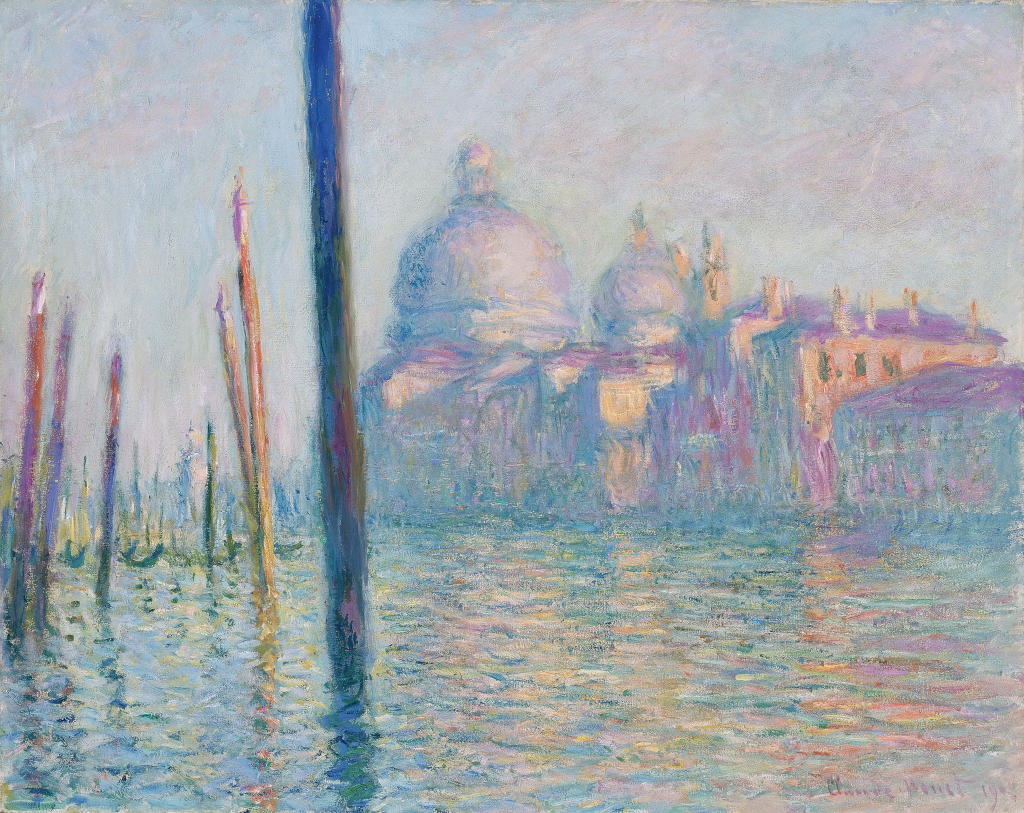
Grand Canal, Venice is the 1908 painting catalogued as Le Grand Canal, Wildenstein 1739. [1] The domes of Santa Maria della Salute rise beyond a broad stretch of shimmering water, while dark mooring poles interrupt the foreground. Monet makes the contrast between those near, solid uprights and the distant, light-filled architecture central to the composition.
At a Glance
- Artist Claude Monet
- Recorded title Le Grand Canal
- Date 1908
- Medium Oil on canvas
- Dimensions 73 x 92 cm
- Catalogue number Wildenstein 1739
- Collection posture Private collection in the 2015 sale record. [1]
The particular Grand Canal canvas
Monet made several closely related views of the Grand Canal and Santa Maria della Salute. The 2005 sale catalogue distinguishes six canvases, numbered 1736 to 1741, and identifies this painting as number 1739. [2] Similar titles do not mean that the works have identical colours, proportions or ownership histories.
Here, the largest foreground pole stands to the left of the main dome. It runs beyond the upper edge and continues down into the water as a broken reflection. Smaller poles and low boats occupy the area further left.
The architecture is pushed back across the canal. Its most recognisable feature is the larger dome, but a second dome, towers and adjacent buildings extend the view to the right. These elements remain distinct enough to identify the place while participating in a continuous field of pale blue, pink and violet.
A Venice visit that became a painting campaign
Monet travelled to Venice with his second wife, Alice, in the autumn of 1908. They accepted Mary Hunter's invitation to stay at the Palazzo Barbaro, then moved to a hotel on the Grand Canal. The National Gallery's account describes a visit of about ten weeks, during which the city's architecture became a sustained subject for painting. [3]
The Arts Council's expert report places their arrival on 1 October and the beginning of Monet's painting on 7 October. It also describes the regular routine that developed, with different locations occupying different parts of the day. [4]
This was more than a succession of casual tourist impressions. Returning to selected views allowed Monet to work with a stable architectural subject while attending to changing air, light and water. The familiar monuments supplied structure without dictating a conventional, minutely detailed cityscape.
Looking from the Palazzo Barbaro
The Grand Canal group is associated with the view towards the Salute from the steps of the Palazzo Barbaro. [2] The foreground poles are therefore not incidental clutter to be removed in pursuit of an unobstructed monument. They make the near waterfront conspicuous.
The largest pole acts almost as a vertical bar across the scene. Its dark blue-green colour is far stronger than most of the church's outline. Because it is so close, it can compete with the much larger building across the canal.
This produces a striking reversal of scale. A modest waterfront object occupies more of the picture's height than the dome behind it. The smaller poles recede in unequal intervals towards the left, reinforcing the sense of distance without relying on a sharply drawn pavement or road.
The result is a view experienced from a particular position, not a diagram of the church. The foreground remains part of the act of looking.
Architecture held together by colour
The larger dome is modelled through changes between cool blue and warmer pink or yellow. Its rounded form remains readable, but its outline softens into the surrounding atmosphere. The smaller dome repeats the shape at a reduced scale and carries the eye towards the right.
Below them, columns and openings appear through alternating upright passages. Some are darker and cooler, others brighter and warmer. Monet does not give every architectural detail the same degree of definition.
That unevenness keeps the building from becoming a separate, fully outlined object pasted onto a watery background. Its colours recur in the canal below, while its edges participate in the same softened handling as the sky.
The adjacent buildings provide more angular shapes and horizontal divisions. Their pink, orange and violet passages extend the warmth of the domes across the right side, balancing the cool force of the foreground pole.
Water that repeats without making a mirror
The lower portion of the canvas is filled with short, mostly horizontal marks. Blue, green, cream and pink strokes interrupt one another, suggesting a surface continually disturbed by small movements.
The reflections do not reproduce the architecture as a clean inverted image. Instead, the building's colours spread and break across the water. Pink and yellow appear beneath the warmer structures, while cooler blue-green passages connect the canal to the darker portions of the facade.
The large pole provides the clearest link between object and reflection. Its vertical descent becomes less continuous as it enters the water. The eye can follow the connection, but the surface prevents the reflected form from remaining completely stable.
This interplay is central to Monet's painting of water . The canal establishes depth and distance while also becoming a visibly worked surface of paint. Neither role entirely displaces the other.
Repeated appointments, not every hour in one picture
Joachim Pissarro's study of the Venice campaign, discussed in the sale catalogue, emphasises Monet's habit of returning to particular motifs at comparable times of day. For this group, atmospheric differences mattered within a relatively stable viewing arrangement. [2]
That is a more precise account than imagining that one canvas records every hour from morning to evening. A series can examine changes between related paintings without turning each individual picture into a complete chronology.
The Arts Council report also distinguishes work begun in Venice from the later selection and completion of paintings for exhibition. [4] The 1908 date is not a guarantee that every mark was applied beside the canal. Monet's outdoor observation and subsequent studio work belong to the same extended process.
His London paintings offer a useful comparison in their repeated architecture, broad water surfaces and atmospheric effects. The resemblance does not make the Thames and Venice interchangeable settings.
From the 1912 exhibition to later collections
This canvas appeared as number 4 in Monet's 1912 Venice exhibition at Galerie Bernheim-Jeune. The dealers Bernheim-Jeune and Durand-Ruel acquired it jointly, and Hunt Henderson bought it in 1913. The 2015 sale record also documents a National Gallery loan from 2006 to 2014. [1]
Those are historical appearances, not a promise of present public display. The painting's title likewise should not be used to attach another version's museum accession or sale history to it.
Its effect can be appreciated without explaining its palette through an unsupported story about Monet's first wife's death decades earlier. The close poles, luminous architecture and broken water already provide a specific visual argument. Solid objects remain identifiable, but colour and atmosphere alter how firmly they seem to occupy the space.
Frequently Asked Questions
It is signed and dated 1908. [1]
Santa Maria della Salute, seen from the Palazzo Barbaro viewpoint. [2]
The wider campaign included later studio work before the 1912 exhibition, so the date should not be treated as proof of wholly outdoor execution. [4]
Discussion
Look again at the images and ideas explored in Grand Canal, Venice. These editorial prompts invite your observations.
Reader Insights
How does the closest mooring pole alter the apparent scale of the church?
Which colours connect the architecture to the canal?
Where does a reflection remain recognisable, and where does it become a pattern of strokes?
Join the Conversation
Share a detail, comparison or question about Grand Canal, Venice below.
References
- Sotheby's , Le Grand Canal, 2015, lot 15, Wildenstein 1739, object details, provenance and exhibitions. View source .
- Sotheby's , Le Grand Canal, 2005, lot 12, same work, six-canvas group and discussion of Joachim Pissarro's Monet and the Mediterranean. View source .
- National Gallery , London, Monet's Venice, institutional online exhibition. View source .
- Arts Council England , expert adviser's statement on Le Palais Ducal, pages 1 and 3, comparative Venice campaign chronology and working process. View source .







