by Tom Gurney
Tom Gurney BSc (Hons) is an art history expert with over 20 years experience
Email: tomgurney1@gmail.com / Phone: +44 7429 011000
Velázquez at the Spanish Court: Introduction
On 6 October 1623, Philip IV instructed an official to put Diego Velázquez on the royal payroll at twenty ducats a month. The young man was to carry out whatever the king ordered within his profession as a painter. In October 1655 another official reported that the crown was advancing Velázquez five thousand reales a month for palace expenses. The money covered purchases such as floor mats and firewood. The controller wanted accounts before he could advise on further payments. Between the two documents lay the making of the royal portraits, battle pictures and interiors for which Velázquez is known. By the second date he was also responsible for some of the practical arrangements that made the king’s rooms habitable and his appearances possible. [1] [2]
The biography covers the Buen Retiro, the hunting lodge and royal commissions.
At a Glance
- Royal appointmentOctober 1623 [1]
- Early likenessThe Met’s standing Philip IV, probably 1624 [3]
- Palace dutiesThe controller’s report documents the lodging officer’s accounts in 1655. [2]
Contents
- A salary and a likeness
- Two portraits for two royal settings
- The practical work behind a royal image
- The oath and accounts of the palace lodging officer
- Installing pictures at El Escorial
- The royal family inside and outside the Alcázar
- Preparing a room on the frontier
- An ambassador asks for two portraits
- Who could put an image before the court?
A salary and a likeness
The October 1623 order names the paymaster for the works at the Alcázar, the Casa de Campo and El Pardo. Its terms put Velázquez in regular service, subject to the king’s directions. A letter of 28 October from Pedro de Hoff Huerta sent on the draft instrument specifying a second form of remuneration, payment for the pictures Velázquez made. The king marked his assent. Hoff’s further memorandum, dated 30 October, explains why the point mattered. He had found a precedent from 1617 in which another royal painter, Bartolomé González, had drawn sixteen ducats a month under terms that expressly excluded additional payment for works. Three papers in the space of a month show how much depended on the language used to hire a painter. The salary was the recurring cost of having Velázquez available. Payment for paintings was a distinct question, settled in the drafting of his terms. [1]
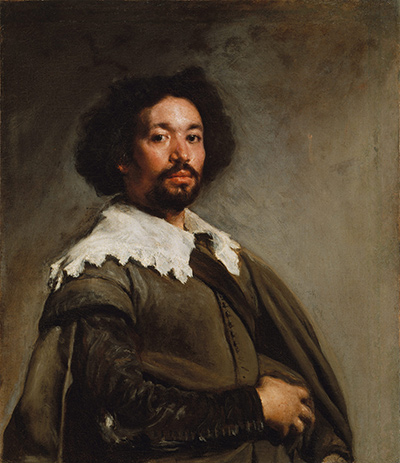
The first sitting has a different source. Francisco Pacheco, Velázquez’s former teacher and father-in-law, dated the first royal likeness to 30 August 1623 and celebrated its reception. His account also gives an intermediary a part in the story. Juan de Fonseca, a royal chaplain, sat for Velázquez, and the resulting portrait reached viewers at court. Pacheco wrote as someone with a familial and professional stake in the outcome. The October order supplies an independent record of the appointment and indicates what the painter had been engaged to do. The two sources trace a route from the circulation of a portrait to an obligation enforceable through a royal office. [1] [4]
A third piece of evidence comes with a surviving picture. The Metropolitan Museum of Art’s full-length Philip IV, 14.40.639, is an autograph repeat of a royal portrait that Velázquez subsequently altered in the version now in the Prado. The Met gives the name of the man who paid for the repeat, the courtier Don García Pérez de Araciel, and the date, 4 December 1624. Here the payment attaches to an identified buyer and picture. The Met canvas also preserves the earlier arrangement of the full-length formula. Philip stands in sober black, his silhouette interrupted at the wrist by the paper he holds. The fall of that paper and the edge of the table register clearly against a broad, muted background. The attributes of a working monarch take up a few inches of canvas. A repeat could carry those details to another room while the figure used to represent the king remained readily recognisable. [3]
A royal order of 22 July 1629 shows how the crown could account for work as it progressed. Philip directed his treasurer general to pay Velázquez four hundred ducats in silver on account of The Triumph of Bacchus and other paintings he was making. The order names Bacchus, and the sum applies to a group of works. What survives is an instruction to pay an advance. It gives a documented instance of payment for painting alongside the continuing relationship set up in 1623. [5]
Painting remained a distinct service as Velázquez acquired household posts. In 1627 he became an ujier de cámara, or chamber usher. The wardrobe appointment belongs to 1636, and records place his appointment as ayuda de cámara, or chamber attendant, in 1643. The IAPH chronology separately lists the designation ayuda de cámara con oficio in 1646. As the titles changed, his position touched on the rooms, attendants and possessions closest to the king. The documentary history of a post can include stages such as appointment, formal designation and exercise. Palomino’s eighteenth-century recapitulation compresses several of those stages, and places the great lodging appointment years before the surviving oath. The dated records allow the painter’s growing responsibilities to be traced alongside the activity at his easel. [6] [7] [8] [9]
The office of usher could itself pass to someone else. In January 1634 Philip authorised Velázquez to transfer the position to his son-in-law, the painter Juan Bautista Martínez del Mazo. The order to the grefier, the household’s recording officer, stipulated that the transfer carry the seniority and terms under which Velázquez had served. That document identifies a household position which can be traced from one man to the next. It helps explain how Mazo entered court records in a capacity alongside painting, and why he later had business of the household to settle after Velázquez’s death. [10]
Velázquez had a workshop in Madrid by 1626, when the twenty-one-year-old Andrés de Brizuela entered as an apprentice. People in that workshop held different positions. Mazo became a painter and court officer. Juan de Pareja worked under enslavement in Velázquez’s studio before developing his own career as a painter. The evidence identifies people who helped sustain the workshop, while attributions for individual copies depend on the history of the particular painting. The Met’s early Philip IV carries unusual weight in this respect because its catalogue identifies it as a repeat by Velázquez himself. [11] [12] [3]
Two portraits for two royal settings
The standing king in Philip IV in Hunting Dress and the armoured rider in Philip IV on Horseback are the same man in landscapes of broadly similar character, painted within a few years of one another. Both are large oil paintings for royal properties. In Philip IV on Horseback, Prado P001178, a nearly square canvas about three metres across gives the horse room to rear and leaves a low band of hills beyond. The king turns in profile and carries a baton. The sweep of his sash and the forward lift of the animal pass across the canvas, while his still torso keeps his head clear against the sky. In the hunting portrait, Prado P001184, the landscape runs up behind the standing figure. The gun crosses his body on a downward diagonal, and a dog sits close by his boots. His body supplies much of the vertical structure in a canvas roughly two metres high and appreciably narrower than the mounted portrait. [13]
The setting at the Buen Retiro explains what the equestrian format could accomplish. In the Salón de Reinos, or Hall of Realms, Philip and his wife Isabel of Bourbon belonged to an ensemble of five mounted portraits, with Philip’s parents at the other end of the room and the young Baltasar Carlos on horseback above the doorway between his own parents. The prince’s smaller canvas, Prado P001180, puts the horse’s chest and legs prominently in view. Its tilt and foreshortening work from below. A person passing through the doorway could look up towards a child who already carried a commander’s baton. Seen across the room, the child could be read as the third generation in a line of mounted rulers. The Prado catalogue reproduces Jonathan Brown’s reconstruction. A modern competition proposal published by the Prado gives another way to imagine the relative heights and viewing distances. The panels furnish an interpretation of the room, and the catalogue’s provenance records establish the paintings’ association with the hall. [13] [14]
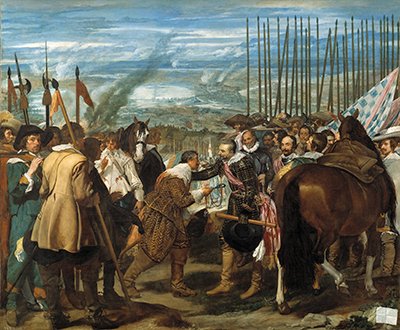
Two features of The Surrender of Breda, Prado P001172, become easier to understand at the scale of that ensemble. The long rhythm of upright lances registers across a room, giving a distant viewer a way into the crowded right side. The small key between the commanders only comes into view at a closer distance. The canvas is roughly the height of Philip’s mounted portrait and wider still. It could carry a whole company of men, horses and marching soldiers across a breadth commensurate with the royal images at the ends. In a programme that also included other painters’ battle scenes and Zurbarán’s Labours of Hercules, Velázquez gave the moment of victory to two people meeting on foot. The room supplied the connection to royal command. A viewer who approached the canvas could see that the victor had put his hand to the other man’s shoulder before receiving the key. [13] [14]
The Torre de la Parada gave the king’s portrait a different set of companions. The lodge stood in the hunting grounds of El Pardo. The Prado catalogue records Philip’s portrait there in the 1705 and 1747 inventories and identifies two related hunting portraits, of Philip’s brother, the Cardinal-Infante Fernando, and his son, Baltasar Carlos. The figures share the equipment of the hunt. In Fernando’s portrait, P001186, the barrel of the gun rises and the dog looks across towards its master. In the king’s, the gun descends and the dog’s lower position and darker head direct attention back to the gloved hand gripping its stock. Baltasar Carlos in Hunting Dress, P001189, gives the young prince a part in the same pursuit. At the Buen Retiro the prince had appeared above a doorway holding a baton. At the lodge two dogs and the handling of a gun helped make him recognisable as a child practising an activity of the adults around him. No comparably secure room-by-room reconstruction places the three hunters at exact heights or intervals. [13]
The lodge held mythologies as well as likenesses. The Prado’s Tereus’ Banquet, painted in 1636–38 and documented in the Torre in the testamentary inventory of Charles II, comes from the wider project involving Rubens. The relationship between the mythological subjects and the hunting portraits can be considered at the level of the property. The Prado places the Rubens and workshop canvas, P001660, in a ground-floor room in 1701. That entry fixes the position of one painting at one date. Across the two commissions, the paintings make it possible to compare what Velázquez could do with the same authorised likeness. At the Buen Retiro the horse rises beneath a king surrounded by family portraits and accounts of victories. At El Pardo the king stands in a group of related hunters. His stillness and economy of gesture survive the shift from armour to a coat and from a commander’s baton to a gun held at rest. [13] [15]
The space a royal hunt required is visible in another painting connected with the lodge. In the National Gallery’s Philip IV hunting Wild Boar (La Tela Real), NG197, a temporary canvas fence encircles the clearing. The king is one mounted figure among many. Carriages gather at the edge and spectators outside the enclosure have room to talk or look on. The gallery’s provenance identifies the painting as probably made for the Torre de la Parada and records it there in the early eighteenth century. The three standing portraits concentrate on the equipment, stance and likeness of individual hunters. The wider view shows the space needed to stage a hunt with a royal party and an audience. [16]
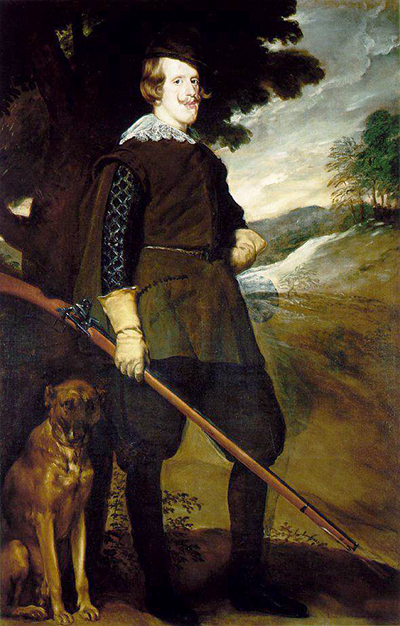
Philip IV as a Hunter. Hunting clothes, gun and dog show how one portrait made sense within the programme of a royal hunting lodge. View Philip IV as a Hunter.
The practical work behind a royal image
In 1644, the king’s campaign took Velázquez out of the palaces around Madrid. The household accounts at Fraga name Pedro Colomo in connection with an easel and include expenditure for fresh rushes in the room. A wooden case was made to send the picture to the queen. In the resulting portrait of Philip IV at Fraga, Frick 1911.1.123, silver trim picks out the edges and seams of the king’s red campaign dress. He holds a baton, as on the large equestrian canvas. At Fraga that small object could communicate command to people attending a service far from the campaign. José Pellicer y Tovar reported that the portrait was shown under a canopy at San Martín in Madrid during the thanksgiving for the recovery of Lleida. The accounts trace the objects and people needed to get a likeness to the capital. The contemporary notice records what happened when it got there. [17] [18]
Velázquez’s work on royal interiors also brought him alongside the officials responsible for fabric, fittings and storage. A report of 22 October 1653 records him drawing attention to an opening in the Alcázar near the rooms used to keep jewels and other valuables. The report records an inspection and the king’s direction to execute the necessary work. Other documents transcribed by María Jesús Muñoz González concern the king’s permission in 1654 for Velázquez to choose objects from the royal store for the sacristy of the Pantheon at El Escorial. The earlier supervisory role and the later power to select furnishings met where a building and its contents had to be dealt with together. One record concerns the integrity of a wall. The other shows the painter exercising judgement over which things would be moved to furnish a different royal site. The documentation lists an ebony tabernacle lined with black velvet and containing an ivory crucifix, and a Flemish Adoration of the Magi with closing panels. The controller and the recording officer were to attend the handover. The papers give the choice a material and an administrative form. Named objects left a royal store for a particular destination. [7]
Velázquez and his artistic context on film
Explore Baroque painting, Spanish portraiture and horses in art with TheHistoryOfArt.
The oath and accounts of the palace lodging officer
The Archivo General del Palacio preserves the record that fixes two dates for Velázquez’s new office. Philip granted him the post of aposentador de palacio in a consultation of the Bureo, the household’s administrative council, on 16 February 1652. Velázquez swore the oath on 8 March before the Count of Montalbán, in the presence of the secretary Sebastián Gutiérrez. He succeeded Pedro de Torres. As the senior officer responsible for preparing palace accommodation, he had people, rooms and equipment in his charge, with duties extending to the places the king visited. The grant changed what the crown could require of him. The oath names the people before whom he took on those responsibilities. [19] [20]
The controller’s October 1655 report belongs to the same palace personnel file. The five thousand reales a month were advances for expenditure through the office. Mats and fuel feature in the report precisely because they were ordinary annual purchases. The controller said that despite repeated requests he had received no regular reckoning and could not tell whether the accounts showed a balance in Velázquez’s favour or against him. The question mattered when another sum was sought for extraordinary expenses. A room that appears ready for use in a picture conceals that work. Somebody had to anticipate what the rooms would need, pay to procure it and certify where the money had gone. [2] [20]
The handover of the office makes the custody of objects equally tangible. In November 1660, after Velázquez’s death, a report on the transfer to his successor Francisco de Rojas described chairs broken or damaged by mice and old boards from packing cases in the effects of the furriera, the household service responsible for preparing and equipping rooms. Rojas wanted unusable chairs excluded from his charge and asked for the scrap wood to be distributed among poorly paid workers in the department. A December 1665 record concerns the 17,957 reales found owing on Velázquez’s accounts and Juan Bautista Martínez del Mazo’s offer to settle the sum so that the family property might be released. The chairs and boards were goods of an office that continued from one holder to the next. The household inventory drawn up after Velázquez’s death was a different document, begun on 11 August 1660 at the request of his executors. Its opening lines identify Mazo and Gaspar de Fuensalida and name Velázquez as chamber attendant, lodging officer and knight of Santiago. The household and the crown had different property to account for. [7] [21]
Further reading
For a closer look at the evidence and paintings:
Collected Writings on Velázquez. Jonathan Brown. Centro de Estudios Europa Hispánica, 2008. English edition
Brown traces the changing relationship between Velázquez and Philip IV across essays on court service, patronage and painting. See the book at CEEH.
Installing pictures at El Escorial
In the 1650s Velázquez helped arrange the display of paintings at El Escorial. His earlier Italian journeys had given him experience ordering and moving works for the crown. At the monastery he had to make pictures of different origins and dimensions fit the available walls. The arrangement Bonaventura Bassegoda reconstructs for the sacristy begins in 1656. Raphael’s Holy Family, known as The Pearl and now Prado P000301, occupied the altar. Tintoretto’s The Washing of the Feet, now P002824, ran for more than five metres along the wall over the cupboards. Six vertical pictures of similar dimensions flanked it, three on either side. A further tier took smaller vertical paintings. The strong horizontal of the Tintoretto sat within an arrangement whose intervals, level changes and use of symmetry could be read from several positions in the room. [22] [8]
The reconstruction draws on the descriptions of the Hieronymite friar Francisco de los Santos. Palomino later celebrated the paintings Velázquez had conveyed to the monastery and the description he is reported to have made for the king. Dimensions and recorded positions can show how a canvas fitted a given space. The surviving evidence is less even about who decided each move, especially in parts of the monastery whose arrangements changed after Velázquez’s death. Here the 1654 permission to select objects for the Pantheon’s sacristy and the 1656 installation in the principal sacristy belong to distinct rooms. They bring out the differences among selecting, transporting and arranging the goods of the crown. [7] [8] [23]
The royal family inside and outside the Alcázar
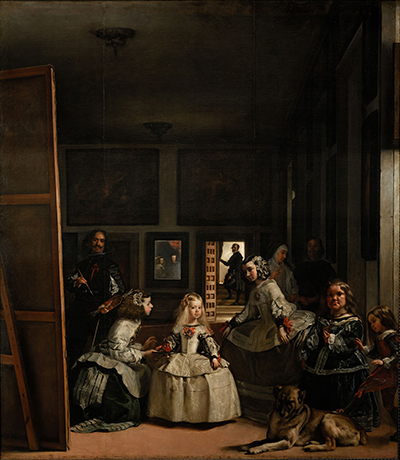
Las Meninas, Prado P001174, gives a painter’s view of a royal interior in the same decade. On the far wall, a mirror lets Philip and Mariana appear where their reflected figures are smaller than some of the frames around them. In the doorway José Nieto, identified by Palomino as the queen’s aposentador, stands at the change of level between the room and the ground beyond. His place in the composition gives the viewer a way to judge distance from the brightly lit foreground. Velázquez leaves the identity of the image on the large canvas at the left to the viewer’s imagination. The named individuals and the presence of a lodging officer at a door bring the working household into view even though the scene is a composition and the positions of the figures are particular to the painting. [13] [24]
Paintings also travelled out from the Alcázar. In 1659 Velázquez painted Margarita in blue and her younger brother Felipe Próspero. The Kunsthistorisches Museum records that the two portraits went to Emperor Leopold I that year. He later married Margarita. Here she stands beside a table, with broken strokes of light running across her blue and silver dress. The dress and face fill much of a picture intended to be seen on its own. A portrait sent abroad had to bring the appearance of a royal child to viewers at another court. Copies could carry details of the setting with them. Gudrun Swoboda notes that a version probably by Mazo of an earlier portrait of Margarita in pink preserves the edge of the low carpeted platform beneath the child. A few strokes show a piece of furniture familiar from the Spanish court. [25] [26]
Preparing a room on the frontier
In 1660 Philip IV travelled to the frontier for the ceremonies around the marriage of his daughter María Teresa to Louis XIV. The match sealed the peace agreed the previous year. Palomino describes Velázquez going ahead with José de Villarreal, an assistant in the furriera and master of royal works, and other employees of the household. The painter’s responsibilities included Philip’s accommodation at Fuenterrabía and the preparations for the Conference House on the Isle of Pheasants in the Bidasoa. Palomino adds that once the party set out on the return, Villarreal went ahead to prepare lodgings while Velázquez stayed with the king. The delegation of work gives substance to the office named in the 1652 oath. Both travel and ceremony required people at one site to be ready for the arrival of people from another. [19] [27]
A print by Adam Perelle after Beaulieu, preserved in the Louvre as 3565 C/1 Recto, identifies the island and dates the royal meeting to 6 June. The Bibliothèque nationale de France catalogues a plan from Beaulieu’s collection of views showing the buildings, bridges of boats and covered galleries by which the kings reached the island. Each court had a way from its own bank to a common room. The approaches formed part of the construction that made a meeting on the river possible. Palomino’s account supplies specific assignments on the Spanish side and dates the formal handover of the infanta to 7 June. Velázquez’s own dated testimony comes from after his return. In a letter to the painter Diego Valentín Díaz he reported reaching Madrid at dawn on 26 June, tired from journeys by night and work by day. He signed it on 3 July. [28] [29] [27] [30]
The letter mentions the queen going to meet Philip at the Casa de Campo and the royal party proceeding to Our Lady of Atocha. The account of the journey ends at places familiar from the court’s daily life. For Velázquez it had meant making arrangements for a moving household and for an encounter that could take place only once. In the Buen Retiro his paintings had helped visitors read the relationships between Philip, his predecessors and his heirs across one room. On the frontier his office helped two royal households bring their living participants into a room together. [13] [27] [30]
An ambassador asks for two portraits
On 24 March 1627 Alessandro Striggi, the Mantuan ambassador in Madrid, wrote to Duke Vincenzo II Gonzaga about a pair of equestrian portraits. One showed Philip IV and the other the Count-Duke of Olivares. Striggi said he had commissioned them from a painter he praised without naming, and that they were to accompany the letter as his gift to the duke. He had already shown them to Olivares. He presented the pictures as an attempt to fulfil his master's wish for lifelike portraits and asked whether he might borrow better examples from Olivares's wardrobe to have them copied. The request put Olivares in the position of deciding how his own likeness and the king's should reach Mantua. [31]
According to Striggi, Olivares looked hard at the two pictures, liked them and said Velázquez could do better. Striggi asked Olivares to approach him personally. The minister immediately gave the order, the ambassador says, and told Velázquez to put other work aside to make two small portraits. At the time the painter was working on the queen's likeness in his quarters. Striggi writes about sending the smaller pictures once finished. The letter records the reported order and the intended dispatch, and leaves completion and receipt open. It gives neither measurements nor enough compositional detail to attach the commission to a surviving picture. [31]
Striggi took credit for turning the conversation to a marriage dispute in which his earlier approaches had failed. He wanted a fresh instruction sent to the Count of Oñate, and says Olivares gave orders for a letter to be written in the king's name. The sequence comes from an ambassador reporting his own performance to his employer. What he chose to report makes the negotiation legible. He commissioned pictures, used their presentation to secure a conversation and sought the intervention of a minister who could interrupt the royal painter's work. The letter also distinguishes the two pictures he said would go with it from the work he had just obtained a promise of. [31]
A surviving print shows a different set of people making Olivares's likeness available. The Prado's Allegorical Portrait of the Count-Duke of Olivares, dated 1626, credits Paulus Pontius on the plate as engraver. Its inscription also credits Velázquez for the model and Rubens for ornamenting and dedicating the image. The likeness forms just one part of the large sheet, which gives substantial space to the arms, ornamental surround and verse. The inscription makes a chain of contributions visible on the object itself. Striggi's letter names the man he wanted to make the second pair, while the print shows how the credit for a likeness could travel with it when other hands prepared the finished work. [31] [32]
Who could put an image before the court?
In Madrid itself the custody of royal likenesses could pass briefly to officers of the law. An October 1633 record names the bailiffs Gabriel de Quirós and Torres de Ordóñez as the men who brought thirty-seven pictures into the court's chamber. The agent Juan de Vega had taken another forty-seven from Madrid painters. The judges asked Vicente Carducho and Velázquez to examine them and declare which could be sold and what changes the others required. Antonio de Toledo recorded the decision and notified six owners, including Antonio Ponce and Francisco Barrera, of restrictions on making, keeping and selling small portraits of Philip and his queen. The six names identify people who held stock. The record gives no secure attribution of individual pictures to those owners. [33]
By the 1650s correspondents in Italy could also invoke Velázquez as someone who knew what might be worth bringing to Madrid. On 10 March 1657 the Duke of Terranova wrote from Rome about a possible purchase of statues and porphyry vessels. He described the opening created when a daughter inherited the collection and married the Marquis Tasis, and represented the couple as more in need of cash than of antiquities. His letter treats the cost of putting the group in Madrid as a separate consideration. For the quality of the objects he offered a check nearer home. He said Velázquez had seen them and could give an opinion once told that they came from the Vitelleschi gallery. This was a proposal and a referral. The letter leaves the painter's assessment and any completed sale unrecorded. [34]
Two years later, it was the painter himself to whom an introduction was addressed. On 1 May 1659 Camillo Massimi wrote to Velázquez from Rocaseca concerning Abbot Odi. Odi was carrying paintings for Philip IV and was to thank the king on behalf of Cardinal Camillo Astalli for favours already received. Massimi commended the abbot to Velázquez and asked for his good offices. He praised the pictures in general terms. The subjects, artists and intended rooms are all unspecified, and the letter of introduction leaves their arrival unconfirmed. The roles are clearer than the contents of the consignment. Astalli sent the abbot, Odi carried the pictures and Massimi addressed the person whose help he sought in Madrid. [35]
Massimi had himself sat to Velázquez in Rome in 1649–50. In the Kingston Lacy portrait he wears the blue of a papal private chamberlain, rendered in ultramarine. The National Trust traces that canvas to Massimi's own collection and then to the Spanish ambassador in Rome, Gaspar de Haro. Examination of the original canvas beneath its lining revealed Haro's mark and coronet, material evidence of Haro's ownership. In 1627 Striggi had turned to Olivares to reach the painter. By 1659 a former sitter wrote directly to Velázquez when he wanted someone carrying paintings to receive a hearing at Philip's court. [31] [35] [36]
Artworks directory
Frequently Asked Questions
The October 1623 order names the paymaster for the works at the Alcázar, the Casa de Campo and El Pardo. Its terms put Velázquez in regular service, subject to the king’s directions. A letter of 28 October from Pedro de Hoff Huerta sent on the draft instrument specifying a second form of remuneration, payment for the pictures Velázquez made. [1]
The standing king in Philip IV in Hunting Dress and the armoured rider in Philip IV on Horseback are the same man in landscapes of broadly similar character, painted within a few years of one another. Both are large oil paintings for royal properties. In Philip IV on Horseback , Prado P001178, a nearly square canvas about three metres across gives the horse room to rear and leaves a low band of hills beyond. [13]
The Archivo General del Palacio preserves the record that fixes two dates for Velázquez’s new office. Philip granted him the post of aposentador de palacio in a consultation of the Bureo , the household’s administrative council, on 16 February 1652. Velázquez swore the oath on 8 March before the Count of Montalbán, in the presence of the secretary Sebastián Gutiérrez. [19] [20]
Discussion
Look again at the images and ideas explored in Velázquez at the Spanish Court. These editorial prompts invite your observations.
Reader Insights
How would a picture made for a palace hall be seen differently from a portrait in a smaller room?
Which details of the painter’s work become visible in the household accounts?
Join the Conversation
Share a detail, comparison or question about Velázquez at the Spanish Court below.
References
- Archivo del Palacio Real de Madrid, appointment and remuneration papers, 6, 28 and 30 October 1623, first document Felipe IV, Casa, leg. 139, Varia Velazqueña, vol. II, pp. 222–223. Spanish transcriptions hosted by the Instituto Andaluz del Patrimonio Histórico. View source.
- Archivo General del Palacio Real, controller’s report on the palace lodging officer’s accounts, 17 October 1655, Expedientes personales, caja 1084, exp. 9, Velázquez Digital, doc. 468. Spanish transcription. View source.
- The Metropolitan Museum of Art, Philip IV (1605–1665), King of Spain, probably 1624, 14.40.639, object record. View source.
- Francisco Pacheco, Arte de la pintura, Seville, 1649, pp. 101–109, first part of the text on Velázquez. Spanish transcription by Santiago Arroyo Esteban. View source.
- Archivo General del Palacio Real, order for payment on account for Bacchus and other paintings, 22 July 1629, Reinados, Felipe IV, Casa, leg. 129, Velázquez Digital, doc. 84. Spanish transcription. View source.
- Instituto Andaluz del Patrimonio Histórico, Biografía de Velázquez, chronology and Madrid career. Spanish. View source.
- María Jesús Muñoz González, “Nuevos datos sobre los oficios y puestos de Velázquez en la Casa Real,” Archivo Español de Arte 72, no. 288, 1999, pp. 546–551, especially documents I–V, Archivo Histórico Nacional, Sección Nobleza, Fondo Frías. Spanish. View source.
- Bonaventura Bassegoda, “Velázquez y la decoración pictórica de El Escorial en 1656,” 1999, especially fig. 1 and the section on the sacristy. Spanish. View source.
- Antonio Palomino, life of Velázquez in El Parnaso español pintoresco laureado, 1724, section XIII on royal offices and rewards. Spanish transcription by Sara Ballester Baghdadi. View source.
- Archivo General del Palacio Real, notification of transfer of Velázquez’s chamber usher post to Juan Bautista Martínez del Mazo, 30 January 1634, Velázquez Digital, doc. 114. Spanish transcription. View source.
- Alfonso E. Pérez Sánchez, “Velázquez, pintor del rey,” pp. 294–295, on the Madrid workshop and the apprenticeship of Andrés de Brizuela. Spanish. View source.
- The Metropolitan Museum of Art, Juan de Pareja, Afro-Hispanic Painter, 2023 exhibition overview, with links to the works and the legal document. View source.
- Julián Gállego, entries 35–40, 43–45 and 73 in Velázquez, Museo del Prado and Ministerio de Cultura, Madrid, 1990. Breda P001172, the five royal equestrian portraits P001176–P001180, the three hunting portraits P001184, P001186 and P001189, and Las Meninas P001174. Spanish. View source.
- David Chipperfield Architects and b720 Fermín Vázquez Arquitectos, Museo Nacional del Prado, 1204SDR, competition proposal, panel 3, “Salón de Reinos”, after José Álvarez Lopera. Spanish. View source.
- Museo Nacional del Prado, Tereus’ Banquet, Peter Paul Rubens and workshop, 1636–38, P001660, collection record and Torre de la Parada inventory provenance. View source.
- National Gallery, London, Philip IV hunting Wild Boar (La Tela Real), probably 1632–37, NG197, object record and provenance. View source.
- Ángel Aterido Fernández, Corpus velazqueño, vol. I, pp. 162–163, documents 177 and 178, household expenses and José Pellicer y Tovar’s notice. Spanish transcriptions. View source.
- The Frick Collection, “History and Function,” The King at War: Velázquez’s Portrait of Philip IV, 2010–11 exhibition dossier, accession 1911.1.123. View source.
- Archivo General del Palacio, oath as palace lodging officer, 8 March 1652, Expedientes personales, caja 1084, exp. 9, Velázquez Digital, doc. 385. Spanish transcription. View source.
- Julia Vázquez, Velázquez, Painter & Curator, Brill, 2024, chapter 5, especially pp. 171–175 on the lodging office and its successive holders. View source.
- Archivo Histórico de Protocolos, Madrid, inventory of the estate of Velázquez and Juana Pacheco, begun 11 August 1660, prot. 8137, fols. 693–709, Velázquez Digital, doc. 540. Spanish transcription. View source.
- Archivio di Stato di Roma, “Il soggiorno di Velázquez a Roma,” with contracts of 13 December 1649, 7 January 1650 and 26 April 1650, 30 Notai Capitolini, Ufficio 32, vols. 143–145. Italian. View source.
- Antonio Palomino, life of Velázquez in El Parnaso español pintoresco laureado, 1724, section VIII on El Escorial and the Hall of Mirrors. Spanish transcription by Sara Ballester Baghdadi. View source.
- Antonio Palomino, life of Velázquez in El Parnaso español pintoresco laureado, 1724, section VII describing Las Meninas. Spanish transcription by Sara Ballester Baghdadi. View source.
- Kunsthistorisches Museum, Infanta Margarita in a Blue Dress, 1659, and Philip Prosper, 1659, inv. 319, in “Only in Vienna,” with the account of their dispatch. View source.
- Gudrun Swoboda, Mengs and Velázquez, Kunsthistorisches Museum, Point of View 29, p. 7 and figs. 5–6, on the possible Mazo copy and the carpeted platform. View source.
- Antonio Palomino, life of Velázquez in El Parnaso español pintoresco laureado, 1724, section XII, on the journey to Irún. Spanish transcription by Sara Ballester Baghdadi. View source.
- Musée du Louvre, Adam Perelle after Beaulieu, Vue de l’Ile des Faisans, dite de la Conférence, etching and engraving, 3565 C/1 Recto, collection record. French. View source.
- Bibliothèque nationale de France, Sébastien de Pontault de Beaulieu, Les glorieuses conquestes de Louis le Grand, collection record, including the description of the Plan de l’Isle des Faisans. French. View source.
- Archivo Diocesano de Valladolid, Diego Velázquez to Diego Valentín Díaz, 3 July 1660, archive of the Colegio de Niñas Huérfanas, Velázquez Digital, doc. 527. Spanish transcription. View source.
- Archivio di Stato di Mantova, Alessandro Striggi to Duke Vincenzo II Gonzaga, Madrid, 24 March 1627, Velázquez Digital, doc. 64, VV 31, CV 50. Italian transcription of the letter excerpt addressed to the duke. View source.
- Museo Nacional del Prado, Allegorical Portrait of the Count-Duke of Olivares, 1626, G002289, collection record and plate inscriptions. View source.
- Archivo Histórico Nacional, order, examination and notice of 1 and 3 October 1633, Consejos, libros de gobierno de la Sala de Alcaldes de Casa y Corte, 1633, fol. 467, Velázquez Digital, doc. 111, VV 53, CV 91. Spanish transcription. View source.
- Archivo de la Casa de Alba, Duke of Terranova on the possible acquisition of statues and porphyry vessels, Rome, 10 March 1657, caja 182–184 as cited by CEEH, Velázquez Digital, doc. 488, VV 171, CV 395. Spanish transcription. View source.
- Archivio Massimo, Camillo Massimi to Diego Velázquez, Rocaseca, 1 May 1659, prot. 276, fol. 15r, Velázquez Digital, doc. 510, CV 409. Spanish transcription. View source.
- National Trust, Diego Velázquez, Cardinal Camillo Massimi, 1649–50, Kingston Lacy, NT 1257142, object record, reverse inscription and provenance. View source.