by Tom Gurney
Tom Gurney BSc (Hons) is an art history expert with over 20 years experience
Email: tomgurney1@gmail.com / Phone: +44 7429 011000
Velázquez’s Italian Journeys: Introduction
In the garden of the Villa Medici in Rome, rough boards fill the arch of a grotto. Above them a strip of white cloth catches the light on a balustrade. Diego Velázquez spent part of his first Italian journey at the villa, where he could study ancient statues. He also had business with sculptures in Italy some twenty years later, when Philip IV sent him to acquire art for Madrid. The boards in this little painting have led scholars to investigate repairs to the grotto and to ask whether the picture belongs to that later trip. The evidence for the two journeys includes everything from a painter’s account of his son-in-law’s travels to a royal adviser’s letter about crates landing in Spain. Each kind of record tells us something different about what Velázquez was doing. [1] [2] [3] [4]
The biography covers the 1648–51 journey in the context of Velázquez’s career.
At a Glance
- First journey1629–31 [1] [3]
- Second journeyLate 1640s to 1651 [3] [4] [5]
- EvidencePacheco’s account covers the first trip. Diplomatic correspondence and orders document the later mission. [1] [4]
The two Italian journeys
Contents
- From Barcelona to Rome, 1629–30
- Drawing in the Vatican and at the Villa Medici
- Apollo’s disclosure and Jacob’s grief
- The second journey begins in Spain, 1648–49
- Three contracts for Madrid
- Faces in Rome and Juan de Pareja’s manumission
- The two garden views and the dates they might bear
- Back in Madrid, June 1651
- Juan de Córdoba commissions the Laocoön
- From the banks of the Tiber to Madrid
- The cast in the Alcázar and the later Academy plaster
From Barcelona to Rome, 1629–30
Velázquez had worked for Philip IV for nearly six years when he first left for Italy. The Instituto Andaluz del Patrimonio Histórico dates his appointment as king’s painter to October 1623 and records that he met Peter Paul Rubens in 1628, the year before the voyage. He was already painting at a court rich in Venetian art. The journey made it possible to see how paintings were placed in Italian churches and palaces, study frescoes in situ and draw from works in collections he needed special permission to enter. Francisco Pacheco, his former teacher and father-in-law, says Philip gave him leave and money for the trip and had two years of his salary paid. The Count-Duke of Olivares supplied additional money and letters of introduction. [1] [2] [5]
In a letter of 26 July 1629, Flavio Atti, the Parmesan ambassador in Madrid, reported that Velázquez said he was travelling to improve his painting. Atti had seen Olivares’s note requesting letters of recommendation for the artist. The letter records the stated purpose and the preparations while Velázquez was still in Spain. [6]
Pacheco dates the embarkation at Barcelona to the feast of Saint Lawrence, 10 August 1629. Velázquez travelled with the party of Ambrogio Spinola, the military commander bound for Milan. The Prado’s 1990 catalogue traces the journey through Genoa and Milan to Venice. In Venice the Spanish ambassador provided lodging and, says Pacheco, sent members of his household to accompany the painter in the city because of the war. The Prado places this precaution in the context of the conflict over the Mantuan succession. The family account gives a sense of the practical arrangements behind an encounter with Italian art. A court painter abroad needed a place to stay, the protection of an embassy and introductions that would carry him to his next stop. [1] [2]
Pacheco’s account takes Velázquez from Venice to Ferrara, where he presented letters to Cardinal Giulio Sacchetti. The cardinal had been papal nuncio in Spain. He arranged lodging and sent a member of his household to guide the visitor as far as Cento. Pacheco also names Bologna and Loreto on the way to Rome. In Bologna, he says, Velázquez passed through without delivering two letters of introduction. These accounts establish a route through northern and central Italy and a Roman stay spanning the period around 1630. Pacheco gives the length of the stay in Rome as about a year and describes time at the Villa Medici over a summer. The Prado chronology places the onward journey to Naples late in 1630 and the return to Madrid in January 1631. Pacheco likewise puts the return at the beginning of 1631. [1] [2] [7]
Venice provides a surviving example of what it meant to study a picture by copying it. The Real Academia de Bellas Artes de San Fernando catalogues a small Last Supper as Velázquez’s copy after Jacopo Tintoretto, dated 1629. A scene made for another setting could be taken down to the scale of a canvas measuring just 63 by 56.5 centimetres. For a painter used to attending closely to the utensils and people in a room, the exercise also involved working out how another artist gave a many-figured scene its unity. During the second journey Velázquez would go back to Venice to buy paintings by Tintoretto. [2] [3] [8]
Drawing in the Vatican and at the Villa Medici
In Rome, Pacheco says, Cardinal Barberini arranged accommodation for Velázquez in the Vatican. The rooms included one with biblical frescoes by Federico Zuccaro. Velázquez found the quarters out of the way and gave them up. He retained permission to enter so that he could draw from Michelangelo’s Last Judgement and works by Raphael. This access let him go back to the same fresco and study how figures worked across an entire wall. The account describes an activity best understood from the scale of the task. Drawing the turn of a single body is one exercise. Following the arrangement of many bodies across an architectural surface is another. [1]
The Villa Medici offered a different kind of study. In Pacheco’s account, Velázquez valued the site above the city for its air in summer and the presence of ancient sculptures he could copy. The Spanish ambassador, the Count of Monterrey, negotiated for accommodation through Florentine representatives and permission from the Grand Duke of Tuscany. Pacheco says Velázquez stayed more than two months before recurring fever made him move. His account establishes why the painter chose the villa and how he gained access. It also provides one of the strongest reasons to consider a date around 1630 for the two surviving garden views. [1] [2]
Pacheco also says Velázquez painted a self-portrait in Rome that Pacheco himself owned. The surviving pictures proposed as self-portraits have their own histories and degrees of certainty. Pacheco says Velázquez painted Philip IV’s sister María of Austria at Naples on his way back from Rome, to take the portrait to the king. Juan J. Luna identifies the surviving Prado bust, P001187, with that sitting and favours 1630 for the abbreviated brushwork in the hair and the soft rendering of the ruff. A document concerning a royal portrait commission in 1628 included the Infanta and leaves open the possibility that this canvas was painted earlier. The sitting is documented by Pacheco. The surviving painting’s connection to it remains open. [1] [2] [26]
Apollo’s disclosure and Jacob’s grief
The Prado dates Apollo in the Forge of Vulcan to 1630. A visitor in an orange mantle has interrupted a metalworking shop. He is Apollo, and the displaced attention of the men around the anvil is the first evidence that he has brought unwelcome news. As the story goes in Ovid, the sun has seen Venus with Mars and tells Venus’s husband Vulcan. The picture lets us follow the disclosure through its effects on a group. The faces turn by different degrees. One mouth hangs open. A workman holds his hammer suspended above the anvil. The hot metal on the anvil holds a bright point low in the picture while the eyes of the men lead back towards the speaker. [2] [9] [10]
The forge still gives close attention to tools and the way they are held, familiar interests from Velázquez’s earlier interior scenes. Here the bodies also describe how deep the room is. A shoulder passes in front of another man’s torso, a back turns away from us and a figure farther in is framed between the men nearer the anvil. In their study of Velázquez’s changing technique, Larry Keith and Dawson Carr discuss the light grey preparation of the canvas and the range of colours the painter used around this period. The equipment, bodies and rear wall remain visible in the same sustained light. A viewer can trace the shock across the whole room and register how different it looks in each figure. [2] [9] [10]
In Joseph’s Bloody Coat Brought to Jacob, now at El Escorial, the thing that interrupts the room is a garment. Joseph’s brothers have sold him and present Jacob with clothing stained with blood to make him believe his son was killed. The cloth supplies an apparent proof that the viewer can understand as a deception. Hands take us from the men in the foreground to Jacob on his raised seat. The chequered floor helps place the brothers at intervals across the room. Between them it carries the eye back towards the distant opening. The little dog’s agitated response offers another direction for our attention while Jacob is absorbed by the garment. [2] [11]
Both pictures make the reception of news visible, and the means of delivering it change what the viewer has to examine. A speaker can draw the entire forge’s attention from the edge of the canvas. In Jacob’s room the witnesses arrange a piece of evidence in full view, and we can see the display working on the person meant to believe it. Part of the comparison lies in the different handling of paint. Patrimonio Nacional’s account of its 2015 restoration of Joseph describes lightly laid passages with barely defined contours alongside heavier accents where the painter wanted emphasis. The cloak, bodies and floor can be read across a broad room without all their edges asserting themselves equally. [9] [10] [11] [12]
Palomino assigned both works to Rome. The Prado catalogue uses the pair to discuss Velázquez’s study of the nude and of the expression of emotion. Patrimonio Nacional’s restoration account also places Joseph around 1630, while Gonzalo Redín’s exhibition essay considers whether the painter made the two canvases in Madrid after his return. The two subjects reached the royal collection together in 1634 via Jerónimo de Villanueva, the protonotary of Aragón, and were recorded at the Buen Retiro. Redín points to the different directions of their light as a reason to consider whether they were designed to hang together, and allows that they may have been paired after they were made. The securely dated purchase establishes when the two works came together for Philip IV. The location of the easel and the original hanging plan are separate questions. [2] [11] [12]
The second journey begins in Spain, 1648–49
In 1647 Velázquez had been made inspector and administrator of building work on the Alcázar’s Octagonal Room. The commission that took him back to Italy grew out of work on the palace. Philip IV wanted paintings, antique sculptures and reproductions of celebrated works, as well as painters who could decorate ceilings in fresco. The royal entourage heading to Italy to meet Philip’s future wife Mariana of Austria provided a way to travel there. The party’s destination was Trento, where the Duke of Maqueda and Nájera was to receive the archduchess. Velázquez had his own programme of work once in Italy. [2] [3] [4] [13]
The Prado dates the departure from Madrid to October 1648 and the embarkation from Málaga, after travel via Granada, to January 1649. The University of Teramo also places the start of the journey in October. Palomino gives November for the departure from Madrid, while the Andalusian institute puts the Italian journey under 1649. The chronology thus joins a late-1648 departure from court to a sea crossing in the new year. Genoa was the Italian landfall. From there Velázquez passed through Milan and reached Venice, where the Spanish ambassador helped put him in touch with sellers. Francesca Curti’s reconstruction dates the Genoa landfall to 11 March and the arrival in Rome to 29 May 1649. The University of Teramo places the Roman arrival in summer. The Roman notarial record independently places his procurement activity in the city by December. [2] [3] [5] [13] [14] [15]
Venice, which Velázquez had visited to see paintings on his first journey, was now a place to buy them. Works by Veronese and Tintoretto feature in the accounts of what he acquired in 1649. Palomino describes a group of paintings for a ceiling by Tintoretto, with an oval picture of the Israelites gathering manna, and a Venus and Adonis by Veronese. He also mentions two paintings of the life of Christ that Velázquez is said to have passed up because he judged that their tempera surfaces would be vulnerable at sea. The story records one of the practical judgements a buyer working far from Madrid had to make. The distance to the palace included the passage from the wall or ceiling for which a work was made to the ship that could carry it. [2] [3] [13]
Accounts also place him in Bologna, Modena, Parma and Florence before his Roman work, with differences in the sequence. In Naples the viceroy, the Count of Oñate, was instructed to support the king’s business. Palomino describes a visit to the Spanish painter Jusepe de Ribera there. Documentation of the court’s interest in fresco painters survives in the correspondence Enriqueta Harris studied. In February 1650 the king asked for an artist of the standing of Pietro da Cortona. By June the court knew that Cortona was unavailable. Velázquez pursued the Bolognese specialists Angelo Michele Colonna and Agostino Mitelli, who eventually came to Spain in 1658. Their arrival belongs to a later stage in the palace project, years after Velázquez himself returned. [2] [4] [13]
Three contracts for Madrid
A Roman contract of 13 December 1649 concerns bronze copies of three antiquities known as the Germanicus, the Vitelleschi Discobolus and the Caetani Satyr. The copies went to the Octagonal Room. Velázquez worked through Juan de Córdoba Herrera, his agent in Rome. The 2022 exhibition at the Real Academia de Bellas Artes de San Fernando included a portrait from the Capitoline collections identified by Curti as Córdoba. The documentary identification puts a face alongside a name in the procurement records. The Metropolitan Museum labels the painting as attributed to Velázquez in its 2023 exhibition checklist. [14] [15] [16]
The contract makes it possible to follow distinct sculptures from named Italian examples into a particular Madrid interior. Velázquez’s earlier experience of studying ancient figures in Roman collections had a different practical application here. He had to arrange for works to be replicated and to coordinate the people whose labour would make those replicas available in Spain. [14] [17]
A contract of 7 January 1650 with Matteo Bonuccelli concerns twelve bronze lions. Their purpose was specific. A pair would support each of six porphyry tabletops in the Alcázar’s Hall of Mirrors. Patrimonio Nacional identifies the lions at the Villa Medici as the sculptural models. In Juan Carreño de Miranda’s later portrait of Carlos II, the Royal Collections Gallery points out how a lion served within the setting of a royal portrait. Several were later reused as supports for tables of hardstone at the Prado. Their history is visible at three different scales, from the Roman sculptural model to the fit of bronze and stone in palace furniture and the furnishing’s place in a painted room. [14] [17] [18]
On 26 April 1650 Velázquez contracted with Orazio Albrizio to make plaster casts from three sculptures in the Vatican’s Belvedere, identified in the contract as the Nile, Apollo and Antinous. The agreement specified the purity of the plaster, set a four-month term and fixed payment at 400 scudi. A cast in plaster allowed a collection to reproduce a figure whose original remained in place. A bronze lion for a porphyry table had to do a different job, combining a sculptural form with a working support. The two orders show why the word “copies” covers only part of the story. The precise material, permission to work from a model, the skill of the makers and the place where each piece would stand affected what the king received. [14] [17]
Faces in Rome and Juan de Pareja’s manumission
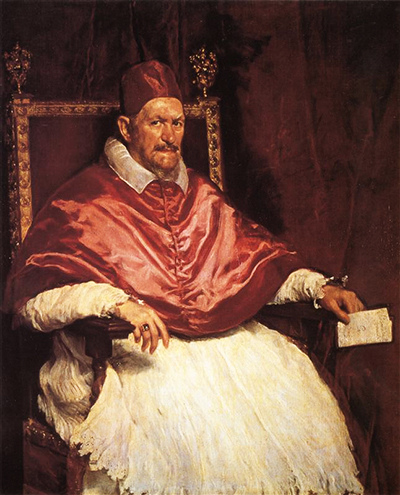
Velázquez made portraits in Rome while the commissions were under way. In the Galleria Doria Pamphilj’s Portrait of Pope Innocent X, the Pope’s palm rests on his chair and his left hand holds a sheet addressed to him. Its pale surface and the hand that controls it show clearly against the clothing. The seated figure fills the canvas, with the cap, cape, upholstery and hanging distinguished by closely judged changes within the reds. The gallery proposes late 1649 to January 1650. Benito Navarrete Prieto discusses a dispatch dated 13 August 1650 that describes a Spanish painter from the royal household preparing the Pope’s portrait. “About 1650” accommodates the difference between the gallery’s proposal and evidence that favours a sitting later that year. [19] [20]
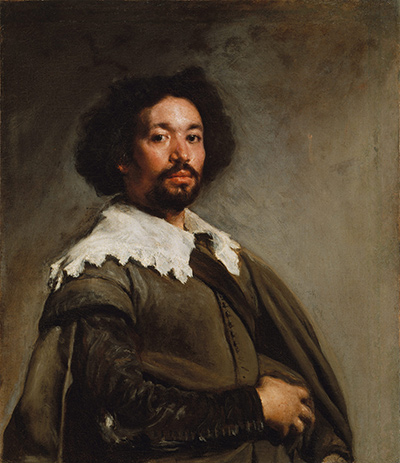
The Metropolitan Museum of Art dates Velázquez’s Portrait of Juan de Pareja to 1650. Pareja, a man of African descent born in southern Spain, was enslaved by Velázquez. He travelled with Velázquez to Italy and sat for him in Rome. His head turns towards us above a white collar. The matt background and quiet colours of the clothes concentrate attention on the face in a way quite different from the array of red surfaces and ceremonial furnishings around Innocent. Palomino later reported that the portrait was exhibited at the Pantheon for the feast of Saint Joseph. Navarrete identifies the occasion as 19 March 1650, after Velázquez’s admission to the Virtuosi al Pantheon in February. The dates place the exhibition within the painter’s participation in a Roman artists’ association. The surviving legal document supplies evidence about the man who sat for it. [13] [20] [21] [16]
On 23 November 1650 a notarial instrument was drawn up in Rome recording the terms of Pareja’s manumission. He was to serve a further four years before becoming free in 1654. The date on the document belongs to the legal act that established the terms, and the four-year provision kept Pareja enslaved beyond the Roman stay. After his emancipation he pursued his own career as a painter in Madrid. In The Calling of Saint Matthew of 1661, he included himself at the left holding a paper that names him as the artist and dates the painting. In the papal portrait the sheet carries Velázquez’s name into the Pope’s hands. Pareja’s own canvas lets the artist appear with the written record of his authorship in his own keeping. [19] [16] [22]
The two garden views and the dates they might bear
The Prado’s two small Villa Medici paintings look out from different places in the same garden. In the view of the boarded grotto façade, P001210, the boards sit across the central arch between dark side openings. Tall cypresses fill much of the area beyond the terrace. The light masonry and the white fabric along the upper balustrade bring the structure towards us even as the trees close in behind it. The men near the grotto are small enough that their presence gives a measure of the structure without telling us much about what they are doing. [2] [23]
The view with the open arch and statue, P001211, uses a related form. The central arch is flanked by two lower, flat-topped openings, an arrangement known as a serliana. The sculpture of Ariadne stretches across the lower part of the opening. Beyond it the trees are flecks and thin verticals, and the eye can follow them into the daylight. Two loosely painted figures in the foreground give the place a human scale. Another figure looks out through a side opening. In one picture a standing viewer faces the barriers that close off the entrance. In the other, the shaded figure and the reclining statue draw our attention to what it means to look through an opening into light. [2] [23]
In the 1990 Prado catalogue Julián Gállego favoured a first-trip date. Pacheco’s testimony establishes Velázquez’s residence at the villa then. Gállego also compared the garden brushwork to the handling in the distance of Joseph’s Bloody Coat. Four small landscapes were bought from Velázquez for Philip IV in 1634. The possible connection of the two surviving views to that payment is especially explicit in the catalogue’s provenance for the open-arch picture. The purchase record describes the group without identifying a villa or an arch, so the association remains a proposal. The Prado’s later Jerez exhibition listed both paintings around 1630. [1] [2] [23]
Enriqueta Harris argued for the second journey in her 1981 study, connecting the boards with evidence of a campaign of repairs at the villa in 1648–49 identified by Glen Andres. As Gállego relates the argument, the records concern work in the grotto, including restoration of walls and the entrance. If the painted boards belong to that work, they would bring the boarded view close to the second Roman stay. The open-arch picture has no equivalent visible repairs. The late date extends to it through the proposal that the two small works belong together. Both appear in the 1666 inventory of the Alcázar. The documentary case for the date of one picture rests in part on whether specific building work can be recognised in it. The case for dating both alike also depends on how the two canvases are understood as a pair. [2] [24]
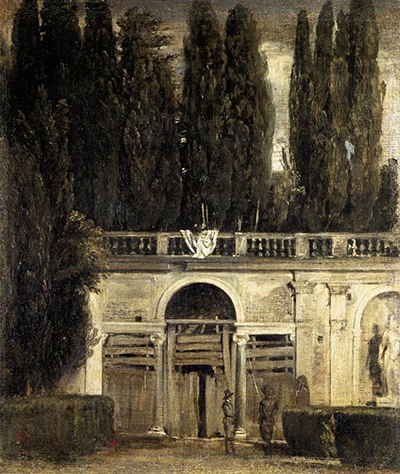
View of the Villa Medici Garden (boarded grotto facade). The boarded opening is one of the details behind the debate about which Italian journey produced the garden pictures. View View of the Grotto Façade at the Villa Medici.
Back in Madrid, June 1651
Royal correspondence began calling Velázquez back by February 1650. Harris found fourteen letters addressed to the Spanish ambassador in Rome, the Duke of the Infantado, dated between 17 February 1650 and 24 July 1651. They record the court’s interest in finishing the commissions and getting the painter home. The earliest known letter in the group favoured a sea passage, which the court expected would avoid delay. Harris notes that Velázquez had left Rome by the time one further instruction, dated 30 December 1650, could reach him. He was still in Italy. Palomino places his final embarkation at Genoa in 1651. The report of his arrival in Madrid came several months after he had left Rome. [4] [13]
A letter dated 23 June 1651 reports that Velázquez had reached Madrid and that crates with part of the work had arrived on the Spanish coast aboard ships from Naples. On 8 July the papal nuncio in Madrid told Cardinal Pamphilj that Velázquez had returned with many original paintings and a portrait of Innocent X that had pleased Philip IV. The latter letter names the sitter and the destination. The identity of the particular canvas that travelled has been debated. A report about the arrival of part of the work also leaves room for the subsequent movement of objects under the care of agents. The paper record bears out the complication of a royal commission in which the painter, the pictures and the objects he ordered could travel home separately. [4] [20] [25]
The first trip brought the studies of a court painter into contact with rooms, frescoes and collections he could return to over weeks and months. The second brought Italian workshops into the work of furnishing the Alcázar. That work continued in Spain, alongside the paintings and royal household duties traced in Velázquez’s biography. In the two garden views the scale is smaller. A bright horizontal ledge, a shadow under an arch and the position of a tiny figure show how much could come out of spending time looking at one place in Rome. [1] [2] [4] [14]
Juan de Córdoba commissions the Laocoön
On 6 August 1651, less than two months after Velázquez was reported back in Madrid, Juan de Córdoba signed a contract in Rome for a plaster cast of the Laocoön. The Vatican marble shows the Trojan priest and his two sons caught in the coils of serpents. Pope Julius II had acquired the group shortly after its discovery in 1506 and put it on display in the Belvedere. Córdoba engaged Cesare Sebastiani to reproduce the sculpture there for Philip IV. The agreement is the first in Antonella Parisi’s survey of the Roman notarial records drawn up after the painter’s departure. Córdoba could act under the power of attorney Velázquez had given him in December 1649, when the commission was still in its early stages. [27] [28]
The agreement brought three kinds of judgement to bear on the same object. Córdoba undertook the legal and financial commitments. Sebastiani had two months to finish the plaster at the Belvedere, for 195 scudi, and had to supply moulds that could be used again. Giuliano Finelli, the sculptor whom the viceroy of Naples had appointed to assist the mission, was present when the agreement was drawn up and had the final say on the quality of the work. The notary referred back to the terms agreed with Orazio Albrizio for other Belvedere casts. An earlier agreement negotiated by Velázquez thus supplied the working terms for a commission his agent made in his absence. A final payment to Sebastiani covering several works, including the Laocoön, is recorded on 20 May 1653. The agreed two months give the workshop deadline. The receipt belongs to a later stage in the accounts. [27] [29]
From the banks of the Tiber to Madrid
Bartolomeo Tam’s account makes it possible to follow the work of packing and moving the sculptures across Rome. Among the charges are 154 cases taken from rooms in the Spanish ambassador’s palace down to the courtyard, where they were tied and coated with pitch. They were carted to the warehouse at Ripa Grande, unloaded and stacked there, then taken out again to go below deck. Tam charged one scudo and fifty baiocchi per case for this sequence of work. A separate charge covers 22 cases brought from the Belvedere to the same warehouse. Parisi notes the use of wool, hay and paper as packing materials. Even before a case went to sea, it could pass repeatedly between porters, carts and stores. [27] [30]
On 28 April 1653 Córdoba hired the masters of the San Girolamo di Bonaventura and the San Nicola to carry about two hundred packages from the Tiber to Naples. The contract describes statues and moulds and specifies three bronzes, two gilded. It also required the masters to arrange for the cargo to be transferred to a waiting galley in Naples. Salvador Salort connects the consignment with the galleys in which the Count of Oñate returned to Spain that year. He identifies the Laocoön among the Belvedere plasters by reading Tam’s accounts alongside the freight agreement. The Academy’s exhibition catalogue likewise places the group in this shipment and dates the arrival of the pieces in Madrid to August 1653. The freight agreement gives a collective description of the load, so the identification of the group in it depends on that reconstruction. [29] [30]
A second agreement on 28 April retained Girolamo Ferreri to accompany the works and continue with them in Madrid. He travelled with his son and an assistant. The sculptor was to join pieces made to fit together, replace parts if they broke and carry out work in wax and metal as needed. He already knew much of the material through his work in Rome. The agreement divided his monthly 100 scudi between 40 payable in Rome for his household and 60 to be paid in Madrid. If the government in Naples changed, Córdoba would remain liable for the Roman portion and Ferreri would have to secure the Spanish portion himself. A January 1654 receipt records a payment to his wife, Sancta Foelix, for the household. A final Roman receipt in February 1657 records settlement after Ferreri had returned from Spain. A change of viceroy could affect who paid the man expected to make the works fit for display. [27] [30]
The cast in the Alcázar and the later Academy plaster
The 1686 Alcázar inventory places the Laocoön cast in the rooms known as the Bóvedas de Tiziano. The palace fire of 1734 left it in fragments. Several pieces passed to the Academy in 1744, and its 1758 inventory recorded pieces described as belonging to one of the sons. The Academy’s catalogue today records a separate plaster head, V-111, as a possible copy made from recovered fragments. That qualified identification leaves open how much the head can tell us directly about Sebastiani’s work. [29] [31]
The full plaster group now catalogued by the Academy as V-012 has a different provenance. The Academy dates it to 1760–1800 and records its transfer in 1811 from the Buen Retiro porcelain factory. Its arms preserve the appearance of the Vatican group following Agostino Cornacchini’s eighteenth-century intervention. Sebastiani worked while the marble still bore earlier additions associated with Giovannangelo Montorsoli. The altered limbs therefore help date the model recorded in a cast, alongside any written account of where the plaster came from. [29] [32]
In 1724 Antonio Palomino gave the Laocoön pride of place in his account of the sculptures Velázquez brought to Spain. The paperwork puts dates and names alongside that account. The commission was still being executed in Rome after the painter had resumed his duties in Madrid. A royal letter from the same period shows that Córdoba continued to send information he could use there. In December 1652 Philip IV told Oñate to buy porphyry vessels for sale in Rome after Córdoba had sent Velázquez a letter with drawings of them. The drawings could inform a purchase at court while Córdoba was still arranging the completion and dispatch of sculpture in Italy. [27] [29] [33]
Artworks directory
Frequently Asked Questions
Velázquez had worked for Philip IV for nearly six years when he first left for Italy. The Instituto Andaluz del Patrimonio Histórico dates his appointment as king’s painter to October 1623 and records that he met Peter Paul Rubens in 1628, the year before the voyage. He was already painting at a court rich in Venetian art. [1] [2] [5]
In Rome, Pacheco says, Cardinal Barberini arranged accommodation for Velázquez in the Vatican. The rooms included one with biblical frescoes by Federico Zuccaro. Velázquez found the quarters out of the way and gave them up. [1]
In 1647 Velázquez had been made inspector and administrator of building work on the Alcázar’s Octagonal Room. The commission that took him back to Italy grew out of work on the palace. Philip IV wanted paintings, antique sculptures and reproductions of celebrated works, as well as painters who could decorate ceilings in fresco. [2] [3] [4] [13]
Discussion
Look again at the images and ideas explored in Velázquez’s Italian Journeys. These editorial prompts invite your observations.
Reader Insights
How did the second journey’s commissions change the work Velázquez had to do in Rome?
Which details in Apollo and Joseph’s Bloody Coat give the two paintings a reason to be seen together?
Join the Conversation
Share a detail, comparison or question about Velázquez’s Italian Journeys below.
References
- Francisco Pacheco, Arte de la pintura, Seville, 1649, pp. 103–105, “El primer viaje a Italia,” Spanish transcription by Santiago Arroyo Esteban. View source.
- Antonio Domínguez Ortiz, Alfonso E. Pérez Sánchez and Julián Gállego, Velázquez, Museo del Prado and Ministerio de Cultura, Madrid, 1990, especially pp. 35–37 and 43–46, and cats. 23, 24, 25, 64 and 65. Spanish. View source.
- Università degli Studi di Teramo, “I viaggi in Italia di Diego Velázquez,” Digital History and Culture Heritage. Italian. View source.
- Enriqueta Harris, “La misión de Velázquez en Italia,” 1960, reprinted in Estudios completos sobre Velázquez, Madrid, Centro de Estudios Europa Hispánica, 2006, pp. 45–47 in the publisher’s excerpt, correspondence I–XII and commentary. Spanish. View source.
- Instituto Andaluz del Patrimonio Histórico, Biografía de Velázquez, chronology for 1623–31 and 1649–51. Spanish. View source.
- Flavio Atti, letter from Madrid to the Duchess of Parma, 26 July 1629, Archivio di Stato di Napoli, Archivio Farnese, Velázquez Digital, doc. 85. Italian transcription. View source.
- Francisco Pacheco, Arte de la pintura, Seville, 1649, “Vuelta a España y final de la biografía,” opening paragraph. Spanish transcription. View source.
- Gloria Martínez Leiva and Ángel Rodríguez Rebollo, “La Última Cena, un cuadro del primer viaje a Italia, en la Academia de San Fernando,” in Velázquez en Italia, Real Academia de Bellas Artes de San Fernando, 2022, pp. 54–62, cat. 1, inv. 063156. Spanish. View source.
- Museo Nacional del Prado, La fragua de Vulcano, 1630, P001171. Spanish object record. View source.
- Larry Keith and Dawson W. Carr, “Velázquez’s ‘Christ after the Flagellation’: Technique in Context,” National Gallery Technical Bulletin 30, 2009, pp. 52–71, especially pp. 67–69. View source.
- Gonzalo Redín Michaus, La túnica de José, Patrimonio Nacional, inv. 10014694, in De Caravaggio a Bernini. Obras maestras del Seicento italiano en las Colecciones Reales. Spanish exhibition catalogue entry. View source.
- Patrimonio Nacional, La túnica de José, account of the 2015 restoration. Spanish. View source.
- Antonio Palomino, El Parnaso español pintoresco laureado, 1724, life of Velázquez, part V, “Dase noticia del segundo viaje que hizo a Italia Don Diego Velazquez de orden de su Majestad,” Spanish transcription by Sara Ballester Baghdadi. View source.
- Archivio di Stato di Roma, “Il soggiorno di Velázquez a Roma,” exhibition account of three contracts, 13 December 1649, 7 January 1650 and 26 April 1650, 30 Notai Capitolini, Ufficio 32, vols. 143–145. Italian. View source.
- Francesca Curti, “Juan de Córdoba, agente di Velázquez a Roma: un ritratto, un’amicizia,” in Velázquez en Italia, Real Academia de Bellas Artes de San Fernando, 2022, pp. 100–111, especially p. 100 and cat. 12. Italian. View source.
- The Metropolitan Museum of Art, Juan de Pareja, Afro-Hispanic Painter, 2023 exhibition objects, with Juan de Córdoba, Archivio di Stato di Roma’s Donatio Libertatis, 1650, and Juan de Pareja’s The Calling of Saint Matthew, 1661. View source.
- Galería de las Colecciones Reales, “El Velázquez mediador cultural protagoniza una muestra conjunta en La Galería, el Museo del Prado y la Real Academia de Bellas Artes de San Fernando,” 5 December 2024, object and contract accounts for the three exhibition locations. Spanish. View source.
- Patrimonio Nacional, Matteo Bonuccelli, León, signed contract, Villa Medici models and later table supports. Spanish object record. View source.
- Galleria Doria Pamphilj, Portrait of Pope Innocent X Pamphilj, FC 289. View source.
- Benito Navarrete Prieto, “Retratos de Velázquez en su segundo viaje a Italia,” in Velázquez en Italia, Real Academia de Bellas Artes de San Fernando, especially pp. 13–14 and 24–26, notes 58–61, on the dispatch identified by Salvador Salort Pons and the portraits of Innocent X. Spanish. View source.
- The Metropolitan Museum of Art, Velázquez, Juan de Pareja (ca. 1608–1670), 1650, 1971.86. View source.
- Carmen Fracchia, “Picturing the Afro-Hispanic Struggle for Freedom in Early Modern Spain,” manuscript pp. 2–4, on the notarial record of Pareja’s manumission. View source.
- Museo Nacional del Prado, Didactic Exhibition: The Prado in Jerez, exhibition checklist, entries 11 and 12 for the boarded grotto and Ariadne views. View source.
- Enriqueta Harris, “Velázquez and the Villa Medici,” The Burlington Magazine 123, no. 942, September 1981, pp. 537–541. Publisher’s abstract, with the repair argument also discussed in [2], cats. 64–65. View source.
- Papal nuncio in Madrid, letter to Cardinal Pamphilj, 8 July 1651, Vatican, Nunziatura di Spagna 102, fol. 391v, Velázquez Digital, doc. 361. Italian transcription. View source.
- Juan J. Luna, entry for María de Austria, Queen of Hungary, Prado P001187, in El retrato español en el Museo del Prado, 2015. Spanish. View source.
- Antonella Parisi, “Per la total perfettione e compimento,” in Velázquez. Esculturas para el Alcázar, Real Academia de Bellas Artes de San Fernando, 2007, especially docs. 1, 9, 15–16 and 21–22 and the discussion of Tam’s accounts. View source.
- Vatican Museums, “Laocoön,” collection record for the marble group in the Octagonal Court. View source.
- Beatriz Sánchez Olalla, “Laocoonte,” in Velázquez. Esculturas para el Alcázar, Real Academia de Bellas Artes de San Fernando, 2007, pp. 486–489. View source.
- Salvador Salort, “La misión de Velázquez y sus agentes en Roma y Venecia: 1649–1653,” Archivo Español de Arte 72, no. 288, 1999, pp. 415–468, especially pp. 442–445 on packing, shipment and Ferreri’s duties. View source.
- Real Academia de Bellas Artes de San Fernando, “Laocoonte (cabeza),” V-111, digital collection record. View source.
- Real Academia de Bellas Artes de San Fernando, “Laocoonte,” V-012, digital collection record. View source.
- David García Cueto, “Sobre las relaciones de Velázquez y don Juan de Córdoba tras el regreso del segundo viaje a Italia,” Archivo Español de Arte 84, no. 334, 2011, pp. 177–180, especially p. 180 and n. 19. View source.