by Tom Gurney
Tom Gurney BSc (Hons) is an art history expert with over 20 years experience
Email: tomgurney1@gmail.com / Phone: +44 7429 011000
Velázquez in Seville and the Bodegones: Introduction
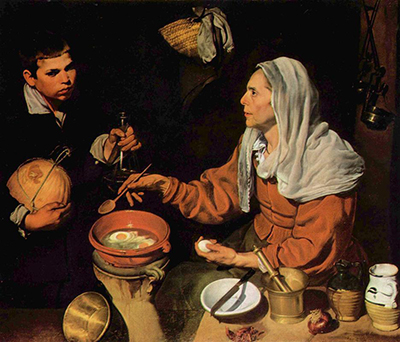
On 14 March 1617, Diego Velázquez demonstrated his skill before two master painters in Seville. He made work with his own hands in their presence and answered their questions about the trade. One of his examiners, Francisco Pacheco, had taught him. The other, Juan de Uceda, was an established painter in the city. The certificate they granted identifies the young man as qualified to paint images in oil. It also entitled him to keep a public shop, employ assistants and take apprentices. A year later, in the painting now known as An Old Woman Cooking Eggs, his materials were oil and canvas and his subject was a woman holding a spoon over an earthenware pan. The examination record names the kind of work he could undertake for a living. The canvas shows how much he could ask of a domestic subject. [1] [2] [3]
The biography covers Pacheco’s workshop and the start of Velázquez’s career.
At a Glance
- WorkshopFrancisco Pacheco, Seville [1] [4]
- Guild qualification14 March 1617 [2]
- Early workAn Old Woman Cooking Eggs, 1618 [3]
Contents
- Learning to paint in a working household
- What counted as a bodegón?
- Clay, glass and the work of hands
- Three kitchens and two stories
- Sacred pictures in the same city
- Who owned the kitchen pictures?
Learning to paint in a working household
Velázquez entered Pacheco’s workshop on 1 December 1610. The six-year term had already begun when his father and Pacheco formalised the agreement in September 1611. An earlier apprenticeship with Francisco de Herrera the Elder belongs to the biographical tradition and remains undocumented. The Pacheco agreement gives a detailed picture of the obligations: Velázquez was to serve in his master’s household and learn the trade, while Pacheco undertook to teach him fully, supply food, clothes and a bed, and care for him during short illnesses. Days lost through absence or illness were to be made up. The final provision for new clothes lists everything from shoes and stockings to a hat. A young painter’s education took place inside a household that had to feed, house and equip him. [1] [4]
In the 1617 examination, the questions assessed knowledge alongside the ability to make things. The examiners judged Velázquez proficient in imaginería, oil painting and the work that went with it. He swore to practise faithfully and keep the guild’s ordinances. His licence applied in Seville and elsewhere in the king’s territories, and the public shop clause gave him the commercial standing of a master. The document establishes his right to run one. There is also evidence of him exercising a master’s responsibility for teaching. In 1620 he took on Diego de Melgar, then about thirteen or fourteen, for six years. Their agreement makes Velázquez answerable for instruction, clothing, board and short periods of illness in much the same terms once applied to Pacheco. [2] [5]
Seville supported these workshops as a trading and ecclesiastical city. It was the seat of the Casa de la Contratación, the institution charged with regulating Spain’s trade with the Americas, and brought merchants, clergy, sailors, artisans and labourers into close proximity. Pacheco’s circle included writers and learned patrons, whose concerns ranged from the authority of an image in a church to the value of painting from life. The Andalusian heritage institute places his own work within an established idealising tradition and identifies Juan de Roelas with a rising naturalistic tendency. Pacheco’s account of making pictures shows how closely those concerns could coexist in one workshop. The same teacher who discussed the proper appearance of the Virgin recommended looking directly at a hand, a face or a length of silk. [1] [6] [7] [8]
What counted as a bodegón?
The Spanish term bodegón covers still-life pictures as well as the figure scenes at issue here. In Velázquez’s early paintings, kitchen implements and food are often conspicuous, and people are shown carrying, preparing or serving things. Selling water, the occupation pictured in The Waterseller of Seville, falls within this discussion too. The word describes a family of subjects. The different sizes of these canvases and the presence of a Gospel episode in some of them give it a wide reach. [7] [9] [10]
Pacheco discussed bodegones in the third book of his Arte de la pintura, published in 1649. He grouped them in a chapter with animals, birds, fish-market pictures and likenesses drawn from life. He asked whether kitchen pictures deserved esteem and answered emphatically that they did when painted as his son-in-law painted them. He held that bodegones and portraits had helped Velázquez arrive at verdadera imitación del natural, a true imitation of what he observed. In another passage Pacheco praised Caravaggio and Jusepe de Ribera for working from life and placed Velázquez in that company. The comparison establishes what Pacheco valued. It gives no direction for tracing one particular kitchen canvas to an Italian painting. [7]
Pacheco also remembered the young Velázquez engaging a village boy to pose in different attitudes, crying and laughing, and drawing heads from him in charcoal with highlights on blue paper. The paper could supply a middle tone while charcoal darkened a cheek or eye socket and highlights brought the nearer forms forward. His account is of repeated practice with an available model. It helps explain why the faces of people cooking and serving deserve the same scrutiny as the vessels. The old woman’s concentration in the Edinburgh canvas and the averted head of the boy at Apsley House each involve the turn of a face through light so that a small change in angle alters what can be read of the person. Pacheco’s account supplies no name for either figure. [3] [7] [10]
This praise was one view of a contested kind of painting. Vicencio Carducho’s Diálogos de la pintura of 1633 counted the lowly conceptions of certain bodegones among the ways painters diminished their art. Pacheco gave a different account of what it took to paint one well. He recalled making a small canvas himself in Madrid in 1625 to please a friend, with two figures from life, flowers, fruit and other things. His example documents one occasion for making such a picture. It also shows why the standing of a subject in a treatise and the social circumstances of making or acquiring a particular example call for different kinds of evidence. [7] [9]
Clay, glass and the work of hands
In An Old Woman Cooking Eggs (National Galleries of Scotland, NG 2180, 1618), the open rim of the pan makes the cooking visible. Two yolks and the uneven spread of the whites take the eye into a space that a higher vessel would hide. The spoon reaches towards that open surface. A knife lies across a bowl in the foreground, and its shadow falls over the curved interior. One object describes the shape of another. Behind the pan the boy carries a flask and a melon, holding each in the way its weight and shape require. Their arrival at the work surface gives the scattered utensils a practical setting. [3] [9]
The Apsley House Waterseller of Seville does nearly the reverse with its biggest pot. The vessel’s broad shoulder fills the lower foreground and hides its contents. One hand takes hold of the handle. The other offers a glass in which the liquid can be seen. A trail of droplets and a set of faint ridges make the body of the jar legible even in half light. At the left, a second vessel gives a different, broken shine and carries a pale bowl on its mouth. The largest object establishes the weight of the work, while the smaller and more fragile one brings the seller and the boy together. The man behind them has already put his vessel to his lips. The two actions occupy separate depths and receive different amounts of light. [10] [11]
Set the figures in Edinburgh beside those at Apsley and a familiar movement begins to look different. At the hearth, the old woman’s hand and spoon project towards a shallow pan where the changing eggs can absorb attention. In the water service, the approach of one set of fingers to another tightens attention around a stemmed glass. The vertical canvas lets the great jar occupy much of the space beneath that meeting. The Edinburgh picture can spread a series of smaller operations sideways across its wider field. Each gathers several separate observations into a single moment. The duration of the action is suggested through things in use, from the egg whites beginning to set to the man in the dark already drinking. [3] [10] [11]
In the Kitchen Maid group, a metal basin and a decorated jug appear on either side of a young woman, whose arms join two groups of objects across the table. Her weight comes down through the arm planted on the wood. The other hand is near the handle of the jug. The basin tilts towards us, so that its lip describes an ellipse and its interior catches broad, irregular passages of light. The white jug stands upright and carries dark markings that turn with its body. A firm edge along the lit rim will carry one of these objects through a passage of shadow. In other places a dark utensil nearly disappears behind a lighter one. The narrow strip of visible surface between their outlines can be enough to tell how they sit. [12] [13] [14] [15]
That placement was worked out in paint. Research on the Art Institute of Chicago’s Kitchen Scene (1935.380) showed that a dark vessel once rose high enough to obscure the foot of the white jug behind it. An infrared image published by Gridley McKim-Smith and colleagues records the change. In the visible picture the lower outline of the dark vessel lets the base of the jug meet the table, placing it more securely behind its neighbour. The investigators also found fine brushed lines along the figure’s face and clothing and the edges of several vessels. Some can be seen on the surface, and others show up in infrared or X-ray images. They identified the hanging basket, copper pot and decorated pitcher as motifs that recur across the early works. On that evidence they proposed that the Chicago composition was assembled from a repertoire of familiar forms. A vessel can be studied from life and its shape used again in a new arrangement. The change to the overlapping jugs gives a concrete instance of the decisions that rearrangement involved. [3] [13] [16]
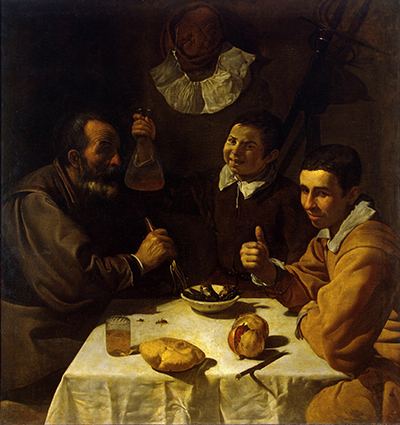
The Lunch (Завтрак). In the Hermitage canvas, the cloth and raised flask bring the diners’ gestures and table objects together. View The Lunch.
Three kitchens and two stories
The Chicago canvas is one of three closely related works. Dublin’s Kitchen Maid with the Supper at Emmaus (National Gallery of Ireland, NGI.4538, about 1617–18) is the widest. Chicago’s Kitchen Scene, dated 1618–20 by the Art Institute, retains a long stretch of table with the basin to the left and utensils to the right. The Museum of Fine Arts, Houston’s Kitchen Maid (55.100, about 1620) is upright. The maid rises above a deeper band of tabletop, and the basin and white jug come close to the edges. The dates are institutional estimates. Houston’s museum announced Zahira Bomford’s attribution to Velázquez after conservation and research in 2018. Surviving formats and recurring objects give the comparison a firm starting point. The order of making remains open. [12] [13] [14] [15] [17]
In Dublin a small rectangle high on the left contains a second table and Christ at supper. The National Gallery of Ireland reads it as a view through a kitchen window. Overpaint was removed in 1933, uncovering a scene that had been concealed in the background. The woman’s turn of the head and the slight lull in her work can be seen in all three canvases. Only the Dublin picture gives the viewer another room in which to look for a possible explanation of her pause. There, the few signals needed for a viewer familiar with Luke’s account to recognise the setting, including the figure facing forward and his companion at the table, fit above the near kitchen objects. In Chicago the corresponding wall is quiet, so attention returns to the woman’s face and hands. No scene of Emmaus is visible in Houston either. Dublin’s treatment history belongs to the Dublin canvas. [12] [13] [14] [15] [18]
The maid’s central position can change how we think about Seville’s households. The Dublin gallery describes her as an African servant. The Metropolitan Museum of Art brought the three works together in its 2023 exhibition about Juan de Pareja, examining the contribution of enslaved people of African descent to seventeenth-century Spanish visual culture. The Art Institute notes that Velázquez, his father and Pacheco were enslavers and raises the possibility of an enslaved model for the Chicago figure. The maid’s identity and legal status are unknown. Bringing the canvases together makes something else apparent. Her weight and reach give direction to much of the foreground in each picture. Only one preserves a visible event with which to connect her attention, and the change of format in Houston gives her figure still more prominence even in the absence of that episode. [12] [13] [15] [19]
In the London Kitchen Scene with Christ in the House of Martha and Mary (National Gallery, NG1375, probably 1618), the smaller scene occupies the opposite upper corner. The large cook uses a mortar and the woman beside her extends a finger. Inside the rectangle, Christ’s lifted hand and the posture of the figure sitting at his feet are legible on a much smaller scale. The National Gallery reads the rectangle as an opening and records other possibilities, including a mirror or a picture on the wall. In Dublin the second table helps carry attention from kitchen to supper. In London the two groups can be joined by attending to their gestures, since the foreground has its own emphatic exchanges of hand and gaze. The small scenes tell different Gospel stories. Emmaus turns on recognising Christ at table. The visit to Martha’s house raises the claims of serving and of listening. [12] [20]
The Dublin and London galleries relate this distribution of attention to sixteenth-century Flemish pictures in which an everyday foreground takes up more of the painted surface than a sacred episode. London suggests that Velázquez may have known the device through engravings. The arrangement gives a painter room to make goods and utensils substantial at close range while using a smaller set of forms for a scene receding behind them. It also lets an ordinary task colour the way a viewer encounters the Gospel. In Dublin the supper is reached across the working woman’s space. In London the complaint about being left to serve has a particular force when the heavy mortar and the food still to be prepared occupy the nearer table. [12] [20]
Further reading
The essays look at the skilled work performed in Seville’s workshops and the society in which Velázquez’s kitchen pictures were made.
Juan de Pareja: Afro-Hispanic Painter in the Age of Velázquez. David Pullins and Vanessa K. Valdés, with essays by Luis Méndez Rodríguez and Erin Kathleen Rowe. The Metropolitan Museum of Art, 2023
Sacred pictures in the same city
The kitchen subjects were made alongside pictures in which the religious figure occupies the foreground. Around 1618 Velázquez painted the companion canvases Saint John the Evangelist on the Island of Patmos (National Gallery, NG6264) and The Immaculate Conception (NG6424). Seville’s public interest in the doctrine gave this pairing a local context, and Pacheco later set out detailed advice on the Virgin’s appearance. The two paintings are first recorded in 1800 in the chapter house of the Shod Carmelites in Seville. The first commission remains unknown. Their shared scale, light and relation of subject show how a pair of paintings could be made to speak across separate canvases. [8] [21]
Saint John looks upwards, pausing over an open book. The Virgin in the companion picture has lowered eyes and hands joined in prayer. Flesh and folds receive a strong light from above left in both works. The direction of the saint’s glance asks us to attend to his vision. The movement from the lit edges of the book to his face is comparable to the movement from a glass or a bowl towards one of the early serving figures. The book and the raised eyes here lead to a revelation, and the companion painting gives that vision another scale and a closer presence. In the kitchens with an inset Velázquez makes a related change of scale within one canvas. A young painter qualified to make religious images could bring his attention to the fall of light and to an arrested gesture into both kinds of work. [8] [12] [20] [21]
Who owned the kitchen pictures?
Some early references identify a work closely enough to make a candidate persuasive. They still record ownership at a particular moment. The National Gallery points to a 1637 inventory for the third Duke of Alcalá that lists a Velázquez of a woman pounding garlic in a kitchen. It could be NG1375, although the description gives no Christ, Martha or Mary. A 1690 Omazur inventory in Seville lists two bodegones as originals by Velázquez without describing their subjects. An inventory from 1698 for the same collection describes an old woman cooking eggs and a boy with a melon. The combination is suggestive of the Scottish painting, while the item itself gives no artist’s name. If either identification is accepted, the passage tells us about a particular house and picture. It leaves the circumstances of the original commission open. [7] [9] [20]
There is closer evidence for the early circle in which The Waterseller moved. Julián Gállego’s Prado catalogue traces it to Juan de Fonseca in Madrid in 1623. The catalogue leaves open whether Velázquez gave it to him or sold it. Fonseca was a Sevillian churchman at court and helped the painter gain access to Philip IV’s circle. The case connects an early picture of a working man with a collector who moved between ecclesiastical and court networks. The relationship between this picture and a court contact is much more specific than a general theory of wealthy buyers of kitchen scenes. Meanwhile the Dublin gallery presents the possible early ownership of its Kitchen Maid by Archbishop Pedro de Castro y Quiñones as a suggestion. Its published provenance places the picture in Sir Otto Beit’s collection by 1913. The Met’s 2023 exhibition proposed that the survival of three versions points to a growing market for images centring people of colour. That proposition concerns demand for a kind of image. It cannot name an early owner or establish the terms on which Velázquez painted one. [1] [11] [12] [19]
The figures suggest the kinds of labour a buyer could see in and around the city. An image of serving could be interesting to a collector for the rendering of clay and glass, for the dignity of a particular figure, or for the sacred action set within an ordinary room. Which of those possibilities mattered to a purchaser depends on evidence for that work. The apprenticeship deed and examination give us unusually exact terms for how the young painter became able to make and market pictures independently. The paintings give us a different kind of precision. In Edinburgh, watching a spoon and a hand is enough to see work in progress. At Apsley House, a large vessel and a small glass hold together a service involving three people. In Dublin, a maid’s pause allows a small scene to share the viewer’s attention with the utensils in front of her. Those arrangements, made in the years before Velázquez’s move to the Spanish court, show the variety of work already possible within a seemingly modest category. [1] [2] [3] [4] [10] [12]
Artworks directory
Frequently Asked Questions
The Spanish term bodegón covers still-life pictures as well as the figure scenes at issue here. In Velázquez’s early paintings, kitchen implements and food are often conspicuous, and people are shown carrying, preparing or serving things. Selling water, the occupation pictured in The Waterseller of Seville , falls within this discussion too. [7] [9] [10]
The Chicago canvas is one of three closely related works. Dublin’s Kitchen Maid with the Supper at Emmaus (National Gallery of Ireland, NGI.4538, about 1617–18) is the widest. Chicago’s Kitchen Scene , dated 1618–20 by the Art Institute, retains a long stretch of table with the basin to the left and utensils to the right. [12] [13] [14] [15] [17]
Discussion
Look again at the images and ideas explored in Velázquez in Seville and the Bodegones. These editorial prompts invite your observations.
Reader Insights
Compare the vessels in Old Woman Cooking Eggs and the Dublin Kitchen Maid. Where does the painter make a small reflection carry the shape of a whole object?
What can the workshop documents tell you about how these pictures were made and sold?
Join the Conversation
Share a detail, comparison or question about Velázquez in Seville and the Bodegones below.
References
- Instituto Andaluz del Patrimonio Histórico, Biografía de Velázquez, Seville chronology and workshop account. Spanish. View source.
- Archivo Histórico Provincial de Sevilla, Carta de examen de Velázquez como pintor, 14 March 1617, Protocolos Notariales, leg. 2484, fols. 85v–86v, Spanish transcription hosted by the Instituto Andaluz del Patrimonio Histórico. View source.
- National Galleries of Scotland, Diego Velázquez, An Old Woman Cooking Eggs, 1618, NG 2180, collection record and John Leighton’s commentary. View source.
- Archivo Histórico Provincial de Sevilla, Carta de aprendizaje de Velázquez con Francisco Pacheco, September 1611, notary Pedro del Carpio, Oficio 4, Spanish transcription hosted by the Instituto Andaluz del Patrimonio Histórico. View source.
- Archivo Histórico Provincial de Sevilla, Carta de aprendizaje de Diego Melgar con Velázquez, 1620, Spanish transcription hosted by the Instituto Andaluz del Patrimonio Histórico, terms and signature clauses. View source.
- Instituto Andaluz del Patrimonio Histórico, Sevilla 1599 and its linked account of painting in Seville. Spanish. View painting account. View source 1. View source 2.
- Francisco Pacheco and Archivo Histórico Provincial de Sevilla, Arte de la pintura, 1649, book III, chapters I and VIII, and Omazur inventories, in Corpus Velazqueño. Documentos y textos, Ministerio de Educación, Cultura y Deporte, 2000, vol. I, pp. 134–135 and 552–553, doc. 517. Spanish. View source.
- The National Gallery, London, Diego Velázquez, The Immaculate Conception, NG6424, collection record and commentary on Pacheco and the companion pictures. View source.
- Julián Gállego, ‘Vieja friendo huevos’, catalogue no. 4 in Antonio Domínguez Ortiz, Alfonso E. Pérez Sánchez and Julián Gállego, Velázquez, Museo del Prado and Ministerio de Cultura, 1990, pp. 74–78, including Carducho and Pacheco at pp. 76–77. Spanish. View source.
- Wellington Collection, Diego Velázquez, The Waterseller of Seville, Apsley House collection entry and full composition. View source.
- Julián Gállego, ‘El aguador de Sevilla’, catalogue no. 3 in Antonio Domínguez Ortiz, Alfonso E. Pérez Sánchez and Julián Gállego, Velázquez, Museo del Prado and Ministerio de Cultura, 1990, pp. 68–73. Spanish. View source.
- National Gallery of Ireland, Diego Velázquez, Kitchen Maid with the Supper at Emmaus, NGI.4538, collection record, description and provenance. View source.
- Art Institute of Chicago, Diego Velázquez, Kitchen Scene, 1935.380, museum collection data and label, object 21934. View source.
- Museum of Fine Arts, Houston, Diego Velázquez, Kitchen Maid, 55.100, collection record. View source.
- The Metropolitan Museum of Art, Juan de Pareja, Afro-Hispanic Painter, 2023, illustrated checklist, the three Kitchen Maid entries. View source.
- Gridley McKim-Smith, Inge Fiedler, Rhona Macbeth, Richard Newman and Frank Zuccari, ‘Velázquez: Painting from Life’, Metropolitan Museum Journal 40, 2005, pp. 79–91, especially pp. 79–82 and figs. 3–4 for Chicago 1935.380. View source.
- Kerry Ingram, ‘Rediscovering a Velázquez: The Attribution of “Kitchen Maid”’, Museum of Fine Arts, Houston, on the 2018 attribution announcement. View source.
- Julián Gállego, catalogue no. 1 in Antonio Domínguez Ortiz, Alfonso E. Pérez Sánchez and Julián Gállego, Velázquez, Museo del Prado and Ministerio de Cultura, 1990, pp. 58–61, including the 1933 cleaning of the Dublin painting. Spanish. View source.
- The Metropolitan Museum of Art, ‘First Major Exhibition on Afro-Hispanic Painter Juan de Pareja, the Subject of Diego Velázquez’s Iconic Portrait, to Open at The Met’, 2023, exhibition context and account of the three loans. View source.
- The National Gallery, London, Diego Velázquez, Kitchen Scene with Christ in the House of Martha and Mary, NG1375, collection entry, in-depth description and provenance discussion. View source.
- The National Gallery, London, Diego Velázquez, Saint John the Evangelist on the Island of Patmos, NG6264, collection entry and commentary on the companion pictures. View source.