by Tom Gurney
Tom Gurney BSc (Hons) is an art history expert with over 20 years experience
Email: tomgurney1@gmail.com / Phone: +44 7429 011000
Diego Velázquez: Style and Technique: Introduction
Look first at the mouth of the earthenware jar in The Waterseller of Seville. The lip catches enough light to describe an opening, while the broad shoulder turns without a continuous bright outline. Tiny points on the jar’s face interrupt the broad change from light to dark. Higher up, the rim of a glass needs only a slight lift in tone against the shadows to become visible. Both vessels occupy the same picture, but the eye has to work differently to find each one. Concentrate on the jar and you notice its surface. Look again at the much smaller glass and what you see first is the space around it and the two hands that are about to meet. [1]
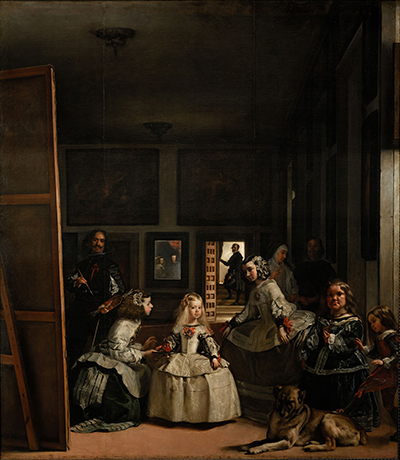
That change of attention occurs across Velázquez’s career. In Christ after the Flagellation, the eye finds an eyelid and nostril with surprising precision, then has to piece together the shape of the bound hands from softened strokes. At the scale of Las Meninas, the pale patch of an open door is legible across a room, while the detail of a cup on a tray depends on a quite different set of small intervals. Technical examination can help explain how the painter made these effects. Some of the best evidence is entirely visible in the painting. Other evidence comes from earlier paint revealed by imaging, from tiny fragments examined in section or from records of changes to the object itself. [2] [3]
At a Glance
- SurfacesFactum recorded colour and surface relief on The Waterseller of Seville. [1]
- GroundsThe National Gallery compared different ground preparations in paintings by Velázquez. [2]
- RevisionsPrado imaging reveals changes to figures in Las Meninas. [3]
Contents
- Where an edge becomes visible
- How the ground contributes to the colour
- Three paint builds in Christ after the Flagellation
- How a lighter ground changes the available tones
- What changes when we step back
- What examinations of Las Meninas reveal
- Motion and the boundaries of The Spinners
- A portrait studied at its edges
- The same sitter in two painters’ hands
- When two canvases share a weave pattern
Where an edge becomes visible
In The Waterseller of Seville, compare the boundary of the waterseller’s head with the profile of the boy. Light picks out the older man’s brow and nose, then travels down into a less distinct boundary at the beard and clothing. The boy’s cheek gives way to the background more gently. Between them, the glass presents a different problem. A bright contour all the way around would make it seem flat or opaque. Short marks allow the darkness to continue through the vessel while locating the lip and stem. Move your attention down to the great jar and the difference in scale is startling. Across a comparatively wide field of earthen colour, light and shade describe volume. In the glass, there is barely room between the signs of volume for the eye to settle. [1]
The jar’s little marks are often read as droplets. For the appearance of wetness, the intervals between them matter as much as their brightness. A more even row of marks would carry across the surface like decoration. Here, the spaces vary, and the light spots sit over broad variations in the earthenware. Their pattern is easy to single out in an enlargement. At the size of the full composition, the marks register within a continuous convex surface, and the turn of that surface helps explain why they catch the eye at all. The same relation between a broad form and small disturbances in its tone gives the older man’s face its texture. Its furrows matter because we have already understood where his head turns into the light. [1]
In 2020 Factum Foundation recorded the Apsley House painting using panoramic composite photography and the Lucida 3D Scanner. The organisation documents separate records for colour and physical surface relief and also shows the recording of the reverse. This provides two ways of looking at a passage such as the jar. Photography captures the distribution of visible marks and colours. The relief data tracks the topography of the painting’s surface, which may be compared with the coloured image. A painted drop has the appearance of projecting within the fiction of the picture. A ridge on the canvas is a physical feature that the scanner can register. Their relationship is a question to put to the records. The recording project establishes the kind of data gathered, and the depiction of water is a reading of the visible marks. [1]
The National Inventory of Continental European Paintings records a different kind of observation about the same canvas. Its entry summarises Zahira Véliz’s identification of fine lines beneath the hands and along parts of the older man’s head and ear, which she associates with a stiff pointed brush. It also reports her interpretation of vertical white strokes below the hands and glass as brush-wiping marks, with the hands finished after the surrounding passage. That reading gives a particular sequence at the point where the two people meet. Three adjacent passages in the finished image, a hand, a glass and the space behind them, can hold evidence of different stages of work. [4]
Compare the London Christ in the House of Martha and Mary. The fine ridges on the fish catch the light in a succession of short changes. The mortar needs a more continuous curve to make sense of the action of grinding. A hard edge cues the lip of a dish, but the shadow under a vessel is broader and less definite. Those differences keep the table from becoming a line-up of equally emphatic shapes. Follow the cook’s hands and a few of the comparatively solid edges gather around the work she is doing. At the upper right the New Testament scene groups bodies across a much smaller area, and gestures carry over the intervening space. The painting moves between ways of making objects and figures legible in the course of a single glance. [5]
How the ground contributes to the colour
The ground is the prepared layer beneath the paint that forms the visible image. Its contribution depends on what goes over it. Where an opaque passage covers it fully, neighbouring painted values do most of the visible work. A thin layer allows its tone to influence the result. An uncovered interval can serve as a small shadow or as the separation between two adjoining shapes. Larry Keith and Dawson W. Carr’s comparison of Velázquez’s preparations begins in Seville, with a greenish-brown earth recommended by his teacher Francisco Pacheco. Their account of the early work also describes thickly applied mixtures across the range of light and shade. A dark colour on the surface may therefore be a substantial body of paint in its own right. [2]
The two early canvases in the National Gallery offer a comparison at the scale of a face. In Saint John the Evangelist on the Island of Patmos, NG6264, the lower jaw and neck have thick dark-brown paint. Keith and Carr identified reserved areas of ground at the mouth and below the eyebrows. Look along the jaw before looking into the opening of the mouth, and notice how differently the two darks function. One turns a sizeable plane of the head away from the light. The other makes a tiny division that allows the lips to part. The exposed ground there has since blanched. Its present paler appearance is a poor measure of the original depth of the shadow. [2]
In The Immaculate Conception, NG6424, the dark parts of the face and neck are also substantial paint, while the early brown preparation supplied much of the original colour of the hair. Follow a broad mass of hair beside the head and consider how little of it needs to resolve into bright strands. At a distance the mass separates the lit flesh from the wider field behind it. Kept within a narrower tonal range, the hair can turn and descend without drawing as much attention as the face. Together, the two pictures show how differently similarly prepared canvases can use that preparation. A small gap in the paint at a mouth and a relatively broad area figuring as hair call on the ground at different scales. [2]
In the Madrid pictures Keith and Carr compare from the 1620s, a red earth ground is characteristic. Their examination set the thick red-brown ground in the London Christ after the Flagellation beside a sample from the Prado’s Triumph of Bacchus. A cross-section exposes the order of layers at the place from which the sample was taken. The illustrated fragment from the Flagellation has grey foreground paint above the reddish preparation. The fragment from Bacchus has pink-red drapery paint containing red lake above its preparation. The grounds are close in constitution, even as the paint above each carries the colour in a different direction. [2]
In the Flagellation, a narrow streak of red remains uncovered along an edge of the guardian angel’s sleeve. Abrasion has also left ground visible in places at the tops of the canvas weave. The two kinds of exposure have different histories. The streak follows the meeting of the colours that describe sleeve and background. Raised threads are positions at which paint has worn away. In the São Paulo full-length Count-Duke of Olivares, Keith and Carr show a further use for the red preparation. It contributes to the depth of the red table covering. Here the colour is capable of doing work across a much broader area than the line at the angel’s sleeve. [2]
The comparison also offers a way to understand what technical evidence can establish about chronology. The grounds of the Flagellation and Bacchus have a closely similar profile in the tests Keith and Carr report. A record of payment in 1629 anchors the history of Bacchus. The payment may have followed the painting’s completion by some time. For the Flagellation, the material comparison favours production in Madrid and the Gallery dates the painting to probably 1628–29. How far Velázquez had developed before his first trip to Italy remains a question that takes in the staging of figures, the treatment of the body, the Spanish devotional subject and the availability of materials. A similarity between preparations can help locate a work among other paintings. The dated transaction gives a different sort of evidence, for an event in the life of one object. [2] [6]
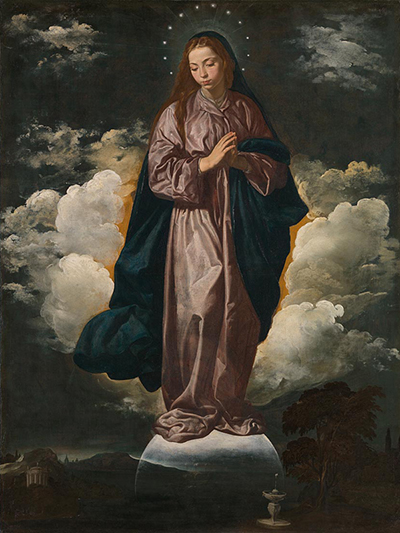
The Immaculate Conception. The early canvas provides an example to consult alongside the discussion of how preparatory layers affect colour and modelling. View The Immaculate Conception.
Three paint builds in Christ after the Flagellation
Start at Christ’s head in the London canvas, NG1148. The bridge of the nose and one small area of the cheek are bright enough to carry the turn of the face. The eye and the inner edge of the nostril can be followed with care. Keith and Carr report that marks in brown-black paint survive visibly in the shadowed parts around the eye, nose, mouth, chin and throat. They describe an initial brushed drawing and a very thin brown application laid locally above it. The underlying preparation is strongly red. The added brown gave the painter a more suitable middle value for the shadows, and lighter opaque paint built up towards the edges of the thin layer. A relatively small area of the canvas thus has its own local preparation over the ground shared with the rest of the picture. [2]
Follow the light down from the head to the body. The torso offers broad changes in tone as the chest opens towards us and falls back into shade. Keith and Carr distinguish the relatively opaque, white-containing grey-brown mixtures in the body and the shadowed parts of the angel’s and child’s faces from the thin handling of Christ’s head. Their paired X-ray details of the Christian Soul and Christ show some of the consequences of that difference. The child’s shadowed jaw still has quite substantial underlying paint. Christ’s head relies more heavily on the darker application below the highlights. One can start from the resemblance of all three figures as painted flesh and arrive, by close inspection and imaging, at different accounts of how individual passages were constructed. [2]
At the loincloth the white paint is thickly laid and makes a strongly apparent break with the skin. By the column, the bound hands are less sharply delimited. Down on the floor the instruments are handled with a further degree of freedom. Their strokes leave the eye to complete small sections of the objects once the overall slant and position are understood. Compare the hands with the head at the same scale. The meeting of the forms at the eye remains a place where one can pause. The hands are easy to locate, but their edges lose clarity in the dark. The difference in emphasis directs attention to Christ’s face while still letting us follow the constraint of his posture. [2] [6]
The straight edges of the column base provide a further observational test. The conservators saw adjoining passages stop at the exposed red ground without an underlying line that they could identify. They suggest that Velázquez might have ruled an initial guide in charcoal and later brushed it away. Their reconstruction accounts for the unusually straight stops. The guide itself remains hypothetical. The marks on Christ’s face can be seen under favourable light, yet the report explains why the analysis did not recover them as a drawing in infrared or radiography. The dark ground gives infrared examination little contrast, and the drawing paint is of relatively low atomic density for the X-ray image. The painter’s line and the limits of the instruments are both part of the evidence. [2]
Researchers also distinguish three significant alterations in the Flagellation: the position of the loincloth, the tilt of the Christian Soul’s head and the placement of the bundled garments at the lower left. These adjustments concern what the eye does across the composition. A tilt can bring the child’s attention more clearly into relation with the adult figure. The dark bundle has more weight when its position helps establish the foreground. Equally instructive is the bright, broad shape in the right of the X-ray detail of Christ’s head that Keith and Carr attribute to material added to the back of the canvas in an old treatment. It enters the same imaging record as the paint. Knowing that it belongs to the reverse prevents a much later intervention from being read as an early decision by Velázquez. [2]
How a lighter ground changes the available tones
Keith and Carr identify a brown ground on the comparatively coarse, open canvas of Joseph’s Bloody Coat Brought to Jacob. Their close-up of a leg shows where the brown contributes to the middle values of flesh. A passage of mid-tone carries a curve between light and shade, so that even when we see very little texture the leg has a visible turn. The brown here could supply that interval across a wider area than the brown applied locally beneath Christ’s face. The two effects belong to different material arrangements. The London head uses a thin adaptation of a red preparation. In Joseph’s Bloody Coat the brown is itself the ground. [2]
In Apollo in the Forge of Vulcan, the authors identify a pale grey preparation. They describe how the lighter, cooler basis could be used for its own value or adjusted in places with translucent warm brown. Thin paint over a pale ground has scope to stay light. Local warming gives the painter room to let other passages fall away towards shadow without carrying a warm preparation through the whole picture. The visible painting makes that scope worth considering. Move from the whitish jug on the shelf to a lit shoulder and then to the hot metal. Their intervals from the surrounding grey and brown differ. The jug remains comparatively cool, the chest rolls through several middle values and the metal announces itself with a much smaller concentration of warmth. The lighting makes all three sensations possible in the same room. Their resemblance to familiar materials is observable without identifying the pigments from the painted surface. [2] [7]
The forge brings some of the hardest outlines to the tools and the edges of armour. A line can make the plane of metal readable in an instant. The backs and shoulders take longer to look at. Form continues across the half-light in a way that cannot be followed as a single line. To see how this handling structures the scene, pick out the back of the smith who stands nearest us, then the men beyond him. Each overlapping form removes some of the evidence for the next figure’s pose. The succession of shifts in tone makes the part that remains visible sufficient for the eye to supply the rest. Apollo’s entrance can be read across the faces with quite small changes in the orientation of a head. The variety of passages, from heavily legible tool to partially seen figure, contributes to our impression of an interruption running through the group. [7]
The paper also reports a work in which two grounds serve different parts of the design. In the Prado’s Sibyl, a red preparation has a second, pale grey layer over it in the zones of background and flesh. The clothing across the torso retains the red as its basis. The comparison with Apollo concerns a choice about where a light surface is useful. This is also a reason to treat the familiar progression from Seville earth to Madrid red to pale grey as a set of strong associations. The same picture could use a colour of preparation familiar from the 1620s along with a lighter priming chosen for selected areas. [2]
Velázquez and his artistic context on film
Explore Baroque painting, Spanish portraiture and horses in art with TheHistoryOfArt.
Further reading
For a closer look at the evidence and paintings:
Collected Writings on Velázquez. Jonathan Brown. Centro de Estudios Europa Hispánica, 2008. English edition
Brown’s essays examine how questions about brushwork and technique affect judgments about who made a painting. See the book at CEEH.
What changes when we step back
In Philip IV of Spain in Brown and Silver, the silver pattern on the king’s costume is legible at a distance. At close range, it breaks into strokes of different lengths and shapes, some curling and some reaching no further than a bright daub. The National Gallery points to how the marks gather into an impression of embroidery. Notice the darker gaps around the bright strokes. The pattern seems to run continuously down the fabric because the marks maintain roughly the direction of the fold or length of the garment through those gaps. The painter can vary the density of marks as the cloth turns, leaving the dark passage to connect the isolated flashes. The face and the long dark shape of the cloak keep the figure intact while the detail of the suit resolves according to distance. [8]
The red table covering in the same portrait carries another lesson about appearances. Keith and Carr contrast its now faded red-lake glazes over a grey ground with the better-preserved colour of the earlier Olivares tablecloths that used a darker red preparation as underpaint. In both cases a red fabric helps set a figure within a standing portrait. The means of producing its colour differ, and the surfaces have responded differently to age. A close view of an apparently weak area of colour in the later portrait therefore gives evidence of the work as we have it, while the examination helps us gauge how strongly that area may once have set off the grey and silver. [2] [8]
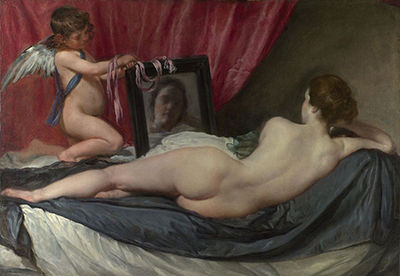
In the Rokeby Venus, distance alters the focus within a figure. The edge at the back and hip is clear enough to sustain the pose. Near the feet the definition slackens, as Keith and Carr note. The figure on a mattress has weight because the contour does not have the same strength everywhere. Let the gaze travel from the feet to the rising curve of the shoulder. The longer passage of light becomes a path to the head. The face in the mirror needs much less clarity than the body to make a great difference to the picture. At a scale where the surface is easy to inspect, the face remains rather indistinct. From further back, even this slight suggestion of features makes the rectangle read as a site of possible exchange with the figure. [2] [9]
The change of viewing distance works in a more complicated way in Las Meninas. The small bright fixtures in the foreground, including the tray and cup, ask us to sort out one set of intervals. At the rear the open doorway and mirror ask for another. From across the room the door still registers as an opening because the stark boundary is kept over a comparatively large area. The mirror keeps a bright centre as well, but its borders and the paired features inside are much less insistent. Move closer and it becomes possible to dwell on a hand or a feature in the mirror, even as those particulars become harder to keep in the same field of attention. Velázquez apportions the light in patches that can serve from both positions. What gets its definition from a strong separation of light and dark is free to operate across the room. A small mark in a nearby dress can add texture at close range and join a much larger mass of light from further off. [3] [10]
What examinations of Las Meninas reveal
The Prado programme described by Carmen Garrido, María Teresa Dávila and Rocío Dávila combined X-radiography, infrared reflectography and analysis of materials and supports. Those methods yield evidence at different scales. An infrared image depends on sufficient penetration and contrast in the layers. An X-radiograph records differences in how strongly the rays are absorbed through the painting and support, so evidence of earlier and later work can be present together. Examination of paint samples helps establish what is in particular passages and how their layers relate. Las Meninas, P001174, shows how such evidence can modify a reading made from the surface. [3] [11]
In the Prado’s Pinceladas de ciencia en Las Meninas, the infrared account notes lines associated with pictures on the right wall and reports no extensive underdrawing visible by that means. The authors also discuss areas where differences in infrared facilitate reading changes that are hard to distinguish in the radiograph. These include parts of Isabel de Velasco’s profile and details in the shadowed figures beyond her. The sparse preparatory lines visible in the examination tell us about this painting and the response of its layers. The visible brown-black passages in the Flagellation illustrate how even a definite brushed line can escape detection in a particular combination of ground, paint and method. Surviving paper evidence raises other questions. The sheets considered in Velázquez’s drawings can be assessed as individual objects, with different degrees of confidence in attribution and different kinds of relationship to paintings. [2] [3]
The Prado guide illustrates a change at Nicolás Pertusato’s leg and at the Infanta’s reaching hand. Look at the leg in the finished painting and it makes a directional push towards the dog, even with the figure close to the edge. A change in the leg alters the spacing around the dog and how far that direction carries across the foreground. The small change by the hand matters on a different scale. The space between fingers, cup and tray tells us how much of an action is still to happen. These revisions coexist with the fast-looking paint. An earlier position established by technical study can sharpen attention to what a later position lets a figure do. [3]
The science guide also reports lead white in the preparation and in the paint mixtures of Las Meninas, as well as several different red colorants, including vermilion, red lake and red iron oxide. The pictured palette offers an image of a painter at work. The analysed samples offer evidence of materials in the actual canvas. For the viewer looking at the small zones of red in the room, the sample results establish that red takes several material forms in this one painting. A vivid accent alone is insufficient to identify which red has been used there. Nor need a picture with few dominant colours have a preparation made with only one substance. The guide reports a light base made with lead white, iron oxides, calcite and organic black. Its tone and the colours seen on top reflect separate decisions. [3]
The appearance of that surface has also changed. In the guide’s illustrations of the painter’s head, a yellowed layer of varnish shifts the way the skin and surrounding tones read. That matters for an image in which much of the back of the room is organised by slight differences between adjacent darks. A coating that changes how readily those intervals can be seen changes the ease with which one can follow the space. After treatment, the present surface remains the one perceived under particular conditions of lighting and distance. The earlier photographs give an additional record with which to compare it. [3]
Motion and the boundaries of The Spinners
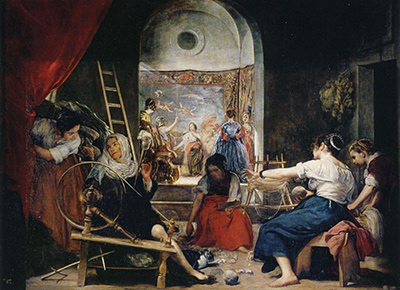
Try following the foreground wheel in The Spinners. The rim has a discernible course, while the indications within it are much less settled. Brightness near the hub and streaks across the darker field let the eye connect the mark to the mechanism without stopping on each spoke. The hands nearby give a second measure of motion. Look from the wrist to the turning circle and from the circle back to the figure feeding the work. The shape of the wheel stays fixed in the composition while its interior seems to turn. The handling of the moving and stationary parts makes the image briefly difficult to resolve at the very point where the action depends on speed. [10]
Across the picture a lit area beyond the foreground workers opens into another setting. The figures there are smaller and confined within an opening, yet the rise in light draws us straight to them. The painter makes some details in the nearer room hard to fix, including the turning wheel, while making a relatively distant group arresting through its light and colour. To test the effect, find first the figures in the rear, then let your eye drop to the steps and continue back towards the wheel. Several changes of scale and light occur in a short span. A viewer can get from a place of sharply apparent action to a place of comparative illumination without seeing each of the intermediate edges equally well. [10]
The strength of that relation is affected by the boundaries of the canvas on view. The Prado’s 2021 report describes the larger surviving support, 220 × 289 cm, and attributes its added perimeter bands to the later eighteenth century. The addition above the scene is more than 40 cm. It gives the upper space far more prominence and increases the apparent remove of the area at the back. The painting has been exhibited with the additions visible and with them masked. The panel installed in 2021 conceals the bands while retaining the enlarged canvas, and the design allows access to the painting. The frame a visitor encounters thus embodies a documented decision about how to present the object. Here an alteration to the support has consequences for the apparent distance to the mythological scene, even with the paint in that scene left in place. [12]
Compare the effect with the revised tilt of the child’s head in the Flagellation or the altered position of the leg in Las Meninas. A revision in the image belongs to the process of making it. A change in the perimeter can transform where an episode seems to sit in the finished composition. Both matter to how we look, and each calls for particular evidence. The strongest close reading starts with a difference in the picture we can point to, whether the height above the back room in The Spinners or the softness of the bound hands in the Flagellation. It can then follow that difference to the painted passage, the documented intervention or the detail revealed by examination. [2] [3] [12]
A portrait studied at its edges
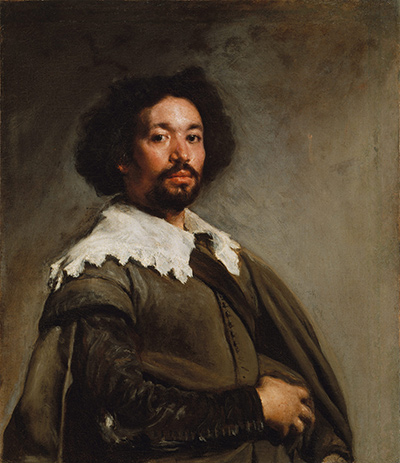
At the left of the sitter’s head in the Metropolitan Museum of Art’s Portrait of a Man, Possibly a Self-Portrait (49.7.42), strands of hair give way unevenly to the background. The boundary was once much firmer. Michael Gallagher’s account of the 2009 treatment describes how old retouching concealed changes to the outline, and how discoloured varnish and toning subdued the thinly painted areas of the portrait. Removing those interventions made the difference between the highly developed face and the abbreviated doublet easier to see. Gallagher left the strong original strokes along the hair and toned down the most distracting abrasion. He found signs of probable scraping there, with its date and author uncertain. The irregular edge visible today carries traces of the painter’s revision as well as subsequent wear. [13] [14]
The radiograph takes the eye to two other edges, along the top and right of the canvas. Gallagher reads traces there as the inside edges of a temporary stretching frame. There are also broad arcs across the radiograph, consistent with drawing a flat knife or spatula across the cloth to spread the ground. Together these features suggest that the portrait was cut from a larger piece that had already been prepared. The margins where the canvas was tacked survived the later lining treatment. Strokes continuing from the face of the picture onto these margins suggest that its final stretching followed the painting. The slight scalloping of the weave near the tacks, known as cusping, is consistent with the layers still being flexible at that stage. [13]
The arcs are evidence of an application pattern. To investigate what was applied, the Met’s scientists mounted tiny samples in cross-section and used polarised light microscopy, Raman spectroscopy and scanning electron microscopy with energy-dispersive X-ray analysis. Gallagher reports that the pinkish buff preparation consists predominantly of coarse lead white and red ochre. A section preserves the order of the layers at the sampling point. The radiograph records their combined response across a much larger area, so reading the arcs as tool marks depends on their form and distribution as well as knowledge of the materials. The cleaned surface offers a third view of the working sequence. In the shadow beneath the heavy brow and below the jaw, the early brown-black blocking still contributes to the modelling. The flesh above it builds through pinker, more opaque paint to the thicker touches that pick out the light. [13]
The same sitter in two painters’ hands
Juan Bautista Martínez del Mazo signed and dated the petition held by the queen in his Queen Mariana of Spain in Mourning (1666, National Gallery, NG2926). That inscription gives the technical comparison a documented starting point. Paul Ackroyd, Dawson Carr and Marika Spring placed the radiograph of her face alongside that of Velázquez’s earlier standing Queen Mariana (Prado, P001191). Both faces have a slightly softened focus in the finished pictures. In Velázquez’s the paint is generally thin enough for the weave to remain visible, with particularly fluent touches around the eyes and lips. In Mazo’s the flesh is more thickly painted, and the brushwork leaves less of the weave apparent. The comparison concerns how each painter made a particular face. Thickness and visible weave vary with the demands of a passage. [15]
Mazo’s portrait also shows how a familiar tool can leave misleadingly familiar traces. Its radiograph has long pale lines that the investigators attributed to a knife or spatula spreading the preparation, a practice also documented in Velázquez. Under the microscope, a section from a grey floor tile in Mazo’s picture shows the tile paint over a layered orange-brown preparation. The analytical study found gypsum with earth pigments in the ground, with more calcium sulphate in the lower layers of some samples. The authors took this distribution as evidence of deliberate mixing. The X-ray lines support a shared way of spreading a preparation. The sample shows that Mazo could use that procedure with a different mixture. [15]
There is a harder comparison in New York. The Met’s other Portrait of a Man (89.15.29, about 1650) has a canvas weave and ground preparation close to those of Velázquez’s Juan de Pareja, and the museum considers the underdrawing consistent with his practice. Its label still reads “Possibly by Velázquez”, with Mazo the less likely alternative in the collection account. The museum describes a close weave resemblance. A same-roll finding would call for a comparison of how thread spacing varies across the supports. Even a finding at that level would concern the cloth used by the painters. [16] [17]
When two canvases share a weave pattern
For two Prado portraits, the distribution of threads provided more specific evidence. Antonio Delgado, Laura Alba-Carcelén and Juan J. Murillo-Fuentes examined Doña Antonia de Ipeñarrieta y Galdós and Her Son, Don Luis (P001196) and the portrait of her husband, Don Diego del Corral y Arellano (P001195). They used the radiographs to locate crossings of horizontal and vertical threads and estimate the spacing in small areas. On their maps, differences in local density make bands that can be followed across a canvas. After flipping the map of Don Diego’s portrait horizontally, the authors found that the bands for the horizontal threads matched those in Doña Antonia’s portrait. They concluded that the two cloths came from the same roll. [17]
A single average count would tell us how fine each cloth was, while losing the sequence of tighter and looser intervals that made this comparison possible. The researchers also compared their result with a method that looks for repeating frequencies in the radiograph. In some patches thick threads dominated that measurement, so it underestimated the number of threads. In other patches the crossings themselves were hard to see. The authors used the maps to assess the match and documented those local failures separately. They also examined changes in thread angle near the sides of Don Diego’s portrait. The periodic pull of the original fastenings led them to infer that the painting retains its original dimensions. Here the fabric records both a relationship between two supports and the stretching of one. The roll could supply more than one painting session, and the weave leaves the timing and sequence of the brushwork to other evidence. [17]
Artworks directory
Frequently Asked Questions
In The Waterseller of Seville , compare the boundary of the waterseller’s head with the profile of the boy. Light picks out the older man’s brow and nose, then travels down into a less distinct boundary at the beard and clothing. The boy’s cheek gives way to the background more gently. [1]
The ground is the prepared layer beneath the paint that forms the visible image. Its contribution depends on what goes over it. Where an opaque passage covers it fully, neighbouring painted values do most of the visible work. [2]
Start at Christ’s head in the London canvas, NG1148. The bridge of the nose and one small area of the cheek are bright enough to carry the turn of the face. The eye and the inner edge of the nostril can be followed with care. [2]
Keith and Carr identify a brown ground on the comparatively coarse, open canvas of Joseph’s Bloody Coat Brought to Jacob . Their close-up of a leg shows where the brown contributes to the middle values of flesh. A passage of mid-tone carries a curve between light and shade, so that even when we see very little texture the leg has a visible turn. [2]
In Philip IV of Spain in Brown and Silver , the silver pattern on the king’s costume is legible at a distance. At close range, it breaks into strokes of different lengths and shapes, some curling and some reaching no further than a bright daub. The National Gallery points to how the marks gather into an impression of embroidery. [8]
The Prado programme described by Carmen Garrido, María Teresa Dávila and Rocío Dávila combined X-radiography, infrared reflectography and analysis of materials and supports. Those methods yield evidence at different scales. An infrared image depends on sufficient penetration and contrast in the layers. [3] [11]
Discussion
Look again at the images and ideas explored in Diego Velázquez: Style and Technique. These editorial prompts invite your observations.
Reader Insights
Find one edge that appears clear from a distance and becomes difficult to trace up close. What marks carry it?
Compare the visible hand and the imaged revision in Las Meninas. What does each tell you about how the figure took shape?
Join the Conversation
Share a detail, comparison or question about Diego Velázquez: Style and Technique below.
References
- Factum Foundation, Velázquez’s The Waterseller of Seville and Two Young Men Eating at a Humble Table, 2020 recording project at Apsley House, with views of the colour recording and the Lucida 3D scan. View source.
- Larry Keith and Dawson W. Carr, “Velázquez’s ‘Christ after the Flagellation’: Technique in Context”, National Gallery Technical Bulletin 30, 2009, pp. 52–70, especially plates 4, 7, 9 and 11–18, figures 2–3, plates 22–24 and notes 3–4, 10–11, 14, 18–19 and 27. View source.
- Fernando Ignacio de Prada Pérez de Azpeitia and José Antonio Martínez Pons, Pinceladas de ciencia en Las Meninas, Museo Nacional del Prado, pp. 5–8, 10–12 and 31, especially figures 5, 9 and 27. Spanish. View source.
- C. M. Kauffmann, revised by Susan Jenkins, The Waterseller of Seville, National Inventory of Continental European Paintings, VADS 33630, “Notes”, including the summary of Zahira Véliz’s 1996 technical study. View source.
- The National Gallery, London, Christ in the House of Martha and Mary, NG1375, collection entry and detail views. View source.
- The National Gallery, London, Christ contemplated by the Christian Soul, NG1148, collection entry. View source.
- Julián Gállego, La fragua de Vulcano, catalogue no. 23, in Antonio Domínguez Ortiz, Alfonso E. Pérez Sánchez and Julián Gállego, Velázquez, Museo del Prado and Ministerio de Cultura, 1990, pp. 158–162, particularly the colour plate on p. 159, P001171. Spanish. View source.
- The National Gallery, London, Philip IV of Spain in Brown and Silver, NG1129, collection entry and detail views. View source.
- The National Gallery, London, The Toilet of Venus (‘The Rokeby Venus’), NG2057, collection entry. View source.
- Museo Nacional del Prado, Área de Educación, Visual Guide to the Prado Museum, The Spinners and Las Meninas, PDF pp. 37–38. English version. View source.
- Carmen Garrido, María Teresa Dávila and Rocío Dávila, “General remarks on the painting technique of Velazquez and restoration carried out at the Museo del Prado”, Studies in Conservation 37, 1992, pp. 46–53, abstract. View source.
- Museo Nacional del Prado, Memoria de actividades 2021, “Ejecución, instalación y presentación del nuevo panel de enmascaramiento para ‘Las hilanderas’ de Velázquez”, pp. 99–100. Spanish. View source.
- Michael Gallagher, “A Velázquez Unveiled”, in Velázquez Rediscovered, The Metropolitan Museum of Art, 2009, pp. 16–22, especially figs. 10–16 and notes 2–4. View source.
- The Metropolitan Museum of Art, Portrait of a Man, Possibly a Self-Portrait, 49.7.42, collection entry. View source.
- Paul Ackroyd, Dawson Carr and Marika Spring, “Mazo’s ‘Queen Mariana of Spain in Mourning’”, National Gallery Technical Bulletin 26, 2005, pp. 43–55, especially pp. 49–53, plate 6 and figs. 2, 4–5. View source.
- The Metropolitan Museum of Art, Portrait of a Man, possibly by Velázquez, 89.15.29, collection entry. View source.
- Antonio Delgado, Laura Alba-Carcelén and Juan J. Murillo-Fuentes, “Crossing points detection in plain weave for old paintings with deep learning”, Engineering Applications of Artificial Intelligence 126, 2023, 107100, especially §7.1, figs. 12–17 and table 1. View source.