 by Tom Gurney
Tom Gurney BSc (Hons) is an art history expert with over 20 years experience
Published on June 19, 2020 / Updated on November 5, 2026
Email: tomgurney1@gmail.com / Phone: +44 7429 011000
The Temptation of Saint Thomas Aquinas
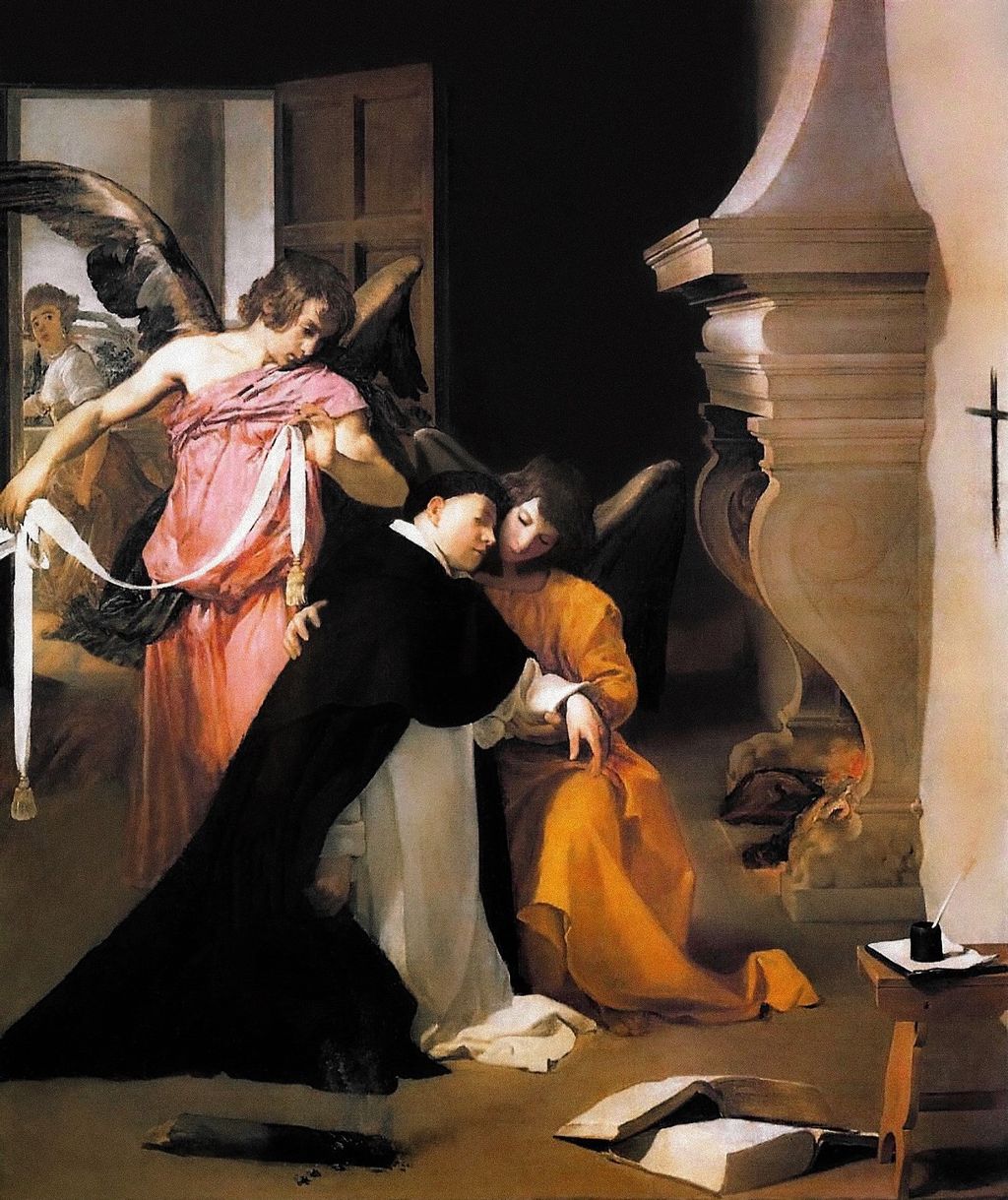
A young Dominican kneels beside a great stone fireplace, his body supported by an angel while another prepares a white cord. Behind them, a woman is already leaving through an open doorway. Velázquez's The Temptation of Saint Thomas Aquinas gathers these separate actions into a scene whose emotional centre is a lowered head and an exhausted face.
The painting belongs to the Museo Diocesano de Arte Sacro de Orihuela, which catalogues it as a work by Diego Velázquez dated 1632. Its subject is Thomas Aquinas, the Dominican theologian, rather than the apostle Thomas. The museum records its origin in the Colegio de Santo Domingo's Sala de Grados, or degree hall. [1] That setting connects the picture's religious story with a particular community of learning.
At a Glance
Where the painting sits in Velázquez’s career
Contents
What moment is being shown?
The subject comes from the legend of Thomas's resistance to sexual temptation. After rejecting a woman with a burning brand, the young friar receives the assistance of two angels. One supports him; the other brings the cord associated with his chastity. The Prado catalogue describes the saint after the struggle, supported by one angel while the other prepares the white cord. The departing woman keeps the earlier confrontation visible. [3]
The title can initially direct attention towards an encounter that is almost over. The woman is small and distant, and Thomas does not turn to watch her. The painting gives much more space to what follows: physical weakness, careful support and the preparation of the cord. Victory appears through the saint's inability to hold himself upright.
This choice changes the viewer's position. We are not placed opposite a contest between two equally prominent figures. We stand close to someone being steadied after a struggle, with the earlier event still visible beyond him.
Two different kinds of assistance
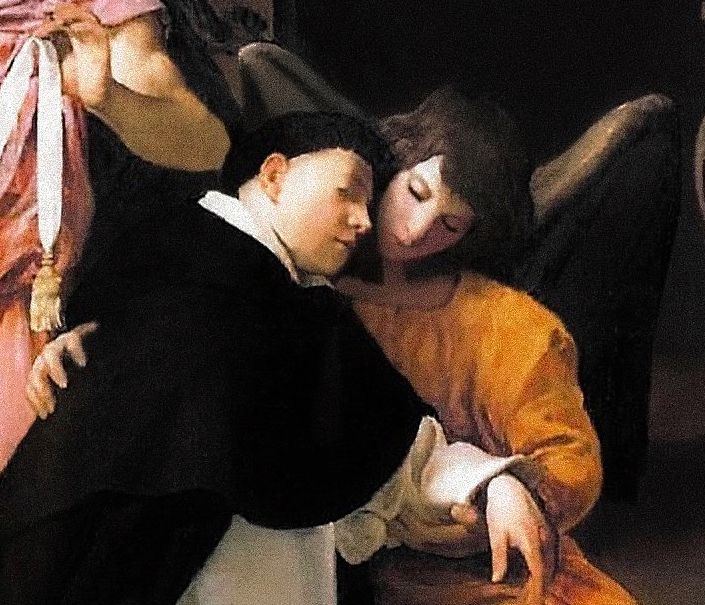
The kneeling angel beside Thomas forms a compact group with him. Their heads are close, and the saint leans towards the angel's golden clothing. His black cloak spreads downwards into a broad dark mass. Against it, the pale face, sleeve and hand become unusually conspicuous, allowing a small gesture to carry considerable weight.
Look at the hand that hangs towards the angel's knee. Its relaxed position differs from the more purposeful actions around it. The saint neither grips a weapon nor points towards a heavenly sign. His body seems to surrender its own support, and the angel supplies what is missing. The closeness of the two heads makes that dependence intimate without requiring an exaggerated expression.
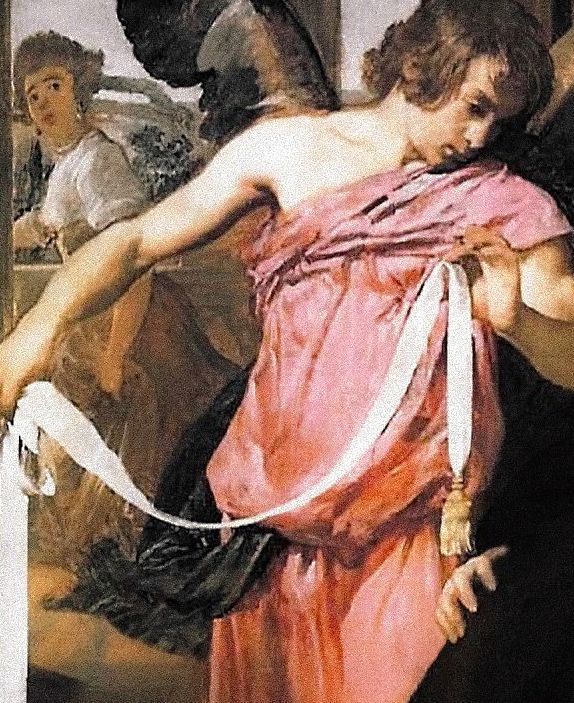
The standing angel opens the arrangement outwards. One arm reaches to the left with the white cord, while the other bends near the body. Pink drapery stretches across the torso in long, broken folds. The angel's wings and extended arm occupy space that the saint's bent posture leaves open.
These figures therefore move at different speeds. The kneeling pair encourages us to pause over a face and a supporting body; the standing angel carries our attention across the room. The cord links an action still to be completed with a figure who appears almost motionless. Together they make assistance both immediate and ceremonial.
Books, ink and the discarded brand
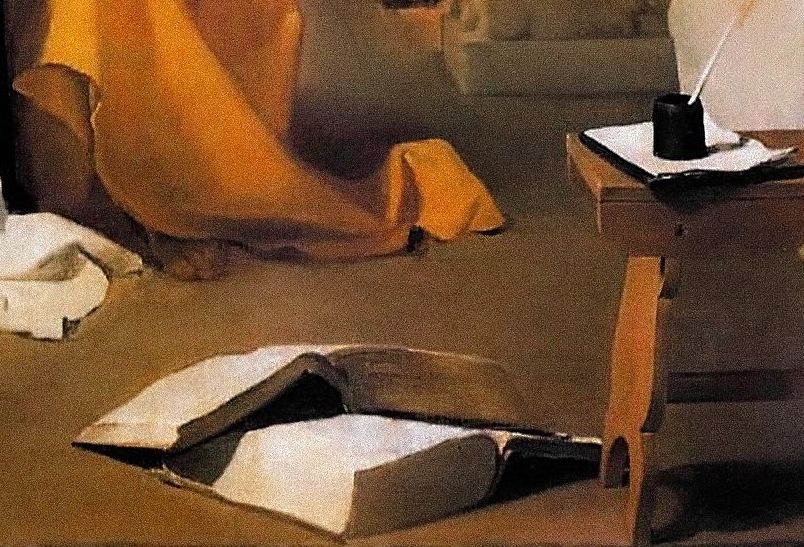
The objects at the front of the room bring another scale of looking into the picture. An open book lies near the lower edge, its pale pages angled towards us. Other volumes and papers occupy the floor and the small wooden support at the right. A dark inkstand and upright quill interrupt the lighter sheet beside them.
These are modest things compared with the fireplace above them, yet their closeness makes them difficult to ignore. They establish a threshold between our space and the figures. The book's open surface invites the eye into the room before the saint's black clothing draws it upwards.
The dark brand lies apart from the writing materials. Its rough, uneven shape contrasts with the straight edges of the pages and wooden furniture. In the story it belongs to an urgent bodily action; the books and ink suggest the quieter activity interrupted by that event. The painting allows the aftermath of disturbance to remain among the familiar equipment of study.
Nothing needs to be happening to these objects for them to hold attention. Their stillness makes the angels' movements more apparent, while the scattered arrangement prevents the foreground from becoming a neatly isolated display.
Annotated Details from The Temptation of Saint Thomas Aquinas
Begin with the two heads, follow the white cord, then look down towards the books and inkstand. The details connect bodily support, the legend and the equipment of study.
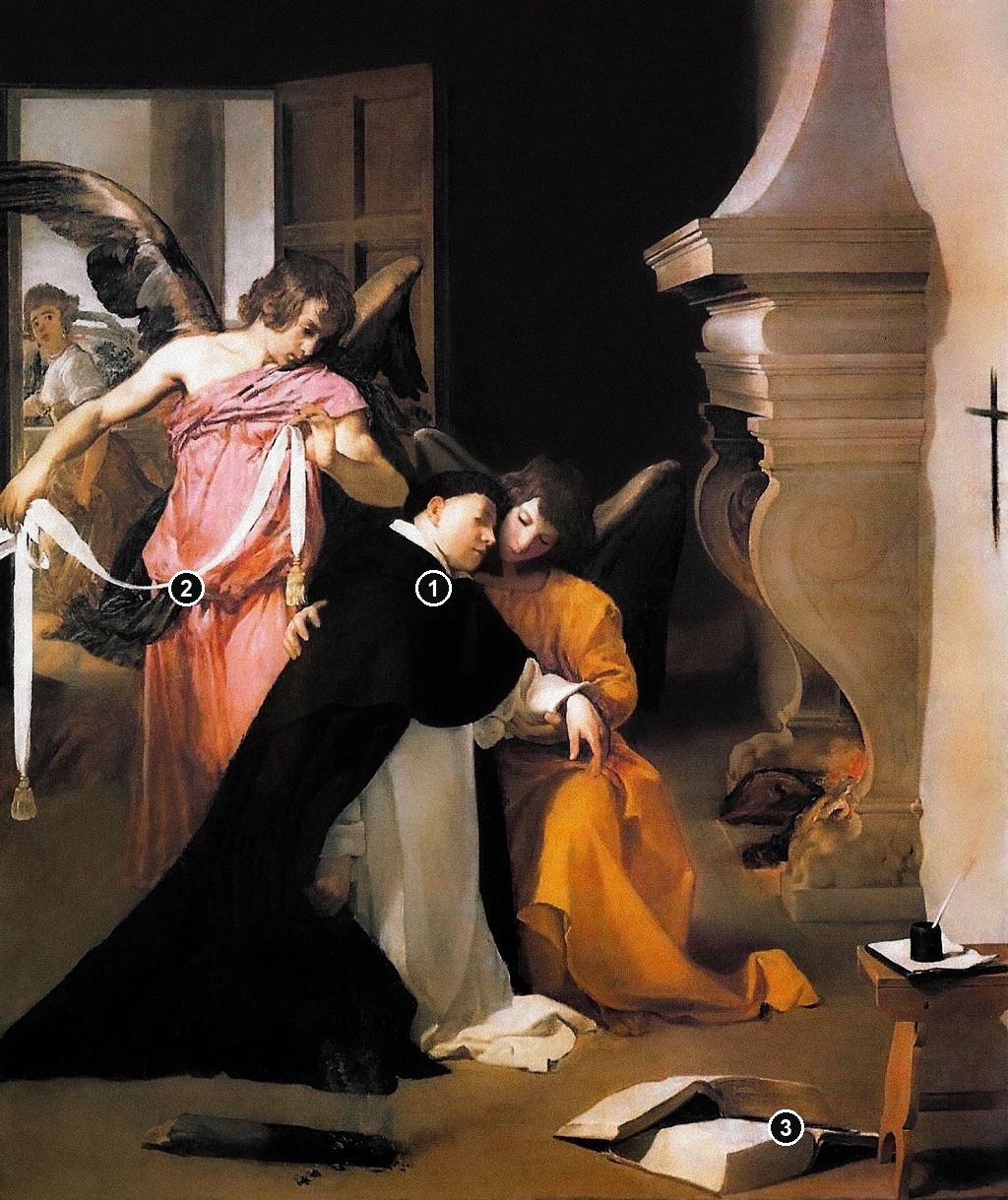
Details from THE TEMPTATION OF SAINT THOMAS AQUINAS
Photograph by RandomShadow, 2021, via Wikimedia Commons, CC BY-SA 4.0. Overview numbered; details cropped and resized directly from the unchanged photograph. These adaptations remain under CC BY-SA 4.0.
The saint and the supporting angel
The saint’s lowered head rests close to the supporting angel. Their small interval concentrates attention within the much larger room.
The white cord
The standing angel holds the cord associated with Thomas’s chastity. Its pale curve extends the action beyond the compact group of heads. [1][3]
Books and the inkstand
Open pages, a quill and an inkstand bring the equipment of study close to the viewer. Their straight edges contrast with the surrounding folds and gestures. [1]
A deep interior with a close human centre
The fireplace gives the right side of the canvas a formidable vertical structure. Its hood narrows as it rises, while projecting mouldings and a curved support divide the stone into distinct surfaces. The figures seem comparatively soft beside these edges: fabric folds, feathers and the exposed shoulder turn through gradual changes of light.
At the other side, the open door carries the eye away from the central group. The woman's turning head remains visible within that lighter distance. She belongs to the story, but her small scale also measures the room. Between her and the foreground books, we can sense how much space separates the departing figure from the saint.
The cross on the wall makes a spare counterpoint to the elaborate fireplace. It consists of two dark strokes, small enough to be missed while following the angels. Once noticed, it gives the right-hand wall another focus without competing with the clustered faces.
The room's depth does not diminish the importance of Thomas. Instead, distance seems to gather around him. The eye can travel towards the doorway or down to the books, but the closeness of the saint and supporting angel repeatedly draws it back. A broad setting becomes the means of concentrating attention on a very small area.
A proposed connection with Tintoretto
Art historians Gloria Martínez Leiva and Ángel Rodríguez Rebollo have compared this interior with Tintoretto's Last Supper at the Scuola Grande di San Rocco in Venice. Their 2011 study discusses a small copy that they attribute to Velázquez and proposes that his encounter with Tintoretto helped shape later spatial inventions. [4]
For the Orihuela painting, they emphasise the large fireplace, the foreground still-life objects and the opening at the back. They also identify a significant difference: architecture and people come closer in scale here, producing a more intimate relationship with the viewer. Their argument concerns a creative transformation of spatial ideas, rather than a simple repetition of another composition. [4]
This is a scholarly proposal, not a surviving account of Velázquez planning the picture. It nevertheless offers a useful way to look: compare the room's large architectural forms with the nearness of the bodies, and ask how each makes the other more affecting.
What the 1633 records establish
The painting's early history became clearer through research published by Javier Sánchez Portas in 1990. He transcribed a March 1633 payment for transporting a picture of Saint Thomas to the Colegio de Santo Domingo, followed in April by payment for a stretcher and for a painter's work on the canvas. He interpreted the sequence as evidence that the painting arrived rolled and was then prepared for display. [2]
Those records give the history a useful limit: the picture was already in Orihuela in spring 1633. They do not name Velázquez or provide an exact day of execution. The museum's 1632 date places the work shortly before this documented arrival. [1] [2]
Sánchez Portas also argued that the royal confessor, the Dominican Antonio de Sotomayor, probably supplied it as a gift. He connected the college's gratitude for Sotomayor's intervention in a dispute with its relationships at court. This proposed patronage is not established by a surviving commission contract. [2]
A debated attribution
The present museum attribution has a more complicated history behind it. In the Prado's 1990 exhibition catalogue, Julián Gállego reviewed earlier proposals involving Nicolás de Villacís and Alonso Cano. He also described arguments that divided responsibility between Cano and Velázquez, alongside attempts to explain the painting's different effects through successive stages of execution. [3]
The differences within the picture help explain why it attracted such discussion. The fireplace is precise and architectural; the standing angel's drapery is expansive; the distant woman has a fleeting presence. Yet a difference in treatment is not, by itself, proof that several painters participated. It also belongs to the painting's organisation of attention, scale and distance.
Gállego's account records a history of interpretation, not a list of equally current museum labels. Today the owning museum names Velázquez, and the 2011 study by Martínez Leiva and Rodríguez Rebollo discusses it as his work. [1] [4] Keeping those positions distinct allows us to recognise both the earlier debate and the attribution under which the painting is now presented.
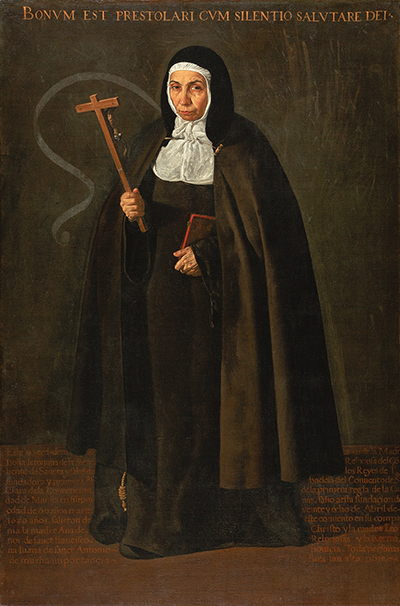
The Venerable Mother Jerónima de la Fuente. A signed work provides a securely documented comparison for the cloth, hands and devotional objects discussed in this attribution-sensitive article. View The Venerable Mother Jerónima de la Fuente.
Returning to the saint
The college provenance gives the books a particular resonance. A painting of a Dominican scholar, once displayed in a degree hall, could be encountered within the educational life of a religious institution. [1] That setting matters without requiring every object to carry a separately documented symbolic meaning. The open volume is first of all something visible, close enough to suggest a reader's place within the room.
Follow the picture from that book towards Thomas's hand, then towards the two heads. The passage brings together surfaces that behave very differently: paper, black cloth, pale skin and golden drapery. Their contrast makes the saint's dependence on the angel physically persuasive. The religious event takes form through the ordinary problem of a body needing support.
Finally, look again towards the woman at the door. Her departure keeps an earlier moment alive, but she no longer controls the scene. The central group offers a slower experience of what has happened. The painting's force lies in that change of pace: a confrontation gives way to stillness, and the viewer is left with the care required to sustain someone at the edge of collapse.
Artworks directory
Frequently Asked Questions
Thomas Aquinas, the Dominican theologian. This is not the apostle Thomas's encounter with the risen Christ. [3]
The Museo Diocesano de Arte Sacro de Orihuela, catalogue number 1. The museum records its provenance from the Colegio de Santo Domingo's Sala de Grados. [1]
Discussion
Follow the picture’s gestures, differences in scale and arrangements of light before deciding which passage holds the scene together.
Which passage first draws you towards the saint: the supporting angel's face, the contrast of black and white clothing, or the relaxed hand above the golden drapery? How does the distant doorway change your sense of the central group?
Reader Insights
Which gesture makes the saint’s exhaustion visible?
How do the books lead you towards the figures?
What does the distant doorway add to the scene?
Join the Conversation
Share a detail, comparison or question about The Temptation of Saint Thomas Aquinas below.
References
- Museo Diocesano de Arte Sacro de Orihuela, La Tentación de Santo Tomás de Aquino, catalogue 1: object fields, provenance and Spanish interpretive text. Consulted 28 October 2026. View source.Splash image: The Temptation of Saint Thomas Aquinas, 1632. Museo Diocesano de Arte Sacro de Orihuela, catalogue 1. Photograph by RandomShadow, 2021, via Wikimedia Commons; resized. Adaptation under CC BY-SA 4.0. · CC BY-SA 4.0
- Javier Sánchez Portas, El “Santo Tomás” de Velázquez del Museo Diocesano de Orihuela, Ars longa: cuadernos de arte, no. 1 (1990), pp. 57–63, especially pp. 57–59 and the transcribed documents on p. 61. Spanish article consulted in full; the archival originals were not independently examined. View source.
- Julián Gállego, Tentación de Santo Tomás de Aquino, entry 29 in Velázquez, exhibition catalogue, Madrid: Museo del Prado and Ministerio de Cultura, 1990, pp. 184–188. Spanish entry and colour plate consulted; earlier scholars' positions are reported through this catalogue. View source.
- Gloria Martínez Leiva and Ángel Rodríguez Rebollo, La Última Cena de Cristo: Velázquez copiando a Tintoretto, Archivo Español de Arte 84, no. 336 (2011), pp. 313–336, especially pp. 333–335. The relevant Spanish discussion of the Orihuela painting and its proposed spatial relationship with Tintoretto was consulted. View source.
- National Gallery, London, Diego Velázquez, Saint John the Evangelist on the Island of Patmos, NG6264. Collection record, artist dates and painting date; accessed 28 October 2026. View source.
- Wikimedia Commons, source reproduction for The Temptation of Saint Thomas Aquinas, photograph by RandomShadow,2021, CC BY-SA4.0. Overview numbered, details cropped and website image resized; adaptations under the same licence. View source.