by Tom Gurney
Tom Gurney BSc (Hons) is an art history expert with over 20 years experience
Email: tomgurney1@gmail.com / Phone: +44 7429 011000
Christ after the Flagellation: Introduction
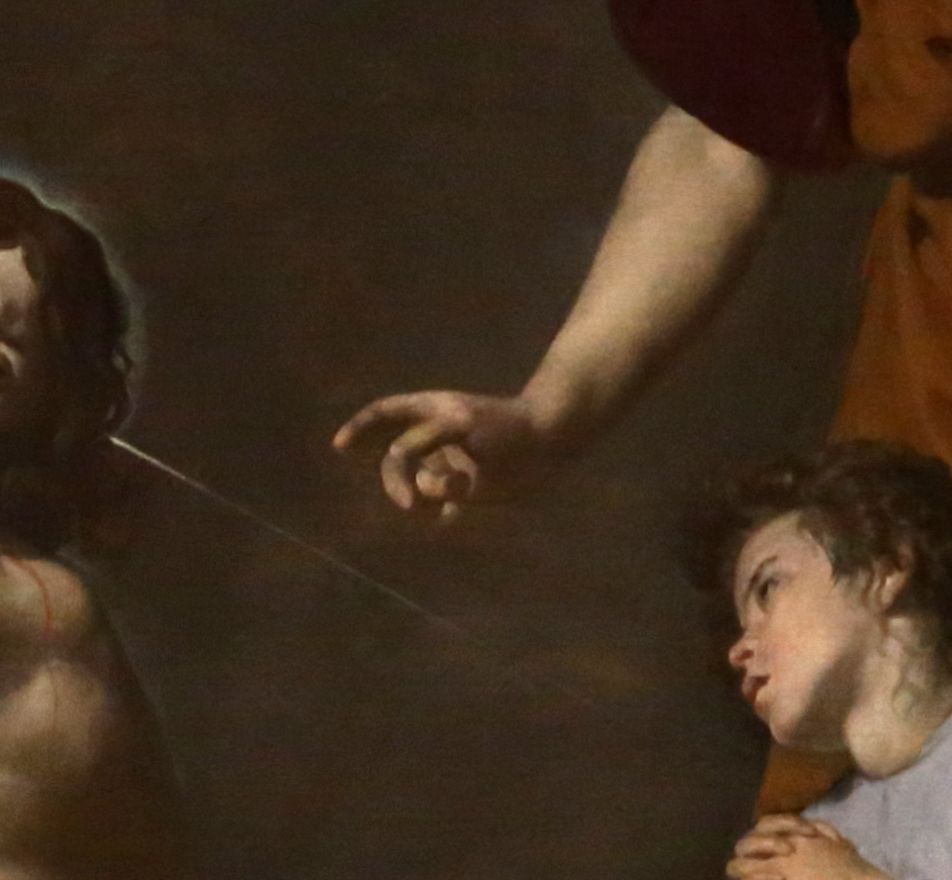
The angel lowers one hand into the dark space between Christ and the kneeling child. Its fingers are level with Christ’s shoulder, and the boy looks past them towards his face. A fine ray, easy to miss at first, reaches from Christ’s head towards the child’s breast. Below them, the scourge and broken twigs lie on the floor. The beating is over and the men who carried it out have gone. The rope running up from Christ’s bound hands to the column still holds him in the place where it happened. [1]
Diego Velázquez’s painting is in the National Gallery, London, under the number NG1148. Its full title is Christ after the Flagellation contemplated by the Christian Soul. The Gallery dates the oil on canvas to probably 1628–29. At 165.1 × 206.4 cm, the picture is broad enough to give the three figures room to keep their distance. Each gesture, even the quiet meeting of the boy’s hands, is legible across that space. [1]
At a Glance
- CollectionNational Gallery, London, NG1148 [1]
- PaintedProbably 1628–29 [1]
- Documented studyA reproduction records a lost drawing related to the angel. [2]
Contents
- The bodies and the room
- Why the child is called the Christian Soul
- What survives of the study for the angel
- The lines in Christ’s face
- Dating the red ground
- The Flagellation and the Crucifixion
The bodies and the room
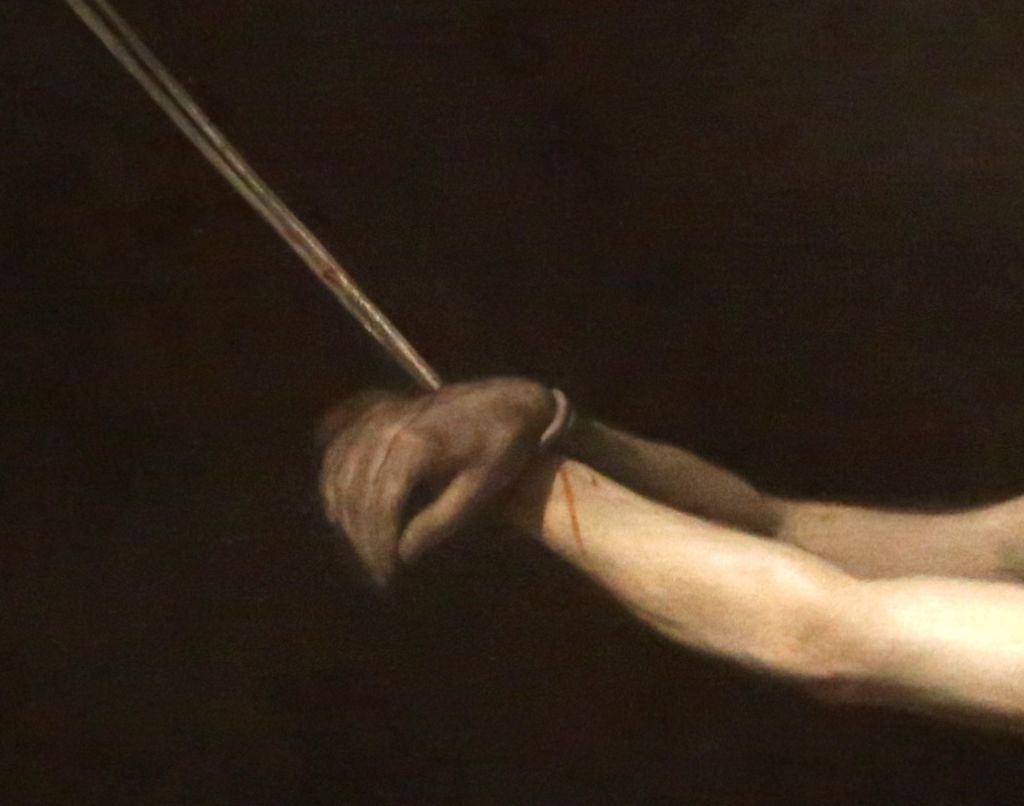
The column is largely swallowed by the left edge and the shadow. Its low stone base and the knot higher up give the eye two points from which to work out its position. The rope takes up the task from there. One length drops beside the column, while the taut diagonal runs out towards the raised wrists. Follow that diagonal down and the arms carry it into the light. Christ has sunk low enough for his bent legs to occupy the floor, yet his shoulders and torso remain drawn towards the point where he is fastened. His head turns away from the column towards the child. The turn makes the face available to us while much of the body is still oriented towards the rope. [1] [3]
The arms catch a nearly continuous light, interrupted at the wrists by the binding and at the shoulder by the rotation of the body. The hands at the end of those arms are soft-edged. Keith and Carr draw attention to the contrast with the more closely defined head. The change in definition makes an appreciable difference to where one looks. The wrists are immediately intelligible as tied hands, while the raised eyes and parted lips take longer to read. A few spots on the exposed skin and streaks on the column carry a further trace of the beating. Much of the back, where the viewer might expect to see its effects, curves away into shadow. [1] [3]
The discarded garments appear at the lower left as a dark mass truncated by the edge. The whiteness at Christ’s waist belongs to his loincloth, with angular strokes and a loose end beside the hip. Between these two areas of cloth, the visible floor gives the legs somewhere to rest. The lashes and twigs in the foreground do a second kind of work. Keith and Carr note how the scourge leads into depth, helping to turn the pale strip below the figures into a surface that extends behind them. The bundle of clothing projects towards the spectator, the column anchors the left side, and a faint division between floor and wall runs behind the group. A few objects give the room enough shape for the child to seem able to move through it. [1] [3]
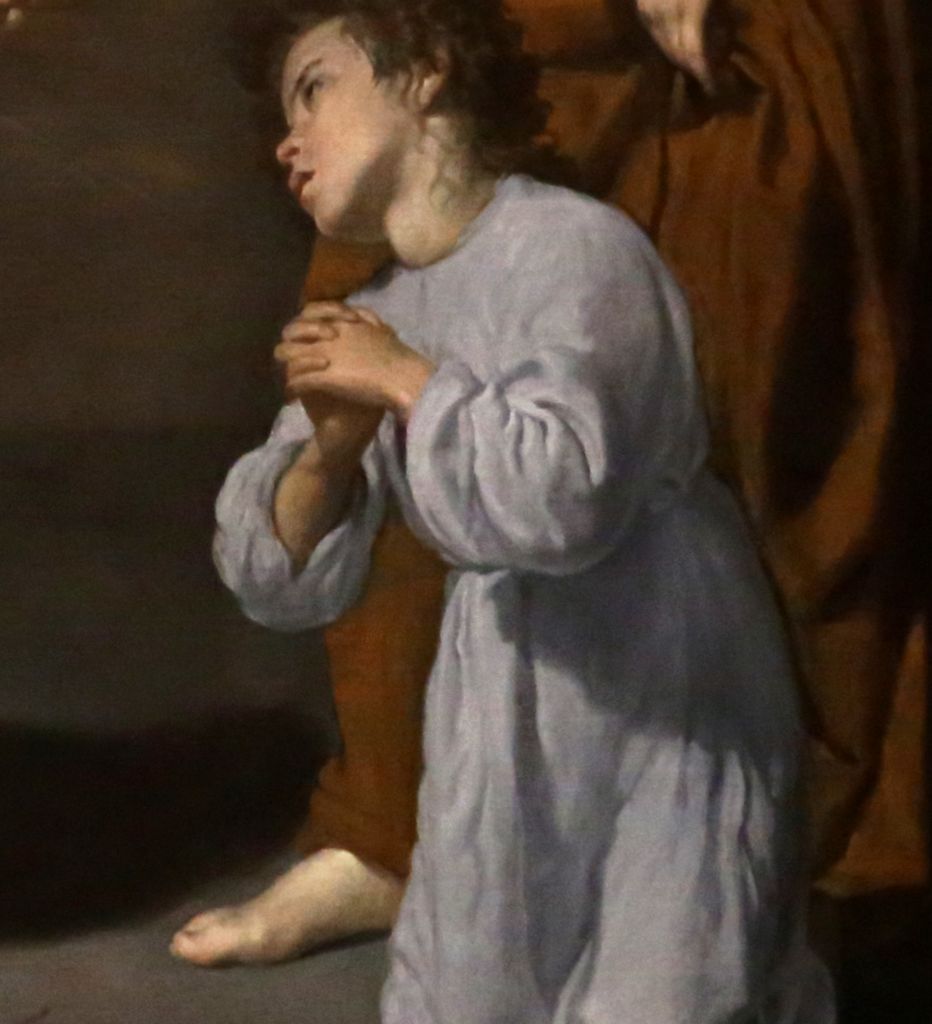
The people at the right mark depth in a less architectural way. The angel’s body is upright, with wings rising into the shadows, while its head dips and one arm reaches forwards. The boy occupies the space in front of its robe. A bare foot beneath the standing figure comes into view beside him, low down, where the material of his pale garment folds onto the floor. The arrangement gives the angel two evident responsibilities. It stands close enough to accompany the child and reaches far enough to direct his eyes away from itself. The pair could have been crowded against Christ. The intervening space lets us register the child’s effort to look. [1] [3]
Why the child is called the Christian Soul
The child embodies a person at prayer. The National Gallery identifies him as the Christian Soul and the figure beside him as its Guardian Angel. The boy inclines his head towards the injured man and clasps his hands under his chin. The angel looks down, where it can see the response of the figure it is guiding. Velázquez gives the exchange an additional direction through the small ray towards the child’s heart. When the line comes into view, it brings Christ’s answering gaze into the action. A scene that initially seems to be about being shown something becomes one in which the act of looking has an effect on the person who looks. [1]
The appearance of a guardian angel and child beside Christ at the column is unusual. Keith and Carr compare a painting dated 1616 by the Sevillian painter and priest Juan de Roelas, now at the Real Monasterio de la Encarnación in Madrid. In Roelas’s tall format the angel and child appear above Christ and to his right. The inscription on that work, as reported by Keith and Carr, calls upon the Soul to pity Christ and accept responsibility for his condition. The authors regard Roelas as a likely precedent for Velázquez and place both works in a Catholic devotional culture that encouraged worshippers to imagine themselves present at episodes in the Passion. They read the exceptional physical presence of Velázquez’s figures as a way to encourage compassion and sorrow for sin. [1] [3]
Roelas’s painting was made for Philip III, who gave it to the convent. The London picture’s earliest known owner is much later. Keith and Carr suggest a small chapel, possibly a conventual one, and consider uses such as personal devotion or instruction for novices. The supposition rests on the subject and scale. The recorded provenance begins with John Savile Lumley’s purchase in Madrid in 1858. He lent the painting for exhibitions in London in 1860 and Brussels in 1873 before presenting it to the National Gallery in 1883. The original patron and setting remain unknown. [1] [3]
What survives of the study for the angel
In a reproduction of a drawing once kept at the Instituto de Jovellanos in Gijón, a standing figure inclines its head and opens a hand towards the lower left. Cloth crosses the chest, bunches at the waist and descends in long folds. The image is reproduced as no. 410 in José Moreno Villa’s 1926 catalogue, a page reprinted in the Gijón museum study of the collection. Carl Justi had already connected the drawing with the London angel. He described it as a preparatory study from a model and drew attention to differences in the head and the hand that lifts the robe. [2] [4]
The shared inclination of the head and extension of the arm are still apparent across the two images. The open hand in the reproduction becomes a more directed gesture in the oil. In the drawing, a hand gathers fabric higher on the body, where the sketch sets up a succession of loops and folds below it. In the painting, the corresponding arm falls alongside the robe, and the winged figure has the child in front of it to give that extended arm a purpose. The comparison gives a reason for considering the sheet a study of the pose. Its connection to the London canvas was recognised before the Gijón drawing collection was destroyed in the fire of August 1936 during the Spanish Civil War. The reproduction is what now permits the comparison, and the loss of the original limits what can be established about its materials or preparation. [1] [2] [4]
On the canvas itself there is a different kind of evidence for working out the design. Marks in the paint record parts of the composition at early stages of its making. The drawings place the lost Gijón sheet among other surviving or recorded works on paper associated with Velázquez. The face on the London canvas lets the eye trace a few decisions he made with a brush. [3] [2]
Annotated Details from Christ after the Flagellation
Follow the rope, the angel’s gesture and the kneeling child.
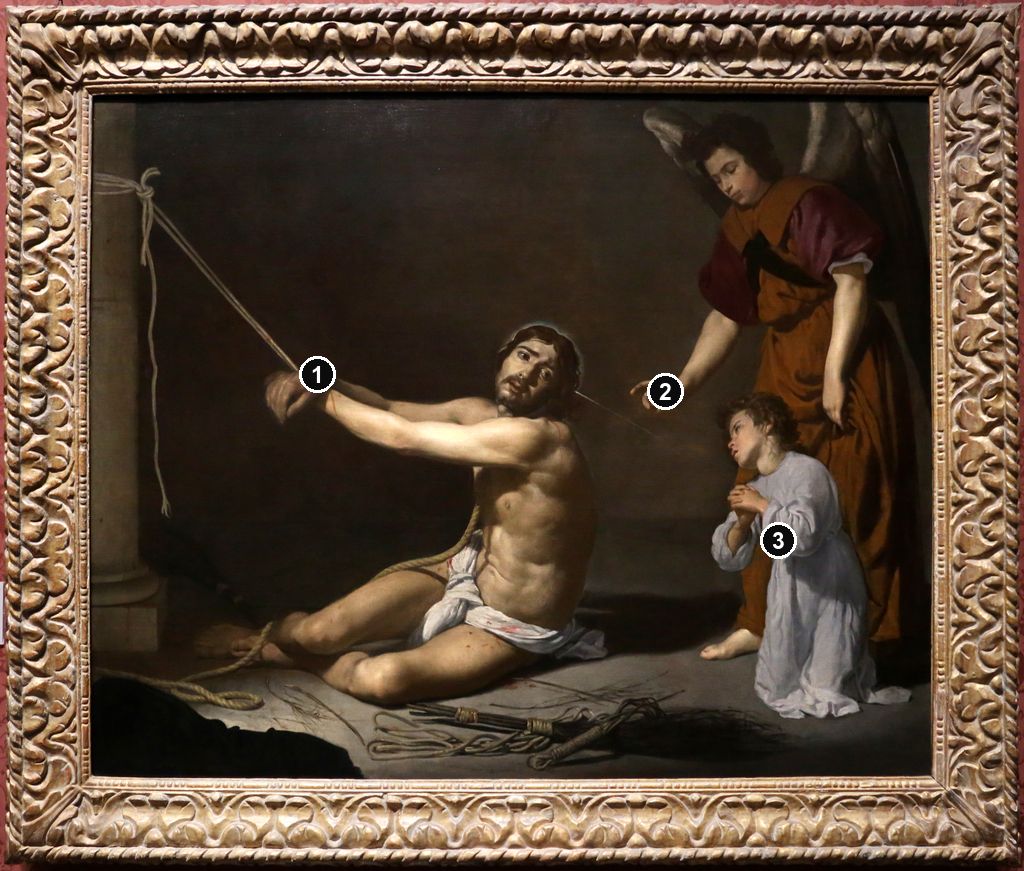
Details from CHRIST AFTER THE FLAGELLATION
The bound hands
The diagonal from the rope to the wrists gives the column a physical connection to the kneeling body.
The angel’s pointing hand
A short stretch of darkness separates the extended hand from Christ. Follow the direction of the gesture towards his body.
The kneeling child
The child’s face turns towards Christ while the hands meet at the chest. The light cloth makes that still pose easy to follow.
Photograph by Sailko via Wikimedia Commons, CC BY 3.0. Numbered labels and detail crops added.
The lines in Christ’s face
Keith and Carr record early brown-black brush lines visible in sufficient light in Christ’s anatomical left eye and along the nose, mouth, chin and Adam’s apple. The shadows here are built thinly enough to let the lines show through. Over the red preparation on the canvas, Velázquez put a thin brown layer locally. Its tone serves for much of the shadow and the passage into middle tones, while more opaque paint brings the lit parts forward. Look at the turn below the mouth. The line gives a feature its definition, then the adjacent brown paint lets it recede again. Christ’s torso and the faces of the angel and child were worked with more opaque grey-brown mixtures containing white. The method used for Christ’s face is local to this passage of the picture. [3]
At the column base the evidence changes. The finished paint stops at straight edges, leaving a narrow streak of red ground, the preparatory layer underneath. There is no visible line in that streak. The authors propose that a ruled guide, possibly in charcoal, could have helped the painter keep the edges straight before being removed. The red streak survives and the guide remains hypothetical. A close view of the column therefore offers a different kind of evidence from the early brushed lines still present on the face. [3]
Keith and Carr explain that the facial lines offered too little contrast against the dark ground in infrared examination and had too low an atomic density to register separately in the X-radiograph. The published X-ray details help to distinguish the heavier application of paint in passages of the child’s flesh from the thinner treatment of Christ’s head. The examination also identifies changes in the placement of the loincloth, the tilt of the child’s head and the position of the bundled garments. They concern the things a viewer can follow across the floor and up into the exchange of looks. The bright stroke at the right of the published X-ray detail of Christ’s head is material later added to the reverse in conservation, as the figure caption specifies. [3]
Dating the red ground
The red under the paint has a bearing on where the painting was made. Keith and Carr compared the preparation with a sample from The Triumph of Bacchus, for which a royal payment is documented in 1629. Both have a ground rich in natural red earth, consistent with a preparation used by Velázquez in Madrid in the 1620s. The ground in the Flagellation is generally covered by the paint above it. A small exposed strip along the angel’s sleeve, where adjacent colours stop short of meeting, gives a view of a red that plays little part in the overall colour as it now appears. [3]
The painting’s handling has also led scholars to place it during or shortly after the first Italian journey. The broadly modelled torso and economical treatment of light and shadow in Christ’s face can seem closer to the ambitious work Velázquez made in Italy than to the painting of Bacchus surrounded by drinkers. The two subjects still share a way of establishing depth through foreshortened bodies and a prominent dark form at lower left. The payment for Bacchus dates a transaction, leaving some latitude in when Velázquez made the picture. Keith and Carr weigh the red preparation alongside the ways he built up the flesh and organised the space. The National Gallery’s preferred dating of probably 1628–29 places the painting near the end of his first years in Madrid, before the 1629 departure. [1] [3]
The paintings made on that journey give the red ground comparison more weight. Keith and Carr identify a brown preparation in Joseph’s Bloody Coat and a pale grey one in Apollo in the Forge of Vulcan. The brown in the Joseph painting serves more extensively through the flesh colours, developing a possibility that Velázquez used in a small area here. In Apollo a pale ground allowed a wider range of tones to be made with thin paint. The Flagellation retains the red Madrid preparation while letting a thin layer of brown do some of the modelling in that crucial face. [3]
The Flagellation and the Crucifixion
In the Prado’s Christ Crucified, P001167, the beams and the extended arms determine the shape of a tall canvas. Christ’s bowed head and falling hair make the face difficult to read, and he is alone on the cross. In London the violence belongs to an earlier moment in the Passion. The rope fixes Christ to a column, the body twists close to the floor, and the face turns to someone who can see it. A further Prado canvas, Christ on the Cross, P002903, is a smaller, separate work. The museum’s 1990 exhibition catalogue discussed a signature dated 1631 on that canvas and expressed reservations about the attribution. [1] [5]
Spend a little longer with the floor and the gaze rises through the picture again. The discarded instruments lead towards the legs and the pale cloth at the waist. The turn of the torso brings the eye to the arms, which run back to the tie at the column. From the knot it takes only a small movement down and across to find Christ’s face. The angel’s outstretched hand and the child’s lifted head both hold attention there. The room is sparsely furnished, but Velázquez has given each of these objects and gestures a place in the slow act of looking that the boy performs. [1] [3]
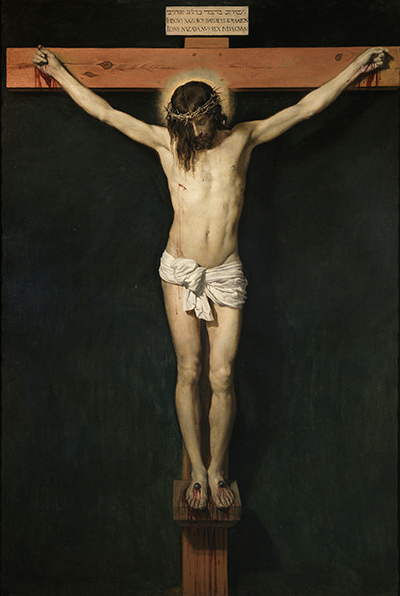
Christ Crucified. Compare an isolated figure on the cross with the relationships between Christ and his witnesses in the London canvas. View Christ Crucified.
Artworks directory
Frequently Asked Questions
National Gallery, London, NG1148 [1]
Probably 1628–29 [1]
The child embodies a person at prayer. The National Gallery identifies him as the Christian Soul and the figure beside him as its Guardian Angel. The boy inclines his head towards the injured man and clasps his hands under his chin. [1]
Discussion
Look again at the images and ideas explored in Christ after the Flagellation. These editorial prompts invite your observations.
Reader Insights
How does the angel’s arm guide your eye across the unoccupied floor?
What do the visible painted lines tell you, and what can only be proposed from the edges near the column?
Join the Conversation
Share a detail, comparison or question about Christ after the Flagellation below.
References
- National Gallery, Christ after the Flagellation contemplated by the Christian Soul, Diego Velázquez, NG1148, collection record and in-depth entry. View source.
- Francisco Crabiffosse Cuesta, La colección de dibujos del Instituto de Jovellanos: Difusión y evocación, Museo Casa Natal de Jovellanos and Muséu del Pueblu d’Asturies, 2020, p. 122, reproduction of José Moreno Villa’s 1926 catalogue no. 410, and pp. 126–131 on the loss of the collection (Spanish). View source.
- Larry Keith and Dawson W. Carr, “Velázquez’s ‘Christ after the Flagellation’: Technique in Context”, National Gallery Technical Bulletin, vol. 30, 2009, pp. 52–70, especially pp. 56–69, plates 9–12 and 14–23, figs. 2–3 and p. 70 n. 14. View source.
- Carl Justi, Diego Velazquez and His Times, translated by A. H. Keane, London, 1889, pp. 245–246, “Christ at the Pillar”, historical account of the Gijón study no. 410. View source.
- Julián Gállego, Museo Nacional del Prado, Velázquez, exhibition catalogue, Madrid, 1990, cat. 27, Cristo en la cruz, Prado P002903, and cat. 28, Cristo crucificado, Prado P001167, pp. 178–183 (Spanish). View source.