 by Tom Gurney
Tom Gurney BSc (Hons) is an art history expert with over 20 years experience
Published on July 7, 2026 / Updated on July 7, 2026
Email: tomgurney1@gmail.com / Phone: +44 7429 011000
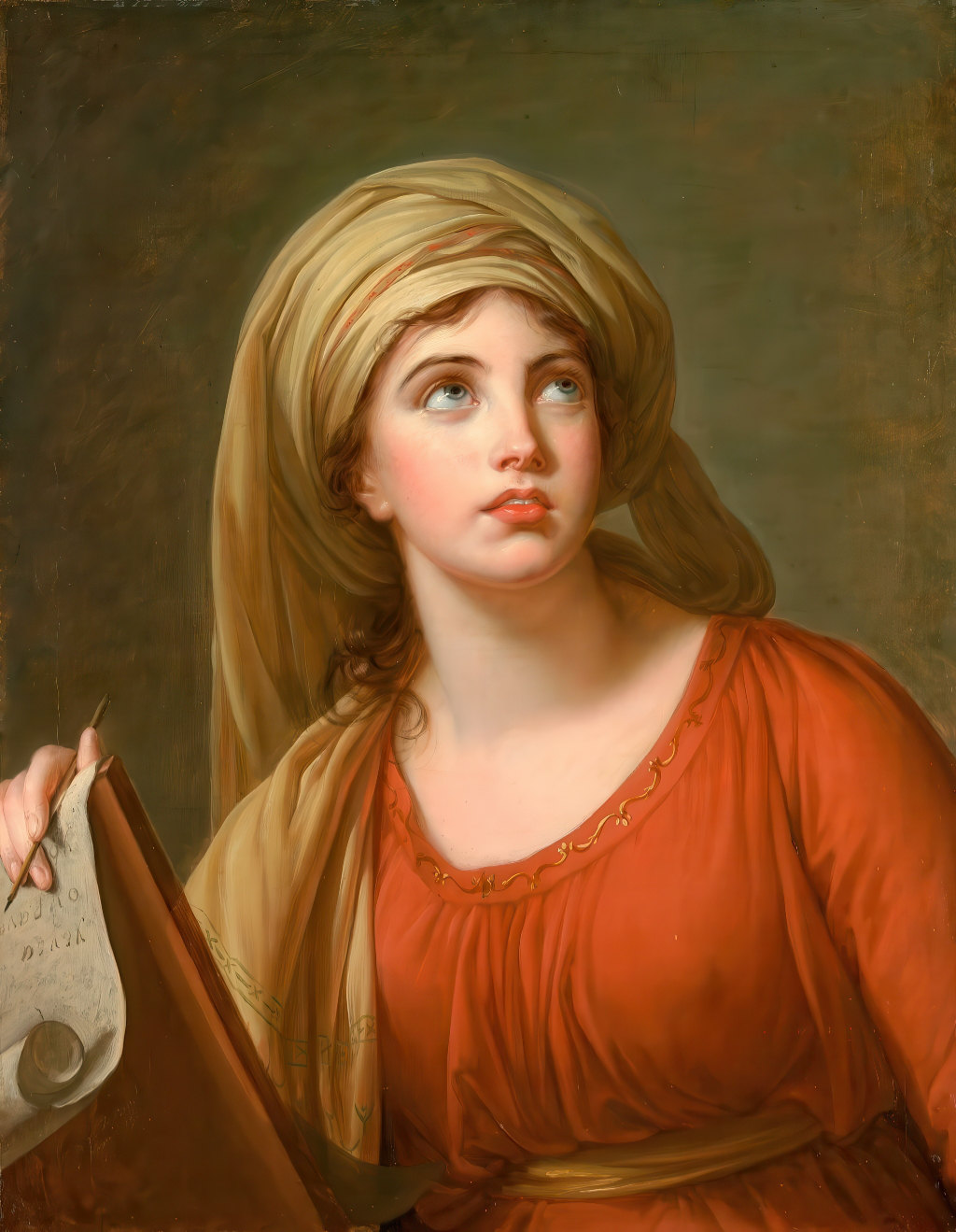
Lady Hamilton as the Cumaean Sibyl by Élisabeth Vigée Le Brun
Élisabeth Vigée Le Brun's Life Study of Lady Hamilton as the Cumaean Sibyl was painted in Rome in 1792. The Met's 2016 exhibition catalogue records the work as an oil on canvas, signed and dated by the artist, measuring 73 x 57.2 cm, and now in a private collection. [1]
This page replaces the earlier working title "Emma Hamilton as the Persian Sibyl". The stronger source trail supports Lady Hamilton as the Cumaean Sibyl, so the page title and slug have been corrected before translation.
The painting is useful because it sits between portrait, role study and theatrical image. Lady Hamilton is still a recognizable modern celebrity, but the Sibyl role lifts the image into antique performance. Vigée Le Brun uses the sitter's fame for expressive transformation rather than straightforward likeness alone.
At a Glance
- Artist:Élisabeth Louise Vigée Le Brun [1]
- Title:Life Study of Lady Hamilton as the Cumaean Sibyl [1]
- Date:1792 [1]
- Medium:Oil on canvas [1]
- Dimensions:73 x 57.2 cm [1]
- Collection:Private collection [1]
- Inscription:Signed and dated at Rome, 1792 [1]
Contents
- At a Glance
- Why It Matters
- Lady Hamilton and Performance
- The Cumaean Sibyl
- Looking Carefully
- Provenance
- Timeline
- Comparison Works
Why It Matters
The painting matters because it turns portraiture into theatrical identity. Lady Hamilton was famous for performance, beauty and self-display, and Vigée Le Brun represented her not as an ordinary sitter but in the guise of the Cumaean Sibyl, a prophetic figure from antiquity. [1]
The work also shows how Vigée Le Brun's exile years expanded her subject range. In Italy, she painted sitters whose identities were shaped by performance, antiquity and international celebrity.
That context separates the painting from the court portraits of the 1780s. Instead of repairing royal reputation or presenting aristocratic ease, Vigée Le Brun is working with a sitter famous for self-display and transformation. The portrait becomes a meeting point between the artist's polished style and Lady Hamilton's theatrical persona.
Lady Hamilton and Performance
The Met catalogue places Emma, Lady Hamilton, in the world of Sir William Hamilton and Naples. It records that the life study was connected to a larger private-collection painting and that Vigée Le Brun painted this first, bust-length version. [1]
This matters because the work is not simply a reduced portrait. It is a study of a role: Lady Hamilton becomes a Sibyl, and portraiture becomes performance.
The term "life study" is also worth taking seriously. It suggests direct observation, but the observation is directed toward a performed identity. Vigée Le Brun is studying a living sitter as she inhabits an antique role, which gives the work its unusual mix of immediacy and theatrical distance. [1]
The Cumaean Sibyl
The Cumaean Sibyl was associated with prophecy and ancient Italy. By placing Lady Hamilton in that role, Vigée Le Brun gives contemporary celebrity an antique, inspired identity.
That makes the page useful beside Madame de Staël as Corinne. Both paintings show women framed through inspired roles: Sibyl and poet.
The comparison also shows the difference between performance and authorship. Lady Hamilton's Sibyl persona depends on bodily expressiveness and theatrical transformation; Madame de Staël's Corinne persona depends on literature, inspiration and self-authored identity. Vigée Le Brun adapts role portraiture to both sitters.
Looking Carefully
The bust-length format concentrates attention on face, expression and costume. The painting is less about setting than transformation. The sitter's identity is carried through pose, gaze and role rather than a detailed narrative scene.
The signed Rome inscription also matters. It fixes the work in Vigée Le Brun's Italian exile years and gives the image a precise place within her international career. [1]
Look especially for how compressed the image is. Because the format is bust-length, the role has to be carried by face, costume, gesture and expression rather than by a full narrative setting. This concentration suits Lady Hamilton's reputation for performance: the sitter's body and expression become the scene.
Provenance
The catalogue traces the work from Sir William Hamilton's 1801 Christie’s sale to Baron St. Helens, then by descent through the FitzHerbert family, and later into private collections. [1]
Timeline
- 1792: Vigée Le Brun paints and signs the life study in Rome. [1]
- 1801: The work appears in Sir William Hamilton's Christie’s sale. [1]
- 1839: It remains with Baron St. Helens until his death. [1]
- 2003: The catalogue records later passage through private collections. [1]
Comparison Works
The strongest internal comparison is Madame de Staël as Corinne. Both images turn living women into inspired figures, but Lady Hamilton is framed through performance and prophecy, while de Staël is framed through authorship and literary identity. [2]
FAQs
The Met catalogue records the painting as Life Study of Lady Hamilton as the Cumaean Sibyl, so this page uses Cumaean Sibyl. [1]
The catalogue records it in a private collection. [1]
The role turns the sitter into an inspired antique figure, aligning portraiture with performance, prophecy and classical imagination.
References
- Joseph Baillio, Katharine Baetjer and Paul Lang, Vigée Le Brun, The Metropolitan Museum of Art, 2016, cat. 50.
- Joseph Baillio, Katharine Baetjer and Paul Lang, Vigée Le Brun, The Metropolitan Museum of Art, 2016, cat. 80.
Discussion
What stands out to you about Élisabeth Vigée Le Brun? Share an observation, question or interpretation with other readers.
Reader Insights
Which visual detail changes how you read the sitter, the artist or the page's central theme?
Which related Vigée Le Brun page helps you understand this work or topic more clearly?
Join the Conversation
Thoughtful comments and questions are welcome.