



 by Tom Gurney
Tom Gurney BSc (Hons) is an art history expert with over 20 years experience
Published on June 19, 2020 / Updated on November 1, 2026
Email: tomgurney1@gmail.com / Phone: +44 7429 011000
Fernand Léger’s paintings: Introduction
Fernand Léger’s paintings give bodies, buildings and everyday possessions an extraordinary physical presence. A limb can resemble a cylinder; a bunch of keys can outweigh a famous face; a patch of colour can cross a body without describing its skin. These changes invite us to look at familiar things afresh. They also make his work more varied than its reputation for mechanical figures and primary colours might suggest. His painted world includes crowded forests, domestic interiors, swimming bodies, circus performers and workers balancing among girders.
Following those subjects across his career reveals changing relationships between people and their surroundings. Early figures are difficult to disentangle from the landscape. In the city pictures, people share the surface with architectural fragments and signs. Later paintings give leisure and collective activity a commanding scale. Throughout, Léger asks how much a painting can alter appearances while retaining contact with ordinary experience. Selected canvases show how that question connects his apparently different phases.
At a Glance
- ArtistFernand Léger
- SubjectPaintings
Contents
- Bodies and landscapes built from volumes
- Colour and the approach to abstraction
- War, machines and the city
- Monumental figures and domestic things
- Objects released into space
- Independent colour and moving bodies
- Leisure, work and the public picture
- From the canvas to its surroundings
Bodies and landscapes built from volumes
In Nudes in the Forest, dated 1909–1911 by the Kröller-Müller Museum, the human body and the wooded setting seem to be made from the same substance. Curving trunks, rounded limbs and sharp-edged planes press against one another. The restrained grey, green and brown palette makes their competing directions especially forceful. The museum identifies three nudes within this dense construction, but the first impression is of a field of volumes rather than three isolated bodies. Looking becomes an active process of distinguishing one form from the next.[1]
This is an important starting point for Léger’s Cubism. A rounded form can retain the suggestion of mass even when its surroundings refuse a coherent depth. In the forest painting, light patches turn across surfaces, while abrupt dark boundaries break their continuity. The eye repeatedly begins to reconstruct a solid figure and then encounters another shape cutting through it. The painting’s energy emerges from that uncertainty about where bodies end and landscape begins.
The exchange between curved and angular forms also gives early urban landscape a role in his development. Katharine Kuh’s 1953 catalogue discusses Léger’s smoke as a substantial pictorial element, capable of dividing a canvas and directing movement. Smoke offered something different from the hard edges of buildings: a changing, rounded shape that he could nevertheless give weight. The city therefore supplied more than machines. Its atmosphere, rooftops and interruptions opened new possibilities for organising painted space.[2]
Nude Model in the Studio, now in the Guggenheim collection and dated 1912–13, moves the figure into another densely constructed setting. In the reproduction, broad pale curves occupy much of the centre, while black wedges and smaller red or yellow areas disrupt any easy reading of the body. Kuh describes the relationship between the nude’s curves and the studio’s broken angles. Across these early paintings, figure, landscape and interior become related problems: each allows Léger to test how a recognisable world can survive a powerful geometric reconstruction.[2]
Paintings in this cluster







Colour and the approach to abstraction
The Contrasts of Forms take that investigation further. In the Fondation Beyeler’s 1913 canvas, bright red areas punctuate a crowded arrangement of white, dark blue and black forms. Shaded curves appear to turn towards us, yet the repeated interruptions prevent them from settling into a continuous object. Patches of exposed-looking ground and loose edges keep the construction visibly painterly. The work can suggest cylinders, cones or bodies without requiring us to name a subject before we can follow its rhythm.[3]
Abstraction here develops from the relationships already active in the early figure paintings. The distinction between a curved mass and a flat patch, or between a brilliant colour and a dark boundary, becomes sufficiently interesting to sustain a canvas. In its 2008 exhibition guide, the Fondation Beyeler emphasised the constructed space of these paintings: forms seem stacked and fitted together. That description helps explain why the image can feel full of depth even while refusing a single scene.[3]
The Beyeler painting is one member of a series, with other canvases bearing similar titles. Its tensions between recognisable volumes and abstract organisation suggest a possibility for later painting: an identifiable object could return within a structure of shapes and colours.
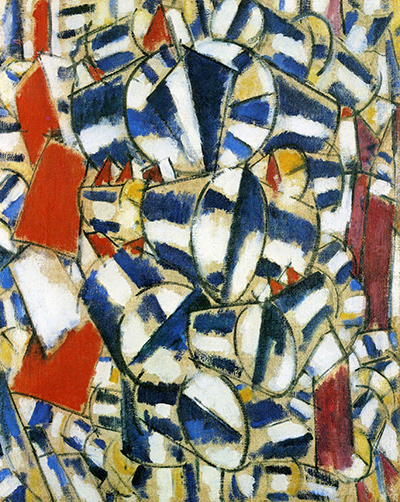
Fernand Léger, Contrast of Forms. Abstraction makes contrasts of form and colour the subject of the picture.
War, machines and the city
The First World War altered the circumstances in which Léger worked and the people and objects he attended to. Rachel Boate’s Metropolitan Museum essay describes his drawings of soldiers and military equipment, and connects his renewed interest in the visible world with respect for the soldier and worker. This relationship matters to the paintings that follow: their mechanical vocabulary grew alongside a continuing concern with human experience and with reaching a wider public.[4]
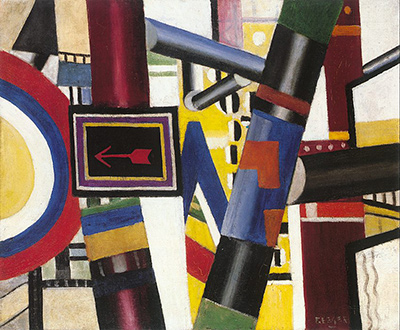
His postwar urban paintings demand a different kind of looking from the early forests. The Art Institute of Chicago’s The Railway Crossing (Sketch) is a small oil study of 1919, distinct from the larger composition for which it prepared. In this canvas, a conspicuous arrow sits among broad cylinders, diagonals and a partial disc. Although the arrow promises direction, the surrounding forms send the eye through several competing routes. The museum describes a circulation of volumes within shallow space, and the image makes that movement tangible through the crowding and crossing of its parts.[5]
The shift in scale becomes decisive in Philadelphia’s The City of the same year. Nearly three metres wide, it presents an environment through fragments: lettering, railings, structural shapes and figures. The Philadelphia Museum of Art identifies these elements and relates the work’s broad, flattened expanse to a mural, theatre backdrop or cinema screen. There is no single viewpoint from which all the fragments become an orderly street. They make the experience of a city through the succession of things that catch the eye.[6]
This is one reason to distinguish urban subject matter from a literal city view. A sign, a disc and a girder have different uses outside the painting, but on its surface their edges and colours interact directly. The large canvas gives those encounters room to accumulate. A small study such as Chicago’s Railway Crossing can compress visual movement; the Philadelphia painting spreads it across a field large enough to confront the viewer bodily. Neither depends on a complete inventory of the machinery or architecture it evokes.
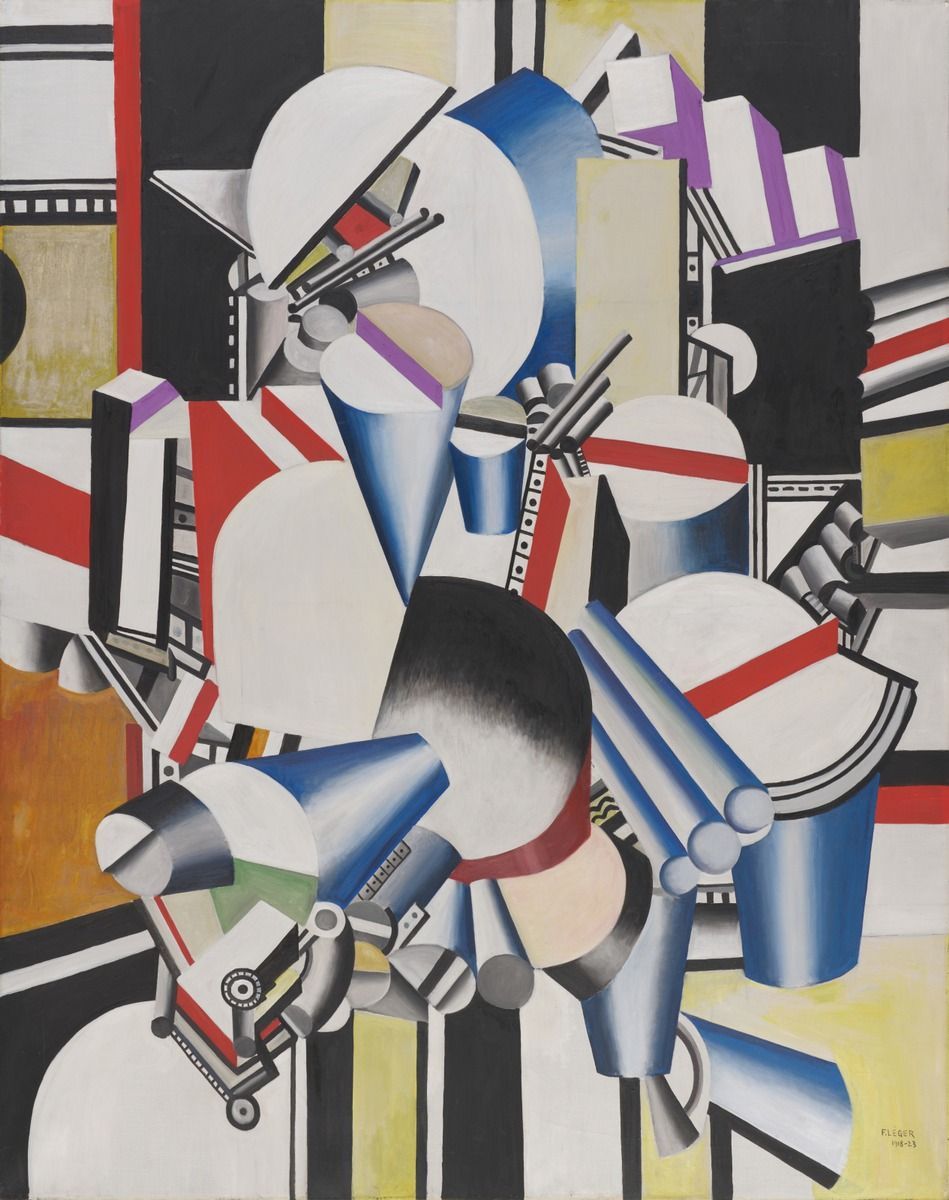
The Met’s Mechanical Elements of 1920 offers a concentrated comparison. Its narrow canvas contains interlocking coloured shapes and shaded tubular forms held within strong black divisions. The museum cautions that Léger’s mechanical paintings do not reproduce identifiable machine parts. Their combinations evoke machinery and contemporary technology. That distinction allows us to enjoy the painting’s exactness without trying to reconstruct a working engine from it. Precision belongs to the painted arrangement even where the objects remain invented.[7]
Monumental figures and domestic things
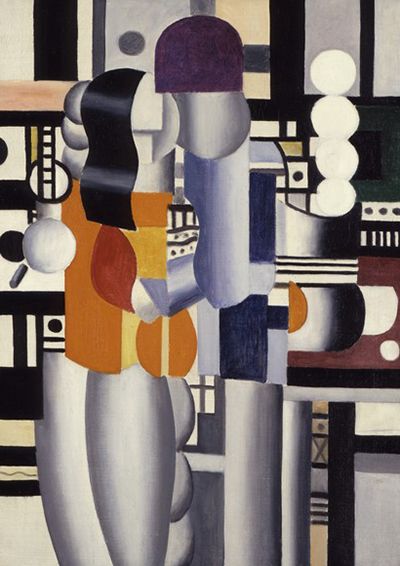
The imposing figures of the early 1920s change the pace of Léger’s painting. MoMA’s Three Women, dated 1921–22, gathers three nudes around a small table in an interior filled with strong patterns. Their curved limbs and gleaming surfaces retain the vocabulary of constructed volumes, but the bodies now read immediately. The frontal faces, rounded knees and horizontal reclining figure establish a substantial human presence amid the room’s competing shapes.[8]
The canvas also changes what monumental painting can contain. A cup, a table and patterned flooring occupy the same composition as a grand grouping of nudes. The red table draws attention to the small scale of domestic activity within the breadth of the picture. Looking from that table to the women’s smooth limbs reveals a continuity between household objects and bodies: each is shaped, weighted and carefully positioned. MoMA’s current label describes the interlocking arrangement in mechanical terms. The image’s stillness nevertheless gives this phase a markedly different tempo from the urban paintings.[8]
The Met’s Woman with a Cat of 1921 belongs to this broader group of monumental female figures. The museum relates its frontal nude both to classical sculptural presence and to the streamlined contemporary design associated with Le Corbusier. Those associations explain why the early 1920s should not be treated as a simple retreat from modernity. The firm, legible body could accommodate historical traditions of figure painting while retaining a distinctly contemporary surface and construction.[9]
Still life makes a related adjustment in scale and attention. Tate’s Still Life with a Beer Mug, dated 1921–22, places an ordinary meal within a dense arrangement of objects and patterns. In Tate’s reproduction, the upright red-and-white mug becomes a forceful shape above the slanting table, while black-and-white diamonds extend below it. The museum’s short description identifies a workman’s lunch. A modest subject thus carries a composition whose visual assertiveness is comparable to that of the figure pictures.[10]
Seen together, these interiors and still lifes broaden the meaning of Léger’s machine-age painting. Modern experience includes the table at which someone eats and the room in which someone rests. The absence of dramatic action gives relationships between shapes time to register. A curved handle, a smooth arm or the edge of a table can become the main event of looking. His paintings make room for daily life by increasing the pictorial authority of things that might otherwise pass unnoticed.
Objects released into space
By 1930, the familiar thing could leave the ordered setting of a room. In Mona Lisa with the Keys, in the Musée national Fernand Léger, a large bunch of keys occupies the centre and projects across a much smaller painted reproduction of Leonardo’s portrait. The keys’ ring and shafts establish a commanding scale; the face remains recognisable but loses the privilege normally attached to it. Soft-edged coloured areas and emphatic linear shapes make several kinds of painted presence coexist.[11]
The museum quotes Léger’s account of seeking an extreme contrast for the keys and finding it in a postcard of the Mona Lisa. This provides a concrete basis for understanding the juxtaposition. An everyday manufactured object meets an endlessly reproduced masterpiece. The result invites attention to the relative size, position and visual force of each image. Their ordinary hierarchy has been rearranged on the canvas.[11]
Comparing the keys with the beer mug also reveals a change in still life’s relationship with gravity. Without a supporting tabletop, distances and overlaps between suspended objects organise the space. Both subjects remain readily named, while their surroundings give them very different degrees of prominence.
The range of shapes available to him was also expanding. The Reina Sofía retrospective describes a growing organic vocabulary in the 1930s, citing works involving gloves and ropes. Such subjects bring irregular edges and flexible forms into a practice often remembered for cylinders and hard geometry. This helps connect the object paintings with the pliant bodies that would occupy his later canvases, while preserving the differences between their subjects.[12]
Independent colour and moving bodies
Léger’s American years of 1940–45 brought further changes to the relationship between drawing and colour. Divers, Blue and Black, painted in 1942–43 and now at the Met, offers a particularly clear example. A broad vertical blue band passes through a tangle of black contours, while green, red and yellow areas occupy other parts of the surface. The contours describe limbs and bodily curves, but the coloured areas do not consistently stop at those boundaries.[13]
This separation gives the viewer two connected activities: following a figure and following a colour. At one moment a hand or foot emerges clearly; at another the blue band draws several bodies into a larger shape. The Met traces the divers theme to Léger’s observation of swimmers while awaiting passage from Marseille to the United States in 1940. That origin preserves contact with an actual scene, even as the painting transforms it into an intricate arrangement of bodies and colour.[13]
The divers also extend his interest in the relationship between individual and group. Their mingling bodies make distinctions between upright and reclining, supported and suspended, less certain. Following a contour can lead from an identifiable limb into a knot of other outlines.

Fernand Léger, Two Women Holding Flowers. In the late work, colour crosses the contours of the figures.
Leisure, work and the public picture
The late paintings give considerable prominence to people enjoying physical activity and shared recreation. In the Met’s The Bicyclists of 1951, a woman and child pause with a bicycle against a vividly coloured landscape. The museum identifies their clothing as circus costume and connects this grouping to an earlier, larger leisure composition. In the image, the broad black contours of bodies and bicycle establish a sturdy network, while the striped costume and round wheels repeat simple, conspicuous patterns.[14]
The picture makes a useful comparison with The Railway Crossing. Both include a mechanism associated with movement. In the earlier work, mechanical and architectural fragments organise an impersonal circulation through shallow space. In The Bicyclists, the mechanism belongs visibly to people who have stopped moving. Léger can give repose the same strength of outline that once conveyed urban pressure. The figure and its equipment now form a legible group within the landscape.
Work receives equally ambitious treatment in The Builders (Final State), painted in 1950 and held at Biot. The three-metre-high canvas places men among brightly coloured girders, ladders, clouds and a hanging rope. The lower group handles a horizontal beam, while other figures occupy elevated positions. The museum describes Léger’s intended contrast between workers and their metal inventions. In the painting, the men’s rounded bodies and differentiated clothing remain distinct within the emphatic straight lines of the structure.[15]
The subject also brings the question of audience into the work’s history. Biot’s account reproduces Léger’s recollection of showing the builders paintings in a Renault factory canteen, where responses developed over time. The episode concerns the practical difficulty of making modern painting part of everyday surroundings. It gives substance to his public ambition without requiring us to assume that a picture of workers automatically communicates in one agreed way to every worker who sees it.[15]
The circus offered another setting for a collective picture. Biot’s The Great Parade on a Red Background of 1953 gathers performers and animals into a strongly outlined ensemble. The museum identifies it as one of several versions preceding the final composition now in the Guggenheim. Its place within a developing series matters: Léger repeatedly rearranged a subject’s components, and a vivid later composition should be approached as a particular solution rather than a summary of all his circus paintings.[16]
From the canvas to its surroundings
The ambition to make paintings occupy public space connects these subjects with Léger’s interest in architecture. The Centre Pompidou dossier follows the development of very large canvases in the 1930s and his subsequent architectural commissions. The scale of Composition with Two Parrots, approximately four by five metres, makes the relationship between picture and room unavoidable. Painting could become a major presence within an inhabited space, and his work for stained glass gave strong colour and bounded shapes another architectural setting.[17]
Easel painting, however, remains central to that ambition. Small studies test arrangements that larger works expand; substantial canvases can organise a room without becoming murals. The Biot museum’s collection includes paintings alongside designs, autonomous drawings and projects for other media, making those relationships visible. Its account of Léger’s varied practice also stresses the role of preparatory work in monumental commissions.[18]
Across the paintings, scale is therefore a relationship between the object, its setting and its viewer. A bunch of keys enlarged within a canvas can acquire authority; a group of workers enlarged to three metres can address a room; a small study can hold an intense arrangement of forms. Léger’s changing subjects continually test those relationships. Following them from the forest to the building site reveals a painter who repeatedly altered the place given to bodies, objects and colour, and the place that painting itself might occupy in ordinary life.
Léger in video
Explore abstraction, monumental painting and cinema through films from MoMA and the Centre Pompidou. These videos offer context for Léger’s wider work; the restoration film is in French.
Restaurer un… Fernand Léger
Follow conservation of Composition with Two Parrots, 1935–39, and look at painting on a monumental scale. French-language film.
Watch on YouTubeFernand Léger artworks directory
Works covered in these articles and further documented works. Studies and finished works have separate entries; alternate titles share an entry. This is not a catalogue raisonné.
| Name | Date | Medium |
|---|---|---|
| Acrobats and Clowns from Le Cirque | 1950 | |
| Adieu New York | 1946 | Painting |
| Ballet mécanique | 1924 | Film |
| Big Julie | 1945 | Painting |
| Builders with Aloe | 1951 | Painting |
| Charlot cubiste | 1924 | Sculpture |
| Chimneys on Rooftops | 1911 | Painting |
| Cirque (artist’s book) | 1950 | |
| Composition | 1929 | Painting |
| Composition (Study for Nude Model in the Studio) | 1912 | Drawing |
| Composition of Three Figures | 1932 | Painting |
| Composition with Two Parrots | 1935–39 | Painting |
| Construction Workers Final State | 1950 | Painting |
| Contrast of Forms | 1913 | Painting |
| Derrière le miroir, nos.121–122 (posthumous publication, includes a lithograph after Léger) | 1960 | |
| Drawing for The Card Game | 1917 | Drawing |
| Drawing for The Staircase | 1913 | Drawing |
| En attendant le départ | 1914 | Drawing |
| Grand Parade with Red Background | 1953 | Painting |
| J’ai tué (illustrated book) | 1918 | |
| La Cocarde, l’avion brisé | About 1916 | Drawing |
| La Couseuse | about1910 | Painting |
| La Fin du monde filmée par l’Ange N.-D. (illustrated book) | 1919 | |
| Les Femmes au bouquet (Women with a Bouquet) | 1921 | Painting |
| Man and Woman | 1921 | Painting |
| Man in Profile with Rope: Study for The Constructors | 1950/1 | Drawing |
| Man in the Blue Hat | 1937 | Painting |
| Matinée d’ivresse, from Les Illuminations | 1949 | |
| Mechanical Elements | 1918–23 | Painting |
| Mechanical Elements (Metropolitan Museum) | 1920 | Painting |
| Men in the City | 1919 | Painting |
| Mes voyages (posthumous illustrated book) | 1960 | |
| Mona Lisa with the Keys | 1930 | Painting |
| Nude Model in the Studio | 1912–13 | Painting |
| Nudes in the Forest | 1909–1911 | Painting |
| Propellers Second State | 1918 | Painting |
| Reading | 1924 | Painting |
| Soldier with a Pipe | 1916 | Painting |
| Soldiers Playing Cards | 1917 | Painting |
| Soldiers Playing Cards (front drawing) | 1916 | Drawing |
| Standing Nude, Rear View | 1911 | Drawing |
| Still Life with a Beer Mug | 1921–2 | Painting |
| Still Life with Tankard | 1921 | Drawing |
| Study for The Aviator | 1920 | Drawing |
| The Acrobat and his Partner | 1948 | Painting |
| The Acrobats in the Circus | 1918 | Painting |
| The Alarm Clock | 1914 | Painting |
| The Chalices and the Sponge, stained-glass model | 1950 | Drawing |
| The City | 1919 | Painting |
| The Disks in the City | 1920 | Painting |
| The Mechanic | 1920 | Painting |
| The Railway Crossing | 1919 | Painting |
| The Three Musicians | 1944, after a 1924–25 drawing | Painting |
| The Wheels | 1945 | Drawing |
| Three Women | 1921–22 | Painting |
| Two Women Holding Flowers | 1954 | Painting |
| Umbrella and Bowler | 1926 | Painting |
| Verdun, dessin du front | About 1915 | Drawing |
| Woman with a Book | 1923 | Painting |
| Woman: Costume Design for La Création du monde | c.1922–23 | Drawing |
Discussion
Look again at the images and ideas explored in Fernand Léger’s paintings. These editorial prompts invite your observations.
Reader Insights
What becomes easier to notice in Paintings when you compare it with Contrast of Forms?
Where does the comparison with Two Women Holding Flowers reveal the clearest change in Léger’s approach?
Which detail would you follow first when returning to the work, and why?
Join the Conversation
Share a detail, comparison or question about Fernand Léger’s paintings below.
References
- Kröller-Müller Museum, Nude Figures in a Forest, object KM 101.045. View source.
- Katharine Kuh, Léger, 1953, especially printed pp. 16–18; Guggenheim Bilbao, Windows on the City: The School of Paris, 1900–1945 press dossier, 2016, selected image caption for Nude Model in the Studio, for the modern date and collection. View source 1. View source 2.
- Fondation Beyeler, Fernand Léger: Paris–New York, 2008 exhibition room guide, entries 1–2; Contraste de formes collection record. View source 1. View source 2.
- Rachel Boate, “Fernand Léger (1881–1955)”, Metropolitan Museum of Art, May 2018. View source.
- Art Institute of Chicago, The Railway Crossing (Sketch), object 1953.341, including the excerpt from Master Paintings in the Art Institute of Chicago, 2013, p. 118. View source.
- Philadelphia Museum of Art, The City, 1919. View source.
- Metropolitan Museum of Art, Mechanical Elements, 1920, object 1999.363.36. View source.
- Museum of Modern Art, Three Women, 1921–22, object 189.1942; 2021 gallery label. View source.
- Metropolitan Museum of Art, Woman with a Cat, 1921, object 1994.486. View source.
- Tate, Still Life with a Beer Mug reproduction and artwork description, 1921–22; Tate collection open data, October 2014 snapshot, object T02035. View source 1. View source 2.
- Musée national Fernand Léger, La Joconde aux clés, 1930. View source.
- Museo Reina Sofía, Fernand Léger retrospective, 1997–98, exhibition overview. View source.
- Metropolitan Museum of Art, Divers, Blue and Black, 1942–43, object 1999.363.37. View source.
- Metropolitan Museum of Art, The Bicyclists, 1951, object 1997.149.11. View source.
- Musée national Fernand Léger, “Les années 50, les constructeurs”, including Les Constructeurs (définitif), 1950, MNFL94001. View source.
- Musée national Fernand Léger, La Grande Parade sur fond rouge, 1953, MNFL96006. View source.
- Centre Pompidou, Fernand Léger teaching dossier, “Les grands formats” and “Le monumental”. View source.
- Musée national Fernand Léger, “Collections”. View source.