 by Tom Gurney
Tom Gurney BSc (Hons) is an art history expert with over 20 years experience
Published on June 19, 2020 / Updated on October 2, 2026
Email: tomgurney1@gmail.com / Phone: +44 7429 011000
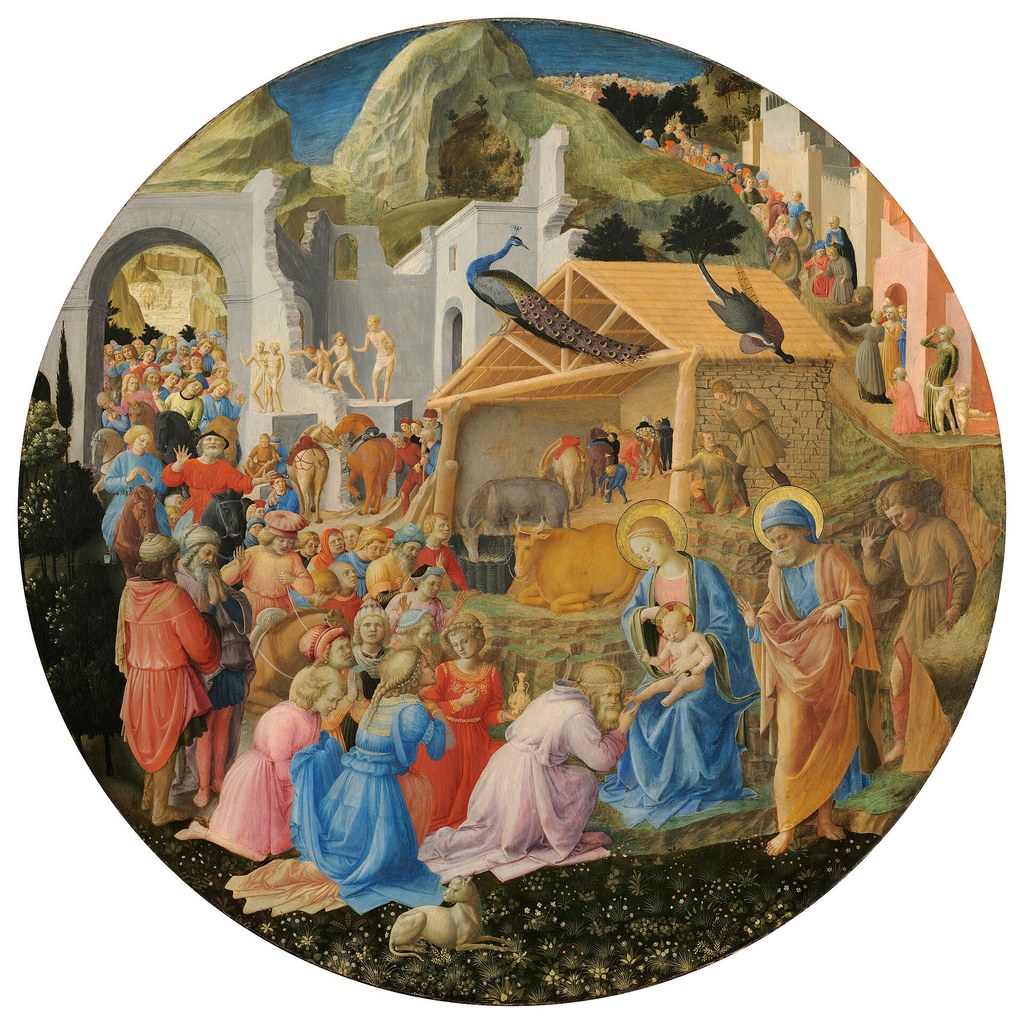
Adoration of the Magi by Fra Angelico and Fra Filippo Lippi
The National Gallery of Art’s great circular Adoration of the Magi is one of the most spectacular paintings associated with Fra Filippo Lippi, but it is also one of the works that most clearly demonstrates why attribution should be treated as historical argument rather than a fixed label. The NGA currently presents the tondo as the work of *Fra Angelico and Fra Filippo Lippi*, dating it broadly to about 1440–1460 and explaining that Angelico began the painting before Lippi completed it.[1]
That collaborative history immediately distinguishes the work from a conventional single-artist masterpiece. The enormous tondo, more than 1.37 metres in diameter, combines the concentrated sacred group of the Virgin, Christ Child and Joseph with a procession of more than one hundred figures, richly dressed Magi, horses, camels, birds, ruins and a winding landscape. The painting was probably made for the Medici family. Its subject was particularly resonant in Florence, where devotion to the Magi was associated with elaborate public processions and where the Medici cultivated the imagery of the Three Kings as part of their religious and dynastic identity.
The NGA’s provenance research connects the tondo plausibly with a large Adoration recorded in Lorenzo de’ Medici’s palace after his death. That inventory described a large round painting of the Virgin, Christ and the Magi “from the hand of Fra Giovanni”—Fra Angelico—and valued it at 100 florins. The identification is not absolutely certain, but the evidence is unusually suggestive. If the Washington painting is indeed the Medici tondo, it preserves a commission that passed through two major Florentine workshops and later through centuries of collecting, attribution changes and art-market movement.
Its modern history is almost as complex as its creation. At different times it was sold or catalogued as Botticelli, Fra Angelico, Filippo Lippi, Filippino Lippi and Benozzo Gozzoli before modern scholarship arrived at the present collaborative attribution. The painting is therefore valuable on two levels: as a magnificent example of Lippi’s contribution to Medici devotional culture and as a case study in how art historians decide who painted a Renaissance object.
At a Glance
- ArtistsFra Angelico and Fra Filippo Lippi
- TitleThe Adoration of the Magi
- Datec. 1440–1460
- MediumTempera on poplar panel
- FormatTondo, or circular panel
- Diameter137.3 cm
- Current locationNational Gallery of Art, Washington, DC
- CollectionSamuel H. Kress Collection
- NGA accession1952.2.2
- Probable patronageMedici family, Florence
- Current NGA interpretationFra Angelico began the work and Fra Filippo Lippi completed it
- Principal subjectThree Magi presenting gifts to the infant Christ
- Scale of processionMore than 100 figures
- Distinctive detailshorses, camels, peacock, pheasant, dog, classical ruins, winding procession and varied costumes
- Important provenance clueProbably connected with a large Medici tondo listed after Lorenzo de’ Medici’s death
- Public-domain imageAvailable from the National Gallery of Art
Contents
- What Does the Painting Show?
- A Medici Painting?
- Fra Filippo Lippi Completed It
- The Tondo Format
- The Magi
- The Nearly Nude Figures
- Colour and Costume
- The Painting as a Prestige Object
- Ancient Ruin and Renaissance Renewal
- From Florence to the Guicciardini
- Comparing Washington with Adoration in the Forest
- Why the Washington Adoration Matters
- FAQs
- References
What Does the Painting Show?
The sacred centre of the image occupies the lower portion of the circle. Mary sits with the infant Christ while Joseph stands nearby. The three Magi approach and kneel, offering gifts to the Child. Around that intimate event grows a remarkably large social world. The procession winds from the upper landscape, through and around ruined architecture, down towards the Holy Family.
More than one hundred people appear. Some travel on foot; others ride horses or camels. Rich garments coexist with simpler dress. Animals fill the painting as actively as people. Horses crowd the procession, an ox and ass occupy the shelter, and birds—including a peacock—stand prominently on the roof. The result is not a quiet Nativity. It is a pilgrimage, spectacle and catalogue of human variety.
The Biblical Story. The Gospel of Matthew tells of Magi arriving from the East after following a star. They seek the newborn “King of the Jews”, eventually reaching the child and Mary. They offer gold, frankincense and myrrh.
Later Christian tradition transformed the Magi into three kings and gave them individual names and identities. Renaissance artists expanded the sparse biblical account into elaborate processional scenes. The subject was particularly attractive to wealthy patrons because it allowed courtly magnificence to coexist with humility. Rich kings approach a child and kneel. The image can therefore celebrate splendour while insisting that worldly rank submits to divine authority.
Florence and the Magi. The National Gallery of Art emphasises Florence’s special devotion to the Magi.[1] Public processions periodically reenacted the journey of the kings through the city. These spectacles joined religion, civic identity, costume and performance.
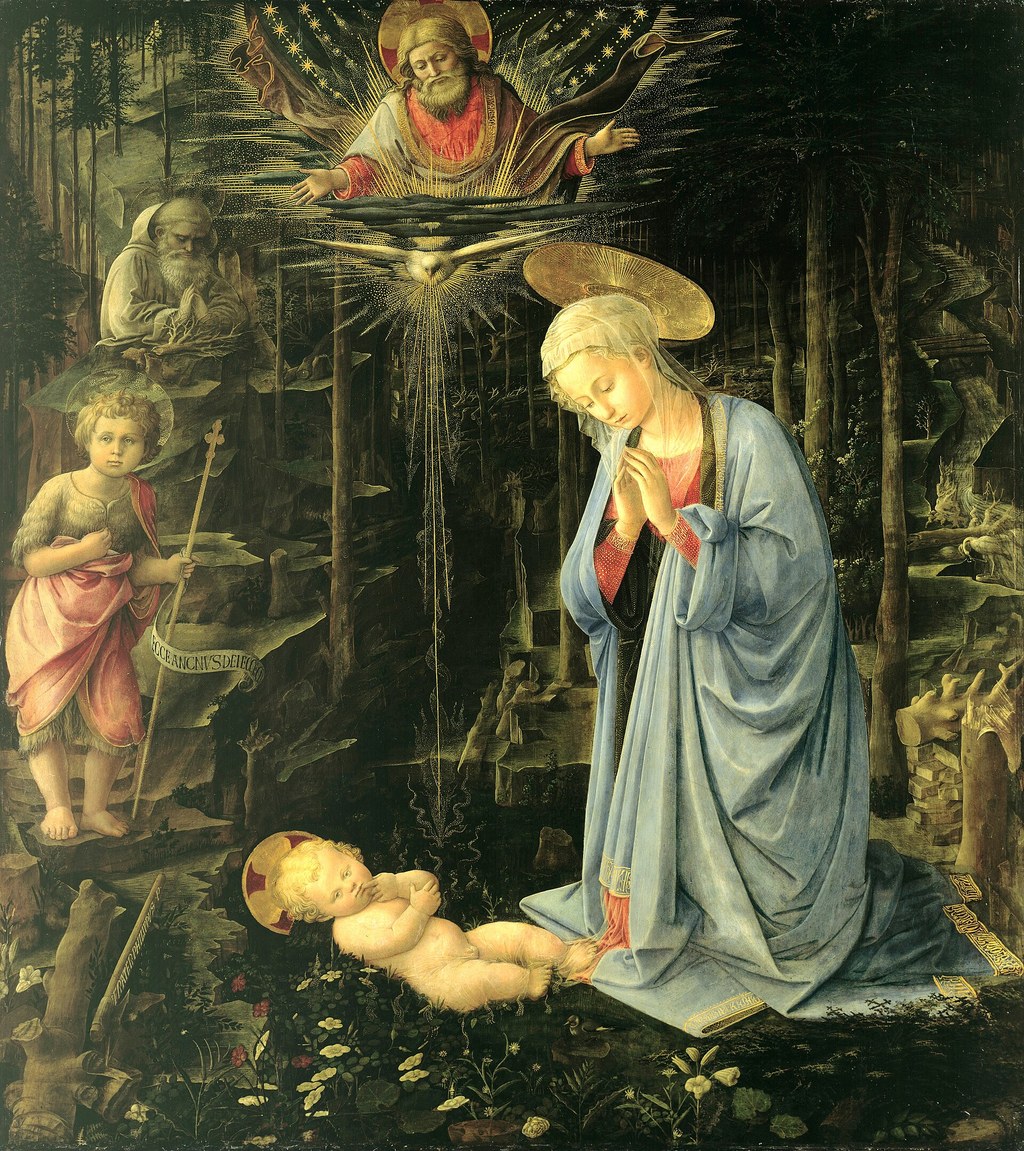
The Medici were deeply involved in Magian devotion. Their association with the subject appears most famously in the Magi Chapel of their palace, where Benozzo Gozzoli later painted the great processional frescoes surrounding Fra Filippo Lippi’s Adoration in the Forest. The Washington tondo belongs to the same cultural world. Even if its exact original room cannot be reconstructed with total certainty, the probable Medici patronage makes the choice of subject highly meaningful.
A Medici Painting?
The NGA records the painting as probably commissioned by a member of the Medici family. One of the strongest clues comes from the inventory drawn up after the death of Lorenzo the Magnificent. A later copy of that inventory records, in Lorenzo’s ground-floor bedroom, a large tondo showing the Virgin, Christ and the Magi bringing offerings.
The painting was attributed there to “Fra Giovanni”, meaning Fra Angelico. Its value was given as 100 florins. The NGA notes that this was a high valuation. Several major paintings by Paolo Uccello and Pesellino in the same room were collectively valued at 300 florins.
The elaborate character and large format of the Washington tondo make the identification plausible. However, the wording should remain careful. The inventory does not contain a modern accession number, and the link depends upon matching description, scale, subject and attribution. The painting was *probably* the Medici tondo, not demonstrably so beyond all doubt.
Fra Angelico Began It. The NGA’s current interpretation states that Fra Angelico began the painting but left it unfinished. This helps explain the historic inventory attribution. An owner or inventory maker could reasonably identify a work by the prestigious master who initiated it even if another artist later completed substantial portions.
Fra Angelico was one of the most important Florentine painters of the first half of the fifteenth century. His work combines clarity of sacred narrative, delicate colour and a devotional seriousness rooted in his Dominican vocation. The Washington painting retains elements that have encouraged scholars to identify his contribution.
Yet determining precisely where one master ends and another begins is difficult. Large Renaissance works could involve assistants even within a single workshop. A collaborative object involving two masters complicates the problem further.
Fra Filippo Lippi Completed It
The NGA now states that Fra Filippo Lippi completed the tondo. This wording gives Lippi a central role without pretending that the entire conception originated with him. His contribution has often been associated with the dense procession, lively figures and decorative richness.
Such features fit well with the narrative vitality visible in his Prato frescoes and his increasing interest in elegant human types. The tondo therefore becomes an important bridge between two major strands of Florentine painting. Fra Angelico contributes one artistic inheritance. Lippi carries the object forward into another. The painting’s long date range, c. 1440–1460, reflects the difficulty of reducing such a complex history to one moment.
Attribution as a Historical Problem. The painting’s catalogue history is extraordinary. In the nineteenth century it circulated under several different names. It was sold in 1810 as a Botticelli.
By 1826 it was described as Fra Angelico. A London sale in 1849 called it Filippo Lippi. At another sale in 1874 it appeared as Filippino Lippi.
Some writers also proposed Benozzo Gozzoli. These changes are not simply embarrassing mistakes. They show that attribution develops as comparative material, technical knowledge and archival evidence improve.
The painting contains stylistic signals associated with several closely connected Florentine artists. Fra Angelico, Lippi, Gozzoli and Botticelli belonged to overlapping generations and networks. Misattribution can therefore reveal genuine visual relationships.
Why Attribution Changed. Connoisseurship traditionally relied heavily upon close visual comparison. A scholar examined faces, hands, drapery, landscape, colour and drawing and compared them with works considered secure. Archival evidence added another layer.
The Lorenzo inventory strengthened the Fra Angelico connection. Modern museum research then combined provenance with stylistic analysis and wider knowledge of workshop practice. The result is the present dual attribution. Future technical examination could refine that history further. The responsible position is therefore to follow the NGA’s current attribution while presenting it as the outcome of scholarship rather than an eternal certainty.
The Tondo Format
The circular format is one of the painting’s most important physical features. A tondo forces a painter to solve composition differently from a rectangle. There are no stable corners.
Figures and landscape must respond to a continuously curving boundary. Lippi and Angelico use the circle to reinforce movement. The procession bends through the landscape and curves towards the sacred group.
The eye can travel around the circumference before returning to Mary and Christ. At 137.3 centimetres in diameter, the painting is exceptionally large for a domestic tondo. Its scale supports the idea of a major elite commission.
Procession and Movement. The procession is the engine of the composition. Figures do not simply stand behind one another. They travel.
The route rises and falls through landscape, passes ruins and approaches the foreground. This structure allows the painting to contain far more people than would fit in a static frontal crowd. Distance becomes narrative.
Those farthest away are still travelling. Those nearest the Holy Family have reached the destination. The image therefore turns geographical depth into time.
More Than One Hundred Figures. The NGA’s recent close-looking feature emphasises that more than one hundred people populate the scene. That number helps explain why the painting rewards prolonged study. Some figures are courtiers.
Others appear more simply dressed. Faces, gestures and clothing vary. The diversity gives the procession the feeling of a society rather than a decorative background.
A viewer can move between the theological centre and small episodes that almost function as independent miniatures. This density was probably part of the painting’s prestige. A major household object could demonstrate artistic labour through abundance.
The Magi
The three principal Magi kneel closest to the Virgin and Child. Their rich clothing distinguishes them from much of the crowd. Their gesture of kneeling creates the theological climax.
After all the movement, power and display, the rulers lower themselves before Christ. The structure therefore leads from magnificence to humility. For Medici patrons, that message was particularly resonant. Their own wealth could be imagined through the splendour of the procession while Christian devotion demanded submission at its end.
Mary and Christ. Mary and Christ occupy comparatively little physical space given the size of the crowd. Yet composition makes them the destination. The entire procession points towards them.
Christ is naked, emphasizing vulnerability and Incarnation. Mary’s clothing is comparatively restrained beside some of the sumptuous courtiers. The contrast clarifies sacred hierarchy. Material splendour belongs to the visitors. Spiritual significance belongs to the Child.
Joseph. Joseph stands near Mary and Jesus. He completes the Holy Family and stabilises the sacred group. His comparatively modest role is typical of many Adoration compositions. The Magi’s encounter with Christ is the principal narrative event. Joseph’s presence nevertheless anchors the scene within the earthly family of Jesus.
Classical Ruins. Crumbling stone architecture occupies a major portion of the painting. The NGA notes that the ruins and nearly nude youths above may refer to the ending of the pagan world. This is a familiar Christian interpretation of ruins in Nativity imagery.
The birth of Christ inaugurates a new era. Ancient structures decay as Christian salvation enters history. At the same time, ruins offered Renaissance painters an opportunity to display fascination with antiquity. They can therefore signify both admiration for the ancient world and its supersession.
The Nearly Nude Figures
Several lightly clothed or nearly nude youths appear around the ruins. Their presence is unusual enough to attract attention. They may participate in the contrast between pagan antiquity and Christian revelation.
Nudity also gave artists an opportunity to demonstrate knowledge of the human body. The precise meaning remains open enough that the NGA describes the interpretation cautiously. The interpretation should therefore remain cautious rather than turning a possibility into a fixed meaning.
Animals. The painting contains an extraordinary animal population. The familiar ox and ass appear in the shelter. Horses carry members of the procession.
Camels signal the Magi’s eastern origin and the distance of their journey. The NGA’s recent interactive feature draws attention to hidden camels and a peculiar white dog. Birds add another layer. The accumulation makes the painting a visual world rather than a bare theological diagram.
The Peacock. A peacock stands prominently on the roof. In Christian imagery, the peacock was often associated with immortality. Ancient belief held that its flesh did not decay.
For a Nativity scene, that symbolism could point beyond Christ’s birth towards resurrection and eternal life. The bird also adds exotic splendour. Its visual beauty makes it effective whether or not every viewer consciously decoded the symbolism.
The Landscape. The procession moves through an expansive landscape. Hills, paths and architecture create a journey long before the kings arrive. Landscape is therefore part of the story.
The Magi must come from elsewhere. Distance proves pilgrimage. The winding route also expands the circular panel psychologically. Although the object is physically bounded, its painted world seems to continue beyond the visible procession.
Colour and Costume
The painting’s costumes range through pale yellows, reds, pinks and blues. Gold trimming marks high status. This variety helps separate figures inside an enormous crowd.
Costume also translates biblical history into the visual language of Renaissance elite culture. The Magi do not appear as historically reconstructed first-century Persian priests. They look like magnificent rulers understood through fifteenth-century imagination. This contemporary translation made the story legible to its first viewers.
Medici Display and Christian Humility. The painting’s probable patronage creates a productive tension. The Medici were among the wealthiest and most influential families in Florence. The Magi offer an image of wealthy rulers whose correct response to Christ is worship.
The subject therefore permits splendour but disciplines it. Gold, horses, attendants and exotic animals culminate in kneeling. This is not necessarily cynical propaganda. Devotion and family identity could be genuinely intertwined. The same religious subject could serve spiritual meditation and social representation simultaneously.
Why the Circle Changes the Story. The circular support does more than decorate the composition. It removes the comfortable horizontal beginning and end that a rectangular procession might provide. Instead, the route coils. The viewer can enter the story at several points and then be carried around the image until the movement resolves at the Holy Family.
This makes the act of looking resemble the journey of the Magi themselves. The crowded upper half encourages exploration, while the lower sacred group offers visual rest. A rectangular version could have arranged the kings in a straightforward left-to-right march. The tondo encourages return and recirculation. That is especially appropriate to a devotional object intended for repeated viewing.
The Painting as a Prestige Object
A diameter of 137.3 centimetres makes this an imposing panel. Producing a wooden circle of that scale required significant preparation before painting began. The support had to be constructed, stabilised, prepared with ground and integrated into a frame.
The sheer number of figures then demanded extensive design and labour. This helps explain why the probable Medici inventory valued the large tondo so highly. The cost did not simply purchase expensive pigment.
It purchased invention, workshop time and a technically ambitious object. The painting therefore communicated prestige through labour as well as iconography. A viewer could recognise that an image containing more than a hundred carefully differentiated figures was not an ordinary household possession.
Looking Closely: Small Narratives Inside the Large One. The NGA’s 2024 close-looking feature is particularly helpful because the painting encourages a mode of viewing that online reproduction often suppresses. At normal page size, the image may read as a colourful mass surrounding Mary and Christ. At high resolution, individual incidents emerge.
A horse turns its head. A dog appears among the crowd. Camels become visible farther back.
Different worshippers fold their hands, look upward or direct their attention towards the destination. These details slow the viewer down. They are not separate biblical episodes, but they create micro-narratives inside the principal journey.
The result is a painting that changes with viewing distance. From across a gallery it is a grand circular procession. From close range it becomes a collection of people, animals and observations.
Ancient Ruin and Renaissance Renewal
The ruins deserve more than a symbolic label. They place Christian revelation literally inside the remains of an older world. For a fifteenth-century Florentine audience fascinated by classical antiquity, this was a productive contradiction.
Ancient Rome could be admired as an artistic and intellectual inheritance while pagan religion was understood as superseded by Christianity. The broken architecture therefore allows admiration and triumph to coexist. Its arches also solve a compositional problem. They give the procession a monumental gateway through which to move. Symbolism and spatial design reinforce one another.
The Magi as an Image of Global Distance. Camels, unusual animals and extravagant dress help the painting imagine geographical remoteness. The Magi come from “the East”, a deliberately broad biblical geography that Renaissance artists translated through available ideas of foreign costume and exotic travel. The image should not be mistaken for ethnographic accuracy.
Its foreignness is constructed from fifteenth-century visual conventions. Yet that constructed distance has narrative value. Christ’s birth draws travellers from beyond the familiar world of Florence.
The procession expands the meaning of the event from local family scene to universal recognition. For Medici viewers involved in international banking and trade, a sacred story built around long-distance movement may have carried additional resonance, although such a connection should be treated as contextual rather than a documented intention.
Collaboration Rather Than Competition. It is tempting to turn the dual attribution into a contest: which passages are “really” Angelico and which are “really” Lippi? That question can be useful, but it can also impose a modern desire for isolated authorship on a Renaissance object. The more important historical fact may be that the painting could pass from one highly regarded Florentine master to another and still emerge as a coherent prestige commission.
Workshop culture made such continuity possible. Artists shared conventions, materials and methods even when their individual styles differed. The tondo therefore provides a strong opportunity to explain collaboration without treating it as a defect. Its artistic identity is richer because its history is layered.
From Florence to the Guicciardini
The NGA provenance traces the work after its probable Medici history into the Guicciardini family. It passed through generations before entering the art market in the early nineteenth century. This long Florentine ownership is important. The painting did not move immediately from Renaissance palace to modern museum. For centuries it remained embedded within elite family collecting.
The Nineteenth-Century Art Market. In 1810 the tondo was sold to François-Honoré Dubois as a work by Botticelli. It later appeared in London. Attributions changed as it passed through sales and collections.
This period illustrates the growth of an international market for Italian Renaissance paintings. Works left historic family settings and entered collections in Britain and elsewhere. Names mattered financially. A painting attributed to Botticelli, Fra Angelico or Lippi occupied a different place in the market. The instability of the label therefore had economic as well as scholarly consequences.
The Cook Collection. The tondo eventually entered the celebrated collection of Sir Francis Cook at Doughty House in Richmond. The Cook collection was an important British private collection of Old Master paintings. The painting remained with the family across generations. It was exhibited internationally before its acquisition by the Kress Foundation. This history contributed to the work’s visibility in modern scholarship.
Kress and the National Gallery of Art. The Samuel H. Kress Foundation acquired the painting in 1947. It entered the National Gallery of Art as a gift in 1952.[1] The NGA now provides the image as public domain, allowing unusually close digital study. That accessibility is valuable for close comparative study. A high-resolution annotated image could identify the Magi, camels, peacock, ruins, procession route and sacred group without copyright barriers from the museum image itself.
Comparing Washington with Adoration in the Forest
The Washington tondo and Lippi’s Berlin Adoration in the Forest reveal radically different possibilities within related devotional themes. Washington is crowded. Berlin is solitary.
Washington celebrates procession and human variety. Berlin emphasises woodland contemplation. Both have Medici connections.
Together they demonstrate that patronage did not force one fixed visual formula. The same family culture could support public-looking magnificence and private mystical austerity. The comparison is especially revealing because both works have Medici connections but radically different devotional atmospheres.
Why the Washington Adoration Matters
The Washington Adoration of the Magi matters because it is simultaneously a painting and an art-historical problem. Its crowded composition offers an extraordinarily rich image of Florentine Magi devotion. Its likely Medici patronage connects it to the city’s most influential family.
Its great tondo format demonstrates the prestige of domestic devotional painting. Its attribution history connects Fra Angelico and Fra Filippo Lippi while revealing how scholarly labels change. Its provenance carries it from probable Medici ownership through the Guicciardini family, nineteenth-century dealers, British collecting, the Kress Foundation and finally the National Gallery of Art.[1]
For Fra Filippo Lippi, the work is especially useful because it prevents a simplistic idea of authorship. Renaissance painting was frequently collaborative. A master might begin, another complete, assistants participate and later scholars struggle to separate hands. The NGA’s present dual attribution preserves that complexity. That makes the painting a particularly modern kind of masterpiece: one whose uncertainty is part of what we know about it.
FAQs
Discussion
What stands out to you most about Adoration of the Magi Washington in relation to Filippo Lippi's wider career?
Reader Insights
Notice how the page connects close visual detail with patronage, workshop practice and the wider Renaissance setting.
Which comparison elsewhere in the cluster helps clarify this work or theme most strongly?
Join the Conversation
Have a thought or observation about Adoration of the Magi Washington? Share it below. Thoughtful responses may be added to this section.
References
- National Gallery of Art, Washington, The Adoration of the Magi, Fra Angelico and Fra Filippo Lippi, collection record and full provenance/bibliography. View Source.
- National Gallery of Art, “Art up Close: Fra Angelico and Fra Filippo Lippi’s Spectacular ‘The Adoration of the Magi’,” 26 December 2024. View Source
- Jeffrey Ruda, Fra Filippo Lippi: Life and Work with a Complete Catalogue, London, 1993.
- Megan Holmes, Fra Filippo Lippi: The Carmelite Painter, Yale University Press, 1999.
- National Gallery of Art bibliography and historic Cook/Kress collection catalogues listed in the museum record.