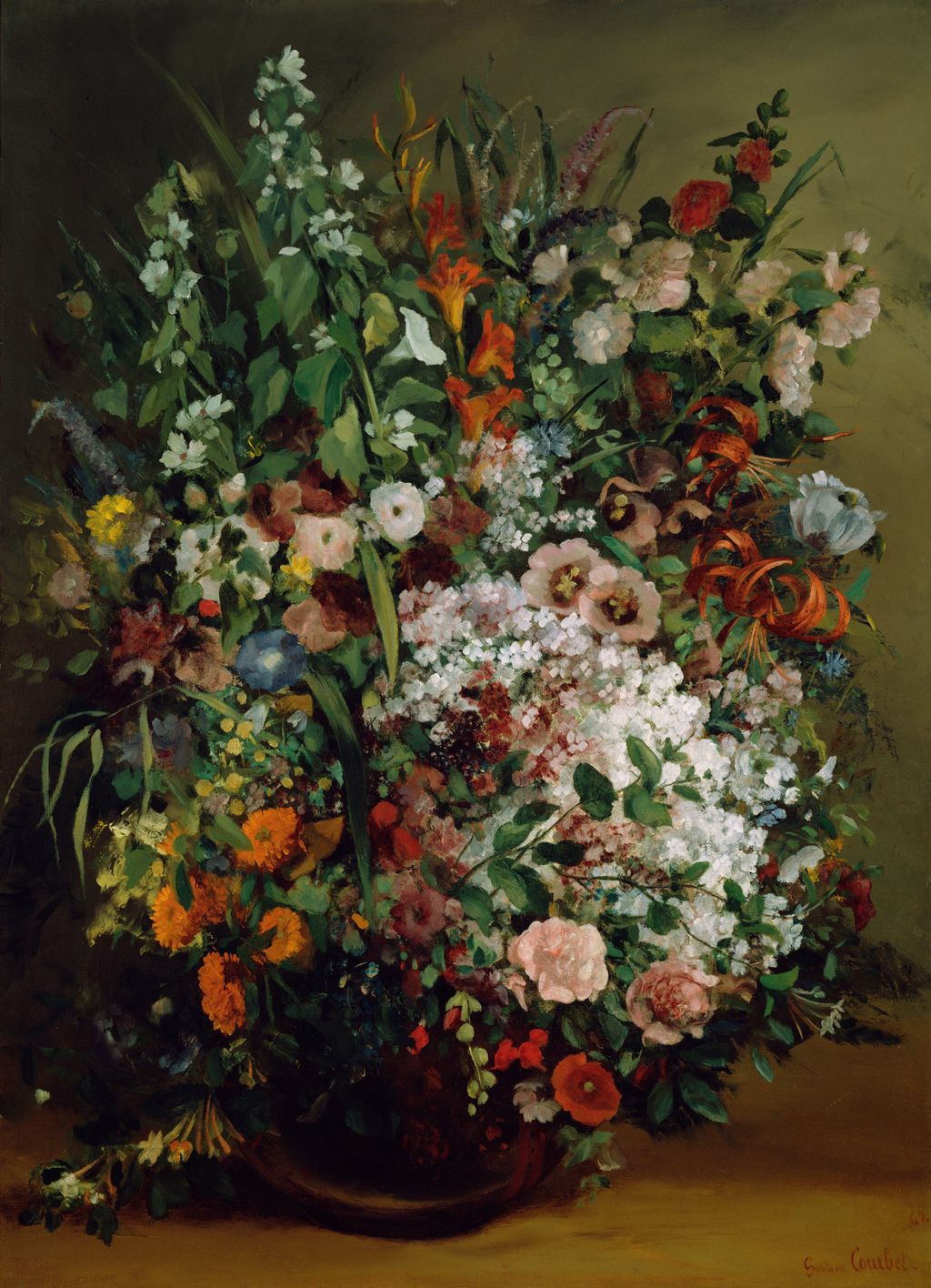
Bouquet of Flowers in a Vase by Gustave Courbet, 85.PA.168 Google Art Project reproduction of the Getty painting, via Wikimedia Commons. Image source. Public domain. Cropped to the canvas.
 by Tom Gurney
Tom Gurney BSc (Hons) is an art history expert with over 20 years experience
Email: tomgurney1@gmail.com / Phone: +44 7429 011000
Bouquet of Flowers in a Vase: Introduction
A thin arc of reflected light at the foot of the vase is almost all that separates it from the shadow above. The flowers have taken over. Small white blossoms run through the middle in a loose diagonal, orange lilies turn out to the right, and a stem straggles across the tabletop at the lower left. Gustave Courbet painted this oil on canvas in 1862. It measures 100.3 × 73.3 cm and belongs to the J. Paul Getty Museum, where it is recorded as 85.PA.168. At just over a metre high, it gives a tabletop subject enough room for the flowers to spread almost from one edge of the canvas to the other. [1]
At a Glance
- Date1862
- MediumOil on canvas
- CollectionJ. Paul Getty Museum, 85.PA.168
Contents
- How the flowers hold together
- The Saintonge flowers
- The Saintes exhibition and other flower paintings
How the flowers hold together
The brightest passage sits to the right of centre. Tiny blossoms bunch so closely that their pale petals nearly merge, then break apart where dark leaves cut across them. Above that mass the stems stand farther apart. A spire of small white flowers rises left of centre, and thin grasses and stalks draw broken lines across the background. Low down, three pale pink blooms catch the light in front of the rest, while a single orange-red poppy hangs lower. A viewer can move from one sharply visible flower to another without finding a continuous outline around the whole bouquet. [1] [2]
The round vase makes the arrangement seem heavier than its loose silhouette suggests. Its foot sits slightly left of centre, below a mass of flowers that extends farther to the right. The stems and leaves at lower left carry some of that weight back across the canvas. The tabletop is clearest at lower right, where the warm brown leaves a patch of open space beside the signature. Farther up, the brown gives way to grey-green without a sharp line between table and wall. Courbet gives the pot enough ground to sit on and leaves the space around the upper blooms open to interpretation. [1] [2]
At the right, narrow orange strokes trace petals curling back on themselves. Beside them a pale blue flower is built from broader marks, and farther down a scatter of short light touches picks out the smallest blossoms. Greens range from bright blades that turn in the light to near-black leaves whose edges are hard to separate from the shadow. The Getty describes Courbet’s use of both brush and palette knife. What is visible in these passages is the change in size, shape and density of the marks. That variation lets the eye distinguish a long, twisting petal from a cluster of tiny ones even where the paint is too freely handled to count them individually. [1] [2]
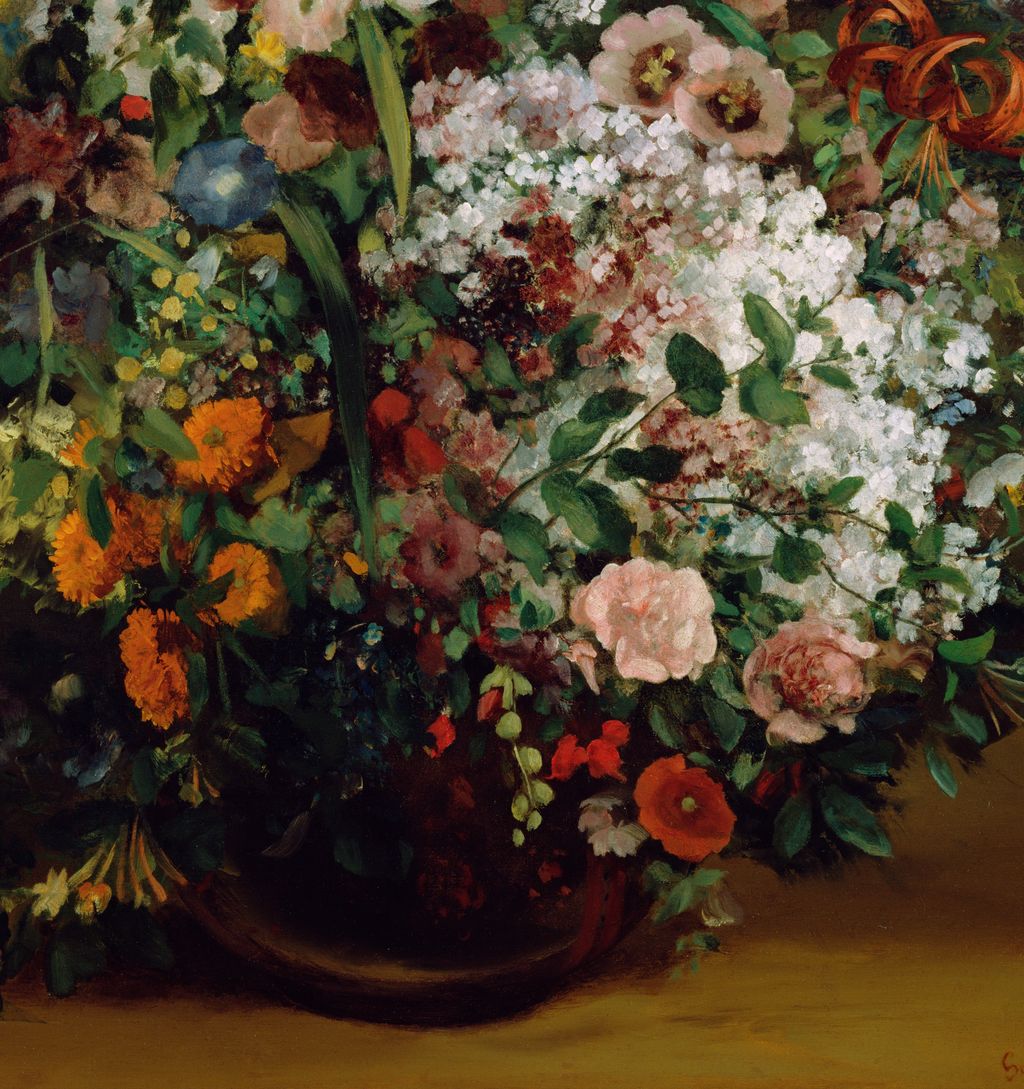
Detail of Bouquet of Flowers in a Vase, Getty 85.PA.168. Shown here, flower heads and vase. Image source. Public domain. Cropped and resized from the source image.
The Saintonge flowers
Courbet came to the Saintonge region of western France in late May 1862 and stayed into April 1863. The visit began with an invitation from the collector Étienne Baudry, whom he had met through the Saintes-born critic Jules-Antoine Castagnary. At the Château de Rochemont near Saintes, Baudry kept gardens, greenhouses and books on plants. The setting gave Courbet access to cultivated rarities as well as familiar garden flowers, and he turned to a subject he had only occasionally painted before. In his Getty essay, Scott C. Allan counts more than twenty flower paintings from the stay. Allan also cites Courbet’s April 1863 letter to Léon Isabey, in which the artist remarks on how much money he was making from flowers. The garden and the market both mattered. [1] [2] [3]
The Getty’s collection record identifies lilies, roses, gladioli, stock, asters, morning glories and poppies, among other flowers. Allan’s essay adds the example of lilac near the middle, which would ordinarily have been past flowering by the time the summer blooms opened. The painter also brought common garden and hedgerow flowers such as honeysuckle and cornflowers into the company of plants grown under glass, including Madagascar jasmine. The bouquet has the immediacy of freshly gathered flowers, yet it combines plants with different flowering seasons. Baudry’s greenhouses are part of the context for that variety. The arrangement itself leaves open how Courbet assembled his models and over what period he painted them. [1] [2]
The Getty compares Courbet’s canvas with Jan van Huysum’s Vase of Flowers of 1722, also in its collection, accession 82.PB.70. In that oil on panel, blooms from different seasons push out from a terracotta vessel ornamented with a relief. Small insects and drops of water reward close inspection. The museum describes how Van Huysum built up thin oil glazes and could work on one picture across different flowering seasons. Courbet’s plain pot offers little to examine by comparison, and he condenses the surface of a bloom into fewer, broader marks. The shared feat is to make flowers from across the year look at home together. Each artist gives that abundance a different pace, with Van Huysum drawing the eye to minute incidents and Courbet leading it from one concentration of colour to another. [1] [2] [4]
The Getty also raises the possibility that cut flowers might recall the Dutch association between floral beauty and the shortness of life. At Saintes Courbet showed two small flower paintings with expressly allegorical inscriptions, made for Fédora Gaudin. The Getty bouquet has a different documentary history. Its mixed seasons support a comparison with older flower painting, while the proposed meaning remains a way of reading it. Even in the crowded centre, the blossoms are at visibly different stages. Closed buds rise at the upper right, while the full roses nearer the base bend towards the tabletop. [1] [2]
The Saintes exhibition and other flower paintings
In January 1863 the bouquet was shown at the town hall in Saintes in an exhibition to raise money for the poor. Allan identifies it as catalogue no. 77, lent by Frédéric Mestreau, a Saintes banker and cognac wholesaler. It was one of five floral still lifes listed among Courbet’s entries. In his review for Le Courrier des Deux-Charentes, Pierre Conil singled out Mestreau’s painting and ranked it alongside works by Rachel Ruysch, Jan van Huysum and other established flower painters. The comparison with Dutch still life thus goes back to the picture’s first exhibition. The Getty treats direct acquisition from Courbet as possible. The canvas passed down through the Mestreau family in 1891 and remained with them until around 1968. Later owned by Florence J. Gould, it was sold at her Sotheby’s sale in New York in 1985 and entered the Getty collection through Acquavella Galleries. [1] [2]
Courbet’s The Trellis, now at the Toledo Museum of Art (1950.309), appeared in the same Saintes exhibition as no. 76. In that wider canvas, also painted in 1862, a woman reaches into a screen of flowers to arrange them. The lattice gives the stems somewhere to rest and the figure gives the blooms a human scale. In the Getty canvas the rounded pot is the sole support visible for the entire mass, and the arrangement’s scale comes through the disproportion between vessel and flowers. The two works put a similar abundance to different uses. In one the viewer follows a person’s reach. In the other the movements to follow are the arcs of stems and the directions in which the blossoms face. [1] [2] [5]
The 1863 Vase of Lilacs, Roses, and Tulips at the Norton Simon Museum (M.1979.24.P), reproduced in the Metropolitan Museum of Art’s catalogue of the Adele and Arthur Lehman Collection, is a smaller oil on canvas measuring 65.1 × 54.3 cm. It shares Courbet’s interest in combining flowers across seasons, with lilacs and tulips named in the title, but its later date and Lehman provenance distinguish it from Mestreau’s picture. The Met’s own Spring Flowers (29.100.121) is a wider composition and the museum catalogues it as a copy after Courbet. Among Courbet’s paintings, the signed Norton Simon canvas offers a comparison on a more intimate scale. At just under two thirds the height of the Getty canvas, it gives the abundance of the mixed bouquet less vertical room in which to unfold. [1] [6] [7] [8]
Allan sets Courbet’s flower painting beside work by younger painters such as Claude Monet and Frédéric Bazille. Monet’s Spring Flowers of 1864, now in Cleveland (1953.155), also gives light petals room to spread against a dark field. Monet distributes his flowers across potted plants, a basket of lilacs and peonies at the front. Courbet packs his into a single rising cluster. The National Gallery of Art in Washington included the Getty painting as Vase of Flowers, no. 93, in its 2017 exhibition Frédéric Bazille and the Birth of Impressionism. That exhibition places Courbet’s picture within a wider return to still life in the 1860s. The resemblance is easiest to see in what the two paintings ask of the eye. A few large areas of light colour are legible at a distance. Closer up, those areas disperse into irregular touches of paint. [2] [9] [10]
Courbet artworks directory
Browse the paintings covered in this guide. Dates identify the specific versions discussed.
Discussion
Look again at the images and ideas explored in Bouquet of Flowers in a Vase. These editorial prompts invite your observations.
Reader Insights
Which flowers or colours draw your eye first?
How do the darker passages change the shape of the bouquet?
Which details distinguish the Getty canvas from Courbet’s other flower paintings?
Join the Conversation
Share a detail, comparison or question about Bouquet of Flowers in a Vase below.
References
- J. Paul Getty Museum, Bouquet of Flowers in a Vase, 1862, object 85.PA.168. View source.
- Scott C. Allan, “Bouquet of Flowers in a Vase,” J. Paul Getty Museum scholarly essay, including notes 6–8 and 11–18. View source.
- Institut Gustave Courbet, Gustave Courbet, une histoire intime au Musée de l’Échevinage à Saintes, exhibition research and account of the Saintonge stay. View source.
- J. Paul Getty Museum, Jan van Huysum, Vase of Flowers, 1722, object 82.PB.70. View source.
- Toledo Museum of Art, Gustave Courbet, The Trellis, 1862, object 1950.309. View source.
- Norton Simon Museum, Gustave Courbet, Vase of Lilacs, Roses, and Tulips, 1863, object M.1979.24.P. View source.
- Metropolitan Museum of Art, The Adele and Arthur Lehman Collection, pp. 62–63, catalogue entry and plate for Flowers in a Vase—Lilacs, Roses, and Tulips. View source.
- Metropolitan Museum of Art, copy after Gustave Courbet, Spring Flowers, ca. 1855–60, object 29.100.121. View source.
- Cleveland Museum of Art, Claude Monet, Spring Flowers, 1864, object 1953.155. View source.
- National Gallery of Art, Frédéric Bazille and the Birth of Impressionism, Washington exhibition checklist, 2017, p. 10, no. 93. View source.