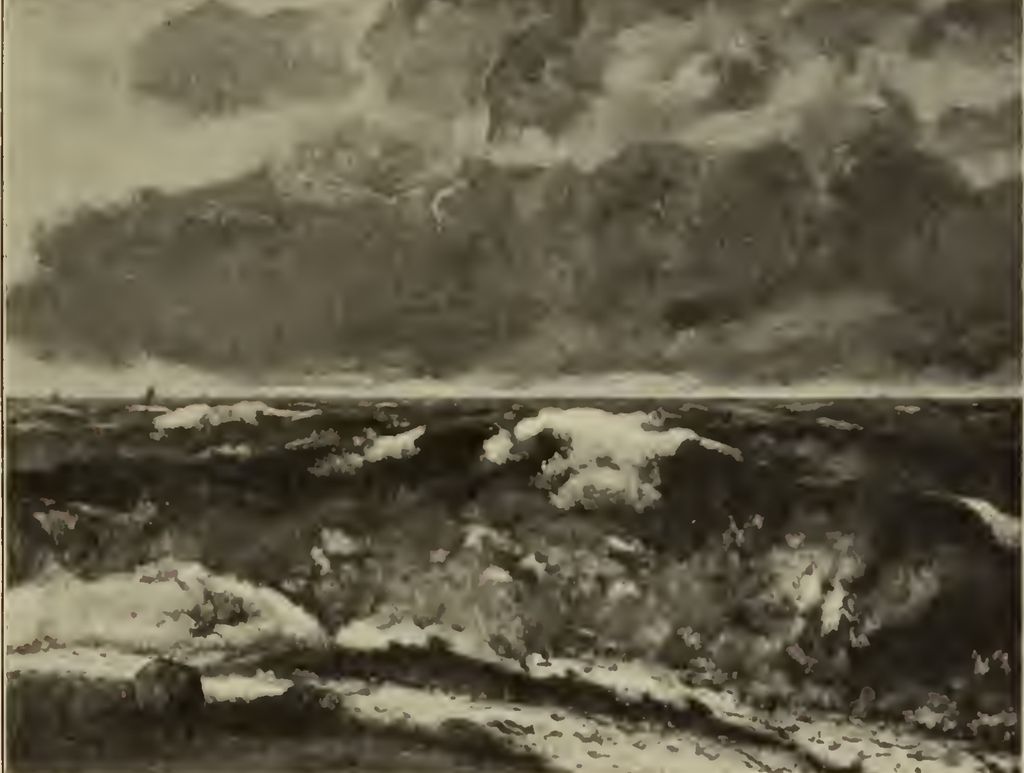
The Stormy Sea, reproduced in Georges Riat’s Gustave Courbet, peintre (1906), p. 271 Internet Archive. Image source. Public domain. Cropped historical reproduction. It does not show the original colours.
 by Tom Gurney
Tom Gurney BSc (Hons) is an art history expert with over 20 years experience
Email: tomgurney1@gmail.com / Phone: +44 7429 011000
The Wave: Introduction
Two wooden boats lie on the shingle at the lower left. Behind them, the water rises almost to the horizon, a broad green-black swell with a patch of white foam tipping forward near its crest. The boats give the eye somewhere to start. We can judge the height of a hull and follow its curve to the stern, then look up at a wave whose dark face takes up much of the view. At the right, where the beach narrows to the bottom of the canvas, the water seems close enough to reach us. [1]
Gustave Courbet exhibited this oil painting at the Paris Salon of 1870 under the title La Mer orageuse (The Stormy Sea). The Musée d’Orsay, which also calls it La Vague (The Wave), records it as RF 213, 116.5 × 160 cm, signed and dated 1870 at the lower left. Courbet painted several canvases known as The Wave. The two boats on the shingle and the large white patch on the crest near the centre are details to look for in the Paris Salon picture. [1] [2]
At a Glance
- Date1870
- MediumOil on canvas
- CollectionMusée d’Orsay, RF 213
Contents
- Where the sea meets the beach
- Courbet’s studio at Étretat
- Two views at the Salon
- The other wave paintings
Where the sea meets the beach
The painting is built in three horizontal bands, but they sit very differently on the canvas. A dark bank of clouds occupies much of the sky, with a patch of blue-green still visible at the upper left. The sea begins beneath a narrow opening of light. Lower down, the shore comes in at an angle, leaving enough space for the boats at the left and almost none by the time it reaches the right. The cloud bank and the horizon hold the view level while the widening sweep of water along the beach draws the eye down towards the right. [1]
Look along the crest and the swell resolves into sections. A scatter of pale marks at the left shows where the water has already begun to break. Closer to the centre a broad cap of foam hangs over the wave’s dark face. At the right a thin pale curve enters from the edge, where the swell carries on out of sight. The foam down by the beach is broken into smaller marks. Some of it spreads in a low wash, while higher patches seem to catch on the slope of the water. Several stages of a wave are visible at once, from the dark rise to the crest beginning to collapse and the spent water running up over the stones. [1]
The boats are more than a measure of scale. Their position on the beach gives us a place to stand in relation to the water. One boat’s dark hull reads as a long solid shape against the lighter wash, while the smaller one sits close to the left edge. A thin upright rises above the larger hull and carries the eye up through the surf. A shore with boats also suggests work that is suspended for the duration of the storm. There is nobody in the foreground to pull the boats farther up the beach or to tell us how the weather will turn. The viewer has to read the signs in the water and sky. [1] [3]
Courbet gives the water much of its weight by applying thick oil paint with a knife. The central white crest has a blunt upper edge and an irregular fringe. Lower down, where the surf thins and mixes with the dark water, the pale marks are flecked with green and grey. The beach has short, broken touches that make it look granular. Seen from farther back, the hull and shingle feel steady, and the uneven bands of white appear to shift across the water. Up close, much of that movement is built from paint laid on densely enough to catch the light in its own right. [1] [4]
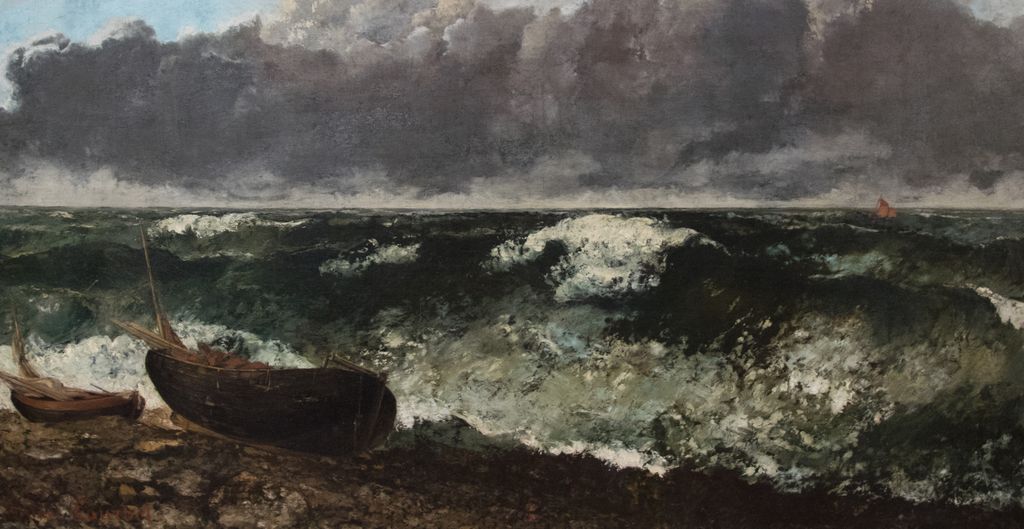
Detail of Gustave Courbet, The Stormy Sea, also known as The Wave, 1870. Musée d’Orsay, RF 213. Shown here, wave crest and foreground boats. Image source. Public domain. Cropped and resized from the source image.
Courbet’s studio at Étretat
Courbet spent several weeks at Étretat, on the Normandy coast, in the late summer of 1869. He worked in a former studio of the painter Eugène Le Poittevin, across from the beach near the Aval cliff. In a letter to the critic Jules-Antoine Castagnary on 6 September, Courbet reported that he had already painted nine seascapes to his satisfaction and intended to start a sea picture 1.60 metres wide for the next Salon. That width agrees with the Orsay Wave. The letter documents his ambition for the exhibition during a productive stay in which he also worked on a large view of the cliffs. [1] [3] [5]
Guy de Maupassant told a more immediate story about the visit in Gil Blas on 28 September 1886. He remembered finding Courbet in a bare room, putting patches of white paint onto a large canvas with a kitchen knife. Between applications Courbet went to the window to study the storm, with salt water striking the glass. Maupassant also remembered a bottle of cider on the mantelpiece. The little detail sets the concentrated work of a painter in an ordinary room against the violence outside. He identified the painting he saw under way as The Wave. The account appeared years after the visit and captures one encounter with Courbet at work. The paint surface and the museum’s account of its handling give a separate basis for looking at the finished Salon canvas. [1] [3]
Two views at the Salon
The Salon catalogue lists La Mer orageuse as number 671. Courbet’s other entry, number 672, was Cliffs at Étretat after the Storm, also now at the Musée d’Orsay, under the number MNR 561. The cliff painting gives a clear view of the Porte d’Aval. Its pale rock and open sky direct attention to the shape of the headland in the light after rain. The storm canvas gives that space to the swell. Étretat explains where Courbet studied the sea, while the cliff painting supplies the landmark that can actually place a viewer on the coast. [1] [2] [6]
The Musée d’Orsay reads the canvases as successive phases of a storm. The pairing also brings out the different jobs Courbet gives the beach. In the cliff view, the shore leads back towards the arch and takes on depth as it passes the boats. In the storm picture, the strip of shingle takes us across the base of the canvas and then disappears under the surge. Courbet makes distance legible in one painting and makes the water feel close in the other. The Met’s The Calm Sea, from 1869, offers a third arrangement. At low tide its two grounded boats sit well in front of a narrow strip of water, and the sky opens above them. There the shore holds our attention because the water has receded so far. [1] [6] [7]
The paintings were a success at the Salon, though their handling gave critics room to disagree. Paul de Saint-Victor compared Courbet’s stormy water to masonry in his review of the 1870 exhibition. The comparison was a complaint about the way a fluid subject seemed to have hardened on the canvas. It also picks out something a viewer can see in the finished work. The wave has a surface with substance, even as the changing edges of the foam make the water appear to be giving way. [4] [6]
The Musée d’Orsay records that the dealer Haro bought The Stormy Sea at the Carlin sale in 1872. The French state acquired it in 1878 for the Musée du Luxembourg, and it appeared at the Exposition universelle that year. Writing about the exhibition, Émile Zola objected to Courbet being represented by a single painting while academic artists had several. The critic’s response, discussed in the Art Institute of Chicago’s catalogue, makes clear how much could be at stake in which paintings the exhibition chose to show. The wave had become the work through which visitors were asked to consider Courbet’s place in modern French painting. It went to the Louvre in 1889 and was assigned to the Musée d’Orsay in 1986. [1] [3]
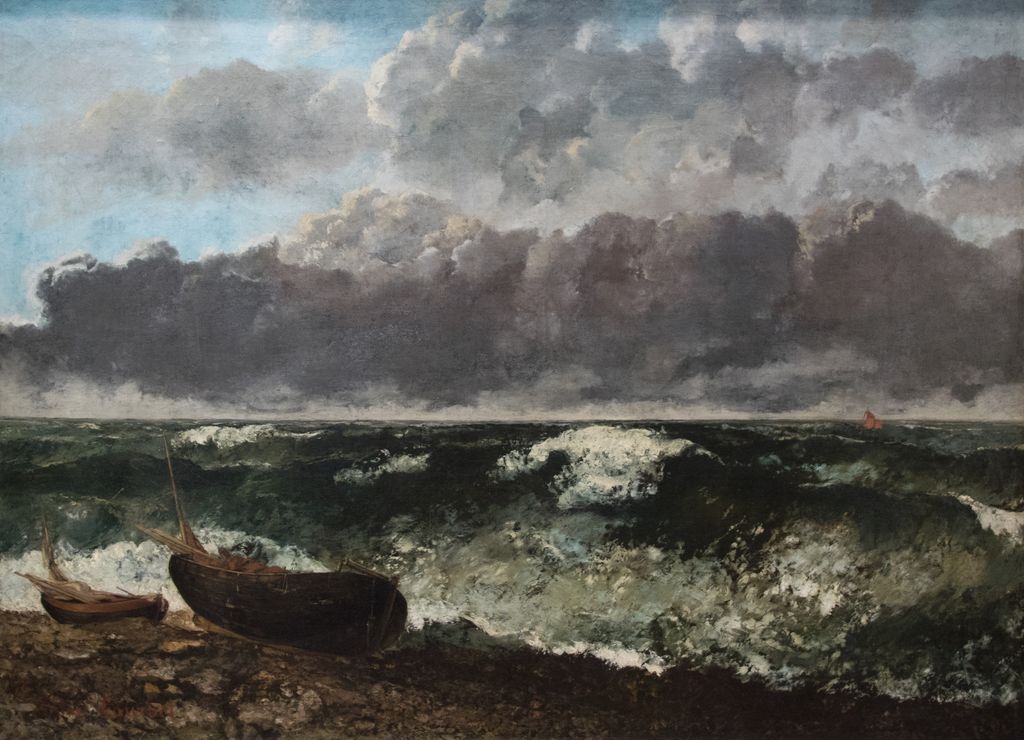
Gustave Courbet, The Stormy Sea, also known as The Wave, 1870. Musée d’Orsay, RF 213. Image source. Public domain. Resized from the complete source image.
The other wave paintings
The canvas at Berlin’s Alte Nationalgalerie is nearly as large as the Paris painting. Die Welle, A I 967, measures 112 × 144 cm and is dated 1869–70. Berlin’s catalogue describes the swell at the moment before it tips and the broad passages of paint spread with a knife. Without the two boats that mark out the shore in the Orsay painting, the steep face of the wave carries more of the picture. The German museum traces that particular work to the critic and dealer Théodore Duret, from whom Hugo von Tschudi acquired it in 1904 for the Nationalgalerie. [1] [8]
Courbet could also make a wave feel imposing on a much smaller canvas. The National Galleries of Scotland’s The Wave, NG 2233, is dated 1869 and measures 46 × 55 cm. Its museum notes the combination of brush and knife strokes and the large sense of space the painting conveys despite its small size. Lyon’s La Vague, B 295, is a different canvas again, dated about 1869–70 and measuring 65.8 × 90.5 cm. Lyon draws attention to its mineral colours and the absence of boats or people. With fewer familiar objects for scale, the force of the wave comes through in the way the paint builds up and the crest presses across the canvas. [5] [9] [10]
The National Museum of Western Art in Tokyo calls its version Waves. Dated about 1870, it measures 72.5 × 92.5 cm and is signed at the lower left. The collector Kōjirō Matsukata bought it in 1921, and it entered the museum in 1959 as P.1959-0062. In Tokyo’s picture, whitecaps rise behind a foreground of crags. They give the waves a hard surface to break against. Compare that with the shingle at the base of the Paris painting, where Courbet lets the wash spread out into a thin diagonal. The difference is in how each painting lets us see what happens when the water reaches land. [1] [11]
In the Paris painting there is a quieter measure of movement beyond that breaking wave. Small marks along the distant waterline are easy to miss below the clouds. Against those nearly level touches, the white crest in the middle looks abrupt and the larger streaks in the foreground seem to run faster. There is enough space between the boats and the horizon for the eye to move from one measure to the next. Even with the swell cut off by the edges, the distant water lets us picture the sea extending well beyond the wave that fills the canvas. [1]
Courbet artworks directory
Browse the paintings covered in this guide. Dates identify the specific versions discussed.
Discussion
Look again at the images and ideas explored in The Wave. These editorial prompts invite your observations.
Reader Insights
What does the position of the horizon do to the wave’s scale?
Which marks make the water seem to move?
What changes when the wave is seen alongside the cliff painting?
Join the Conversation
Share a detail, comparison or question about The Wave below.
References
- Musée d’Orsay, La Mer orageuse, RF 213, collection record, reproduction, provenance and Maupassant extract. View source.
- Musée d’Orsay, Base Salons, La mer orageuse, 1870 Salon catalogue, no. 671, transcription. View source.
- John Collins, Art Institute of Chicago, “Seascape, 1879,” scholarly catalogue, “The Wave as Impressionist Subject” and notes 12–15. View source.
- Städel Museum, Monet’s Coast, sections on Courbet’s storm paintings and Paul de Saint-Victor’s 1870 Salon review. View source.
- Musée des Beaux-Arts de Lyon, Gustave Courbet: The Cliff and the Wave, exhibition research and labels. View source.
- Musée d’Orsay, La Falaise d’Étretat après l’orage, MNR 561, collection record, reproduction and Salon listing. View source.
- The Metropolitan Museum of Art, The Calm Sea, 29.100.566, collection record and reproduction. View source.
- Staatliche Museen zu Berlin, Alte Nationalgalerie, Die Welle, A I 967, collection record and reproduction. View source.
- National Galleries of Scotland, The Wave, NG 2233, collection record and reproduction. View source.
- Musée des Beaux-Arts de Lyon, La Vague, B 295, collection record and reproduction. View source.
- National Museum of Western Art, Tokyo, Waves, P.1959-0062, collection record and provenance. View source.