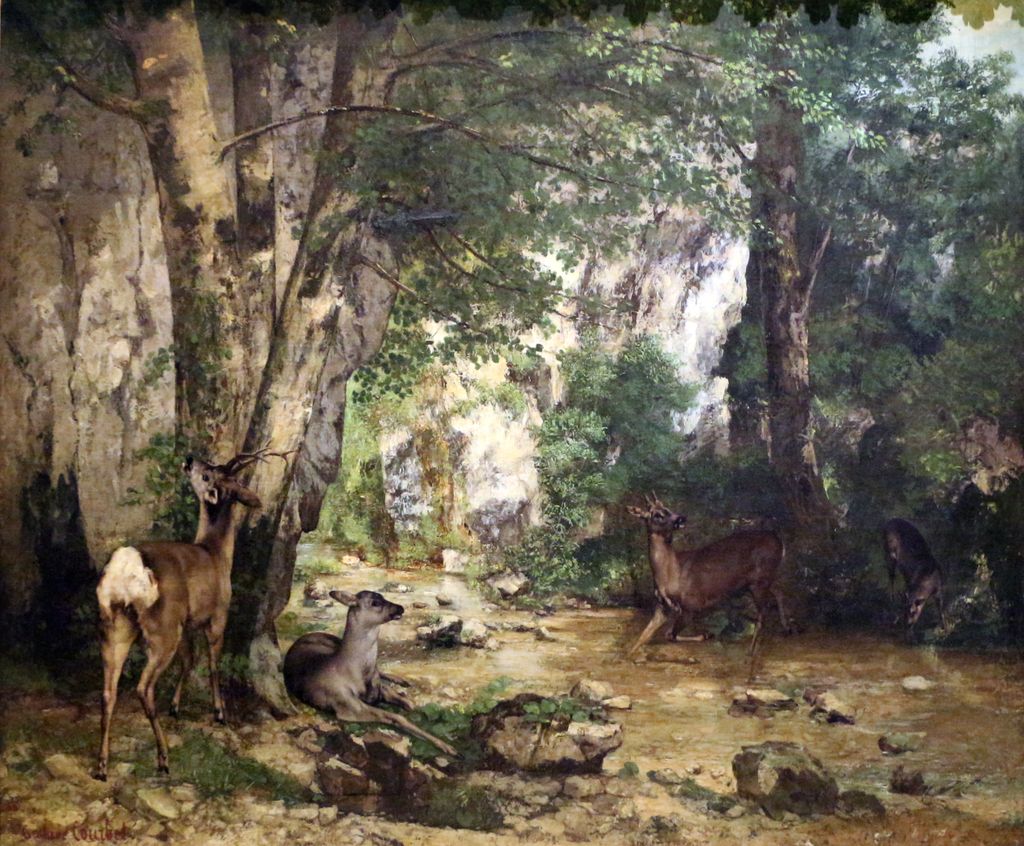
Roe Deer at the Stream of Plaisir-Fontaine by Gustave Courbet, RF 583 Photograph by Sailko. Image source. CC BY 3.0. Cropped to the painted canvas.
 by Tom Gurney
Tom Gurney BSc (Hons) is an art history expert with over 20 years experience
Email: tomgurney1@gmail.com / Phone: +44 7429 011000
Roe Deer at the Stream of Plaisir-Fontaine by Gustave Courbet: Introduction
A roe deer stands among the stones of a shallow stream, one foreleg extended and its head turned back. On the left bank another stretches towards a tree, beside a doe lying with her head up. A fourth lowers its muzzle to the water in the shadows on the far right. Gustave Courbet gives each animal a different activity and leaves enough space around each one for the stream and woods to emerge as subjects in their own right. Painted in 1866, Roe Deer at the Stream of Plaisir-Fontaine (Remise de chevreuils au ruisseau de Plaisir-Fontaine) is an oil on canvas measuring 174 × 209 cm. The Musée d’Orsay holds it as RF 583. [1]
At a Glance
- Date1866
- MediumOil on canvas
- CollectionMusée d’Orsay, RF 583
Contents
- Four deer in a wooded hollow
- Plaisir-Fontaine and the studio at Ornans
- The Salon of 1866 and the public collection
- An earlier painting beneath the stream
- Related canvases and a hunt in the snow
Four deer in a wooded hollow
The largest deer is also the one that shows us least of its face. Its white rump catches the light near the left edge of the painting, and its body narrows away from us towards a trunk. The extended neck and raised muzzle carry the eye up that trunk until the small antlers meet the darker lines of bark and branches. The seated doe at the foot of the tree brings our attention down again. Her front legs lie along the bank, but her lifted neck and dark muzzle point into the open space above the stream. From the pale rump to the doe’s face the picture moves through a sequence of bright and dark accents that make the two bodies legible even where their coats approach the tones of the ground. [1]
The third deer stands sideways just beyond the middle of the canvas. Its near foreleg cuts a slant across the ochre shallows while the body remains almost level. A lifted head and the spread of the ears keep the suggestion of movement alive. The drinking animal to the right is easier to miss. Its dark back comes out of the undergrowth in a curve, and a light edge on its muzzle marks the point where its head meets the stream. The open water between these two animals gives the striding body room to move and the lowered head a quieter place to settle. [1]
Above them, the ground rises steeply into rock and trees. A pale cliff face opens through the foliage near the centre. Below it, the bed of the stream catches much the same warm light, broken into horizontal strokes and small dark interruptions by the stones. On the left, heavy trunks make a screen between the foreground and the brighter recess. On the right, a trunk rises above the deer in the stream and disappears into the canopy. These verticals divide the width of the canvas, while a branch arching overhead joins the two sides. The eyes of the reclining deer sit low against all this height. Even at over two metres wide, the picture feels enclosed. [1]
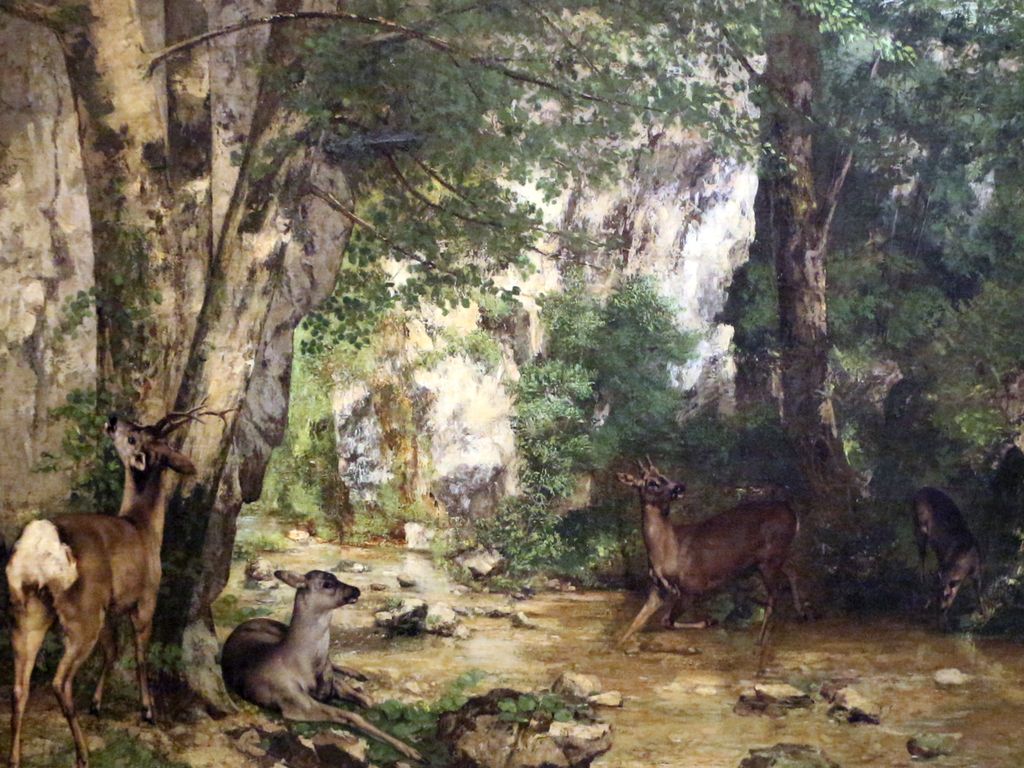
Detail of Roe Deer at the Stream of Plaisir-Fontaine, Orsay RF 583. Shown here, deer at the woodland stream. Photograph by Sailko. Image source. CC BY 3.0. Cropped and resized from the source image.
Plaisir-Fontaine and the studio at Ornans
The French title calls the place a remise, a refuge or resting place for game. The Musée Courbet’s walking dossier situates Plaisirfontaine near Bonnevaux-le-Prieuré, in the Doubs. The stream issues from a cave of the same name and joins the Brême. The dossier connects the painted scene with the stretch towards the cave as the gorge opens. That geographical setting helps explain the unusual proportions of the landscape. There is little sky, even with so much height above the water. A viewer standing in a hollow of this kind would look up into rock and foliage before looking out towards a horizon. The title gives this kind of terrain a particular place in the country around Ornans. [1] [2]
Courbet’s correspondence gives the painting a second setting. In its scholarly catalogue of French paintings, the National Gallery of Art cites an April 1866 letter to Urbain Cuenot in which Courbet said he had worked on the picture in his Ornans studio during the preceding winter and rented roe deer for the purpose. In a letter to Alfred Bruyas reproduced by the Musée Courbet, the painter imagines the doe as if she were receiving visitors in a drawing room. He describes the male browsing on ivy, another animal crossing the stream and a young buck drinking at the bank. One account records the practical arrangements, while the other gives each animal a part in the scene. The drawing-room comparison makes particular sense of the reclining doe, who holds her head high as the standing animals go about their separate business. [2] [3]
The Salon of 1866 and the public collection
The painting appeared at the Paris Salon of 1866 as catalogue number 464. Writing in the Revue des Deux Mondes, Maxime Du Camp admired the clear water, the particularity of the rock and the close study of the animals. He singled out the standing buck with its conspicuous pale rump. Yet he thought the handling of atmospheric perspective needed work and considered the scene almost devoid of composition. The solidity Du Camp admired may have contributed to his sense that the view lacked depth. The bright rock draws the eye straight through the darker foliage, bringing the back of the hollow close to the foreground. The deer look casually spaced, although every pose takes on a different degree of visibility against the rock, tree or water behind it. [1] [4]
Émile Zola, writing in Mon Salon, found charm and life in the deer but thought the painting lacked some of the force he admired in Courbet. Du Camp took the landscape as evidence that Courbet was at his best in this genre. Zola, who wanted Courbet to be recognised for the qualities of works such as The Stone Breakers, was uneasy about seeing him win wider approval with pictures he considered gentler. The fact that both critics could praise the woodland scene while making such different demands on the painter shows how much his reputation accompanied the picture into the exhibition. [4] [5]
Orsay traces the painting from Courbet to the stockbroker Lepel-Cointet, who acquired it for 15,000 francs in 1866. It sold at Lepel-Cointet’s auction at the Hôtel Drouot in 1881 and was shown the following year in the Courbet retrospective at the École des Beaux-Arts. At the Secrétan sale in 1889, a group of collectors that included Antonin Proust bought the canvas for 76,000 francs. The state accepted their gift for the Louvre in 1890. In 1986 the painting was assigned to the Musée d’Orsay. [1]
An earlier painting beneath the stream
Bruno Mottin, writing for the Centre de recherche et de restauration des musées de France (C2RMF), reports that study of the Orsay painting found traces of an underlying composition known from written sources as La Source d’Hippocrène. The identification concerns a painting beneath the visible scene. Courbet made his large woodland scene on a support that had already served another picture. The finding bears on the history of the canvas, while the letter to Cuenot describes a later stage of work on it in the studio. [6]
Related canvases and a hunt in the snow
The Kimbell Art Museum’s Roe Deer at a Stream is a separate oil on canvas dated 1868, measuring 97.5 × 129.8 cm and catalogued as AP 1968.02. The Kimbell points out that several deer in its picture repeat poses found in the Orsay canvas. Comparing the two brings out a distinction between the pose of an individual animal and its place in a scene. Courbet could carry a bodily turn or a stance from one picture to another and set it in a differently proportioned stretch of woodland. A third object calls for care when identifying the 1866 Salon painting. The Royal Museums of Fine Arts of Belgium catalogue an oil with essentially the same French title and year. At 46 × 61 cm and with inventory number 6360, the Brussels picture has its own scale and collection history. [1] [7] [8]
The relation between the animal and its setting changes in The Death of the Stag, painted in 1867. The vast Besançon canvas brings dogs and people into a snowbound clearing, and their movements converge on the stag. At Plaisir-Fontaine each animal has its own direction. The buck at the tree reaches up, the doe turns towards the stream, and the drinking animal sinks almost out of view. The space between the deer is full of things to look at, from the flat stones just under the water to the patches of sunlight on the rock. Where the hunt gives the eye a single event to follow, the stream allows it to linger wherever one of those details catches it. [1] [9]
Courbet artworks directory
Browse the paintings covered in this guide. Dates identify the specific versions discussed.
Discussion
Look again at the images and ideas explored in Roe Deer at the Stream of Plaisir-Fontaine by Gustave Courbet. These editorial prompts invite your observations.
Reader Insights
How does Courbet make the deer visible among the trees?
What changes when the subject is compared with the Kimbell painting?
What does the study of the earlier composition tell you about Courbet’s choices?
Join the Conversation
Share a detail, comparison or question about Roe Deer at the Stream of Plaisir-Fontaine by Gustave Courbet below.
References
- Musée d’Orsay, Remise de chevreuils au ruisseau de Plaisir-Fontaine, RF 583, collection record, reproduction, exhibition history and provenance. View source.
- Musée Courbet, Les Sentiers de Courbet, nº 8. Parcours du Salon des peintres, pp. 80–81, Plaisirfontaine and extracts from Courbet’s correspondence. View source.
- National Gallery of Art, French Paintings of the Nineteenth Century, Part I, p. 112, note 25, citing Courbet’s letter to Urbain Cuenot, 6 April 1866, in Petra ten-Doesschate Chu’s edition of the correspondence, p. 277, no. 66-7. View source.
- Maxime Du Camp, Le Salon de 1866, Revue des Deux Mondes, second series, vol. 63, 1866, pp. 687–719. View source.
- Émile Zola, Mon Salon, 1866, ‘Les chutes’. View source.
- Bruno Mottin, Centre de recherche et de restauration des musées de France, Gustave Courbet étudié et restauré au C2RMF. Un travail au long cours, research overview. View source.
- Kimbell Art Museum, Roe Deer at a Stream, AP 1968.02, collection record and curatorial comparison. View source.
- Royal Museums of Fine Arts of Belgium, La remise des chevreuils au ruisseau de Plaisir-Fontaine, inventory 6360, collection record. View source.
- Musées d’arts et du temps, Besançon, L’Hallali du cerf, D.882.2.1, collection record and reproduction. View source.