The Sleepers by Gustave Courbet Paris Musées / Petit Palais. Image source. CC0 / Public domain.
 by Tom Gurney
Tom Gurney BSc (Hons) is an art history expert with over 20 years experience
Email: tomgurney1@gmail.com / Phone: +44 7429 011000
The Sleepers by Gustave Courbet: Introduction
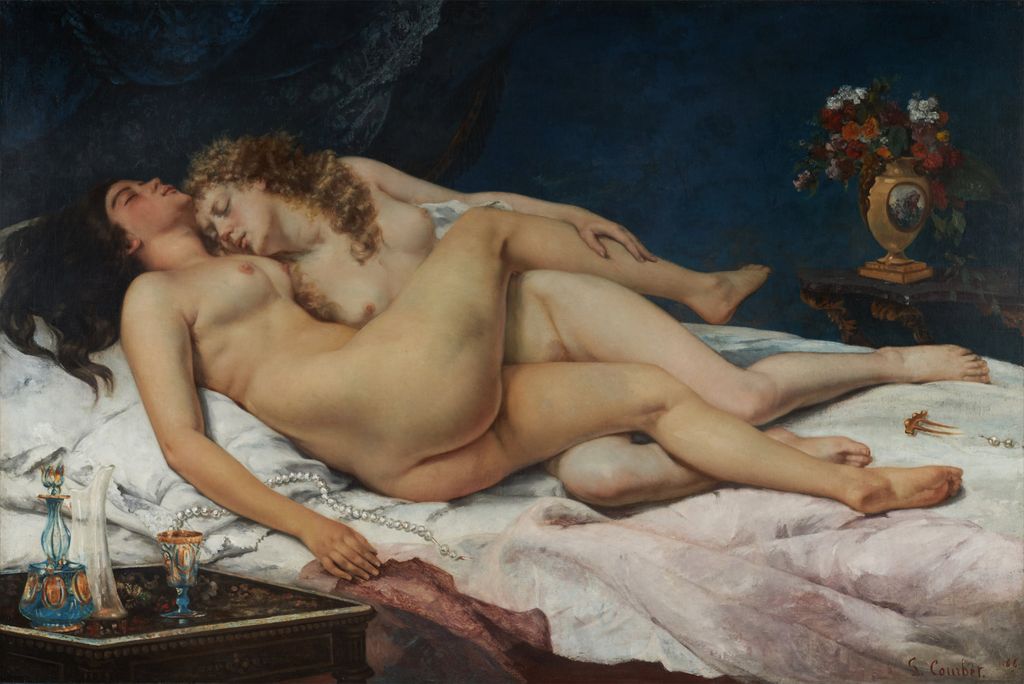
Two women sleep with their heads close together at one end of a bed. One arm trails towards the edge of the sheet and another hand lies across a bent leg. At the foot of the bed, a gold comb catches the light. Beyond it, flowers stand out against the dark blue of the room. Gustave Courbet painted The Sleepers (Le Sommeil) in 1866 for the Ottoman diplomat and collector Khalil-Bey. The oil on canvas measures 135 × 200 cm and belongs to the Petit Palais in Paris, where it is catalogued as PPP3130. Its two-metre width gives a scene intended for private viewing the physical presence of a large exhibition painting. [1] [2]
At a Glance
- Date1866
- MediumOil on canvas
- CollectionPetit Palais, PPP3130
Contents
- How Courbet joins the two figures
- Linen, jewellery and flowers
- A private commission on a public scale
- A Salon comparison and a second painting for Khalil-Bey
- What the early records say about its circulation
- Does the painting show Joanna Hiffernan?
How Courbet joins the two figures
The heads occupy a surprisingly small area on the left. The dark-haired woman has tipped hers back against the pillow. Her companion turns inwards, her cheek settling against the other woman’s shoulder and chest. Their profiles are close enough for their outlines to run into one another, but the light separates them. Warm pink catches the upturned face, while the face tilted down is paler and shaded by curls. The dark hair spreads in long waves over the pillow. The other woman’s tawny curls rise from the forehead and fall in a dense mass over the shoulder. The colours and the direction of the hair carry the distinction between the two figures into the places where their faces are hardest to read. [1]
At the centre, the foreground woman’s raised knee makes a high point that interrupts the long sweep of the bed. Her lower leg angles right. Her other leg extends across the bed at a shallower angle, passing in front of her companion’s. The arrangement repeatedly brings one form across another. Follow the lighter leg out to the right and the ownership of the limbs becomes clear again, a moment after the clustered knees have made it difficult to tell them apart. An arm crosses the back of the group, and the relaxed hand on the raised leg marks a point of contact above that tangle. The nearer arm takes a different course, down across the pillow and along the fold of a reddish cover. Its fingers drop loosely over the fabric. [1]
The positions of the feet give the group both length and depth. One foot is lifted into the dark space behind the bed, with room around its outline. Another rests near the right edge on pale linen. The foot closest to us turns its sole out above the pink coverlet. These points spread the composition horizontally while the faces remain almost touching. The picture asks for two kinds of attention. From across a room the figures can look like a single continuous shape. At close quarters there are all the small discontinuities of contact, from the narrow shadows between limbs to the pressure where a cheek meets a shoulder. [1]
Their closed eyes give the viewer no exchange of glances to follow. The positions of the hands make the embrace legible even so. One hand keeps contact with a companion while the other has slipped away from the centre of the bed. The intimacy of the picture depends on that combination of closeness and slackness. Courbet catches an embrace that has lost the alertness of a deliberate gesture, with the bedding taking much of the weight. [1]
Linen, jewellery and flowers
The sheets set the distance between the bodies and the dark room. Beneath the heads, pale fabric rises high enough to catch the edges of loose strands of hair. Between the figures and the near edge of the bed, white turns through grey and mauve into broad pink folds. Look where the nearer forearm crosses the sheet. The light on the skin changes gently around its curve, while the linen breaks abruptly at each crease. Both are light in colour, but their edges make the difference between flesh and fabric plain. The coverlet hangs low enough in the foreground to carry these changes almost to the frame. [1]
The foreground table is seen obliquely, with two edges receding away from us. A blue vessel and a matching cup carry touches of gold and orange. A pale object rises between them, and tiny reflections break up the darker tabletop. Courbet gives this corner the density of a small still life. It is low and very near, where it could easily compete with the figures, but its lights are small and sharply bounded. The nearby pearls have some of the same pinpoint brightness. Their strand loops across the white sheet close to the lowered hand, where shadows pick out individual beads. Farther right, a comb and a few beads lie apart from the figures. Taken together, the objects suggest interrupted activity around the bed. The paint gives no fixed account of who used them or how they came to rest there. [1] [2]
Across the room the flower vase rests on a second table, higher in the picture. Its small painted oval and bright pedestal are easier to see than the table’s dark carved support. The blooms spread unevenly, with white and red catching the light while leaves dissolve into blue. Between this distant group and the blue vessels in front, the objects give the room a depth the dark wall alone would scarcely convey. Above the sleepers, a heavy curtain is just visible where its edge sweeps diagonally across the blue. Its breadth makes the light fabric on the bed seem finer and more mobile. The textiles and two tables are enough to place the encounter in a furnished room, even though Courbet leaves much of that room in shadow. [1] [2]
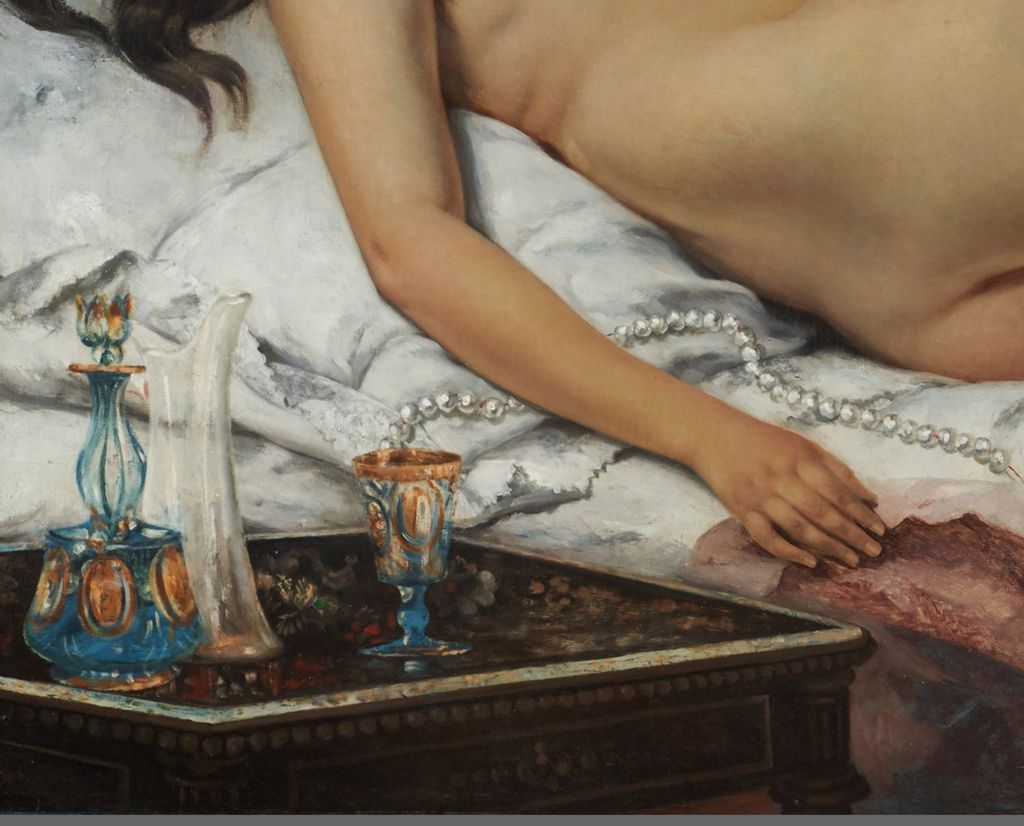
Detail of Le Sommeil, Petit Palais PPP3130. Shown here, glassware, jewellery and bedding. Image source. CC0 / Public domain. Cropped and resized from the source image.
A private commission on a public scale
Khalil-Bey acquired works by Delacroix, Chassériau and Rousseau, sometimes through the dealer Paul Durand-Ruel. He also owned Jean-Auguste-Dominique Ingres’s The Turkish Bath, whose rounded frame encloses a crowded arrangement of bathers. The Louvre records the Ingres in the catalogue of Khalil-Bey’s January 1868 sale. Its presence there gives some sense of the range of his interest in the painted nude. Courbet’s double figure offers an almost opposite distribution of space. The two bodies gather at the centre of a broad rectangle, and the bedroom opens to either side of them. The shapes of the bed and the distance to the furniture are part of what we see. [1] [3]
The Petit Palais connects Courbet’s subject with erotic prints and literary evocations of love between women. The Met’s retrospective also points to eighteenth-century Rococo art and describes the furnishings as a nineteenth-century revival of that taste. There is a difference in scale between turning over a print and facing two nearly life-size figures. Courbet gives sustained attention to passages that could be mere accessories in a smaller image. The flower vase holds the eye long enough to place the back of the room. The uneven spread of the linen gives the painted bodies somewhere to bear down. The result brings the signs of luxury and the weight of the sleeping figures into the same field of view. [1] [2]
The commission was made for an individual collector and depicts intimacy between women. The Met asks viewers to reckon with the male audience for whom it was initially intended. The viewer has a clear view across the bed from a position the sleepers cannot acknowledge. Within the composition, however, the women’s attention stays with each other, expressed through contact rather than a glance towards the room. The painting allows both the familiarity of that embrace and the intrusion of seeing it to register. Its private origins help explain the kind of access the commission offered its patron. [1] [2]
A Salon comparison and a second painting for Khalil-Bey
The Petit Palais compares the painting’s size and contemporary setting with Édouard Manet’s Olympia. Manet painted his canvas in 1863, and its public showing at the 1865 Salon provoked fierce criticism. It is close to Courbet’s in dimensions, and both pictures give pale bedding and objects around it conspicuous roles. In Olympia, a woman meets the viewer’s eyes as another person brings a bouquet. The flowers in The Sleepers have already been put in a vase, and the women’s sleep leaves the viewer unaddressed. Courbet had his own large reclining nude, Woman with a Parrot, accepted by the Salon in 1866. There the bird and the woman’s lifted hand hold a moment of movement in the air above the bed. The Sleepers entered Khalil-Bey’s collection directly, and its two figures give the raised leg and the resting hand a different purpose. [1] [2] [4] [5]
Khalil-Bey was also the first owner of Courbet’s The Origin of the World, painted in 1866 and, in the Musée d’Orsay’s account, probably commissioned by him. The dimensions make a comparison especially revealing. The Origin of the World is only 46.3 × 55.4 cm. The close crop leaves the face outside the canvas and gives the torso, thighs and white fabric virtually the whole space. In The Sleepers, there is room to follow bodies from heads to feet and then to read the space around them. Each picture dictates its own viewing distance. One makes the intimacy of the room visible on a two-metre span. The other confines attention to a close view of a single body. Khalil-Bey could have stood back to take in the spread of the bed in one canvas and stepped close enough to study the fall of light across a single body in the other. [1] [2] [6]
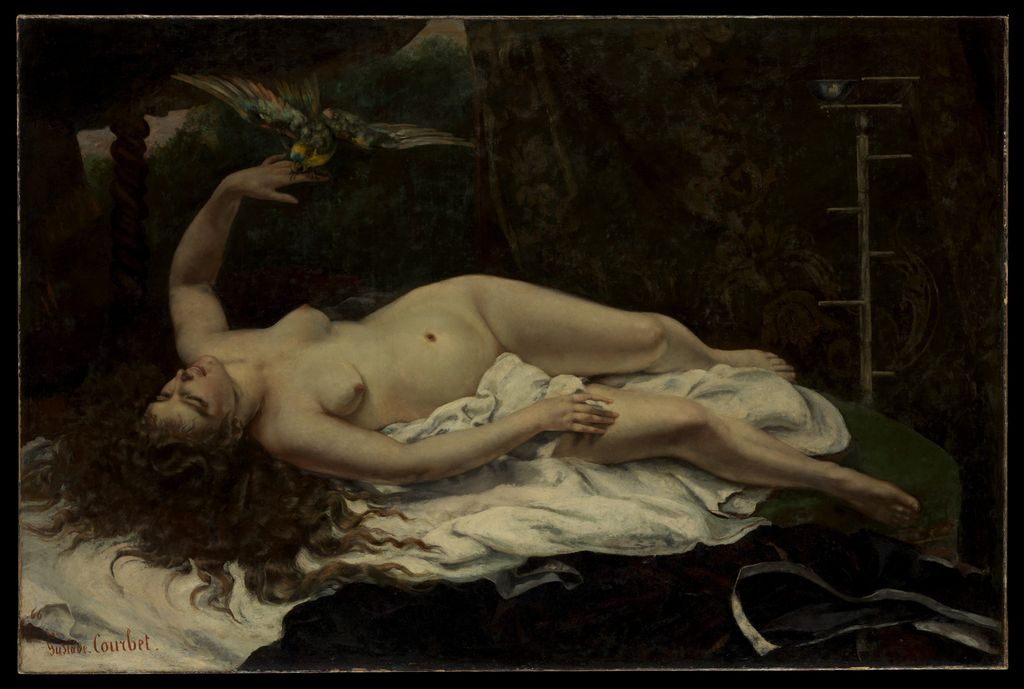
Woman with a Parrot, Met 29.100.57. Image source. CC0 / Public domain. Resized from the complete source image.
What the early records say about its circulation
The January 1868 auction catalogue lists several Courbets but leaves out both large and small erotic canvases. A review in La Vie parisienne on 11 January that year describes a large, uncatalogued Courbet in a room visitors could enter at Khalil-Bey’s gallery. The writer approved of omitting it from the catalogue and thought the room should have been kept closed to women. The account gives neither a title nor a description of the figures. Its emphasis on a large picture makes The Sleepers a plausible identification, especially given the dimensions of the two known works for Khalil-Bey. What the article directly records is a critic’s reaction to an unnamed painting shown to visitors in the collector’s rooms. That kind of viewing could reach beyond the owner’s immediate circle even when the painting stayed out of the official sale list. [6] [7] [8]
The Met’s retrospective notes that the painting figured in Courbet’s police dossier by 1872. The reference records an official interest in the work’s subject, without supplying a secure first exhibition date. A later milestone is well documented. In 1953 the City of Paris bought the canvas from the Galerie Paul Vallotton for the Petit Palais. Paris Musées lists two early Petit Palais exhibition catalogues in the painting’s record. The first accompanied Un Siècle d’art français in 1953–54. The second, published for the museum’s 1955 Courbet exhibition, reproduced the canvas as plate 51. By the time it appeared in the Met’s 2008 retrospective, the painting had been part of the Petit Palais’s public account of Courbet for more than half a century. [2] [9] [10] [11] [12]
Does the painting show Joanna Hiffernan?
The Paris Musées catalogue associates Joanna Hiffernan with the picture. Courbet did paint her around this time. In the Met’s version of Jo, the Beautiful Irishwoman, dated 1865–66, she holds a small mirror and lifts a section of her long reddish hair. The portrait gives a reason for the comparison with the tawny-haired sleeper, especially in the close attention Courbet pays to the way the hair falls over her shoulder. It also shows the limits of a comparison. Jo’s face in the portrait is turned towards the mirror and caught in a steady light. The sleeper’s face tilts into the other woman’s body, and curls and shadow obscure part of it. [10] [13]
The evidence for identifying Jo in the portrait and the catalogue association with The Sleepers carry different weight. Margaret F. MacDonald questioned the proposed association with The Sleepers in her study for the 2022 Hiffernan and Whistler exhibition, as art historian Deborah Cherry notes in her review. The two women in the painting can be described and distinguished with confidence by their poses, colouring and place in the composition. Their names remain uncertain. The picture gives the clearest account of their relationship in small points of contact, especially where the lighter-haired woman’s lowered face comes to rest against her companion. [10] [13] [14]
Courbet artworks directory
Browse the paintings covered in this guide. Dates identify the specific versions discussed.
Discussion
Look again at the images and ideas explored in The Sleepers by Gustave Courbet. These editorial prompts invite your observations.
Reader Insights
How do the fabrics and bedside objects frame the figures?
How would the picture have been seen in a private collection?
What can the surviving records establish about the painting’s early circulation?
Join the Conversation
Share a detail, comparison or question about The Sleepers by Gustave Courbet below.
References
- Petit Palais, Le Sommeil, collection overview for PPP3130. View source.
- Metropolitan Museum of Art, Gustave Courbet, 2008 retrospective checklist, entry for Sleep. View source.
- Musée du Louvre, Jean-Auguste-Dominique Ingres, Le Bain turc, collection record. View source.
- Musée d’Orsay, Édouard Manet, Olympia, collection record RF 644. View source.
- Metropolitan Museum of Art, Gustave Courbet, Woman with a Parrot, collection record 29.100.57. View source.
- Musée d’Orsay, Gustave Courbet, L’Origine du monde, collection record RF 1995 10. View source.
- Collection des tableaux anciens et modernes de S. Exc. Khalil-Bey, auction catalogue, Courbet entries 8–10. View source.
- La Vie parisienne, “Exposition de tableaux de S. E. Khalil-Bey,” 11 January 1868, p. 34. View source.
- Petit Palais, Les donateurs de Courbet, acquisition history. View source.
- Paris Musées, Petit Palais, Le Sommeil, detailed inventory record PPP3130. View source.
- Petit Palais, archival list of exhibitions. View source.
- Julie Blouet, De la place des artistes demeurés en seconde ligne, Université Paris Nanterre doctoral thesis, 2025, p. 92, note 282. Identifies plate 51 of the Petit Palais’s 1955 Courbet catalogue. View source.
- Metropolitan Museum of Art, Gustave Courbet, Jo, La Belle Irlandaise, collection record 29.100.63. View source.
- Deborah Cherry, review of Margaret F. MacDonald et al., The Woman in White: Joanna Hiffernan and James McNeill Whistler, Nineteenth-Century Art Worldwide, Spring 2023, note 2. View source.